Compliance to Evidence-Based Dietary Management Practices for COVID-19 by Pakistani Dietitians
DOI:
https://doi.org/10.32350/bsr.81.02Keywords:
clinical dietitians, COVID-19, dietary guidelines, evidence-based practice, nutrition, well-balanced dietAbstract
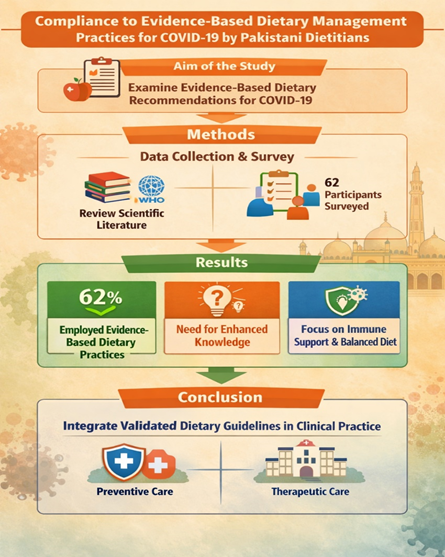
Aim. This study aims to examine the role of evidence-based dietary recommendations practiced by dietitians in clinical settings for COVID-19.
Methods. Secondary data was collected by gathering evidence-based literature from credible organizations and literature sources regarding dietary guidelines on the management of COVID-19. Quantitative data were collected through a questionnaire comprising 20 general questions and filled by 62 participants (4 males and 58 females). The questionnaire was designed to examine the recommended dietary practices. Descriptive statistics were used to determine the alignment of dietitians’ knowledge and practices with the literature.
Results. Although there is a need to improve the approaches and gain more evidence-based knowledge, it is satisfactory to know that dietary guidelines and approaches provided by practicing dietitians or nutritionists in local clinical settings in Pakistan are based on evidence.
Conclusion. The study emphasizes the importance of integrating validated dietary guidelines into clinical nutritional practice for both preventive and therapeutic care. Future research should focus on assessing the long-term effectiveness of these dietary interventions and exploring gaps in their consistent implementation across diverse clinical settings.
Downloads
References
Pal M, Berhanu G, Desalegn C, Kandi V. Severe acute respiratory syndrome coronavirus-2 (SARS-CoV-2): an update. Cureus. 2020;12(3):e7423. https://doi.org/10.7759/cureus.7423
Chowdhury SD, Oommen AM. Epidemiology of COVID-19. J Dig Endosc. 2020;11(1):3-7.
https://doi.org/10.1055/s-0040-1712187
Ashraf S, Parveen S, Ashraf S, et al. Coronavirus epidemiology, diagnosis, and vaccination statistics in Pakistan, China, and India: a brief review. Curr Trends OMICS. 2024;4(1):95-116.
https://doi.org/10.32350/cto.41.06
Abid K, Bari YA, Younas M, Tahir Javaid S, Imran A. Progress of COVID-19 epidemic in Pakistan. Asia Pacific J Public Heal. 2020;32(4):154-156. https://doi.org/10.1177/1010539520927259
Akande OW, Akande TM. COVID-19 pandemic: A global health burden. Niger Postgrad Med J. 2020;27(3):147-55. https://doi.org/10.4103/npmj.npmj_157_20
Aman F, Masood S. How Nutrition can help to fight against COVID-19 Pandemic. Pak J Med Sci. 2020;36:S121-S123. https://doi.org/10.12669/pjms.36.COVID19-S4.2776
de Faria Coelho-Ravagnani C, Corgosinho FC, Sanches FLFZ, Prado CMM, Laviano A, Mota JF. Dietary recommendations during the COVID-19 pandemic. Nutr Rev. 2021;79(4):382-393.
https://doi.org/10.1093/nutrit/nuaa067
Muscogiuri G, Barrea L, Savastano S, Colao A. Nutritional recommendations for CoVID-19 quarantine. Eur J Clin Nutr. 2020;74(6):850-851. https://doi.org/10.1038/s41430-020-0635-2
World Health Organization. Nutrition advice for adults during the COVID-19 outbreak. WHO Web site. http://www.emro.who.int/nutrition/news/nutrition-advice-for-adults-during-the-covid-19-outbreak.html. Accessed June 18, 2024.
Iddir M, Brito A, Dingeo G, et al. Strengthening the immune system and reducing inflammation and oxidative stress through diet and nutrition: considerations during the COVID-19 crisis. Nutrients. 2020;12(6):e1562.
https://doi.org/10.3390/nu12061562
World Health Organization. Food and nutrition tips during self-quarantine. WHO Web site. https://www.who. int/europe/news/item/27-03-2020-food-and-nutrition-during-self-quarantine-what-to-choose-and-how-to-eat-healthily. Updated March 27, 2020.
Clemente-Suárez VJ, Ramos-Campo DJ, Mielgo-Ayuso J, et al. Nutrition in the actual COVID-19 pandemic. a narrative review. Nutrients. 2021;13(6):e1924. https://doi.org/10.3390/nu13061924
Mahan LK, Raymond JL, Escott-Stump S. Krause's Food & the Nutrition Care Process-E-Book. Elsevier Health Sciences; 2013.
Moscatelli F, Sessa F, Valenzano A, et al. COVID-19: Role of nutrition and supplementation. Nutrients. 2021;13(3):e976. https://doi.org/10.3390/nu13030976
El Shikieri AB, Hafiz AH, Adewumi OE, Fijabi OE. The influence of nutritional status and associated factors on the quality of life among COVID-19 patients in Saudi Arabia: a cross-sectional study. Human Nutr Metabol. 2024;36:e200262. https://doi.org/10.1016/j.hnm.2024.200262
Published
How to Cite
Issue
Section
License
Copyright (c) 2026 Maira Tanveer, Izma Azhar, Mahnoor Maqsood, Nafeesa Ismail, Rabia Sagheer, Umar Bacha, Afifa Tanweer

This work is licensed under a Creative Commons Attribution 4.0 International License.
BSR follows an open-access publishing policy and full text of all published articles is available free, immediately upon publication of an issue. The journal’s contents are published and distributed under the terms of the Creative Commons Attribution 4.0 International (CC-BY 4.0) license. Thus, the work submitted to the journal implies that it is original, unpublished work of the authors (neither published previously nor accepted/under consideration for publication elsewhere). On acceptance of a manuscript for publication, a corresponding author on the behalf of all co-authors of the manuscript will sign and submit a completed the Copyright and Author Consent Form.