
Hemipteran Diversity and Genotoxic Effects of Organophosphate In-secticides (Acephate and Profenofos) in Sialkot, Pakistan
DOI:
https://doi.org/10.32350/bsr.81.07Keywords:
acephate, D. cingulatus, genotoxicity, Hemiptera diversity, integrated pest management, micronucleus (MN) assay, organophosphate (OP) insecticides, profenofosAbstract
Background. Agriculture is a cornerstone of Pakistan’s economy and faces significant pest pressure. Hemipteran insects, including aphids, leafhoppers, and true bugs, cause major crop losses and transmit plant pathogens.
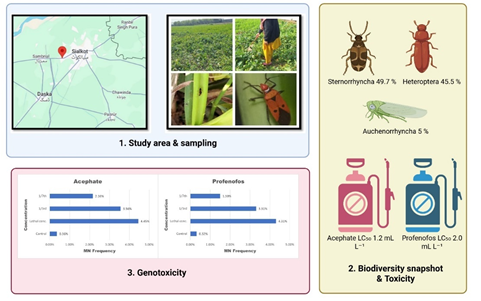
Methods. This study surveyed the foliage-dwelling Hemiptera in Sialkot district and evaluated the toxicity and genotoxicity of two widely used organophosphate (OP) insecticides, acephate and profenofos. The field survey methods (sweep net and hand collection), insecticide bioassays, micronucleus (MN) assay procedures, and statistical analyses were done.
Results. Over a four-month field survey, 1,888 Hemipteran specimens were collected representing 32 species from three suborders. Drosicha corpulenta (a mealybug) and Dysdercus cingulatus (red cotton stainer) were the most abundant, each comprising ~31.8% of the total. Acephate and profenofos were tested on D. cingulatus; acephate showed higher acute toxicity (LC50 - 1.2 mL/L) than profenofos (LC50 - 2.0 mL/L). A micronucleus (MN) assay on hemocytes revealed a dose-dependent increase in DNA damage. MN frequencies in D. cingulatus exposed to acephate at LC50 were ~4.45%, compared to ~4.31% with profenofos, versus ~0.3% in controls. These findings indicate that acephate, while being more toxic to target pests, also induced slightly greater genotoxic effects. The results document the diversity of Hemipteran fauna in a key agricultural region and underscore the need for careful insecticide management.
Conclusion. This integrated approach—combining biodiversity assessment with toxicological and genotoxic analyses—highlights potential trade-offs between pest control efficacy and sublethal impacts, informing sustainable pest management and conservation strategies.
Downloads
References
1. Azam A, Shafique M. Agriculture in Pakistan and its impact on economy: a review. Int J Adv Sci Technol. 2017;103:47-60. http://dx.doi.org/10. 14257/ijast.2017.103.05
2. Abdullah M, Mahmood A, Shah MT, et al. Soil macro-nutrients appraisal and indexing for salinity/sodicity and fertility status of soils in Tehsil Athara-Hazari of District Jhang, Punjab, Pakistan: a precision agricultural approach. Plant Cell Biotechnol Mol Biol. 2022;23(31-32):19-27. https:// doi.org/10.56557/PCBMB/2022/v23i31-327788
3. Bertaccini A, Duduk B, Paltrinieri S, Contaldo N. Phytoplasmas and phytoplasma diseases: a severe threat to agriculture. Am J Plant Sci. 2014;5(12):1763-1788. http://dx.doi. org/10.4236/ajps.2014.512191
4. Halder S, Ghosh S, Khan R, Khan AA, Perween T, Hasan MA. Role of pollination in fruit crops: a review. Pharma Innov J. 2019;8(5):695-702.
5. Guedes RNC, Smagghe G, Stark JD, Desneux N. Pesticide-induced stress in arthropod pests for optimized integrated pest management programs. Annu Rev Entomol. 2016;61:43-62. https://doi.org/10.1146/annurev-ento-010715-023646
6. Kushwaha M, Verma S, Chatterjee S. Profenofos, an acetylcholinesterase-inhibiting organophosphorus pesticide: a short review of its usage, toxicity, and biodegradation. J Environ Qual. 2016;45(5):1478-1489. https:// doi.org/10.2134/jeq2016.03.0100
7. Harnpicharnchai K, Chaiear N, Charerntanyarak L. Residues of organophosphate pesticides used in vegetable cultivation in ambient air, surface water and soil in Thailand. Southeast Asian J Trop Med Public Health. 2013;44(6):1088-1097.
8. Mulla SI, Ameen F, Talwar MP, et al. Organophosphate pesticides: impact on environment, toxicity, and their degradation. In: Bharagava RN, Saxena S, eds. Bioremediation of Industrial Waste for Environmental Safety. Cham: Springer; 2020:265-290.
9. Jan MT, Abbas N, Shad SA, Saleem MA. Resistance to organophosphate, pyrethroid and biorational insecticides in populations of spotted bollworm (Earias vittella) in Pakistan. Crop Prot. 2015;78:247-252. https:// doi.org/10.1016/j.cropro.2015.09.020
10. Asghar A, Qadeer O, Mushtaq S, et al. Assessment of insects diversity with the influence of industrial pollutants in agricultural zones of District Sialkot, Pakistan. Biodiversitas. 2022;23(4):2047-2053.
11. Sahoo KC, Sunitha V, Rao VV, Chary DS. Diversity of hemipteran families at agro-biodiversity park, Hyderabad, India. Entomon. 2021;46(2):143-148. https://doi.org/10.33307/entomon.v46i2.600
12. Fenech M, Kirsch-Volders M, Natarajan AT, et al. Molecular mechanisms of micronucleus, nucleoplasmic bridge and nuclear bud formation in mammalian and human cells. Mutagenesis. 2011;26(1):125-132. https://doi.org/10.1093/mutage/ geq052
13. Santovito A, Audisio M, Bonelli S. A micronucleus assay detects genotoxic effects of herbicide exposure in a protected butterfly species. Ecotoxicology. 2020;29(9):1390-1398. https://doi.org/10.1007/s10646-020-02276-3
14. Ghani A, Maalik S. Assessment of diversity and relative abundance of insect fauna associated with Triticum aestivum from district Sialkot, Pakistan. J King Saud Univ Sci. 2020;32(1):986-995.
15. Borror DJ, DeLong DM. An Introduction to the Study of Insects. 7th ed. Thomson Brooks/Cole; 2005.
16. Hammer Ø, Harper DAT, Ryan PD. PAST: paleontological statistics software package for education and data analysis. Palaeontol Electron. 2001;4(1):e9.
17. Finney DJ. Probit Analysis. 3rd ed. Cambridge, UK: Cambridge University Press; 1971.
18. Ahmed R, Freed S. Biochemical resistance mechanisms against chlorpyrifos, imidacloprid and lambda-cyhalothrin in Rhynchophorus ferrugineus (Coleoptera: Curculionidae). Crop Prot. 2021;143:e105568. https://doi.org/10. 1016/j.cropro.2021.105568
19. Piccini I, Macrì M, Gea M, Dessì L, Bonetta S, Schilirò T, et al. Genotoxic effects of particulate matter on larvae of a common and widespread butterfly along an urbanization gradient. Ecotoxicol Environ Saf. 2023;252:e114638. https://doi.org/10. 1016/j.ecoenv.2023.114638
20. Cim S, Altuntaş H. Anti-oxidative, genotoxic and mutagenic effects of idiobiont endoparasitoid Pimpla turionellae venom on its host Galleria mellonella. Biol Control. 2021;158:e104595. https://doi.org/10. 1016/j.biocontrol.2021.104595
21. Akhtar S, Iqbal J, Jan MT, Yasir MA, Abbas HMK, Rasool KG, et al. Bioassay for evaluating the resistance level of dusky cotton bug (Oxycarenus hyalinipennis) against insecticides sprayed on cotton crop. Pak J Agric Sci. 2023;60(4):593-601. https://doi. org/10.21162/PAKJAS/23.81
22. Altuntaş H, Duman E, Kılıç G. Juglone induced oxidative and genotoxic stress in the model insect Galleria mellonella (Lepidoptera: Pyralidae). Int J Trop Insect Sci. 2020;40(3):611-619. https://doi.org/10.1007/s42690-020-00107-w
23. Kaur M, Bhatnagar A, Dhillon O, Yadav AS. Genotoxic effects of rice-agrochemicals on Channa punctatus and Cyprinus carpio using micronucleus assay and comet assay. Nat Environ Pollut Technol. 2022;21(4):1807-1815. https://doi.org /10.46488/NEPT.2022.v21i04.035
24. Mirfakhraie S, Saeidi K. Aphid and ladybird beetle abundance and diversity in alfalfa fields of southwestern Iran. J Entomol Res. 2017;41(3):283-293. https://doi.org /10.4081/jear.2017.6824
25. Insecticide Resistance Action Committee. Insecticide Resistance Training Manual. United States: IRAC; 2020.
26. Nagrare VS, Fand BB, Naik CB, Naikwadi B, Deshmukh V, Sinh D. Resistance development in cotton mealybug Phenacoccus solenopsis (Hemiptera: Pseudococcidae) to insecticides from organophosphate, thiadiazine and thiourea derivatives. Int J Trop Insect Sci. 2020;40(1):181-188. https://doi.org/10.1007/s42690-019-00068-9
27. Li X, Li S, Liu S, Zhu G. Lethal effect and in vivo genotoxicity of profenofos to Chinese toad (Bufo bufo gargarizans) tadpoles. Arch Environ Contam Toxicol. 2010;59(3):478-483.
28. Farooqi MA, Irsa B, Ali S, Sajjad A, Hassan MW, Akhtar S. Impact of selected insecticides on Apis mellifera (Hymenoptera: Apidae) under controlled conditions. Pak J Zool. 2019;52(1):193-198. https://doi.org/ 10.17582/journal.pjz/2020.52.1.193.198
29. Kelageri SS, Rao CS, Bhushan VS, Reddy PN, Reddy HA, Hymavathy M, et al. Risk analysis of profenofos on tomato in polyhouse and open fields and mitigation of residues for food safety. Int J Agric Environ Biotechnol. 2015;8(1):163-170. https://doi.org /10.5958/2230-732X.2015.00021.2
30. Greish S, Ismail SM, Mosleh YY, Loutfy N, Dessouki AA, Ahmed MT. Human risk assessment of profenofos: a case study in Ismailia, Egypt. Polycycl Aromat Compd. 2011;31(1):28-47. https://doi.org/ 10.1080/10406638.2011.545727
31. Islam M, Malik S. The ecological hazards of profenofos revealed by soil beneficial microorganisms. Environ Pollut. 2024;326:121595.
32. Zhou X, Li Y, Chen G. Comparative transcriptome profiling reveals immune-related gene disruption in Helicoverpa armigera exposed to acephate. Ecotoxicol Environ Saf. 2024;262:e115384. https://doi.org/ 10.1038/s41598-024-74434-0
33. Banerjee P, Mandal A, Saha D. Genotoxic impact of agricultural insecticides as contaminants of river Teesta on Pethia conchonius. Sci Rep. 2024;14:e74434. https://doi.org/10. 1038/s41598-024-74434-0
34. US Environmental Protection Agency. EPA releases updates on organophosphate pesticides: dicrotophos, dimethoate and TCVP. Published 2024.
35. Sani I, Ismail SI, Abdullah S, Jalinas J, Jamian S, Saad N. A review of the biology and control of whitefly Bemisia tabaci (Hemiptera: Aleyrodidae), with special reference to biological control using entomopathogenic fungi. Insects. 2020;11(9):e619. https://doi.org/10. 3390/insects11090619
Published
How to Cite
Issue
Section
License
Copyright (c) 2026 Fatima Tahir Khan, Rabia Afzal

This work is licensed under a Creative Commons Attribution 4.0 International License.
BSR follows an open-access publishing policy and full text of all published articles is available free, immediately upon publication of an issue. The journal’s contents are published and distributed under the terms of the Creative Commons Attribution 4.0 International (CC-BY 4.0) license. Thus, the work submitted to the journal implies that it is original, unpublished work of the authors (neither published previously nor accepted/under consideration for publication elsewhere). On acceptance of a manuscript for publication, a corresponding author on the behalf of all co-authors of the manuscript will sign and submit a completed the Copyright and Author Consent Form.