
Efficacy of Organic Farming Against Charcoal Rot of Chickpea (CICER arietinum L.)
DOI:
https://doi.org/10.32350/bsr.81.06Keywords:
biological disease management, charcoal rot, chickpea, Macrophomina phaseolina, organic farmingAbstract
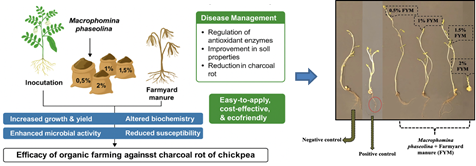
Charcoal rot disease, caused by Macrophomina phaseolina Goid., significantly impacts chickpea (Cicer arietinum L.) production in Pakistan. This study evaluated the efficacy of farmyard manure (FYM) as an ecofriendly management strategy. FYM treatments (0.5%, 1%, 1.5%, and 2%) were applied to M. phaseolina-inoculated soil (positive control), and their effects on disease severity, plant growth, and biochemical parameters were assessed. Results showed that FYM significantly (p £ 0.05) reduced disease infestation in positive control up-to 70%. Moreover, the incorporation of FYM in the soil with M. phaseolina enhanced the physiological traits (total chlorophyll content and soluble sugar (SS)) by 40 to 64% in comparison with positive control. Furthermore, the antioxidant enzyme activities significantly (p £ 0.05) enhanced in C. arietinum, that is, 3 to 4 folds as compared to positive control. Likewise, physiological parameters, for instance, the root and shoot length (SL) and fresh and dry biomass of tested plant significantly (p £ 0.05) increased (up to 70%) in comparison with positive control. The findings suggested that FYM is a cost-effective, sustainable, and environmentally-friendly option for managing charcoal rot disease in chickpea, offering a promising alternative to chemical fungicides.
Downloads
References
Zhang J, Wang J, Zhu C, Singh RP, Chen W. Chickpea: its origin, distribution, nutrition, benefits, breeding, and symbiotic relationship with Mesorhizobium species. Plants (Basel). 2024;13:e429. https://doi.org/10.3390/plants13030429
This comprehensive review highlights the historical and geographical background of chickpea cultivation, its nutritional composition—including proteins, fiber, and minerals—and its agricultural importance globally. It also delves into modern breeding techniques and the plant's symbiotic relationship with Mesorhizobium species, which enhances nitrogen fixation and plant health. The paper is a useful foundation for understanding both the nutritional and ecological significance of chickpea.
Linares-Castañeda A, Corzo-Ríos LJ, Cedillo-Olivos AE, Sánchez-Chino XM, Mora-Escobedo R, Jiménez-Martínez C. Enhancing the nutritional composition and phenolic compound content of sprouted chickpeas using sucrose and chitosan as elicitors. Molecules. 2025;30:e1775. https://doi. org/10.3390/molecules30081775
This experimental study investigates the use of sucrose and chitosan as elicitors to enhance the nutritional quality and phenolic content in sprouted chickpeas. Results show a significant increase in bioactive compounds, suggesting that pre-treatment of chickpeas can improve their functional food value. This research is relevant for food scientists and agronomists aiming to optimize chickpea-based diets and develop value-added products.
Linares-Castañeda A, Jiménez-Martínez C, Cedillo-Olivos AE, Cruz-Narváez Y, Corzo-Ríos LJ. Effects of hydrogen peroxide (H₂O₂) elicitation on protein content and digestibility, phenolic compounds, and antioxidant activity in sprouted chickpeas (Cicer arietinum L.). Appl Food Res. 2025;5:e100785. https://doi.org/10.1016/j.afres.2025.100785
Linares-Castañeda A, Jiménez-Martínez C, Sánchez-Chino XM, Pérez-Pérez V, Cid-Gallegos MS, Corzo-Ríos LJ. Modifying non-nutritional compounds in legumes: processing strategies and new technologies. Food Chem. 2025;463:e141603. https://doi.org/10.1016/j.foodchem.2024.141603
Jameel S, Hameed A, Shah TM. Investigation of distinctive morpho-physio and biochemical alterations in desi chickpea at seedling stage under irrigation, heat, and combined stress. Front Plant Sci. 2021;12:e692745. https://doi.org/10.3389/fpls.2021.692745
Irum S, Khalid MHB, Hussain T, et al. Comprehensive evaluation of agronomic traits, physiological responses, and gene expression in chickpea cultivars under fungal stress. Funct Plant Biol. 2025;52:FP25100. https://doi.org/10.1071/FP25100
Aslam H, Irshad G, Din. Chickpea genotypes evaluation for morpho-yield traits under water stress conditions. J Anim Plant Sci. 2015;25:206-211.
Partap M, Godara SL. Occurrence and distribution of dry root rot of chickpea caused by Macrophomina phaseolina (Tassi) Goid. in arid region of Rajasthan. Legume Res. 2022;45(5):639-645.
Khan SN. Macrophomina phaseolina as causal agent for charcoal rot of sunflower. Mycopath. 2007;5(2):111-118.
Giesler LJ. Charcoal rot. CropWatch Web site. https://cropwatch.unl.edu /plantdisease/soybean/charcoal-rot. Updated, 2016, Accessed February 23, 2026.
Oliveira MS. Macrophomina phaseolina. BugwoodWiki Web site. https://wiki.bugwood.org/Macrophomina_phaseolina. Updated, 2014. Accessed February 23, 2026.
Tziros GT, Samaras A, Karaoglanidis GS. Soil solarization efficiently reduces fungal soilborne pathogen populations, promotes lettuce plant growth, and affects the soil bacterial community. Biology (Basel). 2024;13:e624. https://doi.org/10.3390/biology13080624
Patel N, Desai P, Patel N, Jha A, Gautam HK. Agronanotechnology for plant fungal disease management. Int J Curr Microbiol Appl Sci. 2014;3(10):71-84.
Kumar P. Green revolution and its impact on environment. Int J Res Humanit Soc Sci. 2007;5(3):54-57.
Khan KA, Shoaib A, Awan ZA, Basit A, Hussain M. Macrophomina phaseolina alters the biochemical pathway in Vigna radiata chastened by Zn²⁺ and FYM to improve plant growth. J Plant Interact. 2018;13:131-140. https://doi.org/10.1080/17429145.2018.1441451
Akhtar S, Shoaib A, Javiad I, et al. Farmyard manure, a potential organic additive to reclaim copper and Macrophomina phaseolina stress responses in mash bean plants. Sci Rep. 2023;13:e14383. https://doi.org/10.1038/s41598-023-41509-3
Wei B, Bi J, Qian X, et al. Organic manure amendment fortifies soil health by enriching beneficial metabolites and microorganisms and suppressing plant pathogens. Agronomy. 2025;15(2):e429. https://doi.org/10.3390/agronomy15020429
Liang X, Yu S, Ju Y, Wang Y, Yin D. Integrated management practices foster soil health, productivity, and agroecosystem resilience. Agronomy. 2025;15:e1816. https://doi.org/10.3390/agronomy15081816
Tiwari H, Bhatt R, Singh PK, et al. Micronutrients in the plant-soil-environment continuum: a comprehensive review. Eur J Nutr Food Saf. 2024;16(7):171-178.
Khan MI, Afzal MJ, Bashir S, et al. Improving nutrient uptake, growth, yield and protein content in chickpea by the co-addition of phosphorus fertilizers, organic manures, and Bacillus sp. MN-54. Agronomy. 2021;11:e436. https://doi.org/10.3390/agronomy11030436
Htwe TN, Sharma S, Angmo P, Dhaliwal SS, Saini KS. Potential organic amendments for improving productivity and associated biological properties of low carbon soil. Commun Soil Sci Plant Anal. 2024;56(4):654-670. https://doi.org/10.1080/00103624.2024.2426643
Dong HT, Li Y, Brown P, Akbar D, Xu CY. Effects of nitrogen application on soluble sugar and starch accumulation during sweet potato storage root formation. Horticulturae. 2025;11:e837. https://doi.org/10.3390/horticulturae11070837
Susmita, Singh V, Srivastava A, Pachauri, Bhatt L. Effect of inorganic fertilizer, farmyard manure and biofertilizer on physical and chemical properties of soil and system yield of maize–wheat rotation in Mollisol. Int J Plant Soil Sci. 2024;36(1):264-275. https://doi.org/10.9734/ijpss/2024/v36i14357
Kaur S, Samota MK, Choudhary M, et al. How do plants defend themselves against pathogens—biochemical mechanisms and genetic interventions. Physiol Mol Biol Plants. 2022;28:485-504. https://doi.org/10.1007/s12298-022-01146-y
Hadwan MH, Hussein MJ, Mohammed RM, et al. An improved method for measuring catalase activity in biological samples. Biol Methods Protoc. 2024;9:e015. https://doi.org/10.1093/biomethods/bpae015
Yadav BK, Garg N. Utilization of FYM and hydrogel to improve soil moisture retention, nutrient uptake and onion (Allium cepa L.) yield in semi-arid region of Punjab. Veg Sci. 2024;51:347-352. https://doi.org/10.61180/vegsci.2024.v51.i2.21
Dotaniya ML, Meena MD, Choudhary RL, Meena MK, Meena VD, Singh HV. Determining application rates of FYM and pressmud to improve soil health properties in salt degraded soils. PLoS One. 2025;20(1):e0317463. https://doi.org/10.1371/journal.pone.0317463
Rajni, Gupta N, Sharma S, et al. Integrated effect of organic amendments and inorganic fertilizers on crop productivity and drivers of soil quality under rice-wheat cropping system in the Indo-Gangetic plains of India. Discover Soil. 2025;2:e126. https://doi.org/10.1007/s44378-025-00156-y
Bulla M, Dahiya R, Phogat M, Goyal V, Devi R, Singh P. Effects of long-term application of farmyard manure on soil hydro-thermal properties in semi-arid region of northern India. Commun Soil Sci Plant Anal. 2025;56:1978-1994. https://doi.org/10.1080/00103624.2025.2488401
Gyewali B, Maharjan B, Rana G, Pandey R, Pathak R, Poudel PR. Effect of different organic manures on growth, yield and quality of radish (Raphanus sativus). SAARC J Agric. 2020;18(2):101-114. https://doi.org/10.3329/sja.v18i2.51112
Fang X, Yang Y, Zhao Z, et al. Optimum nitrogen, phosphorous, and potassium fertilizer application increased chrysanthemum growth and quality by reinforcing the soil microbial community and nutrient cycling function. Plants (Basel). 2023;12:e4062. https://doi.org/10.3390/plants12234062
Published
How to Cite
Issue
Section
License
Copyright (c) 2026 Sundus Akhtar, Asma Maryyum, Ayesha Shafqat, Sajida Sharif, Fahad Riaz

This work is licensed under a Creative Commons Attribution 4.0 International License.
BSR follows an open-access publishing policy and full text of all published articles is available free, immediately upon publication of an issue. The journal’s contents are published and distributed under the terms of the Creative Commons Attribution 4.0 International (CC-BY 4.0) license. Thus, the work submitted to the journal implies that it is original, unpublished work of the authors (neither published previously nor accepted/under consideration for publication elsewhere). On acceptance of a manuscript for publication, a corresponding author on the behalf of all co-authors of the manuscript will sign and submit a completed the Copyright and Author Consent Form.