
Impact of Epsom Salt Concentrations on the Growth and Develop-ment of Gladiolus Cultivars
DOI:
https://doi.org/10.32350/bsr.81.05Keywords:
corm development, Epsom salt, flowering, gladiolus, magnesium, sulfurAbstract
Background. Gladiolus is an important ornamental plant known for its vibrant colors and high demand in the market. Its growth is greatly affected by several factors, among which the most prominent are magnesium and sulfur deficiency. Epsom salt is a rich source of magnesium and sulfur and has the ability to improve the vegetative and reproductive attributes of different gladiolus cultivars. However, its optimum concentrations for improved growth and development need to be identified.
Materials and Methods. This study was conducted at the ornamental nursery, The University of Agriculture, Peshawar, Pakistan, following a randomized complete block design with two factors. Factor A comprised Epsom salt concentrations at 0%, 2%, 4%, and 6%. While, Factor B included gladiolus cultivars, namely White Prosperity, Rosa Supreme, Nova Lux, and Advanced Red. Foliar application of Epsom salt was done when the plants reached three to five true leaf stages.
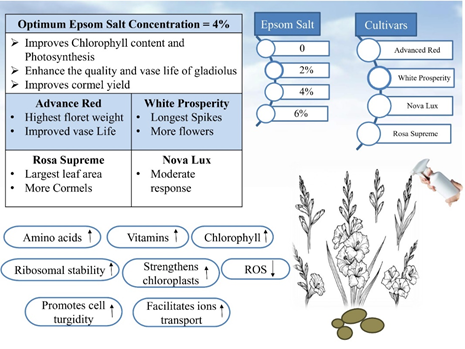
Results. Among all the concentrations, Epsom salt showed greater chlorophyll content at the rate of 4%, as well as the number of florets, floret diameter, floret fresh weight, floret dry weight, spike length, and vase life. Likewise, the highest number of leaves, leaf area, floret diameter, number of florets, floret fresh and dry weight, as well as vase life, weight, and diameter of daughter cormels were observed in the Advance Red cultivar of gladiolus. Interactive effects revealed that Advance Red, with 4% Epsom salt, achieved maximum floret weight, dry matter, and vase life, while the longest spikes were recorded in White Prosperity.
Conclusion. This study identifies 4% Epsom salt as the optimal concentration for enhancing gladiolus growth and floral quality, with Advanced Red emerging as the most responsive cultivar.
Downloads
References
Hameed A, Riaz K, Jameel S, et al. Understanding rhizospheric microbial dynamics in gladiolus corms through quorum sensing and quorum quenching for disease control and growth promotion. BMC Plant Biol. 2024;24(1):996. doi:10.1186/s12870-024-05722-0
Valente L, Savolainen V, Manning J, Goldblatt P, Vargas P. Explaining disparities in species richness between Mediterranean floristic regions: a case study in Gladiolus (Iridaceae). Glob Ecol Biogeogr. 2011;20:881-892. doi:10.1111/j.1466-8238.2010.00644.x
Schwab NT, Streck NA, Becker CC, Langner JA, Uhlmann LO, Ribeiro BSM. A phenological scale for the development of gladiolus. Ann Appl Biol. 2015;166(3):496-507. doi:10.1111/aab.12198
Memon N, Wahocho N, Miano T, Leghari M. Propagation of gladiolus corms and cormels: a review. Afr J Biotechnol. 2016;15:1699-1710. doi:10.5897/AJB2012.1396
Nasir S, Ahmad M, Ali H, et al. Performance of gladiolus cultivars on morphological traits and corm production under the agro-climatic conditions of Peshawar-Pakistan. Indus J Biosci Res. 2025;3(1):58-63. doi:10.70749/ijbr.v3i1.461
Anderson NO. Gladiolus cut flower postharvest performance to direct breeding efforts. Technol Hortic. 2023;3(1):1-12. doi:10.48130/TIH-2023-0021
Jakhar RK, Anjana S. Effect of micronutrients on growth, flowering and corm yield parameters in Gladiolus cv. Nova Lux. Int J Adv Biochem Res. 2024;8(4):7-10. doi:10.33545/26174693.2024.v8.i4a.887
Akhtar S, Bablee A, Rana K, Nigar M, Nadia Z, Salam M. Effects of foliar and root application of epsom salt on aquaponics beetroot (Beta vulgaris) production in confined condition. Asian J Med Biol Res. 2020;6:56-66. doi:10.3329/ajmbr.v6i1.46479
Estefan G, Sommer R, Ryan J. Methods of soil, plant, and water analysis: a manual for the West Asia and North Africa region. International Center for Agricultural Research in the Dry Areas; published online.
Ali H, Ahmad M, Jabin S, et al. Influence of willow bark extracts and application times on the production of roselle. Plant Prot. 2024;8(4):671-677. doi:10.33804/pp.008.04.5422
De Bang TC, Husted S, Laursen KH, Persson DP, Schjoerring JK. The molecular-physiological functions of mineral macronutrients and their consequences for deficiency symptoms in plants. New Phytol. 2021;229:2446-2469. doi:10.1111/nph.17074
Pontes MH, Yeom J, Groisman EA. Reducing ribosome biosynthesis promotes translation during low Mg²⁺ stress. Mol Cell. 2016;64(3):480-492. doi:10.1016/j.molcel.2016.05.008
Pavlů J, Novák J, Koukalová V, Luklová M, Brzobohatý B, Černý M. Cytokinin at the crossroads of abiotic stress signalling pathways. Int J Mol Sci. 2018;19(8):2450. doi:10.3390/ijms19082450
Mushtaq S, Hafiz I, Arif M, Anwar A. Performance evaluation of elite gladiolus cultivars under agro climatic conditions of Rawalpindi. Asian J Adv Agric Res. 2018;5(3):1-6. doi:10.9734/AJAAR/2018/39494
Hossain M, Talukder K, Asaduzzaman M, Mahmud F, Amin N, Sayed M. Study on morphological characteristics of different genotypes of gladiolus flower. J Sci Found. 2013;9(1-2):1-8. doi:10.3329/jsf.v9i1-2.14642
Qiu Z, Esan EO, Ijenyo M, Gunupuru LR, Asiedu SK, Abbey L. Photosynthetic activity and onion growth response to compost and epsom salt. Int J Veg Sci. 2020;26(6):535-546. doi:10.1080/19315260.2019.1671570
Adnan M, Tampubolon K, Rehman F, et al. Influence of foliar application of magnesium on horticultural crops: a review. Agrinula. 2021;4(1):13-21. doi:10.36490/agri.v4i1.109
Narayan OP, Kumar P, Yadav B, Dua M, Johri AK. Sulfur nutrition and its role in plant growth and development. Plant Signal Behav. 2023;18(1):2030082. doi:10.1080/15592324.2022.2030082
Zhang B, Cakmak I, Feng J, et al. Magnesium deficiency reduced the yield and seed germination in wax gourd by affecting the carbohydrate translocation. Front Plant Sci. 2020;11:797. doi:10.3389/fpls.2020.00797
Ishfaq M, Zhong Y, Wang Y, Li X. Magnesium limitation leads to transcriptional down-tuning of auxin synthesis, transport, and signaling in the tomato root. Front Plant Sci. 2021;12:802399. doi:10.3389/fpls.2021.802399
Chopde N, Nehare N, Maske S, Lokhande S, Bhute P. Effect of foliar application of zinc and iron on growth, yield and quality of gladiolus. Plant Arch. 2015;15(1):417-419.
Cakmak I, Kirkby EA. Role of magnesium in carbon partitioning and alleviating photooxidative damage. Physiol Plant. 2008;133:692-704. doi:10.1111/j.1399-3054.2007.01042.x
Gigolashvili T, Kopriva S. Transporters in plant sulfur metabolism. Front Plant Sci. 2014;5:442. doi:10.3389/fpls.2014.00442
El-Naggar A, El-Nasharty A. Effect of potassium fertilization on growth, flowering, corms production and chemical contents of Gladiolus hybrida L. Alex Sci Exch J. 2017;37:714-728. doi:10.21608/asejaiqjsae.2016.2596
Gómez-Pérez L, Valdez-Aguilar LA, Benavides-Mendoza A, Juárez-Maldonado A. Biomass and macronutrient dynamics in mother and daughter corms in Gladiolus × grandiflorus Hort. Rev Bio Cienc. 2018;5(1):1-16.
Kleczkowski LA, Igamberdiev AU. Magnesium signaling in plants. Int J Mol Sci. 2021;22(3):1159. doi:10.3390/ijms22031159
Tian Z, Zhang Y, Zhu L, Jiang B, Wang H, Gao R, Friml J, Xiao G. Strigolactones act downstream of gibberellins to regulate fiber cell elongation and cell wall thickness in cotton (Gossypium hirsutum). Plant Cell. 2022;35(2):4816-4839. doi:10.1093/plcell/koac270
Ahmed N, Zhang B, Bozdar B, et al. The power of magnesium: unlocking the potential for increased yield, quality, and stress tolerance of horticultural crops. Front Plant Sci. 2023;14:1285512. doi:10.3389/fpls.2023.1285512
Kudoyarova GR, Dodd IC, Veselov DS, Rothwell SA, Veselov SY. Common and specific responses to availability of mineral nutrients and water. J Exp Bot. 2015;66(8):2133-2144. doi:10.1093/jxb/erv017
Hawkesford MJ, De Kok LJ. Managing sulphur metabolism in plants. Plant Cell Environ. 2006;29:382-395. doi:10.1111/j.1365-3040.2005.01470.x
Phillips AL. Genetic and transgenic approaches to improving crop performance. In: Davies PJ, ed. Plant Hormones. Springer; 2010:618-645. doi:10.1007/978-1-4020-2686-7_27
Halder NK, Rafiuddin MD, Siddiky MA, Gomes R, Begam KA. Performance of gladiolus as influenced by boron and zinc. Pak J Biol Sci. 2007;10(4):581-585. doi:10.3923/pjbs.2007.581.585
Memon N, Qasim M, Jaskani M, Ahmad R, Anwar R. Effect of various corm sizes on the vegetative, floral and corm yield attributes of gladiolus. Pak J Agric Sci. 2009;46:13-19.
Published
How to Cite
Issue
Section
License
Copyright (c) 2026 Syed Saadullah Shah, Masood Ahmad, Hamza Ali, Shahid Zaman, Saima Naz Malik, Ali Asghar, Ikram Ullah

This work is licensed under a Creative Commons Attribution 4.0 International License.
BSR follows an open-access publishing policy and full text of all published articles is available free, immediately upon publication of an issue. The journal’s contents are published and distributed under the terms of the Creative Commons Attribution 4.0 International (CC-BY 4.0) license. Thus, the work submitted to the journal implies that it is original, unpublished work of the authors (neither published previously nor accepted/under consideration for publication elsewhere). On acceptance of a manuscript for publication, a corresponding author on the behalf of all co-authors of the manuscript will sign and submit a completed the Copyright and Author Consent Form.