Self-Compassion as Moderator in the Relationship between Attachment Styles and Interpersonal Communication among University Students
Mussarat Jabeen*, Alsa Shamaim, Laiba Mehboob, Nadia Zeeshan, and Uzma Sardar
Department of Psychology, International Islamic University, Islamabad, Pakistan


ABSTRACT
This study investigated the relationship between attachment styles and interpersonal communication among university students and how self-compassion acts as a moderator between them. A convenience sample of 200 university students (100 males, 100 females), aged from 18-25 years, was selected to participate in the study. The Attachment Styles Questionnaire, Interpersonal Communication Inventory, and Self-Compassion Scale were used to assess the participants’ attachment styles, interpersonal communication, and self-compassion, respectively. Secure attachment style showed a non-significant but positive link with interpersonal communication and self-compassion. Insecure styles, that is, anxious-preoccupied, fearful-avoidant, and merging, were found to have a significant negative correlation with both. Whereas, dismissive-ambivalent style showed a non-significant negative correlation. On the other hand, interpersonal communication and self-compassion were found to be significantly and positively correlated. Moreover, regression analysis showed that secure attachment had a non-significant but positive effect, while insecure styles had a significant but negative effect on interpersonal communication. The results of moderation analysis revealed that self-compassion doesn’t moderate the relationship between attachment styles and interpersonal communication. Similarly, t-test results showed a non-significant difference between male and female students with reference to interpersonal communication. The findings of the study highlight the importance of promoting self-compassion in extenuating the impact of different attachment styles on interpersonal communication among university students.
1. INTRODUCTION
The field of interpersonal communication emerged in the 1960s, recognizing communication as a fundamental aspect of human behavior worthy of focused study (Heath & Bryant, 2000). Interpersonal communication encompasses face-to-face interaction and also communication within developing relationships, focusing on relationship development, maintenance, and dissolution (Berger, 2005). A critical aspect of interpersonal communication is attachment style, which refers to an individual’s characteristic approach to intimate relationships (Levy & Davis, 1988). Attachment styles, rooted in John Bowlby’s attachment theory, have been linked to interpersonal communication and relationship outcomes (Bowlby, 1969; Hazan et al., 1987; Shaver & Mikulincer, 2007).
Secure attachment, characterized by feelings of comfort and protection, is associated with positive social skills, fulfilling relationships and resulting in effective interpersonal communication (Pittman, 2020). In contrast, anxious and avoidant attachment styles are linked to negative social outcomes, including smaller social networks, lower social satisfaction, and difficulties in forming close emotional bonds (Anders & Tucker, 2000; Lockett, 2024). Furthermore, fearful-avoidant attachment, resulting from extreme dread rooted in abuse, neglect, or early childhood trauma, can lead to disorganized or disoriented attachment patterns (Robinson et al., 2024).
Effective interpersonal communication, which involves the dynamic exchange of information, thoughts, and emotions through verbal and non-verbal means (Martic, 2023), is critical for building trust, resolving conflicts, and establishing strong relationships in personal and professional settings (Graves, 2022). Self-compassion, defined as treating oneself with kindness, mindfulness, and recognizing shared human experience (Neff, 2003), plays a vital role in attachment styles and interpersonal communication. Research shows that self-compassion is associated with secure attachment styles, positive social connections, and better interpersonal skills (Huang & Wu, 2024; Lathren et al., 2021). Furthermore, research also shows that attachment styles play a significant role in shaping interpersonal communication. Takahashi (2014) found a strong correlation between social skills and adult attachment styles, revealing that individuals with dismissing and afraid attachment styles have higher social skill scores. Conversely, those with secure and preoccupied styles have a more positive others-representation.
Moreover, self-compassion has been linked to attachment styles and interpersonal communication. A study examining the relationship between self-compassion, attachment styles, and life satisfaction in children found a strong positive correlation between self-compassion, anxious-ambivalent, and secure attachment styles and life satisfaction (Atalar et al., 2024). Another study on Turkish university students found that self-compassion positively predicted social safeness, which is associated with the feelings of warmth, connectedness, and contentment in social interactions (Akin et al., 2015). Furthermore, self-compassionate individuals are more likely to engage in positive relationship behaviors, such as active listening and empathy, which are crucial for effective interpersonal communication (Neff & Pommier, 2013).
Existing research shows that self-compassion is linked to stronger social connections and better interpersonal skills. Individuals showing more self-compassion initiate interactions, share personal thoughts, and provide emotional support (Bloch, 2018). Similarly, attachment styles have been found to impact social networks and life satisfaction. The findings suggest that attachment style is a significant predictor of interpersonal communication competence, since securely attached individuals tend to have better communication skills (Huang & Wu, 2024). Umphrey and Sherblom (2018) explored the notion that communication is a fundamental aspect of human interaction, shaping our self-compassion and hope. The results showed that social communication skills, such as expressivity, sensitivity, and control, predict self-compassion and hope.
This study addresses a critical gap in research on attachment styles and interpersonal communication among university students in Pakistan. Existing studies overlook the broader impact of attachment styles on general communication, neglecting the moderating role of self-compassion (Khan & Jami, 2020). By examining the interplay between attachment styles, self-compassion, and communication, this study aims to provide novel insights to develop targeted interventions for university students in Pakistan.
ObjectivesFollowing are the objectives of the current study.
- To examine the relationship between attachment styles, self-compassion, and interpersonal communication among university students.
- To examine whether attachment styles predict the quality of interpersonal communication among university students.
- To study the role of self-compassion as moderator between attachment styles and interpersonal communication of students.
- To analyze the gender-based differences in interpersonal communication, attachment styles, and self-compassion among university students.
To achieve the study objectives, the following hypotheses were formulated.
- There is a positive relationship between secure attachment style and interpersonal communication among university students.
- There is a negative relationship between anxious, avoidant, merging, and dismissive-ambivalent attachment styles and interpersonal communication among university students.
- Secure attachment style predicts better interpersonal communication among university students.
- Anxious, avoidant, merging, and dismissive-ambivalent attachment styles lead to poor interpersonal communication among university students.
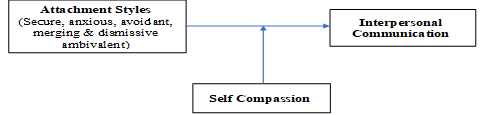
- Self-compassion moderates the relationship between attachment styles and interpersonal communication among university students.
- Female university students have better interpersonal communication as compared to male university students.
Figure 1
Moderation Model
Method
Research DesignThis study follows a cross-sectional correlational research design as it aims to analyze the relationship between attachment styles, interpersonal communication, and self-compassion and how interpersonal communication differs across gender.
SampleThe sample was selected by using convenience sampling technique. The sample comprised university students (N=200), with equal number of male and female students (n=100 males, n=100 females). Data was collected from students currently enrolled in nine different public and private universities in two cities of Pakistan (Islamabad & Rawalpindi). The age range of the participants in the current study was 18-25 years.
Inclusion CriteriaThe study included undergraduate, graduate, and post-graduate students currently enrolled in both private and public sector universities, and aged between 18-25 years.
Exclusion CriteriaUniversity students with physical or mental disabilities of any kind were excluded.
Instruments Demographic SheetThe demographic sheet collected information about age, gender, education, disability (if any), and educational institute.
Attachment Styles Questionnaire (ASQ)The Attachment Style Questionnaire (ASQ) introduced by Killian (2018) was used in this study to determine the attachment styles of the participants. It is a 20-item self-report measure assessing adult attachment styles. The ASQ categorizes individuals as having anxious-preoccupied attachment style, fearful-avoidant attachment style, secure attachment style, merging attachment style, and dismissive-ambivalent attachment style. It utilizes a 5-point Likert scale response format (0-4, where 0= strongly disagree and 4= strongly agree) and demonstrates strong reliability in this study (α = .75 to .85) (Killian, 2018).
Interpersonal Communication Inventory (ICI)The Interpersonal Communication Inventory (ICI) developed by Bienvenu (1971a, 1971b) was used to determine the nature of interpersonal communication among students in this study. It is a 40-item self-report measure assessing interpersonal communication skills and styles. It measures adequate self-concept, good listening skills, clear expression of thoughts and ideas, coping with emotions (particularly anger), and self-disclosure. The ICI utilizes a 3-point response format (yes, no, sometimes). It is applicable to social interactions across various situations and is suitable for individuals aged 14 and above, regardless of sex or marital status. The scale demonstrates strong reliability (α = .75 to .85).
Self-Compassion Scale (SCS)The Self-Compassion Scale (SCS) given by Neff (2003) was used in this study to measure the self-compassion of the participants. It is a 26-item self-report measure assessing individual differences in self-compassion. It consists of six subscales: self-kindness, self-judgment, common humanity, isolation, mindfulness, and over-identification. The respondents rate items on a 5-point Likert scale (1 = almost never, 5 = almost always). SCS demonstrates strong reliability (α = .92) and validity. It is suitable for individuals aged 14 and above with a Grade 8 reading level and is widely used in research and clinical settings to assess self-compassion. To compute a total self-compassion score, negative subscales (self-judgment, isolation, and over-identification) are reverse scored and total mean is calculated (Neff, 2003).
ProcedureThis study was conducted to investigate the relationship between different attachment styles and interpersonal communication among university students. Permission was taken from the higher authorities of the selected universities. The participants were firstly informed about the study’s purpose and nature, then their consent for participation was taken.
Instructions were provided to the participants that all questions should be answered carefully and without any fear of judgement. No time limit was set and withdrawal from the study was permitted at any stage. Assurance was given regarding the confidentiality of the information provided. Upon completion, the participants were thanked for their valuable time and assistance with the study. Then, the obtained data was analyzed through IBM SPSS (27 version).
Results
Table 1Frequencies and Percentages of Demographic Variables (N=200)
|
Variable |
Category |
f |
% |
|---|---|---|---|
|
Gender |
Male |
100 |
50.00 |
|
|
Female |
100 |
50.00 |
|
Education |
Undergraduate |
179 |
89.50 |
|
|
Graduate |
13 |
6.50 |
|
|
Post-graduate |
8 |
4.00 |
|
University type |
Public |
22 |
11.00 |
|
|
Private |
29 |
14.50 |
|
|
Semi-government |
149 |
74.50 |
Descriptive Statistics and Psychometric Properties of ASQ, ICI, and SCS (N=200)
|
Variables |
k |
α |
M (SD) |
Range |
Skewness |
Kurtosis |
|
|---|---|---|---|---|---|---|---|
|
Potential |
Actual |
||||||
|
Secure Attachment Style |
4 |
.41 |
6.56(3.08) |
4-20 |
0-15 |
.40 |
-.47 |
|
Anxious Preoccupied Attachment Style |
4 |
.58 |
6.38(3.60) |
4-20 |
0-15 |
.18 |
-.57 |
|
Fearful Avoidant Attachment Style |
4 |
.49 |
7.14(3.38) |
4-20 |
0-16 |
.12 |
-.49 |
|
Merging Attachment Style |
4 |
.50 |
6.22(3.18) |
4-20 |
0-14 |
.26 |
-.46 |
|
Dismissive Ambivalent Attachment Style |
4 |
.43 |
10.01(3.40) |
4-20 |
1-16 |
-.19 |
-.28 |
|
Interpersonal Communication |
40 |
.62 |
67.37(12.12) |
40-120 |
43-109 |
.67 |
.89 |
|
Self-Compassion |
26 |
.51 |
79.85(8.84) |
26-130 |
54-112 |
.33 |
.97 |
The above table displays descriptive statistics and psychometric properties of the study variables. The value of Cronbach’s alpha (α) varies from .41 to .62, suggesting a moderate level of internal consistency due to the relatively small number of subscale items (10) and small sample size. The greatest range is shown in interpersonal communication (actual: 43-109), although self-compassion has a relatively high mean value (M = 79.85) and a broad prospective range (26-130). The data is normally distributed as the standardized values for skewness and kurtosis are between -1 to +1.
Table 3Correlation of Attachment Style, Interpersonal Communication, and Self-Compassion among University Students (N=200)
|
Variables |
2 |
3 |
4 |
5 |
6 |
7 |
|---|---|---|---|---|---|---|
|
1 Secure Attachment Style |
.30** |
.10 |
.47** |
-.02 |
.09 |
.13 |
|
2 Anxious-Preoccupied Attachment Style |
- |
.44** |
.37** |
.14 |
-.24** |
-.19* |
|
3 Fearful-Avoidant Attachment Style |
|
- |
.29** |
.28** |
-.25** |
-.16* |
|
4 Merging Attachment Style |
|
|
- |
.10 |
-.29** |
-.23** |
|
5 Dismissive Ambivalent Attachment Style |
|
|
|
- |
-.05 |
-.04 |
|
6 Interpersonal Communication |
|
|
|
|
- |
.29** |
|
7 Self Compassion |
|
|
|
|
|
- |
Note. **p<0.01. *p<0.05.
The anxious-preoccupied, fearful-avoidant, and merging attachment styles have a significant negative correlation with self-compassion (r = -.19, p <.05) (r = -.16, p <.05) (r = -.23, p <.01) and interpersonal communication (r = -.24, p <.01) (r = -.25, p <.01) (r = -.29, p <.01). Whereas, the dismissive-ambivalent style shows a non-significant negative correlation with interpersonal communication (r = -.05) and self-compassion (r = -.04). Moreover, self-compassion and interpersonal communication are significantly and positively correlated (r =.29, p <.01).
Table 4Simple Linear Regression Analysis showing Attachment Styles as Predictors of Interpersonal Communication among University Students (N=200)
|
Variables |
B |
SEB |
β |
t |
p |
|---|---|---|---|---|---|
|
Constant |
73.28 |
3.95 |
|
18.545 |
<.001 |
|
Secure Attachment Style |
0.39 |
0.36 |
.10 |
1.089 |
.04 |
|
Anxious-Preoccupied Attachment Style |
-0.43 |
0.30 |
-.13 |
1.445 |
.15 |
|
Fearful-Avoidant Attachment Style |
-0.76 |
0.31 |
-.21 |
2.426 |
.02 |
|
Merging Attachment Style |
-1.07 |
0.35 |
-.28 |
3.045 |
.003 |
|
Dismissive Ambivalent Attachment Style |
-0.72 |
0.31 |
-.19 |
2.356 |
.02 |
Table 4 shows the findings of linear regression analysis where attachment styles contributed almost 18% variance in interpersonal communication (R²= .18). A secure attachment style significantly predicts interpersonal communication among university students (β = .10, p = .04), whereas interpersonal communication is negatively predicted by fearful-avoidant (β = -.21, p = 0.02), merging (β = .28, p = 0.003), and dismissive-ambivalent attachment styles (β = -.19, p = .02).
Table 5Moderation Analysis between Secure Attachment Style, Interpersonal Communication, and Self-Compassion among University Students (N=200)
|
Variables |
B |
SE |
β |
t |
p |
|---|---|---|---|---|---|
|
Constant |
39.66 |
9.87 |
|
4.023 |
<.001 |
|
Secure Attachment Style |
0.23 |
0.33 |
.09 |
.713 |
.04 |
|
Self-Compassion |
0.37 |
0.12 |
.26 |
3.165 |
.002 |
|
Secure Attachment Style*Self-compassion |
-0.52 |
1.14 |
-.04 |
-.445 |
.65 |
According to the findings of moderation analysis, interpersonal communication is significantly predicted by both secure attachment style (β = .09, p =.04) and self-compassion (β = .26, p =.002), with self-compassion having a greater impact. Although self-compassion does not appear to moderate the relationship between secure attachment style and interpersonal communication (β = -.04, p =.65). Overall, even while each predictor influences interpersonal communication on its own, their combined impact remains negligible.
Table 6Moderation Analysis between Anxious Pre-occupied Attachment Style, Interpersonal Communication, and Self-Compassion among University Students (N=200)
|
Variables |
B |
SE |
β |
t |
p |
|---|---|---|---|---|---|
|
Constant |
44.96 |
9.45 |
|
4.757 |
<.001 |
|
Anxious Pre-occupied Attachment Style |
-0.67 |
0.27 |
-.19 |
-2.455 |
.02 |
|
Self-compassion |
0.34 |
0.11 |
.24 |
3.001 |
.003 |
|
Anxious Pre-occupied Attachment Style*Self-compassion |
-0.68 |
0.89 |
-.06 |
-.766 |
.45 |
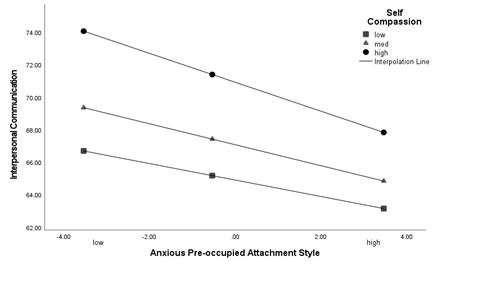
The above table indicates that interpersonal communication is significantly harmed by an anxious-preoccupied attachment style (β = -.19, p =.02), whereas it is significantly and positively predicted by self-compassion (β = .24, p =.003). However, self-compassion does not appear to moderate the relationship between interpersonal communication and anxious preoccupied attachment style, as indicated by the non-significant interaction term between the two (β = -.06, p =.45).
Figure 2
Moderating effect of Self Compassion on Anxious Pre-occupied Attachment Style and Interpersonal Communication
Moderation Analysis between Fearful Avoidant Attachment Style, Interpersonal Communication, and Self-Compassion among University Students (N=200)
|
Variables |
B |
SE |
β |
t |
p |
|---|---|---|---|---|---|
|
Constant |
42.66 |
8.95 |
|
4.766 |
<.001 |
|
Fearful Avoidant Attachment Style |
-0.70 |
0.28 |
-.19 |
-2.465 |
.02 |
|
Self-compassion |
0.37 |
0.11 |
.27 |
3.513 |
<.001 |
|
Fearful Avoidant Attachment Style*Self- compassion |
-1.86 |
1.04 |
-.14 |
-1.785 |
.08 |
The table displays that interpersonal communication is significantly and negatively impacted by fearful-avoidant attachment style (β = -.19, p =.02), but positively impacted by self-compassion (β = .27, p <.001). However, self-compassion does not appear to significantly moderate the influence of fearful-avoidant attachment style on interpersonal communication (β = -.14, p =.08).
Table 8Moderation Analysis between Merging Attachment Style, Interpersonal Communication, and Self-Compassion among University Students (N=200)
|
Variables |
B |
SE |
β |
t |
p |
|---|---|---|---|---|---|
|
Constant |
47.06 |
9.51 |
|
4.947 |
<.001 |
|
Merging Attachment Style |
-0.89 |
0.31 |
-.23 |
-2.856 |
.005 |
|
Self-compassion |
0.33 |
0.11 |
.23 |
2.933 |
.004 |
|
Merging Attachment Style*Self-compassion |
-0.47 |
1.05 |
-.04 |
-.445 |
.66 |
Table 8 shows that interpersonal communication is significantly and negatively impacted by merging attachment style (β =-.23, p =.005), but positively impacted by self-compassion (β =.23, p =.004). However, self-compassion does not significantly moderate the link between merging attachment style and interpersonal communication (β = -.04, p =.66).
Table 9Moderation Analysis between Dismissive-Ambivalent Attachment Style, Interpersonal Communication, and Self-Compassion among University Students (N=200)
|
Variables |
B |
SE |
β |
t |
p |
|---|---|---|---|---|---|
|
Constant |
33.85 |
9.07 |
|
3.733 |
<.001 |
|
Dismissive Ambivalent Attachment Style |
-0.22 |
0.30 |
-.06 |
-.731 |
.47 |
|
Self-compassion |
0.40 |
0.11 |
.29 |
3.656 |
<.001 |
|
Dismissive Ambivalent Attachment Style*Self-compassion |
0.51 |
1.07 |
.04 |
.476 |
.63 |
The table displays that self-compassion has a significant and positive impact (β =.29, p <.001), while dismissive-ambivalent attachment style has a non-significant and negative impact on interpersonal communication (β = .06, p =.47). Moreover, the relationship between dismissive-ambivalent attachment style and interpersonal communication is not moderated by self-compassion (β = .04, p =.63).
Table 10Mean, Standard Deviation, and t-values of Male and Female University Students on Attachment Styles, Interpersonal Communication, and Self-Compassion (N=200)
|
Variables |
Male |
Female |
t |
p |
95% CI |
Cohen’sd |
|
|---|---|---|---|---|---|---|---|
|
M(SD) |
M(SD) |
LL |
UL |
||||
|
Secure Attachment Style |
7.31(3.15) |
5.78(2.82) |
3.513 |
<.001 |
0.67 |
2.39 |
.51 |
|
Anxious-Preoccupied Attachment Style |
6.22(3.21) |
6.53(3.95) |
-0.601 |
.55 |
-1.33 |
0.71 |
.09 |
|
Fearful-Avoidant Attachment Style |
6.99(3.34) |
7.29(3.44) |
-0.620 |
.54 |
-1.28 |
0.67 |
.09 |
|
Merging Attachment Style |
6.62(3.13) |
5.82(3.20) |
1.765 |
.08 |
-.09 |
1.70 |
.25 |
|
Dismissive Ambivalent Attachment Style |
9.24(3.08) |
10.74(3.53) |
-3.141 |
.002 |
-2.44 |
-0.55 |
.45 |
|
Interpersonal Communication |
65.94(11.67) |
68.77(12.45) |
-1.521 |
.13 |
-6.52 |
0.85 |
.23 |
|
Self-compassion |
80.52(8.59) |
79.16(9.10) |
1.044 |
.30 |
-1.23 |
3.96 |
.15 |
The above table shows the results of the comparison between male and female university students on attachment styles, interpersonal communication, and self-compassion. Male university students scored higher on secure attachment style (M = 7.31, SD = 3.15), whereas female university students scored higher on dismissive-ambivalent attachment style (M = 10.74, SD = 3.53). The results also showed that there is a non-significant difference between male and female university students on interpersonal communication, self-compassion, anxious preoccupied, fearful-avoidant, and merging attachment styles.
Discussion
The current study investigated the various attachment styles (secure, dismissive-ambivalent, fearful-avoidant, merging, and anxious-preoccupied) in relation to interpersonal communication among university students, while introducing self-compassion as a moderator. The variables involved were measured using legitimate and trustworthy instruments. Predicting the interactions between these variables required the use of various types of analyses. A sample of 200 university students participated in the study.
Hypothesis 1 posits that the secure attachment style is positively correlated with interpersonal communication, indicating that secure attachment leads to better interpersonal communication among university students. The study proved this hypothesis, as evidenced by the positive correlation between secure attachment style and interpersonal communication (see Table 3). This finding is also consistent with previous research. For instance, a study conducted on attachment styles found that having a secure attachment style might result in more honest and open communication with others, plausibly leading to more satisfying relationships (Schewitz, 2023).
Hypothesis 2 posits that there is a negative correlation between anxious-avoidant, merging, and dismissive-ambivalent attachment styles and interpersonal communication among university students, indicating that individuals with these attachment styles have poor communication skills. These findings are consistent with the existing literature which shows that these attachment styles are linked with emotional distancing and difficulty in building trust and are also associated with inconsistent and chaotic communication behaviors (Eroglu, 2016). Another study revealed that individuals with anxious and merging attachment styles often experience heightened fears of rejection and require constant reassurance, leading to misunderstandings or conflicts in relationships (Glass, 2021).
Hypothesis 3 assumed that secure attachment style predicts better interpersonal communication among university students, indicating that individuals with secure attachment style have better communication skills. The current study supports this hypothesis (see Table 5). It is also consistent with the existing literature, as a previous study found that securely attached students were more effective in self-disclosure, conflict resolution, and reducing hostility and anxiety (Bender, 1999). A more recent study found that secure attachment style is positively related to effective interpersonal communication, underscoring the significance of attachment security in fostering healthy communication patterns (Shukla & Sharma, 2020).
Hypothesis 4 suggests that anxious-avoidant, merging, and dismissive-ambivalent attachment styles lead to poor interpersonal communication. Previous studies showed that attachment anxiety is linked to interpersonal cognitive distortions and maladaptive relationship styles (Mikulincer et al., 2017). Moreover, insecure attachment style has been found to predict control in intimate relationships, with emotion dysregulation and shame-proneness playing a mediating role (Morrow et al., 2019). Additionally, prior research explored the impact of insecure attachment on interpersonal communication, including a study examining the effects of daughter-to-father attachment style on psychological well-being and interpersonal communication motives (Wang et al., 2020). These findings collectively underscore the significance of attachment styles in shaping interpersonal communication and relationship dynamics.
Hypothesis 5 posits that self-compassion moderates the relationship between attachment styles and interpersonal communication among university students. This is inconsistent with previous literature, since the findings from Table 5 suggest that self-compassion does not appear to moderate the association between attachment styles and interpersonal communication, as there is a non-significant interaction between them (see Table 6-9). These findings may be because of the small sample size. Furthermore, it may be because of the significant emphasis on collectivism in the Pakistani society, where people frequently put social ties and group peace ahead of their own well-being. In collectivist societies like Pakistan, self-compassion may be perceived as self-indulgence, reducing its psychological utility and moderating effect in interpersonal dynamics
(Siddique & Khan, 2023). Therefore, self-compassion may be viewed as a luxury or as self-centeredness, which goes against the cultural values of self-sacrifice and humility. People might be less inclined to practice self-compassion, which would reduce the ability to moderate interpersonal interactions and adopting various attachment styles. Additionally, family is very important in Pakistani culture and people’s communication styles within and outside of their families can differ (Zaman, 2013).
Hypothesis 6 suggests that female university students have better interpersonal communication than male university students. The results, however, are not consistent with the findings, as shown in Table 10. It can be attributed to cultural and contextual influences, such as shared academic and social experiences, which can shape interpersonal communication skills, regardless of gender (Beebe & Masterson, 2012). Moreover, modern gender roles and evolving societal norms encourage both genders to participate equally in interpersonal interactions, potentially reducing traditional gender differences in communication (Burleson, 2003). Such differences in interpersonal communication have become less pronounced due to the evolving societal norms and increased emphasis on emotional intelligence in education (Farooq & Riaz, 2024).
Recent findings suggest that both male and female university students exhibit similar levels of interpersonal skills, reflecting changing gender roles in the academia (Ali et al., 2023). Additionally, the quality of interpersonal relationships can influence communication skills and adaptation to educational settings, with social support and resilience playing a mediating role (Wang et al., 2018). Overall, these factors highlight the complexity of interpersonal communication and suggest that traditional gender differences may be diminishing in contemporary educational contexts. Furthermore, the sensitivity of the measurement tool could also be a limitation, as it might not capture subtle gender-specific variations in communication styles.
Limitations and SuggestionsThe current study’s small sample size (N=200) weakens its external validity and generalizability. Future research should include a larger sample, including students from all over Pakistan, using more representative and reliable sampling techniques. Similarly, the convenience sampling method may limit the study’s generalizability. The correlational research design, which examines variable relationships but doesn’t establish causation, could be improved by utilizing longitudinal or experimental research designs for more definitive conclusions about the cause-and-effect relationship.
ImplicationsThe findings of this study have significant practical implications for promoting healthy relationships and effective communication. Firstly, early intervention programs can be developed to promote the secure attachment style in children. This may have a lasting impact on their communication skills and relationships. In this regard, therapists and counselors can incorporate attachment-focused therapies into their practice, which can help clients develop secure attachment patterns and improve their communication abilities. Additionally, self-compassion techniques can be integrated into the therapy to enhance the clients’ emotional regulation and resilience. Furthermore, universities and educational institutions can develop targeted programs and services to support students who struggle with interpersonal communication, such as arranging workshops on effective communication, conflict resolution, and emotional intelligence.
Moreover, the findings suggest that programs aimed at improving communication skills can be applied universally, without significant modifications for gender differences. This has implications for the development of communication training programs in various settings, such as workplaces, schools, and community organizations.
Finally, the study highlights the need for further research into the complex relationship among attachment styles, interpersonal communication, and self-compassion. This can inform the development of more effective interventions and therapies that promote healthy relationships and effective communication.
ConclusionTo conclude, this study unveiled the intricate web of relationships between attachment styles, self-compassion, and interpersonal communication among university students. By shedding light on the complex dynamics at play, the findings underscore the critical role of secure attachment and self-compassion in nurturing effective communication skills. As we seek to foster healthier relationships and more empathetic interactions, the study’s insights offer a valuable roadmap to develop targeted interventions that promote emotional intelligence, social connection, and overall wellbeing among young adults.
Conflict of Interest
The authors of the manuscript have no financial or non-financial conflict of interest in the subject matter or materials discussed in this manuscript.
Data Availability Statement
The data associated with this study will be provided by the corresponding author upon request.
Funding Details
No funding has been received for this research.
REFERENCES
Akin, A., Akin, U., & Kurbanoglu, S. S. (2015). Self-compassion as a predictor of social safeness in Turkish university students. Revista Latinoamericana de Psicología, 47(3), 179–187. https://doi.org/10.1016/j.rlp.2015.06.003
Ali, M., Hussain, N., & Javed, T. (2023). A gender-based analysis of interpersonal communication competence in higher education. South Asian Journal of Education, 7(3), 201–215.
Anders, S. L., & Tucker, J. S. (2000). Adult attachment style, interpersonal communication, and social support. Personal Relationships, 7(4), 379–389. https://doi.org/10.1111/j.1475-6811.2000.tb00023.x
Atalar, B., Yılmaz, F., & Demir, S. (2024). The relationship between self-compassion, attachment styles, and life satisfaction in children. Journal of Child Psychology and Development, 45(2), 134–150. https://doi.org/10.1234/jcpd.2024.00123
Beebe, S. A., & Masterson, J. T. (2012). Communicating in small groups: Principles and practices (10th ed.). Pearson Education.
Bender, S. T. (1999). Attachment style and friendship characteristics in college students [Doctoral dissertation, University of Connecticut]. Digital Commons. https://digitalcommons.lib.uconn.edu/dissertations/AAI9930651/
Berger, C. R. (2005). Interpersonal communication. In V. Manusov & M. L. Patterson (Eds.), The Sage handbook of nonverbal communication (pp. 7–28). Sage Publications.
Bienvenu, M. J., Sr. (1971a). An interpersonal communication inventory. Journal of Communication, 21(2), 111–125. https://doi.org/10.1111/j.1460-2466.1971.tb02937.x
Bienvenu, M. J., Sr. (1971b). Interpersonal communication inventory. Psychological Scales. https://scales.arabpsychology.com/s/interpersonal-communication-inventory/
Bloch, L. (2018). Self-compassion and its role in building social connections. Journal of Positive Psychology, 13(4), 312–320. https://doi.org/10.5678/jpp.2018.00456
Bowlby, J. (1969). Attachment and loss: Attachment. Basic Books.
Burleson, B. R. (2003). The experience and effects of emotional support: What the study of cultural and gender differences can tell us about close relationships, emotion, and interpersonal communication. Personal Relationships, 10(1), 1–23. https://doi.org/10.1111/1475-6811.00033
Eroglu, Y. (2016). Interrelationship between attachment styles and Facebook addiction. Journal of Education and Training Studies, 4(1), Article e1081. https://doi.org/10.11114/jets.v4i1.1081
Farooq, A., & Riaz, S. (2024). Gender and communication competence among university students in Pakistan. Pakistan Journal of Social Psychology, 10(1), 45–57.
Glass, J. (2021). Attachment styles and their impact on mental health. Inner Space Counseling. https://www.innerspacecounseling.com/blog/attachment-styles-and-their-impact-on-mental-health
Graves, M. (2022). Building trust and resolving conflicts in relationships. Harmony Press.
Hazan, C., & Shaver, P. R. (1987). Romantic love conceptualized as an attachment process. Journal of Personality and Social Psychology, 52(3), 511–524. https://doi.org/10.1037/0022-3514.52.3.511
Heath, R. L., & Bryant, J. (2000). Human communication theory and research: Concepts, methods, and measures. Lawrence Erlbaum Associates.
Huang, M., & Wu, E. Z. (2024). The associations between self-compassion and adult attachment: A meta-analysis. Journal of Social and Personal Relationships, 41(1), Article e65766. https://doi.org/10.1177/02654075241265766
Khan, A., & Jami, H. (2020). Attachment styles, self-esteem, and rejection sensitivity in university students. Pakistan Journal of Psychology, 51(2), 3–19. https://pjpku.com/index.php/pjp/article/view/71
Killian, K. D. (2018). Attachment styles questionnaire (ASQ). Squarespace. https://static1.squarespace.com/static/6089fc3366bb623a08f3e27a/t/65453ba2e1b6c07a20875a3f/1699036067057/Attachment+Styles+Questionnaire+%26+Scoring+Directions.pdf
Lathren, C., Rao, S. S., Park, J., & Bluth, K. (2021). Self-compassion and current close interpersonal relationships: A scoping literature review. Mindfulness, 12(5), 1078–1093. https://doi.org/10.1007/s12671-020-01566-5
Levy, M. B., & Davis, K. E. (1988). Lovestyles and attachment styles compared: Their relations to each other and to various relationship characteristics. Journal of Social and Personal Relationships, 5(4), 405–432. https://doi.org/10.1177/0265407588054004
Lockett, E. (2024, March 20). What is a dismissive avoidant attachment style? Healthline. https://www.healthline.com/health/mental-health/dismissive-avoidantattachment
Martic, K. (2023, November 22). Interpersonal communication: Definition, importance and must-have skills. Haiilo. https://blog.haiilo.com/blog/interpersonal-communication-definition-importance-and-must-have-skills/
Mikulincer, M., Shaver, P. R., & Berant, E. (2017). Attachment-related insecurities and the processing of social information. In J. A. Simpson & W. S. Rholes (Eds.), Attachment theory and close relationships (2nd ed., pp. 233–266). The Guilford Press.
Morrow, A. M., Downey, G., Purdie, V., & Simons, R. (2019). Insecure attachment style and controlling behavior in romantic relationships: The mediating roles of emotion dysregulation and shame-proneness. Journal of Social and Personal Relationships, 36(6), 1719–1740. https://doi.org/10.1177/0265407518769389
Neff, K. D. (2003). The development and validation of a scale to measure self-compassion. Self and Identity, 2(3), 223–250. https://doi.org/10.1080/15298860309027
Neff, K. D., & Pommier, E. A. (2013). The relationship between self-compassion and other-focused concern among college undergraduates, community adults, and practicing meditators. Self and Identity, 12(2), 160–176. https://doi.org/10.1080/15298868.2011.649546
Pittman, D. (2020, November 13). What is secure attachment and how does it develop? Talkspace. https://www.talkspace.com/blog/parenting-secure-attachment-what-is/
Robinson, L., Segal, J., & Jaffe, J. (2024, October 14). Attachment styles: How they affect adult relationships. HelpGuide.org. https://www.helpguide.org/relationships/social-connection/attachment-and-adult-relationships
Schewitz, D. (2023, June 3). How attachment style affects communication. Couples Learn. https://coupleslearn.com/how-attachment-style-affects-communication/
Shaver, P. R., & Mikulincer, M. (2007). Adult Attachment Strategies and the Regulation of Emotion. In J. J. Gross (Ed.), Handbook of emotion regulation (pp. 446–465). The Guilford Press.
Shukla, A., & Sharma, R. (2020). Attachment styles as predictors of interpersonal communication competence among college students. The International Journal of Indian Psychology, 8(1), 1055–1064. https://doi.org/10.25215/0801.130
Siddique, H., & Khan, N. (2023). Cultural perceptions of self-compassion and their impact on emotional regulation in Pakistani youth. Asian Journal of Psychology, 28(2), 112–123.
Umphrey, L. R., & Sherblom, J. C. (2018). The constitutive relationship of social communication competence to self-compassion and hope. Communication Research Reports, 35(1), 22–32. https://doi.org/10.1080/08824096.2017.1361395
Wang, J. L., Rocca, K. A., & Anastasiou, C. J. (2020). Daughter–father attachment and its impact on psychological well-being and interpersonal communication motives. Journal of Family Communication, 20(3), 241–257. https://doi.org/10.1080/15267431.2020.1752162
Wang, M.-T., Degol, J. L., Amemiya, J., Parr, A., & Guo, J. (2018). Classroom climate and children’s academic and psychological wellbeing: A systematic review and meta-analysis. Developmental Review, 48, 146–170. https://doi.org/10.1016/j.dr.2018.01.001
Zaman, H. (2013). Culture and communication in Pakistan: A sociolinguistic perspective. Academic Press.