Role of Gratitude and Religious Faith in Promoting Psychological Well-Being among University Students
Wurood Sohail* and Masha Asad Khan
Department of Applied Psychology, Kinnaird College for Women, Lahore, Pakistan


ABSTRACT
This correlational research explores the connection among gratitude, religious faith, and psychological well-being among university students. Through convenience sampling, data was collected from 300 Pakistani university students between the ages 18-25 years (M = 20.79, SD = 1.68) from various private and government universities both in group settings and online through Google forms. Participants were administered a demographics sheet, Gratitude, Questionnaire, Santa Clara Strength of Religious Faith Questionnaire and Ryff’s Psychological Well-being Scale, respectively. The findings indicated that higher levels of gratitude are associated with improved psychological well-being. Religious faith was found to have a significant, positive and weak relationship with environmental mastery, personal growth, positive relations, purpose in life, self-acceptance, and a non-significant relationship with autonomy. Only gratitude emerged to be a significant positive predictor of psychological well-being. Gender differences were found to be significant in terms of gratitude and religious faith, but not for psychological well-being. This suggests that women have significantly higher gratitude and religious faith than men, although the effect size of this difference is small. This study contributes to literature and may help form the foundation for a theoretical model of how gratitude-based exercises and religious activities can help improve well-being.
1. INTRODUCTION
Today’s challenging times have led individuals to seek a fulfilled and psychologically healthy life. University students, in particular, are facing unique challenges related to their academic and their personal lives, affecting their well-being (Park et al., 2020). With increasing awareness of mental health, they are constantly looking for strategies to free themselves from the stresses of life. Among these ways, practicing gratitude and religion both contribute to a higher wellbeing. Emmons and McCullough (2003) state that experiencing gratitude on a regular basis reduces negative emotions and decreases depression, and have further found that gratitude and wellbeing are positively related. Religious values also play a very important role especially during difficult times and result in enhancing well-being (Graça & Brandão, 2024).
Gratitude is an indication of emotional maturity which manifests itself in the form of appreciating ourselves and the people around us (Horder et al., 2013; Wood et al., 2008). Furthermore, it has been defined as acknowledging and appreciating the positive aspects of life and contributes to wellbeing (Watkins, 2014; Wood et al., 2010). Research indicates that gratitude is likely to reduce stress and is associated with enhanced psychological well-being (Demichelis et al., 2024; Hemarajarajeswari & Gupta, 2021).
Religiosity has been identified by previous research as being positively related to both gratitude and psychological well-being (Watkins et al., 2022). Research indicates that people with higher levels of well-being are those who are involved in religious activities (Dağci & Sümer, 2024; Koenig & Al Shohaib, 2024). They are likely to report better psychological health and well-being (Akbayram & Keten, 2024; Graça & Brandão, 2024). Religious people have also been determined to less likely be a victim of psychopathology (Aggarwal et al., 2023). Several studies also supported religious faith to be connected to psychological health and well-being (Laurencelle et al., 2002; Lucchetti et al., 2021).
From a theoretical standpoint, the broaden and build theory of positive emotions, explains how positive emotions such as gratitude widens the thought process and the behaviors of the individual resulting in the development of personal resources and is likely to enhance well-being. (Fredrickson, 2004). Along with this, the Faith development theory proposed by Fowler, an interdisciplinary framework, emphasizes the importance of faith and spirituality, how it changes through the course of life and its impact on an individual. Fowler has defined this as a process with six stages from early childhood to late adulthood demonstrating how faith evolves through time, transforming a person over their lifetime, influencing their psychological functioning (Fowler & Dell, 2006).
Studies have reported gender differences in the records of gratitude, religious faith and psychological well-being in individuals. Research conducted on late adolescents in Pakistan indicated that female adolescents manifested higher level of gratitude and psychological well-being as compared to male adolescents (Naeem et al., 2021; Panhwar & Malik, 2023).
As per the literature quoted above, there is a lack of empirical evidence conducted on gratitude, religious faith and psychological well-being altogether particularly among Pakistani university students. Although religiousness has been extensively researched, research still continues to explore about how religious faith affects psychological well-being and its role as a predictor among university students. This study aims to address the conceptual gap by exploring the relationship between gratitude, religious faith and psychological well-being among Pakistani university students.
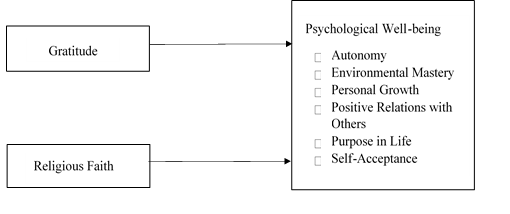
Objectives- To investigate the relationship among gratitude, religious faith, and psychological wellbeing among university students.
- To predict psychological well-being by using gratitude and religious faith among university students.
- To determine gender differences in the level of gratitude, religious faith, and psychological well-being among university students.
- There is likely to be a significant positive relationship between gratitude and psychological well-being.
- There is likely to be a significant positive relationship between religious faith and psychological well-being among university students.
- Gratitude and religious faith are likely to predict psychological well-being among university students.
- There is likely to be a significant gender difference in gratitude, religious faith, and psychological well-being among university students.
Figure 1
Proposed Study Model
Method
Research Design and SampleThe study used a correlational research design. Purposive sample included 300 university students (female n =150; male n =150) from different private and government universities of Lahore. By using G*Power3 (Faul et al., 2007), the sample size was determined.
Table 1
Sociodemographic Characteristics of Participants
|
Variables |
M |
SD |
f |
% |
|---|---|---|---|---|
|
Age |
20.79 |
1.68 |
- |
- |
|
Gender |
- |
- |
|
|
|
Men |
- |
- |
150 |
50.00 |
|
Women |
- |
- |
150 |
50.00 |
|
Religion |
- |
- |
|
|
|
Islam |
- |
- |
289 |
96.30 |
|
Other |
- |
- |
8 |
2.60 |
|
Education |
- |
- |
|
|
|
Undergraduate year 1 |
- |
- |
80 |
26.70 |
|
Undergraduate year 2 |
- |
- |
43 |
14.30 |
|
Undergraduate year 3 |
- |
- |
54 |
18.00 |
|
Undergraduate year 4 |
- |
- |
99 |
33.00 |
|
Postgraduate |
- |
- |
22 |
7.30 |
|
Family System |
|
|
|
|
|
Nuclear |
- |
- |
223 |
74.30 |
|
Joint |
- |
- |
77 |
25.70 |
|
Marital Status |
|
|
|
|
|
Single |
- |
- |
293 |
97.70 |
|
Married |
- |
- |
7 |
2.30 |
Demographic Information sheet was developed by the researcher. Basic information of the participants relevant to the study was acquired. Factors such as gender, age, major, family system, and marital status were obtained.
Gratitude Questionnaire (GQ-6)Six item self-report questionnaire was used to measure gratitude (McCullough et al., 2002). It demonstrates strong psychometric properties (α = 0.86, 0.84) and exhibits excellent internal consistency (Cronbach’s α = 0.82). The measure is structured as a 7-point Likert scale, where 1 represents 'strongly disagree' and 7 represents 'strongly agree'. Total scores on this scale range from 6, indicating very low gratitude, to 42, indicating very high gratitude.
Santa Clara Strength of Religious Faith Questionnaire (SRF)Santa Clara Strength of Religious Faith Questionnaire was used to measure religious faith (Plante & Boccaccini, 1997). The questionnaire features 10 items designed to assess the strength of religious faith or the influence of a higher being in an individual's life. It has been applied in numerous clinical and research contexts with adult participants. It employs a 4-point Likert scale, from 1 (strongly disagree) to 4 (strongly agree), with total scores varying from 10 (indicating low faith strength) to 40 (indicating strong faith strength). With high internal reliability (Cronbach’s α = .95) and split-half reliability (r = .92), this questionnaire is both reliable and valid.
Ryff’s Psychological Well-being ScaleThis scale evaluates six domains of well-being in adults: Self-acceptance (SA), personal growth (PG), purpose in life (PIL), environmental mastery (EM), autonomy, and positive relations (PR) with others. It utilizes a 6-point Likert scale for responses, ranging from 1 (Strongly disagree) to 6 (Strongly agree). Total scores on the scale can vary from 42, indicating low psychological well-being, to 252, indicating high psychological well-being. The scale has been validated and is considered reliable, with an overall reliability coefficient of .70 (Ryff, 1995).
ProcedureThis study was carried out after its approval by the ethical review committee of Kinnaird College for Women, Lahore. Moreover, permission from authors was obtained to use tools in the study. Participants were chosen by using the inclusion and the exclusion criteria. Participants were administered a demographics sheet, Gratitude Questionnaire (GQ-6), Santa Clara Strength of Religious Faith Questionnaire (SRF) and Ryff’s Psychological Well-being Scale, respectively. Administration took 8-10 minutes approximately to fill in the forms. All the ethical considerations were followed while conducting this research.
Results
Firstly, a reliability analyses was run to determine the psychometric properties of the scales used. After that, Pearson product-moment correlation, hierarchical multiple regression, and independent sample t-test were run for hypotheses testing.
Table 2
Psychometric Properties of Study Variables (N = 300)
|
Variables |
k |
M |
SD |
Range |
α |
Skewness |
Kurtosis |
|---|---|---|---|---|---|---|---|
|
Gratitude |
6 |
33.29 |
6.19 |
6-42 |
.80 |
-.82 |
.46 |
|
Religious Faith |
10 |
33.24 |
6.19 |
10-40 |
.94 |
-1.18 |
1.62 |
|
Autonomy |
7 |
28.31 |
5.89 |
7-42 |
.69 |
-.01 |
.03 |
|
Environmental Mastery |
6 |
22.29 |
5.05 |
6-36 |
.64 |
.10 |
.23 |
|
Personal Growth |
7 |
31.33 |
6.02 |
7-42 |
.74 |
-.27 |
-.65 |
|
Positive Relations |
7 |
30.21 |
5.73 |
7-42 |
.68 |
-.10 |
-.36 |
|
Purpose in Life |
7 |
29.57 |
6.08 |
7-42 |
.71 |
-.08 |
-.60 |
|
Self-Acceptance |
7 |
28.68 |
7.11 |
7-42 |
.83 |
-.34 |
.03 |
Results shown in Table 2 indicate that sample distributions show no significant skewness or kurtosis, suggesting that the distributions are approximately normal as all values fall within the acceptable range of ±1.96.
Table 3
Pearson Product Moment Correlation between Gratitude, Religious Faith and Psychological Well-Being among University Students (N=300)
|
Variables |
1 |
2 |
3 |
4 |
5 |
6 |
7 |
8 |
|---|---|---|---|---|---|---|---|---|
|
1.Gratitude |
- |
.43*** |
.32*** |
.42*** |
.49*** |
.53*** |
.49*** |
.50*** |
|
2. RF |
|
- |
.09 |
.25*** |
.17** |
.25*** |
.28*** |
.27*** |
|
3. Autonomy |
|
|
- |
.48*** |
.48*** |
.38*** |
.52*** |
.52*** |
|
4. EM |
|
|
|
- |
.50*** |
.57*** |
.54*** |
.72*** |
|
5. PG |
|
|
|
|
- |
.57*** |
.62*** |
.53*** |
|
6. PR |
|
|
|
|
|
- |
.59*** |
.55*** |
|
7. PIL |
|
|
|
|
|
|
- |
.59*** |
|
8. SA |
|
|
|
|
|
|
|
- |
Note. RF=Religious Faith, EM=Environmental Mastery, PG= Personal Growth, PR=Positive Relations, PIL= Purpose in Life, SA= Self-Acceptance.
**p<.01. ***p<.001
The results determined a significant and positive correlation between gratitude and all subscales of psychological well-being. Gratitude has a significant, positive relationship with PR and SA and has a significant, positive relationship with autonomy, EM, PG, PIL. On the other hand, religious faith does not have a significant relationship with one subscale of psychological well-being which is autonomy; however, it has a significant, positive and weak relationship with EM, PG, PR, PIL and SA. Gratitude and religious faith both are likely to predict psychological well-being among university students as both are significantly and positively correlated with psychological well-being.
Table 4
Multiple Hierarchical Linear Regression showing Gratitude and Religious Faith as Predictors of Autonomy among University Students (N=300)
|
Predictors |
B |
95% CI |
SE |
β |
R2 |
∆R2 |
|
|---|---|---|---|---|---|---|---|
|
LL |
UL |
||||||
|
Step I |
|
|
|
|
|
.105 |
.105 |
|
Constant |
2.58 |
2.08 |
3.07 |
.25 |
- |
|
|
|
Gratitude |
.27 |
.18 |
.35 |
.05 |
.32*** |
|
|
|
Step II |
|
|
|
|
|
.108 |
.003 |
|
Constant |
2.73 |
2.15 |
3.31 |
.30 |
- |
|
|
|
Gratitude |
.29 |
.19 |
.38 |
.05 |
.35*** |
|
|
|
Religious Faith |
-.08 |
-.24 |
.08 |
.08 |
-.06 |
|
|
Note. ***p<.001.
Gratitude and religious faith were included as predictor variables in the regression model. The subscale of psychological well-being (autonomy) was entered as a dependent variable. The data was free from all influential cases, whilst meeting all the regression assumptions. The condition of independent errors was confirmed, as the Durbin-Watson statistic was between the range of 1 to 3, which is acceptable. The absence of perfect multicollinearity was validated through tolerance values, all surpassing 2, thus confirming this assumption. Moreover, the condition of homoscedasticity, normal distribution of errors, and linearity were all satisfied.
In model I, gratitude was entered as one predictor variable and the regression model was significant, R2= .11, F (1, 298) = 35.00, p < .001. In model II, religious faith and gratitude were entered and the regression model turned out to be significant, R2= .11, F (2, 297) = 17.97, p < .001. When the effect of model I was excluded from model II, model II no longer remained significant, ∆R2= .00, F (1, 297) = .95, p= .332. Among all predictors entered, gratitude emerged as significant positive predictor of autonomy among university students. Religious faith did not emerge as a significant predictor of autonomy.
Table 5
Multiple Hierarchical Linear Regression showing Gratitude and Religious Faith as Predictors of Environmental Mastery among University Students (N=300)
|
Predictors |
B |
95% CI |
SE |
β |
R2 |
∆R2 |
|
|---|---|---|---|---|---|---|---|
|
LL |
UL |
||||||
|
Step I |
|
|
|
|
|
.180 |
.180 |
|
Constant |
1.80 |
1.32 |
2.27 |
.24 |
- |
|
|
|
Gratitude |
.35 |
.26 |
.43 |
.04 |
.42*** |
|
|
|
Step II |
|
|
|
|
|
.185 |
.005 |
|
Constant |
1.59 |
1.04 |
2.15 |
.28 |
- |
|
|
|
Gratitude |
.32 |
.23 |
.41 |
.05 |
.39*** |
|
|
|
Religious Faith |
.11 |
-.05 |
.26 |
.08 |
.08 |
|
|
Note. ***p<.001
In model I, gratitude was entered as one predictor variable and the regression model was significant, R2= .18, F (1, 298) = 65.27, p < .001. In model II, religious faith and gratitude were entered and the regression model turned out to be significant, R2= .19, F (2, 297) = 33.65, p < .001. When the effect of model I was excluded from model II, model II no longer remained significant, ∆R2= .01, F (1, 297) = 1.85, p= .175. Among all predictors entered, gratitude emerged as a significant positive predictor of environmental mastery among university students. Religious faith did not emerge as a significant predictor of environmental mastery.
Table 6
Multiple Hierarchical Linear Regression showing Gratitude and Religious Faith as Predictors of Personal Growth among University Students (N=300)
|
Predictors |
B |
95% CI |
SE |
Β |
R2 |
∆R2 |
|
|---|---|---|---|---|---|---|---|
|
LL |
UL |
||||||
|
Step I |
|
|
|
|
|
.243 |
.243 |
|
Constant |
2.19 |
1.73 |
2.66 |
.24 |
- |
|
|
|
Gratitude |
.41 |
.33 |
.49 |
.04 |
.49*** |
|
|
|
Step II |
|
|
|
|
|
.246 |
.002 |
|
Constant |
2.34 |
1.79 |
2.89 |
.28 |
- |
|
|
|
Gratitude |
.43 |
.34 |
.52 |
.05 |
.52*** |
|
|
|
Religious Faith |
-.08 |
-.23 |
.08 |
.08 |
-.06 |
|
|
Note. ***p<.001.
In model I, gratitude was entered as one predictor variable, and the regression model was significant, R2= .24, F (1, 298) = 95.86, p < .001. In model II, religious faith and gratitude were entered and the regression model turned out to be significant, R2= .25, F (2, 297) = 48.41, p < .001. When the effect of model I was excluded from model II, model II no longer remained significant, ∆R2= .00, F (1, 297) = .97, p= .326. Among all predictors entered, gratitude emerged as significant positive predictor of personal growth among university students. Religious faith did not emerge as a significant predictor of personal growth.
Table 7
Multiple Hierarchical Linear Regression showing Gratitude and Religious Faith as Predictors of Positive Relations among University Students (N=300)
|
Predictors |
B |
95% CI |
SE |
β |
R2 |
∆R2 |
|
|---|---|---|---|---|---|---|---|
|
LL |
UL |
||||||
|
Step I |
|
|
|
|
|
.281 |
.281 |
|
Constant |
1.98 |
1.55 |
2.41 |
.22 |
- |
|
|
|
Gratitude |
.42 |
.34 |
.50 |
.04 |
.53*** |
|
|
|
Step II |
|
|
|
|
|
.282 |
.001 |
|
Constant |
1.91 |
1.40 |
2.42 |
.26 |
- |
|
|
|
Gratitude |
.41 |
.33 |
.50 |
.04 |
.52*** |
|
|
|
Religious Faith |
.04 |
-.10 |
.18 |
.07 |
.03 |
|
|
Note. ***p<.001
In model I, gratitude was entered as one predictor variable and the regression model was significant, R2= .28, F (1, 298) = 116.41, p < .001. In model II, religious faith and gratitude were entered and the regression model turned out to be significant, R2= .28, F (2, 297) = 58.22, p < .001. When the effect of model I was excluded from model II, model II no longer remained significant, ∆R2= .00, F (1, 297) = .31, p= .579. Among all predictors entered, gratitude emerged as significant positive predictor of positive relations among university students. Religious faith did not emerge as a significant predictor of positive relations.
Table 8
Multiple Hierarchical Linear Regression showing Gratitude and Religious Faith as Predictors of Purpose in Life among University Students (N=300)
|
Predictors |
B |
95% CI |
SE |
β |
R2 |
∆R2 |
|
|---|---|---|---|---|---|---|---|
|
LL |
UL |
||||||
|
Step I |
|
|
|
|
|
.236 |
.236 |
|
Constant |
1.95 |
1.48 |
2.43 |
.24 |
- |
|
|
|
Gratitude |
.41 |
.33 |
.49 |
.04 |
.49*** |
|
|
|
Step II |
|
|
|
|
|
.243 |
.006 |
|
Constant |
1.72 |
1.17 |
2.28 |
.28 |
- |
|
|
|
Gratitude |
.38 |
.29 |
.47 |
.05 |
.45*** |
|
|
|
Religious Faith |
.12 |
-.03 |
.28 |
.08 |
.09 |
|
|
Note. ***p<.001
In model I, gratitude was entered as one predictor variable and the regression model was significant, R2= .24, F (1, 298) = 92.28, p < .001. In model II, religious faith and gratitude were entered and the regression model turned out to be significant, R2= .24, F (2, 297) = 47.57, p < .001. When the effect of model I was excluded from model II, model II no longer remained significant, ∆R2= .01, F (1, 297) = 2.42, p= .121. Among all predictors entered, gratitude emerged as significant positive predictor of purpose in life among university students. Religious faith did not emerge as a significant predictor of purpose in life.
Table 9
Multiple Hierarchical Linear Regression showing Gratitude and Religious Faith as Predictors of Self-Acceptance among University Students (N=300)
|
Predictors |
B |
95% CI |
SE |
β |
R2 |
∆R2 |
|
|---|---|---|---|---|---|---|---|
|
LL |
UL |
||||||
|
Step I |
|
|
|
|
|
.250 |
.250 |
|
Constant |
1.37 |
.82 |
1.92 |
.28 |
- |
|
|
|
Gratitude |
.49 |
.40 |
.59 |
.05 |
.50*** |
|
|
|
Step II |
|
|
|
|
|
.254 |
.004 |
|
Constant |
1.14 |
.50 |
1.79 |
.33 |
- |
|
|
|
Gratitude |
.46 |
.35 |
.57 |
.06 |
.47*** |
|
|
|
Religious Faith |
.12 |
-.06 |
.30 |
.09 |
.07 |
|
|
Note. ***p<.001.
In model I, gratitude was entered as one predictor variable and the regression model was significant, R2= .25, F (1, 298) = 99.32, p < .001. In model II, religious faith and gratitude were entered and the regression model turned out to be significant, R2= .25, F (2, 297) = 50.62, p < .001. When the effect of model I was excluded from model II, model II no longer remained significant, ∆R2= .00, F (1, 297) = 1.67, p= .195. Among all predictors entered, gratitude emerged as significant positive predictor of self-acceptance among university students. Religious faith did not emerge as a significant predictor of self-acceptance.
Table 10
Independent Sample t-test showing Gender Differences in Gratitude, Religious Faith and Psychological Well-Being among University Students (N=300)
|
Variable |
Men |
Women |
t(298) |
p |
95% CI |
Cohen’s d |
|||
|---|---|---|---|---|---|---|---|---|---|
|
M |
SD |
M |
SD |
LL |
UL |
||||
|
Gratitude |
5.43 |
1.03 |
5.67 |
1.03 |
-1.98 |
.049 |
-.47 |
-.00 |
-0.23 |
|
RF |
3.20 |
.62 |
3.45 |
.60 |
-3.50 |
.001 |
-.38 |
-.11 |
-0.40 |
|
Autonomy |
4.08 |
.85 |
4.01 |
.83 |
.71 |
.48 |
-.12 |
.26 |
- |
|
EM |
3.75 |
.87 |
3.68 |
.81 |
.79 |
.43 |
-.11 |
.27 |
- |
|
PG |
4.50 |
.85 |
4.46 |
.87 |
.35 |
.73 |
-.16 |
.23 |
- |
|
PR |
4.30 |
.81 |
4.33 |
.83 |
-.28 |
.78 |
-.21 |
.16 |
- |
|
PIL |
4.25 |
.81 |
4.20 |
.92 |
.57 |
.57 |
-.14 |
.25 |
- |
|
SA |
4.10 |
.98 |
4.09 |
1.05 |
.10 |
.92 |
-.22 |
.24 |
- |
Note. RF=Religious Faith, EM=Environmental Mastery, PG= Personal Growth, PR=Positive Relations, PIL= Purpose in Life, SA= Self-Acceptance.
The results shown in Table 5 reveal significant gender differences concerning gratitude and religious faith, but no significant differences were found for psychological well-being or its six subscales: autonomy, EM, PG, PR, PIL and SA.
Discussion
The study indicated a significant and positive relationship between gratitude and psychological well-being in university students. Gratitude was also revealed to be a significant positive predictor of psychological well-being. These findings can be interpreted in the light of previous research indicating that those with higher gratitude have greater psychological well-being depicting a positive correlation between the two (Hemarajarajeswari & Gupta, 2021; Saeed & Mahmood, 2024). Gratitude has also been found to significantly predict and influence well-being among students during pandemic times where those students undergoing severe challenges tended to have greater well-being as a result of being grateful (Daulay et al., 2022).
The results can be supported using the Broaden-and-Build Theory of Positive Emotions which explains that positive emotions, such as gratitude, makes individuals flexible in terms of their thoughts and behaviors, and results in the development of personal resources (Fredrickson, 2004). This explains the findings, as gratitude fosters the development of personal resources and in turn enhances well-being. Considering the cultural view, Pakistan has a collectivist background which relates to these research findings. Strong family and social support are sources of guidance especially for the youth which is a crucial stage of life (Hermaen & Bhutto, 2020). Research indicates that social support has been found to significantly impact the link between gratitude and subjective well-being (Kong et al., 2015). Hence, for Pakistani students and young adults, family and social support tends to promote the development of positive emotions, such as gratitude, which in turn enhances wellbeing, thus supporting the results (Hermaen & Bhutto, 2020).
As hypothesized, results showed that there was a significant and positive relationship between religious faith and all of the subscales of psychological well-being except for autonomy. It was also revealed that religious faith did not emerge as a significant predictor of psychological wellbeing. The results of this study can be explained through previous research, indicating a significant relationship between religiosity, and five out of six of the subscales of psychological well-being, except for autonomy (Frazier et al., 2005). Other studies indicate a weak association with autonomy (Greenfield et al., 2009). Similar research also suggested that religious faith, specifically intrinsic religious faith is correlated with psychological well-being (Laurencelle et al., 2002). The findings of religious faith, as not being a significant predictor of psychological well-being, in the present study contradict with previous research indicating religiosity as a predictor of psychological wellbeing where both extrinsic and intrinsic religiosity play a role in predicting psychological wellbeing among university students (Saleem & Saleem, 2017). Similar research conducted on adults from old homes, revealed psychological well-being to be predicted by religiosity (Hafeez & Rafique, 2013). A possible explanation of this contradiction may exist due to the lack of inclusion in the present study on the type of religiosity, God representation and attachment to God that may be useful, other than measuring the strength of faith, in determining the link between religious faith and psychological well-being (Mohaghegh et al., 2022). Another explanation is that although religious faith is linked with psychological well-being, it does not predict psychological well-being as other factors may be responsible which include emotional intelligence, self-efficacy, personal meaning and spirituality (Adeyemo & Adeleye, 2008; Fry, 2000).
The faith development theory can be used to interpret the results of the current study, which states that faith is likely to change throughout life and transform the lives of individuals.
According to this theory, young adults are in the 4th stage i.e. Individuative-reflective Faith stage, hence their focus is on interpersonal interactions through which their faith evolves and this may differ for every individual. This supports the view that although those having a high religious faith may have greater psychological well-being, however, the level of faith differs from one individual to another and may not necessarily result in a higher psychological well-being (Fowler & Dell, 2006). Considering the cultural view, Pakistanis have a cultural heritage and a collectivistic background influenced by religious teachings and values prioritizing family ties and conformity while focusing on well-being of others. Hence, religious values play a very important role in enhancing well-being (Graça & Brandão, 2024). This supports the results indicating the link between religious faith and psychological well-being.
Results have also determined that gender differences were significant in terms of gratitude and religious faith, but not for psychological well-being suggesting that women have significantly higher gratitude and religious faith than men. These findings can be explained through previous literature indicating that female adolescents and adults had higher level of gratitude as compared to males (Naeem et al., 2021; Panhwar & Malik, 2023; Singh et al., 2014). Women have also been shown by research to have high levels of religious identity as compared to men (Ayub et al., 2022). A related study in Iran found that women identified as more religious than men (Ghorbani et al., 2000). Pakistani researches conducted in the past are also in line with findings of this research, indicating women being more religious as compared to men (Khan et al., 2015; Khan et al., 2009). Gender differences reported, indicate that there are fundamental disparities in how we have been socialized and the societal standards that we have absorbed. (Ayub et al., 2022). The finding of no significant gender difference in psychological well-being has also been supported by research (Salleh & Mustaffa, 2016). In terms of the cultural view, Pakistani society involves traditional gender roles defined by the society where women are expected to be caring and men are meant to be strong. As a result of such standards, men are less comfortable in expressing emotions such as gratitude as compared to women (Kashdan et al., 2009). Pakistani society also involves a major role of religious values and it is seen that gender influences one's religious identity structure as well. Women are found to be more inclined to attend religious services, have a religious mindset, and express that religion plays a significant role in their lives (McCullough et al., 2003). This gender difference has been indicated in various studies through comprehensive observations and analysis. For instance, a longitudinal study investigating the religious engagement of adolescents showed that females not only perceive themselves as more religious but also engage more actively in religious practices compared to males (King & Boyatzis, 2004; McCullough et al., 2003). Hence, previous research supports the findings that women have greater levels of gratitude and religious faith as compared to men.
ConclusionIn conclusion, the study revealed a significant and positive relationship between gratitude and psychological well-being. A significant and positive relationship of religious faith with all of the subscales of psychological well-being except for autonomy was found. Gratitude was found to be a significant positive predictor of psychological well-being, however, religious faith did not emerge as a significant predictor. Finally, gender differences were significant in terms of gratitude and religious faith, with women scoring higher than men, but not for psychological well-being.
- It is not possible to determine causal connections between variables as this research is based on correlation statistics. Future studies may undertake to include longitudinal design to overcome this limitation.
- Data was only collected from educated students in urban areas potentially limiting the generalizability of the findings to broader contexts. Less privileged participants should also be included in the sample in order to overcome this issue.
- Indigenous scales must be used to ensure culturally relevant, accurate, and ethical research outcomes.
- Mental health practitioners and counselors can enhance psychological well-being by developing gratitude-based interventions such as incorporating gratitude jars or gratitude journals, which can be implemented among university students.
- Focusing on the role of religiosity may prove to be beneficial for researchers and therapists. This way mental health practitioners, counselors and even parents can help their clients who have religiosity as their strength, benefit from their faith which may help them cope with psychological problems such as depression, contributing to their higher psychological well-being (Hemarajarajeswari & Gupta, 2021).
- Students in universities must be offered mental health programs once a week involving a focus on gratitude and religious faith which will help promote better coping strategies, will enable them to handle both academic and personal challenges and recover quickly from difficulties in life.
- The findings of the present study provide a groundwork for further investigation of the underexplored variable of religious faith and can lay a ground work for conceptualizing a theoretical model of religious faith and its importance in enhancing psychological wellbeing.
Conflict of Interest
The authors of the manuscript have no financial or non-financial conflict of interest in the subject matter or materials discussed in this manuscript.
Data Availability Statement
The data associated will be provided by corresponding author upon reasonable request.
Funding Details
No funding has been received for this research.
REFERENCES
Adeyemo, D. A., & Adeleye, A. T. (2008). Emotional intelligence, religiosity and self-efficacy as predictors of psychological well-being among secondary school adolescents in Ogbomoso, Nigeria. Europe’s Journal of Psychology, 4(1), Article e423. https://doi.org/10.5964/ejop.v4i1.423
Aggarwal, S., Wright, J., Morgan, A., Patton, G., & Reavley, N. (2023). Religiosity and spirituality in the prevention and management of depression and anxiety in young people: A systematic review and meta-analysis. BMC Psychiatry, 23, Article e729. https://doi.org/10.1186/s12888-023-05091-2
Akbayram, H. T., & Keten, H. S. (2024). The relationship between religion, spirituality, psychological well-being, psychological resilience, and life satisfaction of medical students in Gaziantep, Turkey. Journal of Religion and Health, 63, 2847–2859. https://doi.org/10.1007/s10943-024-02027-2
Ayub, N., Iqbal, S., & Rangoonwala, E. (2022). Religious identity and psychological wellbeing: Gender differences among Muslim adolescents. Pakistan Journal of Psychological Research, 37(1), 99–110. https://doi.org/10.33824/pjpr.2022.37.1.06
Dağci, B., & Sümer, N. (2024). The relationship between religion/spirituality, psychological resilience, and well-being among medical students. Journal of Religion and Health, 63(4), 2847–2859. https://doi.org/10.1007/s10943-024-02027-2
Daulay, N., Assingkily, M. S., & Munthe, A. K. (2022). The relationship between gratitude and well-being: The moderating effect of religiosity on university freshmen during the COVID-19 pandemic. Psikohumaniora: Jurnal Penelitian Psikologi, 7(1), 51–64. https://doi.org/10.21580/pjpp.v7i1.11055
Demichelis, O. P., Fowler, J. A., & Young, T. (2024). Better emotion regulation mediates gratitude and increased stress in undergraduate students across a university semester. Stress and Health, 40(5), Article e3417. https://doi.org/10.1002/smi.3417
Emmons, R. A., & McCullough, M. E. (2003). Counting blessings versus burdens: An experimental investigation of gratitude and subjective well-being in daily life. Journal of Personality and Social Psychology, 84(2), 377–389. https://doi.org/10.1037/0022-3514.84.2.377
Faul, F., Erdfelder, E., Lang, A., & Buchner, A. (2007). G*Power 3: A flexible statistical power analysis program for the social, behavioral, and biomedical sciences. Behavior Research Methods, 39(2), 175–191. https://doi.org/10.3758/bf03193146
Fowler, J. W., & Dell, M. L. (2006). The handbook of spiritual development in childhood and adolescence. Sage Publications, Inc.
Frazier, C., Mintz, L. B., & Mobley, M. (2005). A multidimensional look at religious involvement and psychological well-being among urban elderly African Americans. Journal of Counseling Psychology, 52(4), 583–590. https://doi.org/10.1037/0022-0167.52.4.583
Fredrickson, B. L. (2004). The psychology of gratitude. Oxford University Press.
Fry, P. S. (2000). Religious involvement, spirituality and personal meaning for life: Existential predictors of psychological wellbeing in community-residing and institutional care elders. Aging & Mental Health, 4(4), 375–387. https://doi.org/10.1080/713649965
Ghorbani, N., Watson, P. J., Ghramaleki, A. F., Morris, R. J., & Hood, R. W., Jr. (2000). Muslim attitudes towards religion scale: Factors, validity and complexity of relationships with mental health in Iran. Mental Health, Religion & Culture, 3(2), 125–132. https://doi.org/10.1080/713685603
Graça, L., & Brandão, T. (2024). Religious/spiritual coping, emotion regulation, psychological well-being, and life satisfaction among university students. Journal of Psychology and Theology, 52(3), 342–358. https://doi.org/10.1177/00916471231223920
Greenfield, E. A., Vaillant, G. E., & Marks, N. F. (2009). Do formal religious participation and spiritual perceptions have independent linkages with diverse dimensions of psychological well-being? Journal of Health and Social Behavior, 50(2), 196–212. https://doi.org/10.1177/002214650905000206
Hafeez, A., & Rafique, R. (2013). Spirituality and religiosity as predictors of psychological well-being in residents of old homes. The Dialogue, 8(3), 285–301.
Hemarajarajeswari, J., & Gupta, P. K. (2021). Gratitude, psychological well-being and happiness among college students: A correlational study. International Journal of Indian Psychology, 9(1), 532–541. https://doi.org/10.25215/0901.053
Hermaen, H., & Bhutto, Z. H. (2020). Gratitude and forgiveness as predictors of subjective well-being among young adults in Pakistan. Pakistan Journal of Psychological Research, 35(4), 725–738. https://doi.org/10.33824/PJPR.2020.35.4.39
Horder, H. M., Frändin, K., & Larsson, M. E. (2013). Self-respect through ability to keep fear of frailty at a distance: Successful ageing from the perspective of community-dwelling older people. International Journal of Qualitative Studies on Health and Well-being, 8(1), Article e20194. https://doi.org/10.3402/qhw.v8i0.20194
Kashdan, T. B., Mishra, A., Breen, W. E., & Froh, J. J. (2009). Gender differences in gratitude: Examining appraisals, narratives, the willingness to express emotions, and changes in psychological needs. Journal of Personality, 77(3), 691–730. https://doi.org/10.1111/j.1467-6494.2009.00562.x
Khan, Z. H., Sultana, S., & Watson, P. J. (2009). Pakistani Muslims dealing with cancer: Relationships with religious coping, religious orientation, and psychological distress. Research in the Social Scientific Study of Religion, 20, 217–237. https://doi.org/10.1163/ej.9789004175624.i-334.74
Khan, Z. H., Watson, P. J., Naqvi, A. Z., Jahan, K., & Chen, Z. J. (2015). Muslim experiential religiousness in Pakistan: Meaning in life, general well-being and gender differences. Mental Health, Religion & Culture, 18(6), 482–491. https://doi.org/10.1080/13674676.2015.1079602
King, P. E., & Boyatzis, C. J. (2004). Exploring adolescent spiritual and religious development: Current and future theoretical and empirical perspectives. Applied Developmental Science, 8(1), 2–6. https://doi.org/10.1207/S1532480XADS0801_1
Koenig, H. G., & Al Shohaib, S. (2024). Religious involvement and psychological well-being in the Middle East. International Journal of Psychiatry in Medicine, 59(3), 341–359. https://doi.org/10.1177/00912174231197548
Kong, F., Ding, K., & Zhao, J. (2015). The relationships among gratitude, self-esteem, social support and life satisfaction among undergraduate students. Journal of Happiness Studies: An Interdisciplinary Forum on Subjective Well-Being, 16(2), 477–489. https://doi.org/10.1007/s10902-014-9519-2
Laurencelle, R. M., Abell, S. C., & Schwartz, D. J. (2002). The relation between intrinsic religious faith and psychological well-being. International Journal for the Psychology of Religion, 12(2), 109–123. https://doi.org/10.1207/S15327582IJPR1202_03
Lucchetti, G., Koenig, H. G., & Lucchetti, A. L. G. (2021). Spirituality, religiousness, and mental health: A review of the current scientific evidence. World Journal of Clinical Cases, 9(26), 7620–7631. https://doi.org/10.12998/wjcc.v9.i26.7620
McCullough, M. E., Emmons, R. A., & Tsang, J. (2002). The grateful disposition: A conceptual and empirical topography. Journal of Personality and Social Psychology, 82(1), 112–127. https://doi.org/10.1037/0022-3514.82.1.112
McCullough, M. E., Tsang, J. A., & Brion, S. (2003). Personality traits in adolescence as predictors of religiousness in early adulthood: Findings from the Terman longitudinal study. Personality and Social Psychology Bulletin, 29(8), 980–991. https://doi.org/10.1177/0146167203253210
Mohaghegh, F., Eslami, M., Dadfar, M., Lester, D., Ayten, A., Rashidizadeh, A., & Shirzad, F. (2022). The impact of religiosity on the disability, psychological well-being, and somatic health of multiple sclerosis patients. Mental Health, Religion & Culture, 25(5), 519–530. https://doi.org/10.1080/13674676.2022.2051462
Naeem, H., Inam, A., & Sher, F. (2021). Trait gratitude as predictor of psychological well-being among late adolescents. Rawal Medical Journal, 46(1), 155–158. https://www.rmj.org.pk/fulltext/27-1598972760
Park, S. Y., Andalibi, N., Zou, Y., Ambulkar, S., & Huh-Yoo, J. (2020). Understanding students' mental well-being challenges on a university campus: Interview study. JMIR Formative Research, 4(3), Article e15962. https://doi.org/10.2196/15962
Panhwar, M., & Malik, M. (2023). Effects of resilience and gratitude on psychological well-being among young adults. Mader-e-Milat International Journal of Nursing and Allied Sciences, 1(3), 45–56. https://doi.org/10.5281/zenodo.8403709
Plante, T. G., & Boccaccini, M. T. (1997). The Santa Clara strength of religious faith questionnaire. Pastoral Psychology, 45(5), 375–387. https://doi.org/10.1007/BF02230993
Ryff, C. D., & Keyes, C. L. M. (1995). The structure of psychological well-being revisited. Journal of Personality and Social Psychology, 69(4), 719–727. https://doi.org/10.1037/0022-3514.69.4.719
Saeed, B., & Mahmood, S. (2024). Gratitude linking the relationship between psychological well-being and negative life events in the times of COVID-19 within university students. Pakistan Journal of Psychological Research, 39(1), 17–29. https://doi.org/10.33824/PJPR.2024.39.1.02
Saleem, S., & Saleem, T. (2017). Role of religiosity in psychological well-being among medical and non-medical students. Journal of Religion and Health, 56, 1180–1190. https://doi.org/10.1007/s10943-016-0341-5
Salleh, N. A., & Mustaffa, C. S. (2016). Gender differences in the psychological well-being among flood victims in Malaysia. International Review of Management and Marketing, 6(S8), 82–87. https://doi.org/10.15405/epsbs.2016.08.26
Singh, M. (2014). Gratitude and health among young adults. Indian Journal of Positive Psychology, 5(4), 465–468.
Watkins, P. C. (2014). Gratitude and the good life: Toward a psychology of appreciation. Springer.
Watkins, P., Frederick, M., & Davis, D. E. (2022). Gratitude to God predicts religious well-being over time. Religions, 13(8), Article e675. http://dx.doi.org/10.3390/rel13080675
Wood, A. M., Maltby, J., Stewart, N., & Joseph, S. (2008). Conceptualizing gratitude and appreciation as a unitary personality trait. Personality and Individual Differences, 44(3), 621–632. https://doi.org/10.1016/j.paid.2007.09.028
Wood, A. M., Froh, J. J., & Geraghty, A. W. A. (2010). Gratitude and well-being: A review and theoretical integration. Clinical Psychology Review, 30(7), 890–905. https://doi.org/10.1016/j.cpr.2010.03.005