Comparative Analysis of the Impact of Positional Release Technique (PRT) and Ischemic Compression (IC) on Headache Disability and Pain in Cervicogenic Headache (CGH) Patients
Abstract
Abstract Views: 542
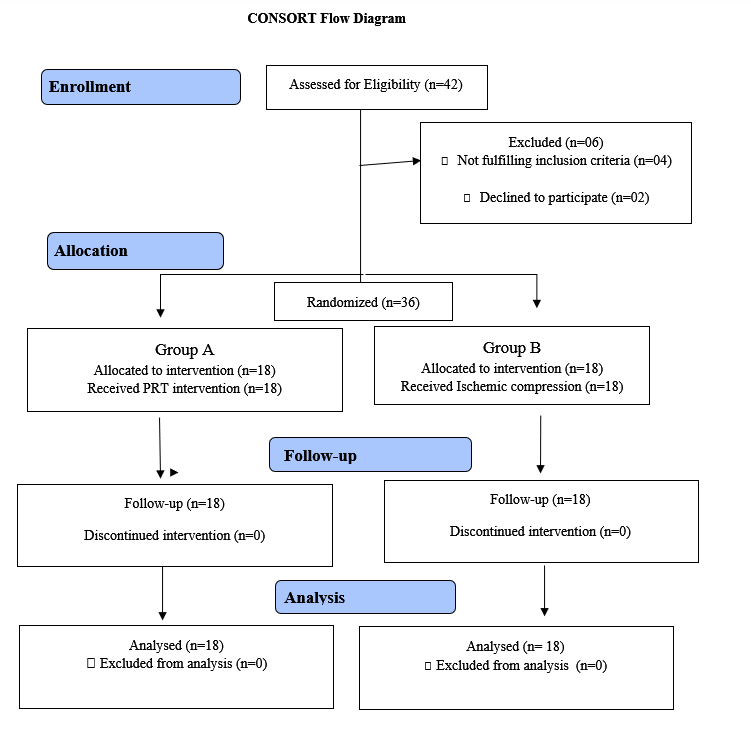
Headache originating from the bony structures or soft tissues of the neck is commonly known as cervicogenic headache. This study was conducted to determine the effects of the positional release technique (PRT) and ischemic compression (IC) on pain and headache disability among patients with cervicogenic headache (CGH). For this purpose, a randomized clinical trial was conducted. Data was collected from the Physiotherapy Department of Sharif Medical Complex, Lahore. A total of 36 CGH patients were assigned into two groups, randomly. The first group was treated with PRT and the other with IC. Both groups were given 12 sessions of therapy over a span of 4-weeks. HDI (Headache Disability Index) and NPRS (Numeric Pain Rating Scale) were used to measure the treatment effect on pain and headache disability before and after treatment. Among the participants (N = 36), the mean age of Group A and Group B was 26.22 ± 2.90 and 24.55 ± 2.55, respectively. A significant difference was found between the mean values of pre- and post-HDI and NPRS, with p-values 0.025 and 0.031, respectively and after treatment p value was 0.001 & 0.00 respectively. The results favoured the use of PRT because there was more variation in the mean values of PRT as compared to IC. Also, the mean values of pre- and post-HDI and NPRS scores varied significantly. Notably, a significant difference was not found between the mean values of both techniques at the beginning of treatment (pre-treatment). However, a significant difference was observed between the mean values of both techniques following treatment (post-treatment) in favour of PRT, since the mean values of PRT varied more than those of IC.
Downloads
References
Haldeman S, Dagenais S. Cervicogenic headaches: A critical review. Spine J. 2001;1(1):31–46. https://doi.org/10.1016/S1529-9430(01)00024-9
van Suijlekom HA, Lamé I, Stomp-van den Berg, Kessels AGH, Weber WEJ. Quality of life of patients with cervicogenic headache: A comparison with control subjects and patients with migraine or tension-type headache. Headache. 2003;43(10):1034–1041.
Headache Classification Committee of the International Headache Society. The international classification of headache disorders, 3rd edition (beta version). Cephalalgia. 2013;33(9):629–808. https://doi.org/10.1177/0333102413485658
Headache Classification Subcommittee of the International Headache Society. The international classification of headache disorders. Cephalalgia. 2004;24(1):9–160.
Sjaastad O, Saunte C, Hovdahl H, Breivik H, Grønbâk E. "Cervicogenic" headache. An hypothesis. Cephalalgia. 1983;3(4):249–256. https://doi.org/10.1046/j.1468-2982.1983.0304249.x
Jull G, Trott P, Potter H, et al. A randomized controlled trial of exercise and manipulative therapy for cervicogenic headache. Spine. 2002;27(17):1835–1843.
Downs MB, Laporte C. Conflicting dermatome maps: Educational and clinical implications. J Orthop Sports Phys Ther. 2011;41(6):427–434. https://www.jospt.org/doi/10.2519/jospt.2011.3506
Travell JG, Simons DG. Myofascial pain and dysfunction: The trigger point manual. Lippincott Williams & Wilkins; 1983.
Sikdar S, Shah JP, Gilliams E, Gebreab T, Gerber LH. Assessment of myofascial trigger points (MTrPs): A new application of ultrasound imaging and vibration sonoelastography. Paper presented at: 2008 30th Annual International Conference of the IEEE Engineering in Medicine and Biology Society; August 20¬¬–25, 2008; Vancouver, Canada. https://doi.org/10.1109/IEMBS.2008.4650480
Hong C-Z, Hsueh T-C. Difference in pain relief after trigger point injections in myofascial pain patients with and without fibromyalgia. Arch Phys Med Rehabil. 1996;77(11):1161–1166. https://doi.org/10.1016/S0003-9993(96)90141-0
Alvarez DJ, Rockwell PG. Trigger points: Diagnosis and management. Am Fam Physician. 2002;65(4):653–661.
Han SC, Harrison P. Myofascial pain syndrome and trigger-point management. Reg Anesth Pain Med. 1997;22(1):89–101. https://doi.org/10.1016/S1098-7339(06)80062-3
Chaitow L. Ligaments and positional release techniques? J Bodyw Mov Ther. 2009;13(2):115–116. https://doi.org/10.1016/j.jbmt.2009.01.001
Okeson J. History and examination for temporomandibular disorders. In: Okeson J, ed. Management of Temporomandibular Disorders and Occlusion. 4th ed. St Louis: Mosby; 1998: 234–309.
D'Ambrogio KJ, Roth GB. Positional Release Therapy: Assessment & Treatment of Musculoskeletal Dysfunction. Mosby Incorporated; 1997.
Ruiz-Sáez M, Fernández-de-las-Peñas C, Blanco CR, Martínez-Segura R, García-León R. Changes in pressure pain sensitivity in latent myofascial trigger points in the upper trapezius muscle after a cervical spine manipulation in pain-free subjects. J Manipulative Physiol Ther. 2007;30(8):578–583. https://doi.org/10.1016/j.jmpt.2007.07.014
Smania N, Corato E, Fiaschi A, Pietropoli P, Aglioti SM, Tinazzi M. Repetitive magnetic stimulation a novel therapeutic approach for myofascial pain syndrome. J Neurol. 2005;252:307–314. https://doi.org/10.1007/s00415-005-0642-1
Srbely JZ, Dickey JP. Randomized controlled study of the antinociceptive effect of ultrasound on trigger point sensitivity: Novel applications in myofascial therapy? Clin Rehabil. 2007;21(5):411–417. https://doi.org/10.1177/0269215507073342
Wong CK, Schauer-Alvarez C. Effect of strain counterstrain on Pain and strength in hip musculature. J Man Manip Ther. 2004;12(4):215–223. https://doi.org/10.1179/106698104790825185
Alexander KM. Use of strain-counterstrain as an adjunct for treatment of chronic lower abdominal pain. Phys Ther Case Rep. 1999;2:205–208.
Lewis C, Flynn TW. The use of strain-counterstrain in the treatment of patients with low back pain. J Man Manip Ther. 2001;9(2):92–98. https://doi.org/10.1179/jmt.2001.9.2.92
Deig D. Positional Release Technique: From A Dynamic Systems Perspective. Boston: Butterworth-Heinemann; 2001.
Giammatteo T, Weiselfish-Giammatteo S. Integrative Manual Therapy for The Autonomic Nervous System and Related Disorders: Utilizing Advanced Strain and Counterstrain Technique. Berkeley, California: North Atlantic Books; 1998.
Tatkare S, Tatkare N, Kavar K. A comparative study between various pain rating scales as response options in patients with diabetic neuropathy. Indian J Basic Appl Med Res. 2016;5(2):410–414.
Britnell S, Cole J, Isherwood L, et al. Postural health in women: The role of physiotherapy. J Obstet Gynaecol Can. 2005;27(5):493–500.
Bron C, Dommerholt J, Stegenga B, Wensing M, Oostendorp RA. High prevalence of shoulder girdle muscles with myofascial trigger points in patients with shoulder pain. BMC Musculoskelet Disord. 2011;12:e139. https://doi.org/10.1186/1471-2474-12-139
Fernández-de-las-Penas C, Ge H-Y, Arendt-Nielsen L, Cuadrado ML, Pareja JA. The local and referred pain from myofascial trigger points in the temporalis muscle contributes to pain profile in chronic tension-type headache. Clin J Pain. 2007;23(9):786–792. https://doi.org/10.1097/AJP.0b013e318153496a
Meseguer AA, Fernández-de-las-Peñas C, Navarro-Poza JL, Rodríguez-Blanco C, Gandia JJB. Immediate effects of the strain/counterstrain technique in local pain evoked by tender points in the upper trapezius muscle. Clin Chiropr. 2006;9(3):112–118. https://doi.org/10.1016/j.clch.2006.06.003
Blanco CR, de las Peñas CF, Xumet JEH, Algaba CP, Rabadán MF, de la Quintana MCL. Changes in active mouth opening following a single treatment of latent myofascial trigger points in the masseter muscle involving post-isometric relaxation or strain/counterstrain. J Bodyw Mov Ther. 2006;10(3):197–205. https://doi.org/10.1016/j.jbmt.2005.07.002
Hutchinson JR. An investigation into the efficacy of strain-counterstrain technique to produce immediate changes in pressure pain thresholds in symptomatic subjects [master’s thesis]. Unitec; 2007.
Bendtsen L, Jensen R, Jensen NK, Olesen J. Muscle palpation with controlled finger pressure: New equipment for the study of tender myofascial tissues. Pain. 1994;59(2):235–239. https://doi.org/10.1016/0304-3959(94)90076-0
AL-Shawabka SA, Shenouda MM, Balbaa AA. Positional release technique versus manual pressure release on the upper trapezius muscle in patients with myofascial pain dysfunction syndrome. Bull Fac Phys Ther. 2013;18(1):55–63.
Copyright (c) 2023 Shahbaz Ahmad, Muhammad Umar, Muhammad Asim, Zohaib Khan, Azeem Ahmed Iqbal

This work is licensed under a Creative Commons Attribution 4.0 International License.
Authors retain copyright and grant the journal right of first publication with the work simultaneously licensed under a Creative Commons Attribution (CC-BY) 4.0 License that allows others to share the work with an acknowledgement of the work’s authorship and initial publication in this journal