
TLR2 Arg677Trp Polymorphism Increases Susceptibility to Tuberculosis in Homozygous Wild Type Individuals
DOI:
https://doi.org/10.32350/cto.52.02Keywords:
genotype, mycobacterium tuberculosis, single nucleotide polymorphism, tuberculosis, toll-like receptorAbstract
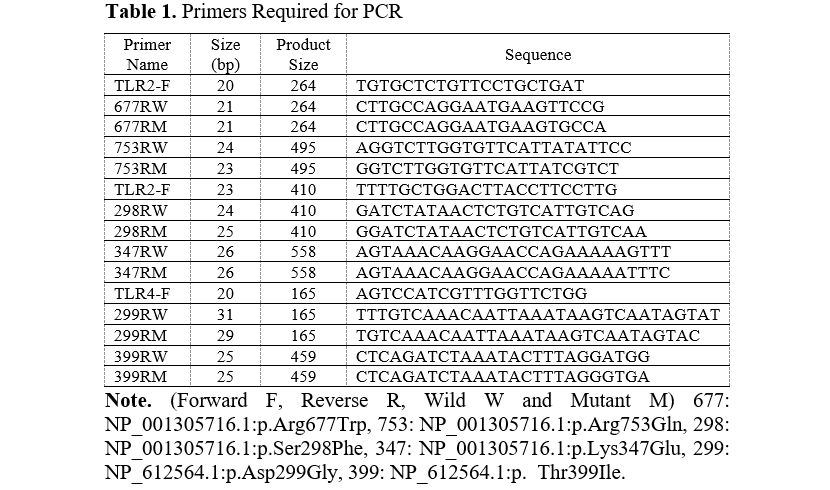
Single nucleotide polymorphisms (SNPs) of Toll-like Receptors TLR2 and TLR4 have been associated with the susceptibility and severity of tuberculosis in different populations, worldwide. However, no such report is available about the Pakistani population. Genetic polymorphisms can be considered as markers for the likelihood of developing pulmonary tuberculosis. TLR family has a significant role in enhancing innate immunity which mediates the inflammatory reaction against a broad array of pathogens. TLRs are critical in determining immune response to mycobacteria by interacting with various bacterial molecular patterns. In this case-control study, genomic DNA from 100 patients and 100 controls were extracted. SNP genotyping of 6 SNPs, namely TLR2 NC_000004.12:g.153703800C>T, NP_001305716.1:p.Ser298Phe, NC_000004.12:g.153703946A>G, NP_001305716.1:p.Lys347Glu, NC_000004.12:g.153704936C>T NP_001305716.1:p.Arg677Trp, and NC_000004.12:g.153705165G>A, NP_001305716.1:p.Arg753Gln and TLR4, NC_000009.12:g.117713024A>G NP_612564.1:p.Asp299Gly, and NC_000009.12:g.117713324C>T, NP_612564.1:pThr399Ile were performed. with amplification refractory mutation system (ARMS) PCR. The results showed that out of the 6 above-mentioned SNPs, only NC_000004.12:g.153704936C>T (NP_001305716.1:p.Arg677Trp), C>C wild-type genotype has a statistically significant association with tuberculosis (p < 0.05). Although this genotype showed no significant association with bacillary load, which shows disease severity. Furthermore, no significant association was found between bacillary load and duration of symptoms. It was concluded that in the study population of newly diagnosed cases of TB, as well as the positive association of NC_000004.12:g.153704936C>T (NP_001305716.1:p.Arg677Trp) wild-type genotype with TB susceptibility, needs to be validated on a larger population.
Downloads
References
Linh NN, Viney K, Gegia M, et al. World Health Organization treatment outcome definitions for tuberculosis: 2021 update. Eur Respir J. 2021;58(2):e2100804. https://doi.org/10.1183/13993003.00804-2021
Chakaya J, Khan M, Ntoumi F, et al. Global tuberculosis report 2020—reflections on the global TB burden, treatment and prevention efforts. Int J Infect Dis. 2021;113:S7-S12. https://doi.org/10.1016/j.ijid.2021.02.107
Perea-Jacobo R, Muñiz-Salazar R, Laniado-Laborín R, et al. SLCO1B1 and SLC10A1 polymorphism and plasma rifampin concentrations in patients with comorbidity tuberculosis–diabetes mellitus in Baja California, Mexico. Tuberculosis. 2022;136:e102248. https://doi.org/10.1016/j.tube.2022.102248
Chen R, Zou J, Chen J, Zhong X, Kang R, Tang D. Pattern recognition receptors: function, regulation and therapeutic potential. Signal Transduct Target Ther. 2025;10(1):e216. https://doi.org/10.1038/s41392-025-02264-1
Wicherska-Pawłowska K, Wróbel T, Rybka J. Toll-like receptors (TLRs), NOD-like receptors (NLRs), and RIG-I-like receptors (RLRs) in innate immunity. TLRs, NLRs, and RLRs ligands as immunotherapeutic agents for hematopoietic diseases. Int J Mol Sci. 2021;22(24):e13397. https://doi.org/10.3390/ijms222413397
Asami J, Shimizu T. Structural and functional understanding of the toll-like receptors. Protein Sci. 2021;30(4):761-772. https://doi.org/10.1002/pro.4043
Heine H, Zamyatina A. Therapeutic targeting of TLR4 for inflammation, infection, and cancer: a perspective for disaccharide lipid A mimetics. Pharmaceuticals. 2022;16(1):e23. https://doi.org/10.3390/ph16010023
Zihad SNK, Sifat N, Islam MA, et al. Role of pattern recognition receptors in sensing mycobacterium tuberculosis. Heliyon. 2023;9(10):e20636. https://doi.org/10.1016/j.heliyon.2023.e20636
De Benedetti F, Prencipe G, Bracaglia C, Marasco E, Grom AA. Targeting interferon-γ in hyperinflammation: opportunities and challenges. Nat Rev Rheumatol. 2021;17(11):678-691. https://doi.org/10.1038/s41584-021-00694-z
Mertz P, Jeannel J, Guffroy A, et al. Granulomatous manifestations associated with COVID-19 infection: is there a link between these two diseases? Autoimmun Rev. 2021;20(6):e102824. https://doi.org/10.1016/j.autrev.2021.102824
Mukherjee S, Patra R, Behzadi P, Masotti A, Paolini A, Sarshar M. Toll-like receptor-guided therapeutic intervention of human cancers: molecular and immunological perspectives. Front Immunol. 2023;14:e1244345. https://doi.org/10.3389/fimmu.2023.1244345
Fang XH, Li ZJ, Liu CY, Mor G, Liao AH. Macrophage memory: types, mechanisms, and its role in health and disease. Immunology. 2024;171(1):18-30. https://doi.org/10.1111/imm.13697
Behairy MY, Abdelrahman AA, Toraih EA, et al. Investigation of TLR2 and TLR4 polymorphisms and sepsis susceptibility: computational and experimental approaches. Int J Mol Sci. 2022;23(18):e10982. https://doi.org/10.3390/ijms231810982
Rostamtabar M, Esmaeilzadeh S, Tourani M, et al. Pathophysiological roles of chronic low-grade inflammation mediators in polycystic ovary syndrome. J Cell Physiol. 2021;236(2):824-838. https://doi.org/10.1002/jcp.29912
Xue Y, Zhao Z, Wang H, et al. Toll-like receptors 2 and 4 gene polymorphisms in a southeastern Chinese population with tuberculosis. Int J Immunogenet. 2010;37(2):135-138. https://doi.org/10.1111/j.1744-313X.2009.00892.x
Overbey EG, Ryon K, Kim J, et al. Collection of biospecimens from the Inspiration4 mission establishes the standards for the space omics and medical atlas (SOMA). Nat Commun. 2024;15(1):e4964. https://doi.org/10.1038/s41467-024-48806-z
Lee MR, Chen YL, Wu CW, et al. Toll-like receptor and matrix metalloproteinase single-nucleotide polymorphisms, haplotypes, and polygenic risk score differentiated between tuberculosis disease and infection. Int J Infect Dis. 2022;125:61-66. https://doi.org/10.1016/j.ijid.2022.10.020
Davoodi H, Ghaemi EA, Jamali A, Naeeme JS, Shakeri F. Arg677Trp and Arg753Gln polymorphisms in TLR2 genes detected in patients with tuberculosis in Golestan Province, Iran. Jundishapur J Microbiol. 2018;11(4):e13933. https://doi.org/10.5812/jjm.13933
El-Masry EA, Taher I, Hetta HF, Eldahdouh SS. Pulmonary tuberculosis susceptibility and association with toll-like receptor 2 NC_000004.12:g.153705165 (NP_001305716.1:p.Arg753Gln) polymorphism. J Infect Dev Ctries. 2022;16(1):125-133. https://doi.org/10.3855/jidc.14885
Varshney D, Singh SV, Mohanty KK, et al. Toll-like receptor 2 (-196 to -174) del and TLR1 743 A>G gene polymorphism—a possible association with drug-resistant tuberculosis in the North Indian population. Front Microbiol. 2024;14:e1305974. https://doi.org/10.3389/fmicb.2023.1305974
Fatima T, Syed A, Elgorban AM, et al. Role of TLR4 Asp299Gly and Thr399Ile gene polymorphisms as a risk factor in human cytomegalovirus positive pregnant women. Reprod Sci. 2025;32(7):2331-2339. https://doi.org/10.1007/s43032-025-01912-9
Zhou Y, Zhang M. Associations between genetic polymorphisms of TLRs and susceptibility to tuberculosis: a meta-analysis. Innate Immun. 2020;26(2):75-83. https://doi.org/10.1177/1753425919862354
Yamashita Y, Tsurumi J, Ohno M, et al. Efficient molecular doping of polymeric semiconductors driven by anion exchange. Nature. 2019;572(7771):634-638. https://doi.org/10.1038/s41586-019-1504-9
Fouad NA, Saeed AM, Mahedy AW. Toll-like receptor-4 gene polymorphism and susceptibility to pulmonary tuberculosis. Egypt J Immunol. 2019;26(2):1-10.
Gutiérrez-Romero KJ, Falfán-Valencia R, Ramírez-Venegas A, et al. Altered levels of IFN-γ, IL-4, and IL-5 depend on the TLR4 rs4986790 genotype in COPD smokers but not those exposed to biomass-burning smoke. Front Immunol. 2024;15:e1411408. https://doi.org/10.3389/fimmu.2024.1411408
Sharma S, Priya I, Sharma I, et al. Protective association of TLR6 rs5743810 with pulmonary tuberculosis in the population of Jammu region. Indian J Microbiol. 2025;65:1-9. https://doi.org/10.1007/s12088-024-01432-1
Singh AK, Prakash S, Garg R, Jain P, Kumar R, Jain A. Polymorphisms in vitamin D receptor, toll-like receptor 2 and toll-like receptor 4 genes linked with dengue susceptibility. Bioinformation. 2021;17(4):506-513. https://doi.org/10.6026/97320630017506
Bose M, Giri A, Varma-Basil M. Comparative genetic association analysis of human genetic susceptibility to pulmonary and lymph node tuberculosis. Genes. 2023;14(1):e207. https://doi.org/10.3390/genes14010207
Palittapongarnpim P, Tantivitayakul P, Aiewsakun P, Mahasirimongkol S, Jaemsai B. Genomic interactions between Mycobacterium tuberculosis and humans. Annu Rev Genomics Hum Genet. 2024;25:183-209. https://doi.org/10.1146/annurev-genom-021623-101844
Downloads
Published
How to Cite
Issue
Section
License
Author(s) retain copyright and grant the journal right of first publication with the work simultaneously licensed under a Creative Commons Attribution (CC-BY) 4.0 License that allows others to share the work with an acknowledgment of the work’s authorship and initial publication in this journal.