
Enhancement of the Ceftazidime Efficacy through Cutting-Edge Modifications and In Silico Repurposing against Multidrug Resistance in Pseudomonas Aeruginosa
DOI:
https://doi.org/10.32350/cto.52.03Keywords:
ADMET studies, antibiotic resistance, drug resistance, drug repurposing, drug safety, molecular interaction, Pseudomonas aeruginosaAbstract
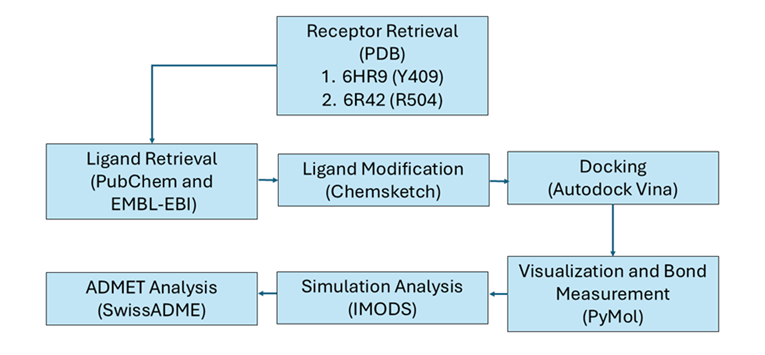
Pseudomonas aeruginosa causes acute and chronic infections in patients hospitalized after surgery, heat burns, and other injuries. Different antibiotics are used to treat bacterial infections. A commonly used cephalosporin, namely ceftazidime, shows a significant effect against P. aeruginosa. Ceftazidime targets penicillin-binding protein in P. aeruginosa. Currently used antibiotics are facing resistance due to different mechanisms. Targeting the mutated penicillin-binding protein 3 of P. aeruginosa, this study aims to improve the binding affinities of ceftazidime by adding various functional groups in methylpridinium ring. In silico tools were used to modify the structure of ceftazidime to make it effective against the resistant strains of P. aeruginosa. The 3D structures of normal and mutated penicillin-binding proteins were retrieved from Protein Data Bank (PDB). The structure of the antibiotic was retrieved from PubChem and EMBL-EBI, which was modified through Chemsketch. Azide and phenyl carbonyl groups were added in the methylpridinium ring of ceftazidime. AutoDock Vina was used to visualize the binding affinities of the engineered ceftazidime with proteins. PyMOL was used for visualization. The binding affinity of the engineered ceftazidime was improved upto -8.9 kcal/mol. Simulation analysis of the complex showed its eigenvalue and covariance. The feasibility of the modified structures was verified using SwissADME. ADMET analysis confirmed that these structures remain feasible for utilization after clinical trials. The above modifications allow a better treatment of infections caused by stronger and resistant P. aeruginosa strains. Further analysis needs to be carried out in order to improve other antibiotics and different conjugates for the effective treatment of infections caused by this bacteria.
Downloads
References
Denissen J, Reyneke B, Waso-Reyneke M, et al. Prevalence of ESKAPE pathogens in the environment: antibiotic resistance status, community-acquired infection and risk to human health. Int J Hyg Environ Health. 2022;244:e114006. https://doi.org/10.1016/j.ijheh.2022.114006
Urgancı NN, Yılmaz N, Alaşalvar GK, Yıldırım Z. Pseudomonas aeruginosa and its pathogenicity. Turk J Agric Food Sci Technol. 2022;10(4):726-738. https://doi.org/10.24925/turjaf.v10i4.726-738.4986
Rather MA. A Study on Inhibition of Biofilm and Virulence Factors of Pseudomonas Aeruginosa and Candida Albicans Using Selected Ethnomedicinal Plants of North East India [dissertation]. Tezpur University; 2023.
Saied WI, Mourvillier B, Cohen Y, et al. A comparison of the mortality risk associated with ventilator-acquired bacterial pneumonia and nonventilator ICU-acquired bacterial pneumonia. Crit Care Med. 2019;47(3):345-352. https://doi.org/10.1097/CCM.0000000000003553
Alshammari MK, Alotaibi MA, AlOtaibi AS, et al. Prevalence and etiology of community- and hospital-acquired pneumonia in Saudi Arabia and their antimicrobial susceptibility patterns: a systematic review. Medicina (Kaunas). 2023;59(4):e760. https://doi.org/10.3390/medicina59040760
Szabó S, Feier B, Capatina D, Tertis M, Cristea C, Popa A. An overview of healthcare associated infections and their detection methods caused by pathogen bacteria in Romania and Europe. J Clin Med. 2022;11(11):e3204. https://doi.org/10.3390/jcm11113204
Biscione A, Corrado G, Quagliozzi L, et al. Healthcare associated infections in gynecologic oncology: clinical and economic impact. Int J Gynecol Cancer. 2023;33(2):278-284. https://doi.org/10.1136/ijgc-2022-003847
Pachori P, Gothalwal R, Gandhi P. Emergence of antibiotic resistant Pseudomonas aeruginosa in intensive care unit: a critical review. Genes Dis. 2019;6(2):109-119. https://doi.org/10.1016/j.gendis.2019.04.001
Karruli A, Catalini C, D’Amore C, et al. Evidence-based treatment of Pseudomonas aeruginosa infections: a critical reappraisal. Antibiotics (Basel). 2023;12(2):e399. https://doi.org/10.3390/antibiotics12020399
Al-Haideri HH. β-Lactam antibiotic induces the expression of blaOXA-51-like and blaOXA-23 in clinically isolated Acinetobacter baumannii and Acinetobacter lowffii. In: Elrefaei AHA, ed., Recent Progress in Microbiology and Biotechnology. Book Publisher International; 2020:13-30.
Abdullah S. Study the Antibacterial Effects of Silver Nanoparticles on Gene Expression of Some Resistant Genes Among Multidrug Resistant Bacteria [dissertation]. College of Veterinary Medicine; 2021.
Bashawri YMA. Understanding the Role of Wastewater in the Spread of Antibiotic Resistant Bacteria [dissertation]. Bangor University; 2019.
Wang Y, Wang J, Wang R, Cai Y. Resistance to ceftazidime–avibactam and underlying mechanisms. J Glob Antimicrob Resist. 2020;22:18-27. https://doi.org/10.1016/j.jgar.2019.12.009
Glen KA, Lamont IL. Penicillin-binding protein 3 sequence variations reduce susceptibility of Pseudomonas aeruginosa to β-lactams but inhibit cell division. J Antimicrob Chemother. 2024;79(9):2170-2178. https://doi.org/10.1093/jac/dkae203
Yano H, Nakata N, Yahara K, Sugai M, Sato Y. Specific variants in ftsI reduce carbapenem susceptibility in Pseudomonas aeruginosa. Microbiol Spectr. 2025;13(8):e01027-25. https://doi.org/10.1128/spectrum.01027-25
Ramsay KA, Rehman A, Wardel A, et al. Ceftazidime resistance in Pseudomonas aeruginosa is multigenic and complex. PLoS One. 2023;18(5):e0285856. https://doi.org/10.1371/journal.pone.0285856
He L, Zhai L, Sun J, et al. Substituted-amidine functionalized monocyclic β-lactams: synthesis and in vitro antibacterial profile. J Chem. 2021;2021:e9955206. https://doi.org/10.1155/2021/9955206
Chen PC, Wharton RE, Patel PA, Oyelere AK. Direct diazo-transfer reaction on β-lactam: synthesis and preliminary biological activities of 6-triazolylpenicillanic acids. Bioorg Med Chem. 2007;15(23):7288-7300. https://doi.org/10.1016/j.bmc.2007.08.035
Huguenot F, Vidal M. Phenyloxycarbonyl (Phoc) carbamate: chemioselective reactivity and tetra-n-butylammonium fluoride deprotection study. ACS Omega. 2022;7(49):44861-44868. https://doi.org/10.1021/acsomega.2c04979
Bui BTS, Auroy T, Haupt K. Fighting antibiotic-resistant bacteria: promising strategies orchestrated by molecularly imprinted polymers. Angew Chem Int Ed. 2022;61(8):e202106493. https://doi.org/10.1002/anie.202106493
Santi I, Manfredi P, Maffei E, Egli A, Jenal U. Evolution of antibiotic tolerance shapes resistance development in chronic Pseudomonas aeruginosa infections. mBio. 2021;12(1):e03482-20. https://doi.org/10.1128/mbio.03482-20
Al-Khikani FH, Ayit AS. Pseudomonas aeruginosa a tenacious uropathogen: increasing challenges and few solutions. Biomed Biotechnol Res J. 2022;6(3):311-318. https://doi.org/10.4103/bbrj.bbrj_256_21
Naveed M, Ain N, Aziz T, et al. Revolutionizing treatment for toxic shock syndrome with engineered super chromones to combat antibiotic-resistant Staphylococcus aureus. Eur Rev Med Pharmacol Sci. 2023;27(11):5301-5309.
Tanveer L, Batool S, Mubeen H, et al. Enhancing the therapeutic potential of FDA-approved ifosfamide and 5-fluorouracil through rational chemical modifications for endometrial cancer treatment. Med Oncol. 2025;42(8):e281. https://doi.org/10.1007/s12032-025-02821-2
Phetsang W, Blaskovich MA, Butler MS, et al. An azido-oxazolidinone antibiotic for live bacterial cell imaging and generation of antibiotic variants. Bioorg Med Chem. 2014;22(16):4490-4498. https://doi.org/10.1016/j.bmc.2014.05.054
Naveed M, Tehreem S, Arshad S, et al. Design of a novel multiple epitope-based vaccine: an immunoinformatics approach to combat SARS-CoV-2 strains. J Infect Public Health. 2021;14(7):938-946. https://doi.org/10.1016/j.jiph.2021.04.010
Akbarian M, Chen SH. Instability challenges and stabilization strategies of pharmaceutical proteins. Pharmaceutics. 2022;14(11):e2533. https://doi.org/10.3390/pharmaceutics14112533
Naveed M, Ali I, Aziz T, et al. Halogens engineering-based design of agonists for boosting expression of frataxin protein in Friedreich's ataxia. Eur Rev Med Pharmacol Sci. 2023;27(15):6972-6984.
Naveed M, Ain NU, Aziz T, et al. Side chain inset of neurogenerative amino acids to metalloproteins: a therapeutic signature for huntingtin protein in Huntington’s disease. Eur Rev Med Pharmacol Sci. 2023;27(14):6831-6842.
Downloads
Published
How to Cite
Issue
Section
License
Author(s) retain copyright and grant the journal right of first publication with the work simultaneously licensed under a Creative Commons Attribution (CC-BY) 4.0 License that allows others to share the work with an acknowledgment of the work’s authorship and initial publication in this journal.