
| Review | Open Access |
|---|
Behavioral Approach Towards Islamic Finance in Pakistan: A Preliminary Investigation |
 |
|---|
 Huma Nawaz1* and Shamaila Nawaz2
1Department of Management Sciences, Islamia University of Bahawalpur, Pakistan
2Allama Iqbal Open University, Islamabad, Pakistan
Islamic financial practices emphasize on the instillation of Islamic laws in the practices that are considered ethical in this world. The purpose of this paper is to determine the factors of Islamic banking promotion among Pakistani educated community. Demographic factors, attitude and financial recommendation items were examined to determine the influence of these factors in promoting ethical financial instruments. The paper follows quantitative research in nature. It explored more than two theories. After a conceptual analysis of the theory of reasoned action (TRA) and theory of planned behavior, this paper investigates the impact of ethical behavior towards the selection of Islamic financial products and services in Pakistan. The descriptive and inferential techniques were used on 194 respondents of Pakistan. There are some positive and significant relationships between behavior intuition and promotion of Islamic products and services. To trigger a specific financial sector of an economy, managers in the Islamic banks should account best individual outcome on ethical decision, rule-based ethical decisions in which the rational approach is not adopted. This study implies that promotion of financial services is achieved when there is improvement in awareness about ethical financial products and services.
1. INTRODUCTION
The discussion surrounding the ethical foundation of financial system have intensified across the education and finance industry (Nawaz, 2020). This study examines the ethical entanglement of the growing perception about Islamic banking and finance industry with respect to empathic concern. Numerous commentators have provided the influence of attitude towards consumer decision process (Eagly & Chaiken, 1993; Fazio, 1986; Mansor & Che-Mat, 2009). A study based on Ajzen (1991) theory of planned behaviour (TPB) conferred that attitude and perceived behavior are significant factors in selecting Islamic financial products and services (Alam et al., 2012). Decomposed Theory of Planned Behavior (DTPB) based study concluded that attitude, subjective norm and perceived behavioral control were found to have a significant impact on the intention to adopt Islamic banking services in Morocco (Echchabi & Aziz, 2012).
The literature on attitude is however, dominated by a focus on quality of product and services, which financial institutions and halal brands have to provide, in order to be perceived and judged as satisfactory to the need of specific people of a territory. In our study, we examine how empathic characteristics increasingly draw upon the intuition and decision-making process of a person. Several scholars including Gintis (2006), Clarke and Aram (1997), De Cremer & Tenbrunsel (2012), and Ismaeel and Blaim (2012) had already strengthened literature on the basis of behavioral theories. Instead, we will try to fill the research gap by investigating the individual behavioral norms on the basis of subjective norms and attitude. We then explore the question of how the subjective norms of each individual affect a person’s attitude towards product selection by using descriptive statistics. The major question is: what is the strength of the relationship between subjective norms and attitude?
This study extends the theory of planned behavior and proposes a model by putting the additional variable of promotional recommendation (R) in the basic model of Theory of planned behavior. This factor is also used by many studies such as Bendapudi et al. (1996), Fisher and Ackerman (1998), Sargeant (1999), Webb et al. (2000) and Bennett (2003). Based upon exploratory studies, investigation on behavioral studies toward the selection of ethical based services is lacking and the studies are questionable, requiring further inquiries. To our information, less research work has been conducted to explore specific aspects of ethical behavior in the context of Pakistan, that predict the promotional factors of Islamic banking and finance services. This research is an attempt to bridge the gap that is linked to the literature of Islamic finance. In a nutshell, this study investigates the relationship between subjective norms, behavior intuition and promotion of Islamic products and services by using descriptive statistics. Finally, this study aims to predict the influence of behavior intuition and service controlled motivation on the promotion of financial ethical products and services.
The main objective of this study is to develop the conception of ‘empathic characteristics’ in an attempt to investigate the role of environmental factors, intuition, and the plan behavior that tries to go beyond, to short term individual thinking orientation.
The global Islamic financial institutions are established on the basis of interest free system. The interest free financial products and services provide a deep insight for ethical financial systems. The previous literature (Grais & Rajhi, 2015; Nawaz et al., 2018; Mahmood, 2009; Siddiqui, 2013) highlighted the important aspects of Islamic finance. However, religiosity, ethical judgment (Bakar et al., 2013a; Steenhaut & Kenhove, 2006) attitude, financial recommendation and demographic items are also important factors in shaping the behavior of consumers towards products and services (Amin, 2012).
According to Islamic law, the interest, excessive uncertainty, unfairness, financial transactions in sinful activities including gambling and chance-based games trading in all financial process is prohibited. The impact of environmental factors is considered an important issue for the development of financial operations, so it is important to determine environmental elements associated with particular banking scenarios.
Background of ResearchThe impact of environmental factors on development of Islamic financial system was substantially investigated. Muhammad Ali et al. (2017) surveyed and analyzed demographic attributes of 466 responses in Pakistan. The researchers gathered data using a self-administered survey. The results of the empirical analysis suggest that subjective norms and attitudes show a positive and substantial impact on the intentions of selecting an Islamic product. Whereas, the perceived financial cost has a negative effect on the intentions of choosing an Islamic product. Moreover, ‘subjective norms’ was found to be the most influential factor to predict the selection of Islamic financial product (Salman et al., 2018).
Amin et al. (2014), examine the factors influencing the acceptance of Islamic home financing products amongst potential stakeholders of Malaysian Islamic banks. Data was collected from two cities of East Malaysia i.e. Kota Kinabalu & Labuan, using questionnaire survey. A total of 300 questionnaires were distributed; and 278 were found usable. Researchers used probit model to investigate the effects of attitude, subjective norm, perceived behavioral control, Islamicity of product and demographic factors on consumer acceptance of Islamic home financing products. The study findings show that attitude, subjective norm, perceived control and Islamicity of products are significant factors in determining the consumer acceptance of Islamic home financing products. Meanwhile, the study finds that demographic items including marital status, occupation, ethnicity and religion are influential. However, study results also showed that monthly income, academic qualification and gender have little effects on the consumer acceptance (Amin et al., 2014; Meghraoui, & Mokhtari, 2021).
In another study, Zinser (2019) concluded that positive attitudes about Islamic banking and financial services will be a significant predictor of Muslims’ intention to use Islamic banking and financial services (Jimoh et al., 2022). Research done by Hoque et al. (2018) showed that despite the growing interest in taking into account the behavior of customers of Islamic banks, previous research has not given much attention to exploring the moderating effects of customer intent link. Khraim (2010) found that religious education, and sensitive products, about whom respondent may have doubts about its use due to its characteristics, plays a significant role in influencing social and consumer behavior.
Relevant TheoriesTheory of Reasoned Action (TRA)
Islamic law forbids believers of Islam to take any interest-related income (Abduh et al., 2011). A number of studies used theory of reasoned action (TRA) to explain and predict the behavior of respondents towards Islamic ethical financial products and services (Hausenblas et al., 1997; Kamil, & Kasri, 2021). Amin et al. (2010) employed the theory of reasoned action (TRA) to find the applicability of this conventional theory on one product (Qardhul Hassan) of Islamic finance. The researchers concluded that "attitude" and “subjective norm" were important factors to influence respondents’ perception of accepting Qardhul Hassan-financing. The theory of reasoned action (TRA) was also used to predict the intention to choose halal product (Islamic ethical product) among Malaysians. Lada et al. (2009) used a structured questionnaire to elicit responses using a convenience sampling size of 485 responses. This work extends the applicability of the theory of reasoned action to study the attitude towards halal product usage among Malaysians. The researchers conferred the importance of TRA model to predict the intention of Muslims to choose halal products. Research finding shows that attitude and subjective norm were positively related to intention.
According to Echchabi and Olaniyi (2012), normative belief and motivation have a positive impact on the subjective norm. Researchers used Theory of Reasoned Action to examine the number of factors that influence the intention to adopt Islamic financial ethical products in Malaysia. The authors suggest that institutions should focus on the group influence as part of their approach to strengthen the image and promotion of the Islamic financial ethical products in Malaysia.
As this theory is applied in this paper, variables of subjective norms and attitudes are included to explain the influence of independent variables on the dependent variable. Descriptive statistics is used to study independent and dependent variables. According to Liu et al. (1999), descriptive statistics create natural center-outward ordering of the sample points.
Theory of Planned Behavior (TPB)Ajzen (1985) proposed the theory of planned behavior in 1985. According to this theory “Attitude, subjective norms, and actual control over the behavior under consideration, together shape an individual's behavioral intentions and behaviors” (p.12).
Islamic financial industry is the emerging global industry grounded in Islamic ethical precepts. As with traditional banks, Islamic ethical financial products are meant to offer products that reflect the desires of their stakeholders. One study examines the effects of attitude, social influence, religious obligations, government support and the pricing of intent to use Islamic personal financing. The sample consisted of 150 customers of Bank Islam Malaysian Berhad and Bank Muamalat Malaysia Berhad. The data analysis was done using factor analysis, correlation and regression. The result finding shows that attitude, social influence and pricing of Islamic personal financing has a significant impact on intention to use Islamic personal financing (Amin et al., 2011).
Many studies including (Nasri & Charfeddine, 2012; Shih & Fang, 2004; Xiao, 2008; Yousafzai et al., 2010) used theory of planned behavior (TPB) to explore its impact on financial decision making process. As applied in these papers, three variables are included to the theory to explain and predict the influence of independent variables on the dependent variable.
Research GapMost of the research on behavioral ethics in Islamic finance concentrates around Middle Eastern countries. However, this paper focuses on the study of South Asia. The respondents of this study are from Pakistan. Qadeer (2006) in his book entitled ‘Pakistan-Social and Cultural Transformations in a Muslim Nation’ found that though political and economic histories of Pakistan are plentiful, however, social history has been an ignored field in and that there is no systematic interpretation of the evolving social institutions and cultural patterns. Our study is filling the gap by providing insight to financial institutions of Pakistan to deliver ethical services keeping in view the level of awareness regarding the population to whom they are targeting for selling their products and services.
Subjective NormsSubjective Norm is defined as “a person’s perception that most people who are important to him think he should or should not perform the behaviour in question” (Ajzen & Fishbein, 1980). Randall and Gibson (1991) used TBD to investigate the ethical decision making of medical professionals. The research study showed that attitude has a greater impact on the variance of intention while subjective norm explained a moderate amount of the variance. In another study, the researcher used structural equation model to explore the theory of planned behavior. The results show a significant causal path from subjective norm to attitude. This suggests that attitude formation, that is the good or bad towards the behavior, is affected by how important others consider the effectiveness of the behavior to be. The theory of planned behavior expects that behavioral belief will affect one’s attitude. The author in this study also investigates about the source of one’s belief. The belief, quite reasonably comes so, from one’s parents, teachers, peers, etc. Briefly, they are the person’s weighty others. If this is true, the effect of the weighty others on attitude formation cannot be ignored (Billah, 2021; Chang, 1998).
In this study the subjective norm was measured by one objective: “Most of the respondents having awareness about Islamic financial ethical products and services are confident that Islamic financial institutions will provide them with products according to their need” (SN). The SN was rated on a 5-point likert scale ranging.
Service-Controlled MotivationService-controlled motivation (SCM) was measured using Likert scale method by the following objective: “Islamic financial institutions have full competency to provide best quality services” They were rated on a 5-point likert scale.
Othman and Owen (2001) suggest that it is essential that Islamic banks put cultural differences at the forefront when adopting quality services. Authors suggest a new model to measure service quality called CARTER. The structural operation of Islamic ethical financial products derives from the Islamic principles, and thus differs in soul, cultural values and practice from traditional banking financial operations. Because of the market competition, users’ prospect to receive high quality services and fast technological changes in today’s world, Islamic financial institutions must therefore think strategically in delivering high-quality products and services to satisfy their users and stakeholders. The researcher concluded that variable of validity is significant for all CARTER items that have appeared in both items i.e., weights and percentages. Also, the strong link between service quality and customer satisfaction has been debated. The study also suggests a setup plan for Kuwait Finance House to provide service quality, and shows the importance of training as well.
Shafie et al. (2004) consider importance of liberalization, deregulation and technological advancement for integrated banking industry. For them, these are important for a competitive market place. Except a few structural changes, the products and services of Islamic banks are generally undifferentiated to traditional banks. So, this is integral for the development of Islamic banks to offer quality products and services. Authors used a CARTER model to measures the perceptions of Malaysian Islamic bank’s users, and concluded that the level of satisfaction is significant.
Intuition BehaviorIntuition behaviour (IB) was measured using a Likert scale. On a 5-point scale, respondents were asked by one objective: “Products and services of Islamic financial institutions of Pakistan are satisfying their ethical belief”. They were rated on a 5-point likert scale.
To classify the persons according to their needs, many authors study the effects of socio demographic variables such as gender, age and education. To examine the range of daily financial affairs, Fünfgeld and Wang (2009) consider both self-stated attitudes and behaviours. The sample size consisted of 1,282 respondents from Switzerland. The collected data from the questionnaire survey was analyzed by factor analysis. Factor analysis found five dimensions to financial attitudes and behaviours. This included anxiety, interest in financial matters, decision making styles, the need for preventative savings, and the trend towards spending.
Islamic Banking is growing rapidly in Pakistan, a country with almost 98% Muslim population. Ahmad and Bashir (2014) examine the customers’ awareness level (CAL) about products offered by Islamic Banks to assess customers’ service utilization decision (CSUD) in selected cities of Pakistan. They used case study, focus group and unstructured interviews to develop a structured questionnaire for a random sample of 200 respondents. Authors analyze data by descriptive Statistics, Correlation and Regression. The research findings reveal that there is less awareness among the Pakistani respondents regarding Islamic financial ethical products and services. However, there is strong positive significant relationship between customers’ awareness level and Customer’s Service Utilization Decision.
Intension to Recommend Islamic Ethical Products and ServicesThe respondent’s intention to recommend (R) Islamic ethical financial services was measured using Likert scale. The objective of this scale item was to find the intent of respondents to recommend Islamic financial ethical products and services to its parents, teachers, peers, etc.. The scales for its question ranged from strongly agree to strongly disagree.
A number of development models, or frameworks were developed for analyzing ethical decision making within the past 10 years. However, the framework has potential as a way with which to examine marketers’ ethical decision making (Dubinsky & Loken, 1989).
Past research has recognized the influence of religion on promoting products and services (Alserhan, 2017; Arham, 2010; Cutler, 1992; Sandıkçı, 2011; Wilson, 2012). Ethical products available through Islam has attracted more Muslims. In order to analyse the influence of religion on products, Bakar et al. (2013b) compared the influence of low and high symbolic values. However, the research findings contradict the notion that the values of religious symbols attract more people of the Muslim faith.
Methods
This paper draws upon survey questionnaire of one ninety-four respondents who are academicians at Pakistani Higher Educational Institutions. We identified these academicians using our own professional networks and online professional groups at LinkedIn. The aim was to generate a specific sample that represents the educated young generation of Pakistan and belongs to a salaried class.
Research QuestionsResearch Questions 1: For inferential statistics, following research question was constructed. Is there a statistically significant relationship between Service Controlled Motivation (SCM) and Recommendation (R)?
Following hypotheses are developed to answer the research question.
Null Hypothesis (H0):
There is no statistically significant relationship between Service Controlled Motivation (SCM) and Recommendation (R).
Alternative Hypothesis (H1):
There is a statistically significant relationship between Service controlled motivation (SCM) and Recommendation (R).
Research Question 2: Is there a statistically significant relationship between behavior intuition (IB) and Recommendation (R)?
Following hypotheses are developed to answer the research question.
Null Hypothesis (H0):
There is no statistically significant relationship between behavior intuition (IB) and Recommendation (R).
Alternative Hypothesis (H2):
There is a statistically significant relationship between behavior intuition (IB) and Recommendation (R).
Results
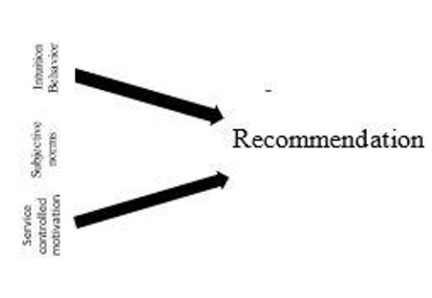
The graphical presentation of the collected data is represented in the figure 1. Outliers can be a pervasive methodological challenge (Aguinis et al., 2020). Descriptive statistics is used to respond to practical needs of data analysis (Nishisato, 2006; Norušis, 2006). The reliability of data was checked by Cronbach’s alpha. Univariate outliers were examined for gender, income, religion, age, subjective norms, Intuition Behaviour, Service controlled motivation, and the variable of recommendation. An outlier was defined as any value which falls outside the range of +/- 3.29 standard deviations from the mean (Tabachnick & Fidell, 2013).
Figure 1
Schematic Representation of Research
Demographic Information
|
Variable |
No. of Outliers |
|---|---|
|
Religion |
3 |
|
Age |
5 |
Religion had three outliers, and age had five outliers. Table 1 presents the number of outliers in each variable. Summary statistics were calculated for gender, income, religion, age, subjective norms, Intuition behaviour, service controlled motivation and variable of recommendation.
Table 2Summary Statistics Table for Interval and Ratio Variables (N = 194)
|
Variable |
M |
SD |
SE |
Skewness |
Kurtosis |
|---|---|---|---|---|---|
|
Income |
2.26 |
1.20 |
0.09 |
0.98 |
0.19 |
|
Subjective norms |
2.09 |
1.01 |
0.07 |
0.50 |
-0.52 |
|
Religion |
1.02 |
0.13 |
0.01 |
6.18 |
42.81 |
|
Age |
1.65 |
0.70 |
0.05 |
1.29 |
3.40 |
|
Recommend |
2.12 |
1.13 |
0.08 |
0.72 |
-0.16 |
|
Intuition Behavior |
2.02 |
1.01 |
0.07 |
0.78 |
0.29 |
|
Service controlled motivation |
2.93 |
1.33 |
0.10 |
0.08 |
-1.16 |
A Spearman correlation analysis was conducted among gender, income, religion, age, subjective norms, intuition behaviour, service-controlled motivation and variable of recommendation.
A Spearman correlation requires the relationship between each pair of variables to remain the same (Conover & Iman, 1981). This assumption is violated if the scatter diagram points between a pair of variables seem to shift from a positive relationship to a negative or negative relationship to a positive relationship. A regression line has been added to assist the interpretation.
There was a substantial positive correlation between subjective norms and recommendation (rs = 0.46, p < 0.001). The correlation coefficient between the subjective norms and the recommendation was 0.46, suggesting an effect of a medium size. This correlation indicates that as subjective norms increase, recommendation tends to increase. A strong positive correlation was found between subjective norms and intuition behaviour (rs = 0.59, p < 0.001). The correlation coefficient between subjective norms and intuition behavior was 0.59, indicating a large effect size. This correlation suggests that as subjective norms rise, the behaviour of the intuition tends to rise. There was a substantial positive correlation between subjective standards and the service-controlled motivation variable (rs = 0.49, p < 0.001). The correlation coefficient between subjective norms, and the variable of service controlled motivation was 0.49, indicating a moderate effect size. This correlation indicates that as the variable of subjective norms increases, the variable of service controlled motivation inclines to increase. There was a substantial positive correlation between the recommendation and intuition behavior (rs = 0.58, p < .001).
The correlation coefficient between recommendation and intuition behaviour was 0.58, indicating a high degree of effect. This correlation indicates that as the recommendation increases, intuitive behaviour tends to increase. There has been a significant positive correlation between the recommendation and the service-controlled motivation (rs = 0.44, p < .001). The correlation coefficient between the recommendation and service controlled motivation was 0.44, indicating a moderate magnitude of effect size. This relationship indicates that when the recommendation increases, the service controlled motivation tends to increase. There was a significant positive correlation between intuitional behaviour and service controlled motivation (rs = 0.44, p < .001). The correlation coefficient of intuitive behaviour with service-controlled motivation was 0.44, indicating a moderate magnitude of effect. This correlation indicates that as intuition behavior increases, so does the service controlled motivation. Table 3 presents the correlational results.
Table 3Spearman Correlation Matrix among Study Variables
|
Variable |
1 |
2 |
3 |
4 |
5 |
6 |
7 |
8 |
|---|---|---|---|---|---|---|---|---|
|
1. Gender |
- |
|
|
|
|
|
|
|
|
2. Income |
0.10 |
- |
|
|
|
|
|
|
|
3. Subjective norms |
0.05 |
-0.05 |
- |
|
|
|
|
|
|
4. Religion |
-0.09 |
-0.04 |
0.09 |
- |
|
|
|
|
|
5. Age |
-0.01 |
0.07 |
0.04 |
-0.00 |
- |
|
|
|
|
6. Recommendation |
0.09 |
0.07 |
0.46 |
0.06 |
0.02 |
- |
|
|
|
7. Intuition Behavior |
0.06 |
0.08 |
0.59 |
0.08 |
0.04 |
0.58 |
- |
|
|
8. Service controlled motivation |
0.06 |
0.01 |
0.49 |
-0.01 |
0.09 |
0.44 |
0.44 |
- |
Note. The critical values are 0.14, 0.19, and 0.24 for significance levels .05, .01, and .001 respectively.
Table 4 shows the reliability coefficients of the data for each variable of this work. In total, the constructs have a higher coefficient (<.6), which is an acceptable value for survey research. This indicates a high level of internal consistency Sekaran (2000).
Table 4
Reliability Statistics
|
Cronbach's Alpha |
No. of Items |
|---|---|
|
.603 |
8 |
After utilizing exploratory factor analysis using principal component analysis, the information in the Table 5 shows that Factor 1 has an eigenvalue of 2.482, which accounts for 31.028% of the total variance. While the 14.752% of the total variance will be explained by the second factor. Moreover, Factor 3 has an eigenvalue of 1.102, which accounts for 13.744% of the total variance. Hence, if only two factors are extracted in this analysis, the total variance explained will be 42%.
Table 5
Total Variance Explained
|
Component |
Initial Eigenvalues |
||
|---|---|---|---|
|
Total |
% of Variance |
Cumulative % |
|
|
1 |
2.482 |
31.028 |
31.028 |
|
2 |
1.180 |
14.752 |
45.780 |
|
3 |
1.102 |
13.774 |
59.554 |
|
4 |
.890 |
11.122 |
70.677 |
|
5 |
.841 |
10.507 |
81.183 |
|
6 |
.583 |
7.287 |
88.471 |
|
7 |
.554 |
6.924 |
95.394 |
|
8 |
.368 |
4.606 |
100.000 |
Note. Extraction Method: Principal Component Analysis.
Multiple regression analysis was used to determine the impact of IB and SCM on R. The p value for variable IB and SCM is .000 and .001 respectively. As the calculated p-value is below 0.05 alpha, the samples provide sufficient evidence of a meaningful relationship between IB and R., SCM and R. A positive relationship has been found between SCM and R. An increase in SCM leads to increase in R. Moreover, result findings showed IB as an important predictor for R.
Discussion
This study of behavioral ethics of progression shift is transitioning across different planning behaviors. This study describes how the individual behavioral pattern differentially affects the sense of ethical decision of an individual. For those from the regal bearing, the intuition to choose the path of ethical action leads them to follow their moral competence and forces them to take the “ethical decisions”.
According to Street et al. (2001), motivation and ability to engage in moral reasoning are two important factors for individual cognitive behavior. The results from the forward stepwise regression model answered our research questions. It revealed that behavior intuition (IB) is more significant than Islamic products governance, service controlled motivation (SCM). This shows that behavior intuition (IB) plays a critical role in providing direction to adopt and promote Islamic finance services.
The individual choice to select products and services of Islamic banking is based on rationalist approach, and moral intensity leads them to recommend other individuals to take similar ethical decision. It may be imperative to distinguish that individuals especially institutional, working class individuals, lack adequate time for such echo, and develop their instinctive responses to promote ethical behavior, by means of experience (Mintzberg, 1973; Sonenshein, 2007). The result of this study confirms the significant role of individual behavior intuition in promoting specific ethical decision towards preferring a financial system in a country’s regulatory environment.
However, the service controlled motivation (SCM) of ethical stimuli is considered as less important predictor to direct individuals to take a positive ethical decision. This finding is contrary to a number of past findings, since the service quality has a significant influence towards overall individual preferences for Islamic banking product and services (Ali et al., 2009; Amin & Isa, 2008; Dusuki & Abdullah, 2007; Othman & Owen, 2001; Shafie et al., 2004). Previous empirical research argues that a large location of service units are important factors when it comes to making a final decision, rather than just a specific belief about a product (Saini et al., 2011). The above results imply that to trigger a specific financial sector within an economy, Islamic bank managers should take into account three factors: Best individual outcome on ethical decision; Islamic finance generally is not to create a capital gain (Nawaz, 2019). When explaining an ethical decision, people often focus not only on the result of ethical decisions, but also on the one that motivates them to make such a decision. It is not just determined by the intensity and greatness of the kindness but also by how they believe the individual who helped them decided to support (Ames et al., 2004). The religious affiliation of Pakistanis may justify and empower the strength of these results (Haque, 2010; Nawaz & Bardai, 2017); Rule-based ethical decisions in which the rational approach is not adopted. Decision maker intentionally or unintentionally invokes an explicit rule of behavior (Weber & Lindemann, 2007); Market system (Asutay, 2007; Nawaz et al., 2018; Terragni & Kjærnes, 2005).
The consequence of this study for practitioners is that the promotion of financial services takes place when improvements in awareness about ethical financial products, services, and market forces are made regarding the target segment of a territory to enhance the selling of products and services. Some limitations might be related to judgement and interpretation of respondent’s data. The first limitation is lack of study of each individual personality traits in a longitudinal manner as the questionnaire was distributed only once (Ajzen, 1991). Another limitation is the sample size being small and common method bias as only one survey method i.e. questionnaire procedure, was used to collect data of variables. A large sample size would have allowed more accurate and valid results (Faulkner, 2003). The small sample size precludes a rigid analysis of the frame. It is required to explore normative theories by engaging in descriptive research (Tenbrunsel et al., 2008). This study is only dealing with the financial institutions of Pakistan that are implementing Islamic financial practices. Moreover, respondents are only from Pakistan, Thus, the results could only be generalized for Pakistan.
Author Contribution
Huma Nawaz: formal analysis, resources, writing – review & editing, validation. .Shamaila Nawaz: . conceptualization, methodology, data curation, visualization, formal analysis.
Conflict of Interest
The authors of the manuscript have no financial or non-financial conflict of interest in the subject matter or materials discussed in this manuscript.
Data Availability Statement
Data supporting the findings of this study will be made available by the corresponding author upon request.
Funding Details
No funding has been received for this research.
Generative AI Disclosure Statement
The authors did not used any type of generative artificial intelligence software for this research.
REFERENCES
Abduh, M., Duasa, J., & Omar, M. A. (2011). Factors influencing depositors' withdrawal behavior in Islamic banks: A theory of reasoned action. World Academy of Science, Engineering and Technology, 60, 2074–2079.
Aguinis, H., Ramani, R. S., & Cascio, W. F. (2020). Methodological practices in international business research: An after-action review of challenges and solutions. Journal of International Business Studies, 51(9), 1593–1608. https://doi.org/10.1057/s41267-020-00353-7
Ahmad, A., & Bashir, R. (2014). An investigation of customers' awareness level and customers' service utilization decision in Islamic banking. Pakistan Economic and Social Review, 59–74.
Ajzen, I. (1985). From intentions to actions: A theory of planned behavior. In J. Kuhl & J. Beckmann (Eds.), Action control (pp. 11–39). Springer.
Ajzen, I. (1991). The theory of planned behavior. Organizational Behavior and Human Decision Processes, 50, 179–211. https://doi.org/10.1016/0749-5978(91)90020-T
Ajzen, I., & Fishbein, M. (1980). Understanding attitudes and predicting social behaviour. Prentice Hall.
Ali, H., Zainuddin, A., Rashid, W. E. W., & Jusoff, K. (2009). Customer satisfaction in Malaysian Islamic banking. International Journal of Economics and Finance, 1(1), 197–202.
Ali, M., Raza, S. A., & Puah, C.-H. (2017). Factors affecting the selection of Islamic credit cards in Pakistan: The TRA model. Journal of Islamic Marketing, 8, 330–344. https://doi.org/10.1108/JIMA-06-2015-0043
Alserhan, B. A. (2017). The principles of Islamic marketing. Routledge.
Ames, D. R., Flynn, F. J., & Weber, E. U. (2004). It's the thought that counts: On perceiving how helpers decide to lend a hand. Personality and Social Psychology Bulletin, 30, 461–474. https://doi.org/10.1177/0146167203261890
Amin, H. (2012). Patronage factors of Malaysian local customers toward Islamic credit cards. Management Research Review, 35, 512–530. https://doi.org/10.1108/01409171211238271
Amin, H., Ghazali, M., & Supinah, R. (2010). Determinants of Qardhul Hassan financing acceptance among Malaysian bank customers: An empirical analysis. International Journal of Business and Society, 11, 1–16.
Amin, H., Rahman, A. R. A., & Razak, D. A. (2014). Consumer acceptance of Islamic home financing. International Journal of Housing Markets and Analysis, 7, 307–332. https://doi.org/10.1108/IJHMA-12-2012-0063
Amin, H., Rahman, A. R. A., Sondoh, L. S. Jr, & Hwa, A. M. C. (2011). Determinants of customers' intention to use Islamic personal financing: The case of Malaysian Islamic banks. Journal of Islamic Accounting and Business Research, 2, 22–42. https://doi.org/10.1108/17590811111129490
Amin, M., & Isa, Z. (2008). An examination of the relationship between service quality perception and customer satisfaction: A SEM approach towards Malaysian Islamic banking. International Journal of Islamic and Middle Eastern Finance and Management, 1, 191–209. https://doi.org/10.1108/17538390810901131
Arham, M. (2010). Islamic perspectives on marketing. Journal of Islamic Marketing, 1, 149–164. https://doi.org/10.1108/17590831011055888
Asutay, M. (2007). A political economy approach to Islamic economics: Systemic understanding for an alternative economic system. Kyoto Bulletin of Islamic Area Studies, 1, 3–18.
Bakar, A., Lee, R., & Hazarina Hashim, N. (2013a). Parsing religiosity, guilt and materialism on consumer ethics. Journal of Islamic Marketing, 4, 232–244. https://doi.org/10.1108/JIMA-04-2012-0018
Bakar, A., Lee, R., & Rungie, C. (2013b). The effects of religious symbols in product packaging on Muslim consumer responses. Australasian Marketing Journal, 21, 198–204. https://doi.org/10.1016/j.ausmj.2013.07.002
Bendapudi, N., Singh, S. N., & Bendapudi, V. (1996). Enhancing helping behavior: An integrative framework for promotion planning. Journal of Marketing, 60, 33–49. https://doi.org/10.1177/002224299606000303
Bennett, R. (2003). Factors underlying the inclination to donate to particular types of charity. International Journal of Nonprofit and Voluntary Sector Marketing, 8, 12–29. https://doi.org/10.1002/nvsm.198
Billah, M. (2021). The socio-economic consequences of the COVID-19 lockdown on the economy of Bangladesh: An analysis. Journal of Contemporary Business and Islamic Finance, 1(1), 58–66.
Chang, M. K. (1998). Predicting unethical behavior: A comparison of the theory of reasoned action and the theory of planned behavior. Journal of Business Ethics, 17, 1825–1834. https://doi.org/10.1023/A:1005721401993
Clarke, R., & Aram, J. (1997). Universal values, behavioral ethics and entrepreneurship. Journal of Business Ethics, 16, 561–572. https://doi.org/10.1023/A:1017945805125
Conover, W. J., & Iman, R. L. (1981). Rank transformations as a bridge between parametric and nonparametric statistics. The American Statistician, 35, 124–129. https://doi.org/10.1080/00031305.1981.10479327
Cutler, B. D. (1992). Religion and marketing: Important research area or a footnote in the literature? Journal of Professional Services Marketing, 8, 153–164. https://doi.org/10.1300/J090v08n01_12
De Cremer, D., & Tenbrunsel, A. E. (2012). Behavioral business ethics: Shaping an emerging field. Routledge.
Dubinsky, A. J., & Loken, B. (1989). Analyzing ethical decision making in marketing. Journal of Business Research, 19, 83–107. https://doi.org/10.1016/0148-2963(89)90001-5
Dusuki, A. W., & Abdullah, N. I. (2007). Why do Malaysian customers patronise Islamic banks? International Journal of Bank Marketing, 25, 142–160. https://doi.org/10.1108/02652320710739850
Eagly, A. H., & Chaiken, S. (1993). The psychology of attitudes. Harcourt Brace Jovanovich College Publishers.
Echchabi, A., & Aziz, H. A. (2012). Empirical investigation of customers' perception and adoption towards Islamic banking services in Morocco. Middle-East Journal of Scientific Research, 12, 849–858.
Echchabi, A., & Olaniyi, O. N. (2012). Using theory of reasoned action to model the patronisation behaviour of Islamic banks' customers in Malaysia. Research Journal of Business Management, 6, 70–82. https://doi.org/10.3758/BF03195514
Faulkner, L. (2003). Beyond the five-user assumption: Benefits of increased sample sizes in usability testing. Behavior Research Methods, Instruments, & Computers, 35, 379–383. https://doi.org/10.3758/BF03195514
Fazio, R. H. (1986). How do attitudes guide behavior? In R. M. Sorrentino & E. T. Higgins (Eds.), Handbook of motivation and cognition: Foundations of social behavior (Vol. 1, pp. 204–243). Guilford Press.
Fisher, R. J., & Ackerman, D. (1998). The effects of recognition and group need on volunteerism: A social norm perspective. Journal of Consumer Research, 25, 262–275. https://doi.org/10.1086/209538
Fünfgeld, B., & Wang, M. (2009). Attitudes and behaviour in everyday finance: Evidence from Switzerland. International Journal of Bank Marketing, 27, 108–128. https://doi.org/10.1108/02652320910935607
Gintis, H. (2006). Behavioral ethics meets natural justice. Politics, Philosophy & Economics, 5, 5–32. https://doi.org/10.1177/1470594X06060617
Grais, W., & Rajhi, W. (2015). Islamic finance, contagion effects, spillovers and monetary policy. Journal of Islamic Accounting and Business Research, 6, 208–221. https://doi.org/10.1108/JIABR-12-2012-0079
Haque, A. (2010). Islamic banking in Malaysia: A study of attitudinal differences of Malaysian customers. European Journal of Economics, Finance and Administrative Sciences, 18, 7–18.
Hausenblas, H. A., Carron, A. V., & Mack, D. E. (1997). Application of the theories of reasoned action and planned behavior to exercise behavior: A meta-analysis. Journal of Sport and Exercise Psychology, 19, 36–51. https://doi.org/10.1123/jsep.19.1.36
Hoque, M. E., Nik Hashim, N. M. H., & Azmi, M. H. B. (2018). Moderating effects of marketing communication and financial consideration on customer attitude and intention to purchase Islamic banking products: A conceptual framework. Journal of Islamic Marketing, 9, 799–822. https://doi.org/10.1108/JIMA-01-2017-0005
Ismaeel, M., & Blaim, K. (2012). Toward applied Islamic business ethics: Responsible halal business. Journal of Management Development, 31, 1090–1100. https://doi.org/10.1108/02621711211281889
Jimoh, A., Attah, J. A., Bamigbade, D. D., & Abdurraheem, A. A. (2022). Effects of credit, liquidity, and operational risks on efficiency of Islamic banks in Africa. Journal of Contemporary Business and Islamic Finance, 2(2), 135–152.
Kamil, M., & Kasri, R. (2021). Motivation for charitable act: A case study of cash waqf during pandemic in Indonesia. Journal of Contemporary Business and Islamic Finance, 1(1), 32–49.
Khraim, H. (2010). Measuring religiosity in consumer research from an Islamic perspective. Journal of Economic and Administrative Sciences, 26, 52–78. https://doi.org/10.1108/10264116201000003
Lada, S., Tanakinjal, G. H., & Amin, H. (2009). Predicting intention to choose halal products using theory of reasoned action. International Journal of Islamic and Middle Eastern Finance and Management, 2, 66–76. https://doi.org/10.1108/17538390910946276
Liu, R. Y., Parelius, J. M., & Singh, K. (1999). Multivariate analysis by data depth: Descriptive statistics, graphics and inference (with discussion and a rejoinder by Liu and Singh). The Annals of Statistics, 27, 783–858. https://doi.org/10.1214/aos/1018031260
Mahmood, R. (2009). Islamic governance, capital structure, and equity finance: Examining the possibilities of American financial Sharīʿah boards. International Journal of Legal Information, 37, 29–58. https://doi.org/10.1017/S0731126500003437
Mansor, N., & Che-Mat, A. (2009). Islamic credit card: Are demographic factors a good indicator? Asian Social Science, 5, 17–26.
Meghraoui, M. A., & Mokhtari, K. (2021). Factors delaying Islamic banking in Algeria. International Journal of Islamic Marketing and Branding, 6(1), 79–94. https://doi.org/10.1504/IJIMB.2021.117595
Mintzberg, H. (1973). The nature of managerial work. HarperCollins.
Nasri, W., & Charfeddine, L. (2012). Factors affecting the adoption of Internet banking in Tunisia: An integration theory of acceptance model and theory of planned behavior. The Journal of High Technology Management Research, 23, 1–14. https://doi.org/10.1016/j.hitech.2012.03.001
Nawaz, H. (2019). An investigation into factors that determine the growth rate in Islamic banking and finance. Future Business Journal, 5(1), Article e1. https://doi.org/10.1186/s43093-019-0003-7
Nawaz, H. (2020). Growth performance of Islamic finance industry: Comparison between Pakistan and Malaysia (Publication no. 28031332) [Doctoral dissertation, Al-Madinah International University]. ProQuest Dissertations & Theses.
Nawaz, H., & Bardai, B. (2017). Perceptions and acceptance of Islamic banking in Pakistan. International Sciences of Management Journal, 2, 1–14.
Nawaz, H., Bardai, B., & Alkhawlani, M. (2018). The mediating effect of products and services on growth rate of Malaysian Islamic financial system. Journal of Economic Cooperation & Development, 39(1), 109–142
Nishisato, S. (2006). Multidimensional nonlinear descriptive analysis. Chapman and Hall/CRC.
Norusis, M. J. (2006). SPSS 14.0 guide to data analysis. Prentice Hall.
Othman, A., & Owen, L. (2001). Adopting and measuring customer service quality (SQ) in Islamic banks: A case study in Kuwait Finance House. International Journal of Islamic Financial Services, 3, 1–26.
Qadeer, M. (2006). Pakistan: Social and cultural transformations in a Muslim nation. Routledge.
Randall, D. M., & Gibson, A. M. (1991). Ethical decision making in the medical profession: An application of the theory of planned behavior. Journal of Business Ethics, 10, 111–122. https://doi.org/10.1007/BF00383614
Saini, Y., Bick, G., & Abdulla, L. (2011). Consumer awareness and usage of Islamic banking products in South Africa. South African Journal of Economic and Management Sciences, 14, 298–313.
Salman, A., Nawaz, H., Bukhari, S. M. H., & Baker, A. (2018). Growth analysis of Islamic banking in Pakistan: A qualitative approach. Academy of Accounting and Financial Studies Journal, 22, 1–8.
Sandıkcı, Ö. (2011). Researching Islamic marketing: Past and future perspectives. Journal of Islamic Marketing, 2, 246–258. https://doi.org/10.1108/17590831111164778
Sargeant, A. (1999). Charitable giving: Towards a model of donor behaviour. Journal of Marketing Management, 15, 215–238. https://doi.org/10.1362/026725799784870351
Sekaran, U. (2000). Research methods for business: A skill-building approach. John Wiley & Sons.
Shafie, S., Azmi, W. N. W., & Haron, S. (2004). Adopting and measuring customer service quality in Islamic banks. Journal of Muamalat and Islamic Finance Research, 1, 1–12.
Shih, Y.-Y., & Fang, K. (2004). The use of a decomposed theory of planned behavior to study Internet banking in Taiwan. Internet Research, 14, 213–223. https://doi.org/10.1108/10662240410542643
Siddiqui, A. A. (2013). Islamic banking industry: Growing amid challenges. Journal of Islamic Banking and Finance, 30, 13–18.
Sonenshein, S. (2007). The role of construction, intuition, and justification in responding to ethical issues at work: The sensemaking–intuition model. Academy of Management Review, 32, 1022–1040. https://doi.org/10.5465/amr.2007.26585677
Steenhaut, S., & Van Kenhove, P. (2006). The mediating role of anticipated guilt in consumers' ethical decision-making. Journal of Business Ethics, 69, 269–288. https://doi.org/10.1007/s10551-006-9090-9
Street, M. D., Douglas, S. C., Geiger, S. W., & Martinko, M. J. (2001). The impact of cognitive expenditure on the ethical decision-making process: The cognitive elaboration model. Organizational Behavior and Human Decision Processes, 86, 256–277. https://doi.org/10.1006/obhd.2001.2957
Tabachnick, B. G., & Fidell, L. S. (2013). Using multivariate statistics (International ed.). Pearson.
Tenbrunsel, A. E., & Smith-Crowe, K. (2008). Ethical decision making: Where we've been and where we're going. The Academy of Management Annals, 2, 545–607. https://doi.org/10.5465/19416520802211677
Terragni, L., & Kjærnes, U. (2005). Ethical consumption in Norway: Why is it so low? In M. Boström, A. Føllesdal, M. Klintman, M. Micheletti & M. P. Sørensen (Eds.), Political consumerism: Its motivations, power, and conditions in the Nordic countries and elsewhere (pp. 471–486). Norden.
Webb, D. J., Green, C. L., & Brashear, T. G. (2000). Development and validation of scales to measure attitudes influencing monetary donations to charitable organizations. Journal of the Academy of Marketing Science, 28, 299–309. https://doi.org/10.1177/0092070300282010
Weber, E. U., & Lindemann, P. G. (2007). From intuition to analysis: Making decisions with our head, our heart, or by the book. In H. Plessner, C. Betsch, & T. Betsch (Eds.), Intuition in judgment and decision making (pp. 191–208). Lawrence Erlbaum.
Wilson, J. A. (2012). The new wave of transformational Islamic marketing: Reflections and definitions. Journal of Islamic Marketing, 3, 5–11. https://doi.org/10.1108/17590831211225436
Xiao, J. J. (2008). Applying behavior theories to financial behavior. In J. J. Xiao (Ed.), Handbook of consumer finance research. Springer.
Yousafzai, S. Y., Foxall, G. R., & Pallister, J. G. (2010). Explaining internet banking behavior: Theory of reasoned action, theory of planned behavior, or technology acceptance model? Journal of Applied Social Psychology, 40, 1172–1202. https://doi.org/10.1111/j.1559-1816.2010.00615.x
Zinser, B. A. (2019). Retail Islamic banking and financial services: Determinants of use by Muslims in the USA. Journal of Islamic Marketing, 10(1), 168–190. https://doi.org/10.1108/JIMA-07-2017-0074