

| Review | Open Access |
|---|
Institutional Transformation of Zakat Towards a Maqashid Shariah-Based Distribution System and Econophysics Model: A Critical Conceptual Study from an Islamic Economic Perspective |
 |
|---|
 Maliatu Fitriah*
Uin Syarif Hidayatullah Jakarta, Indonesia
This article proposes a new approach in designing zakat institutions based on maqashid shariah by integrating an econophysics distribution model as a conceptual solution. Criticism of the dominance of legal-formal and consumptive approaches in zakat institutional practices underlies efforts to reconstruct a more participatory and outcome-based zakat distribution system. Through a normative-conceptual approach, this article presents a dynamic zakat distribution model based on surplus stock and wealth flow from a social physics perspective. The study also suggests strengthening zakat institutions through digitalization, hybrid governance, and the development of a maqashid index. These findings offer a significant contribution to the development of a transformative and sustainable zakat institution.
1. INTRODUCTION
Zakat is a vital element in Islamic economics, functioning not only as a religious obligation but also as an instrument for wealth distribution and social justice. However, contemporary zakat practice in Indonesia remains trapped within a legal-formal logic that emphasizes administrative reporting and financial output alone, often neglecting its socio-spiritual effectiveness. The gap between regulation and the realization of maqashid has become a critical point highlighting the urgency of transforming zakat institutions.
Zakat serves as a fundamental pillar in the Islamic economic system, functioning as a mechanism for wealth distribution, poverty alleviation, and strengthening social solidarity. Its existence carries not only a normative dimension as a religious obligation but also plays a central role in building an economy grounded in justice and social balance (Amalia, 2023; Sayuti et al., 2025). Although the legal framework for zakat has been reinforced through formal regulations such as Law No. 23 of 2011, zakat institutions in Indonesia and other Muslim countries continue to face serious challenges. The gap between the legal-formal approach and the achievement of maqashid shariah remains a central concern in contemporary discourse (Nita et al., 2025).
Institutionally, many zakat organizations still operate within a managerial framework that is administrative and consumptive in nature. As a result, the effectiveness of zakat as a tool for redistribution and social transformation has not been optimally achieved. This is supported by findings indicating that low public trust in zakat institutions is largely due to weaknesses in transparency, accountability, and the participation of mustahik (Joko & Niswatin, 2025). On the other hand, more participatory and community-based Islamic philanthropic approaches have shown more promising results in building the sustainable empowerment of the mustahik.
Therefore, a new theoretical approach is needed to reorganize zakat institutions so that they align more closely with the values of maqashid shariah. In this context, maqashid shariah—which includes the protection of religion (ḥifẓ al-dīn), life (al-nafs), intellect (al-‘aql), lineage (al-nasl), and wealth (al-māl)—must serve as an evaluative framework in designing zakat distribution systems oriented towards social-structural impact (Amalia, 2023).
Nevertheless, value-based approaches alone are insufficient. The transformation of zakat institutions also requires a distribution model capable of simulating wealth circulation more realistically and dynamically. Econophysics theory offers an interdisciplinary approach that adapts concepts of energy flow and surplus stock in economics into wealth distribution models in society (Kato & Hiroi, 2021). In econophysics-based simulations, productive zakat redistribution can drive structural economic change from an unequal (Pareto) distribution to a more equal (Gaussian) distribution and systematically reduce the Gini inequality index (Kato & Hiroi, 2021).
Unfortunately, to date, there is little literature that comprehensively integrates maqashid shariah principles with the econophysics approach in the context of zakat institutions. This creates a conceptual gap that must be bridged through normative and theoretical critical studies. Therefore, this study is important in redesigning zakat institutions that are not only legally and shariah-compliant but also transformative, adaptive, and based on a participatory ecosystem that is socially just and structurally measurable (Singagerda & Asmaria, 2023).
In recent decades, an interdisciplinary approach known as econophysics has emerged— namely, the application of principles and models from statistical physics to analyze economic dynamics and wealth distribution. This approach models the economic system as a complex network of agents, similar to particle systems in thermodynamics, which interact and transact in a stochastic and dynamic manner (Mantegna & Stanley, 2000; Schinckus, 2017). In the context of Islamic economics, econophysics offers the opportunity to view the zakat system not merely as a fund transfer mechanism, but as a wealth circulation system based on surplus flow that can be calculated, analyzed, and simulated structurally. One of its implications is that zakat can be engineered to reduce extreme inequality through distribution approaches such as the kinetic exchange model, which has been statistically proven effective in simulating distributional shifts from the Pareto pattern to a more equitable distribution form (Mimkes, 2012; Thébault et al., 2018).
As an empirical example, Indonesia’s national zakat potential is estimated to exceed IDR 327 trillion per year, yet the actual collection still falls below 4% of that potential (BAZNAS, 2025). Additionally, Indonesia's inequality index (Gini ratio) as of 2023 stands at 0.388— indicating relatively high inequality. This inequality shows that conventional distribution approaches, which are linear and administrative in nature, have not yet delivered transformative impact in the structural realization of maqashid shariah. Therefore, the econophysics approach—with its stochastic simulations and wealth flow modeling—can open discourse on zakat distribution based on more adaptive and measurable socio-economic dynamics (Rickles, 2011; Thébault et al., 2018).
The objective of this study is to formulate a conceptual model of zakat institutions based on maqashid shariah, integrated with the econophysics approach, aiming to strengthen zakat distribution systems that are more just, sustainable, and significantly impactful in both social and spiritual dimensions.
Literature Analysis
Zakat and Maqashid ShariahResearch on zakat institutions from the perspective of maqashid shariah has extensively highlighted the importance of integrating values of social justice, protection of mustahik, and sustainability in zakat distribution as a form of actualizing the objectives of shariah (maqashid). In this context, the dimensions of ḥifẓ al-māl (protection of wealth), ḥifẓ al-nafs (protection of life), and ḥifẓ al-dīn (protection of faith) serve as the main foundations in assessing how far a zakat institution functions in a transformative manner (Amalia, 2023; Sayuti et al., 2025). Several studies also underline the limitations of legal-formal approaches in zakat management in Indonesia, which often fail to comprehensively measure social and spiritual outcomes (Nita et al., 2025). Therefore, this literature emphasizes the need for structural innovation and value-based evaluation grounded in maqashid to strengthen the legitimacy and effectiveness of zakat distribution.
Econophysics in Wealth DistributionStudies in the field of econophysics offer highly relevant interdisciplinary approaches to reformulate zakat distribution systems. In the seminal work of Mantegna and Stanley (2000), wealth distribution modeling is introduced using statistical physics theory, where economic agents are treated like particles that exchange energy (money) stochastically. The Dragulescu and Yakovenko (2000) model further describes income distribution as exponential, which can be modified through regulatory interventions such as zakat.
Asset exchange models that incorporate saving propensity, such as the Chakraborti– Chakrabarti–Manna (CCM) model, show that wealth distribution tends to become more equitable as collaboration between economic agents increases (Dragulescu & Yakovenko, 2000; Mimkes, 2012). This theory is highly applicable in viewing zakat as a wealth redistribution mechanism based on flow, rather than a one-way transfer.
Other literature from Mimkes (2012) and Thébault et al. (2018) demonstrates that applying social physics distribution models can help identify inequality, map surplus stock, and design dynamic systems for more efficient redistribution. These ideas underpin the operationalization of zakat based on econophysics models as developed by Kato and Hiroi (2021) and Kato (2022), which specifically model distribution based on surplus agents and feedback loops as analytical tools.
The study of zakat institutions from the perspective of Islamic economics requires not only normative-dogmatic approaches but also structural and systemic ones. The theory of maqashid shariah, particularly the dimensions of ḥifẓ al-māl (protection of wealth), ḥifẓ al-nafs (protection of life), and ḥifẓ al-dīn (protection of religion), becomes the main basis for building the theological legitimacy of a transformative zakat institution. In this sense, zakat is not only understood as a religious obligation but as a structured, sustainable, and measurable mechanism of social justice (Amalia, 2023; Sayuti et al., 2025).
The Spiritual Dimension in Zakat Distribution: Strengthening Ḥifẓ al-NafsZakat distribution in Islam not only aims to reduce economic inequality but also to foster spiritual awareness in both the zakat payer (muzaki) and recipient (mustahik). From the perspective of maqashid shariah, particularly ḥifẓ al-nafs, zakat does not merely preserve life in a physical sense, but also nurtures inner peace, self-worth, and a deeper connection with spiritual values. Outcome-based zakat distribution, such as productive zakat and economic empowerment, contributes significantly to awaken the self-reliance of mustahik. When the mustahik experience tangible benefits from zakat, a sense of gratitude, self-confidence, and hope (raja’) arises, which in turn strengthens their faith (Santoso, 2025).
For the muzaki, zakat is not merely a legal obligation but an act of worship that internalizes the values of monotheism (tawhid) and social piety. The act of giving zakat with real impact can erode ego, foster empathy, and strengthen social bonds (Sayuti et al., 2025). Therefore, zakat distribution should ideally reflect an integration between spiritual-transcendental and functional-economic aspects.
This dimension distinguishes zakat from conventional redistribution mechanisms. In Islam, the success of zakat distribution is not measured solely by the amount disbursed, but by how much it revives the economically and spiritually weakened souls. Hence, future performance indicators for zakat institutions must include the dimension of spiritual transformation as an expression of comprehensive public benefit (maslahah).
The maqashid theory developed by Al-Ghazali and Al-Shatibi (2022) emphasizes that Islamic law must be directed toward achieving public welfare (maslahah). In the context of zakat, this means that its management must tangibly elevate the welfare of the mustahik. However, contemporary zakat institutions, such as those in Indonesia, still face challenges regarding governance effectiveness, public accountability, and community involvement in the distribution process (Joko & Niswatin, 2025; Nita et al., 2025).
Literature on zakat institutions reveals a dominance of bureaucratic approaches that emphasize legal-formal regulation but lack structural innovation. Studies by Singagerda and Asmaria (2023), as well as an analysis by Amalia (2023), show that zakat institutions focusing solely on administrative aspects often fail to address the root causes of distribution problems— namely, social and economic inequality. Meanwhile, the public’s preference for direct zakat disbursement indicates a trust gap between formal institutions and the community (Amalia, 2023; Nita et al., 2025).
Thus, a new theoretical and integrative approach is needed. One such approach is the integration of the econophysics model—a social physics approach that models economic distribution flows akin to energy systems in physics. In this approach, zakat is viewed as an energy transfer from surplus to deficit agents, making zakat distribution not static, but dynamic—based on flow, system imbalance, and social recursiveness (Kato & Hiroi, 2021).
This econophysics theory is highly relevant when linked with the reality of productive zakat distribution. In an article by Kato and Hiroi (2021), it is demonstrated how distributional modeling based on flow and surplus stock can lead to a more just and resilient economic system. When paired with maqashid principles, this model has the potential to create zakat institutions that are not only legal and formal but also structurally just and data-driven.
Operationalizing Econophysics Theory in the Zakat SchemeThe theory of econophysics in zakat distribution can be operationalized through two main concepts: surplus stock and flow-based redistribution. In the framework of social physics, surplus stock refers to the accumulation of unused wealth held by certain individuals or groups, while flow describes the dynamic movement of wealth from one entity to another, resembling energy flow in a thermodynamic system (Kato & Hiroi, 2021). Its application in the zakat system is highly relevant, as zakat essentially draws from dormant (surplus) wealth to be channeled to groups experiencing a deficit. When zakat distribution is carried out productively and recurrently—such as through micro-financing, business training, and entrepreneurial incubation for mustahik—it transitions from a one-way system into a sustainable wealth flow system.
Technically, the operationalization of this concept begins with mapping and classifying the wealth of zakat payers (muzaki), especially unproductive assets that can be converted into sources for productive zakat. Zakat institutions need to develop spatial and sectoral databases to identify potential surplus agents in society. Furthermore, zakat distribution should not be limited to cash consumption but designed through dynamic distribution channels such as interest-free business financing, business training, and community-based economic models. Within the econophysics framework, this system resembles a diffusive flow, where wealth continues to circulate until social equilibrium is achieved among groups.
The next crucial step is the implementation of a feedback loop system, where the success of zakat distribution is measured not just by the total funds disbursed but also by the economic and social effects generated. Indicators such as mustahik self-reliance, the number of newly established microenterprises, and capital turnover rates can be used to assess program effectiveness. To enhance accountability and predictability, zakat distribution systems can also be modeled digitally—for example, through blockchain technology or integrated zakat information systems—enabling real-time tracking and visualization of fund flows. Such digital simulations create a zakat system that is responsive, transparent, and adaptive to the changing needs of the mustahik.
Through this approach, econophysics theory becomes not merely an interdisciplinary metaphor but a systematic and measurable analytical framework for designing zakat distribution systems. It helps zakat institutions avoid stagnation associated with one-way distribution and instead promotes long-term economic inclusion. This application paves the way for a living, adaptive zakat system aligned with maqashid shariah and the structural realities of the poor (Arif, 2022; Kato, 2022).
Furthermore, analysis from Nita et al. (2025) and documents on zakat philanthropy (Ismail et al., 2022) show a need for zakat institutional design that is participatory, accountable, and socially outcome-based. In fact, Amalia (2023) emphasizes that zakat should function as a social investment of the ummah, not merely as an annual obligation. Therefore, the theoretical approach in this study combines maqashid shariah as a normative foundation, governance theory as an operational framework, and econophysics as an alternative distribution model.
With this integrative approach, the zakat distribution framework can be reformulated as a dynamic redistribution system emphasizing efficiency, justice, and accountability. Through literature analysis and theoretical synthesis, this study aims to construct a new theoretical framework that positions zakat as a pillar of social transformation based on maqashid and social physics. This constitutes a vital contribution to the development of Islamic economics that is responsive to structural challenges and grounded in Islamic transcendental values.
Research Methodology
Research ApproachThis study employs a normative-conceptual qualitative approach, focusing on the analysis of concepts, norms, and theories relevant to constructing a zakat institutional design based on maqashid shariah and econophysics modeling. The primary goal of this method is to form a critical and argumentative framework to theoretically and philosophically reconstruct the paradigm of zakat institutions, rather than to empirically test quantitative data.
This research is categorized as library research, in which the primary data is sourced from primary and secondary literature. Primary sources include the Qur'an, Hadith, and classical maqashid shariah literature by scholars such as Al-Ghazali and Al-Shatibi. Meanwhile, secondary sources consist of zakat-related legal regulations in Indonesia (such as Law No. 23 of 2011), academic journal articles, institutional zakat studies, and literature in social physics related to econophysics (Kato & Hiroi, 2021; Ismail et al., 2022).
Data Source and Analysis TechniqueData collection was conducted through documentary analysis, which involves reviewing official documents, academic journals, and scholarly articles previously published—such as those by Sayuti et al. (2025), Anita et al. (2025), Joko and Niswatin (2025), and Amalia (2023). In addition, documents from international journals related to social physics distribution models (econophysics) were analyzed to gain interdisciplinary perspectives.
The data analysis technique was carried out in two main stages:
Conceptual Data ReductionLiterature data were classified based on their relevance to three main domains of analysis:
- Maqashid shariah theory in zakat management,
- Institutional theory and contemporary zakat governance,
- Econophysics approach in distribution
Hermeneutic Synthesis and Theoretical Elaboration
Analysis was conducted using a maqashidic hermeneutical approach to interpret maqashid values within the framework of modern zakat institutions. Subsequently, econophysics theory was used as an analytical tool to reengineer a zakat distribution system that is dynamic and flow-based. This approach enables both narrative and structural construction in building a zakat distribution framework that is participatory, adaptive, and socially just.
Within the framework of this study, an interdisciplinary approach was applied by integrating normative frameworks in Islamic economics, with quantitative-modeling approaches from statistical physics (econophysics). Conceptually, the maqashid shariah dimension functions as the ethical and theological foundation for assessing the validity of zakat distribution, while econophysics provides a systemic modeling framework for analyzing wealth flows and distribution dynamics within complex systems (Mantegna & Stanley, 2000; Mimkes, 2012).
The integration of these two approaches supports the formation of a zakat distribution framework that is not only normatively valid but also accurate in mapping zakat interaction patterns and flows within society. The synthesis process was carried out through the following analytical scheme:
➜⬛ Literature data → Observation of the zakat system → Econophysics distribution model (flow, surplus, feedback) → Integration of maqashid shariah values in distribution.
Thus, the thought process in this study moves from conceptual reading to the formulation of a zakat distribution system that is based on maqashid but constructed with the logic of dynamic systems. This approach also adopts agent exchange models and stochastic distribution as analytical basis for describing the potential for distributional inequality and the impact of zakat intervention on the microeconomic systems of society (Dragulescu & Yakovenko, 2000; Kato & Hiroi, 2021).
With this methodology, the research is expected to produce an original and solution- oriented conceptual framework as an academic and policy foundation for zakat institutions, aligned with the challenges of contemporary Islamic economics and promoting institutional transformation toward a transcendental, interdisciplinary knowledge-based distribution system.
Results and Discussion
The transformation of zakat institutions within the framework of maqashid shariah and the econophysics approach indicates an urgent need for alternative approaches to zakat distribution design—ones that are more value-based, and oriented toward long-term impact. Most current zakat institutions still operate within an administrative and consumptive bureaucratic framework that does not prioritize social outcomes or the structural transformation of mustahik (Nita et al., 2025; Joko & Niswatin, 2025).
Theoretical Concept of Econophysics in the Context of ZakatEconophysics is an interdisciplinary approach that adopts theories and methods from statistical physics to analyze economic phenomena such as wealth distribution, inequality, and market dynamics (Mantegna & Stanley, 2000). In the context of zakat, the distribution system can be analogized as an energy transfer process in a physical system, where wealth is viewed as "energy" that flows from wealthy entities (surplus agents) to poor entities (deficit agents) through the medium of the zakat institution.
This distribution is not a static process but involves flow, imbalance (gradient), and social resistance that affect the effectiveness of wealth circulation (Kato & Hiroi, 2021). Zakat in this framework acts as a catalyst to stabilize the economic system through recursive redistribution flows regulated within a social loop.
The integration of maqashid shariah—particularly the principles of ḥifẓ al-māl (protection of wealth) and ḥifẓ al-nafs (protection of life)—is crucial in evaluating the effectiveness of zakat distribution. Research by Singagerda and Asmaria (2023) emphasizes that productive zakat distribution, such as for MSMEs, has a significant impact on improving economic self- reliance and mustahik welfare. This illustrates the potential of zakat as a catalyst for justice- based economic development.
Application of Physics-Based Distribution Models (DY, CCM, Flow Model)On the other hand, the econophysics model provides a new dimension in zakat management by viewing economic distribution as a dynamic system based on flow and stock. Simulations in research by Kato and Hiroi (2021) demonstrate that metabolic economy-based distribution systems can reduce the Gini coefficient and accelerate wealth redistribution from rich to poor within the framework of Islamic economics.
Several models in econophysics can be utilized to formulate zakat distribution schemes:
- DY Model (Dragulescu–Yakovenko Model)
This model describes money distribution stochastically as:
|
(𝒎) |
𝑷(𝒎) = 𝟏 e-m/(m)
where P(m) is the probability of a person having wealth m, and ⟨m⟩ is the average wealth (Dragulescu & Yakovenko, 2000).
This distribution is exponential, and highly unequal without interventions such as zakat.
- CCM Model (Chakraborti–Chakrabarti–Manna)
This model incorporates saving propensity (λ), with the equations: mi′ = λmi + ε[(1–λ)(mi + mj)]
mj′ = λmj + (1–ε)[(1–λ)(mi + mj)]
where ε is the stochastic exchange parameter.
Zakat can be inserted as an external redistribution force that periodically reduces mi from the surplus agent and increases mj for the deficit agent.
- Flow-Based Redistribution Model
In the flow model framework, zakat functions like a fluid current influenced by social resistance (Rs) and poverty gradients (Δm):
∆𝒎 = Q 𝑹𝒔
where Q is the zakat flow rate to mustahik. The higher the social resistance (e.g., bureaucracy, stigma, digital divide), the lower the effectiveness of zakat distribution.
However, the effectiveness of institutions is strongly influenced by public trust. The trust gap phenomenon arises from the lack of transparency and accountability of formal zakat institutions such as BAZNAS and LAZ, prompting people to prefer direct zakat disbursement (Amalia, 2023; Sayuti et al., 2025). This indicates that a legal-formal approach alone is insufficient. Institutional renewal in zakat must emphasize participatory, accountable, and data- based governance—by adopting digitization systems as successfully implemented in Malaysia and the United Arab Emirates (Nita et al., 2025)
The study by Joko and Niswatin (2025) also highlights the weak level of participation in zakat governance at the local level. The static and bureaucratic nature of current zakat distribution models hinders the social transformation expected from zakat funds. Therefore, it is crucial to build a zakat system based on a feedback loop that includes the mustahik in the planning and evaluation of distribution.
Figure 1
Maqashid-Econophysics-Based Zakat Institutional Model
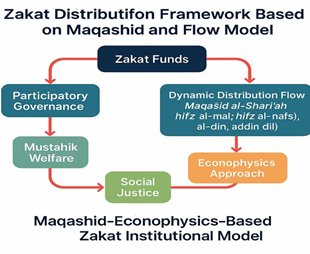
From an epistemological standpoint, zakat must be repositioned not only as an individual religious obligation but also as an Islamic fiscal mechanism aimed at achieving structural justice and long-term economic redistribution. By combining maqashid shariah and the econophysics approach, the design of zakat institutions can be directed toward an adaptive, inclusive, and outcome-based distribution model (Kato & Hiroi, 2021).
Empirical Illustration of Productive Zakat Implementation Based on FlowTo enrich the theoretical framework of flow-based zakat distribution within the econophysics approach, it is important to include empirical illustrations from actual zakat institutional practices in various countries. One relevant example can be found in the "Economic Distribution Zakat" program implemented by Lembaga Zakat Selangor (LZS) in Malaysia. In this program, zakat distribution is not only given in cash but is developed into productive economic instruments such as business capital assistance, skills training, business incubation, and community-based intensive development. Internal evaluations from LZS show that 72% of mustahik beneficiaries experienced increased income and economic independence within two years. This outcome-oriented approach uses a continuous monitoring mechanism through a transparent and measurable digital information system (Jubri et al., 2025). Structurally, this model reflects the logic of dynamic wealth flow distribution within the econophysics model, where zakat funds are recirculated through productive processes to create systemic balance.
A similar approach is found in the implementation of the "Zakat Community Development" (ZCD) program by BAZNAS Indonesia. This program has been implemented in various regions such as Lombok, Garut, and Bengkulu, using a cluster approach based on local potential. Zakat is distributed in the form of business equipment assistance, micro-capital, intensive training, and continuous entrepreneurship mentoring. Evaluations of ZCD implementation during the 2019–2023 period show that more than 65% of the mustahik experienced improved living standards, as measured by indicators such as income, economic participation, and reduced dependency on consumptive assistance (Santoso, 2025). This approach implicitly applies the principle of flow modeling, where zakat no longer stops at one-way distribution but transforms into a long-term social investment instrument. These two case studies strengthen the theoretical relevance of this article to field realities and demonstrate that the integration of maqashid shariah with dynamic distribution models can be practically and measurably realized within contemporary zakat institutional systems.
Integration of Maqashid Shariah with Physics-Based ModelsThis physics-based distribution model can be integrated with maqashid shariah through the mapping of values as follows:
Table 1
Physics-Based Distribution Model Integrated with Maqashid Shariah Through the Mapping of Values
| Maqashid Values | Physics System Parameters | Zakat Application Indicators |
|---|---|---|
| ḥifẓ al-māl | Distribution gradient (Δm) | Real-time mapping of zakat surplus–deficit |
| ḥifẓ al-nafs | Zakat flow (Q) | Level of mustahik empowerment, income improvement |
| ḥifẓ al-‘ird | Social resistance (Rs) | Reduction of stigma, increased participation and access |
Thus, zakat becomes not only a transfer mechanism but also a structural healing instrument addressing social, spiritual, and institutional inequality.
The following table presents a comparison of zakat institutions in several countries by examining their distribution approaches and alignment with the maqashid-econophysics model.
Table 2
Zakat Institutions in Several Countries
| Country | Institutional Model | Distribution Approach | Relevance to Maqashid- Econophysics |
|---|---|---|---|
| Malaysia | LZS, MAIWP | Digital, productive, outcome-based | Highly relevant: integration of maqashid values & zakat flow |
| United Arab Emirates | Dubai International Humanitarian | Blockchain zakat, smart contracts | High potential: high digital transparency and efficiency |
| Indonesia | BAZNAS, LAZ | Administrative dominant, one-way distribution | Needs reform: not yet outcome-based or recursive |
Below is a flowchart of a dynamic zakat system based on maqashid–econophysics:
Muzaki
↓
Zakat Fund
↓
[Physics Distribution Models: Flow, CCM, DY]
↓
Mustahik
↓
Maqashid Evaluation: ḥifẓ al-nafs, al-māl, al-‘ird
↓
Social Transformation & Emergence of New Muzaki
Key Variablesm: agent’s wealth Q: zakat flow
Rs: social resistance λ: saving propensity ε: transfer fluctuation
Feedback loopmustahik → empowered → becomes new muzaki
This system creates participatory and transparent zakat circulation that reduces social entropy.
ConclusionThis study concludes that the reformulation of contemporary zakat institutions must be carried out comprehensively by integrating two key approaches: the values of maqashid shariah as the normative framework and the econophysics distribution model as a structural-dynamic approach. Dependence on legal-formal approaches is no longer sufficient in addressing social inequality and the complex economic realities of the ummah. On the contrary, approaches that emphasize structural justice, community involvement, and outcome orientation have proven to be more aligned with maqashid principles and more adaptive to contemporary realities.
Maqashid-based zakat distribution encourages zakat institutions to transform from merely administrative entities into agents of change that promote wealth redistribution in a just, sustainable, and dignified manner. Herein lies the significant contribution of econophysics theory, which offers a wealth flow model based on the principles of flow and surplus stock— dynamic, and adaptive to social changes. This model not only increases distribution effectiveness but also strengthens institutional accountability and transparency.
The convergence of these two approaches results in a zakat institutional design that is not only responsive to the real needs of society but also capable of measuring success based on the quality of social impact produced. Maqashid values such as protection of wealth (ḥifẓ al-māl) and life (ḥifẓ al-nafs) are reflected in zakat distribution creating comprehensive public benefit (maslahah). Therefore, institutions such as the Ministry of Religious Affairs, BAZNAS, and LAZ should adopt evaluation systems based on flow modeling and social impact. Meanwhile, Islamic economics higher education institutions should begin integrating this interdisciplinary approach as part of a more applicable epistemological transformation.
It is important to emphasize that the econophysics approach in the context of zakat institutions is not intended to replace the normative principles of sharia or zakat fiqh, but rather to serve as an analytical tool to measure the effectiveness of zakat distribution structurally and systemically. Thus, dynamic and stochastic system-based distribution modeling can complement the sharia approach in understanding the mustahik’s social reality, and the effectiveness of wealth circulation (Dragulescu & Yakovenko, 2000; Mantegna & Stanley, 2000; Mimkes, 2012).
RecommendationsBased on the findings and conceptual discussion, this study recommends several strategic steps to strengthen zakat institutions in the contemporary era:
Governance Reform: Reconstruct zakat governance by integrating maqashid shariah indicators and flow-based distribution models. This aims to ensure that zakat performance evaluations are not only numerical but also consider social and spiritual impacts.
Strengthening Mustahik Data Systems: Zakat institutions must develop digital and spatial databases to ensure that zakat distribution is well-targeted, and avoids duplication.
Improving Transparency and Public Accountability: Bridging the trust gap between society and zakat institutions must become a priority. This can be achieved through outcome-based reporting and community, mosque, and private sector involvement in productive zakat distribution.
Adopting a Hybrid Institutional Model: Zakat institutions should adopt hybrid institutional models that combine state regulatory control with community-based innovation. This approach will create more inclusive, adaptive, and efficient governance.
Developing a Maqashid-Based Zakat Distribution Index: A maqashid-based zakat distribution index should be developed to measure distribution success holistically. This index must cover aspects such as mustahik economic self-reliance, social network strengthening, and dignified livelihood preservation.
Exploring Agent-Based Modeling (ABM): Future research is encouraged to explore the application of agent-based modeling (ABM) in zakat distribution system simulations. This model enables the visualization of agent behaviors (muzaki, mustahik, institutions) in various social and economic scenarios, thereby allowing projections based on real interactions and system complexity (Dragulescu & Yakovenko, 2000; Kato & Hiroi, 2021).
Developing Predictive Technologies: Zakat institutions should begin developing predictive technologies based on artificial intelligence (AI), blockchain, and flow visualization systems to manage zakat flows in real time. These systems not only enhance transparency and accountability but also enable adaptive prediction of mustahik needs based on evolving social dynamics (Kato, 2022; Ismail et al., 2022).
Author Contribution
Maliatu Fitriah: sole author
Conflict of Interest
The author of the manuscript has no financial or non-financial conflict of interest in the subject matter or materials discussed in this manuscript.
Data Availability Statement
Data supporting the findings of this study will be made available by the corresponding author upon request.
Funding Details
No funding has been received for this research.
Generative AI Disclosure Statement
The authors did not used any type of generative artificial intelligence software for this research.
REFERENCES
Al-Shatibi, I. (2022). Al-Muwafaqat fi usul al-shariah (Vol. 2). Dar al-Kutub al-Ilmiyyah.
Amalia, N. (2023). Zakat preaching materials. Sundakelapa.
Arif, M. A. (2022). Zakat charity and wealth distribution: An agent-based computational model. International Journal of Zakat, 7(1), 63–74.
BAZNAS. (2025, October 9). BAZNAS holds expert discussion, pushes digital transformation and fiscal integration of national zakat. https://www.puskasbaznas.com/home/activities/2073-baznas-holds-expert-discussion-pushes-digital-transformation-and-fiscal-integration-of-national-zakat
Dragulescu, A., & Yakovenko, V. M. (2000). Statistical mechanics of money. The European Physical Journal B, 17(4), 723–729. https://doi.org/10.1007/s100510070114
Ismail, I., Misrah, M., & Soemitra, A. (2022). Bibliometric analysis of Zakat Development in Indonesia during the Covid-19 Pandemic. Jurnal Ilmiah Ekonomi Islam, 8(2), 1357–1364. https://doi.org/10.29040/jiei.v8i2.5425
Joko, H. P., & Niswatin, N. H. (2025). Islamic social business model in enhancing community welfare: A maqashid shariah and sustainable economy approach. Murabahah: Journal of Islamic Economics, 1(1), 37–54. https://doi.org/10.36769/asy.v18i1.75
Jubri, M. M., Sawari, M. F. M., & Zakaria, M. S. (2025). Redefining Asnaf Fi Sabillah: Contemporary Interpretations and Zakat Distribution Practices in Islamic Banking and Finance Institutions (IBFIs). Journal of Islamic Finance, 14(1), 46–59.
Kato, T. (2022). Islamic and capitalist economies: Comparison using econophysics models of wealth exchange and redistribution. PLOS ONE, 17(9), Article e0275113. https://doi.org/10.1371/journal.pone.0275113
Kato, T., & Hiroi, Y. (2021). Wealth disparities and economic flow: Assessment using an asset exchange model with the surplus stock of the wealthy. PLOS ONE, 16(10), Article e0259323. https://doi.org/10.1371/journal.pone.0259323
Mantegna, R. N., & Stanley, H. E. (2000). An introduction to econophysics: Correlations and complexity in finance. Cambridge University Press.
Mimkes, J. (2012). Introduction to macro-econophysics and finance. Continuum Mechanics and Thermodynamics, 24(4), 731–737. https://doi.org/10.1007/s00161-011-0223-8
Nita, A., Wahyu, A., Hanafi, A., & Sayuti, M. N. (2025). Building a sustainable crowdfunding model: Application of maqashid shariah in collecting infaq, alms and waqf in the digital era. Management of Zakat and Waqf Journal, 7(1), 1–12. https://doi.org/10.15642/mzw.2025.7.1.18-36
Rickles, D. (2011). Econophysics and the complexity of financial markets. In C. Hooker (Ed.), Philosophy of complex systems (pp. 531–565). North-Holland.
Santoso, I. R. (2025). Suitability of crowdfunding in Islamic social finance from the perspective of maqasid shariah. Jurnal Ilmiah Ekonomi Islam, 11(1), 69–78.
Sayuti, M. N., Firdaus, M., & Hakim, A. (2025). Beyond charity: Towards an outcome-based zakat distribution framework. Islamic Economics Journal, 13(2), 101–118.
Schinckus, C. (2017). 1996–2016: Two decades of econophysics. The European Physical Journal Special Topics, 225(17–18), 3091–3104. https://doi.org/10.1140/epjst/e2016-60099-y
Singagerda, F. S., & Asmaria, A. (2023). Peran zakat dan pembiayaan syariah bagi UMKM dalam mewujudkan Sustainable Development Goals (SDGs). Jurnal Ilmiah Ekonomi Islam, 9(1), 535–539. https://doi.org/10.29040/jiei.v9i1.8166
Thébault, K., Bradley, S., & Reutlinger, A. (2018). Modelling inequality. The British Journal for the Philosophy of Science, 69(3), 691–718.