

| Review | Open Access |
|---|
Impact of Socioeconomic Conditions due to Delays in the Completion of Urban Transit: A Case Study of Peshawar Bus Transit |
 |
|---|
 Shahad Ahmad Khan1 and Humaira Tabassum2*
1The Urban Unit, Lahore, Pakistan.
2City and Regional Planning Department, University of Engineering and Technology, Lahore, Pakistan.
The city of Peshawar needed an organized public transportation system for decades. The provincial government has recently finished mega project of Bus Rapid Transit (BRT) with the assistance of the Asian Development Bank (ADB) and City Development Initiative for Asia (CDIA). The project started in 2017 and could not meet the completion deadlines, and the delay had economic and social implications. This research presented the public transport challenges in Peshawar, the characteristics of the BRT project, an analysis of the delayed completion, and its reasons and effects. In addition to the literature review, the researchers collected first-hand data through a survey from three types of respondents. In the interviews, officials and experts commented on the reasons behind the delayed completion, and traders and the public expressed how it impacted their lives and businesses. The research found that administrative shortfalls, political fluctuations, and inappropriate technical planning are the reasons behind delays. Consequently, the public suffered from traffic congestion, time wastage, health issues, and effects on their social and economic life.
1. INTRODUCTION
Situated at the confluence of Indus valley and Iranian Plateau, Peshawar has remained a nodal point between Central and South Asia for the last two thousand years. It is the sixth largest city of Pakistan with a population of about two million and a fast growth rate of 3.7% (Pakistan Bureau of Statistics, 2017). According to some reports, almost 44% of the population of Khyber Pakhtunkhwa (KPK) is poor (Asian Development Bank [ADB], 2017a; Urban Policy Unit, 2014). The provincial government has faced pressure to deliver long awaited reliable public transport services (ADB, 2017c; Urban Policy Unit, 2014). The project of Bus Rapid Transit (BRT) was initiated by the provincial government of KPK to deliver long-needed reliable public transport services to the residents of Peshawar. However, the time delays happened in completion of the transit service not only increased the construction cost several times to the planned amount (Economic Affairs Division, 2019) but also impacted social lives of the residents. It increased their travel cost, reduced their businesses, and deteriorated their environment. The current study aimed to investigate and analyze the effects of this project and delays the public and government have faced (Bahadur, 2019; Khattak, 2019; Shah, 2019; Yousafzai, 2019).
Transportation Situation in Peshawar CityIn the wake of the mounting transportation needs of the bustling city of Peshawar, an integrated mass transit system has remained absent in the development policies (Urban Policy Unit, 2014; City Development Initiative for Asia [CDIA], 2022). The Traffic Management Plan (AAA Engineering Consultants, 2018) and various other publications provide insight to the dismal transportation situation. In the name of public transport, a combination of various privately-operated modes, such as mini wagons, Suzuki utility vehicles, all-terrain vehicles, and pick-up trucks, provide the means of public transportation (ADB, 2017a; Ahmed et al, 2021). The system needed proper governmental supervision for improvement in safety and maintenance which they could not accomplish (ADB, 2017c). The lack of responsive initiatives resulted in a lack of repair of the vehicles, uncomfortable seating arrangements, broken-down bus stop shelters, and inappropriate behavior of the operating staff (Urban Policy Unit, 2014; Ahmed et al., 2021). Surveys conducted for the Peshawar BRT planning revealed that most people in Peshawar were not satisfied and felt unsafe with the available public transport (ADB, 2017c).
The deficient and neglected mass transportation facilities resulted in a tremendous increase in the paratransit modes of travel, such as taxis, rickshaws, and an annual surge of 23.85% in private car ownership in Peshawar between 1998 and 2012 (Ahmed et al., 2021; Ali et al., 2012; AAA Engineering Consultants, 2018). From the year 1998 to 2010, the overall addition in the number of vehicles was 126.4%, corresponding to 0.85% road network expansion (AAA Engineering Consultants, 2018). Limited road infrastructure and its stagnant growth (Ali et al., 2012; AAA Engineering Consultants, 2018) has left the residents of Peshawar with chaotic, hazardous, and polluting transportation options for decades coupled with unsafe mobility that poses challenges, especially for women, children, old, and other weaker sections of the population (ADB, 2017a; Ali et al, 2012; Gongadze, et al., 2022; Iftikhar & Lions, 2022; AAA Engineering Consultants, 2018).
To address the transportation problems of Peshawar, the provincial government improved some road infrastructure through the construction of flyovers and traffic management measures (AAA Engineering Consultants, 2018). However, it could not help much to reduce the congestion. The city was in dire need of some mass transit which should be reliable, comfortable, and user-friendly (Iftikhar & Lions, 2022). There have been some attempts in the distant past to introduce mass public transport projects. Jacobs et al. (1986) while researching public transport in developing countries, found that from 1978 to 1983, there was a significant increase in the bus fleet in Peshawar. This suggested that government invested in the past to reform public transport. Yet later years could not see further improvement in this sector. Instead, it declined to privately-owned unreliable, unsafe, and chaotic services. In 2012, a country-wide drive of ‘bus transit construction’ started in Pakistan with exclusive bus service lanes on dedicated routes built in Lahore, Multan, and Rawalpindi/Islamabad. The provincial government of KPK conceived the project of BRT for Peshawar in 2017.
Salient Features of Peshawar BRT ProjectThe initiative for the BRT system came from a transportation feasibility study conducted as a part of the City Development Initiative for Asia in May 2014 (CDIA, 2022). The project complies with the objectives of the KPK provincial Comprehensive Development Strategy 2010-2017 (Government of Khyber Pakhtunkhwa, 2022). A long-term national development plan by the Government of Pakistan, such as “Vision 2030,” and “Pakistan 2025: One Nation—One Vision,” (Government of Pakistan, 2014) has already proposed to invest in modern transport systems in KPK. In the wake of public transport problems in the city, the BRT project intended to provide efficient, reliable, and comfortable transit which could help improve the quality of life for the people of Peshawar (ADB, 2017c; Iftikhar & Lions, 2022). In its established 20-year public transportation vision, the research by CDIA identified six feeder corridors that would be implemented phase by phase. The Government of KPK viewed the project as extraordinary to be carried out with the financial sponsorship of the Asian Development Bank (Ahmad & Ahmad, 2019; ADB, 2017c). Peshawar Development Authority (PDA) executed the project (under the Khyber Pakhtunkhwa Urban Mobility Authority) and a specially-created institution ‘TransPeshawar,’ would be responsible for the system's maintenance and operations (ADB, 2017c).
Peshawar BRT has a 28km roadway with 31 stations from Chamkani Mor to Karkhano market and eight feeder routes (ADB, 2017c) (see Figure 1). The planned commercial speed of buses is 27 km/h and a peak frequency of 38 buses per hour in each direction. As shown in Figure 2, it has 3 kilometers long underpasses, 8 kilometers of flyovers (elevated), and 15 kilometers at grade route. With an average headway of 2.5 minutes, 115 buses (79 buses in the main corridor and 36 off the corridor) were planned to serve 100,000 people every day on the corridor (Haider et al., 2021). In comparison to the other BRT projects implemented across the country, Peshawar BRT included improvement of pedestrian facilities, traffic management, intersections improvement, parking management, and construction of bicycle paths along the entire corridor (ADB, 2017c). The project has also attempted to provide user-friendly travel for all passengers including women and children (Khan et al., 2021).
Figure 1
Peshawar BRT Route Map

Note. Source: Haider et al. (2021)
The project commenced in October 2017 and on that occasion, the Chief Minister of KPK stated to complete the project in six months (Khan, 2019; Khattak, 2018). On the contrary, the project suffered delay upon completion. Missing the first deadline caused a ripple effect, resulting in at least seven further deadlines promised by the officials and politicians (Khattak, 2019). A government representative commented that the project had become a challenge for the government to make its completion possible (Bahadur, 2019). After missing several timelines, the buses finally started operating on August 14th, 2020, three years after construction commencement for which the provincial government faced criticism (Bahadur, 2019; Faiz, 2022; Khan, 2019).
Research MethodologyFor the assessment of the socioeconomic impact of the project on the public, the study employed ‘mixed method’ approach using both qualitative and quantitative data. Moreover, the data was collected from both primary and secondary sources.
The researchers organized interview surveys during the construction of the project in July-August 2020. The whole BRT route has three parts called Reach 1,2, and 3 (ADB, 2017b). The Reach 3 was selected as the study area which stretches from Karkhano Market to Aman Chowk as shown in Figure 2. The stretch of the G.T. (Grand Trunk) road is the hub of commercial activities and therefore, considered suitable for data collection.
The respondent groups comprised three categories. The first two categories included shopkeepers and general users along the 13.8 km section of the road. The sample size was 204 using Slovin’s formula with convenience sampling technique for surveys. The interviews consisted of in-person conversations with the respondents. In addition to this, the opinions of officials and experts (third type of respondents) of the PDA, Transport Department of Peshawar, and the University of Peshawar were also recorded. The questionnaire was uploaded online on google docs and then sent through the WhatsApp application. A total of twenty officials from both departments responded with complete answers. Afterwards, SPSS was used for analysis and Endnote for referencing.
Figure 2
Reach 3 of Peshawar BRT Route

Note. Source: Google Maps retrieved in 2020
Exploration of the Mega Projects’ Problems in LiteratureThe researchers conducted a literature review to find out how mega projects were carried out elsewhere and what problems they faced during execution. The literature revealed that problems confronted in BRT Peshawar were neither novel nor unknown. Similar issues occurred in various mega projects in other parts of the world, as noted by various researchers.
Chan and Kumaraswamy (1997) and Sharma et al. (2019) noted that in construction projects, adjournments are due to defective site organization, unanticipated ground situations, slow decision-making that comprise all project teams, as well as client-initiated and necessary work disparities. The contractor oversees daily construction activities and converts the drawing into a working project. Resultantly, the client should select the most qualified and competent contractor to ensure the completion of the projects timely (Singh & Tiong, 2006). Whereas according to Han et al. (2009), large public transit systems are frequently delayed due to numerous uncertainties and challenges encountered during the development and implementation phases, resulting in schedule delays and cost overruns. Resultantly, many existing owners/residents living along proposed transit routes may genuinely be concerned about the project’s completion date and whether it would be built as planned.
Project delays have various negative consequences including higher budgets and lower efficiency and revenue, effecting daily lives of people. After analyzing ten mega road projects in Sub-Saharan Africa. Kahangirwe and Vanclay (2024) identified that poor planning and management had severe social, economic, and environmental impacts. The delays in the construction projects not only impact the contractors, consultants, or clients, however, it affects the economy as well, particularly in developing countries where the construction industry makes significant contribution to the Gross Domestic Product (GDP) (Al-Kharashi & Skitmore 2009; Faridi & El-Sayegh, 2006). Moreover, Kim et al. (2017) noted that there are also costs of inconvenience and noise to nearby residents, which may turn the transit project into a liability during the lengthy construction period. Consequently, there would be loss of stakeholders’ trust, barring by authorities, waste of money and time, as well as the loss of reputation.
Results
The delay resulted in numerous financial, social, and political problems. The most important is the multifold upsurge in the project’s cost. During the plan-making phase, the total estimated cost of the project was Rs. 41 billion (USD 587 million) (Project Administration Manual, 2017). In the years 2018-2019, organizers reviewed the PC-1 (project concept) and revised the cost estimation as Rs. 66.437 billion (US$ 593 million) (Economic Affairs Division, 2019). By the time the project was completed in 2020, the cost had escalated to Rs. 70 billion (Khattak, 2018). An important head in this cost expansion is the consultancy charges which were continuously paid from the start till the completion and the delay for several reasons made this head enormously bigger (300% on original estimate) (Malik, 2022). Although the Lahore Metro, Multan Metro, and Rawalpindi-Islamabad Metro all had massive budgets of Rs. 29.6 billion, Rs. 29 billion, and Rs. 42.8 billion, respectively (“Peshawar Metro Bus”, 2017) for which they faced criticism. However, Peshawar BRT proved to be the most expensive of all. The overrun expense for the BRT Peshawar is 17 billion PKR (“Multi-billion, long-delayed”, 2019), incurring a Rs 4.67 billion deficit (Buneri, 2021). Due to the ongoing development of feeder routes of TransPeshawar, the budget is not yet final and may be more than the current incurred Rs. 70 billion, making it even more expensive (“Peshawar Metro Bus”, 2017).
Apart from the escalated construction costs, the delay has caused various social issues. Recurring news reports highlight the reduced road width due to project site restrictions, regular traffic jams, parking problems, and air pollution due to high concentrations of dust and smoke (Bahadur, 2019; Khattak, 2019; Shah, 2019; Yousafzai, 2019). For local traders on GT Road and University Road, along the BRT route, low customer turnout, as much as 40% lower than before the start of BRT construction, has affected their businesses (Bahadur, 2019; Shah, 2019). Road closures and congestion have affected the daily life and mobility of the residents (Lead Pakistan, 2022). Utility supply lines of natural gas and drinking water were damaged all over and broken drainage pipes created havoc, especially during rains but the responsible authorities did not pay attention (Bahadur, 2019). Local shopkeepers and residents stated that the project has occupied them mentally and economically. A psychiatrist noted the rise in blood pressure, heart problems, and ulcers which further led to anxiety, stress, and frustration among the residents (Shah, 2019).
Table 1 provides the results of interviews (by author/s) conducted with the shopkeepers. All types of shops comprising garments, shoes, groceries, furniture, auto workshops, and shoes were included in the interviews.
Table 1 Impact of BRT Peshawar Construction Delay on Local Traders
|
Interview questions |
Negative Response % |
Positive Response % |
No/Impartial Response % |
|---|---|---|---|
|
Project Badly Impacting Business |
22 |
68 |
10 |
|
Property Values Decreased |
16 |
78 |
6 |
|
Customer Turnover Decreased |
20 |
72 |
8 |
|
Business Closure |
37 |
5 |
58 |
|
Business Restoration |
6 |
31 |
63 |
|
Future Expectations |
71 |
23 |
6 |
|
Goods Mobility Cost Increased |
17 |
83 |
0 |
|
Effect on Customer Parking |
26 |
62 |
12 |
Note. Source: Field survey (2020)
Upon survey inquiry, most of the respondents said that bad road conditions, increase in transportation costs, and the reduction in parking space have led to a reduction in customer turnout. The decline in sales has caused some businesses to collapse. They agreed that project completion may increase the potential value of their commercial properties, however, they perceive decline in the property values and even closure of their businesses under current circumstances. They were not certain whether anticipated improvement in those conditions would materialize or not. The collected data and the tone in which people were replying indicated that the BRT project has created social cumbrances, and the delay enhanced their difficulties multiple times.
Interviews from general road users are compiled in Table 2 below. The respondents were businesspeople (39%), government employees (20%), students (16%), laborers (6%), and unemployed/homemakers.
Table 2 Impact of BRT Construction Phase on Residents of Peshawar
|
Interview question |
Negative Response % |
Positive Response % |
No/Impartial Response % |
|---|---|---|---|
|
Badly impacting life |
22 |
73 |
5 |
|
Rise in noise pollution |
19 |
81 |
|
|
Difficult to travel on a personal vehicle |
22 |
78 |
|
|
Rising vehicle maintenance cost |
21 |
79 |
|
|
Increasing travel cost |
21 |
79 |
|
|
Impact on public utilities |
18 |
82 |
|
|
Harmful effects on greenery |
19 |
81 |
|
|
Road conditions worsened |
19 |
66 |
15 |
|
Illnesses due to construction rising |
20 |
80 |
|
|
Health cost increased |
22 |
78 |
|
|
Travel time to work and education increased |
24 |
76 |
|
|
Property price increased |
24 |
76 |
|
|
Government doing traffic management |
86 |
14 |
|
Note. Source: Field Survey 2020
In the interviews, most of the respondents (73%) expressed that their lives are negatively affected by the project. They reported that eroded road conditions, reduced right of way, and traffic blockage resulted in increased travel time, extra fuel consumption, rise in noise pollution, and additional vehicle maintenance. They deplored the failure of the government to make effective traffic management to avoid congestion. Almost half of the respondents stated that due to difficult mobility, they suffered from job loss or had to change the educational institution of their family members. The increased transportation cost caused a reduction in their travel on personal vehicles. Social trips declined by 40%, recreational by 20%, and educational by 16% compared to the time before the BRT project started.
The construction activities also disrupted the supply of line infrastructure, such as electricity, natural gas, and drinking water supply for up to 6 days in some cases. Moreover, due to dust, reduction in greenery, congestion, and fuel burning, people suffered from breathing problems (62% responses), flu (13%), and anxiety (13%), which increased their medical expenses (70% responses). Hence, the one-to-one survey results conformed to the daily life problems reported by different news reports about the effects of BRT Peshawar construction and delay.
Causes of the DelayAccording to a report prepared by the Provincial Inspection Team, the Peshawar BRT suffered from poor planning and design, bad administration, and neglectful project execution (Khan, 2019). However, politicians related to the KPK province ruling party also counted court stay orders and cases filed in the National Accountability Bureau (NAB) as causes of the delay in the timely completion (Yousafzai, 2019).
The project’s technical design has remained subject to consistent alterations. According to a government official, there were more than twenty significant changes and countless small ones made in the basic design after construction commenced (Khattak, 2019; Khattak, 2018). A few times, due to crucial structural changes, they dismantled and reworked some constructed route sections (Bahadur, 2019). At some stations, the entrance was too narrow for two bus widths to pass along which had to be razed, then redesigned and reconstructed (Bahadur, 2019). According to a study for the BRT project, agencies had not conducted a proper feasibility analysis for geotechnical factors, sewerage systems, water supply systems, and traffic management (Idrees & Shafiq, 2021). Ahmad and Ahmad (2019) commented that the organizations planned the project without proper forecasting and engineering work, which hampered the project's timely completion and invalidated the budget estimates.
There are reports of several administrative problems, including poor supervision, lack of coordination among institutions, and corruption. In a progress review meeting (called in October 2019) ‘China Railway Construction Corporation’, a partner in the BRT venture, and a local contractor were held partially responsible for the undue delay. The Chinese company cited security risks, and the local contractors blamed the government officials for failing to make timely approvals. However, the official engineers accused the erroneous appointments of project managers who could not supervise the work appropriately (Ali, 2019).
In addition to the bureaucratic flaws, there have been reports of financial irregularities. The audited Project Financial Statement (2022) prepared by PDA accounted for financial irregularities worth 47 billion PKR in Peshawar BRT. Some reports and articles mentioned shady activities, embezzlement, corruption within the institutional setup, and illegal subcontracting (Faiz 2022; Khan, 2019). The allegations against the officials included spending funds without approval, illegal hiring of consultants, and inability to recover money from contractors ("Report Reveals Irregularities", 2022). There are reports for investigations started by NAB for alleged corruption charges against the former Director General of PDA (Ali, 2022). Financial irregularities played a role in extensions of the completion schedule of BRT Peshawar.
Analysis of the Interviews with Experts and Officials in PeshawarThe interviews with officials and experts included four official town planners and civil engineers from PDA, five civil engineers from Trans Peshawar, five project managers from the KP transport department, and six town planners and scholars from the University of Peshawar. The researchers conducted a total of twenty interviews and tabulated the responses as below.
Table 3 Interview Responses from Officials and Experts
|
Interview Questions |
Strongly Agreed |
Agreed |
Disagreed |
Impartial/No Response |
|---|---|---|---|---|
|
BRT Project was feasible |
6 |
4 |
8 |
2 |
|
Lack of planning |
14 |
4 |
|
2 |
|
Lack of public cooperation |
7 |
9 |
4 |
|
|
Excessive traffic load |
6 |
6 |
7 |
1 |
|
Inappropriate design |
9 |
9 |
|
2 |
|
Uncontrollable external factors |
10 |
8 |
2 |
|
|
Unplanned project timeline |
8 |
10 |
|
2 |
|
Change in project scope |
12 |
5 |
3 |
|
|
Absence of public participation |
6 |
14 |
|
|
Note. Source: Field Survey 2020
The survey results revealed that largely the planners, whether officials or private consultants, strongly agreed on deficient planning and groundwork of the project. Most of the respondents agreed on the lack of feasibility and planning, inappropriate design, and poorly set timeline for completion. They also mentioned some unexpected external factors, such as rainstorms in Peshawar, workers’ strikes, uncontrolled flooding in the rainy season, and the provincial political scenario among the reasons behind the excessive delays. Reports of the environmental and socio-economic assessment, for instance, ADB (2017c), were prepared; however, their scope was just a formality. More than half of the respondents strongly agreed that the alterations in the project’s scope since the beginning produced confusion, leading to time wastage and unwanted delay. One respondent said that authorities considered other alternative transport solutions initially, and the decision to build a designated bus route was a little surprising for the officials. Experts in the development authority stated that hasty planning deprived appropriate public participation, which could have been a source of valuable suggestions and cooperation needed in mega projects for public acceptability and successful completion.
BRT Project FeedbackAccording to a users’ feedback report compiled by ADB (2021), the service became immediately popular, as revealed by a rise in ridership to 145,000 trips per day within three months of the inauguration. As per a survey conducted for the report, people of Peshawar, especially women, appreciated BRT as an efficient, reliable, secure, and cheaper means of transportation. Some other publications also counted the benefits of the implemented project. Gul (2021) described it as a gift for the women of Peshawar. A study conducted to measure the user-friendliness of the BRT Peshawar concluded that most women expressed satisfaction with the facilities at stations and onboard (Khan et al., 2021). Similarly, Gongadze et al. (2022) applauded the provision of the desperately needed facility and hoped that it would create progress opportunities for marginalized groups.
Figure 3
Traffic Conditions along BRT Peshawar Route during Construction
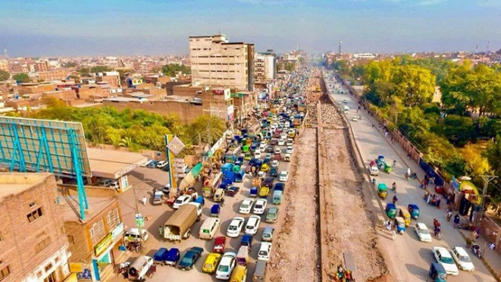
On the other hand, some analysts criticized the project operation after completion. Lead Pakistan (2022) commented that instead of providing the promised relief to the city’s residents, BRT dedicated lane, squeezed the road width, and made traffic queues longer than before (see Figures 3 and 4). Some reports noted the increasing traffic jams on other roads of Peshawar, and people blamed BRT for making other traffic modes de-tour (Safi, 2022). A statement from the Auditor General of Pakistan identified technical problems with the fleet of buses, which would incur further costs for repairs (Gishkori, 2020), and another criticism targeted the project’s fiscal deficit (Buneri, 2021). The critiques indicate that despite providing a pioneer facility, the project still has issues to resolve.
Figure 4
Traffic Congestion on the Road along BRT Peshawar

Discussion
Mega projects need thorough planning and timely execution, as delays in implementation imply huge financial costs and social repercussions. To understand the cause of delays in the case of Peshawar BRT, higher level political involvement, institutional incapacities, and lack of public participation are important factors to consider.
News reports and discussions with officials of development agencies suggest that the decision to initiate the BRT mega project was more a political contest rather than a technical or need-based assessment. Although being a political preference does not harm the authenticity of a public project, as politicians supposedly carry public representation. However, the construction of a bus service within the jurisdiction of a city requires relevant local representation to deliberate on available options. Handing authority to the provincial government made this project vulnerable to fluctuations at higher levels of politics that are relatively less connected to the daily problems of the public. Several publications have reported traffic woes in Peshawar and advocated for comprehensive public transport services long before the conception of BRT. However, the provincial government took the decision unanimously without much thought about alternatives.
In the whole progression of the Peshawar BRT, few public consultations are recorded. Surveys conducted by ADB highlighted the problems of chaotic public transport before and relief provided after the introduction of BRT service. For this project, a huge investment was made only in a section of the G.T. road, and standards were kept up to the international level. Whereas, the rest of the city is still struggling with the same old chaotic system. Ironically, even BRT service could not do much to reduce the congestion on G.T. road (figures 3 and 4). An organized public/stakeholders’ consultation might have explored other alternatives for consideration to solve traffic issues in Peshawar. In this regard, the capability of relevant development institutions is questionable. They are responsible for the administration and accommodation of appropriate public participation in their planning procedures.
In the matter of delayed completion of Peshawar BRT, lack of institutional capacity has an important role to play. Failure to maintain a progressive bus system that existed during the 1980s in Peshawar and letting the public transport decline to contemporary chaos indicate institutional incompetence. The present urban administration system in Pakistan was inherited from the British colonists. Since the independence of Pakistan, the colonial institutional system continued to operate with the same or marginal changes in their powers and procedures of which top-down decision-making and taking advice from higher authority are among the fundamental logics of their existence. The governments have relied on foreign consultants to solve local problems from the early days. Reforming institutions to allow them to evolve according to the local environment is still a pending national task which results in intrinsic incapacities to carry out mega projects. Dependency on other countries' financial and technical support makes coordination crucial to completing the projects in time, which was lacking in the Peshawar BRT case. During interviews with officials, many agreed that the planning of this project was not cautiously done. It resulted in design faults after construction and subsequent demolition caused further delays, and financial and social costs for which the common citizens are the ultimate sufferers.
Conclusion
The commencement of the mega project of BRT is a long-awaited initiative from the government to address the public transportation needs of the people of Peshawar. After the commencement of the project in 2017, the excessive delay in completion was attributed to defects in the initial design, administrative inadequacies, and political interventions. The delay in the timeline resulted in escalating the project’s financial cost and enhancing social problems. People of Peshawar faced traffic jams, pollution, excessive vehicle maintenance, and wastage of time and money as the reduced right of ways, bad road conditions, and inadequate management could not manage the traffic loads. In each question of the social survey, 70-80% respondents expressed the situation problematic. Although the project has provided relief to various sections of society, there is room for improvement and lessons for future projects.
Conflict of Interest
The authors of the manuscript have no financial or non-financial conflict of interest in the subject matter or materials discussed in this manuscript.
Data Availability Statement
Data associated with this study will be provided by corresponding author upon reasonable request.
Funding Details
The authors received no specific funding for this work.
REFERENCES
AAA Engineering Consultants. (2018). Traffic management plan for four cities (Peshawar, Mardan, Kohat & Abbotabad). Urban Policy Unit, Planning & Development Department. https://urbanpolicyunit.gkp.pk/wp-content/uploads/2020/03/Traffic-Management-Plan-Peshawar.o.pdf
Ahmad, S. F., & Ahmad, S. I. (2019). Should we build mega transport projects in cities? The case of TransPeshawar Pakistan. International Journal of Experiential Learning & Case Studies, 4(1), 63–73.
Ahmed, S., Waheed, A., & Shah, S. A. A. (2021). Characteristics of informal transport in Pakistan: A case study of Peshawar city. Journal of Southwest Jiaotong University, 56(6), Article e010. https://doi.org/10.35741/issn.0258-2724.56.6.85
Ali, M. (2019, November 21). ADB to fix responsibility for delay in Peshawar Bus Project. Dawn News. https://www.dawn.com/news/1517907/adb-to-fix-responsibility-for-delay-in-peshawar-bus-project
Ali, S. F. (2022, September 24). NAB to probe corruption in Peshawar's BRT Project. Geo News. https://www.geo.tv/latest/442366-nab-to-probe-corruption-in-peshawars-brt-project
Ali, Z., Shah, D. A. A., & Hussain, A. (2012). Growing traffic in Peshawar: An analysis of causes and impacts. South Asian Studies, 27(2), 381–396.
Al-Kharashi, A., & Skitmore, M. (2009). Causes of delays in Saudi Arabian public sector construction projects. Construction Management and Economics, 27(1), 3–23. https://doi.org/10.1080/01446190802541457
Asian Development Bank. (2017a). Peshawar sustainable bus rapid transit corridor project: Report and recommendation of the President. https://www.adb.org/projects/documents/pak-48289-002-rrp
Asian Development Bank. (2017b). Pakistan: Peshawar sustainable bus rapid transit corridor project. https://www.adb.org/projects/48289-002/main
Asian Development Bank. (2017c). Power generation efficiency improvement project: Environmental impact assessment. https://www.adb.org/projects/documents/uzb-49253-003-eia
Asian Development Bank. (2021). A newly completed bus rapid transit system is transforming lives of people in Peshawar. https://www.adb.org/results/newly-completed-bus-rapid-transit-system-transforming-lives-peshawar-pakistan
Audited Project Financial Statement. (2022). Audited project financial statements – Asian Development Bank. Peshawar Development Authority. https://www.adb.org/sites/default/files/project-documents/48289/48289-002-apfs-en_0.pdf
Bahadur, I. (2019, December 26). BRT Peshawar: A tale of poor planning, execution and cost escalation. Pakistan Today. https://www.pakistantoday.com.pk/2021/12/26/peshawars-brt-faces-rs4-67bn-deficit-in-past-two-years/
Buneri, A. (2021, December 26). Peshawar's BRT faces Rs 4.67 bn deficit in past two years. Pakistan Today. https://www.pakistantoday.com.pk/2021/12/26/peshawars-brt-faces-rs4-67bn-deficit-in-past-two-years/
CDIA. (2022). Peshawar urban transport. https://cdia.asia/project/peshawar-urban-transport/
Chan, D. W., & Kumaraswamy, M. M. (1997). A comparative study of causes of time overruns in Hong Kong construction projects. International Journal of Project Management, 15(1), 55–63.
Economic Affairs Division. (2019). Ministry of economic affairs, economic affairs division. Government of Pakistan. http://ead.gov.pk/NewsDetail/NWRhOTE1NzktOWYzMS00NzA4LTk1YTgtNjZkMDNiZjk5OTli
Faiz, A. (2022). We are on the same page: The curious case of Imran Khan's populism in Pakistan. In A. Dieckhoff, C. Jaffrelot, & E. Massicard (Eds.), Contemporary populists in power (55–74). Palgrave Macmillan.
Faridi, A. S., & El-Sayegh, S. M. (2006). Significant factors causing delay in the UAE construction industry. Construction Management and Economics, 24(11), 1167–1176. https://doi.org/10.1080/01446190600827033
Gishkori, Z. (2020, September 21). Auditors expose serious faults in Peshawar BRT bus fleet. The News International. https://www.thenews.com.pk/print/717986-auditors-expose-serious-faults-in-peshawar-brt-bus-fleet
Gongadze, S., Maassen, A., & Serohina, L. (2022, August 16). 5 cities show how to thrive in turbulent times. World Resources Institute. https://www.wri.org/insights/5-cities-show-how-thrive-turbulent-times
Government of Khyber Pakhtunkhwa. (2022). Khyber Pakhtunkhwa comprehensive development strategy 2010–2017. https://pndkp.gov.pk/download/comprehensive-development-strategy-2010-2017/
Government of Pakistan. (2014). Pakistan 2025: One nation: One vision. https://policy.asiapacificenergy.org/node/2910
Gul, R. (2021, February 9). A gift for the Women of Peshawar. The News International. https://www.thenews.com.pk/magazine/you/785571-a-gift-for-the-women-of-peshawar
Haider, F., Rehman, Z. U., Khan, A. H., Ilyas, M., & Khan, I. (2021). Performance evaluation of BRT standard in decision support system for integrated transportation policy. Sustainability, 13(4), Article e1957. https://doi.org/10.3390/su13041957
Han, S. H., Yun, S., Kim, H., Kwak, Y. H., Park, H. K., & Lee, S. H. (2009). Analyzing schedule delay of mega project: Lessons learned from Korea train express. IEEE Transactions on Engineering Management, 56(2), 243–256. https://doi.org/10.1109/TEM.2009.2016042
Idrees, S., & Shafiq, M. T. (2021). Factors for time and cost overrun in public projects. Journal of Engineering, Project & Production Management, 11(3), 243–254. https://doi.org/10.2478/jeppm-2021-0023
Iftikhar, R., & Lions, C. (2022). Interorganizational knowledge sharing barriers and enablers: the case of Peshawar Bus Rapid Transit project. International Journal of Managing Projects in Business, 15(5), 769–792. https://doi.org/10.1108/IJMPB-11-2021-0313
Jacobs, G. D., Fouracre, P. R., & Maunder, D. A. C. (1986, October 2). A review of public transport operations in third world cities [Paper presentation]. Proceedings of a Conference Organized by the Institution of Civil Engineers, Great Britain, London.
Kahangirwe, P., & Vanclay, F. (2024). Social impacts arising from road infrastructure projects in Sub-Saharan Africa: Better management of social issues is needed in road construction, upgrading and rehabilitation. Impact Assessment and Project Appraisal, 42(4), 309–322. https://doi.org/10.1080/14615517.2024.2385877
Khan, I. (2019, April 3). Damning report of public money waste on Peshawar BRT. Dawn News. https://www.dawn.com/news/1473563
Khan, S. M., Anwar, A., & Zulfiqar, H. (2021). Analysis of urban transport in Peshawar for user-friendliness. Global Regional Review, 6, 258–265. https://doi.org/10.31703/grr.2021(VI-I).28
Khattak, S. (2018, March 14). Design changes to delay Peshawar BRT project. The Express Tribune. https://tribune.com.pk/story/1659178/many-cooks-design-changes-delay-project
Khattak, S. (2019, April 5). Peshawar BRT: How not to complete a project. The Friday Times. https://www.thefridaytimes.com/2019/04/05/peshawar-brt-how-not-to-complete-a-project/
Kim, A. A., Sadatsafavi, H., Anderson, S. D., & Bishop, P. (2017). Preparing for the future of transportation construction: Strategies for state transportation agencies. Journal of Management in Engineering, 33(3), Article e04016045. https://doi.org/10.1061/(ASCE)ME.1943-5479.0000494
Lead Pakistan. (2020, September 17). BRT’s launch fails to address traffic issue in Peshawar. https://leadpakistan.com.pk/news/brts-launch-fails-to-address-traffic-issue-in-peshawar/
Malik, A. A. (2022, August 23). Peshawar BRT project: Consultancy charges surge from RS816M to Rs. 2.362 bn. The News International. https://www.thenews.com.pk/print/984726-peshawar-brt-project-consultancy-charges-surge-from-rs816m-to-rs2-362bn
Multi-billion, long-delayed bus rapid transit (BRT) project in Peshawar. (2019, January 31). Daily Times. https://dailytimes.com.pk/372774/multi-billion-long-delayed-bus-rapid-transit-brt-project-in-peshawar/
Pakistan Bureau of Statistics. (2017). Table - 1 area, population by sex, sex ratio - census in Pakistan. Government of Pakistan. https://www.pbs.gov.pk/sites/default/files/population/2017/tables/kpk/Table01p.pdf
Peshawar Metro Bus Project costlier than Lahore, Pindi’s. (2017, March 17). Dawn News. https://www.dawn.com/news/1321463
Project Administration Manual. (2017). Peshawar sustainable bus rapid transit corridor project: Project administration manual. Asian Development Bank. https://www.adb.org/projects/documents/pak-48289-002-pam
Report reveals irregularities worth billions of Rupees in Peshawar BRT project. (2022, August 18). Geo News. https://www.geo.tv/latest/434501-report-reveals-irregularities-worth-billions-of-rupees-in-peshawar-brt-project
Safi, J. (2022, October 22). Peshawar's Bus Rapid Transport project causes devastation. The Friday Times. https://www.thefridaytimes.com/2022/10/22/peshawars-bus-rapid-transport-project-causes-devastation/
Shah, S. Q. (2019, October 24). BRT project getting on people's nerves in Peshawar. Dawn News. https://www.dawn.com/news/1512588
Sharma, M., Trivedi, A. S., & Sharma, A. (2019). Analysis of Delays in Building Construction Projects. International Journal for Research in Applied Science and Engineering Technology, 7, 621–629.
Singh, D., & Tiong, R. L. (2006). Contractor selection criteria: investigation of opinions of Singapore construction practitioners. Journal of Construction Engineering and Management, 132(9), 998–1008. https://doi.org/10.1061/(ASCE)0733-9364(2006)132:9(998)
Urban Policy Unit. (2014). Urban transport pre-feasibility study Peshawar, Pakistan. Government of Khyber Pakhtunkhwa. https://urbanpolicyunit.gkp.pk/wp-content/uploads/2020/03/Urban-Transport-Pre-Feasibility-Study.pdf
Yousafzai, W. (2019, April 1). Peshawar bus rapid transit: Blessing or curse? The Express Tribune. https://tribune.com.pk/story/1941399/peshawar-bus-rapid-transit-blessing-curse.