
| Review | Open Access |
|---|
Role of Transport Policies in Promoting Older Adults' Mobility: A Review of Government Policies in Pakistan |
 |
|---|
 Muhammad Ahmad Al-Rashid1*, Muhammad Nadeem2
1Department of Urban and Regional Planning, Faculty of Built Environment, Universiti Malaya, Kuala Lumpur, Malaysia
2Graduate School of Urban Innovation, Yokohama National University, Yokohama, Japan
The current study critically reviewed government transport policies in Pakistan, focusing on their effectiveness in promoting mobility among older adults in Lahore. By examining existing institutional frameworks and policy documents, the research highlighted acute challenges to address the definite mobility needs of older adults. Findings revealed a lack of sustained, comprehensive initiatives tailored to improving elderly mobility, exacerbated by bureaucratic inefficiencies and weak coordination among institutions. Policy interventions often prioritize technical solutions over holistic approaches, considering age-related mobility constraints and societal attitudes toward aging. Additionally, older adults are entirely excluded from the policy-making process. This study suggested a paradigm shift towards inclusive transport policies that integrate age-friendly features and actively engage older adults in planning processes, thereby fostering a more accessible urban transport environment for older adults in Pakistan.
1. INTRODUCTION
People now have longer lives than they had previously, and the number of individuals over the age of 65 is rising worldwide. According to the United Nations (2015), the proportion of older adults (aged 60 and above) has increased from 384 million in 1950 to about 901 million in 2015. A similar trend can be observed in Pakistan, where the percentage of older adults is projected to reach 14% by 2050 (Bashir & Nazir, 2022; Cheema, 2013; Islam et al., 2025). Such a swift increase in the older population could negatively affect transport accessibility and activity participation. The aging population has led to a rise in the prevalence of inactivity, decreased mobility, and less active travel (Ahacic et al., 2000; Chodzko-Zajko et al., 2009; He et al., 2018).
Resultantly, older adults are more likely to be marginalized, to be subject to social inequity, to have relatively limited engagement in everyday activities, and to have their health conditions deteriorate (He et al., 2018). Furthermore, physical, financial, or mobility restrictions significantly contribute to low activity participation (Ignaccolo et al., 2016). Insufficient access to public transportation may contribute to persistent and widening social divides, resulting in decreased social cohesion, social welfare, and overall standard of living (Banister, 2005; Hui & Habib, 2014; Kenyon, 2011). Thus, accessibility and mobility are essential considerations for sustainable transport planning.
Coupled with an older population and a pressing need for sustainable transportation development, it appears more necessary than ever to combine hands and develop a comprehensive transport system capable of providing high accessibility for everyone (Banister, 2008). On the contrary, older adults' unique accessibility and activity demands are seldom recognized, and neither are the social implications of transport policies adequately considered (Van Regenmortel et al., 2016; Walsh et al., 2017). The key reasons behind this are poor transport policy-making and negligence in research on transport development. Hence, considerable mobility challenges among older adults require innovative policies and methods to address urban public transport delivery (Lucas & Stanley, 2013).
Older adults in Pakistan experience critical mobility challenges and remain physically inactive due to the unavailability of sustainable transport modes (Ahmad et al., 2019; Al-Rashid et al., 2023). Public transport infrastructure also poses significant challenges and is not age-friendly, limiting travel options for older adults (Al-Rashid et al., 2022). Consequently, older adults in Pakistan mainly depend on private vehicles and need support from their caretakers even for their everyday needs (Al-Rashid et al., 2021; Sabzwari & Azhar, 2011). It suggests the significance of local transport policies to address such mobility needs among older adults in Pakistan. This study aimed to critically review the transport-related policies and management structures in Pakistan and analyzed the extent to which these policies address the mobility issues of older adults.
The article is structured as follows: the next section explains the existing policy-making structure concerning transportation in Pakistan. Section 3 discusses various programs and policy documents on transport prepared by the federal, provincial, and district governments. Section 4 highlights the critical issues and gaps in the existing policies, plans, and programs. The last section concludes the research and provides recommendations.
Literature Review
Transport policies play a critical part in supporting mobility for older adults. Accessible public transport and concessionary fares, like low-floor buses, have been implemented to tackle the UK's affordability and physical limitations (Metz, 2003). Furthermore, it was added that the Disability Discrimination Act ensures public service vehicles are accessible to older people with disabilities. However, the efficiency of specific policies remains challenging to assess, requiring improved assessment methods (Lin & Cui, 2021). Mercado et al. (2010) researched transport policies and mobility options for older adults in Ontario, Canada. They found a pressing need for an obligation concerning three major policy aspects: provision of mobility options, legislative and institutional methods, and building accessible mobility environments. Previous studies focused on policies addressing older people's mobility needs are limited in context and are mostly confined to case studies of a specific policy in a particular region (Haustein & Siren, 2014; Rye & Carreno, 2008).
In developing countries, behavior changing communication interventions have shown promise in improving knowledge and educating about protection for older adults (Patil et al., 2022). Tennakoon et al. (2020) studied transport equity for older adults in Sri Lanka. They found that older people face challenges while accessing public transportation, restricting their contribution to society. Olawole and Aloba (2014) determined the mobility characteristics of older adults and their correlated satisfaction level with transport services in Osogbo, Southwestern Nigeria. They found low satisfaction levels with transport services among different age groups. They recommended that the government needs to add the problems of old adults' mobility and safety to the transport policy and affordable public transport services.
In developing countries, few initiatives have been taken towards enhancing safety and access to public transport infrastructure for older adults (Krüger et al., 2021). Despite the efforts from various institutions to address the needs of the aging population regarding public transport, such as bus rapid transit, improvement in non-motorized transport, and bus corridors with priority lanes, inequalities are faced by older adults when accessing the transport infrastructure (Fan & Chen, 2020). Subsidized fares have made public transport accessible and affordable in Latin American countries, such as Chile and Colombia (Patil et al., 2022). Additionally, technological innovations and car design variations are evolving as possible solutions to keep mobility in older adults (Lin & Cui, 2021). Though good governance and stakeholder participation are necessary steps to foster sustainable urban transport infrastructure, the absence of assessment and inter-sectoral coordination persists in primary confronts (Patil et al., 2022). Policies can be adapted in other developing countries to make public and non-motorized modes accessible and affordable to older adults regardless of income.
Sustainable transport systems integrating age-friendly infrastructure add to a wide-ranging mobility framework, accelerating independent travel for older adults (Zhang & Yang, 2024). This study recommended that public transport inclusion may improve older adults' social engagement, health, and subjective well-being. It could also enhance travel opportunities for active aging in four ways: physical accessibility, affordability, accessibility to services, and age-friendly information. Similarly, Tinella et al. (2023) explored how to encourage an older adult's public transport system using three features: accessibility, affordability, and safety. A psychological perspective was also introduced by considering the psycho-physical preferences and needs of older adults and the personal factors influencing them. Four areas were considered: comfort and convenience, physical health and well-being, social inclusion and ageism, and independence and autonomy.
A study examined mobility in older adults regarding personal and built-environment factors linked with subjective transportation deficiency in the United States (Kim, 2011). It was found that older low-income people and suburban residents face higher transport deficiency, lessened through walkable activity clusters. They suggested improving walkability, safe driving, and creating suburban service nodes to foster accessibility. Similarly, Ramírez-Saiz et al. (2025) identified the role of design elements to encourage social inclusion among older adults. They found considerable overlaps in the mobility requirements among older adults, specifically regarding inclusive features, such as barrier-free crossings, noise reduction, intermediate seating, and enhanced wayfinding. These measures with universal design encourage older adults' mobility.
While extensive research has examined transport policies supporting older adults' mobility in developed and high-income countries, there is a significant lack of studies focusing on developing nations. Existing literature predominantly addresses well-established transport systems with strong institutional frameworks, leaving a gap in understanding how policies function in regions with limited resources and evolving governance structures. The current study addressed this gap by critically analyzing transport policies and institutional frameworks in Pakistan, where the aging population is rapidly increasing, yet mobility challenges remain underexplored in policy discourse.
Methodology
This study assessed the effectiveness of government transport policies in enhancing mobility among older adults in Pakistan, with a specific focus on Lahore metropolitan. Initially, a comprehensive literature review synthesized existing knowledge on transport policies, aging demographics, and urban mobility challenges within the Pakistani context using relevant studies and documents. The study reviewed academic journals, conference proceedings, books, project reports, and manuals of the Planning Commission of Pakistan. Subsequently, a critical analysis of official policy documents and strategic plans scrutinized provisions and implementations to address older adults' mobility needs at the federal, provincial, and district levels. These documents were analyzed using a qualitative policy analysis approach to identify key features, priorities, and gaps in transport policy provisions related to older adults. The analysis aimed to uncover policy formulation and implementation patterns, highlight challenges, and identify opportunities in order to improve mobility access for the aging population in urban Pakistan.
Existing Institutional and Policymaking Structure in PakistanThe Constitution of Pakistan designates the Government of Pakistan as the established governing body of the four provinces that comprise the parliamentary democratic republic known as the Islamic Republic of Pakistan. Due to British influences, the governance system in Pakistan is based on the Westminster system of the United Kingdom. Thus, the executive, legislative, and judicial branches mainly encompass the government, where the Prime Minister, the Constitution in the Parliament, and the Supreme Court confer all rights. The President of Pakistan acts as a figurehead, while the Prime Minister, who is directly elected by the people, leads the executive branch and oversees the federal cabinet. In addition, the President has the authority to enact ordinances and laws under the constitution.
Similarly, the federal cabinet plays a significant role in preparing and executing national programs associated with several sectors, notably transport development and planning (Imran, 2010). On the other hand, the provincial governments were declared autonomous after the 18th amendment of the Constitution (Hussain & Kokab, 2012). Thus, each provincial government comprises an independent provincial cabinet responsible for overseeing its provincial departments. The provincial and district-level departments mainly prepare and implement the policies and plans. Additionally, their respective provincial governments make budgetary allocations to each provincial department. However, the Government of Pakistan controls domestic funds and foreign aid for provincial and local governments through the federal ministries (Imran, 2010). Hence, different federal ministries and provincial departments deal separately with transport planning and development.
Several organizations in Pakistan are involved in guiding and preparing transport policies. The national government is vital in transportation decision-making due to a centralized governance structure. It possesses considerable leverage over domestic capital and foreign development assistance. Although the Planning Commission, working under the Ministry of Planning, Development and Special Initiatives, is not directly linked to the transport sector, it substantially influences it via budgetary allocation for all essential development plans. The Planning Commission oversees all programs and seeks consent from the National Economic Council (NEC). The Executive Committee of NEC then approves all development programs of the private and public sectors and implements economic policies (Imran, 2010).
Notably, various ministries and associated national, provincial, and district departments oversee and plan multiple transportation systems in Pakistan. Table 1 and 2 given below list these ministries and departments and their transportation-related functions and responsibilities.
Table 1 Transport-related Institutions, their Roles, and Responsibilities
|
Ministry |
Department |
Main Responsibilities and Functions in Transport Development |
|---|---|---|
|
Ministry of Planning, Development and Special Initiatives |
Planning Commission |
· Guides strategic planning and socio-economic growth in the country · Prepares special reports and annual development plans · Distributes resources and funds to different sectors, including transportation · Possesses leverage over "official development assistance" from donor agencies |
|
Ministry of Communication |
National Highway Authority (NHA) |
· Established in 1991. It oversees the national highway planning, construction, functioning, repair, and management |
|
National Transport Research Centre (NTRC) |
· Initially, NTRC was a part of the Ministry of Planning, Development and Special Initiatives but it moved to the Ministry of Communication in 1992 · Serves as the Research and Development department for the Ministry of Communication · Has undertaken 278 research studies on various forms of transportation |
|
|
National Highways and Motorways Police (NH&MP) |
· Founded in 1997 · Mainly responsible for enforcing traffic laws on national highways and motorways · The first institution to introduce highway legislation in Pakistan |
|
|
Ministry of Railways |
Pakistan Railways |
· A state-owned national organization in charge of all railway operations in the country · Introduced special travel discount offers for older adults |
Table 2 Provincial Level Transport-related Institutions, their Roles, and Responsibilities
|
Ministry |
Department |
Main Responsibilities and Functions in Transport Development |
|---|---|---|
|
Transport and Masstransit Department |
Punjab Provincial Transport Authority (PTA) |
· Transport Department · Responsible for provincial transport legislation, planning, and policy · Initiates special public transport initiatives and regulates transport fares · Provincial Transport Authority |
|
|
· Oversees inter-city and inter-provincial route permits · Supervises fares, speed, and parking for freight and passenger transport · Ensures collaboration with District Regional Transport Authorities (DRTA) · Lahore Regional Transport Authority (LRTA) operates at the district level |
|
|
Punjab Mass Transit Authority (PMA) |
· A statutory body established in 2015 · Plans, operates, constructs, and maintains mass rapid transit systems in the major cities of Punjab · Previously, it was founded as the Punjab Metrobus Authority in 2012 to oversee the operation of a Metro bus in Lahore · Later, PMA took over services to plan, construct, and operate metro bus services in Punjab |
|
|
Transport Planning Unit (TPU) |
· Established in 2011 · Designs policies to guide and promote public transport · Reviews existing transport policies, development programs, and strategies · Conducts studies and develops comprehensive long-term transportation plans for the cities of Punjab |
|
|
Punjab Transport Company (PTC) |
· Established in 2009 by the Government of Punjab · Responsible for providing affordable, safe, and convenient urban transport on the different routes in Lahore · Plans, connects, organizes, and reclassifies routes, as well as regulates urban transport on certain routes · Develops and maintains urban transport and critical facilities |
|
|
Punjab Road Transport Corporation (PRTC) |
· Established in 1977 under the administrative control of the Federal Government · Manages public bus operations in Lahore and other cities in Punjab |
|
|
Lahore Development Authority (LDA) |
Traffic Engineering and Transport Planning Agency (TEPA) |
· Promotes traffic and transport infrastructure in Lahore City · Deals with urban transport policy and planning · Conducts urban transport surveys and research, prepares, and implements traffic management schemes and public transport infrastructure improvement plans · Ensures collaboration with concerned departments · Organizes training and awareness campaigns |
|
Municipal Corporation Lahore |
· Smallest administrative units · Provides municipal services, including street construction within their jurisdiction |
|
|
Planning and Development (P&D) Board |
The Urban Unit, Lahore |
· P &D, a leading planning institute at the provincial level · Coordinates and supervises development programs and activities of several departments at the provincial level · Formulates long- and short-term plans · Urban Unit serves as a project management unit to P&D: o Handles various urban problems, including transport o The urban transport and connectivity sector focuses on policy and strategic planning of transport for the cities of Punjab |
|
Road and Bridges Section |
· Finance road works through their budgets · Seeks financial assistance from the federal government |
|
|
Environment Section |
· Two relevant authorities: 1) Parks and Horticulture Authority (PHA) and 2) Lahore Parking Company (LPC) PHA is responsible for environmental protection, including transport pollution while LPC receives charges from roadside billboards and vehicle parking in Lahore |
|
|
Communication and Works (C&W) Department |
|
· Develops, executes, and maintains all roads and bridges in Punjab province · Highways Department, Architecture Department, and District Support and Monitoring Department) work together with C&W · Provides technical support to ensure optimal road and transport development in Punjab |
|
Housing, Urban Development, and Public Health Engineering |
Punjab Housing and Town PlanningAgency (PHATA) |
· Oversees comprehensive planning in urban areas · Prepares provincial, regional, and district land-use development plans covering transportation sectors |
|
Environment Protection Department |
Environmental Protection Agency (EPA) |
· Oversees environmental protection, preservation, restoration, and enhancement · Emissions prevention and advocates sustainable development in the province · Vehicle emissions report and evaluation · Environmental Impact Assessment and Initial Environmental Examination of railway and road projects · Informs customers of eco-friendly technologies · Establishes testing and monitoring systems for ambient air quality |
|
Home Department |
Traffic Police |
· Responsible for implementing traffic regulations and laws · Issues driving licenses, maintaining a road crash database · Traffic management |
|
Excise and Taxation Department |
|
· Deals with Motor vehicle dealer registration · Collects vehicle transfer and registration fees, and annual token tax |
The summary presented in Table 1 and 2 show that many federal, provincial, and district agencies are directly or indirectly responsible for the transportation sector. As previously discussed, the Planning Commission is the leading federal-level planning policy, coordinating with different federal ministries and provincial departments. For transportation, the Planning Commission supervises the transport-related planning projects prepared by the Provincial HUDPHE Departments. Similarly, the provincial Transport and C&W Departments coordinate with the Federal Ministry of Communication. Moreover, the C&W Department coordinates with the Pakistan Railways and aligns their future transport proposals. The provincial and district-level transport organizations directly report to their respective provincial departments within the provincial hierarchy.
Figure 1
Hierarchy of the Transport-related Institutions
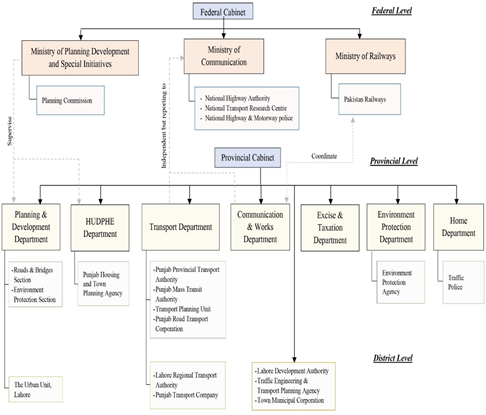
Existing studies report a lack of coordination among these transport departments due to their conflicting roles and responsibilities (Imran, 2010; Meakin, 1998). The problem is even more severe regarding the urban public transportation system. According to Imran (2009), the national government neither offered public transportation operations nor introduced urban transportation services. Instead, it encouraged the provincial government to hand the operating system to private companies. However, with the introduction of the Punjab Mass Transit Authority (PMA), public transport dynamics have improved in major cities, such as Lahore. The detailed hierarchy of the transport-related institutions is presented in Figure1.
Existing Policies and Planning Documents on TransportThis section explains the transportation policies and plans prepared by national, provincial, and district governments. The following sub-section reviews the planning commission documents. Following that, the transportation development strategies of 'other' federal and provincial ministries would be addressed.
Planning Commission DocumentsAs previously stated, the Planning Commission is the leading planning agency that prepares transportation policies at the national level. This section reviews the related plans and policies formulated by the Planning Commission. Table 3 summarizes the five-year development plans, vision documents, and other policies prepared by the Planning Commission. The critical features of these documents would help analyze how well they meet older adults' transportation needs.
Table 3 Relevant Documents Prepared by the Planning Commission
|
Document |
Description |
|---|---|
|
1st Five-Year Plan 1955-1960 |
· Transport was considered vital and allocated 17.8% of the overall development budget · Simultaneous road-based transportation and a railway system · Proposed a 'planning cell' within each ministry |
|
2nd Five-Year Plan 1960-1965 |
· Emphasized transport and communication along with socio-economic growth priorities · Suggested to prepare a long-term development plan for transport · Proposed to conduct surveys and collect rigorous statistical or quantitative data to understand transportation needs · The transportation sector was provided with 17.63% of the overall development expenses. Within this, 55% was set aside for roads and 45 percent for railways |
|
3rd Five-Year Plan 1965-1970 |
· Improved and reliable transportation was considered necessary for quick economic growth · Advocated a thorough reorientation, reconstruction, and modernization of the transport system, for instance, upgrading existing facilities and geographical expansion of roads · Road transport was particularly preferred in West Pakistan |
|
4th Five-Year Plan 1971-1976 |
· Traffic surveys, accessibility demands, and land use plans should be utilized to frame the relevant transport strategies · Stressed the importance of road transportation investment · Emphasized an integrated approach to urban growth, including transport · Road widening, providing parking spaces, and better mass transport facilities are the solutions to the poor transport system · Stressed the preparation of a 'traffic and transportation plan' for each metropolitan area |
|
5th Five-Year Plan 1977-1983 |
· Despite introducing new public buses, the plan recognized that urban passenger transportation was insufficient · For the first time, urban development was addressed in a separate chapter · In addition to offering more transportation options, measures were suggested to reduce people's travel needs |
|
6th Five-Year Plan 1983-1988 |
· Enhanced the public-private relationship in urban transportation · Aimed to quadruple public transportation's fleet size by the conclusion of each planned year · Suggested rising transportation fares to attract private-sector investment · Facilitated transportation research by allocating fifty million rupees to the development of the National Highway Research Institute and thirty million to the National Transport Research Centre (NTRC) |
|
7th Five-Year Plan 1988-1993 |
· Prioritized road development in contrast to other transportation modes · International financing in shaping medium-term development plans · Highlighted the need for comprehensive traffic studies to meet travel demand · Proposed welfare programs explicitly for older adults, for instance, travel concessions for trains and buses |
|
8th Five-Year Plan 1993-1998 |
· Road transport was preferred because it would contribute to economic growth · The need for more mobility was stated as a cause for road investment · No evidence of the travel quality or accessibility of disadvantaged population groups was found |
|
Medium-term Development Framework (MTDF) 2005-10 |
· Also advocated road construction and road transport investments · Even in the 'urban development and housing' segment, 61% of the Public Sector Development Programme (PSDP) was set aside to build urban flyovers, interchanges, and underpasses · No allocation for non-motorized and public transport |
|
Pakistan Vision 2030 |
· Conceived cities as "engines of economic growth" · Considered transport planning is essential to enhancing the life quality and economic functioning of urban areas · Envisioned that: "We must prepare for the aging of our population and issues related to caring for the aged in 2030" |
|
Pakistan Framework for Economic Growth 2010-15 |
· Transportation was integrated into a broader and more inclusive view of communication, including technological, physical, and social interactions · Public transport modes were considered the least preferred transport modes · Suggested a road-based and rail-mix network |
|
11th Five-Year Plan (2013-18) |
· Targeted to develop an integrated transport system in order to improve regional connectivity · Aimed at road development and railway line expansion but urban public transport was not prioritized |
|
Pakistan Vision 2025 |
· Stressed 'sustained and inclusive higher growth' · Prioritized regional transport connectivity |
|
12th Five Year Plan (2018- 23) |
· Considered the PSDP as the most significant policy tools · Transportation and logistics allocated for 33% of the PSDP · Proposed the introduction of a multi-modal transportation system |
|
National Transport Policy of Pakistan, 2018 |
· Aimed to develop a transportation system that supports efficient, accessible, safe, secure, inclusive, and environmentally sustainable access and mobility · Specified guiding principles for various aspects of transportation, including road networks, railways, airports and aviation, ports and shipping, transport logistics, urban transportation, and legislative and institutional frameworks · Congestion, ineffective traffic management, and a shortage of public transit initiatives are identified as vital concerns that must be addressed · Demand, cost, and socio-environmental impacts must be considered to increase acceptance of rail mass transit systems |
It can be seen from Table 3 that the Planning Commission has actively worked and prepared long-term national policies. The work started soon after independence in 1947, and the first national five-year plan was launched in 1955. Each five-year plan set the targets, and the proposed strategies were addressed in each consecutive plan till the eighth five-year plan (1993-1998). After the eighth plan, the government switched to the national development frameworks as an alternative to the five-year development plans. Similarly, long-term vision documents were proposed to support the development frameworks. However, the focus shifted back to the five-year plans due to the inadequacy and limited scope within these frameworks. Thus, in 2013, the eleventh five-year plan was launched. The twelfth five-year plan was recently implemented in 2018. Similarly, the Planning Commission proposed a national-level transport policy to address the transport issues in 2018.
Provincial and District Level Transport DocumentsTable 4 summarizes the urban transport plans for the Lahore district prepared by relevant provincial and district institutions to analyze the extent to which older adults' transportation issues have been discussed in these plans.
Table 4 Provincial and District-level Transport Plans and Policies for Lahore
|
Document |
Description |
|---|---|
|
Master Plan for Greater Lahore (1965 –1980) |
· Housing and Physical Planning (H&PP) Department of Punjab started preparing the Master Plan for Greater Lahore in 1961. However, the plan took five years to complete and was referred to the Provincial Government for adoption in 1966 · Lahore was proposed as a metropolis with self-sufficient industrialized towns on the outskirts · Proposed a green belt around Lahore · The major transport initiatives include the ring road, complemented by a circular railway, new bridges, grade-separated intersections, multi-story and underground parking, and cycle tracks on major roads |
|
Lahore Urban Development and Traffic Study (1980 –2000) |
· The study was jointly prepared by international experts, World Bank consultants, and local consultants for LDA · Future growth in the South and Southwest axes was expected and thus, sufficient transport infrastructure was proposed · Mainly focused on constructing new roads with the least preference for public transportation, for instance, constructing a ring road · Proposed TEPA to manage the transport infrastructure |
|
Model Urban Transport System in Lahore, 1980 |
· Volvo International Development Corporation conducted this study · The project included transportation planning, vehicle provision, capacity building, and structural transformation · It specified a Trip Generation Model that could be used to forecast travel demand · Reported various concerns for an effective bus-based public transportation network in Lahore · Advocated for a public-private bus-based public transportation system, and as a result, the Swedish Government donated 350 Volvo buses to Lahore, which were included in the fleet |
|
Punjab Urban Development Project (1988 –1997) |
· It was a World Bank-funded project · Emphasized the training of local organizations to upgrade the geometric design of existing roads in Lahore and drive forward the long-stalled Ring Road proposal · The main focus was on the improvement of road geometry, and public transport was neglected |
|
Comprehensive Study on Transportation System in Lahore (1990 –2010) |
· Conducted with the financial and technical support of JICA · Proposed grade-separated road, a network of semi- and full ring roads, and most importantly, a light-rail transit system in Lahore |
|
Lahore Roads Rehabilitation Project, 1997 |
· Launched and funded by the Punjab government · Aimed to transform primary roads, repair secondary and tertiary roads, and build grade-separated overhead bridges and underpasses on railway lines |
|
Urban Public Transport Policy, 1998 |
· Concluded with the assistance of the World Bank and foreign experts · Emphasized introducing a bus-based public transit system on a contract basis, where the government serves as a regulatory body and the private sector deals with the operations |
|
Integrated Master Plan for Lahore (2001–2021) |
· Prepared by national experts in early 2000 · The plan prioritized the urban road network and ring road development while discounting the potential of improving the public transportation system · Correspondingly, a limited budget was allocated to the public transport domain · It was mainly a road development plan, not an inclusive transportation plan |
|
Medium-Term Development Framework for Punjab, 2005 |
· The provincial government formulated and implemented it during 2006-09 · The foundation of an Urban Commission to devise comprehensive urban policies was one of the proposed objectives within this framework · Suggested the Provincial Urban Transport Policy as a guideline to steer the Comprehensive Urban Transport Strategy for Lahore · This framework proposed preparing future urban development plans and emphasized improving urban transport |
|
Lahore Rapid Mass Transit System (LRMTS) |
· MVA Asia Ltd. (foreign consultants) performed a study and generated proposals for a mass transit system in Lahore · Recommended a Lahore Rapid Mass Transit System (LRMTS), comprising a rail-based four-line network · The rail system was proposed based on the success of previously introduced air-conditioned franchised buses |
|
Lahore Urban Transport Master Plan (LUTMP) 2030 |
· Comprise numerous strategies and projects for traffic management, highway network development, and, most importantly, public transport improvements · Based on the concept and findings of LRMTS, proposed rail-based mass transit system (RMTS) and bus rapid transit (BRT) systems · Proposed four rail-based transit lines. Green and Orange Lines were scheduled for the first phase, while Purple and Blue lines for the second phase · Proposed comprehensive BRT network and integrated ticketing mechanism to link overlapping routes and reduce transfer delays · The plan suggested operating BRT on the RMTS corridor if there is a ten-year gap before RMTS supplements it |
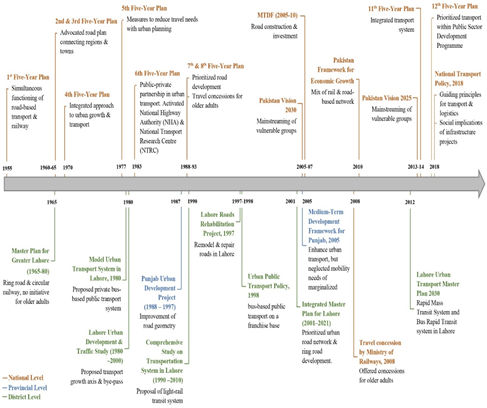
The above table depicts numerous plans and strategies that were prepared in the past to guide urban transport in the Lahore district. However, transportation has been discussed exclusively, along with the specific transport master plans and the overall urban master plan. Similarly, it was debated within the provincial urban policy and medium-term development framework. Thus, it provided a variety of dimensions to manage transport issues in the Punjab and Lahore districts. The detailed timeline showing the visual summary of all policies and plans is provided in Figure 2.
Figure 2
Timeline of the Relevant Transport Policies and Plans Implemented
Discussion
This section discusses the critical issues and loopholes in the current policies, plans, and programs carried out in Pakistan regarding transportation policies that consider older adults' mobility needs. The section is divided into four parts: issues and gaps in the national and provincial/district level policies are separately discussed, and problems have been identified.
National-level Policies on TransportThe transportation sector has been significantly identified and discussed in the aforementioned national vision documents and five-year plans from the very start. As a result, the transportation sector has been considered vital for the country's economic growth and has received significant budgetary allocations throughout the timeline. However, several issues persist in these plans.
Road Development and Inter-regional ConnectivityAlmost all the plans, including MDTF and economic framework, advocated road construction and transport investments. Developing roads to provide regional connections remained the primary goal. Even in the urban development segments, most financial capital was set aside for road widening and building urban flyovers, interchanges, and underpasses. The preference for road transport was maintained in most of the plans, with the premise that it would contribute to the speedy economic growth of the country. However, promoting urban public transport was not prioritized and gained little attention. Moreover, the non-motorized and public transportation sectors were not allocated any funds, even in major cities of the country.
No Integration of Transport in Urban Development PlansThe importance and need to incorporate the transport dimension in the urban development agenda were identified even in the initial five-year plans. For instance, the 2nd five-year plan advocated forming a long-term transportation development plan that subsequent development plans can pursue. Similarly, the fourth five-year plan stressed the significance of a comprehensive approach to urban growth and transportation. However, most of the subsequent plans did not follow the suggestions. Although it was stated in recent five-year plans and vision documents, urban public transit was not thoroughly discussed, particularly its inclusion in the overarching urban development framework.
Lack of Focus on Older Adults' Accessibility and MobilityDetailed research, rigorous statistical or quantitative surveys, and travel data collection were required to better understand transportation needs. Likewise, the fourth five-year plan revealed the importance of traffic predictions, accessibility, and land use transportation planning to shape transport strategies. In this regard, the sixth five-year plan also facilitated transportation research by allocating 50 million rupees to the development of the National Highway Research Institute and 30 million to the NTRC.
However, the transport and urban development plans failed to incorporate older adults' mobility needs, except for travel concessions for trains and buses for older adults. Even Pakistan Vision 2030 stated, "We must prepare for the aging of our population and issues related to caring for the aged in 2030". Yet, it overlooked the significance of accessible transport for older adults' development. Similarly, the later plans and policies provide no evidence of the travel quality or accessibility for older adults.
The recent National Transport Policy 2018 also did not outline the problems of older adults' transport in the urban context of Pakistan. Indeed, the words "older adults" and "senior citizens" are not featured in the policy document. However, when it comes to using public transit, it relates to all users. All initiatives and programs should address older adults' mobility and transportation issues.
Insufficient Community Participation in Policy FormulationSince engineers, designers, and planners are considered experts in the transport sector, it is generally believed that transportation is a specialized realm in which the general public appears to have limited knowledge. According to the National Transport Policy 2018, the consultation process includes arranging meetings with key stakeholders in the transportation sector, drafting discussion papers for dissemination to stakeholder groups, delivering workshops to present findings, and encouraging participant feedback and suggestions. Nevertheless, the needs of the general public—especially those of older adults—are frequently disregarded in this consultation process. They are, therefore, incapable of expressing their issues or bringing up a discussion of their transportation needs.
Changing Priorities of Policymakers and Poor Implementation of PlansAlthough legislative mechanisms rely heavily on 'expert' and 'technical' competence, the individual in charge of the policymaking organization also has a significant impact. For instance, while five-year plans and other medium or long-term plans are formulated in the planning commission, these seem practically meaningless when the 'person at the top' goes. Similarly, there is no assurance or recognition of the development plans when a new leader takes control. Hence, the change in the priorities of policymakers and leaders ultimately hinders the effective implementation of programs.
Provincial or District-level Policies on Transport
Transport development has also been prioritized and discussed at the provincial and district levels. As a result, provincial policies and district master plans have jointly been implemented and complemented. Evaluating the public transport policy and planning documents prepared for the Lahore district has provided an intriguing example of how policy paradigms have evolved, been gradually modified, and retained. Regardless of the undeniable benefits that public transportation policies and plans could have brought, the review provided several flaws in the policy implementation and development. It is summarized as:
Focus on Road Development and WideningNumerous urban transport plans have been prepared and implemented in the past. However, somehow, these plans primarily focused on road development and widening and neglected the significance of public transport. For instance, the Integrated Master Plan for Lahore (2001–2021), which was supposed to provide guidelines and strategies for urban transport, more likely emerged as a road development plan. In addition, the Punjab Urban Development Project and Lahore Roads Rehabilitation Project, which were initiated in 1988 and 1997, failed to consider the public transport aspects and focused mainly on road development and the improvement of road geometry.
Insufficient Institutional Capacity and Lack of Investment in Public TransportNumerous efforts have been made in public transport provision but the lack of institutional capability for planning and managing public transport initiatives has resulted in the abandonment of many projects. For instance, during the late 1990s and early 2000s, some efforts were made by the Urban Public Transport Policy of 1998, which led to a slight improvement in the public transportation system of Lahore, and over 700 new buses began service on various routes. However, due to the limited functional capacity within the Transport Department, the government was unable to have much influence.
Some attempts were also made to improve the institutional capacities, however, they largely failed. Notably, the Lahore Urban Development and Traffic Study (1980 –2000) suggested deregulation of the institutional structure. As a result, the Transport Engineering and Planning Unit (TEPU) was founded to manage and plan the transport infrastructure. Similarly, some institutional reforms were also made in 1977, where the private sector was encouraged to compete with government-owned bus services. Punjab Road Transport Corporation (PRTC) and Punjab Urban Transport Corporation (PUTC) were founded in this regard. However, the public sector could not manage its projects despite these initiatives.
Lack of Government Interest and Investment in Public TransportOver the years, there has been little attention from the government and insufficient funding allocated to public transportation infrastructure programs. Moreover, corporate consultants and foreign funding organizations were mainly tasked with planning and implementing other public transportation projects. For instance, PUTC and Volvo International Development Corporation collaborated and launched a Model Urban Transport System project for Lahore in 1980. As a result, 350 new Volvo buses were introduced into the fleet. However, PUTC did not advance its fleet to meet the increased demand and extended the bus route system in Lahore. Resultantly, PUTC attempted to entice the private sector by introducing a franchise bus scheme on exclusive routes operated and monitored by the private sector. However, all these attempts remained unsuccessful, and PUTC bus services began to dwindle. Thus, new buses were not bought, which shows a lack of government intent. As a result, the PUTC-managed public-owned bus system in Lahore crumpled just after a few years of service. The above-said example also reveals the government's reliance on international and private experts and its lack of intent to invest in and improve public transport infrastructure.
Political BarriersThe influence of politics has consistently been a major barrier to the execution of development initiatives. Good urban transportation ideas have repeatedly been abandoned due to a lack of strong political leadership. For instance, a circular railway was proposed in the Master Plan for Greater Lahore (1965 –1980). It was pretty influential in connecting the peripheral areas with the city center. However, regardless of the innovative efforts, the circular railway as a mass transit did not provoke the interest of concerned stakeholders. Similarly, the Lahore Urban Development and Traffic Study (LUDTS) in 1980 again emphasized the Lahore Ring Road and circular railway Project. Still, it failed to create adequate public and non-motorized transportation plans for Lahore due to political pressure. Moreover, the 'Comprehensive Study on Transportation System in Lahore' in 1991 highlighted and proposed the light-rail transit system. However, political reasons again hindered the development of these transit services.
Neglected Travel Needs of Older AdultsRegardless of the innovative efforts over the years, older adults' public transport and mobility needs have largely been neglected. Except for the few fiscal measures taken by PMA and PTC, such as 'Free Transport Card', which permits older adults and people with disabilities to ride PTC buses throughout the city of Lahore for free, and 'discounted tickets' for metro services, all the transport plans and policies were dealt technically.
Even though different strategies were proposed in the Medium-Term Development Framework for Punjab to improve urban transport, it also failed to address the public transport issues and older adults' travel needs. Similarly, the recent Lahore Urban Transport Master Plan (LUTMP) for 2030, which discretely focused on providing a mass-rapid transit system, does not consider the distinctive mobility needs of older adults. Thus, most provincial policies and district transport plans have failed to address the public transport issues and older adults' travel needs.
ConclusionThis study reviewed the existing institutional framework and transport policies and plans implemented in Pakistan, focusing on Lahore metropolitan. The main objective of this study was to emphasize how far these transport policies are effective and have addressed older adults' mobility needs. The findings are based on a comprehensive review of existing policies in the transport sector with a particular emphasis on older adults' needs. The findings suggested that no long-term and systematic endeavor has been introduced in Pakistan to improve older adults' mobility besides intermittent interventions on transportation issues. Equally, this concern has not been seriously addressed in planning and policy documents at various levels.
One of the challenges is the bureaucratic structure and limited coordination among policymaking organizations. Poor coordination contributes to and exaggerates rivalry among different organizations. Furthermore, where older adults' transport and accessibility needs are acknowledged, potential 'solutions' are mainly technical. Notably, this ignores the critical needs and limitations on older adults' mobility and the need for widespread attitude change to ensure that older adults have little trouble accessing and using public transportation. Besides, older adults are excluded from and do not participate in the policymaking process. This is because planners and engineers dominate the transportation sector, which is regarded as a 'technical' area in which the general public, particularly older adults, has no role. This exclusion leads to the implementation of transportation policies that fail to recognize older adults' complex travel needs. As a result, transportation policy ignores 'age-friendly characteristics'. Consequently, the development policy for older adults becomes 'transport or mobility blind'.
Future RecommendationsThis study offered the following recommendations to improve transportation for older adults in Lahore, Pakistan. Firstly, policies must integrate their needs into all transport plans and develop a long-term strategy. Furthermore, inclusive policymaking should involve older adults in decision-making processes. Secondly, a centralized body should oversee coordination among institutions to avoid bureaucratic rivalry. Thirdly, solutions must address social and psychological factors, not just technical ones. Fourthly, design standards should ensure age-friendly and barrier-free access, while subsidized transport and paratransit services enhance accessibility among older adults. Fifthly, continuous monitoring and public awareness campaigns can further support implementing and improving these policies.
Conflict of Interest
The authors of the manuscript have no financial or non-financial conflict of interest in the subject matter or materials discussed in this manuscript.
Data Availability Statement
The data associated with this study will be provided by the corresponding author upon request.
Funding Details
This study is a part of the doctoral research of the first author, conducted at the Faculty of Built Environment, Universiti Malaya, Malaysia. The authors also acknowledge the financial support from the Higher Education Commission (HEC), Pakistan (SAP # 50035725) for conducting this research.
REFERENCES
Ahacic, K., Parker, M., & Thorslund, M. (2000). Mobility limitations in the Swedish population from 1968 to 1992: Age, gender and social class differences. Aging Clinical and Experimental Research, 12(3), 190–198. https://doi.org/10.1007/BF03339836
Ahmad, Z., Batool, Z., & Starkey, P. (2019). Understanding mobility characteristics and needs of older persons in urban Pakistan with respect to use of public transport and self-driving. Journal of Transport Geography, 74, 181–190. https://doi.org/10.1016/j.jtrangeo.2018.11.015
Al-Rashid, M. A., Harumain, Y. A. S., Goh, H. C., & Ahmad, Z. (2021). Psychosocial factors of public transport users and social inclusion implications among older women in Pakistan. Journal of Urban Planning and Development, 147(4), Article e04021046. https://doi.org/10.1061/(ASCE)UP.1943-5444.0000727
Al-Rashid, M. A., Harumain, Y. A. S., Goh, H. C., & Campisi, T. (2023). Psychosocial barriers to public transport use triggers older adults' social exclusion: Empirical evidence from Pakistan. Journal of Urban Planning and Development, 149(1), Article e04022050. https://doi.org/10.1061/JUPDDM.UPENG-4097
Al-Rashid, M. A., Nadeem, M., Campisi, T., Shamsul Harumain, Y. A., & Goh, H. C. (2022). How do psychosocial barriers shape public transport use? A mixed-method study among older adults in Pakistan. Sustainability, 14(19), Article e12471. https://doi.org/10.3390/su141912471
Banister, D. (2005). Unsustainable transport: City transport in the new century. Taylor & Francis.
Banister, D. (2008). The sustainable mobility paradigm. Transport Policy, 15(2), 73–80. https://doi.org/10.1016/j.tranpol.2007.10.005
Bashir, S., & Nazir, S. (2022). Burden of diseases among elderly in Pakistan. Pakistan Institute of Development Economics. https://ideas.repec.org/p/pid/kbrief/202257.html
Cheema, A. N. (2013). Upcoming picture of ageing population: Pakistan. Quality & Quantity, 47(5), 2399–2413. https://doi.org/10.1007/s11135-012-9660-0
Chodzko-Zajko, W. J., Proctor, D. N., Singh, M. A. F., Minson, C. T., Nigg, C. R., Salem, G. J., & Skinner, J. S. (2009). Exercise and physical activity for older adults. Medicine & Science in Sports & Exercise, 41(7), 1510–1530. https://doi.org/10.1249/MSS.0b013e3181a0c95c
Fan, A., & Chen, X. (2020). Exploring the relationship between transport interventions, mode choice, and travel perception: An empirical study in Beijing, China. International Journal of Environmental Research and Public Health, 17(12), 1–19. https://doi.org/10.3390/ijerph17124258
He, S. Y., Cheung, Y. H., & Tao, S. (2018). Travel mobility and social participation among older people in a transit metropolis: A socio-spatial-temporal perspective. Transportation Research Part A: Policy and Practice, 118, 608–626. https://doi.org/10.1016/j.tra.2018.09.006
Haustein, S., & Siren, A. (2014). Seniors' unmet mobility needs - how important is a driving licence? Journal of Transport Geography, 41, 45–52. https://doi.org/10.1016/j.jtrangeo.2014.08.001
Hui, V., & Habib, K. N. (2014). An investigation of transport-related social exclusion of the at-risk community (homeless people) in Toronto, Canada. National Academies. https://trid.trb.org/View/1287880
Hussain, M., & Kokab, R. U. (2012). Eighteenth amendment in the constitution of Pakistan: Success and controversies. Asian Social Science, 8(1), 81–88. https://doi.org/10.5539/ass.v8n1p81
Ignaccolo, M., Inturri, G., Giuffrida, N., & Torrisi, V. (2016, November 24–25). Public transport accessibility and social exclusion: Making the connections [Paper presentation]. Proceedings of the 3rd International Conference on Traffic and Transport Engineering, Belgrade, Serbia.
Imran, M. (2009). Public transport in Pakistan: A critical overview. Journal of Public Transportation, 12(2), 53–83. https://doi.org/10.5038/2375-0901.12.2.4
Imran, M. (2010). Institutional barriers to sustainable urban transport in Pakistan. Oxford University Press.
Islam, B., Li, T., Ibrahim, T. I., Yang, D., Lv, H., Zhang, Q., Xu, M., Gassara, G., & Wang, J. (2025). The relationship between levels of physical activity, adherence to the MIND diet, and cognitive impairment in adults aged 65 years or older in Pakistan. Journal of Alzheimer's Disease Reports, 9, 1–13. https://doi.org/10.1177/25424823241290132
Kim, S. (2011). Assessing mobility in an aging society: Personal and built environment factors associated with older people's subjective transportation deficiency in the US. Transportation Research Part F: Traffic Psychology and Behaviour, 14(5), 422–429. https://doi.org/10.1016/j.trf.2011.04.011
Kenyon, S. (2011). Transport and social exclusion: Access to higher education in the UK policy context. Journal of Transport Geography, 19(4), 763–771. https://doi.org/10.1016/j.jtrangeo.2010.09.005
Krüger, F., Titz, A., Arndt, R., Groß, F., Mehrbach, F., Pajung, V., Suda, L., Wadenstorfer, M., & Wimmer, L. (2021). The Bus Rapid Transit (BRT) in Dar es Salaam: A pilot study on critical infrastructure, sustainable urban development and livelihoods. Sustainability, 13(3), Article e1058. https://doi.org/10.3390/su13031058
Lin, D., & Cui, J. (2021). Transport and mobility needs for an ageing society from a policy perspective: Review and implications. International Journal of Environmental Research and Public Health, 18(22), Article e11802. https://doi.org/10.3390/ijerph182211802
Lucas, K., & Stanley, J. (2013, July 15–18). Achieving socially sustainable transport in the development context [Paper presentation]. Anais da 13th World Conference on Transport Research, Rio de Janeiro, Brazil.
Meakin, R. (1998). The Lahore public transport policy and institutions study. The World Bank.
Mercado, R., Páez, A., & Newbold, K. B. (2010). Transport policy and the provision of mobility options in an aging society: A case study of Ontario, Canada. Journal of Transport Geography, 18(5), 649–661. https://doi.org/10.1016/j.jtrangeo.2010.03.017
Metz, D. (2003). Transport policy for an ageing population. Transport Reviews, 23(4), 375–386. https://doi.org/10.1080/0144164032000048573
Olawole, M. O., & Aloba, O. (2014). Mobility characteristics of the elderly and their associated level of satisfaction with transport services in Osogbo, Southwestern Nigeria. Transport Policy, 35, 105–116. https://doi.org/10.1016/j.tranpol.2014.05.018
Patil, D. S., Bailey, A., Yadav, U. N., George, S., Helbich, M., Ettema, D., & Ashok, L. (2022). Contextual factors influencing the urban mobility infrastructure interventions and policies for older adults in low- and middle-income countries: A realist review. BMC Public Health, 22(1), 1–13. https://doi.org/10.1186/s12889-022-13875-6
Ramírez-Saiz, A., Larriva, M. T. B., Martín, D. J., & Alonso, A. (2025). Enhancing urban mobility for all: The role of universal design in supporting social inclusion for older adults and people with disabilities. Urban Science, 9(46), 1–34. https://doi.org/10.3390/urbansci9020046
Rye, T., & Carreno, M. (2008). Concessionary fares and bus operator reimbursement in Scotland and Wales: No better or no worse off? Transport Policy, 15(4), 242–250. https://doi.org/10.1016/j.tranpol.2008.06.003
Sabzwari, S. R., & Azhar, G. (2011). Ageing in Pakistan—A new challenge. Ageing International, 36(4), 423–427. https://doi.org/10.1007/s12126-010-9082-z
Simon, D. (1996). Transport and development in the Third World. Routledge.
Tennakoon, V., Wiles, J., Peiris-John, R., Wickremasinghe, R., Kool, B., & Ameratunga, S. (2020). Transport equity in Sri Lanka: Experiences linked to disability and older age. Journal of Transport and Health, 18, Article e100913. https://doi.org/10.1016/j.jth.2020.100913
Tinella, L., Bosco, A., Traficante, S., Napoletano, R., Ricciardi, E., Spano, G., Lopez, A., Sanesi, G., Bergantino, A. S., & Caffò, A. O. (2023). Fostering an age-friendly sustainable transport system: A psychological perspective. Sustainability, 15(18), Article e13972. https://doi.org/10.3390/su151813972
United Nations. (2015). The world population prospects: The 2015 revision. https://www.un.org/en/development/desa/publications/world-population-prospects-2015-revision.html
Van Regenmortel, S., De Donder, L., Dury, S., Smetcoren, A.-S., De Witte, N., & Verté, D. (2016). Social exclusion in later life: A systematic review of the literature. Journal of Population Ageing, 9(4), 315–344. https://doi.org/10.1007/s12062-016-9145-3
Walsh, K., Scharf, T., & Keating, N. (2017). Social exclusion of older persons: A scoping review and conceptual framework. European Journal of Ageing, 14(1), 81–98. https://doi.org/10.1007/s10433-016-0398-8
Zhang, N., & Yang, Q. (2024). Public transport inclusion and active aging: A systematic review on elderly mobility. Journal of Traffic and Transportation Engineering, 11(2), 312–347. https://doi.org/10.1016/j.jtte.2024.04.001