

| Review | Open Access |
|---|
Exploring Sustainability through the Lens of Pakistani Artists |
 |
|---|
 Fariha Rashid* and Suffah Naeem
University of Home Economics, Lahore, Pakistan
Sustainability in fine arts represents a framework that incorporates environmental consciousness into artistic creation and production. This approach has influenced artists to prioritize the use of eco-friendly and energy saving techniques. Material selection is one of the important parts of this practice as it effects the environment and the aesthetics of the artwork. Artists are opting for recyclable, non-toxic and renewable materials to reduce waste and minimize carbon emissions. These materials carry their own stories and significance, giving an insightful meaning to the artwork. The move towards sustainability encourages artists to experiment with material in order to understand its impact on the environment along with its artistic presence. The research focuses on three Pakistani artists and their series of artworks which is particularly created on sustainability subject matter. The methodology adopted for this paper is qualitative along with analytical approach with a focus on visual analysis which is further supported by artist interviews and secondary literature. Key findings of this research are that in Pakistan sustainable art practice is not just a trend in creating art but it’s a step towards spreading awareness where material plays an important role. Through carefully selected material, artists create artworks that build a dialogue between the work and viewer. In future, these practices and introduction of new media can pave way for upcoming researches and artists to put conscious effort in creating art pieces that align with the environment.
1. INTRODUCTION
Art has always played its role in reflecting societal values and concerns. It captures the essence of cultural and environmental shifts. In recent years, the rise in environmental issues has led artists to think about incorporating materials that are energy efficient and waste minimizing. The effort spent in selecting material for art creation cannot be undermined; it has a direct influence on the environment as well as artistic expression (Jean, 2019). After independence, there were Western and Indian influences on Pakistani artists. To look at it from a different angle, these influences introduced a variety of media. Artists were experimenting in every genre with every available medium. The need of the hour was to create an identity by developing an indigenous style (Syed & Abdullah, 2015). By this time, ready-made material was available in art shops, and the laborious efforts of painting and surface making were left far behind.
Sustainability in art is not just a trend nor is it merely about replacing harmful material with eco-friendly ones. It changes how an artist feels about his society and environment. Unfortunately, not much data is available on such subjects in Pakistan apart from Western practiced data which creates a gap and also leads us to numerous questions related to artists. Are they really affected by the declining environment or are they simply following a global trend? Are the artworks reflecting material innovation? Are they depicting their own culture or society by any means? This paper addresses these questions by analyzing how Pakistani artists are rewriting their cultural identity by reducing their carbon footprint. Not only this, research contributes to the role of developing consciousness towards environment through engaging art pieces.
Literature ReviewSustainability in art has its roots traced back to the Environmental Art Movement, also known as Eco-Art movement emerged in late 1960’s as a response to growing environmental concerns, roughly 150 years after the second Industrial Revolution.
In recent years, sustainability in art has gained significance not only internationally but nationally too. According to Goldsmith, an art piece created consciously reduces carbon footprint and it creates a connection between artists and their environment, making them aware of their responsibilities (Goldsmith, 2021).
Ali mentioned that contemporary Pakistani artists are exploring themes of preserving the environment through art material and their subject matter. Numerous artists are creating art through scrap and mix media which brings to light the creative methods of waste utilization (Ali, 2021).
To have better understanding of sustainable material choices, it is important to consider what problems are caused by traditional (readymade/ factory made) art materials. The most readily available material includes acrylic, oil, synthetic brushes, and solvents with chemicals which are harmful both for our environment and health. Acrylic paints, though popular for their versatility and quick drying time, are made from petroleum-based polymers that are not biodegradable. The production of these polymers contributes to greenhouse gas emissions, and the disposal of acrylic waste can lead to micro plastic pollution (Chris, 2023). Traditional oil paints consist of natural oils and pigments, but the solvents used for cleaning and thinning—like turpentine and mineral spirits—are toxic and can emit volatile organic compounds (VOCs), leading to air pollution and health risks (Pandey & Kiran, 2020)
Revival of traditional techniques and preservation of culture has forced artists to revert to eco- friendly alternatives. Rather than relying on harmful substances artists are preferring materials that are much safer and easily available This dimension has led researchers to discuss the prospects of sustainable material being an important part of art and design practice. In Pakistan, numerous articles have been written on the importance of sustainability but most of them have not discussed how conceptually, artists are engaging with sustainability, using it to shape their artworks and reinterpreting its meaning. Addressing this issue can provide a new dimension to the relationship between artwork, material and ecology. Furthermore, it will give an identity to the South Asian context (Liaqat, 2023).
Innovative Sustainable AlternativesIn response to the environmental concerns, manufacturers have introduced reusable materials like plant-based dyes, mineral pigments and natural binders as these are biodegradable, and artists are trying to utilize them in their artworks. Gouaches and other water based acrylic paints are gaining popularity because not only are they easy to clean, they are also less toxic and give an impact similar to traditional oil colors.[1] Not only painters, but sculptors are also using recycled and upcycled materials such as scrap metal and wood. Numerous alternatives are available when it comes to painting surfaces including canvases made from recycled materials and natural fibre brushes as well (Akhter et al., 2024).
Methodology
This research is based on qualitative methodology which includes visual study, artist interviews and secondary literature review. The focus remains towards the understanding of artistic practices, selection of material and concept behind creating a sustainable art piece.
Research DesignThe research aims to examine how Pakistani artists are incorporating sustainable materials in their artworks, making it exploratory and interpretive. This case study is based on three artists, Naveed Sadiq, Raheela Abro and Adeela Suleman. The particular series discussed in the paper sheds light on their effort to achieve sustainable approach.
Data Collection- It includes analysis of the selected artworks in terms of subject matter, material and technicalities that represent sustainability.
- Interviews with artists build a narrative on what motivated them and the challenges they faced.
- Articles, exhibition reviews, interviews, statements and academic literature was examined to identify each artists’ effort.
This research is based on three artists which cannot represent the whole of Pakistani art community’s sustainable practice. Unfortunately, there was limited material available and due to this, an inclusive comparison with international artists was restrained. Further, this paper addresses current artistic practice, however, sustainability is an evolving field in which new developments are expected and may extend beyond the scope of this paper.
Results
In the contemporary art world, many artists are consciously making an effort in their material choices, and seeking alternatives that have less harmful impact. In Pakistan, oil painters used to paint with linseed oil but the process took ample time to dry. Though it had a shine to it but unfortunately due to time taking process of drying, many artists shifted to turpentine in order to produce more works in shorter span of time. Miniaturists always prepared their own paints but with the availability of chemical based opaque watercolours, the laborious process of paint making has also died (Dadi, 2017).
Recently, due to the rise in climate change issues and waste disposal problems, Pakistani artists are spreading awareness about the problem through their artworks by becoming mindful of ‘material use’. Not only are they voicing the issue but also providing solutions by introducing the traditional eco-friendly materials with advancement to incorporate in their artworks. Not every artist is consciously working under the concept of sustainability but most of them, in their own capacity, have produced at least one series of artworks that is based on environment friendly material.
Naveed Sadiq, a Karachi based miniaturist has re-started the technique of pigment making (Mirza, 2020). Artists working with other mediums have also explored sustainable options like how Adeela Suleman created a series where she worked with left over/ pre-existed fabric. Artisans were employed for embroidery. Here, not only an eco-friendly approach was used but the artist also created employment for the ones in need (Grosvenor Gallery, 2021).
Adeela Suleman is a contemporary Pakistani visual artist based in Karachi. Mostly, she has created sculptures with organic forms such as birds and flowers. Her art explores the problems of form and is intrigued with socio-political concerns which are deeply rooted in Pakistani contemporary culture. The medium she uses in the making of her sculptures are found objects from everyday household.
In her sustainable series, the material she opted for is fabric including banarsi silk, jamawar, raw silk and velvet (Figure 1).[2] The use of pre-existing fabric represents an eco-friendly approach towards art and environment. Here, the choice of material explains the motive of work. These fabrics forming two-dimensional art promote the usage of waste or pre-existing materials. It also represents the rebirth of traditional techniques where our heritage is celebrated. Suleman’s approach towards this art form fosters a meaningful expression as the use of fabric, stitching together leftover pieces, hand embroidery by employing artisans, along with the representation of traditional technique also minimizes carbon foot print (Suleman, 2021).
Figure 1
Memory May Be a Paradise, 2021, by Adeela Suleman. Acrylic on Canvas, 64 × 95 in (162.6 × 241.3 cm) (Suleman, 2021).
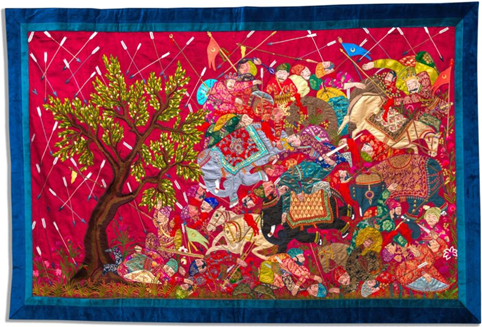
Regarding the content, this large-scale artwork draws inspiration from Manaku’s Pahari miniature titled “The Nightmare dream of the king: The Fearsome Aftermath of the Battle of Kurukshetra (circa 1740). This scene is from Mahabharat portraying the battle. Originally it was created in Pahari miniature painting style but Suleman gave it a new touch by incorporating fabric and embroidery (Manaku, ca. 1740).[3] Luxurious material such as jamawar and banarsi fabric, brocade and deep pink fabric is used to depict the violence and bloodshed. The details of the subject matter are fascinating yet among the violence caused by the battle rises a tree of life (Zia, 2021).
Raheela Abro, a visual artist from Karachi, promotes the United Nations Sustainable Development Goals through her work, with a special emphasis on quality education and responsible consumption.[4] One can see her dedication to these causes clearly reflecting in her artistic creations. Abro discusses the issue of technological waste, particularly focusing on the large amount of electronic waste produced in Pakistan through sim card. The improper disposal is the cause of severe environmental risk because of the release of toxic substances like mercury and cadmium into the environment, potentially harming both human health and ecological systems (Syed & Kandel, 2023).
Using SIM cards in both two-dimensional miniature paintings and three-dimensional sculptures, she offers a critical commentary on the environmental impact of electronic waste in Pakistan, a country with over 181 million cellular subscribers (Syed & Kandel, 2023).
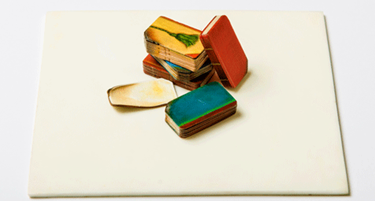
In her series titled “SIM”, which is based on ‘Souch, Ilm, Maqam', Abro explores the development of our society through identity and its relationship with technology.[5] This art piece combines the subject matters of communication, memory and knowledge. These brightly colored sim cards are placed in an irregular manner with rough edges highlighting two important points; one: the impermanence of technology, and second: the consequences of our reading habits. Once discarded, these sims are worth nothing as if they never served any purpose. By recycling them, the artist has opened up a new gateway to look at things in a different manner. It also invites viewers to contemplate on the connectivity and the leftover pieces which are no longer in use (Figure 2). The pandemic has highlighted the urgency of making education accessible and her works represent the transition to electronic devices as means of learning and teaching (Sheikh, 2021).
Figure 2
Miniature Books made-up with a Cell Phone's SIMs
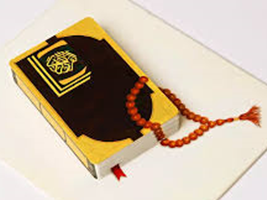
In another art piece she created a detailed and realistic representation of the Holy book, Quran.[6] On the cover one can see rich yellow and dark brown colours and on the bottom left corner a tasbeeh is painted.[7] This image is a representation of connectivity with faith and identity (Mirza, 2021). The whole composition is arranged on a white background which enhances the focal elements (Figure 3).
Figure 3
Holy Book Still Life with Cell Phone Sims
Naveed Sadiq is a Karachi based miniaturist who is known for his pigment making skills. He is reviving the age-old tradition of paint making through stone grinding. To be sure about his material and its impact along with paint making, he prepares his own wasli too (Ali, 2018).[8]His responsible behaviour proves that as an artist, he is mindful of his environment (Figures 4,5,6 & 7).
The artist doesn’t create, he participates in the creation, it’s not something we do; it’s a quality of being (Mirza, 2020).
In figure 4, the image explains the process of grinding paint through stone pestle and mortar, and storing it in jars to further create tints and shades. In figure 5, the artist is shown applying glue within sheets for wasli preparation.
Figure 4
Pigment Grinding
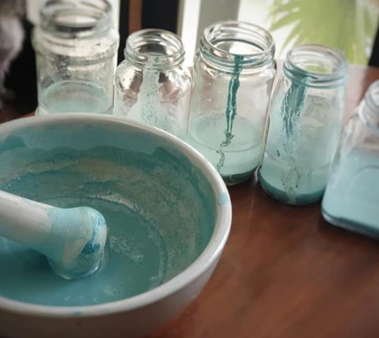
Figure 5
Wasli Making
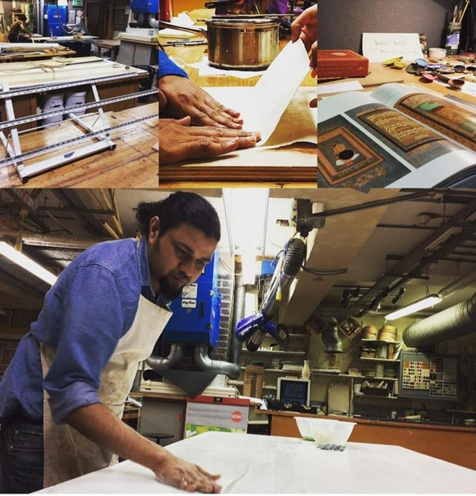
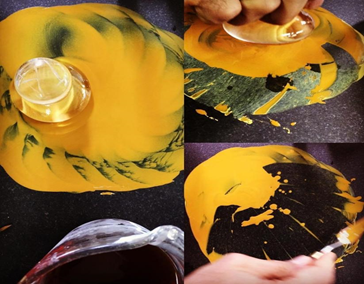
In Figures 6 and 7, it shows the laborious process of paint making by grinding the paint and making it grain free. Sadiq’s process and efforts as a post-modernist/ contemporary artist is ingraining towards the concept of sustainable usage of materials which are made from natural dyes and are bio-degradable without the usage of any chemicals.
Figure 6
Paint Making

Figure 7
Paint Making
Discussion
Artists all around the world in contemporary times are not only questioning self and identity, but are also well aware of their surroundings. Be it addressing the socio-political changes or the natural alteration of our environment. The post modernism mindset of the artist community not only evolved artists as independent beings but additionally made them aware of the works they were producing, the works and materials which are going to stay long after they will be gone. The move towards sustainable art practice is gaining popularity but several challenges remain. Sustainable materials are more costly and sometimes are difficult to obtain, requiring artists to adjust their techniques to accommodate new mediums.
The discussion identifies both challenges and opportunities in continuing artworks based on eco- friendly material. The most important challenge an artist faces is the high cost of material. On the other hand, if the awareness is increased through collaborative projects and trainings, more artists will adopt leading to easy access to environment friendly material.
The analysis integrates international studies, for example, Goldsmith (2021) explains how environment friendly artworks creates a bond between art and environment, and this can be seen in Suleman and Abro’s artworks where both created pieces with already discarded material. Ali (2021) states that numerous Pakistani artists create artworks from junk material which is again seen in Abro’s SIM card installations. Not only this, Liaqat (2023) defines Pakistani artists as someone who ignores their heritage but Sadiq’s work has defined the statement by reviving the age-old tradition of pigment making.
To conclude, the study results in the assertion that Pakistani artists are not just adopting the trend but are conscious of their surroundings and the efforts that need to be done to make this a better place for them and for the future.
Additionally, there is a pressing need for increased education and awareness regarding the environmental impacts of art materials and the advantages of sustainable alternatives. Despite the challenges, there are significant opportunities for innovations and collaborations. Artists, manufacturers, and institutions can join hands to develop new materials, enhance supply chains, and promote sustainable practices. Art schools and organizations play an important role in educating future artists about sustainability, thereby fostering a more environmentally conscious approach within the field. Further, such awareness can be built around selection of materials, art making processes and selection of themes for the nearer future.
Conclusion
To conclude, sustainability is not just a trend, neither a fashion. It is a solution to save the environment and make it liveable for future generations. Artists, being an important part of society, have provided a few solutions through their artworks within their limits which are beneficial. Sustainability is a responsibility and means to fill the gap between concerns and narrative but unfortunately challenges are there including higher costs and limited availability of eco-friendly material. This is not just the duty of artists but also of the manufacturers who are making paints and other materials to not opt for harmful substances.
Conflict of Interest
The authors of the manuscript have no financial or non-financial conflict of interest in the subject matter or materials discussed in this manuscript.
Data Availability Statement
Data associated with this study will be provided by corresponding author upon reasonable request.
Funding Details
The authors received no specific funding for this work.
REFERENCES
Akhter, P., Arshad, A., & Hussain, M. (2024). A review on environmental impacts of paints and strategies for producing eco-friendly paints. International Journal of Environmental Science and Technology, 22, Article e05760. https://doi.org/10.1007/s13762-024-05760-z
Ali, S. (2021, March 28). Exhibition: The art of war. Dawn. http://www.dawn.com/news/1615013
Ali, S. (2018). Reframing the miniature. Newsline. http://newslinemagazine.com/magazine/reframing-the-miniature/
Chris. (2023, May 12). Is acrylic paint natural or synthetic? Exploring sustainable options for your home. The Organic & Natural Paint Co. https://organicnaturalpaint.co.uk/faq/is-acrylic-paint-natural-or-synthetic-exploring-sustainable-options-for-your-home/
Dadi, I. (2017, September 14). A brief history of Pakistani art and the people who shaped it. Scroll.in. https://scroll.in/magazine/850531/a-brief-history-of-pakistani-art-and-the-people-who-shaped-it
Grosvenor Gallery. (2021, September 11–October 1). Patterns of the past: Weaving heritage in “Pakistani” art [Exhibition curated by Dr. Zehra Jumabhoy]. Grosvenor Gallery. https://www.grosvenorgallery.com/exhibitions/322/works/
Goldsmith, R. (2021). Sustainable art: The role of environmentally conscious creativity in contemporary art. Routledge.
Jean, H. (2019). Connecting art and science: An artist’s perspective on environmental sustainability [Doctoral dissertation, University of Vermont]. Scholar Works. https://scholarworks.uvm.edu/envstheses/54/
Liaqat, S. (2023). Found objects as art: Influence of Marcel Duchamp on contemporary Pakistani art. Journal of Development and Social Sciences, 4(3), 945–955. https://doi.org/10.47205/jdss.2023(4-iii)86
Manaku. (ca. 1740). “The Nightmare Dream of a King: The Fearsome Aftermath of the Battle of Kurukshetra,” Folio from the unfinished “Small Guler” Bhagavata Purana (The Ancient Story of God). The Metropolitan Museum of Art. https://www.metmuseum.org/art/collection/search/662767
Mirza, Q. (2020, January 5). Dissecting post modernity. The News International. http://www.thenews.com.pk/tns/detail/1592976-dissecting-post-modernity
Mirza, Q. (2021, August 22). A SIM-ful of messages. The News on Sunday. https://www.thenews.com.pk/tns/detail/880571-a-sim-ful-of-messages
Sheikh, N. (2021). Exhibition: Making a connection. Dawn. https://www.dawn.com/news/1645874
Pandey, P., & Kiran, U. V. (2020). Degradation of paints and its microbial effect on health and environment. Journal of Critical Reviews, 7(19), 4879–4884.
Suleman, A. (2021). Memory may be a Paradise 1. Artsy. https://www.artsy.net/artwork/adeela-suleman-memory-may-be-a-paradise-1
Syed, K., & Abdullah, S. (2015). Chronicling Pakistan's art movements from traditional to contemporary: 1960-2011. Wacana Seni Journal of Arts Discourse, 14, 31–58.
Syed, Z., & Kandel, D. (2023, May 3). Karachi artist Raheela Abro is using discarded SIM cards for her artwork. Arts Help. https://www.artshelp.com/karachi-artist-raheela-abro-discarded-sim-cards-sustainablity/
Zia, S. F. (2021, September 27). Fabric and frolic: A case of identity and belonging. The Karachi Collective. https://thekarachicollective.com/fabric-and-frolic/
Zia, S. F. (2018, September 2). Exhibition: The sacred grid. Dawn. http://www.dawn.com/news/1430118
[1]In the form of homemade curd made from soured skim milk, it has been a traditional adhesive and binder for more than eight centuries. Refined, pure, powdered casein, which can be dissolved with ammonia, has been used for easel and mural paintings since the latter 19th and early 20th centuries.
[2]banarsi silk (a fine quality silk variant originating from Varanasi, Uttar Pradesh, India), jamawar (a type of fabric made in Kashmir known for its intricate designs), raw silk (made from cocoon made by silkworms) and velvet (a luxurious, soft fabric known for its dense, plush pile)
[3]a style of Indian painting that originated in the Himalayan hill kingdoms from the 17th to 19th centuries.
[4]Adopted by the United Nations in 2015, these goals address global challenges, aiming to end poverty, protect the planet, and ensure prosperity for all by 2030.
[5]Souch means thoughts, Ilm means knowledge, Maqam means place.
[6]Holy book for Muslims.
[7]Tasbeeh- beaded necklace type for praying purpos.
[8]A handmade paper used for miniature painting