

| Review | Open Access |
|---|
A Sacred Journey through Time: Documenting Aesthetics, Material Decay, and Preservation Needs of Jamia Masjid Akbaria |
 |
|---|
 Muhammad Naeem Khalid*, Jahanzaib Qamar, and Tariq Mahmood
University of Southern Punjab, Multan, Pakistan
Masjid Akbaria, a magnificent mosque in Multan, Pakistan is renowned for its remarkable historical architecture and deep cultural significance. Constructed in the 20th century, it stands as a testament to the grandeur and artistic excellence of the British era. The mosque's intricate details, including delicate calligraphy, vibrant frescoes, and sophisticated structural elements, contribute to its historical and architectural significance. The current research examined the historical background, architectural features, and significance of the Masjid Akbaria's architectural style. Moreover, it underscored the value of mosque's elements and its magnificent design, incorporating documentation and aesthetic evaluation to support its preservation. Additionally, the study highlighted the crucial role of both local communities and governmental bodies in protecting this cultural heritage site. By blending traditional preservation techniques with contemporary conservation methods, it presented a comprehensive approach to restoring the mosque, ensuring its enduring function as a spiritual and cultural landmark.
1. INTRODUCTION
In Arabic, a "masjid" is a sacred space at the heart of Islamic practice, serving as a place for communal prayer, worship, reflection, and spiritual growth. Beyond its religious role, it also functions as a social and cultural center for the Muslim community. Architecturally, a masjid often features a prayer hall, a mihrab (a niche indicating the direction of Mecca), a minbar (a pulpit for sermons), and frequently a dome symbolizing the unity of the Muslim ummah under Allah’s guidance. More than just a place of worship, the masjid fosters a sense of collective identity by hosting educational programs, religious gatherings, and social services, reinforcing core values of peace, unity, and devotion to God. As a place of worship for Muslims, mosques are among the most frequently constructed building types in Muslim-majority countries, with numerous new mosques built each year. Compared to other building types within the Islamic architectural tradition, mosque architecture has undergone remarkable development and is now found in even the most remote parts of the world (Hillenbrand, 2000). However, many of these mosques often lack architectural design quality, resulting in structures that fail to harmonize with their surroundings and contribute to environmental disfigurement (Urey, Ozgur, 2013). It was within this context that scholarly research on mosque architecture began to emerge in Malaysia during the post-independence era. In the 1970s, formal academic inquiries were initiated by local universities through their newly established schools of architecture. These efforts, along with publications aimed at a broader audience—such as those by Nasir (1984), Rasdi (2000, 2007), and Hashim (2005), among others—have significantly contributed to the development of historical and architectural understanding in this field.
Literature Review
The notion that Islamic architectural development originated in the Arabian heartland before gradually spreading to the peripheries of the Muslim world is a recurring theme in numerous texts on Islamic architecture. The concentration of historical mosques and the wealth of existing documentation in this core region are evident in studies by Fletcher and Fletcher (1905) and Frishman and Khan (2007). This idea is reflected in references to the classical mosques of major Muslim empires, which often serve as architectural benchmarks for mosques elsewhere, as seen in the work of Michell (2006). A more commonly adopted framework divides mosque architecture into three historical periods: pre-colonial, colonial, and post-independence, as suggested by Yeang (1992). Meanwhile, the architectural diversity found in Southeast Asia is frequently generalized or oversimplified, as seen in the works of Al-Faruqi and Al-Faruqi (1986). This underscores a narrative shaped by the broader cultural and religious diffusion of Islam from its Arabian origins to the wider world. These texts offer a range of classification systems for mosque architecture.
Nasir (1984) proposed a stylistic and cultural distinction between influences from within the Malay world and those from outside it. An alternative categorization, used by Ahmad (1999) and Hashim (2005), classifies mosques into vernacular, colonial, and modern styles. Expanding further, Rasdi (2007) introduced a more detailed seven-part typology. This includes traditional vernacular, Sino-eclectic, colonial, North Indian, modern vernacular, modernist expressionism, and post-modern revivalism. The architectural typology seen in Arabia, Spain, and North Africa adopted a highly imitative form characterized by a hypostyle hall with a flat roof, occasionally accented by small domes above the mihrab and entrance. This design typically includes a surrounding sahn (courtyard), creating a continuous link around the mosque’s structure. The prominent use of domes became a characteristic of Ottoman and Central Asian Mosque typologies, which drew inspiration from the central-domed churches of the Roman Catholic tradition. These mosques typically feature one or more slender minarets. The main prayer hall is dominated by a large semi-circular dome, supported by half-domes on the sides to counterbalance the structural thrust of the wide span. Additionally, this typology often includes a perimeter sahn, usually covered with numerous small domes. Mosques in the Indian subcontinent were generally modeled after the Iranian style, particularly evident in the use of grand gateways. However, they are distinctly recognizable by their preference for bulbous onion-shaped domes and characteristic arches. Another notable feature is the expansive courtyard space, typically including a sahn (Rasdi, 2007).
Punjab, Pakistan, boasts a rich and diverse architectural heritage, with Multan, known as the "City of Saints" (Madina-tul-Aulya), standing out for its remarkable monuments spread across the region. Multan is particularly distinguished for its unique architectural style, especially in mausoleums and mosques (Salahuddin et al., 2024). In performing ritual prayer, a Muslim affirms personal faith in God, while group prayer reinforces a sense of belonging to the broader community of believers, recalling the first ummah of Prophet Muhammad (Peace Be Upon Him). The masjid serves as the focal point of communal prayer, acting as a bridge between the present and the early Islamic era (Khan, 1990). Any examination of contemporary architecture across different regions of the world must consider both the physical and visual context of a building, as well as the ideological choices that shaped its form. The built environment and its architectural models have been selectively valued, often more drastically than in pre-nineteenth-century traditions. Disruptions in the continuous adaptation and reinterpretation of past architectural symbols can be observed across all regions.
Methodology
This research adopted a qualitative, case-study-based approach to assess the current condition of Jamia Masjid Akbaria. The author conducted an on-site visit to systematically observe and document the mosque's existing physical state. Detailed photographic documentation and visual inspection methods were employed to identify signs of material decay. Emphasis was placed on the external elevation, aesthetics, architectural elements, and areas vulnerable to environmental exposure. Observations were recorded using field notes, sketches, and images to ensure an accurate representation of the mosque's present condition. The collected data served as a foundation to analyze the causes of rapid decay, including inadequate maintenance, environmental hazards, and the impact of aging materials. This methodology enabled a grounded understanding of the conservation challenges facing the historic structure.
Data Collection & Observational Study
Jamia Masjid Akbaria is situated near Multan along 9-KM Bosan Road near Ali University. The mosque is considered as an architectural masterpiece dating back to the 20th century and is a remarkable example of Islamic Art and Architecture (Figure 1). Renowned for its intricate calligraphy, exquisite frescoes, and grand structural elements, the mosque embodies the artistic and spiritual essence of traditional masjid architecture. However, over time, it has faced deterioration due to aging, environmental factors, and, to some extent, inadequate maintenance. As a significant cultural and historical landmark, preserving and documenting Jamia Masjid Akbaria is essential to safeguarding its rich heritage for future generations, ensuring it continues to reflect Multan’s legacy of Islamic monuments. Efforts in documentation and education would help uphold its status as a lasting symbol of Islamic architecture and cultural identity. Over the past 40 years, local authorities in the Islamic world have played a more significant role than individuals or neighborhood communities in the construction of urban mosques. They typically undertake mosque construction in three key contexts: within the existing urban fabric to establish a settlement's nucleus, along the periphery of communities, such as near a cornice or village entrance, or as an integral part of newly-developed urban areas, including new towns and suburban developments (Khan, 1990).
Figure 1Exterior View of the Jamia Masjid Akbaria

9-KM, Bosan Road, Near Ali University and University of Southern Punjab, Multan

Google Earth View (Left) of Masjid Akbaria Adjacent to Derbar Peer Syed Akber Shah, 30°17’18.56” N 71°31’10.51” E, Accessed on 25-3-25, and View of Masjid Akbaria Adjacent to Derbar Peer Syed Akber Shah (Right)

Functional Type
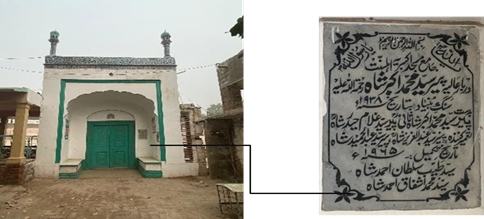
The foundation stone of the masjid marks its construction timeline, which began in 1938 and was completed in 1965. The mosque is closely associated with the esteemed figures, namely Syed Tayab Sultan Ahmad Shah and Syed Muhammad Asfaq Ahmad Shah and is situated near the mausoleum of Peer Syed Muhammad Akbar Shah.
Figure 4Jamia Masjid Akbaria Foundation Stone
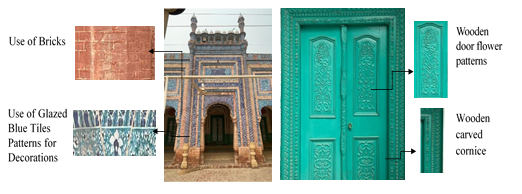
Bricks are used for masjid construction, blue tiles are used for aesthetics, and wood is used for doors.
Figure 5
Jamia Masjid Akbaria External Materials
Physical Condition
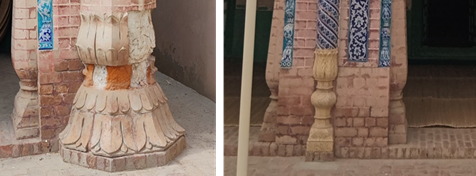
Building IntegrityThe overall physical integrity of the structure is well-maintained. However, moisture is visible on the DPC of the front elevation, which could potentially damage the architectural details in that section of the masjid.
Figure 6
External Materials Moisture is Visible on the Front Elevation
No areas of the building have been demolished.
Structural ConditionThe mosque's structural strength remains intact, reflecting both its continued use and the natural aging of its materials.
Architectural DescriptionMost scholars now agree that the Prophet’s (PBUH) Mosque, also known as Mescid-i Nebevi, serves as the architectural prototype for mosques, beginning in the early years of Islam, particularly during the caliphate of Omar. Over time, this mosque underwent expansions, eventually laying the groundwork for the Umayyad Mosque style. As Jeremy Johns notes, the concept of the Prophet’s
(PBUH) Mosque exerted such a profound influence on early Islamic religious architecture that it shaped the layout of nearly every Jamia Mosque constructed afterwards. According to Johns, Omar is "portrayed as an almost obsessive mosque-builder", having reportedly mandated that all congregational mosques follow a unified layout—an approach that ultimately became the architectural standard across Islamic religious buildings (Johns, 1999, pp. 69, 109, 110–112).
Jamia Masjid Akbaria, situated in Multan, Pakistan, is a significant historical mosque, showcasing a unique architectural style that harmoniously combines traditional Islamic and regional influences. Renowned for its grandeur and religious importance, the mosque follows a classic Islamic layout, featuring a prayer hall, verandah, and courtyard designed to accommodate large congregational gatherings, particularly during Eid and other religious occasions.
Figure 7
Plan of Jamia Masjid Akbaria. Scale: NTS
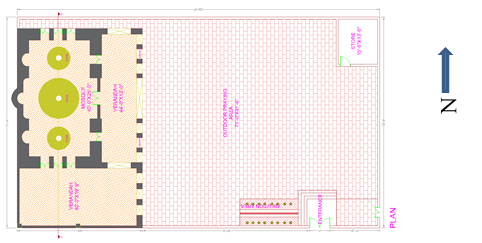
In detail, the mosque follows a rectangular layout, incorporating key architectural elements, such as a main prayer hall, a verandah on the east and south sides, and a spacious courtyard. This design enhances natural ventilation, provides shaded areas for worshippers, and facilitates smooth movement during congregational prayers. The courtyard serves as an open gathering space, accommodating larger crowds during significant religious events.
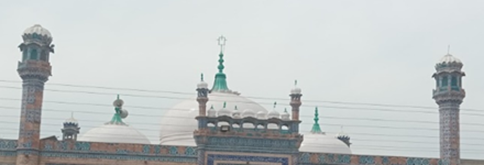
Domes and MinaretsMasjid Akbaria is distinguished by its three grand domes that elegantly crown the central prayer hall. Designed in a hemispherical style, these domes feature a lotus flower motif at the external center, complemented by intricate patterns and calligraphy. Beyond their aesthetic appeal, the domes serve a structural purpose by distributing weight efficiently. This enhances acoustics for prayer recitations and reinforces the mosque's spiritual ambiance. Their presence also establishes a strong visual identity, making the masjid a significant architectural and cultural landmark.
Figure 8
Domes and Minarets of Jamia Masjid Akbaria
Norberg-Schulz refers to the minaret as a "mere reminder of heaven", describing it as a vertical element that, standing relatively independent from surrounding structures, symbolizes an inherent connection between the earth and the sky (Norberg-Schulz, 1986, p. 12). Similarly, in Arabic liturgical tradition, the minaret is described as the "gate between heaven and earth" and is associated with the Arabic letter alif, which takes the form of a simple vertical line (Johnson, 1979, p. 173).
The mosque Akbaria is graced with four towering minarets, two positioned at the front and two at the back, enhancing the architectural grandeur of the prayer hall. These minarets, a defining feature of traditional Islamic architecture, serve both symbolic and functional purposes. They stand as cultural icons, representing the spiritual significance of the masjid, while also playing a practical role in the call to prayer (Adhan), guiding worshippers to congregational worship. Their strategic placement adds to the mosque’s visual harmony, making it a true masterpiece of Islamic design.
Figure 9
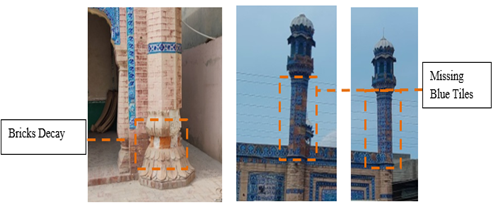
Decay of Materials on the Outer Façade of Jamia Masjid Akbaria
Creswell maintained that the primary function of the minaret was to facilitate the adhan, or call to prayer. In the earliest days of Islam, Muslims gathered for prayer without any formal summons. However, upon learning that Jews used a horn and Christians a naqus (clapper) for their religious calls, they sought a comparable method (Creswell, 1926, p. 137). One of the Prophet’s (PBUH) companions proposed using human voice, and after some consideration, the Prophet (PBUH) approved this idea and instructed his herald to call the faithful to prayer. Initially, mosques did not have minarets; instead, the adhan was delivered from city walls or the rooftops of mosques and nearby buildings (Bloom, 2001, p. 55).
The minarets at Masjid Akbaria are carefully proportioned to complement the scale of the prayer hall and other architectural elements of the masjid, ensuring visual harmony. They are adorned with intricate brick flower patterns at the base, while the shafts feature glazed blue tile decorations, adding to their aesthetic appeal. However, due to aging and environmental factors, some bricks at the base have begun to deteriorate (Figure 9) and several blue tiles are missing, disrupting the original pattern, as depicted in (Figure 9 and Figure 10). These signs of wear highlight the need for preservation efforts to restore the minarets to their former glory.
Facade and OrnamentationThe exterior of Masjid Akbaria is adorned with elaborate tile work, enhancing its architectural magnificence. The vibrant use of glazed tiles in shades of blue, green, and other striking colors reflects a hallmark of Islamic design, creating a visually captivating effect. On the eastern side, a verandah leads towards the main prayer hall, featuring a central entrance flanked by three gracefully arched passageways on both the left and right sides. This design not only contributes to the mosque’s aesthetic appeal but also provides a welcoming transition space, guiding worshippers into the sacred interior.
The entire front façade of the mosque is adorned with exquisite blue tiles and Quranic calligraphy on the exterior, enhancing its spiritual and artistic significance. The central entrance stands out with intricate detailing, featuring a prominent arch enriched with decorative elements. A defining architectural highlight is the iwan, a grand vaulted space that adds depth and grandeur to the entrance. Crowning this entrance are two small minarets and domes, further emphasizing the mosque’s majestic presence. These elements collectively contribute to the mosque’s aesthetic harmony and symbolic importance, as illustrated in Figure 9.
Figure 10
Verandah and External Entrance of Masjid Akbaria

The eastern verandah features elegantly crafted brick columns that enhance the architectural beauty of the mosque, seamlessly blending with the front elevation and showcasing masterful brick construction. These columns support a series of arches, creating a visually appealing and structurally balanced design. Above the arches, the square sections are adorned with intricate Quranic calligraphy, adding a spiritual and decorative element to the structure. This combination of craftsmanship and religious artistry highlights the mosque’s rich heritage and attention to detail in its construction.
Figure 11
Brick Columns and Calligraphy of Masjid Akbaria

Verandah: The front-side verandah features a series of intricately designed brick columns, enhancing the aesthetic appeal of the structure. Internally, it is adorned with beautifully inscribed Urdu poetry, adding a cultural and literary dimension to the space. The ceiling showcases exquisite wooden and floral patterns, reflecting the spiritual and artistic heritage of the mosque. These floral motifs, despite the passage of time, remain intact, preserving their historical and architectural significance. This enduring craftsmanship contributes to the sacred ambiance of the space, as illustrated in Figure 13 and Figure 14.
Figure 12
View of Verandah from Inside Out of Masjid Akbaria
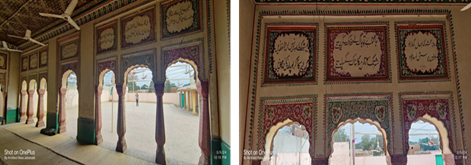
Figure 13
Celling View of Verandah from Inside of Masjid Akbaria

Figure 14
Internal View of Verandah from Inside of Masjid Akbaria
The central prayer hall of the mosque is crowned with three domes, with one large central dome (Figure 15, left) and two smaller domes on either side (Figure 15, right). This arrangement creates a sense of grandeur and spiritual elevation, enhancing the sacred atmosphere for worshippers. The large dome features two openings in its drum, allowing natural light to filter in and illuminate the interior. The surrounding walls and ceilings are adorned with intricate geometric patterns and Quranic calligraphy, reinforcing both the architectural beauty and the mosque’s spiritual significance.
Figure 15
Domes View of Masjid Akbaria
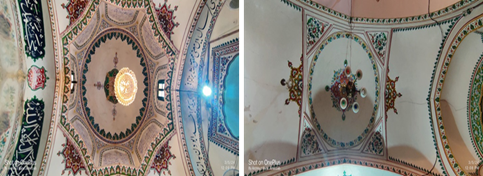
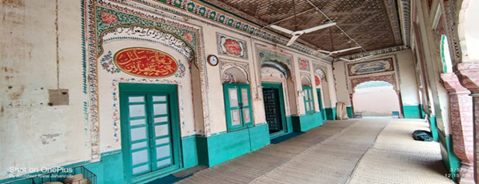
The verandah features three entrances leading into the main prayer hall, with the central door standing out as the most elaborately decorated compared to the two side doors. Both internally and externally, the central entrance showcases intricate ornamentation, enhancing its prominence as the primary gateway to the sacred space. The detailed craftsmanship reflects the mosque’s artistic heritage and spiritual significance, guiding worshippers into the main hall with a sense of reverence and grandeur.
The north and south walls of the mosque also feature doors leading into the main prayer hall, enhancing accessibility while allowing natural light and ventilation to flow through the space (Figure 16, left). These additional entrances contribute to the openness of the hall, creating a well-lit and airy environment for worshippers. One of the most significant and beautifully adorned elements of the mosque is the Mihrab, the niche indicating the direction of prayer. According to the mosque’s caretaker, gold water finishing has been applied to the Mihrab, adding to its grandeur and spiritual aura. Certain areas covered with polythene are believed to contain gold content, preserving the ornamentation and highlighting the mosque’s artistic and cultural heritage (Figure 17).
Figure 16
View of Entrance to Hall from Inside Out Masjid Akbaria

Figure 17
View of Entrance to Mihrab from Inside Masjid Akbaria
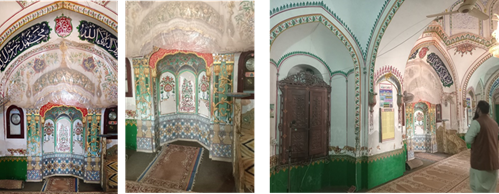
The interior walls of the mosque are adorned with intricate patterns, vibrant colors, and ornamental motifs, creating a visually captivating and spiritually uplifting environment. These artistic elements enhance the sense of reverence and devotion within the space. The grand domes, along with their elaborate decorations, contribute to the mosque’s majestic ambiance, making it a place of deep worship and connection to Allah’s greatness. Some of these stunning decorative features are illustrated in Figure 18, showcasing the mosque’s artistic and architectural heritage.
Figure 18
Decorations from Inside Masjid Akbaria
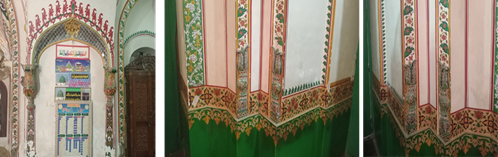
Table 1 Comparative study of Architectural Elements of Akbaria Masjid with Two other Masjids
|
Dominant Architectural Features in Jamia Masjid Akbaria Multan |
Dominant Architectural Features in Badshahi Masjid Lahore |
Dominant Architectural Features in Abbasi Shahi Jamia Masjid Derawar Fort |
|---|---|---|
|
Front verandah with arches |
Front verandah with arches |
Front verandah with arches |
|
4 corner minarets, central dominant iwan |
4 corner minarets, central dominant iwan |
4 corner minarets, central dominant iwan |
|
1 central large and 2 side small domes |
1 central large and 2 side small domes |
1 central large and 2 side small domes |
|
Main prayer hall divided internally in three segments covered with domes |
Main prayer hall divided internally in three segments covered with domes |
Main prayer hall divided internally in three segments covered with domes |
|
Finishes: Blue glazed tiles |
Finishes: Red sandstone |
Finishes: White marble |
|
Construction time 1938 |
Construction time 1671 |
Construction time 1835 |
 |
 |
 |
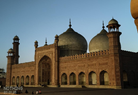
Table Shows the Comparative study of Architectural Elements of Akbaria Masjid with Two other Masjids. Table 1. presents a comparative analysis of the dominant architectural features of three Jamia Masjids located in different cities and built during different periods. While the structural and aesthetic elements remain consistent across all three mosques—reflecting the core characteristics of Indo-Islamic architecture in the region—the primary distinction lies in the choice of finishing or decorative materials. In Jamia Masjid Akbaria, glazed blue tiles are used not only as decorative elements but also to reflect the cultural identity and spiritual heritage of the 'City of Saints'. In contrast, the Badshahi Masjid in Lahore features red sandstone, which enhances the building’s grandeur and signifies the use of locally available materials. Meanwhile, the Abbasi Shahi Jamia Masjid Qila Derawar employs white marble as a finishing material, chosen for its ability to remain cool under the region’s extreme heat, making it both a functional and aesthetic choice suited to the local climate.
Analysis and DiscussionFigure 19
Beautiful Arial view of the Masjid Akbaria from South Side
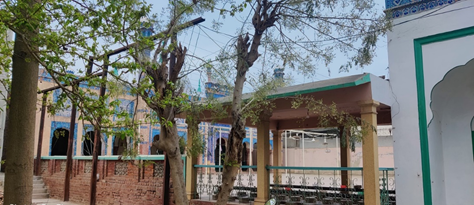
Jamia Masjid Akbaria serves as a vital center for the local community, functioning not only as a place of worship but also as a hub for social and educational activities. It provides space for religious gatherings, educational programs, and community events, fostering a strong sense of unity and spiritual growth. Architecturally, the mosque stands as a remarkable example of Islamic heritage, showcasing an exquisite blend of traditional elements, such as brick arches, domes, minarets, intricate calligraphy, and decorative tile work. Its design is deeply-rooted in the regional architectural legacy, harmonizing with the local climate through open courtyards for ventilation and shaded areas to offer relief from the intense heat.
Preservation Concerns and Conservation EffortsDespite its historical and cultural significance, Masjid Akbaria is experiencing material decay, particularly on its exterior, due to inadequate maintenance. Visible signs of considerable damage are apparent in various sections of the structure, posing a risk to its long-term preservation. If immediate restoration efforts are not undertaken, the condition of this valuable heritage site may continue to decline. While the overall structural integrity of the mosque remains stable, proactive conservation measures are essential to safeguarding its architectural beauty and cultural legacy for future generations. Restoration efforts would help ensure that this magnificent landmark continues to stand as a symbol of faith, history, and artistic excellence. Masjid Akbaria is currently facing rapid material decay, particularly on its exterior side, due to inadequate maintenance and exposure to environmental hazards. As illustrated in Figure 9, the base of the mosque’s main minarets is undergoing rapid decay. The upper sections of the minarets, adorned with glazed blue tiles, also exhibit considerable damage. This degradation stems from prolonged neglect, environmental factors, and a lack of community engagement, resulting in visible disruption to the original tile work patterns. Figure 1 highlights further deterioration along the parapet wall, which features elaborate glazed blue tile work. Missing tiles have led to a noticeable break in the visual harmony of the mosque’s front façade. Meanwhile, the verandah on the front elevation, supported by a series of intricately constructed brick columns (Figures 11 and 12), shows signs of advanced weathering and material fatigue. The brickwork, affected by age and environmental stressors, is deteriorating and could potentially compromise the building’s structural integrity if left unaddressed.
In Figure 12, four decorative bands of glazed blue tiles are visible above the shaft of the minarets. Damage to the second through fourth bands has resulted in discontinuities in the geometric tile patterns, further diminishing the mosque’s aesthetic coherence. The uppermost section of the minarets, also decorated with glazed tiles, is partially decayed, with surviving tiles no longer forming a complete pattern. Although no immediate structural failure was observed during the documentation process, the primary concern lies in the progressive degradation of the mosque’s decorative elements. Preserving these features is crucial to maintain the building’s historical and architectural integrity. Conservation efforts should prioritize the restoration and replacement of damaged or missing tiles to recover the original appearance of the façade. Ensuring structural stability through necessary repairs is also essential to prevent future deterioration. In addition, protective measures should be implemented to shield the mosque from further environmental damage, such as pollution and weathering. Engaging the local community and raising awareness about the cultural and historical significance of Masjid Akbaria is equally vital. Involving local stakeholders in the preservation process may foster sustainable conservation practices and ensure the mosque’s legacy is protected for future generations.
Traditional Techniques for ConservationTo ensure the preservation of this historical monument and to prevent further decay, the following traditional conservation methods can be employed:
DocumentationSystematic documentation of the mosque’s architectural features through photographs, drawings, and written records is essential to preserve its legacy for future generations.
Regular MaintenanceRoutine cleaning, upkeep, and timely repairs may help protect the monument from gradual damage and decay.
Use of Traditional Materials and TechniquesRestoration should incorporate historically accurate materials and methods to maintain authenticity.
Preservation of Original FabricIt is important to retain the original materials, craftsmanship, and historical elements that define the building’s cultural value.
Minimal InterventionConservation efforts should focus on necessary repairs to protect the site's authenticity. Engaging skilled local artisans familiar with traditional techniques helps ensure that the heritage is preserved with respect to its historical context.
Role of Local Communities and Government Bodies in the Protection of Jamia Masjid AkbariaThe preservation of Jamia Masjid Akbaria requires a collaborative effort between local communities and government institutions. Local communities play a vital role as custodians of cultural heritage. Their active participation in regular upkeep, reporting of damages, and promotion of awareness may significantly enhance conservation efforts. Community-led initiatives, such as heritage walks, educational programs, and volunteer maintenance groups, foster a sense of ownership and responsibility towards the mosque. On the other hand, government bodies must ensure legal protection of the site by declaring it a protected heritage monument under relevant conservation laws. They should allocate adequate funding, provide technical support, and engage conservation professionals to undertake restoration. Additionally, policies encouraging public-private partnerships and training programs for local artisans in traditional techniques can contribute to sustainable preservation. Together, these efforts may ensure that Jamia Masjid Akbaria continues to reflect the historical and architectural legacy of the region for generations to come.
Critical Results
Jamia Masjid Akbaria stands as a testament to the rich Islamic architectural and cultural heritage of Multan. With its grand domes, towering minarets, intricate calligraphy, and beautifully crafted brick and tile work, the mosque reflects the artistic brilliance of its time. Its rectangular layout, open courtyards, and ventilated spaces harmonize with the regional climate, ensuring both aesthetic appeal and functional utility. Beyond its architectural grandeur, the mosque plays a pivotal role in the spiritual, educational, and social fabric of the community. It serves as a center for religious gatherings, educational programs, and cultural events, reinforcing the collective identity of the local Muslim population. However, despite its enduring significance, the mosque faces challenges due to aging and environmental factors. External material decay, missing tiles, and signs of structural wear highlight the urgent need for conservation efforts. If restoration initiatives are not implemented in time, the deterioration could impact its long-term preservation.
Material Deterioration IdentifiedSignificant external decay was observed, particularly in:
- The base and upper portions of the minarets (Figure 9).
- The parapet wall adorned with glazed blue tiles (Figure 10).
- The brick columns in the verandah area (Figures 11 and 12).
- Glazed tiles were missing or damaged, disrupting geometric and decorative patterns.
- Brickwork was showing signs of weathering, possibly due to aging and environmental stressors.
- These damages were visually significant and aesthetically diminish the mosque’s façade.
- While no immediate structural failure was observed, ongoing deterioration may lead towards future structural vulnerabilities, especially if left unaddressed.
- Inadequate maintenance, prolonged neglect, and environmental hazards (e.g., pollution, weathering).
- A lack of community engagement is contributing to the mosque’s neglect and accelerating deterioration.
- The mosque is of significant heritage value, and its degradation threatens both its architectural integrity and cultural symbolism.
- It is not only a physical structure but a symbol of faith, history, and artistic excellence.
Urgent restoration and conservation efforts are recommended to:
- Restore decorative elements (especially tile work).
- Prevent future structural damage.
- Preserve the mosque’s aesthetic and historical value for future generations.
- The discussion underscores the importance of community involvement in the mosque’s preservation, emphasizing sustainability and long-term protection.
The analysis highlights that Masjid Akbaria, despite retaining its structural integrity, is at serious risk due to surface-level decay and neglect. The results suggest that immediate intervention is necessary to halt ongoing deterioration, restore damaged elements, and ensure the long-term conservation of this culturally and architecturally significant heritage site. The discussion effectively connects the physical state of the mosque with broader themes of cultural heritage preservation, community responsibility, and the importance of sustained maintenance.
RecommendationsThe mosque maintains its structural strength, with its domes, minarets, and main hall in good condition. External surfaces, including blue tile work and brick patterns, show signs of damage due to environmental exposure. Immediate maintenance, including tile restoration, structural reinforcement, and preventive conservation, is essential to safeguarding its legacy. The mosque continues to be a cornerstone of Islamic heritage in Multan, attracting worshippers and visitors alike. Integrating traditional restoration techniques with modern conservation methods would ensure the mosque remains a spiritual and historical landmark for future generations.
At last, proactive restoration and maintenance efforts are crucial to preserving Jamia Masjid Akbaria’s historical, religious, and architectural significance. By addressing current challenges and implementing conservation strategies, this magnificent mosque may continue to inspire and serve as a beacon of Islamic heritage for generations to come. As population is increasing and
DHA Multan’s boundary wall is approaching to this small community, it is compulsory to take the advantage of the time this master piece of architecture must be saved and documented for the standing monument.
Conflict of Interest
The authors of the manuscript have no financial or non-financial conflict of interest in the subject matter or materials discussed in this manuscript.
Data Availability Statement
Data availability is not applicable as no new data was created.
Funding Statement
The authors received no specific funding for this work.
REFERENCES
Ahmad, A. G. (1999, January 30–3 February). The architectural styles of mosques in Malaysia: From vernacular to modern structures [Paper presentation]. Proceedings of the symposium on Mosque architecture: The historic and urban developments of Mosque architecture, Riyadh, Saudi Arabia.
Al-Faruqi, I. R., & Al-Faruqi, L. L. (1986). The cultural atlas of Islam. Macmillan.
Bloom, J. M. (2001). Creswell and the origins of the minaret. Muqarnas, 8, 55–65.
Creswell, K. A. C. (1926). The evolution of the minaret with special reference to Egypt. Burlington Magazine, 48(277), 134–140.
Fletcher, B., & Fletcher, B. F. (1905). A history of architecture on the comparative method for the student, craftsman, and amateur (5th ed.). Batsford Books.
Frishman, M., & Khan, H.-U. (Eds.). (2007). The mosque: History, architectural development & regional diversity. Thames & Hudson.
Hashim, D. M. (2005). Indian and Mogul influences on mosques. In V. F. Chen (Ed.), The encyclopedia of Malaysia: Architecture (Vol. 5, pp. 84–85). Archipelago Press.
Hillenbrand, R. (2000). Islamic architecture: Form, function and meaning. Edinburgh University Press.
Ismail, A. S. (2008). The influence of Islamic political ideology on the design of state mosques in West Malaysia (1957–2003) [Doctoral dissertation, Queensland University of Technology]. QUT ePrints. https://eprints.qut.edu.au/19371/
Johns, J. (1999). The “House of the Prophet” and the concept of the mosque. In J. Johns (Ed.), Bayt Al-Maqdis: Jerusalem and early Islam (pp. 59–72). Oxford University Press.
Johnson, P. (1979). Civilizations of the Holy land. Weidenfeld and Nicolson.
Khan, H. U. (1990). The architecture of the mosque: An overview and design directions. In H. Salam (Ed.), Expressions of Islam in buildings (pp. 109–127). Concept Media.
Michell, G. (Ed.). (2006). Architecture of the Islamic world. Thames & Hudson.
Nasir, A. H. (1984). Masjid-masjid di Semenanjung Malaysia. Berita Publishing.
Norberg-Schulz, C. (1986, April 21–25). The architecture of unity [Paper presentation]. Proceedings of Seminar Ten in the series of Architectural Transformations in the Islamic World, Granada, Spain.
Rasdi, M. T. H. M. (2000). The architectural heritage of the Malay world: The traditional mosque. Penerbit Universiti Teknologi Malaysia.
Rasdi, M. T. M. (2007). Mosque architecture in Malaysia: Classification of styles and possible influence. Jurnal Alam Bina, 9(3), 1–37.
Salahuddin, S., Chauhan, M. K., Bhatti, O. S., & Mujahid, S. (2024). Regional Progression Gardens of Lahore in Context of Design & Open Spaces with Historical Timeline: Pre and Post Partition. Journal of Historical Studies, X, 288-310.
Urey, O. (2013). Transformation of minarets in contemporary mosque architecture in Turkey. International Journal of Sport Culture and Science, 1(4), 95–107.
Yeang, K. (1992). The architecture of Malaysia. The Pepin Press.