
| Review | Open Access |
|---|
Seizing Ahlussunah wal Jama’ah: The Identity Contesting In Hermeneutic Digital Platform in Indonesia |
 |
|---|
 Arfan*,
D. I. Ansusa Putra ,
Muhammad Rafii
Arfan*,
D. I. Ansusa Putra ,
Muhammad Rafii
UIN Sulthan Thaha Saifuddin Jambi, Indonesia
The identity of Ahlussunah wal Jama'ah (Aswaja) has become a hallmark of the Nahdlatul Ulama (NU) organization in Indonesia. However, Salafi declared itself as the Aswaja and continued to campaign true AhlusSunnah, while labeling others as heretics. This article delves into the issue of the struggle for Aswaja claims between NU and Salafi in Indonesia as represented on their official websites. To explore this contestation, the article uses Fairclough's critical discourse analysis, which is useful to uncover meanings and ideas within published texts, processes of discourse production, and their implications for socio-religious practices in Indonesia. The findings of this study reveal differences in hermeneutical strategies used by NU and Salafi, especially on social, cultural, and governmental issues. Based on its hermeneutical approach, Salafi claims that Aswaja, as defined by the Salafi manhaj, represents the authentic and safe path. In contrast, NU contructs its distinction through the concept of Aswaja an-Nahdliyah which it presents as more relevant to Indonesian Muslims. NU and Salafi continue to compete for Aswaja's authority in Indonesia, utilizing digital platforms and employing jargon they consider inherited from the Companions and Tabi'in, such as returning to the Qur’ān and Sunnah, the purity of monotheism, and anti-bid'ah. This article demonstrates that this struggle for Aswaja's authority has become a new feature of Islamic religious life in Indonesia and an authoritative medium for their followers to strengthen their understanding of Islam in the digital era. This allows for a competitive NU-Salafi relationship to co-exist in addressing religious issues in the future.
1. INTRODUCTION
Muslims hold several perspectives on AhlusSunnah wal Jama'ah (Aswaja). As a result of these differing perspectives, the concept of Aswaja has evolved. At the International Congress of Sunni Islam in 2016, participants debated the question, “Who are AhlusSunnah wal Jama'ah?” This conference was attended by 100 experts representing various schools of thought of 30 nations, who issued an official fatwa stating that Wahabi, Salafiyah, and Takfiri are not part of the Aswaja group.1
Discrepancies in theologicy, fiqh, and tasawuf have obscured the concept of Aswaja. Various opinions among Muslims have been significantly influenced by variances in Aswaja's understanding of the essence of Allah, destiny, and other theological concerns. For instance, Asy'ariyah and Maturidiyah are frequently cited as representative of Aswaja theology; however, this perspective was not universally accepted among theological schools of the time. Aswaja is associated with the four major schools of fiqh, although the practice of fiqh law varies across Muslim communities.2 With regard to Sufism, most Aswaja adherents regard it as integral to Islamic teachings, whereas Salafi groups reject it.3
In Indonesia, differences in social and political circumstances between regions have blurred the definition of Aswaja. According to Lutfi, the term Aswaja is often used to distinguish between moderate and extremist parties. However, the boundary between moderation and extremism often shifts in response to local, political and cultural contexts.4 In the Indonesian context, Aswaja is frequently associated with Nahdlatul Ulama (NU), which takes a traditional and moderate stance.5 Accordingly, NU adopts the Asy‘ariyah and Maturidiyah schools of thought, which give greater weight to revelation than to reason in matters of aqidah.6
The vagueness of the definition of Aswaja results from certain organizations using Aswaja as their group identity. According to Atho Mudzhar, Islamic groups claim the label Aswaja to assert the legitimacy and authenticity of their teachings.7 Such claims often spark disputes over who truly has the right to bear the term Aswaja. Salafi claims regarding the truth of their religious beliefs have met with resistance from moderate Islamic groups in Indonesia, particularly as the Salafi movement has expanded significantly since the Reform era.8
The struggle over Aswaja is inextricably linked to how the term AhlusSunnah wal Jama'ah is understood in the Qur’ān and Hadīth. On the one hand, groups tend to emphasize labels and group identity over substantive understanding. They claim to be the followers of Aswaja and reject other groups. Each group’s assertion of being Aswaja implies that they possess evidence supporting their claim. However, the disparities between them often concern secondary matters rather than core principles, and those differences are mingled with social and political interests. Among Indonesian Muslims, intense conflicts among organizations claiming to be Aswaja frequently arise between Nahdlatul Ulama and Salafi in the socio-religious, cultural and political context.9
Previous literature has largely focused on the NU-Salafi elite in their preaching and in contesting responses to religious issues in Indonesia. This article looks into the struggle for Aswaja’s authority as reflected on their official websites, highlighting the contestation between Salafi and NU interpretations of Aswaja. The tension surrounding Aswaja claims between NU and Salafi has been persistent, and rarely subsides. Salafis often assert that many of the religious practices carried out by NU are bid'ah, heretical, and endanger the Islamic faith. These dynamics give rise to several questions about the contestation over Aswaja between NU and Salafi groups in Indonesian Muslim society: first, the concept of Aswaja among NU, second, the concept of Aswaja Salafi, and third, the meeting point and conflict between these two Islamic groups.
2. Research Method ology
This paper employs a literature study using the correspondence theory of truth. The primary sources used are NU and Salafi broadcast media, namely nu.or.id and muslim.or.id, and references published by these two groups, in the form of books, bulletins, and articles based on Aswaja. Meanwhile, secondary sources of data for this study were obtained through relevant studies on the themes of “AhlusSunnah wal Jama'ah, Salafi, and NU”. A total of 13 articles were analyzed, published between 2007 and 2019. The selection criteria used the keywords “AhlusSunnah wal Jama'ah, Madzhab, Taqlid, and Manhaj” on both websites. Meanwhile, the analysis used in this study is Fairclough's critical discourse analysis. The first stage is useful for revealing the meaning and ideas of each text. The second stage analyzes the discourse practices produced by NU and Salafi on their websites. The third stage, Fairclough's critical discourse analysis is relevant to highlight social practices in the context of the struggle for Aswaja Islam, both versions of NU and Salafi.
3. Result and Discussion
3.1. The Concept of AhlusSunnah wal Jama'ah Nahdlatul UlamaIn Indonesia, the Hadīth concerning seventy-three groups has long been popularized within NU circles. This is evident in their active propagation of the Aswaja message. This is included in the “Risalah AhlusSunnah wal Jama'ah” by Hasyim Asy'ari, the founder of NU, in Article VIII on “The Division of Muslims into Seventy-Three Groups, Explaining the Theology of Heretical Groups, and the Saved Group, namely AhlusSunnah wal Jama'ah”:
The Jews will be separated into seventy-one groups, Christians into seventy-two groups, and my Ummah into seventy-three groups; all will go to hell, except one group. When the Companions inquired, “Who are they, O Messenger of Allah? the Apostle replied, they are people who follow my teachings and those of my Companions.”10
This provides the normative foundation for identifying the true Islamic sect that, according to the Prophet Muhammad, will be saved. However, this Hadīth is not without criticism, according to Shia scholars. Some parties, such as the NU and Salafi, interpret the Hadīth differently. According to NU, the division of Muslims in this Hadīth is figurative, cannot be understood textually.11 By contrast, Salafis consider this Hadīth to be literal, and they believe that they are the ones who are saved. This is because, according to them, Salafis follow the commands of the Qur'ān and Hadīth and reject any bid'ah as a threat to the teachings of tawhid in Islam.12
Kyai Hasyim, a prominent founder of NU, explained this Hadīth by asserting: “Syihab al-Khafaji stated in the book Nasim al-Riyadh, that the saved group is “Ahlussunah wal Jama'ah.”13 Hasyim Asy'ari is the most well-known Indonesian Islamic figure who campaigned for the teachings of Aswaja Islam. The argument has been associated with NU's struggle and opposition to the Saudi Arabian government's policy of destroying the tombs of the Prophet Muhammad's companions in 1925.14
Since then, NU has continued to assert its position as an Islamic organization that adheres to the Aswaja creed and ideology. This commitment is reflected in the provisions and agreements of NU’s founders as stated in the NU Articles of Association and Bylaws in Article 5:
Nahdlatul Ulama adheres to Islamic beliefs according to the ideology of AhlusSunnah wal Jama'ah; in terms of faith it follows the sect of Imam Abu Hasan Al-Asy'ari and Imam Abu Manshur Al-Maturidi, in the area of jurisprudence it follows one of the four sects, namely Imam Hanafi, Maliki, Syafi'i, and Hanbali, and in the terms of Sufism it follows the sect of Imam Al-Junaid Al-Bagdadi and Abu Hamid Al-Ghazali.
This provision is a matter of principle that would never be altered in the future, because the existence of NU is believed based on Kyai Hasyim Asy'ari's fully dedicated spiritual and physical life struggle. Outwardly, he continued to consult with Sheikh Cholil Bangkalan, while inwardly, he practiced fasting and performing istikharah to seek guidance from Allah. This is reinforced by Hasyim Asy’ari’s work entitled “Forty Hadīth Concerning the Establishment of Nahdlatul Ulama.”15 The results of Kyai Hasyim's istikharah was actually conveyed to his teacher, Kyai Cholil Bangkalan, and Cholil approved the establishment of NU through the symbol of giving a stick and prayer beads through his student As'ad Syamsul Arifin.16
In the aspect of aqidah, NU follows the Asy'ariyah and Maturidiyah schools which give greater weight to revelation over reason in understanding matters of aqidah, the nature of God, the words of God, and God's actions.17 NU views Asy'ari and Maturidi as representatives of true faith in Islamic theology, recognizing their role in combining revelation with reason that was able to bridge the fatalism of Jabariyah and the rationality of Mu'tazilah.
NU bases its jurisprudence on the four major Islamic schools of thought, emphasizing the authority of the imams’ interpretations. As an Islamic organization, it consistently grounds its beliefs and practices in religious principles, aiming to uphold and preserve Islam.18 In jurisprudence, this is explicitly stated in NU’s Articles of Association in the early days of its existence “This association's goals are to uphold the madzhabs of the four imams (Muhammad bin Idris as-Syafi'i, Malik bin Anas, Abu Hanifah an-Nu'man, or Ahmad bin Hanbal) and to carry out any action that advances Islam.”
Imam al-Gazali (d.1111) and Junaid al-Baghdadi (830-910), two prominent figures in Sufism, have played a significant role in the spread of Aswaja's understanding. Their ideas had a significant impact on the Islamic world, including Indonesia.19 Al-Ghazali is frequently mentioned as a figure involved in the establishment of Aswaja as a theological tradition. The Islamic society in Indonesia, particularly traditionalists, reveres al-Ghazali. NU boarding schools in Indonesia have consistently acknowledged al-Ghazali's writings in education and religious groups.20
In addition to the reasons stated above, today's NU generation regards the Aswaja creed as a teaching whose truth stems from the Prophet Muhammad, and is applicable to issues in any time and place.21 This demonstrates that this knowledge is widespread and has existed in spirit and teaching since the Prophet Muhammad. Because of this, Kyai Hasyim Asy'ari called on Muslims in Indonesia to join the NU organization:
O ulama and devoted leaders among the Ahlussunah wal Jama'ah and the four imam families; You have all learned from those who came before you, and they have learned from those who came before them, and so on. And you will always seek the source of your religious knowledge. Come on, all of you and all of your followers from the poor, the rich, the common people, and the mighty, flock to join this jam'iyah named Jam'iyyah Nahdlatul Ulama.22
The authority and legality strengthen the Aswaja NU concept’s legitimacy and authoritative foundation, which are recognized by the majority of Muslims. The NU statute contains key sources in the disciplines of faith, jurisprudence, and Sufism for carrying out Islamic teachings that are close and relevant to the lives of humanity throughout history.
However, as aterm, Aswaja has been claimed by Islamic groups around the world. Radical extremist and terrorist groups consider themselves Aswaja; so do groups that mislead and accuse fellow Muslims of disbelief, and those that claim to follow only the Qur’ān and Sunnah. This reality motivates NU academics to use the word "Aswaja an-Nahdliyah" to differentiate themselves from groups claiming to be Aswaja. This is because NU possesses traits not found in other groups claiming to be Aswaja.23 Aswaja an-Nahdliyah reflects NU’s distinctive understanding of Islamic practices recognized within its tradition, such as Islamic religious traditions and the practice of the teachings of mu'tabar Sufism.24
This emphasizes that, in the NU tradition, Aswaja encompasses a number of thoughts and consequences for NU members to consider, practice, and move on. NU academics have championed madzhab as a method of carrying out Islamic principles. NU's religious traditions align with Qur’ānic ideals, the Prophet's Sunnah, and the companions. In propagating this awareness, NU hopes to adapt to the digital era and reach out to the digital community via the nu.or.id website. NU has realized that it cannot operate only offline; it must also enter cyberspace as a gathering place for the wider community.

Figure 1. Home Page nu.or.id
NU Online's nu.or.id portal promotes Aswaja ideology based on the Qur’ān, Hadīth, companions, and scholars. This website's contributors include a variety of NU figures of both national and local levels. This medium also collects reports and news from many parts of Indonesia, including East Java, Central Java, West Java, Lampung, Jakarta, the Riau Islands, Banten, and Jombang.
3.2. The Urgency of the Qauli and Manhaji SectsMadzhab is a system or way of thought that someone uses to provide legal certainty for a case or event based on the Qur’ān and Hadīth s. Madzhab can also be defined as a mujtahid imam's opinion on a legal issue based on the understanding of the Qur’ān and Hadīth. The majority of scholars permit and even encourage ordinary Muslims to strictly adhere to one of the madhabs of the Hanafi, Maliki, Syafi'i, and Hambali schools of fiqh.25 Therefore, Misbah rejected any concept or belief that distances or restricts Muslims from adhering to a specific school of thought.26
In the Aswaja NU tradition, Kyai Hasyim established a solid framework for NU believers to seek a madzhab. Article III clearly outlines the Khithah of the Salaf Salih, the explanation of Sawadul A'dzam in the contemporary period, and the need of sticking to one of the four madzhabs, which are:
The majority of ulama follow the fourth madzhab. So, Imam Bukhari follows the Shafi'i school of thought, using Hadīth from al-Khumaidi, al-Za'farani, and al-Karabisi. Likewise with Ibn Khuzaimah and al-Nisa'i. Meanwhile, Imam Junaid al-Baghdadi belongs to the Sufyan Tsauri madzhab, Imam al-Syibli to the Maliki madzhab, Imam al-Muhasibi to the Shafi'i madzhab, Imam al-Jariri to the Hanafi madzhab, Sheikh Abdul Qadir al-Jailani to the Hanbali madzhab, and al-Syadili to the Maliki madzhab. So, adhering to a single mazhab guarantees the essence of truth, puts you closer to accuracy, and makes it easier to obtain teachings.27
Hasyim emphasized that following a school of thought does not prevent a Muslim from deviating from his religion, but rather ensures accuracy and approaches the essence of truth. Kyai Hasyim emphasized caution against religious practices that lack an authoritative basis in Islam.28 NU's fiqh schools of thought saw considerable modifications, particularly in methodology. The importance of establishing the technique became apparent following the National Conference of Ulama in 1992, as evidenced by two factors. First, the meeting provided instructions on the Qauli school of thought, secondly, there was a rise of concepts associated with the Manhaji school of thought.29 The movement in NU's school of thought demonstrates the dynamic nature of Islamic law, which is constantly changing in response to the most pressing concerns. This awareness demonstrates NU's position, which continues to lead and accompany changes in Muslim society while remaining under the guidance of Aswaja Islam.
3.3. Obligatory Taqlid for Lay MuslimsThe necessity of taqlid in Aswaja NU is based on various Qur’ān ic verses. The necessity of taqlid (carrying out religious practices based on the opinions of scholars without knowing the evidence) among Muslims demonstrates that not everyone can grasp and study the Qur’ān.30 This is undoubtedly rational, because understanding the Qur’ān requires knowledge that everyone has to posses. On that basis, NU mandates taqlid for the general population, as stated in the “Risalah AhlusSunnah wal Jama'ah” in Article IV addressing the obligation of taqlid for People Who Are Not Capable of Ijtihad, as follows:
Lay people are not required to adhere to a specific school of thought in every situation they encounter. A person who follows the Shafi'i school of thinking, for example, is not required to do so indefinitely; nonetheless, it is allowed to switch to another school of thought. For lay individuals who lack the ability to reason and have never read books on branches of jurisprudence (fiqhiyyah), their mere confession of adhering to a school of thought cannot serve as valid proof for resolving legal issues (for him to determine a problem).31
Article IV above essentially affirms the role of taqlid in Aswaja NU. Kyai Hasyim knows that not all Muslims in Indonesia have the opportunity to enhance their understanding of Islam and do not possess expertise in Islamic studies such as fiqh. Therefore, the limits of lay people in knowing religion must be facilitated by taqlid to one of the mujtahid imams whose depth of knowledge has been recognised.32 So, in essence, NU prescribes taqlid for those who lack a thorough understanding of Islamic legal principles. Therefore, for ordinary people, relying on qualified mujtahid scholars is mandatory. As confirmed in the Qur’ān in at-Taubah 09: 122, an-Nahl 16: 43 and Fathir 35: 28.33
The verse emphasizes the significance of an educated person in Islam as a warning system, role model, mentor, and a venue for Muslims to ask questions. For it is only the scholars who genuinely fear Allah. Indirectly, the Qur’ān urges that academics serve as a stronghold in the midst of the people by carrying out Islam's teachings.34 Although reason serves as the cornerstone of ijtihad, particularly in legal matters, it must be grounded in the Qur’ān and Hadīth and kept free of lust.
3.4. The Concept of AhlusSunnah wal Jama'ah SalafiAswaja is an important sect in Islam. Every group, sect, or Islamic organization in Indonesia claims to be followers of Aswaja, including Salafi. According to Salafi, Aswaja includes everyone who follows the Sunna of the Prophet and his companions emulating the understanding and practices of the companions, tabi'in and those who followed them. As a result, they consistently echo and popularize the discourse of "purifying the faith and spreading the Sunnah" with the following doctrines: returning to the Qur’ān and Hadīth, monotheism, AhlusSunnah wal Jama'ah, al-Wala' wa al-Barra', rejecting hizbiyah, hakimiyah, and jihād.
According to Salafi thought, the companions of the Prophet Muhammad were the best people. Therefore, everyone is prohibited from mentioning and badmouthing them. However, Aswaja does not consider the companions of the Prophet as infallible people. This is a path in Islam that Aswaja has taken.35 Aswaja Salafi claim that their approach to Islam mirrors that of the Prophet and the early generations (salaf shalih). They frequently criticize practices absent in the Prophet’s time, such as innovations, seeking blessings from people, celebrating the Prophet’s birthday, and similar rituals.
Salafi contend that it is crucial to clarify the meaning of Aswaja so that Muslims can differentiate between interpretations that are consistent with and inconsistent with the Qur’ān and Sunnah. The following are crucial elements in comprehending Aswaja:36
- Have faith in God's destiny.
- The Qur'ān is Kalamullah.
- Believe in the existence of the Day of Judgment.
- Believe that on the Day of Resurrection Allah will speak to His servants.
- Believe in the torment of the grave and questions from angels in the grave.
- Believe in the intercession of the Prophet Muhammad for his people.
- Believe in the appearance of the Dajjal.
- Believing one's faith includes actions and words, and can decrease and increase.
- Follow and obey Muslim leaders who are safe and do not violate the Shari'a.
- Do not rebel against Muslim leaders.
- Believe that a Muslim will definitely go to hell or heaven.
- Believe that a Muslim who dies in sin will face consequences in accordance with Allah’s justice and mercy, as outlined in Islamic teachings.
Salafi teachings have gained influence in Indonesia, driven by dissatisfaction with Islamic groups seen as insincere or lacking authority. Many Muslims leave such organizations for Salafism, viewing it as a way to reaffirm Islam as central to their identity.37 In Indonesia, the Salafis spread their da’wah through digital media, radio, and sites like muslim.or.id, aiming to broaden Muslim support and reach underserved communities, while indirectly strengthening the authority of groups and figures within the Muslim public sphere.38
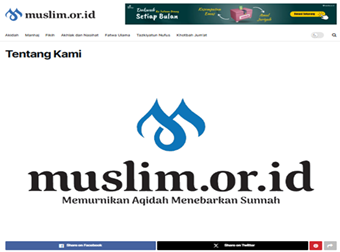
Figure 2. Home Page muslim.or.id
The website has been online since 2005. Each day, they publish a variety of scientific publications. Since 2005, muslim.or.id has published around 6800 Islamic articles based on the Qur’ān and Sunnah, as understood by the Salafus Shalih. The published articles are divided into sections such as Aqidah, Morals, Fiqh and Muamalah, Manhaj, Islamic History, Al Qur’ān, Hadīth, Family, Muslimah, Ulama Biography, Prayer and Dhikr, and study Information. Since its inception, this website has been accessed by 40,000 individuals per day. Notably, the platform deliberately avoids displaying photographs of women, citing concerns that such images may invite slander and serve as a source of immorality for viewers.
The Future of Islam: Aswaja Salafi
The Salafis strongly believe that the manhaj that they follow is endorsed by Allah and the Messenger. Salafis argue that the manhaj teaches, directs, and practices Islam as a whole, based on monotheism and the fundamentals of religion commanded by Allah and the Prophet Muhammad.39 As a result, they predict that the future of Islam will be Sunni Salafi Islam.40 Urban Salafi activists are starting to penetrate campuses to spread their understanding which is leading the way for the future progress of Islam.41 On the other hand, the Salafis have to work hard in the long term to avoid resistance from the community who feel threatened by their presence.42
The future of Islam can only be realized by restoring the caliphate with the method of the Prophet Muhammad. The Companions and their followers are the ones who will restore the caliphate at the end of time, namely people who are religious with the method of the Salaf Shalih and their followers until the end of time.43 So, being a Salafi is neither prohibited by Islam nor an act of heresy, as Salafis deserve to be called Aswaja.44
Salafis have believed that Allah, through revelation and natural events in the world, has shown the future of Islam. According to them, returning to the progress, glory, and height of Islam in the future is the Salafi manhaj.45 Salafis believe that the Islamic groups that have emerged thus far have made numerous deviations in their beliefs, such as prioritizing reason over revelation, rejecting or questioning Islamic teachings found in the Qur’ān and Sunnah.
Urban Salafis are skilled at shifting formations to disseminate their Islamic ideas. Salafis have used the internet era to build radio stations, social media platforms, and digital communities to advocate for their Islamic identity. Urban Salafis think that their beliefs remain relevant to current issues. They have even developed a Salafist approach that may address the issues and problems of modern society.46 As a result, Salafis engage in competition and dispute with other Islamic groups in order to gain religious authority and be regarded as the Islam of the future.47
3.5. Manhaj Salaf: The Only Way to SalvationSalafis then identified themselves as a group through the Salaf manhaj. According to Salafis, Allah has built a safe and straight way for the three early generations of Islam above, prioritizing His faithful. So, if Muslims want to be safe and on the correct track, they should follow the manhaj salaf, which ensures that a Muslim's life is always dedicated to Allah and free of errors, doubts, and diversions.48
Sidawi, emphasized the importance of the straight road as practiced and carried out during the Salaf manhaj. According to him, this is evident and cannot be refuted or rejected because it is consistent with the Prophet Muhammad's message. Even the deviant path was abundant in the early days of Islam, yet it must be rejected and removed since it leads people astray. To support his point of view, Sidawi quoted a Hadīth .
Ibn Mas'ud's acquaintance reported that the Messenger of Allah once traced a line with his hand and stated, “This is Allah's straight path.” Then he drew many lines on the right and left. Then he remarked, “There is no road in these paths unless Satan invites him”, and then he read the phrase (which means)”: and this is my straight path, so follow it and do not take crooked paths so that you wander from His path.49
Salafis uphold the Prophet Muhammad’s teachings with full acceptance, believing that redemption in this life and the hereafter can only be attained through the Salaf manhaj. They view this path as the sole way for Muslims to achieve Allah’s promised virtues and excellence.50 Salafis hold that rejecting or opposing the Manhaj Salaf brings divine consequences: in this world, a risk of straying, and in the hereafter, the punishment of Hell. For them, following the Salaf path is obligatory, as abandoning it is deemed forbidden.51
This belief helps Salafis spread their understanding and teachings through the six pillars of AhlusSunnah da'wah, which are: purifying religion, there is only one path to salvation and truth, following the Qur’ān and Sunnah with the understanding of the Salaf Shalih, achieving glory with knowledge, refuting and rejecting people who deviate (amar ma'ruf nahi munkar), tashfiyah, and tarbiyah.52 This is in line with the fact that Salafi preaching attempts to bring Muslims back to the straight path.53
3.6. Meeting Points and Conflicts between NU and SalafiAhlusSunnah wal Jama'ah is the largest sect in Islamic history, comprising those who adhere to the teachings of the Prophet Muhammad, his companions, tabi'in, and the generation that followed them. Idrus Romli observed that there were two groups that have long contested the claim to represent Aswaja: the followers of the Ash'ari and Maturidi schools, and the followers of Ibn Taimiyyah, namely Salafis.54 Yazid Jawas noted that before the advent of Islam, disputes among religious followers led to division and misguidance. He sees a parallel in the frequent disagreements among Muslims today, asserting that only those within Aswaja who adhere to the Qur’ān, the Sunnah, and the teachings of the early generations remain on the correct path.55
The perspectives of NU and Salafi representatives shown above demonstrate two opposing viewpoints, with assertions of safety and truth on their side. Exclusivism in one manhaj has a negative impact on religiously motivated radicalization movements. Salafis frame concepts and lifestyle habits that are regarded foreign to Islam in accordance with the purity of Islamic teachings. In contrast, NU addresses local needs, traditions, and pre-existing cultures.
Table 1. Meeting Points and Conflicts Between NU and Salafi
|
Institution |
Doctrine |
|
|---|---|---|
|
Meeting |
Opposition |
|
|
NU-SALAFI |
1. The political dispute of the Prophet's companions is ijtihad. 2. It is difficult to accuse someone of being an infidel. 3. Humans are deemed sinful in this world, but Allah decides what happens in the afterlife. 4. The nature and essence of Allah are two different things, but cannot be separated, 5. Rebellion against the government is strictly illegal. |
1. Reason is important in interpreting the Qur’ān and Hadīth . 2. Accepting a culture that is in line with sharia. 3. Human activities are primarily created by God, yet humans have control over their actions under Allah's will. 4. It is difficult to mislead others' beliefs or opinions. 5. Interpretation of the Quran and Hadīth . 6. Purification of Tawhid |
|
Legal Source: al-Qur’ān , Hadīth’s, serta Ijma’, Companions dan Ulama. |
Legal Soure: Qiyas |
|
|
Sect, Taqlid, and Ittiba’ |
Tauhid Rububiyah, Uluhiyyah, and Asma’ was Shifat |
|
|
Aswaja values: tolerance, justice, and commanding the good and evil. |
Bid’ah, Moderate, Not inclined to discussion, scholar and philosopher, Tasawuf dan Tariqoh, Aswaja NU's religious practices. |
|
The Salafi movement which is oriented towards purifying monotheism and destroying Islamic traditions in Indonesia, as in table 1 above, has been rejected by the majority of Muslim society, both from the NU and Muhammadiyah groups. The Indonesian Islamic tradition serves as an intermediary for spreading and instilling Islamic ideals among Muslims without erasing their cultural heritage.56
However, the Salafis did not lack ideas for counter-movements to spread their doctrinal understanding. The Salafi movement began to evolve and adapt, including acceptance of the concept of a nation state in Indonesia with a democratic government. This highlights the significance of flexibility for Salafis in propagating and maintaining their views and manhaj in modern Indonesia.57
Salafis appear to be extremely rigorous in their interpretation of Islamic texts. As a result, Muslim groups that claim to follow the Salafi method do not understand Salafi principles in their entirety, but instead hide behind the term ‘Salafi.’58 However, differences in understanding the meaning of the Qur’ān and Sunnah are reflected in the production of discourse and ideas disseminated through their websites. This shows that ideological conflicts can become the starting point of disputes in thought and movements in the digital era.
The notion of purifying monotheism and rejecting heresy is central to the intellectual conflict between NU and Salafi. One of the efforts taken by these two groups to reach a larger audience is to use digital platforms such as websites to include the concepts of each group's teachings.59 Traditionalist Muslim societies, like the Salafi, challenge the authenticity of Islamic traditions or culture. On the contrary, the conservative NU faction bases its beliefs on the opinions of experts and religious reasoning derived from Islamic literature. The impact of this fight is that NU and Salafis gain public sympathy through mosques and the digital realm.60
Both organizations find common ground and disagree with arguments based on the Qur’ān and Hadīth . NU and Salafi attempt to demonstrate the correspondence of the two sources of Islamic teachings in publications published on both the nu.or.id and muslim.or.id websites. NU attempts to validate and enhance its claims by citing scholarly interpretations and authoritative sources. NU's presentation displays the inclusive character of Aswaja NU with legitimacy from the Quran and Hadīth , as well as interpretations from scholars. The website nu.or.id presents comprehensive and contextual religious discourse in an effort to accommodate social practices in understanding religion.
On the contrary, Salafis continue to voice their teachings by referring to the Qur’ān and Hadīth to demonstrate their arguments. Contributors to the muslim.or.id website present articles that minimize the role of reason, with some articles containing only verses from the Qur’ān and Hadīth . This is in line with their approach, asserting that Salafis do not give reason a broader role in understanding Islamic teachings. However, this attitude reveals the exclusive-textual hermeneutics of Salafis in understanding Islamic teachings. This reinforces the thesis that Salafis continue to maintain an ideology of puritanism and scripturalism in understanding the Qur’ān and Hadīth .
4. Conclusion
In Indonesia, the struggle for AhlusSunnah wal Jama'ah between the NU and the Salafi groups is a historical struggle that continues to repeat itself. In general, NU and Salafi organizations strive to reach wider audiences in order to communicate and sustain their religious knowledge through digital methods. The emergence of the nu.or.id and muslim.or.id websites has provided a platform for the two sides to debate Islamic matters. In order to legitimize and strengthen Islamic thinking, NU scholars distinguish Aswaja by using the name Aswaja an-Nahdliyah. In contrast, Aswaja Salafis assert that their ideology is authentic and true, and will be the future of Islam. The NU-Salafi meeting points include appreciating the companions, recognizing Allah's characteristics and essence, referencing the Qur’ān , Hadīth , Ijma' of friends and scholars, establishing a school of thought, taqlid, and ittiba. Meanwhile, the NU-Salafi rivalry manifests in religious thinking, movement, and practice. Reason plays an important role in understanding and interpreting the Qur’ān and Hadīth , in accepting culture, and in applying Qiyas. Conflicts arise particularly in relation to Sufism and approaches to moderation within the movement. The final point of contention is NU's religious practices.
The rivalry between these two groups over the claim to Aswaja has spread widely, confusing ordinary Muslims and deepening divisions within the ummah. Reducing such disputes is essential to avoid repetitive debates, allowing Muslims to concentrate on contemporary religious issues. Nevertheless, future relations will likely remain competitive, marked by differing theological views yet still capable of coexistence within social life.
Authors Contribution
Arfan Aziz: Contributed fully to the formulation of the research idea and literature review, and partially to data collection, data analysis, methodology writing, and manuscript revision. D.I. Ansusa Putra: Contributed fully to critical review, substantiative revision, and finalization of the manuscript, and partially to interpretation of findings, analysis, and approval of the manuscript. Muhammad Rafii: Contributed fully to data collection, data analysis, and writing the methodology and results and partially to idea formulation, literature review, and manuscript revision.
Conflict of Interest
The authors of the manuscript have no financial or non-financial conflict of interest in the subject matter or materials discussed in this manuscript.
Data Availability Statement
Data supporting the findings of this study will be made available by the corresponding author upon request.
Funding Details
No funding has been received for this research.
Generative AI Disclosure Statement
Chat GPT was used to simplify the sentences for greater clarity without altering the scientific subtsnce, under the supervision of the authors.
Bibliography
Ahdori, Abdul Rahman. “Kiai Ishom Jabarkan Konsep Aṣwaja an-Nahdliyah” [“Kiai Ishom Explains the Concept of Aṣwaja an-Nahdliyah”]. NU Online. August 6, 2019. https://nu.or.id/nasional/kiai-ishom-jabarkan-konsep-aswaja-an-nahdliyah-MWXtc.
Alawi, Abdullah. “Surat Hamka untuk KH Mahfudz Shiddiq tentang Ijtihad dan Taqlid.” NU Online. July, 8 2018. https://www.nu.or.id/fragmen/surat-hamka-untuk-kh-mahfudz-shiddiq-tentang-ijtihad-dan-taqlid-5bch3.
Aminuddin, Luthfi Hadi. From Qauli to Manhaji: The Dynamics of Islamic Legal Fatwa-Issuing Methods in Nahdlatul Ulama. I. Surabaya: PW LTN NU Jawa Timur/LTN Pustaka, 2022.
Anam, Choirul. Growth and Development of Nahdlatul Ulama. Surabaya: Duta Aksara Mulia, 2010.
Anwari, and Mahbib. “Tak Mampu Ijtihad atau Ittiba? Orang Awam Silakan Taqlid” [“Unable to Perform Ijtihad or Ittiba? Common People May Follow Taqlid”]. NU Online. June 16, 2016. https://nu.or.id/nasional/tak-mampu-ijtihad-atau-ittiba-orang-awam-silakan-taqlid-bddZq.
Arifianto, Alexander R. “From Ideological to Political Sectarianism: Nahdlatul Ulama, Muhammadiyah, and the State in Indonesia.” Religion, State and Society 49, no. 2 (2021): 1–16, https://doi.org/10.1080/09637494.2021.1902247.
Asy’ari, Hasyim. “Forty Hadīth s Concerning the Establishment of Nahdlatul Ulama.” In The Basic Principles and Services of Nahdlatul Ulama), edited by M. Bisri Adib Hattani. Pati: Forum Kajian Ke-NU-an, 2014.
—. Introduction to the Basic Law. Surabaya: Tashwirul Afkar, 1926.
Asy’ari, Hasyim. The Message of AhlusSunnah Wal Jama’ah. Kota Bekasi: Pustaka al-Muqsith, 2021.
Aulia, Sulthonul., Ardhi Maulana Fajrin, Abdoulie Ceesay, and Musa Jallow Birkbeck. “Unity or Divergence: Nahdlatul Ulama and Muhammadiyah Perspective on Interfaith Moderation.” Al-Wasatiyah: Journal of Religious Moderation 3, no. 2 (2024): 110–37. https://doi.org/10.30631/jrm.v3i2.69.
Chaplin, Chris. “Salafi Activism and the Promotion of a Modern Muslim Identity: Evolving Mediums of Da’wa Amongst Yogyakartan University Students.” South East Asia Research 26, no. 1 (2018): 3–20, https://doi.org/10.1177/0967828X17752414.
—. “Salafi Islamic Piety as Civic Activism: Wahdah Islamiyah and Differentiated Citizenship in Indonesia.” Citizenship Studies 22, no. 2 (2018): 208–23, https://doi.org/10.1080/13621025.2018.1445488.
Faizi, Fuad. “Moderating Resistances: The Reproduction of Muslim Religious Space in the Dutch East Indies.” Al-Jami’ah: Journal of Islamic Studies 61, no. 2 (2023): 297–328, https://doi.org/10.14421/ajis.2023.612.297-328.
Faradila, Hanesty., Aimmatuz Sa’adah, Cukup Rojali, and Hajam Hajam. “Sufism in Historical Perspective: From Classical Traditions to Modern Interpretations.” Tarikhuna: Journal of History and History Education 6, no. 2 (2024): 307–315, https://doi.org/10.15548/thje.v6i2.10257.
Febriansyah, Denny., and Dawoud Sudqi El-Alami. “Moderate Islam Vis-a-Vis Salafism in Indonesia: An Ideological Competition.” Walisongo: Jurnal Penelitian Sosial Keagamaan 29, no. 1 (2021): 55–78, https://doi.org/10.21580/ws.29.1.7212.
Gusmian, Islah. “KH Misbah Ibn Zainul Musthafa (1916-1994 AD): Thinker and Writer of Religious Texts from Islamic Boarding Schools.” Jurnal Lektur Keagamaan 14, no. 1 (2016): 115–134, https://doi.org/10.31291/jlk.v14i1.474.
Haidar, M. Ali. Nahdlatul Ulama and Islam in Indonesia: The Fiqh Approach to Politics. Jakarta: Gramedia Pustaka Utama, 1994.
Han, Muhammad Ibtissam, and Ismi Rahmayanti. “Salafi Jihadists and Religious Terrorism: Ideology, Factions and Jihadist Religious Interpretations.” Kordinat: Jurnal Komunikasi Antar Perguruan Tinggi Agama Islam 20, no. 1 (2021): 3–22. https://doi.org/10.15408/kordinat.v20i1.19024.
Hasan, Noorhaidi. “Salafism in Indonesia: Transnational Islam, Violent Activism, and Cultural Resistance.” In Routledge Handbook of Contemporary Indonesia, edited by Robert W. Hefner, 246–56. London: Routledge, 2018.
—. “The Salafi Movement in Indonesia: Transnational Dynamics and Local Development.” Comparative Studies of South Asia, Africa and the Middle East 27, no. 1 (2007): 83–94. https://doi.org/10.1215/1089201x-2006-045.
Hasyim, Arrazy. Puritan Islamic Theology Genealogy and Salafi Teachings. III. Tangerang Selatan: Yayasan Wakaf Darus-Sunnah, 2019.
Hilali, Salim bin ‘Id. Getting to Know the Salafi Manhaj. Bogor: Pustaka at-Taqwa, 2008.
Hilali, Syaikh Abu Usamah Salim bin ‘Ied. “The Coming Islam Is Sunni Salafi Islam.” Majalah As-Sunnah. Surakarta, 2001.
Huda, KH Nuril. “Bagaimana Hukumnya Taqlid?” NU Online. November 27, 2007. https://nu.or.id/syariah/bagaimana-hukumnya-taqlid-l6FH6.
Ikhwanudin, Hasim. “Kemuliaan Para Sahabat Nabi.” Buletin At-Tauhid (Buletin Muslim), July 29, 2016. https://buletin.muslim.or.id/kemuliaan-para-sahabat-nabi/.
Ishomuddin, Ahmad. "Mengapa Kita Harus Bermazhab" [Why Should We Have a School of Thought?]. NU Online. 2018. https://nu.or.id/syariah/mengapa-kita-harus-bermazhab-y02OR.
Ismail, A Ilyas, and Badrah Uyuni. "Ghazali's Sufism and Its Influence in Indonesia." DINIKA: Academic Journal of Islamic Studies 4, no. 1 (2019): 21–44. https://doi.org/10.22515/dinika.v4i1.1712.
Jahroni, Jajang. "Ritual, Bid’ah, and the Negotiation of the Public Sphere in Contemporary Indonesia." Studia Islamika 25, no. 1 (2018): 1–35. https://doi.org/10.15408/sdi.v25i1.5308.
Jawas, Yazid bin Abdul Qadir. Noble with the Salaf Manhaj. Bogor: Pustaka at-Taqwa, 2008.
Jubba, Hasse, Jaffary Awang, Zuly Qodir, Hannani, and Mustaqim Pabbajah. "The Contestation between Conservative and Moderate Muslims in Promoting Islamic Moderatism in Indonesia." Cogent Social Sciences 8, no. 1 (2022): 1–14, https://doi.org/10.1080/23311886.2022.2116162.
Kanafi, Imam, Harapandi Dahri, Susminingsih Susminingsih, and Syamsul Bakhri. “The Contribution of AhlusSunnah Waljamaah’s Theology in Establishing Moderate Islam in Indonesia.” HTS Teologiese Studies/Theological Studies 77, no. 4 (2021): 1–10. https://doi.org/10.4102/hts.v77i4.6437.
Lutfi. “Tafsir in the Socio-Political Context of Indonesia A Case Study of Ahmad Sanusi’s Qur’ān ic Interpretation as a Medium of Struggle During the Colonial Period.” University of Canberra, Australia, 2023.
Masitah, Dewi. “Hybrid Islamic Study: The AhlusSunnah Wal Jamaah Conflict Between NU and Salafis in Pasuruan.” Al Qodiri: Jurnal Pendidikan, Sosial Dan Keagamaan 18, no. 3 (2020): 818–35.
Mianoki, Adika. “Hakikat Manhaj Salaf: Bagian 1” [“The Essence of the Salaf Manhaj: Part 1”]. Muslim.or.id. November 4, 2022. https://muslim.or.id/80012-hakikat-manhaj-salaf-bag-1.html.
Misrawi, Zuhairi. Hadratussyaikh Hasyim Asy’ari: Moderation, Community, and Nationality. Jakarta: Penerbit Buku Kompas, 2010.
Mudzhar, Atho. Maintaining Ashwaja and Community Harmony. Jakarta: Balitbang dan Diklat Kementerian Agama RI, 2012.
Nur’aeni, Ulvah, and Arfian Hikmat Ramdan. “Ideological Contestation on Youtube Between Salafi and Nahdhatul Ulama in Indonesia.” Journal of Contemporary Islam and Muslim Societies 7, no. 1 (2023): 28–64. https://doi.org/10.30821/jcims.v7i1.15244.
Nurhuda, Abid. “Conceptions of Reason and Revelation in Discourses Mu’tazilah, Asya’riyah, and Maturidiyah (Samarkhan and Bukhara).” Islamadina: Jurnal Pemikiran Islam 25, no. 1 (2024): 132–42. https://doi.org/10.30595/islamadina.v0i0.19651.
Purnama, Yulian. “Siapakah Ahlus Sunnah wal Jama’ah?” [“Who Are the People of the Sunnah and the Community?”]. Buletin Muslim (Buletin At-Tauhid), January 6, 2009. https://buletin.muslim.or.id/siapakah-ahlus-sunnah-wal-jama%E2%80%99ah/.
Ramli, Muhammad Idrus. Provisions for Defenders of AhlusSunnah Wal Jama’ah: Facing Salafi-Wahhabi Radicalism. Surabaya: Aswaja NU Center Jawa Timur, 2013.
Roziqin, Akhmad Ainur, Puspa Arum Yasinatul, Ali Mursyid Azisi, Luluk Fikri Zuhriyah, and Moh Hakim Alfarisi. “The Challenge of Religious Moderation amidst the Rise of Religious Extremism among Instant Ustadz in Indonesia.” Al-Wasatiyah: Journal of Religious Moderation 4, no. 1 (2025): 1–30. https://doi.org/10.30631/jrm.v4i1.110.
Safe’i, Abdulah. “Redefining Ijtihad and Taqlid: An Effort to Reactualize and Revitalize a Socio-Historical Perspective.” ADLIYA: Jurnal Hukum Dan Kemanusiaan 11, no. 1 (2019): 25–40. https://doi.org/10.15575/adliya.v11i1.4850.
Saleh, Muhammad. “The Existence of Madzhab in Contemporary Islamic Law.” Istinbath: Jurnal Hukum 13, no. 1 (2016): 147–62.
Saparudin. “Desacralization of Religious Authority Tuan Guru Salafi Purification versus Nahdlatul Wathan Traditionalism.” Khazanah: Jurnal Studi Islam Dan Humaniora 20, no. 1 (2022): 25–44. https://doi.org/10.18592/khazanah.v20i1.6384.
Sidawi, Abu Ubaidah Yusuf bin Mukhtar. 40 Hadīth s about the Manhaj of the AhlusSunnah Wal Jama’ah. Bandung: YAU, 2023.
Siddiq, Achmad. Nahdlatul Ulama’s Thinking Guidelines. I. Jember: PMII Jember, 1969.
Somantri, Denden, Aden Yibni Fahrizal, and Abdul Azis Hakim. Aswaja An-Nahdliyah: Typology and Practice of AhlusSunnah Wal Jama’ah An-Nahdliyah. Kota Malang: Literasi Nusantara Abadi, 2024.
Su'aidi, Hasan. "NU-Muhammadiyyah's View on the Hadīth of Iftiraq Al-Ummah." Jurnal Penelitian 7, no. 1 (2010).
Sunarwoto. “Salafi Dakwah Radio: A Contest for Religious Authority.” Archipel-Etudes Interdisciplinaires Sur Le Monde Insulindien, no. 91 (2016): 203–30. https://doi.org/10.4000/archipel.314.
Syamsir, Ahmad, Muhammad Andi Septiadi, Muhamad Ilham Nurhakiki, Muhammad Ihsan Al-Habsy, and Muhammad Rizal Arifin Hidayah. “Salafi Puritanism in Indonesia.” International Journal of Islamic Khazanah 11, no. 2 (2021): 134–49. https://doi.org/10.15575/ijik.v11i2.13199.
Tabroni, Roni, and Idham. “From Radical Labels to Moderate Islam: The Transformation of the Salafism Movement in Indonesia.” Indonesian Journal of Islam and Muslim Societies 13, no. 2 (2023): 279–306. https://doi.org/10.18326/ijims.v13i2.279-306.
Taslim, Abdullah. “Manfaat dan Keutamaan Mengikuti Manhaj (Metode Pemahaman Salaf)” [“The Benefits and Virtues of Following the Manhaj (Method of Understanding of the Pious Predecessors)”]. Muslim.or.id. March 14, 2009. https://muslim.or.id/572-manfaat-dan-keutamaan-mengikuti-manhaj-metode-pemahaman-salaf.html.
Vatchagaev, Mairbek. “Chechnya Hosts International Islamic Conference.” Eurasia Daily Monitor (September 22, 2016). https://jamestown.org/program/chechnya-hosts-international-islamic-conference/.
Wahyudi, Ari. “6 Pilar Dakwah Ahlussunnah” [“6 Pillars of Ahlus Sunnah Da‘wah”]. Muslim.or.id. March 2, 2014. https://muslim.or.id/20357-6-pilar-dakwah-ahlussunnah.html.
—. “Cara Mudah Mempelajari Aqidah Ahlus Sunnah” [“Easy Way to Learn the Belief of Ahlus Sunnah”]. Muslim.or.id. June 14, 2010. https://muslim.or.id/3633-cara-mudah-mempelajari-aqidah-ahlus-sunnah-1.html .
1Mairbek Vatchagaev, “Chechnya Hosts International Islamic Conference,” Eurasia Daily Monitor (September 22, 2016), https://jamestown.org/program/chechnya-hosts-international-islamic-conference/.
2Imam Kanafi et al., “The Contribution of Ahlussunnah Waljamaah’s Theology in Establishing Moderate Islam in Indonesia,” HTS Teologiese Studies/Theological Studies 77, no. 4 (2021): 9, https://doi.org/10.4102/hts.v77i4.6437.
3Arrazy Hasyim, Puritan Islamic Theology Genealogy and Salafi Teachings, III (Tangerang Selatan: Yayasan Wakaf Darus-Sunnah, 2019), 173.
4Lutfi, “Tafsir in the Socio-Political Context of Indonesia A Case Study of Ahmad Sanusi’s Qur’anic Interpretation as a Medium of Struggle During the Colonial Period” (University of Canberra, Australia, 2023), 45.
5Fuad Faizi, “Moderating Resistances: The Reproduction of Muslim Religious Space in the Dutch East Indies,” Al-Jami’ah: Journal of Islamic Studies 61, no. 2 (2023): 299, https://doi.org/10.14421/ajis.2023.612.297-328.
6M. Ali Haidar, Nahdlatul Ulama and Islam in Indonesia: The Fiqh Approach to Politics (Jakarta: Gramedia Pustaka Utama, 1994), 74.
7Atho Mudzhar, Maintaining Ashwaja and Community Harmony (Jakarta: Balitbang dan Diklat Kementerian Agama RI, 2012).
8Denny Febriansyah and Dawoud Sudqi El-Alami, “Moderate Islam Vis-a-Vis Salafism in Indonesia: An Ideological Competition,” Walisongo: Jurnal Penelitian Sosial Keagamaan 29, no. 1 (2021): 69, https://doi.org/10.21580/ws.29.1.7212.
9Dewi Masitah, “Hybrid Islamic Study: The Ahlussunnah Wal Jamaah Conflict Between NU and Salafis in Pasuruan,” Al Qodiri: Jurnal Pendidikan, Sosial Dan Keagamaan 18, no. 3 (2020): 833; Hasse Jubba et al., “The Contestation between Conservative and Moderate Muslims in Promoting Islamic Moderatism in Indonesia,” Cogent Social Sciences 8, no. 1 (2022): 1–14, https://doi.org/10.1080/23311886.2022.2116162.
10Hasyim Asy’ari, The Message of Ahlussunnah Wal Jama’ah (Kota Bekasi: Pustaka al-Muqsith, 2021), 100.
11Hasan Su’aidi, “NU-Muhammadiyyah’s View on the Hadith of Iftiraq Al-Ummah,” Jurnal Penelitian 7, no. 1 (2010): 5.
12Muhammad Ibtissam Han, and Ismi Rahmayanti, “Salafi Jihadists and Religious Terrorism: Ideology, Factions and Jihadist Religious Interpretations,” Kordinat: Jurnal Komunikasi Antar Perguruan Tinggi Agama Islam 20, no. 1 (2021): 3–22, https://doi.org/10.15408/kordinat.v20i1.19024.
13Asy’ari, The Message of Ahlussunnah Wal Jama’ah, 100.
14Zuhairi Misrawi, Hadratussyaikh Hasyim Asy’ari: Moderation, Community, and Nationality (Jakarta: Penerbit Buku Kompas, 2010), 78.
15Hasyim Asy’ari, “Forty Hadiths Concerning the Establishment of Nahdlatul Ulama,” in The Basic Principles and Services of Nahdlatul Ulama), ed. M. Bisri Adib Hattani (Pati: Forum Kajian Ke-NU-an, 2014), 27.
16Choirul Anam, Growth and Development of Nahdlatul Ulama (Surabaya: Duta Aksara Mulia, 2010), 50.
17Abid Nurhuda, “Conceptions of Reason and Revelation in Discourses Mu’tazilah, Asya’riyah, and Maturidiyah (Samarkhan and Bukhara),” Islamadina: Jurnal Pemikiran Islam 25, no. 1 (2024): 132–142, https://doi.org/10.30595/islamadina.v0i0.19651.
18Achmad Siddiq, Nahdlatul Ulama's Thinking Guidelines, I (Jember: PMII Jember, 1969), 12.
19Hanesty Faradila et al., "Sufism in Historical Perspective: From Classical Traditions to Modern Interpretations," Tarikhuna: Journal of History and History Education 6, no. 2 (2024): 307–15, https://doi.org/10.15548/thje.v6i2.10257.
20A Ilyas Ismail and Badrah Uyuni, “Ghazali's Sufism and Its Influence in Indonesia," DINIKA: Academic Journal of Islamic Studies 4, no. 1 (2019): 36, https://doi.org/10.22515/dinika.v4i1.1712.
21 Sulthonul Aulia et al., “Unity or Divergence: Nahdlatul Ulama and Muhammadiyah Perspective on Interfaith Moderation,” Al-Wasatiyah: Journal of Religious Moderation 3, no. 2 (2024): 118, https://doi.org/10.30631/jrm.v3i2.69.
22Hasyim Asy’ari, Introduction to the Basic Law (Surabaya: Tashwirul Afkar, 1926), 30.
23Abdul Rahman Ahdori, “Kiai Ishom Jabarkan Konsep Aṣwaja an-Nahdliyah” [“Kiai Ishom Explains the Concept of Aṣwaja an-Nahdliyah”], NU Online, August 6, 2019, https://nu.or.id/nasional/kiai-ishom-jabarkan-konsep-aswaja-an-nahdliyah-MWXtc
24Denden Somantri, Aden Yibni Fahrizal, and Abdul Azis Hakim, Aswaja An-Nahdliyah: Typology and Practice of Ahlussunnah Wal Jama’ah An-Nahdliyah (Kota Malang: Literasi Nusantara Abadi, 2024), 87.
25Muhammad Saleh, “The Existence of Madzhab in Contemporary Islamic Law,” Istinbath: Jurnal Hukum 13, no. 1 (2016): 147–62, https://e-journal.metrouniv.ac.id/istinbath/article/view/547.
26Islah Gusmian, “KH Misbah Ibn Zainul Musthafa (1916-1994 AD): Thinker and Writer of Religious Texts from Islamic Boarding Schools,” Jurnal Lektur Keagamaan 14, no. 1 (2016): 115–34, https://doi.org/10.31291/jlk.v14i1.474.
27Asy’ari, The Message of Ahlussunnah Wal Jama’ah, 24–25.
28Ahmad Ishomuddin, “Mengapa Kita Harus Bermazhab” [Why Should We Have a School of Thought?], NU Online, 2018, https://nu.or.id/syariah/mengapa-kita-harus-bermazhab-y02OR.
29Luthfi Hadi Aminuddin, From Qauli to Manhaji: The Dynamics of Islamic Legal Fatwa-Issuing Methods in Nahdlatul Ulama, I (Surabaya: PW LTN NU Jawa Timur/LTN Pustaka, 2022), 178.
30 Abdulah Safe’i, “Redefining Ijtihad and Taqlid: An Effort to Reactualize and Revitalize a Socio-Historical Perspective,” ADLIYA: Jurnal Hukum Dan Kemanusiaan 11, no. 1 (2019): 37, https://doi.org/10.15575/adliya.v11i1.4850.
31Asy’ari, The Message of Ahlussunnah Wal Jama’ah, 29.
32Anwari and Mahbib, “Tak Mampu Ijtihad atau Ittiba? Orang Awam Silakan Taqlid” [“Unable to Perform Ijtihad or Ittiba? Common People May Follow Taqlid”], NU Online, June 16, 2016, https://nu.or.id/nasional/tak-mampu-ijtihad-atau-ittiba-orang-awam-silakan-taqlid-bddZq.
33KH Nuril Huda, “Bagaimana Hukumnya Taqlid?” NU Online, November 27, 2007, https://nu.or.id/syariah/bagaimana-hukumnya-taqlid-l6FH6.
34Abdullah Alawi, “Surat Hamka untuk KH Mahfudz Shiddiq tentang Ijtihad dan Taqlid,” NU Online, July 8, 2018, https://www.nu.or.id/fragmen/surat-hamka-untuk-kh-mahfudz-shiddiq-tentang-ijtihad-dan-taqlid-5bch3.
35Hasim Ikhwanudin, “The Glory of the Prophet’s Companions,” Buletin At-Tauhid (Buletin Muslim), July 29, 2016, https://buletin.muslim.or.id/kemuliaan-para-sahabat-nabi/.
36Yulian Purnama, “Siapakah Ahlus Sunnah wal Jama’ah?” ["Who Are the People of the Sunnah and the Community?"], Buletin Muslim (Buletin At-Tauhid), January 6, 2009, https://buletin.muslim.or.id/siapakah-ahlus-sunnah-wal-jama%E2%80%99ah/.
37Chris Chaplin, “Salafi Islamic Piety as Civic Activism: Wahdah Islamiyah and Differentiated Citizenship in Indonesia,” Citizenship Studies 22, no. 2 (2018): 215, https://doi.org/10.1080/13621025.2018.1445488.
38Sunarwoto, “Salafi Dakwah Radio: A Contest for Religious Authority,” Archipel-Etudes Interdisciplinaires Sur Le Monde Insulindien, no. 91 (2016): 229, https://doi.org/10.4000/archipel.314.
39Abdullah Taslim, “Manfaat dan Keutamaan Mengikuti Manhaj (Metode Pemahaman Salaf)” [“The Benefits and Virtues of Following the Manhaj (Method of Understanding of the Pious Predecessors)”], Muslim.or.id, March 14, 2009, https://muslim.or.id/572-manfaat-dan-keutamaan-mengikuti-manhaj-metode-pemahaman-salaf.html.
40Syaikh Abu Usamah Salim bin ‘Ied Hilali, “The Coming Islam Is Sunni Salafi Islam,” Majalah As-Sunnah (Surakarta, 2001), 5.
41Chris Chaplin, “Salafi Activism and the Promotion of a Modern Muslim Identity: Evolving Mediums of Da’wa Amongst Yogyakartan University Students,” South East Asia Research 26, no. 1 (2018): 17, https://doi.org/10.1177/0967828X17752414.
42Noorhaidi Hasan, “Salafism in Indonesia: Transnational Islam, Violent Activism, and Cultural Resistance,” in Routledge Handbook of Contemporary Indonesia, ed. Robert W. Hefner (London: Routledge, 2018), 246–56.
43Salim bin ‘Id Hilali, Getting to Know the Salafi Manhaj (Bogor: Pustaka at-Taqwa, 2008), 35.
44Ari Wahyudi, “Cara Mudah Mempelajari Aqidah Ahlus Sunnah” [“Easy Way to Learn the Belief of Ahlus Sunnah”], Muslim.or.id, June 14, 2010, https://muslim.or.id/3633-cara-mudah-mempelajari-aqidah-ahlus-sunnah-1.html.
45Hilali, Getting to Know the Salafi Manhaj, 4.
46Chaplin, “Salafi Activism and the Promotion of a Modern Muslim Identity: Evolving Mediums of Da’wa Amongst Yogyakartan University Students,” 14.
47Saparudin, “Desacralization of Religious Authority Tuan Guru Salafi Purification versus Nahdlatul Wathan Traditionalism,” Khazanah: Jurnal Studi Islam Dan Humaniora 20, no. 1 (2022): 40, https://doi.org/10.18592/khazanah.v20i1.6384; Akhmad Ainur Roziqin et al., “The Challenge of Religious Moderation amidst the Rise of Religious Extremism among Instant Ustadz in Indonesia,” Al-Wasatiyah: Journal of Religious Moderation 4, no. 1 (2025): 11, https://doi.org/10.30631/jrm.v4i1.110.
48Adika Mianoki, “Hakikat Manhaj Salaf: Bagian 1” [“The Essence of the Salaf Manhaj: Part 1”], Muslim.or.id, November 4, 2022, https://muslim.or.id/80012-hakikat-manhaj-salaf-bag-1.html.
49Abu Ubaidah Yusuf bin Mukhtar Sidawi, 40 Hadiths about the Manhaj of the Ahlussunnah Wal Jama’ah (Bandung: YAU, 2023), 18.
50Taslim, “Benefits and Virtues of Following the Manhaj (Method of Understanding) of the Salaf.”
51Yazid bin Abdul Qadir Jawas, Noble with the Salaf Manhaj (Bogor: Pustaka at-Taqwa, 2008), 64.
52Ari Wahyudi, “6 Pilar Dakwah Ahlussunnah” [“6 Pillars of Ahlus Sunnah Da‘wah”], Muslim.or.id, March 2, 2014, https://muslim.or.id/20357-6-pilar-dakwah-ahlussunnah.html.
53Noorhaidi Hasan, “The Salafi Movement in Indonesia: Transnational Dynamics and Local Development,” Comparative Studies of South Asia, Africa and the Middle East 27, no. 1 (2007): 84, https://doi.org/10.1215/1089201x-2006-045.
54Muhammad Idrus Ramli, Provisions for Defenders of Ahlussunnah Wal Jama’ah: Facing Salafi-Wahhabi Radicalism (Surabaya: Aswaja NU Center Jawa Timur, 2013), 25.
55Jawas, Noble with the Salaf Manhaj, 35.
56Alexander R Arifianto, “From Ideological to Political Sectarianism: Nahdlatul Ulama, Muhammadiyah, and the State in Indonesia,” Religion, State & Society 49, no. 2 (2021): 9, https://doi.org/10.1080/09637494.2021.1902247.
57Roni Tabroni and Idham, “From Radical Labels to Moderate Islam: The Transformation of the Salafism Movement in Indonesia,” Indonesian Journal of Islam and Muslim Societies 13, no. 2 (2023): 280, https://doi.org/10.18326/ijims.v13i2.279-306.
58Ahmad Syamsir et al., “Salafi Puritanism in Indonesia,” International Journal of Islamic Khazanah 11, no. 2 (2021): 134–49, https://doi.org/10.15575/ijik.v11i2.13199.
59Ulvah Nur’aeni, and Arfian Hikmat Ramdan, “Ideological Contestation on Youtube Between Salafi and Nahdhatul Ulama in Indonesia,” Journal of Contemporary Islam and Muslim Societies 7, no. 1 (2023): 50, https://doi.org/10.30821/jcims.v7i1.15244.
60Jajang Jahroni, “Ritual, Bid ‘ah, and the Negotiation of the Public Sphere in Contemporary Indonesia,” Studia Islamika 25, no. 1 (2018): 20, https://doi.org/10.15408/sdi.v25i1.5308.