
| Review | Open Access |
|---|
New Aesthetics: Narrating Muslim Female Heroes in Hollywood Films |
 |
|---|
 Anas Ahmadi*
1 Indonesian Language and Literature Education Universitas Negeri Surabaya, Indonesia
This study aims to explore the new aesthetics of Muslim female heroes in Hollywood films through the perspective of feminism. This research uses qualitative method, and data collection techniques are carried out through literature studies. The data for this study were collected from the Ms. Marvel film (2022) produced by the Marvel Cinematic Universe. The results of this study showed the following findings: first, Ms. Marvel presents a new narrative of Muslim women as heroes, which have never been portrayed in Western films; second, Kamala Khan, a Muslim hero, possesses superpowers that enable her to fly, make clouds, and stretch her body; third, Kamala Khan as a Muslim female hero saves people who need help; fourth, Ms. Marvel is a global market strategy to bring Muslims to the surface; and fifth, Islamic identity is depicted powerfully through symbols of the daily lives of devout Muslims, hijab, prayer, mosques, and Eid al-Fitr. Such depictions are able to embrace Muslim audiences who are spread across various countries in the world. This study is expected to contribute internationally to research on feminism in Hollywood films. Furthermore, the results of this study are expected to be considered as a new breakthrough in research on heroism that has so far been dominated by men and male perspectives.
1. INTRODUCTION
In recent decades, feminism has received considerable scholarly attention due to the emergence of the feminist movement. On a global scale, for example in Europe, studies on feminism are largely focused on the existence of women in political and parliamentary contexts.1 In America, studies on feminism are centered around the problems of migrant women.2 In Asia, studies on feminism are often examined to address political and governmental issues;3 and in Arabia, recent studies on feminism mostly explore violence against women.4 Feminism is a broad area of research and is therefore often explored through interdisciplinary approaches, from politics, sociology, cultural studies, to queer/LGBTQ+ issues.
Similarly, feminism is also frequently examined within the field of film studies. Representations of feminism in films are often examined in relation to gender equality5 and LGBTQ+ issues.6 Some studies have examined the portrayals of feminism in films that depict crimes committed by women as perpetrators or against women as victims.7 At the current global level, research on feminism is increasingly popular along with the growing productions of films and literature that feature heroes. The global rise in studies on feminism has been shown to be partly influenced by the development of masculinity studies, which have been both the response to and reflection of feminism.8 On the one hand, masculinity advocates for men’s rights and increases awareness of men’s experiences in various segments of life. On the other hand, feminism promotes women’s rights and raises awareness of women’s experiences in multiple aspects of life.
In the last five years, feminism has been explored in various scholarly works. The following studies illustrate different approaches to the subject. Irshad highlights Indian women from a deconstructive perspective and discovers that women are depicted as lesbian figures and have extraordinary academic prowess.9 In addition, Karimpaniyil and Bhat explore the representations of the equality between masculinity and feminism in patriarchal families in films.10 Galbraith and Rose examine animated films from a trans-feminine/LGBT perspective,11 while McInerney explores the racial narratives of yellow and white women.12 All studies on feminism in films discuss queer women in their relations to psychology, sociology, and racism. Another research was conducted by Story on black radical feminism and its advocation for women’s equality.13 From a different perspective, Ashgar and Khan conducted a study on Islamic feminism was conducted to explore discrimination and racism against Muslim women in Western societies, showing that Western films often portray the stereotypical images of Muslim women.14 These previous studies reveal that women are depicted in films through different perspectives. To date, however, very few studies have examined Muslim women represented in films as heroes, primarily because there are few Western films featuring Muslim women in heroic roles.
Several studies have been written about Muslim females, namely women in the construction of Western films which are considered to convey more stereotypes of Muslim female.15 The strong identity of Muslim female in Pakistan and highlighting the positive side of female;16 the new identity of Arab female in Arab films which often feature themes of resistance and female's struggle.17 Therefore, this study attempts to address the gap by examining the representations of Muslim women as heroes in Hollywood films. On one hand, it aims to explore the construction of Muslim women’s identity through heroic roles in these industries. On the other hand, it attempts to challenge dominant Western narratives that often associate Islam with terrorism. In addition, while the concept of the hero has gained considerable scholarly attention, much of this research has focused predominantly on male figures.18 Thus, this study aims to examine women portrayed as heroes in films and more specifically to uplift women who are often considered weak and vulnerable, often being depicted as the victims in classic and contemporary films.
Despite its worthiness of scholarly investigation, Muslim heroes in films, especially in Eastern/Asian and Western films, are still understudied. Heroes in films are largely produced by the Western and European film industries, featuring diverse themes, such as cowboys, inter-ethnic/national wars, and queer/LGBTQ+. In these films, however, heroes are frequently portrayed as and dominated by men. Women do appear in such films, but often portray second-class characters19 and rarely play heroes. Apart from that, when it comes to Muslim women, they never appear as heroes in Hollywood films. Historically, from the advent of Hollywood films in the 1800s to the present, the heroines have never been Muslim women. Furthermore, Hollywood films, through the Marvel Entertainment company, actively produce Marvel Comics-based hero films. At least in 2024, several hero films were released, for examples Aquaman, Deadpool 2, Venom 3, and Spider Man: Beyond the Spider-Verse. All the heroes featured in these films are portrayed by Western men. Similarly, heroes in cartoon films have also been predominantly produced by the Western film industry since the 1980s.20 Cartoon films that promote heroism include Heman, Superman, Batman, Spiderman, and Super Mario and are adapted from Western comics. Likewise, detectives in cartoon films are also portrayed by male characters, for example a film called The Adventures of Tintin. The grand narrative is closely linked to the propaganda and ideological construction of colonialist thought, particularly Western and European, which seeks to create a boundary between the West and the East through globally distributed films.
From the perspective of the grand narrative of globalism, the West is often identified as a symbol of progress, stability, civilization, and scientific advancement, thereby asserting itself as the leader of the modern world. In contrast, the East is frequently depicted as backward, uncivilized, and as a home to mysticism.21 Moreover, terrorism is often thought to originate from the East, and immigrants are depicted as a contributor to social instability in the West. Such claims, reinforcing the perceptions that the West is a symbol of progress and the East is a symbol of backwardness, have resulted in frictions between the West and the East. When considered within the context of Islam, which is a major religion in the world, Western films often portray it through the frameworks of extremism and terrorism.22 These portrayals are, in fact, Western narratives and constructions that depict Islam as a source of global fear and terror. Consequently, the depictions of Islamic heroes in Western films remain extremely rare. Renard claims that until recently, there have been few studies on Islam, particularly those related to heroes,23 suggesting that heroes are underexplored in Islamic studies. At least three factors contribute to the limited research on Muslim women depicted as heroes in films. First, few global films feature Muslim heroes, especially female ones. Second, in Islamic contexts, it remains a prevailing belief that women are not qualified to become heroes, leaders, or imams. Third, Western propaganda is strongly maintained, resulting in the exclusion of Muslims portrayed as heroes in films. For these reasons, this study aims to investigate the representations of Muslim women as heroes in Hollywood films. Hollywood was chosen due to its large share of the world’s audience.
Compared to men as heroes, women depicted as heroes in Islamic, Western, and Eastern cinema remain scarce. There are three primary reasons why more male heroes are portrayed in films. First, the majority of films about heroes are adapted from novels or comics that feature men as protagonists. Second, male authors or writers tend to construct male characters as heroes. Third, based on the general public perception, men are regarded as more physically powerful than women, making it appear more logical to feature men rather than women as heroes. All these factors contribute to a notion that a hero is typically male, although women can also be assigned heroic roles in films. This phenomenon suggests that little research has been conducted to explore Muslim female as heroes in Hollywood cinema. Therefore, this study seeks to address this gap by conducting research on the representations of female Muslims in Hollywood films. As widely known, Hollywood films have attracted a considerable number of global audiences.24 This study is expected to provide scientific contributions to feminism studies that narrate Muslim heroes, which have not been widely conducted by researchers. This study will contribute to Islamic studies highlighting Islamic heroes globally portrayed in Hollywood films. Furthermore, this study is expected to provide a global-scale description on female Muslims as heroes and emphasize the notion that Muslims, especially women in the context of feminism, can also be depicted as heroes in films.
Feminism studies focus on raising awareness of gender equality. Feminism is a movement aimed at increasing women’s consciousness towards cultural constructions in society. Feminism emerges due to women’s realization of oppression imposed by men. Women have risen to demonstrate that they are capable of achieving equality with men in various aspects of life. An Egyptian feminist, Saadawi argued that feminism as a movement must aim to elevate the status of women to be equal to that of men.25 Women should be capable of challenging male propaganda that frequently exploit religious justifications to degrade women. Men have also been shown to use religion to control and restrict women. Likewise, another Moroccan feminist, Mernissi, asserted that women must resist and challenge men26 who have harmed and oppressed them. Women advocating for themselves and other women ultimately become heroes for women worldwide.
Historically, the concept of a hero originates from folklore studies and heroic mythology, often emerging to confront tough and powerful enemies, such as monsters, giants, villains, and tricksters.27 Hercules, for example, is a mythological hero who fights to overcome natural obstacles and defeat monsters. To be acknowledged as a hero, Hercules had to defeat formidable enemies. Another well-known heroic figure is Oedipus, who fought the Sphinx. Representations of heroes in the past strongly involved offspring of gods, embodying masculinity, bravery, strength, and supernatural powers used to defeat their enemies. Despite being considered irrational and mythical, folklore heroes follow a morphological structure, which has been studied within the field of linguistics to determine the forms of heroes.28 This suggests that folklore heroes follow a typical formula that has persisted since the ancient times. The birth of such a hero in the folklore society is highly anticipated and glorified by its supporting community, as the hero has exceptional abilities to save his people from the oppression imposed by cruel regimes or monstrous beings across diverse racial, religious, and cultural contexts.29 From a contemporary perspective, the concept of a hero has undergone rapid changes and developments.
A hero possessing superpowers appears not only in mythology or indigenous traditions, but also in various narrative forms, such as literature, film, and modern art. Contemporary heroes are represented as tough and strong protagonists who are capable of defeating enemies.30 They are often depicted as handsome and muscular men and are admired by women. Moreover, the hero in modern narratives is often portrayed as a man defending the truth and justice, making them a desired figure within society. Recent developments in research on heroes have largely focused on men and masculinity, especially those portrayed in Hollywood films. Research on heroes, however, has received little attention. Several recent studies on heroes found the following: heroes are sexualized,31 Hollywood and Asian films’ depiction of women as heroes and prostitutes create an ambiguity in women’s roles,32 heroes appear in films as an anomaly archetype,33 and heroes in Chinese and American films are portrayed through the lens of individualism, collectivism, masculinity, feminism, and power distance.34
In relation to female heroes, conceptually it is not much different from male heroes. Female heroes are also figures who are mighty, strong, and masculine. The concept of masculinity in female heroes is sometimes implied because it intersects with men rather than women.35 Some facts seem to belittle female heroes, starting with the terms ‘heroes’ for men and ‘sheroes for women.36 Furthermore, the identity of female heroes that appear in fiction-nonfiction media is less strong because they still need the help of men. 37In recent development, feminism is stronger and better at constructing female heroes.38 In this context, a female hero is a figure who is able to defeat enemies, save people in need, and fight monsters/villains. These female heroes have historically appeared in mythological stories and have developed up to the present.39 The figure of the female hero can appear in the following genres: children, teenage, mother, or grandmother. Research on female heroes reinforces the narrative that female heroes have existed for a long time, from (classical) mythology to (modern) film. However, researchers have not yet focused much on female heroes. This has resulted in a paucity of findings on female heroes in mythology, literature, or film.
2. Method
This study employed a qualitative approach, utilizing data narration conducted by the researcher in an in-depth-interpretive manner.40 The data were collected through a documentary study41 on a Hollywood film that represents Muslim women as heroes. The film used in this study was a Hollywood film series/shorts series called >Ms. Marvel (2022), which is part of a series of films produced by the Marvel Cinematic Universe (MCU). Ms. Marvel is divided into six series with a running time of around 48 minutes. The film was chosen due to its predominant representations of Muslim women as the protagonists and heroes. The data were then analyzed using an adapted flow model,42 consisting of identification, classification, reduction, validation, presentation of data, which were performed repeatedly in order to produce a deep and adequate construction-interpretation. To assess the validity of the qualitative data collected in this study, the researcher conducted a 'peer discussion' with experts in the field of popular culture and films in the context of feminism and obtained constructive, in-depth theoretical and methodological input.43 In this context, the researcher served as both the key instrument and the constructor of findings. Therefore, an in-depth interpretative analysis was conducted to obtain adequate, original, and meaningful insights. At the final stage, the researcher reviewed the theoretical, methodological, and analytical aspects to ensure that the research findings on Muslim women as heroes in Hollywood films series/shorts series could be presented comprehensively.
3. Tracing the Historicism of the Narrative of Muslim Female Heroes in Hollywood Films
In Western films, Islam is often constructed and discredited with undesirable narratives, such as terrorism, irrationality, and fanaticism.44 This is also reinforced by research conducted by Shaheen, who found that Hollywood films classify Islamic stereotypes with the following characters: cruel murderers, cruel rapists, religious fanatics, rich but stupid people, and perpetrators of sexual/physical violence against women.45 Furthermore, Islam in Hollywood films is narrated as demonic and portrayed as an enemy by the Westerners, thus creating Islamic propaganda with the terms Islamophobia, demonic Islam,46 and separatist Islam. In terms of language, Yahioui asserts that the subtitles or translations of Hollywood films also reinforce the stereotypes of Islam through the language consumed by audiences.47
Stereotypes of Islam in Hollywood films have exacerbated since the terrorist attacks in the United States of America on September 11, 2001 (commonly referred to as 9/11), including the films 9/11, Farenheit 9/11, World Trade Center.48 The attack involved the crashing of a hijacked plane into the World Trade Center buildings, resulting in the deaths of 2,000 people. This tragedy was later depicted in the film, which was released in 2017 by Atlas Distribution Company. However, Morey and Amina claim that the post-9/11 issue of portraying Islam inherently linked to terrorism, persecution, and values incompatible with the West, are based on weak assumptions.49 However, it is evident that Western films produced after the 9/11 tragedy have contributed to the emergence of Islamophobia,50 serving as a propaganda strategy that influences the perceptions of Islam in the international arena. The portrayals of Muslim heroes in Hollywood films have never existed. Historically, Hollywood films began around the 1910s marked by the emergence of film distributors, such as Paramount Pictures, Universal Pictures, Fox Searchlight Pictures, Warner Bros. with black and white films, for example the Charlie Chaplin film. In the 1920s, Hollywood films explored themes about local ethnicities, war, and slavery.51 In the following years, Hollywood entered its golden age and was also called 'New Hollywood', which produced more universal-themed films, including The Godfather, Chinatown, Shampoo, Nashville, Taxi Driver, and Jaws. The themes became more explicit, addressing issues about sexuality, drug use, and crime.52
In the 1930s, female hero characters began to appear. Research conducted by Tisel found that Hollywood female hero films from 1930 to 2000, including Little Women (1933), Show Boat (1936), The Shop around the Corner (1940), and Sabrina (1954) are associated with the modern context. It also found that female heroes are depicted as possessing leadership qualities, strength, and involvement in romantic relationships.53 Another study conducted by Tasker examined the prowess of female heroes in classic Hollywood films, namely Red Sonja (1985), which portrays feminism and heroism.54 It found that no Muslim heroes have been depicted in Hollywood films, indicating that the narratives of Islamic heroes in Hollywood films are absent, thereby no representations have been found in films. In fact, in this context, Muslim women have been depicted miserably in the conceptualization of global or Western society,55 resulting in the lack of Muslim heroes in global films, especially Hollywood cinema. In the following years, representations of female heroes were still dominated by the West. It was not until 2022 that global film researchers were surprised by the release of Ms. Marvel, a Hollywood film featuring Muslim women, indicating the transformations in the global cinema. The film is considered a ‘new protagonis Muslim’, as it features Muslim women as the main characters,56 who have never appeared in previous Hollywood films. Aesyah said that Ms. Marvel depicts gender equality and the strength of Muslim women in the West,57 which had never been portrayed in Western films before. This is the novelty, uniqueness, and new aesthetics in Hollywood films.
The study deserves appreciation, as it demonstrated that the identity of Muslim women has gained recognition in the West. Within this context, the researcher attempted to trace the historical trail of Muslim women who turned into heroes. Ms. Marvel narrates the early appearance of a female character named Kamala Khan. She is the child of a devout Muslim family and is of Pakistani-American descent living in Jersey City, United States. Despite being a high school student, she dreams of becoming a hero since she is a huge fan of the Avengers, especially Captain Marvel. The dream drives her to join AvengerCon, which is a Marvel cosplay competition, and she attempts to win it. When the competition session begins and Kamala Khan goes up on stage, a power suddenly without her realizing it emerges from within her. In this scene, Ms. Marvel, a Muslim hero, first appears. She unleashes superpowers, shocking everyone. She can also use these superpowers to save her friends who also participated in the competition from falling from a height.
4. Muslim Heroine’s Superpowers and Islamic Identity
Kamala Khan gains superpowers from a magical bracelet she finds at home. The magical bracelet, known as the Nega-Bands, activates the cosmic energy inside her. When wearing it, Kamala is able to fly, create clouds with her hands similar to Spider-Man’s web-slinging, and stretch her limbs like Mister Fantastic, allowing her to be faster and more efficient in saving other people and catching enemies. Despite her extraordinary abilities, she remains humble and does not boast about her superpowers to anyone. Instead, she keeps her superpowers hidden.
In order to maintain anonymity, Kamala wears a face mask and a superhero-style costume from Marvel. In the process of making clothes, Kamala experiments with several types of costumes that are typically worn by Marvel heroes. This process indicates that Kamala attempts to embrace hybridity, acculturation, and intersectionality in terms of appearance. She also makes an effort to ensure that her costume suits her identity as a devout Muslim. Therefore, her Marvel-inspired costume features long sleeves, long pants, and a face-covering mask.
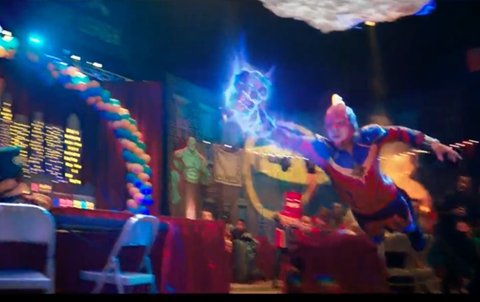
Figure 1. Kamala Khan Reveals Her Super Powers to Help Her Friends
Kamala actively trains to strengthen her superpowers. After finding out that her superpowers originate from within herself, she begins to practice regularly to understand and control them. She is determined to use her superpowers responsibly to help and save others. As a Muslim female with superpowers, Kamala chooses not to use her powers for evil, but for humanity. As a Muslim female hero who has superpowers, Kamala Khan not only saves women, but she also tries to save men who need help. In this context, as a woman, Kamala Khan is not gender biased. She also tries to provide assistance to anyone who needs help.
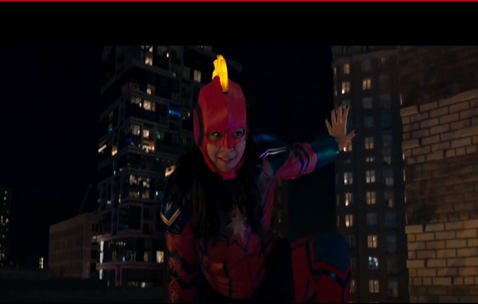
Figure 2. The Super Suit Worn by Kamala Khan When Saving People
As a Muslim female hero, Kamala Khan is portrayed to be against racism. She helps anyone in need and saves them wholeheartedly. She is also depicted as a cheerful, kind, and smiling woman. This portrayal signifies the true identity of a Muslim, who is not a source of chaos, a monster, or a threat to society, whether on a local (city), national, or international scale. Films are one of the most popular media to represent ethnic, religious, and cultural identities. The film Ms. Marvel, for example, prominently represents Islamic identity. As a Western film, Ms. Marvel is an anomaly, as there has never been a Muslim female depicted as a hero. Furthermore, the film strongly emphasizes Islamic identity through narratives and visuals that highlight Islamic symbols. The first Islamic symbol depicted in the film relates to daily life. Kamala Khan's family is portrayed as devoutly Muslim, demonstrated by regularly performing prayers, practicing Islamic worship, and upholding Islamic values. The following picture shows Kamala’s extended family is going to have a meal and perform activities. When Kamala Khan reveals she wants to join the Avengers cosplay event, her parents did not allow her because they thought that the event is a party for adults involving alcoholic drinks. When Kamala Khan has learned to drive, she starts with 'bismillah'. This indicates that the teachings of Islam are still firmly held by Muslims in the west.
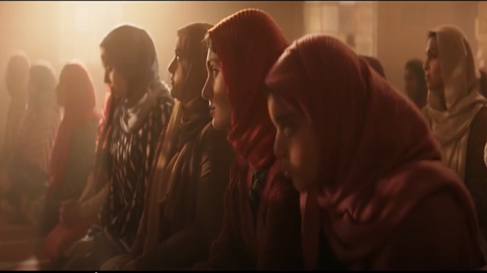
Figure 3. Muslim Women Wearing Hijab
The second Islamic symbol depicted in the film is the ablution performed by Kalama Khan and her brother before praying. Kamala Khan often prays in the mosque, portrayed magnificently. Inside the mosque, women wearing hijab are seen. A Muslim woman wearing a hijab and a Muslim man wearing a long beard and a head-covering turban symbolize the Muslim community. Regarding hijab, currently Muslim women are not completely orthodox in its use, but they can be flexible in wearing it as a fashion. The hijab in the modern context is no longer considered solely as a symbol of Muslim women's religiosity. However, the hijab is also a symbol of Muslim women's fashion culture trends which follow world fashion developments with flexibility, comfort and trends.58 Therefore, wearing hijab is inseparable from Islamic piety.59 In Ms. Marvel, however, hijab is not consistently worn by Muslim women. Kamala Khan does not always wear hijab in her daily life. In addition, the Eid al-Fitr festival celebrated by Muslims on every 1 Shawwal is featured in Ms. Marvel. The scene depicts the excitement to celebrate Eid al-Fitr. The symbolism of Islam in Ms. Marvel is strongly displayed, indicating that the awareness of Islamic identity has increased in the Western context.
5. Reinterpretation of the Grand Narrative of Muslim Female Heroes in Films: Hollywood's Revival or Marketing Strategy?
The portrayal of a Muslim female hero in Ms. Marvel, which is a Hollywood film, raises significant questions. On the one hand, the dominant narrative on a global scale indicates that Islam has gained acceptance in the West. Islamic identity has been reinforced and recognized by the West. Therefore, Hollywood as a representation of the West has allowed Muslim female characters as heroes. In fact, until now, there has never been a Hollywood film portraying Muslim women as heroes and protagonists. A number of researchers highly appreciate the emergence of Muslim female heroes. For example,60 Elabd argues that Ms. Marvel is a Hollywood film that attempts to deconstruct Islamophobia on an international scale. Similarly, Andreassen reveals that Ms. Marvel displays the 'de-monstering' of Muslims and Islam to the global audience. Muslims in Ms. Marvel are portrayed as helpful, friendly, and kind saviors. They are also depicted as people who do not like to cause trouble and violate community ethics.61 In fact, Ms. Marvel is considered a breakthrough by Disney and Marvel in elevating minority women as heroes.62 Ms. Marvel is seen as a breath of fresh air and represents de-monstering, de-Islamophobia, de-stereotyping of Islam, suggesting transformations in the Hollywood industry. The evolution of Hollywood films indicates a shift from a previous absence of Islamic narratives to the inclusion of Islamic heroes. However, from a critical discourse perspective, the emergence of Muslim women as heroes in Hollywood films cannot be entirely separated from global film marketing strategies.
From a global film marketing perspective, film audiences are increasingly dominated by Muslims, both in Asian and Western cinema.63 For this reason, Hollywood is making an effort to attract market share from Muslim audience by portraying Muslims as the protagonists and superheroes. Similarly, Ms. Marvel attempts to depict the identity of a minority group as a hero in the framework of popular culture. Whether it is acknowledged or not, the resonance of Disney and Marvel in adapting Ms. Marvel from a comic book published in 2014 into a big screen film in 2022 has received significant appreciation from the global audience. In the comic version, Ms. Marvel is considered challenging and breaking down the issue of gender-race-religion stereotypes.64 Consequently, the public has provided positive responses to the comic book. In terms of the targeted-age group, Marvel is aiming for global film audiences aged 30 and under. Therefore, Marvel selecting a Muslim female hero aged 16 years aims to attract teenage audiences on a global scale.65 The selection of this age is a market strategy because the majority of film viewers fall within this category. In addition, the market strategy was executed by Marvel by featuring major themes related to political issues. This also helped boost ticket sales for Marvel films.66 In fact, the incorporated themes are shallow in terms of substance.
Currently, Hollywood is attempting to make a massive transformation to attract a market share for global film audiences. The strategy carried out by Hollywood film producers, namely advertising carried out on a large scale globally, especially to countries with large populations like India and China, significantly increased the number of screens for film screenings and film releases.67 This strategy aims to prevent the loss of the domestic film market share, which is currently the main competitor, namely India,68 China,69 and South Korea.70 In response to these changes, Hollywood is striving for the collaboration with domestic film markets that embrace all ethnicities, races, and religions in order to gain a larger market share of film audiences,71 who have a love for domestic figures and also Hollywood films. Moreover, Hollywood also collaborates with multi-ethnic representations. For example, black people are portrayed as heroes in the Black Panther film (2018), which deconstructs the notion that black people cannot be depicted as superheroes in Hollywood films.72 In fact, Saunders revealed that films featuring black superheroes are more profitable than those featuring white ones. This is proven by the revenue of USD 1.347 billion from the Black Panther film tickets.73 All of these efforts are made by Hollywood as part of their global market strategy. Otherwise, Hollywood will lose to domestic film competitors. Marvel's film marketing strategies are presented in Table 1 below.
Table 1. Hollywood film marketing strategies
|
No. |
Component |
Marketing strategy |
|---|---|---|
|
1. |
Religion |
Elevating Muslim characters/superheroes |
|
2. |
Race |
Elevating black characters/superheroes |
|
3. |
Age |
Featuring characters/superheroes aged 30 or below |
|
4. |
Culture |
Featuring characters/superheroes who come from a particular local culture/country, especially large countries with a large market share. |
|
5 |
Theme |
Raising sensitive, controversial, political themes, highlighting the West as the leader |
|
6. |
Writer/Director |
Muslim, diaspora |
On the other hand, Ms. Marvel seeks to promote a Muslim female hero as the protagonist. This film also opens the world's eyes to the idea that ethnic minorities in the diaspora, specifically Pakistani-Americans, can also be heroes capable of saving others. As a Muslim female hero, she possesses superpowers that are equally strong to other Marvel characters’ extraordinary abilities. Thus, there are no portrayals of elements of race, religion, ethnicity, or marginalized groups in the film. However, if examined more deeply, the Ms. Marvel film presents a Muslim female hero in the context of teenagers. In Marvel films, the dominant female hero characters chosen are teenagers74 who gain superpowers by conquering their enemies or saving others.75 On this scale, it appears that the identity of a Muslim hero is still at the adolescent or immature level. Therefore, she becomes a hero by saving her friends. This indicates that Muslims as heroes have not yet reached the level of saving the world, but are still at the level of saving friends or city residents on a local scale. More importantly, this indicates that Hollywood is not brave enough to accept wholeheartedly that Muslims are the saviors of the world or even world leaders. At this stage, it seems that Hollywood is paving the way for the identity of Muslim female heroes at the city/local level as a trial and see the response of global film audiences.
6. Conclusion
Films have featured more non-Muslim hero characters, with Hollywood heroes largely dominated by white actors. However, in recent developments, Hollywood films have transformed by joining new aesthetic movements. This is marked by the emergence of Black Panther whose main character is black and the emergence of Ms. Marvel whose main character is a Muslim woman. On one hand, Hollywood, particularly Disney and Marvel, can accept a new Muslim identity: de-monstering, de-terrorism, de-Islamophobia, de-monism. On the other hand, the West started the discussions about more profitable market strategies. There are currently around two billion Muslims in the world, serving as a new orientation of the global film market. Therefore, Hollywood as an extension of the West, is trying to open and dismantle the barriers that are considered deadly to the global film market share. For this reason, the West features characters in global films involving the identity of minority races, Muslims, LGBTQ+, with collaboration with domestic figures.
Given the new aesthetics offered by Hollywood films, the following findings can be identified. First, since its inception in 1910, Hollywood has never presented a female Muslim hero figure until in 2021. This is due to various factors ranging from different racial, religious and gender-based discrimination, propaganda, and terrorism. In 2022, Hollywood carried out a new aesthetic transformation by presenting a female Muslim hero in Ms. Marvel. This means that the character of Kamala Khan represents Muslim women in the world as heroes. As a superwoman, Kamala Khan has superpowers that can be used to save others. Third, the emergence of Ms. Marvel strengthens the identity of Islam as a kind, civilized, and peace-loving religion. Fourth, the identity of Islam is very strongly constructed in Ms. Marvel, through the hijab symbol, the mosque symbol, the prayers performed by Muslims, and also the Eid celebration.
On a global scale, the results of this study are expected to contribute to feminist research within the context of Islamic studies, including Islamic feminism in the context of philosophy, psychology, sociology, anthropology, religion, and cultural studies, or even art and literature. The results of this study also reconstructing, reinterpreting, and re-narrating the stigma that research on global-scale Muslim female heroes in Hollywood films is still minimal in Islam. The results of this study are also expected to be an embryo for other researchers who want to conduct research on global-scale Muslim female heroes. It is possible for further researchers to conduct comparative studies on Muslim female heroes in Eastern vs. Western countries. In addition, specifically this study is expected to open new discourse and deconstruct global thinking that often claims that women are weak and vulnerable figures so they cannot be heroes. For this reason, Islamic feminists and postfeminist are expected to be stronger in carrying out new constructions regarding Muslim female heroes. The new construction is not a resistance to the male hero identity that has been dominant in Hollywood films, but rather it represents racial and gender-based equality by showing that Muslim female can also be heroes in films or other contexts on a global scale. In another context, Muslim females can also be heroes not only in films, fiction, or art, but also in education, social, cultural, and religious fields.
6.1. Future DirectThe rise of Hollywood film on a global scale has given rise to both benefits and challenges. It has given rise to various studies and interpretations of the film, both in monodisciplinary and interdisciplinary contexts. Hollywood films are developing in accordance with global market demand. Therefore, some Hollywood films are starting to strengthen the Islamic identity in them. Religious studies/Islamic studies in this case are expected to be more flexible in conducting studies on Hollywood films with the hope of producing more resolutive findings for the development of Islam on a global scale.
Author Contribution
Anas Ahmadi was solely responsible for this research
Conflict of Interest
The authors of the manuscript have absolutely no financial or non-financial conflict of interest regarding the subject matter or material discussed in this manuscript.
Data Availability Statement
The data associated with this study will be provided by the corresponding author upon request.
Funding Details
This research did not receive a grant from any funding source or agency.
Generative AI Disclosure Statement
The authors did not used any type of generative AI software for this research.
Bibliography
Aayeshah, Wajeehah. “Empowered and Strong: Muslim Female Community in Ms. Marvel.” In Superhero Bodies, edited by Wendy Haslem, Elizabeth MacFarlane, and Sarah Richardson, 59–73. New York: Routledge, 2018.
Adamson, Maria., and Elisabeth K. Kelan. "‘Female Heroes’: Celebrity Executives as Postfeminist Role Models.” British Journal of Management 30, no. 4 (2019): 981–996. https://doi.org/10.1111/1467-8551.12320
Afifulloh, M. “Gender Construction in Original Netflix Films: A Representation Study.” Galactica Media: Journal of Media Studies 7, no. 1 (2025): 48–68, https://doi.org/10.46539/gmd.v7i1.529
Ahmadi, Anas. “A Spiritual Journey of an Indonesian Woman: The Evidence through Literature from a Psychospiritual Perspective.” Cogent Arts and Humanities 10, no. 2 (2023): 221–13. https://doi.org/10.1080/23311983.2023.2270789
Ahmadi, Anas. “Masculinities to Trans-Femininities: Evidence Through The “Girl” Film.” Masculinities and Social Change 13, no. 1 (2024): 63–82, https://doi.org/10.17583/mcs.11837
Ahmadi, Anas. “The Traces of Oppression and Trauma to Ethnic Minorities in Indonesia Who Experienced Rape on the 12 May 1998 Tragedy.” Journal of Ethnic and Cultural Studies 8, no. 2 (2021): 126–144. https://doi.org/10.29333/ejecs/744
Ahmadi, Anas, Kamal Yusuf, Sharifah Fazliyaton, et al. “The Transformation of Islamic Identity Behind the Screen: Indonesian Horror Films, 1980-2020." Journal of Indonesian Islam 19, no. 1 (2025): 188–213. https://jiis.uinsby.ac.id/index.php/JIIs/article/view/30858
Akabli, J., and C. Chahdi. “Hollywood’s (mis) Construction of Gender: The Aesthetics and Politics of Stigmatising Arab/Muslim Women.” International Journal of Linguistics, Literature and Translation 5, no. 8 (2022): 17–28. https://doi.org/10.32996/ijllt.2022.5.8.3
Alhalal, Eman. “Strategies Used by Saudi Arabian Women to Respond to Intimate Partner Violence.” Journal of Family Violence (2025): 1–13. https://doi.org/10.1007/s10896-025-00808-1
Andreassen, Anja Borg. “Yes, We Khan: Diversity and De-Monsterization of Muslim Identities in 'Ms. Marvel'(2014–).” North Lit 42 (2019): 67–82. https://doi.org/10.7557/13.5005
Asghar, Muhammad, and Abdul Hamid Khan. “Disparagement of Islamic Femininity and the Pervasiveness of Racial Prejudice in Western Society: A Postcolonial Feminist Perspective of the Selected Narrative.” Shnakhat 3, no. 3 (2024): 499–512.
Beauvoir, Simon De. The Second Sex. London: Cape, 1949.
Bennion-Nixon, Lee-Jane. "We (Still) Need a Woman for the Job: The Warrior Woman, Feminism and Cinema in the Digital Age." Sense of Cinema. 2010. https://www.sensesofcinema.com/2010/feature-article/we-still-need-a-woman-for-the-job/.
Biskind, Peter. Easy Riders Raging Bulls: How the Sex-Drugs-And Rock 'N Roll Generation Saved. New York: Simon and Schuster, 2011.
Bowar, Kyra. “There is no Normal”: How Ms. Marvel Constitutes US American Citizenship Between Comics and Screen.” Master's thesis, Colorado State University, 2024.
Carli, Linda L. “Women Heroes.” In Encyclopedia of Heroism Studies, edited by Scott T. Allison, James K. Beggan, and George R. Goethals, 2239–2246. Cham: Springer International Publishing, 2024.
Cooper-Cunningham, Dean. “Drawing Fear of Difference: Race, Gender, and National Identity in Ms. Marvel Comics.” Millennium 48, no. 2, (2020): 165–197. https://doi.org/10.1177/0305829819889
Dastidar, Sayantan Ghosh., and Caroline Elliott. “The Indian Film Industry in a Changing International Market.” Journal of Cultural Economics 44 (2020): 97–116. https://doi.org/10.1007/s10824-019-09351-6
Elabd, Arwa. “Ms. Marvel Substitutes Fears with Facts: Deconstructing Islamophobia.” Meditating and Mediating Change: State–Society–Religion (German: Landesdruckerei, 2020):109–122.
Fabricius, Charlotte Johanne. “The Size of the Fight in The Girl: Violent Girlhood in Ms. Marvel.” The Journal of Popular Culture 56, no. 5–6 (2023): 910–921. https://doi.org/10.1111/jpcu.13273
Fatima, Saroosh. “Muslims in Movies: The Hollywood Construction.” Pakistan Journal of Society, Education and Language (PJSEL) 2, no. 1 (2016): 54–75. https://pjsel.jehanf.com/index.php/journal/article/view/104
Frech, Elena. “Gendered Exits: The Role of Parliamentarians, Parties and Voters in Women's Departure from The European Parliament.” European Union Politics 26, no 1 (2025): 145–166. https://doi.org/10.1177/1465116524130
Fries, Maureen. “Female Heroes, Heroines, and Counter-Heroes: Images of Women in Arthurian Tradition.” In Arthurian Women, edited by Thelma S. Fenster and Norris J. Lacy, 59–73. New York: Routledge, 2015.
Galbraith, Patrick W., and Megan Catherine Rose. “Animated Femininities, Queer Discontent: An Interview with Colin Armistead and Phoebe Chan.” Journal of Femininities 1, no. 4 (2024): 1–15. https://doi.org/10.1163/29501229-bja10001
González-Velázquez, Carlos Allende., Karen E. Shackleford, Lauren N. Keller, Cynthia Vinney, and Lawrence M. Drake. “Watching Black Panther with Racially Diverse Youth: Relationships Between Film Viewing, Ethnicity, Ethnic Identity, Empowerment, and Wellbeing.” Review of Communication 20, no. 3 (2020): 250–259. https://doi.org/10.1080/15358593.2020.1778067
Hoque, Morshadul and Md Kamal Uddin, “Climate Change and Adaptation Policies in South Asia: Addressing the Gender-Specific Needs of Women.” Local Environment (2025): 1–19, https://doi.org/10.1007/978-3-030-87934-1_21
Hyunyoung Lee and Heywon Park. “A Study on the Muslim Women's Fashioning in Southeast Asia-Focus on Indonesia and Malaysia.” Journal of Fashion Business 24, no. 2 (2020): 85–99.
Irshad, Shaista. “Hegemonic Femininity: Negotiating the Stereotypes of Gender in the Indian Movies Fire (1996) and Shakuntala Devi (2020).” Media Watch 15, no. 3 (2024): 345–366. https://doi.org/10.1177/097609112311803
Karimpaniyil, Roshan., and Pranamya Bhat. “Masculinities, Femininities, and The Patriarchal Family: A Reading of The Great Indian Kitchen.” Journal for Cultural Research 28, no. 1 (2024): 102–115, https://doi.org/10.1080/14797585.2023.2300071.
Kent, Miriam. “Marvel Women: Femininity, Representation and Post-feminism in Films Based on Marvel Comics.” PhD diss., University of East Anglia, 2016.
Kent, Miriam. “Unveiling Marvels: Ms. Marvel and The Reception of The New Muslim Superheroine.” Feminist Media Studies 15, no. 3 (2015): 522–527. https://doi.org/10.1080/14680777.2015.1031964.
Khanum, Masroor., and Zafar Iqbal. “Hollywood Movies Stamping of Islam and Muslims: An Analysis of Representation.” Journal of Journalism, Media Science & Creative Arts 2, no. 2 (2022): 39–52, https://doi.org/10.56596/jjmsca.v2i2.27.
Khushbakht, Syeda Mehmoona. “The Aurat March (2018-2022) in the Context of Gendered-Islamophobia: A Case of Muslim Women's Identity in Pakistan.” Journal of Islamic Thought and Civilization 12, no. 2 (2022): 271–285, https://doi.org/10.32350/jitc.122.19.
Kim, Eun-mee. “Market Competition and Cultural Tensions Between Hollywood and The Korean Film Industry.” International Journal on Media Management 6, no. 3–4 (2004): 207–216, https://doi.org/10.1080/14241277.2004.9669403.
Kim, Minjeong, and Rachelle J. Brunn-Bevel. “Hollywood's Global Expansion and Racialized Film Industry.” Humanity & Society 44, no. 1 (2020): 37–66, https://doi.org/10.1177/0160597619832.
Küngerü, Ayhan. “The Demonization of Islam in Contemporary Hollywood Cinema.” In International Perspectives on Rethinking Evil in Film and Television. New York: IGI Global, 2021.
Lee, Moon-Haeng., and Eun-Kyoung Han. “Competition: Hollywood Versus Domestic Films: Release Strategies of Hollywood Films in South Korea.” International Journal on Media Management 8(3), (2006): 125–33, https://doi.org/10.1207/s14241250ijmm0803_3.
Lermontov, Mikhail. A Hero of Our Time. Oxford University Press, 2013.
Lu Zijie, Eric Tseng, and Zisheng Xu. “The Analysis of Marvel (Disney) Marketing Strategies.” In 2022 7th International Conference on Financial Innovation and Economic Development (ICFIED 2022). Atlantis Press, 2022.
Mains, Christine., Brad J. Ricca, Holly Hassel, and Lynda Rucker. “Heroes or Sheroes.” Women in Science Fiction and Fantasy 1 (2009): 179–190.
McGowan, David. Animated Personalities: Cartoon Characters and Stardom in American Theatrical Shorts. University of Texas Press, 2019.
McInerney, Kerry. “From Cyborg Irony to Oriental Fantasy: The Racial Limits of Cyborg Feminisms in Ex Machina and Ghost in the Shell.” Signs: Journal of Women in Culture and Society 50, no. 2 (2025): 397–419.
Mernissi, Fatima. Women's Rebellion and Islamic Memory. London: Zed Books, 1996.
Merriam, Sharan B., and Robin S. Grenier, eds. Qualitative Research in Practice: Examples for Discussion and Analysis. New Jersey: John Wiley & Sons, 2019.
Miles, Matthew B. Qualitative Data Analysis: An Expanded Sourcebook. California: Thousand Oaks, 1994.
Moran, Albert, ed. Policy films. London: Routledge, 1996.
Morey, Peter, and Amina Yaqin. Framing Muslims: Stereotyping and Representation After 9/11. Harvard University Press, 2011.
Noureen, Abida, Shabana Nazar, and Nayyer Mustafa. “Historical Misrepresentation of Islam and Muslim: A Descriptive Review of Hollywood.” Pakistan Social Sciences Review 4, no. 2 (2020): 680–90.
Pal Payel and Goutam Karmakar. “Masculinity, Media, and Public Image: Review of the Film An Action Hero.” Media Asia 51, no. 1 (2024): 167–173.
Peng, Danyu. “The Marvel Universe's Character Partnerships-Reflecting on Cultural Diversity and Marketing Strategy.” Academic Journal of Humanities & Social Sciences 7, no. 1 (2024): 80–88.
Pennell, Hillary., and Elizabeth Behm-Morawitz. “The Empowering (Super) Heroine? The Effects of Sexualized Female Characters in Superhero Films on Women.” Sex Roles 72 (2015): 211–220, https://doi.org/10.1007/s11199-015-0455-3.
Peterson, Kristin M. “Beyond Fashion Tips and Hijab Tutorials.” Film Criticism 40, no. 2 (2016): 1–14.
Propp, Vladimir. “Study of the Folktale: Structure and History.” Dispositio 1, no. 3 (1976): 277–292.
Raglan, Lord. “The Heroes of Tradition.” Folklore 45, no. 3 (1934): 212–231.
Rank, Otto. “Myth of the Birth of the Hero.” The Journal of Nervous and Mental Disease 41, no. 2 (1914): 110–117.
Al-Rawi, Ahmed. “The Representation of September 11th and American Islamophobia in non-Western Cinema.” Media, War and Conflict 7, no. 2 (2014): 152–164, https://doi.org/10.1177/1750635214530
Redmond, Sean, and Liza Tsaliki. “Gender Studies Special Issue 'Emergent Femininities and Masculinities in the 21st Century Media and Popular Culture'.” Journal of Gender Studies (2025): 1–9, https://doi.org/10.1080/09589236.2025.2489578.
Renard, John. Islam and the Heroic Image: Themes in Literature and the Visual Arts. Macon: Mercer University Press, 1999.
El-Saadawi, Nawal. The Hidden Face of Eve: Women in the Arab World. London: Bloomsbury Publishing, 2015.
Sadiq, Saba., Noshina Saleem, and Hanan Ahamad Mian. “Women Portrayal in Contemporary Pakistani Films.” Pakistan Social Sciences Review 9 no 1 (2025): 27–40, https://doi.org/10.35484/plhr.2025(9-I)03.
Said, Edward W. Orientalism. New York: Vintage Books, 1979.
Sameed, Syed Ajmal. “The New Woman: Women’s Resistance in Saudi Movies-An Analysis of Wadjda and The Perfect Candidate.” International Journal of English: Literature, Language and Skills, 13 no 4 (2025): 17–22.
Saunders, Robert A. “(Profitable) Imaginaries of Black Power: The Popular and Political Geographies of Black Panther.” Political Geography 69 (2019): 139–149.
Schubart, Rikke. Super Bitches and Action Babes: The Female Hero in Popular Cinema, 1970-2006. London: McFarland, 2014.
Shaheen, Jack G. “Reel Bad Arabs: How Hollywood Vilifies a People.” The Annals of the American Academy of Political and Social Science 1 (2003): 171–193, https://doi.org/10.1177/000271620358800101 .
Story, Kaila Adia. “Black Dahlias–The Radical Black Femme and Black Feminist Traditions Within Black Studies.” Journal of Femininities 1, (2025): 1–20. https://doi.org/10.1163/29501229-bja10019
Strömberg, Fredrik. “"Yo, Rag-Head!": Arab and Muslim Superheroes in American Comic Books After 9/11.” Amerikastudien/American Studies 56, no. 4 (2011): 573–601.
Su, Wendy. “Cultural Policy and Film Industry as Negotiation of Power: The Chinese State's Role and Strategies and its Engagement with Global Hollywood 1994–2012.” Pacific Affairs 87, no. 1 (2014): 93–114, http://www.jstor.org/stable/43590825.
Sung, Kyoung-suk. “Heroic Princesses Across Cultural Horizons: A Comparative Analysis of Tomoe Gozen, Mulan, and Princess Bari Beyond Folklore.” In The Myriad Faces of Heroes and Heroines: Folkloric Tradition and Modern Contemporaries in Asia, edited by Julian Patrick Ward, Kelly Kar Yue Chan, and Chi Sum Garfield Lau, 53–70. Singapore: Springer Nature Singapore, 2025. https://doi.org/10.1007/978-981-97-8959-7_4.
Tasker, Yvonne. Women Warriors: Gender, Sexuality and Hollywood's Fighting Heroines. London: Taylor and Francis, 2004.
Tisell, Heidi. “The Development in Hollywood's Gender Roles: Heroes and Heroines in Re-Interpretations of Women's Films, 1930-2000.” Master's thesis, University of Oslo, 2006.
Woodley, Baylee. “Medieval Femmes: Exploring Queer Femininities in the Visual Culture of Late Medieval England and France.” PhD diss., University of London, University College London (United Kingdom), 2025.
Worthen, Holly. “Migration, Racial Capitalism, and Indigenous Women: Re-Reading the Gendered and Racialized Histories of US/Mexican Migration.” Journal of Ethnic and Migration Studies 51, no. 1 (2025): 402–421. https://doi.org/10.1080/1369183X.2023.2295238
Yahiaoui, Rashid. “Fansubbing and The Perpetuation of Western Popular Culture's Gender and Racial Stereotypes in Arabic.” International Journal of Society, Culture and Language 10, no. 2 (2022): 1–11.
Yang, Kexin. “The Role of Values: A Study of Female Heroes in Chinese and American Movies.” Communications in Humanities Research 65 (2025): 16–21, https://doi.org/10.54254/2753-7064/2024.19776.
1Elena Frech, “Gendered Exits: The Role of Parliamentarians, Parties and Voters in Women's Departure from The European Parliament,” European Union Politics (2025): 145–166, https://doi.org/10.1177/14651165241300273.
2Holly Worthen, “Migration, Racial Capitalism, and Indigenous Women: Re-Reading the Gendered and Racialized Histories of US/Mexican Migration,” Journal of Ethnic and Migration Studies 51, no. 1 (2025): 402–421, https://doi.org/10.1080/1369183X.2023.2295238.
3Morshadul Hoque, and Md Kamal Uddin, “Climate Change and Adaptation Policies in South Asia: Addressing the Gender-Specific Needs of Women,” Local Environment (2025): 1–19, https://doi.org/10.1080/13549839.2025.2456549
4Eman Alhalal, “Strategies Used by Saudi Arabian Women to Respond to Intimate Partner Violence,” Journal of Family Violence (2025): 1–13, https://doi.org/10.1007/s10896-025-00808-1.
5Sean Redmond, and Liza Tsaliki, “Emergent Femininities and Masculinities in the 21st Century Media and Popular Culture,” Journal of Gender Studies (2025): 1–9, https://doi.org/10.1080/09589236.2025.2489578.
6Baylee Woodley, “Medieval Femmes: Exploring Queer Femininities in the Visual Culture of Late Medieval England and France,” PhD diss., University of London, University College London (United Kingdom, 2025), ProQuest Dissertations & Theses Global (Publication No. 31840503), https://www.proquest.com/openview/c3b027064e89a8f21c76559c6a867a49/1?pq-origsite=gscholar&cbl=2026366&diss=y.
7M. Afifulloh, “Gender Construction in Original Netflix Films: A Representation Study,” Galactica Media: Journal of Media Studies 7, no. 1 (2025): 48–68, https://cyberleninka.ru/article/n/gender-construction-in-original-netflix-film-a-representation-study.
8Anas Ahmadi, “Masculinities to Trans-Femininities: Evidence Through The 'Girl' Film,” Masculinities and Social Change 13, no. 1 (2024): 63–82, https://dialnet.unirioja.es/servlet/articulo?codigo=9373325.
9Shaista Irshad, “Hegemonic Femininity: Negotiating the Stereotypes of Gender in the Indian Movies Fire (1996) and Shakuntala Devi (2020),” Media Watch 15, no. 3 (2024): 345–366, https://doi.org/10.1177/09760911231180343
10Roshan Karimpaniyil and Pranamya Bhat, “Masculinities, Femininities, and The Patriarchal Family: A Reading of The Great Indian Kitchen,” Journal for Cultural Research 28, no. 1 (2024): 102–115, https://doi.org/10.1080/14797585.2023.2300071
11Patrick W. Galbraith and Megan Catherine Rose, “Animated Femininities, Queer Discontent: An Interview with Colin Armistead and Phoebe Chan,” Journal of Femininities 1, (2024): 1–15, https://brill.com/view/journals/fem/1/2/article-p198_003.xml.
12Kerry McInerney, “From Cyborg Irony to Oriental Fantasy: The Racial Limits of Cyborg Feminisms in Ex Machina and Ghost in the Shell,” Signs: Journal of Women in Culture and Society 50, no. 2 (2025): 397–419, https://www.journals.uchicago.edu/doi/abs/10.1086/733017.
13Kaila Adia Story, “Black Dahlias–The Radical Black Femme and Black Feminist Traditions Within Black Studies,” Journal of Femininities 1, (2025): 1–20.
14Muhammad Asghar, and Abdul Hamid Khan, “Disparagement of Islamic Femininity and the Pervasiveness of Racial Prejudice in Western Society: A Postcolonial Feminist Perspective of the Selected Narrative,” Shnakhat 3, no. 3 (2024): 499–512, https://shnakhat.com/index.php/shnakhat/article/view/376.
15J. Akabli and C. Chahdi, “Hollywood’s (mis) Construction of Gender: The Aesthetics and Politics of Stigmatising Arab/Muslim Women,” International Journal of Linguistics, Literature and Translation 5 no 8, (2022): 17–28, https://doi.org/10.32996/ijllt.2022.5.8.3.
16Saba Sadiq, Noshina Saleem, and Hanan Ahamad Mian, “Women Portrayal in Contemporary Pakistani Films,” Pakistan Social Sciences Review 9, no 1 (2025): 27–40, https://doi.org/10.35484/plhr.2025(9-I)03.
17Syed Ajmal Sameed, “The New Woman: Women’s Resistance in Saudi Movies-An Analysis of Wadjda and The Perfect Candidate,” International Journal of English: Literature, Language and Skills, 13 no 4 (2025): 17–22.
18Payel Pal, and Goutam Karmakar. “Masculinity, Media, and Public Image: Review of the Film an Action Hero,” Media Asia 51, no. 1 (2024): 167–173, https://doi.org/10.1080/01296612.2023.2170053.
19Simon De Beauvoir, The Second Sex (London: Cape, 1949).
20David McGowan, Animated Personalities: Cartoon Characters and Stardom in American Theatrical Shorts (Austin: University of Texas Press, 2019).
21Edward W. Said, Orientalism (New York: Vintage Books, 1979).
22Abida Noureen, Shabana Nazar, and Nayyer Mustafa, “Historical Misrepresentation of Islam and Muslim: A Descriptive Review of Hollywood,” Pakistan Social Sciences Review 4, no. 2 (2020): 680–690.
23John Renard, Islam and the Heroic Image: Themes in Literature and the Visual Arts (Macon: Mercer University Press, 1999).
24Masroor Khanum and Zafar Iqbal, “Hollywood Movies Stamping of Islam and Muslims: An Analysis of Representation,” Journal of Journalism, Media Science and Creative Arts 2, no. 2 (2022): 39–52, https://doi.org/10.56596/jjmsca.v2i2.27.
25Nawal El Saadawi, The Hidden Face of Eve: Women in The Arab World (London: Bloomsbury Publishing, 2015).
26Fatima Mernissi, Women's Rebellion and Islamic Memory (London: Zed books, 1996).
27Lord Raglan, “The Hero of Tradition,” Folklore 45, no. 3 (1934): 212–231, https://doi.org/10.1080/0015587X.1934.9718559.
28Vladimir Propp, “Study of the Folktale: Structure and History,” Dispositio 1, no. 3 (1976): 277–292.
29Otto Rank, “Myth of the Birth of the Hero,” The Journal of Nervous and Mental Disease 41, no. 2 (1914): 110–117.
30Mikhail Lermontov, A Hero of Our Time (Oxford: OUP Oxford, 2013).
31Hillary Pennell, and Elizabeth Behm-Morawitz, “The Empowering (super) Heroine? The Effects of Sexualized Female Characters in Superhero Films on Women,” Sex Roles 72 (2015): 211–220, https://doi.org/10.1007/s11199-015-0455-3.
32Rikke Schubart, Super Bitches and Action Babes: The Female Hero in Popular Cinema, 1970-2006 (McFarland, 2014).
33Lee-Jane Bennion-Nixon, "We (Still) Need a Woman for the Job: The Warrior Woman, Feminism and Cinema in the Digital Age," Sense of Cinema, 2010, https://www.sensesofcinema.com/2010/feature-article/we-still-need-a-woman-for-the-job/
34Kexin Yang, “The Role of Values: A Study of Female Heroes in Chinese and American Movies,” Communications in Humanities Research 65 (2025): 16–21, http://dx.doi.org/10.54254/2753-7064/2024.19776.
35Linda L. Carli, “Women Heroes,” in Encyclopedia of Heroism Studies, ed. Scott T. Allison, James K. Beggan, and George R. Goethals (Cham: Springer International Publishing, 2024), 2239–2246.
36Christine Mains, Brad J. Ricca, Holly Hassel, and Lynda Rucker, “Heroes or Sheroes,” Women in Science Fiction and Fantasy 1 (2009): 179–190.
37Maureen Fries, “Female Heroes, Heroines, and Counter-Heroes: Images of Women in Arthurian Tradition,” in Arthurian Women, ed. Thelma S. Fenster, and Norris J. Lacy (Routledge, 2015), 59–73.
38Maria Adamson, and Elisabeth K. Kelan, “Female Heroes’: Celebrity Executives as Postfeminist Role Models,” British Journal of Management 30, no. 4 (2019): 981–996, https://doi.org/10.1111/1467-8551.12320.
39Kyoung-suk Sung, “Heroic Princesses Across Cultural Horizons: A Comparative Analysis of Tomoe Gozen, Mulan, and Princess Bari Beyond Folklore,” in The Myriad Faces of Heroes and Heroines: Folkloric Tradition and Modern Contemporaries in Asia, ed. Julian Patrick Ward, Kelly Kar Yue Chan, and Chi Sum Garfield Lau (Singapore: Springer Nature Singapore, 2025), 53–70, https://doi.org/10.1007/978-981-97-8959-7_4.
40Anas Ahmadi, “The Traces of Oppression and Trauma to Ethnic Minorities in Indonesia Who Experienced Rape on the 12 May 1998 Tragedy,” Journal of Ethnic and Cultural Studies 8, no. 2, (2021): 126–144.
41Anas Ahmadi, “A Spiritual Journey of An Indonesian Woman: The Evidence Through Literature from A Psychospiritual Perspective,” Cogent Arts & Humanities 10, no. 2 (2023): 221–213, https://doi.org/10.1080/23311983.2023.2270789.
42Matthew B. Miles, Qualitative Data Analysis: An Expanded Sourcebook (California: Thousand Oaks, 1994).
43Sharan B. Merriam, and Robin S. Grenier, eds, Qualitative Research in Practice: Examples for Discussion and Analysis (New Jersey: John Wiley & Sons, 2019).
44Saroosh Fatima, “Muslims in Movies: The Hollywood Construction,” Pakistan Journal of Society, Education and Language (PJSEL) 2, no. 1 (2016): 54–75.
45Jack G. Shaheen, “Reel Bad Arabs: How Hollywood Vilifies a People,” The Annals of the American Academy of Political and Social Science 1 (2003): 171–193, https://doi.org/10.1177/0002716203588001011.
46Ayhan Küngerü, “The Demonization of Islam in Contemporary Hollywood Cinema,” In International Perspectives on Rethinking Evil in Film and Television, ed. Dilan Tüysüz (New York: IGI Global, 2021), 176–192.
47Rashid Yahiaoui, “Fansubbing and The Perpetuation of Western Popular Culture's Gender and Racial Stereotypes in Arabic,” International Journal of Society, Culture and Language 10, no. 2 (Themed Issue on the Socio-Psychology of Language) (2022): 1–11, https://doi.org/10.22034/ijscl.2022.554602.2646.
48Fredrik Strömberg, “Yo, Rag-Head!": Arab and Muslim Superheroes in American Comic Books After 9/11,” Amerikastudien/American Studies 56, no. 4 (2011): 573–601.
49Peter Morey and Amina Yaqin, Framing Muslims: Stereotyping and Representation After 9/11. (Harvard University Press, 2011).
50Ahmed Al-Rawi, “The representation of September 11th and American Islamophobia in non-Western Cinema,” Media, War and Conflict 7, no. 2 (2014): 152–164, https://doi.org/10.1177/1750635214530208.
51Albert Moran, ed. Film Policy. (London: Routledge, 1996).
52Peter Biskind, Easy Riders Raging Bulls: How the Sex-Drugs-And Rock 'N Roll Generation Saved. (New York: Simon and Schuster, 2011).
53Heidi Tisell, “The Development in Hollywood's Gender Roles: Heroes and Heroines in Re-Interpretations of Women's Films, 1930-2000,” (Master's Thesis, University of Oslo, 2006).
54Yvonne Tasker, Women Warriors: Gender, Sexuality and Hollywood's Fighting Heroines. (London: Taylor and Francis, 2004).
55Syeda Mehmoona Khushbakht, “The Aurat March (2018-2022) in the Context of Gendered-Islamophobia: A Case of Muslim Women's Identity in Pakistan,” Journal of Islamic Thought and Civilization 12, no. 2 (2022): 271–285, https://doi.org/10.32350/jitc.122.19.
56Miriam Kent, “Unveiling Marvels: Ms. Marvel and the Reception of the New Muslim Superheroine,” Feminist Media Studies 15, no. 3 (2015): 522–527, https://doi.org/10.1080/14680777.2015.1031964.
57Wajeehah Aayeshah, “Empowered and Strong: Muslim Female Community in Ms. Marvel,” in Superhero Bodies, ed. Wendy Haslem, Elizabeth MacFarlane, and Sarah Richardson (Routledge, 2018), 59–73.
58 Hyunyoung Lee, and Heywon Park, “A Study on the Muslim Women's Fashioning in Southeast Asia-Focus on Indonesia and Malaysia,” Journal of Fashion Business 24, no. 2 (2006): 85–99.
59Kristin M. Peterson, “Beyond Fashion Tips and Hijab Tutorials,” Film Criticism 40, no. 2 (2016): 1–14.
60Arwa Elabd, “Ms. Marvel Substitutes Fears with Facts: Deconstructing Islamophobia,” in Meditating and Mediating Change: State–Society–Religion, ed. Maureen Daly Goggin and Urša Marinšek (Graz: Graz University Press, 2020), 109–121.
61Anja Borg Andreassen, “Yes, We Khan: Diversity and De-Monsterization of Muslim Identities in 'Ms. Marvel' (2014–),” North Lit 42 (2019): 67–82.
62Kyra Bowar, “There Is No Normal”: How Ms. Marvel Constitutes US American Citizenship Between Comics and Screen,” (Master's Thesis, Colorado State University, 2024).
63 Anas Ahmadi, et al., “The Transformation of Islamic Identity Behind The Screen: Indonesian Horror Films, 1980-2020,” Journal of Indonesian Islam 19, no. 1 (2025): 188–213.
64Dean Cooper-Cunningham, “Drawing Fear of Difference: Race, Gender, and National Identity in Ms. Marvel Comics,” Millennium 48, no. 2 (2020): 165–197, https://doi.org/10.1177/0305829819889133.
65Zijie Lu et al., “The Analysis of Marvel (Disney) Marketing Strategies,” In 2022 7th International Conference on Financial Innovation and Economic Development (ICFIED 2022). (Atlantis Press, 2022), 1929-1934.
66Danyu Peng, “The Marvel Universe's Character Partnerships-Reflecting on Cultural Diversity and Marketing Strategy,” Academic Journal of Humanities and Social Sciences 7, no. 1 (2024): 80-88.
67Moon-Haeng Lee, and Eun-Kyoung Han, “Competition: Hollywood Versus Domestic Films: Release Strategies of Hollywood Films in South Korea,” International Journal on Media Management 8, no. 3 (2006): 125–33, https://doi.org/10.1207/s14241250ijmm0803_3.
68Sayantan Ghosh Dastidar, and Caroline Elliott, “The Indian Film Industry in a Changing International Market,” Journal of Cultural Economics 44 (2020): 97–116, https://doi.org/10.1007/s10824-019-09351-6.
69Wendy Su, “Cultural Policy and Film Industry as Negotiation of Power: The Chinese State's Role and Strategies and Its Engagement with Global Hollywood 1994–2012,” Pacific Affairs 87, no. 1 (2014): 93–114, https://doi.org/10.5509/201487193.
70Eun-mee Kim, “Market Competition and Cultural Tensions Between Hollywood and The Korean Film Industry,” International Journal on Media Management 6, no. 3-4 (2004): 207–216, https://doi.org/10.1080/14241277.2004.9669403.
71Minjeong Kim, and Rachelle J. Brunn-Bevel, “Hollywood's Global Expansion and Racialized Film Industry,” Humanity and Society 44, no. 1 (2020): 37–66, https://doi.org/10.1177/0160597619832045.
72Carlos A. González-Velázquez et al., “Watching Black Panther with Racially Diverse Youth: Relationships Between Film Viewing, Ethnicity, Ethnic Identity, Empowerment, and Wellbeing,” Review of Communication 20, no. 3 (2020): 250–259, https://doi.org/10.1016/j.polgeo.2018.12.010.
73Robert A. Saunders, “(Profitable) Imaginaries of Black Power: The Popular and Political Geographies of Black Panther,” Political Geography 69 (2019): 139–149, https://doi.org/10.1016/j.polgeo.2018.12.010.
74Miriam Kent, “Marvel Women: Femininity, Representation and Postfeminism in Films Based on Marvel Comics,” PhD diss., (University of East Anglia, 2016), https://ueaeprints.uea.ac.uk/id/eprint/64255/.
75Charlotte Johanne Fabricius, “The Size of the Fight in The Girl: Violent Girlhood in Ms. Marvel,” The Journal of Popular Culture 56, no. 5-6 (2023): 910–921, https://doi.org/10.1111/jpcu.13273.