
| Review | Open Access |
|---|
From Valikhanov to Tokayev: Islam in the Kazakh Nation-Building Agenda |
 |
|---|
 Husam Abdulridha Bahiya1, Mohammed Radhee Ghadheb2, and Furat Jamal Hassan1
1 Department of Arabic Calligraphy and Ornaments, College of Fine Arts,University of Baghdad, Baghdad, Iraq
2General Directorate of Education of Baghdad, Ministry of Education, Baghdad, Iraq
The current study aimed to examine the ornamental design systems employed in Qur’ānic manuscripts, focusing on the celebrated copy of the Qur’ān produced by Yaqut al-Mustasimi in 690 AH/1291 CE, a distinguished exemplar of the Baghdad School. The research addressed the problem of how illuminators developed systematic ornamental frameworks that balanced aesthetic harmony with the codicological functions of the manuscript. Adopting a descriptive-analytical method, the study investigated selected folios noted for their preservation, visual clarity, and representative artistic value—particularly the introductory pages and opening surahs. Through detailed structural analysis, five distinct ornamental systems were identified. These included quadrilateral symmetry, bilateral symmetry, radial organization, diffusion through modular repetition, and combined multiple frameworks. The findings demonstrated that these systems were neither arbitrary nor purely decorative, however, grounded in geometric logic and deliberate design methodology. A notable feature is the integration of symmetry with controlled asymmetry, particularly in double-page spreads, which ensured continuity between facing folios and reflected advanced spatial planning. The research highlighted how Baghdadi illuminators, constrained by the prohibition of figural imagery, transformed vegetal and geometric motifs into highly sophisticated compositional systems. These strategies not only defined the visual identity of the Abbasid Qur’ān but also established a legacy that shaped later Islamic manuscript traditions. By articulating the methodological foundations of these systems, the study contributed to a deeper understanding of Islamic manuscript design. Additionally, it provided a framework to analyze ornamental logic in historical and contemporary Qur’ānic art.
1. INTRODUCTION
The Abbasid Caliphate (750–1517 CE / 132–923 AH) marked one of the most flourishing eras of Islamic civilization, with Baghdad serving as its political, intellectual, and artistic capital. Under Abbasid patronage, the arts of calligraphy and ornamentation reached new levels of sophistication, making the Qur’ān not only a sacred text but also a visual masterpiece.
The reign of Caliph al-Mustaʿṣim (1226–1258 CE / 623–656 AH) combined artistic patronage with political vulnerability. In 1258 CE (656 AH), Baghdad fell to the Mongols, which led to the collapse of Abbasid political authority. Despite this rupture, the city continued to flourish as a center of artistic and intellectual activity.
It was within this context that Yaqut al-Mustasimi (d. 1298 CE / 698 AH) emerged as one of the most distinguished masters of Arabic calligraphy and Qur’ānic ornamentation. His celebrated manuscript of the Qur’ān, completed in 690 AH (1291 CE), exemplifies the Baghdadi ornamental style at its height. Special decorative attention was given to the opening chapter, Surah al-Fātiḥah (1:1–7), and the initial verses of Surah al-Baqarah (2:1–5), which were often emphasized in Islamic manuscript illumination.
While numerous studies have explored Islamic calligraphy, manuscript illumination, and ornamental practices in broad terms, few have undertaken a focused investigation into the systematic design principles within a single Qur’ānic manuscript. Existing scholarship often emphasizes stylistic description or symbolic interpretation, yet lacks an in-depth analysis of the structural logics that governed the creation of ornamental frameworks. The Arabic calligraphy and Islamic ornaments organize spatial order, guide transition, and deepen the spiritual atmosphere.1 Thus, this gap underscores the need for a detailed study that not only documents visual features but also reveals the compositional methodologies underlying them.
1.1. Research ObjectivesThe current research sets out following three primary objectives:
- To identify the ornamental design systems employed in Yaqut al-Mustasimi’s Qur’ān as a representative exemplar of the Baghdadi School.
- To analyze the structural and geometric logic that organizes these systems, with attention to the balance between symmetry and controlled asymmetry.
- To demonstrate the cultural and artistic significance of these design strategies, highlighting their role in shaping the visual identity of Abbasid Qur’ānic manuscripts and their lasting influence on subsequent traditions of Islamic art.
By addressing this gap, the study advanced scholarly understanding of Islamic manuscript design not merely as an aesthetic practice but as a codified methodology that reflects both intellectual sophistication and cultural identity. This inquiry was prompted by several scholarly and artistic imperatives:
1.1.1. Preservation of Heritage
The Qur’ānic manuscript attributed to Yaqut reflects a high level of artistic originality rooted in Baghdadi tradition. Documenting and analyzing its visual systems support the preservation and identification of this unique artistic heritage.
1.1.2. Aesthetic and Educational Value
The compositions studied in this manuscript exhibit a striking degree of aesthetic harmony and technical sophistication. Such qualities command the attention of both scholars and students, warranting a comprehensive examination of the underlying design methodologies and the aesthetic dimensions they articulate.
Through a detailed analysis of Yaqut al-Mustasimi’s work, this study contributed to the theoretical and practical understanding of ornamental systems in Islamic art. Furthermore, it offered valuable insights into the intellectual and creative strategies of one of Baghdad’s most influential artistic figures.
Literature Review
2.1. Ornamental Design Systems in Qur’ānic Manuscripts: Aesthetic Foundations and Structural ApproachesThe arts of decoration and gilding in Islamic civilization attained exceptional levels of refinement and innovation, particularly in response to the sustained efforts of Muslim illuminators to enhance the visual and spiritual appeal of the Holy Qur’ān. Their meticulous designs combined geometric precision with symbolic motifs, reflecting both artistic mastery and theological depth. These innovations not only enriched Qur’ānic manuscripts but also influenced wider traditions of Islamic art and architecture.2 Across successive Islamic periods, the Qur’ān served as a central object of devotion and a fertile platform for creative expression. This sacred text was not only revered for its spiritual content but also honored through its visual presentation—elevated by sophisticated ornamentation that aimed to display it in the most aesthetically-refined and respectful form.3
Once the calligraphy was complete, the illuminator began the task of adorning the text with ornamental elements, such as vegetal motifs, arabesques, braids, and ribbons. These embellishments not only heightened the aesthetic harmony of the manuscript but also guided the reader’s contemplation toward its sacred content. In this way, ornamentation functioned as both a visual embellishment and a spiritual mediator.4 These decorations were never applied arbitrarily. Instead, they followed a compositional logic that was closely-tied to the spatial layout of the script, creating a decorative system that maintained harmony with the sanctity of the text and reinforced its visual coherence.5 To achieve such compositional balance, the illuminator typically began with a spatial division of the decorative surface, employing geometric principles to subdivide the area into clearly-defined segments. These subdivisions—referred to as ornamental design systems—provided a structural framework within which motifs could be positioned systematically. The use of axes, proportional grids, and modular units allowed for the harmonious distribution of decorative forms, resulting in a unified and coherent visual composition.6 These design systems were both methodical and adaptive. Depending on the artistic objectives and the complexity of the composition, a single system might suffice, or multiple systems could be integrated within one manuscript page. The benefit of this structured approach lies in its capacity to organize space with precision, maintain visual continuity, and elevate the decorative function to a level of intellectual and spiritual engagement.7
Thus, the development of ornamental design systems in Islamic manuscript art reveals a sophisticated interplay between geometry, artistic vision, and devotional intent. This study highlighted the importance of these systems as foundational to understanding the aesthetic structure of Qur’ānic illumination and as a vital component of Islamic visual culture.8
2.2. Symmetrical Division System along a Single AxisThis system entails dividing the decorative field into two equal and mirrored sections on either side of a central, imaginary axis—either vertically or horizontally. The result is a symmetrical composition in which each half reflects the other, creating a balanced and harmonious structure.
This approach was frequently employed by the decorator in the construction of ornamental units, where the central axis served as the foundational line that bifurcated the design into two equivalent parts. Such symmetrical arrangements not only enhance visual stability but also reflect a deeper aesthetic principle rooted in balance and order.9 An example of this application is illustrated in Figure 1. Bilateral symmetry conveys the principle of mīzān (balance), central to Qur’ānic cosmology. By reflecting one half onto the other, the illuminator embodies divine justice and equilibrium in creation. The mirrored halves symbolize harmony between the seen and unseen worlds, reminding the reader that all existence is grounded in divine order.
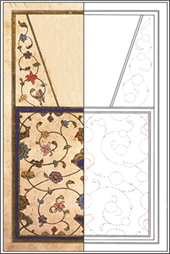
Figure 1. Symmetrical Division System along a Single Axis
2.3. Quadruple Division System Based on Two Perpendicular AxesIn this system, the decorative surface is divided into four sections through the intersection of two perpendicular imaginary axes—horizontal and vertical. The resulting structure may yield either symmetrical or asymmetrical compositions, depending on the spatial arrangement and the decorative objectives.10 This method is rooted in the principle of organizational modularity, whereby a single quarter-unit of the design is constructed and then systematically repeated four times to form a unified ornamental whole.
This quarter-unit functions as the fundamental modular component that ensures visual coherence and formal integration across the composition.11 As illustrated in Figure 2, the illuminator employed a combination of ornamental systems: quadrilateral repetition, particularly in the central medallion or inner basin of each page’s decorative layout, and bilateral repetition for the marginal frames of each page independently. However, in instances where both facing pages were considered as a single unified composition (a double-page spread), the illuminator extended the use of the quadrilateral system to the framing elements as well, creating a coherent and balanced structure across the spread.12 The four-part division reflects the completeness of creation and the universality of divine law. It resonates with symbolic associations of the number four—cardinal directions, elements, and cosmic order—suggesting that revelation extends across the totality of existence. The methodical repetition of one quarter into a whole, mirrors the Qur’ānic theme of unity emerging from multiplicity.
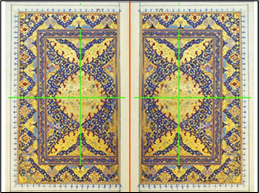
Figure 2. Quadruple Division System Based on Two Perpendicular Axes
2.4. Radial Division System from a Central PointAmong the decorative systems employed in the illumination of Qur’ānic manuscripts is the radial division system, which is particularly effective when the calligraphic layout assumes a circular form. In such compositions, the calligrapher arranges the Qur’ānic text concentrically, centering it within the geometric core of the page's inner field—often referred to as the inner basin. The illuminator, in turn, adopts a radical approach to ornamentation, dividing the surrounding space using imaginary axes that radiate outwards from a central point. These axes serve as guides for the placement of decorative motifs, resulting in a balanced composition that emanates harmoniously from the center. This system is exclusively associated with circular or radial configurations, and is especially suited for central medallions or roundels within the manuscript layout. An application of this technique is depicted in Figure 3. Radial layouts radiating from a center embody tawḥīd (oneness of God) as the source from which all things emanate. The circular rhythm evokes spiritual centrality, with God as the axis mundi. The eye’s movement outward from the center mirrors the believer’s journey from divine origin toward universal expansion, while always remaining tied to the core.
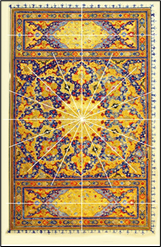
Figure 3. Radial Division System from a Central Point
2.5. Geometric Systems in Qur’ānic Manuscript OrnamentationThe diffusion system represents a geometric approach to ornamental composition in which the decorator divides the available surface into uniform, recurring geometric units—often in the form of squares or rectangles—arranged adjacently through a network of perpendicular intersecting lines. This division is reminiscent of floor tiling in architectural design and allows for the complete coverage of expansive surfaces with visual consistency and structural integrity.
Once the field has been subdivided, the decorator formulates a single ornamental module within one unit, which is then systematically repeated across the remaining segments to achieve full spatial coverage. This modular repetition ensures continuity and harmony across the decorated surface, enabling efficient and aesthetically-pleasing ornamentation of areas regardless of their size or shape. Such a method also reflects the geometric logic underlying Islamic art, where unity emerges from the interplay of repeated elements. In this way, the design embodies both mathematical precision and symbolic notions of infinity.13
The strength of the diffusion system lies in its adaptability and scalability, making it particularly effective for large-format manuscripts or architectural inscriptions.14 An example of this technique is shown in Figure 4.
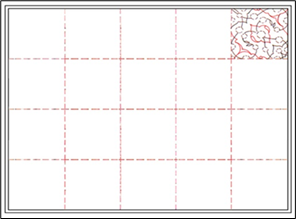
Figure 4. Geometric Systems in Qur’ānic Manuscript Ornamentation
2.6. Multiple Cadastral Division SystemThe multiple cadastral division system is characterized by its compositional flexibility and structural diversity. Unlike other systems based on a singular organizational principle, this approach involves the simultaneous use of multiple ornamental frameworks within a single decorative composition. It reflects the illuminator’s advanced level of artistic control, as it requires the orchestration of distinct design systems while preserving visual harmony and thematic unity.15 This system allows the decorator to respond to specific functional, aesthetic, and textual requirements within the manuscript page. Rather than applying a uniform pattern across the entire surface, the illuminator adapts individual segments of the page to distinct structural logics. These segments may vary in size, format, and ornamental purpose—such as surah headings, marginal decorations, or text-end indicators—and each is constructed using the most appropriate design method.16 As illustrated in Figure 5, this compositional strategy is evident in the illuminator’s treatment of a manuscript page containing a surah transition. The main ornamental panel, which houses the title of the forthcoming surah, is constructed using the quadruple division system, creating a symmetrical and prominent central element. This arrangement enhances the reader’s visual focus on the surah heading. At the same time, it reinforces the spiritual significance of the transition between sections of the Holy Qur’ān.17 To its side, a narrow decorative extension follows the bilateral symmetry system, lending directional balance and guiding the viewer’s gaze across the page. At the end of the surah, a circular motif based on the radial symmetry system provides closure to the textual content while acting as a focal point of ornamental rhythm and emphasis. This system corresponds to the art historical concept of balance through mirroring, often interpreted as a visual metaphor for divine order.
This integration of diverse systems within one layout demonstrates a non-linear, multi-axial approach to ornamental composition. No single system dominates; rather, each section of decoration adheres to its own internal logic while contributing to the overall aesthetic integrity of the page. This method requires deep spatial awareness, precise geometric planning, and a nuanced understanding of how different decorative grammars can coexist in dialogue without disrupting the sacred function of the text. Employing multiple cadastral divisions demonstrates the peak of structural and aesthetic complexity achieved in Islamic manuscript decoration. It not only enriches the visual texture of the page but also reflects the intellectual versatility and creativity of the Islamic illuminator in adapting ornamentation to the diverse visual and spiritual needs of Qur’ānic manuscripts. The diffusion of a small motif across the surface symbolizes the concept of infinity—God’s attributes without limit. Just as the unit expands endlessly across the page, divine presence permeates every corner of creation. This system also demonstrates how disciplined modularity transforms into visual infinity, resonating with Islamic metaphysics of the eternal.
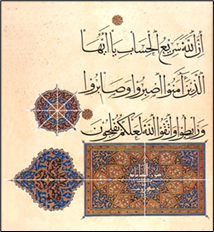
Figure 5. Multiple Cadastral Division System
3. Methodology
The current study adopted a descriptive–analytical approach, which is most suitable to examine ornamental systems in Qur’ānic manuscripts. Unlike experimental or purely historical methods, this approach enables the researcher to document the visual features of the manuscript and to analyze their underlying structural and geometric logic. The method rests on a systematic observation of selected samples, followed by analytical interpretation of their compositional strategies.
The Qur’ānic manuscript of Yaqut al-Mustasimi, produced in Baghdad in 690 AH/1291 CE, was deliberately chosen for analysis due to its historical and artistic significance. The selection was guided by three main criteria:
Chronological and geographical relevance – The manuscript belongs to the late Abbasid period in Baghdad, representing a mature stage in the development of Islamic ornamental art and embodying the Baghdadi School’s distinct identity.
State of preservation and legibility – The chosen folios maintain a high degree of physical integrity and clarity, allowing for precise identification and documentation of decorative elements.
Representative artistic value – Particular attention was given to sections traditionally emphasized by illuminators, such as the introductory folios, the opening chapter Surah al-Fātiḥah (1:1–7), and the initial verses of Surah al-Baqarah (2:1–5), in addition to the manuscript’s cover. These sections encapsulate the highest level of ornamental innovation and thus serve as ideal subjects for analysis.
The analytical process proceeded in three stages:
- Structural identification – Each decorative field was examined to determine the underlying geometric system (as bilateral symmetry, quadrilateral symmetry, radial layout, modular diffusion, or a combination of systems).
- Axis and modular analysis – Attention was given to axes of symmetry, proportional grids, and the repetition of modular units, in order to uncover the logic of spatial division and ornamental organization.
- Comparative evaluation – The results of individual sample analyses were compared to identify common design strategies as well as distinctive variations, with particular focus on how illuminators balanced symmetry, controlled asymmetry, and folio-to-folio continuity.
The descriptive–analytical approach was selected because it allows the research to move beyond stylistic description and to expose the codified design methodology of the manuscript. It also facilitates the integration of visual documentation with interpretive analysis, highlighting both the technical construction of ornamental systems and their cultural significance. This method ensures that the study not only describes the artistic features of Yaqut’s Qur’ān but also situates them within broader discussions on the intellectual and aesthetic foundations of Islamic manuscript ornamentation.
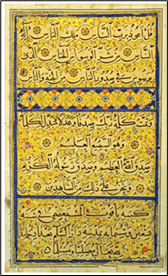
Figure 6. Comprehensive Documentation of the Qur’ānic Manuscript Page
4. Sample Analysis
4.1. Sample No. 1: Analysis of the Underlying Design SystemThe ornamental structure of the analyzed sample is fundamentally based on a quadrilateral symmetry system, wherein the decorative field is divided by two perpendicular, intersecting axes—horizontal and vertical—that bisect the page into four equal quadrants. This axial framework provides a stable geometric base upon which the entire composition is constructed, as illustrated in Figure A. Each quadrant mirrors the others in both form and proportion, reflecting the artist’s adherence to principles of balance, repetition, and geometric harmony that are foundational to Islamic decorative practice.
At the core of the design process is the construction of a modular ornamental quadrant—a primary visual unit designed within a single section. 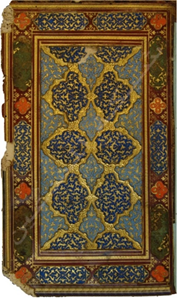 This quadrant is then replicated with precision across the remaining three sectors using methods of reflection and rotation. This results in a composition that is structurally unified yet rhythmically dynamic. The use of this system demonstrates the decorator’s mathematical awareness and spatial sensitivity, as symmetry is not merely visual but structurally embedded into the design logic.
However, the composition is not limited to this symmetrical repetition. A notable design intervention occurs within the inner rectangular zone, where the decorator introduces a diffusion-based partitioning system. In this inner field, the space is subdivided into smaller, equal geometric units—typically squares or rectangles—resembling a tiling scheme. Within one of these subdivisions, the decorator crafts a base motif, which is then seamlessly repeated across the remaining units to achieve full ornamental saturation of the central field.
The combination of quadrilateral symmetry in the main framework with modular diffusion inside the central field reveals a refined visual hierarchy that reflects the decorator’s advanced planning. The decorator deliberately varies his approach to ensure that the viewer’s eye is not confined to a static rhythm rather moves across the page through alternating zones of uniformity and variation. This strategic juxtaposition avoids visual monotony and infuses the design with a sense of depth, intricacy, and controlled diversity.
Furthermore, the contrast in scale between the outer quadrants and the finer units of the inner rectangle enhances the viewer’s perception of depth and movement. The decorator’s decision to preserve symmetrical consistency along all four sides while simultaneously introducing micro-level variation in the central zone highlights his ability to operate on multiple spatial registers—microstructural symmetry and microstructural variation—within a single composition, as evidenced in Figure B.
This multi-layered approach exemplifies the maturity of Baghdadi manuscript illumination during the Abbasid period. Furthermore, it affirms the intentionality with which Muslim decorators employed geometry not only as a visual principle but as a creative methodology.
This analysis demonstrates how the use of quadrilateral symmetry combined with diffusion reflects the research objective of uncovering systematic geometric logics in Qur’ānic ornamentation. This affirms that decorative structures were based on planned, modular design rather than arbitrary embellishment.
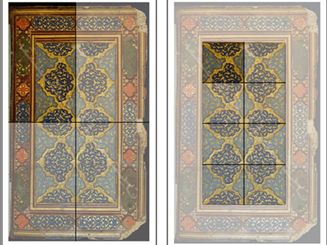
Figure A: Shows the geometric framework based on the quadrilateral symmetry system
Figure B: Illustrates the inner rectangular zone where the diffusion (modular repetition) system
4.2. Sample No. 2: Analysis of the Underlying Design SystemThe illuminator employed a quadrilateral division system to structure the decorative layout of the manuscript page, focusing particularly on the interior field. This was achieved by organizing the ornamental composition along two perpendicular axes, dividing the space into four primary quadrants, as illustrated in Figure A. This system yielded several visually symmetrical zones, where ornamental elements were mirrored and repeated to reinforce structural harmony and balance.
However, a closer analysis reveals that the symmetry is not strictly uniform. 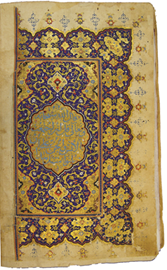 The illuminator appears to have designed an ornamental module that covered one-fifth of the central field, which was then replicated across the composition using a flip-flop mirroring technique. This is a method where the unit is reflected alternately along both horizontal and vertical directions until the form is visually complete.
Importantly, the vertical axis does not divide the layout into two perfectly identical halves. This results in a slight asymmetry that gives the visual impression of dual vertical axis lines, while the horizontal axis remains singular and consistent, as evidenced in Figure B. This intentional deviation stems from the nature of the ornamental frame, which encircles only three sides of the inner decorative field, leaving the left margin open, as shown in Figure C.
This open margin is not a compositional flaw but a deliberate structural decision rooted in the tradition of double-page Qur’ānic illumination. Since this page represents the right-hand folio when the Qur’ān is opened, it is designed to visually and structurally correspond with its counterpart on the left page. This practice of asymmetrical framing is common in Islamic manuscript illumination, especially in opening spreads or chapter headings, where the two facing pages collectively form a unified ornamental entity.
Despite relying on a repeated ornamental quarter, the illuminator maintained visual openness on the left side of the page, ensuring seamless visual continuity with the opposing folio. The decorative scheme is composed primarily of floral motifs, including cup-shaped floral elements and cloud-band forms. These are arranged in a way that respects both decorative fluidity and compositional interdependence between the two pages.
This nuanced approach highlights the sophisticated spatial reasoning of the illuminator, who balances modular repetition with functional asymmetry to meet both aesthetic goals and manuscript conventions. The result is a layout that is simultaneously harmonious within itself and integrated within the larger codicological structure of the Qur’ānic manuscript. This example highlights the intentional asymmetry that ensures inter-folio continuity. This directly supports the study’s key finding that Baghdadi illuminators balanced structural harmony with codicological functions, thereby reinforcing the Qur’ān’s visual unity across facing pages.
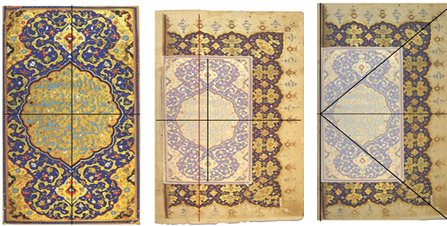
Figure A: Depicts the overall page layout divided by perpendicular axes in the quadrilateral system
Figure B: Highlights the intentional vertical offset in the symmetry axis
Figure C: Displays the left side left open intentionally to visually merge with the facing page
4.3. Sample No. 3: Analysis of the Underlying Design SystemThe design system underlying this sample is firmly grounded in the principle of quadrilateral symmetry, a structural approach applied consistently throughout the composition—whether in the overall layout, the internal modules carrying surah titles, the striped inner frame, or the outer frame that borders three sides of the page. This symmetrical framework is conceptually aligned with the decorative methodology observed in Sample (1), where the decorative plane was divided into four segments around two perpendicular axes, forming the basis of the page’s compositional logic.
It is important to note, however, that while quadrilateral symmetry constitutes the dominant organizational principle of the composition, deliberate deviations were introduced—most notably in relation to the vertical axes. These asymmetries are not the result of technical limitations rather reflect codicological considerations associated with facing-page integration. As outlined in Sample (2), the right and left folios were conceived as complementary units, collectively forming a unified ornamental field (see discussion in Sample 2). This divergence stems from a structural adaptation: the ornamental frame on this page complements its counterpart on the facing page, which, together, forms a unified decorative entity when the Qur’ān is opened. Resultantly, the decorator intentionally disregarded the complete unification of vertical symmetry axes, as seen in Figure B, in favor of maintaining inter-page cohesion and aesthetic dialogue.
A similar design strategy can be observed in Sample (1), where the decorator intentionally limited the application of the axial system to only three corners of the frame, as illustrated in Figure C. 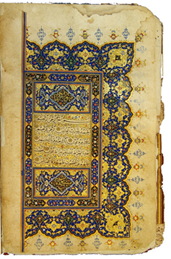 This selective approach acknowledges the codicological function of the page—specifically, its position as the right-hand folio in an open Qur’ānic spread. The left-hand page serves as its symmetrical counterpart, and together they construct a dual-page ornamental field, particularly surrounding the “opening verses of Surat al-Baqarah (2:1–5).”
Further emphasizing the sophistication of the design, the decorator created two rectangular zones above and below the main writing area, each containing key textual indicators. The upper rectangle displays the inscription “Surat al-Fātiḥah (1:1–7),” while the lower one reads “Seven Verses,” both enclosed in elegant ornamental ribbons. These zones were also designed according to the principles of quadrilateral division. This reinforces compositional unity and guides the viewer’s eye through an ordered visual hierarchy.
The methodological consistency observed in the use of quadrilateral symmetry—both in structural division and decorativedistribution—demonstrates not only the illuminator’s technical mastery but also his understanding of how form and function interact in Islamic manuscript art. Significantly, this approach developed into a codified artistic methodology, later adopted by generations of manuscript decorators, and continues to influence contemporary Qur’ānic design traditions to this day.
This case illustrates the integration of quadrilateral and radial systems, confirming the research finding that multiple ornamental frameworks could coexist in one layout. This reflects both methodological sophistication and the spiritual symbolism of centrality in Islamic design.
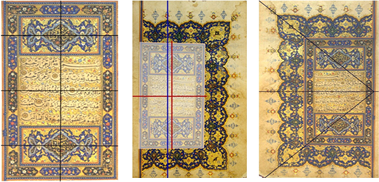
Figure A: Shows the overall structural framework using the quadrilateral division system
Figure B: Indicates the deliberate deviation of the vertical axis to align compositionally with the facing page
Figure C: Shows the selective application of symmetry to only three corners
4.4. Comparative Analysis of Qur’ānic Ornamentation Samples
The comparative examination of the three selected Qur’ānic manuscript samples reveals both shared principles and distinctive applications in their decorative design systems. While quadrilateral symmetry serves as a foundational approach in all three cases, the manner of execution, degree of axial adherence, and compositional complexity vary significantly. This reflects the artistic intentions, page functions, and visual strategies of each illuminator.
Sample (1) demonstrates a strict and classical application of quadrilateral symmetry, with the decorative field divided along two perpendicular axes into four identical quadrants. The ornamental unit is mirrored uniformly, resulting in a fully symmetrical and self-contained page. The frame is closed on all four sides, suggesting a composition that does not require visual continuity with another page. This model exemplifies geometric rigor and visual stability, suitable for highlighting central textual openings or independent folios.
Sample (2) exemplifies the deliberate use of partial asymmetry to facilitate inter-folio continuity, leaving the left margin open in order to integrate with the facing page. Sample (3) employs a comparable approach, though it incorporates additional layers of complexity through the integration of radial elements. For a detailed explanation of the principles underlying folio integration, reference should be made to the analysis presented in Sample (2).
Sample (3) introduces an additional layer of complexity by combining quadrilateral symmetry with radial organization. While the outer structural divisions follow traditional four-axis symmetry, the central medallion or inner field is constructed using a radial division system. The decorative elements radiate outward from a central point, creating a circular focal zone. This dual-system structure reflects a high level of spatial intelligence and visual hierarchy. Moreover, the ornamentation integrates floral motifs, cup elements, and cloud forms, blending modular and organic elements. The result is a page that achieves both formal symmetry and ornamental dynamism.
In conclusion, all three samples reflect a shared aesthetic heritage rooted in Islamic geometric design. However, the first sample focuses on internal structural precision, the second on inter-folio continuity and modular variation, and the third on layered symmetry through axial and radial convergence. These differences reveal the evolution of design logic and visual sophistication in Qur’ānic manuscript illumination. This underscores the decorator's capacity to balance function, beauty, and spiritual reverence in diverse and context-specific ways as shown in Table 1. The comparative analysis underscores how variations in symmetry, inter-folio integration, and radial organization align with the research objectives of identifying core ornamental systems and demonstrating their adaptability across different manuscript contexts.
Table 1. Comparative Analysis of Qur’ānic Ornamentation Samples
|
Aspect of Comparison |
Sample (1) |
Sample (2) |
Sample (3) |
|---|---|---|---|
|
Primary Design System |
Strict quadrilateral symmetry |
Quadrilateral symmetry with functional asymmetry |
Combined quadrilateral and radial systems |
|
Axis Symmetry |
Two perpendicular axes, symmetrical in all directions |
Horizontal axis unified; vertical axis intentionally offset |
Horizontal axis stable; vertical axis asymmetrical in ornamental frame |
|
Frame Structure |
Fully enclosed ornamental frame |
Three-sided frame, open on the left for page integration |
Partially enclosed frame with radial elements in center |
|
Ornamental Unit Strategy |
Single quadrant repeated across all four quadrants |
One-fifth section mirrored in flip-flop technique |
Quarter unit repeated with radial rotation; floral motif emphasis |
|
Integration with Opposite Page |
Not applicable (self-contained page) |
Yes, connected to facing left page |
Yes, composition complements opposite page with radial connection |
|
Use of Diffusion Method |
Not used; emphasis on quadrant repetition |
Used within inner rectangle for modular repetition |
Used in central medallion for circular ornamental balance |
|
Treatment of Surah Titles |
Placed within symmetrical ribbons using axial structure |
Surah name and verse count in top and bottom ribbons |
Surah titles placed within circular bands and decorative fields |
|
Artistic Intent |
Focused on formal balance and geometric clarity |
Balancing visual continuity with flexible composition |
Emphasis on dynamic movement, center-focused layout, and harmony |
5. Results and Discussion
Through the descriptive-analytical investigation of the illuminated manuscript of the Holy Qur’ān by Yaqut al-Mustasimi, a prominent figure in the Baghdadi school of the late Abbasid period, the research revealed a comprehensive system of ornamental organization grounded in geometric logic and artistic intent. The illuminator’s approach to the spatial division of the page demonstrates a deep understanding of compositional structure, aesthetic unity, and symbolic repetition, which collectively define the ornamental identity of this manuscript.
The research confirmed that ornamental compositions in the manuscript are not randomly constructed but are based on well-defined spatial systems. These systems serve as a structural infrastructure that governs the placement and repetition of motifs, ensuring harmony, balance, and visual coherence across the page.
The analysis uncovered five distinct ornamental design systems, each characterized by its own principles of spatial organization and aesthetic effect:
- Quadrilateral Symmetry System: Based on dividing the space into four equal parts using two perpendicular axes. A single ornamental unit (quarter) is repeated in a rotational or mirrored manner to create a unified composition.
- Bilateral Symmetry System: Utilizes a single vertical or horizontal axis to create mirrored symmetry on either side. This system is particularly effective for smaller panels or linear decorations.
- Diffusion System: Relies on the subdivision of the field into regularly repeating geometric units (squares or rectangles), filled with a basic motif repeated to form a continuous ornamental texture.
- Radial System: Organizes decorative elements around a central point, radiating outward in circular symmetry. This system is frequently used for central medallions or roundels and emphasizes spiritual centrality.
- Multiple (Combined) System: Involves the integration of two or more of the above systems within a single composition. This approach demonstrates advanced planning and flexibility, often used in double-page spreads (as the opening of the Qur’ān).
While symmetry serves as a dominant organizing principle, the study found deliberate asymmetries—especially in vertical axes—introduced to maintain visual continuity across facing pages. This interdependence between right and left folios reveals a high level of codicological awareness.
The illuminator’s reliance on flip-flop repetition, mirroring, and rotational permutations within each system illustrates a pursuit of aesthetic variety within structural unity. This results in dynamic visual fields that remain coherent despite the complexity of their constituent elements.
The design strategies identified in this study represent not only technical mastery but also an artistic legacy. These systems have become foundational methodologies that influenced generations of Muslim illuminators and remain evident in contemporary Qur’ānic manuscripts and calligraphic traditions.
5.1Recommendations and Future DirectionsIt is recommended that similar illuminated manuscripts, particularly those representing the Baghdadi School, be digitally documented using high-resolution imaging and 3D modeling. This will ensure their preservation and provide accessible research material for future studies in Islamic art and manuscript heritage.
Future research could benefit from conducting comparative analyses between the ornamental systems of different Islamic artistic schools (e.g., Andalusian, Maghrebi, Persian, and Ottoman) to further delineate the unique contributions and shared principles across Islamic civilizations.
It is recommended to establish a specialized visual and analytical database dedicated to Qur’ānic ornamentation systems, classified by type, region, and historical period. Such a resource would facilitate scholarly access and interdisciplinary collaboration.
Practical workshops and training programs should be initiated to revive the traditional techniques used by illuminators like Yaqut al-Mustasimi, ensuring the transmission of both theoretical knowledge and manual craftsmanship to new generations of artists.
Future studies may benefit from interdisciplinary collaboration between art historians, theologians, mathematicians, and digital humanities scholars to deepen understanding of the aesthetic, spiritual, and structural frameworks that define Islamic manuscript ornamentation.
Authors’ Contribution
Husam A. Bahiya: conceptualization, methodology, writing – original draft. Mohammed Radhee Ghadheb: data curation, formal analysis, visualization. Furat Jamal Hassan: supervision, writing – review & editing.
Conflict of Interest
The authors of the manuscript have no financial or non-financial conflict of interest in the subject matter or materials discussed in this manuscript.
Data Availability Statement
Data supporting the findings of this study will be made available by the corresponding author upon request.
Funding Details
No funding has been received for this research.
Generative AI Disclosure Statement
The authors did not used any type of generative artificial intelligence software for this research.
Bibliography
Abdul, Aziz., and Mahytab Hassan El-Banna. “A Criteria for Balancing between Movement and Stillness in Islamic Decorations (Arabic Calligraphy Heritage Applied in the Field of Metal Furniture),” International Design Journal 14, no. 4 (2024): 385–395, https://doi.org/10.21608/idj.2024.358290.
Al-Addal, Samera Ibrahim Kadum. “Planning and Developing the Archaeological Tourist Sites in Baghdad: Al-Mustansiriya School as a Model.” PalArch's Journal of Archaeology of Egypt/Egyptology 17, no. 7 (2020): 12383–12396. https://staff.uokufa.edu.iq/faculty/detail/samerai.AL-ADDAL/
Alami, Mohammed Hamdouni. Art and Architecture in the Islamic Tradition: Aesthetics, Politics and Desire in Early Islam. Bloomsbury Publishing, 2013.
Ali Mahdi, Thalfaa., and Amin Abdel Zahra Yassin. “Isomorphism and Its Approximation in Islamic Art Decorations.” Al-Academy 116, (2025): 109–124. https://doi.org/10.35560/jcofarts1418.
Kolmek, Emine Filiz. “Visual Language of Islamic Arts: An Exploration of Islamic Decorative Arts and Religious Symbolism.” Paper presented at the International European Conference on Interdisciplinary Scientific Research, Lisbon, Portugal, 2025.
Dariyadi, Moch Wahib., Nurul Murtadho, Ibnu Samsul Huda, and Abd Rauf Tan Sri Hassan. “Arabic calligraphy as mosque decoration: architectural significance in Indonesia.” City, Territory and Architecture 12. no. 1(2025): 23, https://doi.org/10.1186/s40410-025-00271-x.
Ghadheb, Mohammed Radhee., Oday Abdulhameed Majeed, and Furat Jamal Hassan. “Undermining the Familiar and Embodiment Content in Arabic Calligraphy.” Journal of Islamic Thought and Civilization 13, no. 1 (2023): 47–58, https://doi.org/10.32350/jitc.131.04.
Hamdy, Rawaa Fadhel., and Fawzia Irhayyim Al-Assadi. “Aesthetic Values in Islamic Ornamentation—Abbasid Architecture as a Model.” Paper presented at the AIP Conf. Proc. 2651, 020073 (2023), https://doi.org/10.1063/5.0106153
Hassan, Furat Jamal., and Ahmad Masher Kakhel. “Theory of Sustainability and Creativity and Its Relationship to Environmental Art & Technological Development in Islamic Architecture in Bosnia and Al-Hersic.” Jordan Journal of Arts 13, no. 2 (2020): 237–250, https://doi.org/10.47011/13.2.5.
Hataf, Ali Hussein., and Mahmoud Shaker Jabr. “The Aesthetics of the Decorative Composition of the Basmalah in Contemporary Arab Painting.” PalArch's Journal of Archaeology of Egypt/Egyptology 17, no. 7 (2020): 3637–3650.
Mahmood, Russul Saad., and Oday Qusay Abdulqader Alchalabi. “The Importance of Classifying the Traditional Mosulian Ornaments in Enhancing the Conservation Process.” Planning 17, no. 5 (2022): 1605–1613, https://doi.org/10.18280/ijsdp.170525.
Marwa, Baydoun., Fadzli Irwan Bin Bahrudin., and Reham Baydoun. “Categorisation of Islamic Wall Decorations in Four Buildings: Visual Analysis and Comparative Study for Stylistic and Historical Contexts.” Journal of Architecture, Planning and Construction Management 14, no. 1 (2024): 94–114, https://doi.org/10.31436/japcm.v14i1.872.
Milwright, Marcus. “Samarra and Abbasid Ornament.” A Companion to Islamic Art and Architecture (2017): 177–196, https://doi.org/10.1002/9781119069218.ch7.
Sajed, Pourmahmoud., and A Fahimifar. “A Study on the ‘Philosophy of Decoration’in the Seljuk Period (5th to 6th Centuries Ce) Emphasizing the Dome of ‘Taj Al-Molk’of the Isfahan Grand Mosque.” SPbU Bulletin. Philosophy and Conflictology 40, no. 2 (2024): 353–364.
Shafiq, Jeanan. “Architectural Elements in Islamic Ornamentation: New Vision in Contemporary Islamic Art.” Art Des. Stud 21 (2014): 11–21.
Sibahi, Haider Kadim, and Furat Jamal Hassan. “Space Efficiency in the Arabic Calligraphy Panel.” Al-Academy, no. 104 (2022): 73-90, https://doi.org/10.35560/jcofarts104/73-90.
Thornton, Jonathan. Applied Decoration for Historic Interiors Preserving Composition Ornament. Vol. 34: US Department of the Interior, National Park Service, Cultural Resources, 1994.
1Dariyadi, Moch Wahib, Nurul Murtadho, Ibnu Samsul Huda, and Abd Rauf Tan Sri Hassan. "Arabic calligraphy as mosque decoration: architectural significance in Indonesia", City, Territory and Architecture 12. no. 1(2025): 23, https://doi.org/10.1186/s40410-025-00271-x.
2Baydoun, Marwa, Fadzli Irwan Bin Bahrudin, and Reham Baydoun, “Categorisation of Islamic Wall Decorations in Four Buildings: Visual Analysis and Comparative Study for Stylistic and Historical Contexts,” Journal of Architecture, Planning and Construction Management 14, no. 1 (2024): 94–114, https://doi.org/10.31436/japcm.v14i1.872.
3Mohammed Radhee Ghadheb, Oday Abdulhameed Majeed, and Furat Jamal Hassan, “Undermining the Familiar and Embodiment Content in Arabic Calligraphy,” Journal of Islamic Thought and Civilization 13, no. 1 (2023): 47–58, https://doi.org/10.32350/jitc.131.04.
4Thalfaa, Ali Mahdi, and Amin Abdel Zahra Yassin, “Isomorphism and Its Approximation in Islamic Art Decorations,” Al-Academy 116, (2025): 109–124. https://doi.org/10.35560/jcofarts1418
5Jonathan Thornton, Applied Decoration for Historic Interiors Preserving Composition Ornament, vol. 34 (Washington, DC: US Department of the Interior, National Park Service, Cultural Resources, 1994).
6Haider Kadim Sibahi and Furat Jamal Hassan, “Space Efficiency in the Arabic Calligraphy Panel,” Al-Academy, no. 104 (2022): 73–90, https://doi.org/10.35560/jcofarts104/73-90.
7Ali Hussein Hataf, and Mahmoud Shaker Jabr, “The Aesthetics of the Decorative Composition of the Basmalah in Contemporary Arab Painting,” PalArch’s Journal of Archaeology of Egypt/Egyptology 17, no. 7 (2020): 3637–3650.
8Mohammed Hamdouni Alami, Art and Architecture in the Islamic Tradition: Aesthetics, Politics and Desire in Early Islam (London: Bloomsbury Publishing, 2013).
9Marcus Milwright, “Samarra and Abbasid Ornament,” in A Companion to Islamic Art and Architecture, ed. Finbarr Barry Flood and Gülru Necipoğlu (Hoboken, NJ: Wiley-Blackwell, 2017), 177–196, https://doi.org/10.1002/9781119069218.ch7.
10Emine Filiz Kolmek, “Visual Language of Islamic Arts: An Exploration of Islamic Decorative Arts and Religious Symbolism” (paper presented at the International European Conference on Interdisciplinary Scientific Research, Lisbon, Portugal, 2025).
11Russul Saad Mahmood, and Oday Qusay Abdulqader Alchalabi, “The Importance of Classifying the Traditional Mosulian Ornaments in Enhancing the Conservation Process,” Planning 17, no. 5 (2022): 1605–1613, https://doi.org/10.18280/ijsdp.170525.
12Furat Jamal Hassan, and Ahmad Masher Kakhel, “Theory of Sustainability and Creativity & Its Relationship to Environmental Art and Technological Development in Islamic Architecture in Bosnia and Al-Hersic,” Jordan Journal of Arts 13, no. 2 (2020): 237–50, https://doi.org/10.47011/13.2.5.
13Pourmahmoud, Sajed, and A Fahimifar, “A Study on the ‘Philosophy of Decoration’in the Seljuk Period (5th to 6th Centuries Ce) Emphasizing the Dome of ‘Taj Al-Molk’of the Isfahan Grand Mosque,” SPbU Bulletin. Philosophy and Conflictology 40, no. 2 (2024): 353–364.
14Rawaa Fadhel Hamdy, and Fawzia Irhayyim Al-Assadi, “Aesthetic Values in Islamic Ornamentation—Abbasid Architecture as a Model,” paper presented at the AIP Conf. Proc. 2651, 020073 (2023). https://doi.org/10.1063/5.0106153
15Samera Ibrahim Kadum Al-Addal, “Planning and Developing the Archaeological Tourist Sites in Baghdad: Al-Mustansiriya School as a Model,” PalArch’s Journal of Archaeology of Egypt/Egyptology 17, no. 7 (2020): 12383–96. https://staff.uokufa.edu.iq/faculty/detail/samerai.AL-ADDAL/
16Jeanan Shafiq, “Architectural Elements in Islamic Ornamentation: New Vision in Contemporary Islamic Art,” Art Design Studies 21 (2014): 11–21.
17Aziz, Abdul, and Mahytab Hassan El-Banna, “A Criteria for Balancing between Movement and Stillness in Islamic Decorations (Arabic Calligraphy Heritage Applied in the Field of Metal Furniture),” International Design Journal 14, no. 4 (2024): 385–395, https://doi.org/10.21608/idj.2024.358290.