
| Review | Open Access |
|---|
Sustainable Development Goal 6 and the Prophetic Guidance on Water: A Hadīth-Based Framework |
 |
|---|
 Fatima Zohra Aouati and Khaled Obaideen
College of Sharia and Islamic Studies, University of Sharjah, United Arab Emirates
Water scarcity, pollution, and inefficient use remain critical barriers to achieving Sustainable Development Goal 6 (SDG 6: Clean Water and Sanitation). The attainment of Sustainable Development Goal (Clean water and Sanitation), SDG#6, is critically undermined due to pressing issues, like water scarcity, pollution, and inefficient management of water resources. While Islamic civilisation has developed and emphasised frameworks governing water access, hygiene, and conservation, these resources are integrated seldomly into modern contemporary sustainability discourse. The current study fills this gap by systematically examining the Prophetic tradition (ḥadīth) and aligning it with SDG#6 targeting clean water and sanitation needs and its governance for water management. A qualitative textual approach was deployed by extracting 27 authenticated narrations from five canonical Sunni collections, which were coded into themes of equity and access, conservation and efficiency, pollution prevention, sanitation and hygiene, and ecosystem care. These thematic variations were then mapped to all six substantive SDG#6, along with its implementation targets (6.a–6.b). Indicatively, the findings revealed a close relevance between Prophetic teachings and the SDG#6 framework: guidance against monopolising surplus water aligns with equitable access; prohibitions on wastefulness support efficiency; injunctions against polluting stagnant water parallel source-protection standards; and compassion toward animals broadens the scope of ecosystem care. The contribution of this work lies in providing a faith-sensitive ethical framework for water governance. By embedding SDG#6 within Prophetic ethics, the study enhances legitimacy, mobilises religious institutions, and offers practical entry points for culturally resonant policy instruments. By situating Islamic traditions within the discourse on sustainability, the current research will be beneficial in demonstrating valuable resources for advancing global sustainability goals (SDG#6), particularly in Muslim-majority contexts.
1. INTRODUCTION
The relationship between humanity and the environment has long been dependent on society and its social culture. Likewise, Islamic traditional values in light of the Qurʾān and Sunnah always provide us with clear guidelines to maintain not only moral but also ethical and natural values in order to be a responsible citizen. Thus, stressing nature and natural balance, Islam aims to govern society in environmental aspects by maintaining natural ethical values. The Qurʾānic teachings have always promoted maintaining a balance and management in daily life aspects. Accordingly, the Qurʾān and Sunnah guide us to maintain earthly resources to avoid reckless use of the natural blessings of Allah.1 In light of this discussion, the contemporary issue of water scarcity represents a critical challenge of the twenty-first century.2 A significant portion of the global population currently lacks access to clean drinking water, and this number is projected to rise without decisive intervention, particularly as climate variability escalates in the lead-up to the 2030 target for the United Nations Sustainable Development Goal 6 (SDG#6): “Ensuring availability and sustainable management of water and sanitation for all.”3 Previous research has indicated that the holistic approach is interconnected with the natural world, emphasising that resources must be utilised in a way that never harms the environment. The urgency surrounding this issue underscores the central importance of SDG#6, not confined to global public welfare but also within academic discourses across environmental governance, development studies, and comparative religious ethics. These disciplines collectively endeavour to identify and promote equitable, efficient, and ecologically sustainable approaches to water resource management. 4
Within the field of Islamic studies, an emerging corpus of “eco-fiqh” scholarship posits that the Qurʾānic text and Prophetic traditions offer a substantive foundation of environmental principles. The Qurʾān emphasises the principle of moderation, advocating a sustainable approach for the consumption of natural resources. Nevertheless, most Islamic-environmental studies remain confined to ethical appeals only, highlighting general values of stewardship and conservation. However, none has undertaken a target-level, indicator-specific mapping of Prophetic traditions directly aligned with the SDG#6 (Clean Water and Sanitation) framework. This absence leaves a critical gap at the intersection of Islamic ethics and global development policy, especially concerning water governance. This article addresses that gap by offering the first systematic alignment of water-related Hadīths with SDG#6 targets and indicators, providing a framework for faith-sensitive water governance.
By analyzing water-related Hadīths thematically, this paper links each theme to the relevant SDG #6 targets. The study further aims to demonstrate that the Prophetic teachings supply a coherent ethical framework that can complement, and potentially strengthen, contemporary water-governance instruments.
Accordingly, this study is guided by two central research questions:
- What ethical and environmental principles about water do the Prophetic traditions (ḥadīth) articulate?
- How do these principles align with the specific targets and indicators of SDG#6?
To answer these questions, a qualitative textual methodology was employed. Canonical Sunni compilations — Sahih al-Bukhari, Sahih Muslim, Sunan Abu Dawud, Sunan Ibn Majah, and Jamiʿ at-Tirmidhi — are systematically screened for water-related narrations. Identified Hadīths are coded into themes (access, conservation, pollution prevention, sanitation, ecosystem care) and then mapped to SDG 6 targets, with cross-validation against United Nations indicator definitions. This design ensures that religious texts are interpreted in context while remaining commensurable with development metrics.
The significance of the research lies in its potential to bridge Islamic ethical capital with policy practice: by translating centuries-old teachings into SDG language, the study offers policymakers, educators, and faith leaders a culturally resonant toolkit for advancing water sustainability.
The paper proceeds as follows. Section 2 reviews Islamic environmental ethics and the current interdisciplinary literature on religion and sustainable development, highlighting existing gaps. Section 3 details the methodology. Section 4 presents the thematic results and SDG mapping. Section 5 discusses the broader implications for water governance and outlines limitations. Section 6 concludes with recommendations and directions for future research.
2. Methodology
This study follows a qualitative thematic approach to understand various dimensions of the selected themes. This exploratory approach was useful in aligning the selected themes with the prophetic teachings. Figure 1 below illustrates the methodology adopted to conduct this study, outlining a systematic process for selecting, analysing, and aligning Prophetic water-related traditions with the specific targets of Sustainable Development Goals (SDG#6).
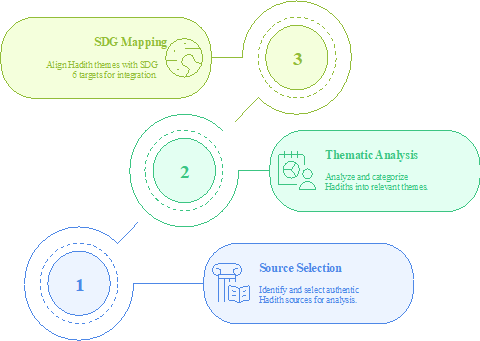
Figure 1. Research Methodology
2.1 Source SelectionThe study adopts a qualitative textual analysis approach, primarily drawing upon canonical Hadīth compilations recognized across the Sunni Islamic tradition. The selected sources include:
- Sahih al-Bukhari
- Sahih Muslim
- Sunan Ibn Majah
- Sunan Abu Dawud, and
- Jami‘ at-Tirmidhi
These collections were chosen for their authenticity, comprehensive scope, and established status within Islamic jurisprudence (fiqh) and ethical discourse. Within these sources, Hadīths explicitly or implicitly referencing water use, access, sanitation, hygiene, and environmental stewardship were identified. Researchers reviewed both Arabic texts and authenticated English translations to ensure accurate interpretation and context of these selected Hadīths.
2.2 Thematic AnalysisA qualitative thematic analysis was employed to extract recurring patterns and ethical instructions related to water from the selected Hadīths. The steps included:
- Identification: Each Hadīth containing water-related guidance (e.g., on cleanliness, conservation, access, pollution) was collected and catalogued.
- Coding: Content was coded manually using predefined themes, such as water access and equity, conservation and efficiency, pollution prevention, ritual hygiene, and ecosystem protection.
- Clustering: The Hadīths were grouped into thematic clusters to reflect their conceptual emphasis. These clusters were not mutually exclusive but reflected overlapping ethical domains relevant to sustainable water governance.
- Validation: Clusters were reviewed for consistency and comprehensiveness, ensuring that each Hadīth was placed based on both textual meaning and jurisprudential context.
The initial corpus comprised 2,241 narrations related to water, sanitation, and cleanliness across the five canonical Sunni Hadīth compilations. From this set, 787 narrations were identified and recorded in both Ṣaḥīḥ al-Bukhārī and Ṣaḥīḥ Muslim (without repetition). Applying the inclusion criteria further refined the corpus to 183 narrations, specifically those offering explicit or implicit normative guidance on water allocation, usage, pollution prevention, sanitation, or ecological care. Purely descriptive reports (e.g., narrations noting the Prophet’s personal preference without broader ethical instruction) or with weak/unauthenticated chains were excluded. This process resulted in a final dataset of 27 rigorously authenticated narrations.
The five thematic clusters—access and equity, conservation and efficiency, pollution prevention, sanitation and hygiene, and ecosystem care were derived inductively but are also consistent with both Islamic jurisprudential categories (fiqh al-ʿibādāt and fiqh al-muʿāmalāt) and contemporary water governance frameworks. For example, conservation and efficiency emerged from narrations that prescribe moderation in ablution, which directly align with SDG#6.4. As an illustration of the coding process, the narration “Do not withhold surplus water so that pasture may not be withheld” (Sahih al-Bukhari 2353) was first coded under “access and equity,” then mapped to SDG Target 6.1 (universal access). This stepwise coding ensured consistency across narrations and transparency for interdisciplinary readers.
This method ensured that the ethical content was not decontextualized from its religious significance, while allowing for systematic alignment with sustainability goals.
2.3 Aligning Sustainable Development Goals (SDGs) with Strategic Pathways of Islamic TeachingsTo bridge the gap between traditional Islamic teachings and modern development frameworks, the thematic Hadīth clusters were mapped to specific targets within SDG#6 (Clean Water and Sanitation). The mapping relied on:
- Target-level analysis of SDG#6 as outlined by the United Nations (e.g., 6.1 for universal access, 6.2 for sanitation, 6.3 for water quality).
- Conceptual alignment between the ethical implications of Hadīth teachings and the intended outcomes of the SDG targets.
- Cross-referencing with SDG indicator descriptions to ensure relevance (e.g., linking Hadīths about preventing contamination of water with SDG Target 6.3 on improving water quality).
Each Hadīth was matched to one or more SDG targets based on its underlying moral directive and social function. This integrative approach illustrates how Islamic ethical teachings can provide complementary insights to contemporary water governance and sustainability policies.
3. Results and Thematic Analysis
This section organises the 27 water-related ḥadīth into thematic clusters—each linked to a specific SDG#6 target on “Clean Water and Sanitation”—and analyses the ethical principles they convey in light of contemporary sustainability frameworks (for the full corpus, including Arabic incipits, English translations, source details, and URLs, see Table 1).
Table 1. Ḥadīth Corpus on Water Aligned with SDG#6
|
No. |
Primary Source (Collection & Chapter) |
Ḥadīth No. and English Translation (abridged) |
Arabic Incipit |
Key Text |
Permanent URL |
|---|---|---|---|---|---|
|
Sahih al-Bukhari Chapter 2: Superfluous water should not be withheld from others, Book 42: Distribution of Water |
7853-Narrated Abu Huraira: Allah's Messenger said, “Do not withhold the surplus water, for doing so prevents people from grazing their livestock” 2354-Narrated Abu Huraira: Allah's Messenger said: |
7853 - عَنْ أَبِي هُرَيْرَةَ رَضِيَ اللهُ عَنْهُ : أَنَّ رَسُولَ اللهِ صَلَّى اللهُ عَلَيْهِ وَسَلَّمَ قَالَ : لَا يُمْنَعُ فَضْلُ الْمَاءِ لِيُمْنَعَ بِهِ الْكَلَأُ . 2354 - عَنْ أَبِي هُرَيْرَةَ رَضِيَ اللهُ عَنْهُ : أَنَّ رَسُولَ اللهِ صَلَّى اللهُ عَلَيْهِ وَسَلَّمَ قَالَ : لَا تَمْنَعُوا فَضْلَ الْمَاءِ لِتَمْنَعُوا بِهِ فَضْلَ الْكَلَإِ . |
صحيح البخاري - كتاب الشرب والمساقاة - باب من قال إن صاحب الماء أحق بالماء حتى يروى لِقَوْلِ النَّبِيِّ صَلَّى اللهُ عَلَيْهِ وَسَلَّمَ لَا يُمْنَعُ فَضْلُ الْمَاءِ (جزء 3, صفحة 110) |
||
|
Sahih al-Bukhari Chapter 5: What tricks are disliked in bargains, Book 90: Tricks |
6962-Narrated Abu Huraira: Allah's Messenger said, "One should not withhold surplus water to prevent others from benefiting from the pasture.” |
6962 - عَنْ أَبِي هُرَيْرَةَ : أَنَّ رَسُولَ اللهِ صَلَّى اللهُ عَلَيْهِ وَسَلَّمَ قَالَ: لَا يُمْنَعُ فَضْلُ الْمَاءِ لِيُمْنَعَ بِهِ فَضْلُ الْكَلَإِ . |
صحيح البخاري - كتاب الحيل - باب ما يكره من الاحتيال في البيوع ولا يمنع فضل الماء ليمنع به فضل الكلإ - (جزء 9, صفحة 24) |
||
|
Sahih Muslim. Chapter 8: The prohibition of selling surplus water in the Desert, which is needed for grazing. Book 22: Transactions |
1565a- Jabir bin Abdullah (may Allah be pleased with him) reported that Allah's Messenger forbade the sale of surplus water. |
(١٥٦٥) عن جابر بن عبد الله قال: « نهى رسول الله ﷺ عن بيع فضل الماء .» |
صحيح مسلم، كتاب البيوع باب تحريم بيع فضل الماء الذي يكون بالفلاة ويحتاج إليه لرعي الكلأ، (5/34) |
||
|
Sahih Muslim. Chapter 8: The prohibition of selling surplus water in the Desert, which is needed for grazing. Book 22: Transactions |
1566a-Abu Huraira (may Allah be pleased with him) reported that Allah's Messenger said: "Do not withhold excess water, lest it prevent the growth of vegetation. |
(١٥٦٦) عن أبي هريرة أن رسول الله ﷺ قال: « لا يمنع فضل الماء ليمنع به الكلأ ».
|
صحيح مسلم، كتاب البيوع باب تحريم بيع فضل الماء الذي يكون بالفلاة ويحتاج إليه لرعي الكلأ، (5/34) |
||
|
Sahih al-Bukhari Chapter 5: The sin of him who withholds water from travellers, Book 42: Distribution of Water |
2358-Narrated Abu Huraira: Allah's Messenger said, “Three types of people whom Allah will neither look at on the Day of Resurrection, nor purify, and they will have a painful punishment. Among them is a man who has surplus water on the road but withholds it from a traveller in need.” |
2358 - ثَلَاثَةٌ لَا يَنْظُرُ اللهُ إِلَيْهِمْ يَوْمَ الْقِيَامَةِ وَلَا يُزَكِّيهِمْ وَلَهُمْ عَذَابٌ أَلِيمٌ : رَجُلٌ كَانَ لَهُ فَضْلُ مَاءٍ بِالطَّرِيقِ فَمَنَعَهُ مِنَ ابْنِ السَّبِيلِ |
صحيح البخاري - كتاب الشرب والمساقاة - باب إثم من منع ابن السبيل من الماء(جزء 3, صفحة 110) |
||
|
Sunan Ibn Majah Chapter 16: The Muslims Are Partners in Three Things, Book 16: The Chapters on Pawning |
2472- It was narrated from Ibn 'Abbas that the Messenger of Allah said: ““Muslims are partners in three things: water, pasture, and fire, and their price is unlawful.” |
عَنِ ابْنِ عَبَّاسٍ، قَالَ قَالَ رَسُولُ اللَّهِ صلى الله عليه وسلم " الْمُسْلِمُونَ شُرَكَاءُ فِي ثَلاَثٍ فِي الْمَاءِ وَالْكَلإِ وَالنَّارِ وَثَمَنُهُ حَرَامٌ " . قَالَ أَبُو سَعِيدٍ يَعْنِي الْمَاءَ الْجَارِيَ . |
2472 - ابن ماجه، السنن، في أبواب الرهون، باب المسلمون شركاء فِي ثلاث، 3/528، حديث رقم: 2472. ابن ماجه، السنن، في أبواب الرهون، باب المسلمون شركاء فِي ثلاث، 3/528، حديث رقم: 2472. |
||
|
Sahih al-Bukhari Chapter 9: The superiority of providing water, Book 42: Distribution of Water |
2363-Narrated Abu Huraira: The Messenger of Allah said, “While a man was walking, he felt thirsty. He found a well, went down into it, and drank. As he came out, he saw a dog panting and licking the earth out of thirst. The man said, 'This dog is experiencing the same thirst that I felt.' So, he went back down, filled his shoe with water, held it in his mouth, climbed out, and gave the dog a drink. Allah appreciated his good deed and forgave him.” The people asked, "O Messenger of Allah, is there a reward for us in serving animals?" He replied, "Yes, there is a reward for serving any living being." |
2363 - عَنْ أَبِي هُرَيْرَةَ رَضِيَ اللهُ عَنْهُ:أَنَّ رَسُولَ اللهِ صَلَّى اللهُ عَلَيْهِ وَسَلَّمَ قَالَ : بَيْنَا رَجُلٌ يَمْشِي ، فَاشْتَدَّ عَلَيْهِ الْعَطَشُ ، فَنَزَلَ بِئْرًا فَشَرِبَ مِنْهَا ، ثُمَّ خَرَجَ فَإِذَا هُوَ بِكَلْبٍ يَلْهَثُ ، يَأْكُلُ الثَّرَى مِنَ الْعَطَشِ ، فَقَالَ : لَقَدْ بَلَغَ هَذَا مِثْلُ الَّذِي بَلَغَ بِي ، فَمَلَأَ خُفَّهُ ثُمَّ أَمْسَكَهُ بِفِيهِ ، ثُمَّ رَقِيَ فَسَقَى الْكَلْبَ ، فَشَكَرَ اللهُ لَهُ فَغَفَرَ لَهُ ، قَالُوا : يَا رَسُولَ اللهِ ، وَإِنَّ لَنَا فِي الْبَهَائِمِ أَجْرًا ؟ قَالَ : فِي كُلِّ كَبِدٍ رَطْبَةٍ أَجْرٌ. |
صحيح البخاري - كتاب الشرب والمساقاة - باب فضل سقي الماء - (جزء 3, صفحة 111) |
||
|
Sahih al-Bukhari Chapter 16: Milking she-camels at water places, Book 42: Distribution of Water |
2378-Narrated Abu Huraira: The Prophet said, “One of the rights of a she-camel is that it should be milked at the water source.” |
2378 - عَنْ أَبِي هُرَيْرَةَ رَضِيَ اللهُ عَنْهُ ، عَنِ النَّبِيِّ صَلَّى اللهُ عَلَيْهِ وَسَلَّمَ قَالَ : مِنْ حَقِّ الْإِبِلِ أَنْ تُحْلَبَ عَلَى الْمَاءِ |
صحيح البخاري - كتاب الشرب والمساقاة - باب حلب الإبل على الماء - (جزء 3, صفحة 114) |
||
|
Sahih al-Bukhari Chapter 17: If a housefly falls in the drink, book 59: Beginning of Creation |
3321-Narrated Abu Huraira (Allah be pleased with him): The Messenger of Allah said, “A sinful woman was forgiven because she passed by a dog at the edge of a well, panting as |
3321 - عَنْ أَبِي هُرَيْرَةَ رَضِيَ اللهُ عَنْهُ عَنْ رَسُولِ اللهِ صَلَّى اللهُ عَلَيْهِ وَسَلَّمَ قَالَ غُفِرَ لِامْرَأَةٍ مُومِسَةٍ مَرَّتْ بِكَلْبٍ عَلَى رَأْسِ رَكِيٍّ يَلْهَثُ قَالَ كَادَ يَقْتُلُهُ الْعَطَشُ فَنَزَعَتْ خُفَّهَا فَأَوْثَقَتْهُ بِخِمَارِهَا فَنَزَعَتْ لَهُ مِنَ الْمَاءِ فَغُفِرَ لَهَا بِذَلِكَ |
صحيح البخاري - كتاب بدء الخلق - باب إذا وقع الذباب في شراب أحدكم فليغمسه - (جزء 4, صفحة 130) |
||
|
|
|
it was near to dying from thirst. She took off her shoe, tied it with her headscarf, and used it to draw water for the dog. Allah forgave her for that act |
|
|
|
|
Sahih al-Bukhari Chapter 68: Urinating in stagnant water, Book 4: Ablutions (Wudu') |
239-Narrated Abu Huraira: The Prophet said, “Do not urinate in stagnant water that does not flow, and then use it for washing.” |
239 - لَا يَبُولَنَّ أَحَدُكُمْ فِي الْمَاءِ الدَّائِمِ الَّذِي لَا يَجْرِي ، ثُمَّ يَغْتَسِلُ فِيهِ . |
صحيح البخاري - كتاب الوضوء - باب البول في الماء الدائم (جزء 1, صفحة 57) |
https://Sunnah.com/bukhari:239
|
|
|
Sahih Muslim Chapter 28: The prohibition of urinating into standing water, Book 2: Purification |
281-Narrated Jabir: The Messenger of Allah forbade urinating in stagnant water. |
(281) عن جابر عن رسول الله ﷺ أنه « نهى أن يبال في الماء الراكد" |
صحيح مسلم، كتاب الطهارة باب النهي عن البول في الماء الراكد، (1/162) |
|
|
|
Sahih Muslim Chapter 28: The prohibition of urinating into standing water, Book 2: Purification |
282 -Narrated Abu Huraira: The Messenger of Allah said, “None of you should urinate in standing water and then use it for washing. |
(282) عن أبي هريرة عن النبي ﷺ قال: « لا يبولن أحدكم في الماء الدائم ثم يغتسل منه ». |
مسلم، الجامع الصحيح، في كتاب الطهارة، باب النهي عَنْ البول فِي الماء الراكد، ج:1، ص: 235، حديث رقم: 282. |
https://Sunnah.com/muslim:282a
|
|
|
Sahih Muslim Chapter 29: Prohibition of performing ghusl in standing |
283-Narrated Abu Huraira: The Messenger of Allah said, “None of you should wash in |
(٢٨٣) أبا هريرة يقول: قال رسول الله ﷺ: « لا يغتسل أحدكم في الماء الدائم وهو جنب فقال: كيف يفعل |
صحيح مسلم، كتاب الطهارة، باب النهي عن الاغتسال في الماء الراكد، (1/163) |
|
|
|
|
water, Book 2:Purification |
standing water while in a state of Janabah (ritual impurity).” Abu Huraira was asked how one should wash instead, and he replied, "Water should be taken out in handfuls |
يا أبا هريرة؟ قال: يتناوله تناولا ». |
|
|
|
Sahih Muslim Chapter 10: The amount of water with which it is recommended to perform ghusl in the case of janabah; a man and woman washing from a single vessel; one of them washing with the left-over water of the other, Book 3: Menstruation |
321a -Narrated Salama bin Abd al-Rahman on the authority of A’isha: When the Messenger of Allah took a bath, he would start by washing his right hand, pouring water over it. Then, he would pour water over the impurity with his right hand and wash it away using his left hand. After removing the impurity, he would pour water over his head. A’isha added, “The Messenger of Allah and I would take a bath from the same vessel after sexual intercourse.” |
(٣٢١) قَالَتْ عَائِشَةُ: « كَانَ رَسُولُ اللهِ ﷺ إِذَا اغْتَسَلَ بَدَأَ بِيَمِينِهِ، فَصَبَّ عَلَيْهَا مِنَ الْمَاءِ فَغَسَلَهَا، ثُمَّ صَبَّ الْمَاءَ عَلَى الْأَذَى الَّذِي بِهِ بِيَمِينِهِ، وَغَسَلَ عَنْهُ بِشِمَالِهِ، حَتَّى إِذَا فَرَغَ مِنْ ذَلِكَ صَبَّ عَلَى رَأْسِهِ، قَالَتْ عَائِشَةُ: كُنْتُ أَغْتَسِلُ أَنَا وَرَسُولُ اللهِ ﷺ مِنْ إِنَاءٍ وَاحِدٍ، وَنَحْنُ جُنُبَانِ. |
صحيح مسلم، كتاب الحيض باب القدر المستحب من الماء في غسل الجنابة وغسل الرجل والمرأة في إناء واحد، (1/176). |
||
|
Sahih Muslim Chapter 10: The amount of |
326a -Narrated Safina: The Messenger of |
(٣٢٦) عن سفينة قال: « كان رسول الله ﷺ |
صحيح مسلم، كتاب الحيض باب القدر المستحب من الماء في |
||
|
|
water with which it is recommended to perform ghusl in the case of janabah; a man and woman washing from a single vessel; one of them washing with the left-over water of the other, Book 3: Menstruation |
Allah took a bath using one Sā‘ of water after sexual intercourse and performed ablution with one Mudd. |
يغسله الصاع من الماء من الجنابة، ويوضئه المد ». |
غسل الجنابة وغسل الرجل والمرأة في إناء واحد (1/177) |
|
|
Sunan Ibn Majah Chapter 22: The Land Around A Well (Which Belongs Only To The Well Owner), Book 16: The Chapters on Pawning |
2487-Narrated by Abu Sa‘eed Al-Khudri: The Messenger of Allah said, “The land surrounding a well, which is considered part of it, extends as far as the length of its rope in all directions” |
"حريم البئر مدّ رشائها" |
2487 - أخرجه ابن ماجة في (السنن) [كتاب الرهون، باب: حريم البئر، رقم: 2487 ، ج 3 [538/ درجة الحديث: ضعيف. |
||
|
Sunan Ibn Majah Chapter 22: The Land Around A Well (Which Belongs Only To The Well Owner), Book 16: The Chapters on Pawning |
2486-Narrated by ‘Abdullah bin Mughaffal: The Prophet said, “Whoever digs a well is entitled to a surrounding area of forty forearm lengths as a resting place for his flocks.” |
عنْ عَبْدِ اللَّهِ بْنِ مُغَفَّلٍ، أَنَّ النَّبِيَّ صلى الله عليه وسلم قَالَ " مَنْ حَفَرَ بِئْرًا فَلَهُ أَرْبَعُونَ ذِرَاعًا عَطَنًا لِمَاشِيَتِهِ " . |
2486 - وأخرجه ابن ماجة في (السنن)، أبواب الرهون، باب:حريم البئر، رقم: 2486 ، ج 3. [537/ درﺟﺔ اﳊﺪﻳﺚ:ﺣﺴﻦ. |
||
|
Sahih al-Bukhari Chapter 33: If somebody keeps an endowment, or stipulates that he should benefit by it as the other Muslims do, Book 55: Wills and Testaments (Wasaayaa) |
2778 -‘Uthman (RA) said, “Don’t you know that the Messenger of Allah said, ‘Whoever buys and digs the Well of Ruma will be granted Paradise’? And I bought and dug it.” |
من حَفَر رومَة فله الجنة أَنَّ عُثْمَانَ ـ رضى الله عنه ـ أَلَسْتُمْ تَعْلَمُونَ أَنَّ رَسُولَ اللَّهِ صلى الله عليه وسلم قَالَ " مَنْ حَفَرَ رُومَةَ فَلَهُ الْجَنَّةُ ". فَحَفَرْتُهَا، |
2778 - أخرجه البخاري في صحيحه، كتاب الوصايا، باب: إذا وقف بئرا أو أرضا واشترط لنفسه ، (13/4) حديث رقم 2778 |
||
|
Sunan Abi Dawud Chapter 14: The Places Where It Is Prohibited To Urinate, Book 1: Purification |
26-Narrated Mu'adh ibn Jabal: The Messenger of Allah said, "Beware of three things that provoke cursing: relieving yourself at watering places, on the thoroughfares, and in the shade of trees." |
ومثاله أيضا، ما جاء عَنْ مُعَاذِ بْنِ جَبَلٍ، قَالَ: «قَالَ رَسُولُ اللهِ -ﷺ-: اتَّقُوا الْمَلَاعِنَ الثَّلَاثَةَ: الْبَرَازَ فِي الْمَوَارِدِ، وَقَارِعَةِ الطَّرِيقِ، وَالظِّلِّ». |
26 - أبو داود، السنن، تحقيق شعَيب الأرناؤوط ومحَمَّد كامِل قره بللي، (بيروت: دار الرسالة العالمية، 1430 هـ - 2009م)، ط،01، كتاب الطهارة، باب المواضع التي نهى النبي عن البول فيها، ج:1، ص:21، حديث رقم25. |
||
|
Sunan Ibn Majah Chapter 76: Water basins, Book 1: Purification and its Sunnah |
521-Narrated Abu Umamah Al-Bahili: The Messenger of Allah said, "Water is not made impure by anything except that which changes its smell, taste, and color."'" |
الْمَاءُ لَا يُنَجِّسُهُ شَيْءٌ إِلَّا مَا غَلَبَ عَلَى رِيحِهِ وَطَعْمِهِ وَلَوْنِهِ |
521 - ابن ماجه، السنن، في أبواب الطهارة وسننها، باب الحياض، ج:1، ص: 327، حديث رقم: 521. قال المحقق الأرناؤوط: صحيح لغيره دون قوله: "إلا ما غلب على ريحه وطعمه ولونه"، |
||
|
Jami` at-Tirmidhi Chapter 50: Something Else For That. Book 1: Purification |
67-Narrated Ibn Umar: "I heard Allah's Messenger being asked about water in open areas where predators and beasts come to it.” He said, “When the water reaches two Qullah, it does not become impure.” |
عَنِ ابْنِ عُمَرَ قَالَ: «سَمِعْتُ رَسُولَ اللهِ -ﷺ-وَهُوَ يُسْأَلُ عَنِ الْمَاءِ يَكُونُ فِي الْفَلَاةِ مِنَ الْأَرْضِ وَمَا يَنُوبُهُ مِنَ السِّبَاعِ وَالدَّوَابِّ، قَالَ: فَقَالَ رَسُولُ اللهِ -ﷺ-: إِذَا كَانَ الْمَاءُ قُلَّتَيْنِ؛ لَمْ يَحْمِلِ الْخَبَثَ» قَالَ عَبْدَةُ قَالَ مُحَمَّدُ بْنُ إِسْحَاقَ الْقُلَّةُ هِيَ الْجِرَارُ وَالْقُلَّةُ الَّتِي يُسْتَقَى فِيهَا . قَالَ أَبُو عِيسَى وَهُوَ قَوْلُ الشَّافِعِيِّ وَأَحْمَدَ وَإِسْحَاقَ قَالُوا إِذَا كَانَ الْمَاءُ قُلَّتَيْنِ لَمْ يُنَجِّسْهُ شَيْءٌ مَا لَمْ يَتَغَيَّرْ رِيحُهُ أَوْ طَعْمُهُ وَقَالُوا يَكُونُ نَحْوًا مِنْ خَمْسِ قِرَبٍ . |
67 - أبواب الطهارة عن رسول الله - ﷺ-، باب منه آخر، 1/97، حديث رقم: 67. قال الألباني: "صحيح"، إرواء الغليل في تخريج أحاديث منار السبيل، (بيروت: المكتب الإسلامي، 1405 هـ - 1985م)، ط02، ج:1، ص:61. |
||
|
Sahih Muslim Chapter 27: Rulings on what was licked by a dog, Book 2: Purification |
279a -Narrated Abu Huraira: The Messenger of Allah said, "When a dog licks a utensil belonging to any one of you, the contents should be thrown away, and the utensil should be washed seven times.” |
إذَا ولغَ الكلْب في إناء أحدِكُمْ فَليرِقه، ثم ليغسلْه سَبعَ مرارٍ |
279 - أخرجه مسلم في صحيحه، كتاب الطهارة، باب: حكم ولوغ الكلب، 1/234 حديث رقم 279 |
||
|
Sunan Ibn Majah Chapter 48: Concerning moderation in ablution and avoiding extravagance, Book 1: Purification and its Sunnah |
425-Narrated 'Abdullah bin 'Amr: The Messenger of Allah passed by Sa'd while he was performing ablution and said, 'What is this extravagance?' Sa'd replied, 'Can there be any extravagance in ablution?' The Prophet said, 'Yes, even if you are on the bank of a flowing river. |
عَنْ عَبْدِ اللَّهِ بْنِ عَمْرٍو، أَنَّ رَسُولَ اللَّهِ ـ صلى الله عليه وسلم ـ مَرَّ بِسَعْدٍ وَهُوَ يَتَوَضَّأُ فَقَالَ " مَا هَذَا السَّرَفُ " . فَقَالَ أَفِي الْوُضُوءِ إِسْرَافٌ قَالَ " نَعَمْ وَإِنْ كُنْتَ عَلَى نَهَرٍ جَارٍ. |
425 - أخرجه ابن ماجه، كتاب الطهارة وسننها، باب ما جاء في القصد في الوضوء وكراهية التعدي فيه،(ص119) حديث( 425 |
||
|
Sunan Ibn Majah Chapter 48: Concerning moderation in ablution and avoiding extravagance, Book 1: Purification and its Sunnah |
424-Narrated Ibn 'Umar: "The Messenger of Allah saw a man performing ablution and said, 'Do not be extravagant, do not be extravagant in using water.” |
عَنِ ابْنِ عُمَرَ، قَالَ رَأَى رَسُولُ اللَّهِ ـ صلى الله عليه وسلم ـ رَجُلاً يَتَوَضَّأُ فَقَالَ " لاَ تُسْرِفْ لاَ تُسْرِفْ " |
424 - أخرجه ابن ماجه، كتاب الطهارة وسننها، باب ما جاء في القصد في الوضوء وكراهية التعدي فيه،(ص119) حديث( 424 |
The prophetic teachings strongly emphasize the communal right to water and the immorality of monopolizing surplus water resources. Several Hadīths from Sahih al-Bukhari and Sahih Muslim explicitly prohibit withholding excess water, particularly in contexts where it impedes access to pasture or harms travellers in need.
- Sahih al-Bukhari 2353 / 6962: “Do not withhold surplus water, for doing so prevents people from grazing their livestock.”
- Sahih Muslim 1566a–c: “Do not withhold excess water, lest it prevent the growth of vegetation.”
- Sahih al-Bukhari 2358: “Among the three whom Allah will neither look at nor purify on the Day of Judgment is the man who has surplus water on the road but withholds it from a traveller in need.”
These teachings align directly with SDG 6.1, which advocates for equitable access to safe and affordable water for all, and SDG 6.b, which promotes inclusive, community-based water management.
Moreover, Sunan Ibn Majah 2472 narrates: “Muslims are partners in three things: water, pasture, and fire. Their price is unlawful.”
This Hadīth reinforces the principle of shared water rights and aligns closely with SDG 6.5, which emphasizes integrated and participatory approaches to water resources.
3.2 Water Conservation and EfficiencyIslamic teachings advocate moderation, particularly in water usage during purification rituals. The Prophet Muhammad emphasized this principle in several Hadīths:
- Sunan Ibn Majah 425: The Prophet saw Sa'd using a lot of water for ablution and said: “What is this extravagance?” Sa'd asked: “Can there be extravagance in ablution?” He replied: “Yes, even if you are on the bank of a flowing river.”
- Sunan Ibn Majah 424: “Do not be extravagant in using water,” the Prophet repeated twice upon seeing a man performing ablution.
- Sahih Muslim 326a: “The Prophet used one Sā‘a of water for ghusl and one Mudd for ablution.”
These Hadīths support SDG#6.4, which focuses on increasing water-use efficiency and sustainable withdrawals.
3.3 Water Quality and Pollution PreventionThe Prophet Muhammad strictly prohibited actions that contaminate water sources:
- Sahih al-Bukhari 239 / Sahih Muslim 281, 282a: “Do not urinate in stagnant water and then wash in it.”
- Sahih Muslim 283: “Do not perform ghusl in standing water while in a state of major impurity.”
- Sunan Abu Dawud 26: “Beware of the three things that bring about curses: defecating at water sources, on pathways, and under shade.”
- Sahih Muslim 279a: “When a dog licks a utensil, it must be washed seven times.”
These narrations align with SDG#6.3, which aims to improve water quality by reducing pollution, and SDG#6.2, which advocates for sanitation and hygiene.
3.4 Sanitation and Ritual HygieneSeveral Hadīths provide practical guidelines on sanitation and the correct use of water during purification:
- Sahih Muslim 321a: A’isha (RA) reported: “The Messenger of Allah and I used to perform ghusl together from a single container, taking water by the handful.”
- Sahih Muslim 282a, 283: Emphasize hygienic practices during ghusl and warn against direct contact with stagnant water.
These practices reflect the values of SDG 6.2 (safe sanitation and hygiene) and SDG 6.4 (water-use efficiency).
3.5 Animal Rights and Ecosystem ProtectionThe prophetic tradition promotes compassion toward animals and consideration for the broader ecosystem.
- Sahih al-Bukhari 2363: “A man gave water to a thirsty dog and Allah forgave him for that act.”
- Sahih al-Bukhari 3321: “A sinful woman was forgiven because she drew water for a thirsty dog near a well.”
- Sahih al-Bukhari 2378: “It is one of the rights of a she-camel that it be milked at the water source.”
4.strong Discussion
The aforementioned arguments provide an elaborated discussion, which interprets the thematic results through the analytical lens of SDG#6, thereby demonstrating how Prophetic water ethics can be operationalised to advance each of the goal’s constituent targets. Whereas previous scholarship has recognised broad affinities between Islamic teachings and environmental stewardship, few studies have pursued a target-specific correspondence that moves beyond descriptive comparisons toward actionable implementation strategies. By locating individual ḥadīth narrations within the SDG#6 indicator architecture, this study contributes a rigorously mapped ethically governed framework that can inform contemporary water-governance regimes in Muslim-majority contexts and, by extension, in any setting where Islamic social capital exerts influence on collective behaviour.
4.1 Target 6.1: Universal and Equitable Access to Safe and Affordable Drinking-WaterProphetic directives forbidding the monopolisation of “surplus” (faḍl) water articulate a normative entitlement that closely parallels the human-rights vocabulary embedded in Target 6.1. The report of Abū Hurayra, “Do not withhold surplus water so that pasture may not be withheld” that explicitly links physical access to socio-economic wellbeing, underscoring the interdependence between water availability and livelihood security. Contemporary human-rights jurisprudence, which frames potable water as a prerequisite for the enjoyment of other rights, thus finds an antecedent in these narrations.
Operationally, the Prophetic ban on pricing life-sustaining volumes of water, “Muslims are partners in water, pasture, and fire; their price is unlawful,” may be interpreted as a call for a “lifeline” tariff structure in which a basic quantity of safe water is provided at minimal or no cost. Empirical evaluations of pro-poor blocks in Jordan and Morocco indicate that lifeline subsidies, when paired with volumetric tariffs for higher use tiers, enhance indicator 6.1.1 without jeopardising cost recovery. Framing such policies via authoritative Islamic jurisprudence could increase public acceptability and compliance, particularly where scepticism toward state-imposed tariffs persists.
At the institutional level, a Sharīʿah-compliant ombudsman system, analogous to the historical muḥtasib, could adjudicate access disputes and monitor equity outcomes, thereby augmenting state regulatory capacity while drawing legitimacy from religious tradition. The integration of Prophetic ethics into statutory water laws thus represents both a normative alignment and a pragmatic governance innovation.
4.2 Target 6.2: Adequate and Equitable Sanitation and HygieneCanonical narrations regarding ritual purity extend beyond strictly spiritual domains to encompass public-health foresight. The prohibition of defecation at water sources, thoroughfares, and shaded communal areas, “Beware of three matters that provoke cursing…” pre-empts pathogen transmission along what contemporary epidemiology terms the faecal–oral pathway. Similarly, the injunction against urinating in stagnant water anticipates modern hygienic standards for source protection.
These ḥadīth, therefore, provide contextually salient content for Community-Led Total Sanitation (CLTS) initiatives, which depend on locally embedded social norms and peer enforcement rather than hierarchical regulation. In parallel, the Prophetic practice of completing ghusl with one sāʿ (≈ 2.5 L) and wuḍūʾ with one mudd (≈ 0.6 L) sets a clear behavioural benchmark for water-efficient hygiene, demonstrating that rigorous cleanliness can be achieved without compromising resource conservation.
4.3 Target 6.3: Improvement of Water Quality and Reduction of PollutionSeveral narrations prescribe behavioural restrictions that align with water-quality management under Target 6.3. The command to discard the contents of, and to wash seven times, a utensil licked by a dog reflects an implicit germ theory by acknowledging the risk of zoonotic contamination. More importantly, the prohibition against polluting standing water establishes an ethical category of “water misuse” that modern environmental law characterises as point-source pollution.
Translating these norms into policy might entail Sharīʿah-compliant certification schemes whereby industrial enterprises secure a religiously grounded environmental seal only if effluent standards—and thus indicator 6.3.1—are met. Analogous programmes in Indonesia’s halal-industrial parks suggest that religious branding can mobilise consumer pressure to exceed baseline regulatory requirements. Municipally, mosque committees could be enlisted to monitor informal wastewater discharge in peri-urban settlements, providing low-cost data for local authorities.
4.4 Target 6.4: Water-Use Efficiency and Sustainable WithdrawalsEfficiency themes permeate ḥadīth literature. The Prophet’s reprimand of Saʿd for excessive use, “Isrāf, even if beside a flowing river”29 discredits the assumption that abundance legitimises waste. This insight is crucial for Gulf Cooperation Council states, where high per capita consumption coexists with capital-intensive desalination. These findings support the argument that faith-aligned behavioural cues can complement technological solutions, achieving efficiency gains unattainable by engineering measures alone.
4.5 Target 6.5: Integrated Water-Resources Management (IWRM)The communal orientation of the water-related ḥadīth, particularly the compound nexus of water, pasture, and fire, provides normative support for basin-level cooperation—an essential component of IWRM.30 By explicitly linking water access to grazing rights, the Prophet Muhammad anticipates the modern concept of socio-ecological linkages within a catchment.
Historically, Sharīʿah courts functioned as fora for resolving irrigation disputes; their procedures emphasised equitable rotation and maintenance obligations. Revived as multi-stakeholder “Water Ethics Panels,” such institutions could deliberatively align customary practice with hydrological science, thereby raising a country’s IWRM index (indicator 6.5.1). Importantly, the panels’ legitimacy would derive from both technical expertise and religious authority, mitigating the enforcement gap that often plagues statutory regulation in rural areas.
4.6 Target 6.6: Protection and Restoration of Water-Related EcosystemsNarratives that celebrate mercy toward animals—culminating in divine forgiveness granted individuals who quenched the thirst of a dog by extending moral consideration beyond human beneficiaries. Combined with injunctions recognising livestock drinking rights, these reports endorse an ecocentric ethic congruent with Target 6.6.
The spatial prescription of a forty-cubit easement around wells further illustrates an early awareness of riparian-buffer functions. Codifying such easements in contemporary land-use plans can protect recharge zones and wetland margins, thus supporting indicator 6.6.1 (change in the extent of water-related ecosystems). Financially, the waqf model—exemplified by ʿUthmān’s endowment of the Well of Rūmah offers a precedent for trust-fund mechanisms dedicated to habitat restoration, merging theological reward with ecological benefit.
4.7 Targets 6. a and 6. b: International Cooperation and Community ParticipationThe strategic relevance of Islamic endowments (awqāf) for financing transboundary water projects positions the Prophetic tradition as a catalyst for Target 6.a. Sukūk (Islamic bonds) structured as “water waqf” could channel Gulf philanthropic capital into sanitation infrastructure in lower-income Organisation of Islamic Cooperation (OIC) states, aligning faith-based charity with SDG finance.
Concurrently, the participatory ethos embedded in the phrase “Muslims are partners” undergirds Target 6.b, which emphasises local engagement in water management.
4.8 Synergies, Trade-Offs, and Maqāṣid-Based BalancingImplementing prophetic teachings can yield positive cross-target synergies, yet unintended trade-offs remain possible. Large-scale desalination, while improving access (Target 6.1), raises brine-discharge challenges that threaten coastal ecosystems (Target 6.6). The moderation norm implicit in anti-isrāf ḥadīth tempers demand, thereby reducing reliance on high-energy supply augmentation. A maqāṣid al-sharīʿah lens—prioritising the preservation of life, intellect, progeny, property, and faith—offers a principled method for adjudicating such trade-offs, ensuring that interventions respect the holistic intent of Islamic law while satisfying SDG metrics.
4.9. LimitationsAlthough this study underscores how prophetic guidance could improve water governance, we must acknowledge several limitations. Firstly, varying assessments of ḥadīth authenticity across Islamic schools may affect the universal acceptance of specific narrations, making cross-sectarian application complex. Secondly, there is a risk of selective use of religious texts, where policymakers or institutions emphasize certain narrations to legitimize predetermined agendas rather than upholding the holistic Prophetic ethic. Finally, integrating fiqh-based ethical principles into global governance frameworks presenting practical challenges, including reconciling religiously grounded directives with secular policy instruments and ensuring compatibility with diverse cultural and legal contexts. Recognizing these risks is essential for balanced application and underscores the need for further interdisciplinary dialogue.
4.10. ConclusionThis study contributes academically by offering the first systematic mapping of water-related Prophetic traditions (ḥadīth) to each target and indicator of SDG#6 and its sub-indicators. By moving beyond general ethical reflections to target-level alignment, it demonstrates that Islamic sources provide not only moral guidance but also a coherent framework commensurable with contemporary sustainability metrics.
The findings also carry practical significance for water governance. The study showcased that by embedding SDG#6 objectives within Prophetic ethics can enhance legitimacy, strengthen cultural resonance, and mobilise religious institutions as partners in sustainability initiatives. This faith-sensitive approach can support policy instruments ranging from lifeline tariffs and sanitation campaigns to conservation measures and ecosystem protection, thereby bridging global development agendas with locally embedded values.
4.11. Future Directions and RecommendationsFuture research can extend this foundation in three directions. Firstly, researchers need empirical studies to assess whether Hadīth-based messaging produces measurable changes in water-use behaviour and sanitation practices. Secondly, further exploration of cross-sectarian jurisprudence would broaden applicability across diverse Muslim communities. Thirdly, comparative analysis with other faith traditions could enrich interfaith dialogue on sustainability, highlighting common ethical resources for global water governance. Together, these directions ensure that the normative insights of this study are tested, expanded, and translated into inclusive strategies for advancing SDG#6.
Authors’ Contribution
Fatima Zohra Aouati: conceptualization, methodology, validation, formal analysis, investigation, resources, data curation, writing - original draft, writing -review & editing, visualization, supervision. Khaled Obaideen: conceptualization, methodology, validation, formal analysis, data curation, writing - original draft, writing review & editing, visualization.
Conflict of Interest
The authors declare that they have no known competing financial interests or personal relationships that could have appeared to influence the work reported in this paper.
Data Availability Statement
Data availability statement is not applicable as no new data has been collected.
Funding Details
This research did not receive funding from any external source.
Generative AI Disclosure Statement
The authors did not used any type of generative artificial intelligence software for this research.
Bibliography
A.Rehman, “The Qurʾānic Perspective on Natural Resource Management and Its Implications for Sustainable Development,” Al-Qurʾān and Water Science2, no. 1 (2025): 1–10.
Almunawar, Mohammad Nabil, Anas Miftah Fauzi, Zainab Syifa Almunawar, and Masairol Masri. “Modelling Business Ecosystem of Halal Industry–Case Halal Food Industry in Indonesia.” Journal of Islamic Marketing (2025), https://doi.org/10.1108/JIMA-06-2024-0221.
Alsyouf, Leen, Imad Alsyouf, and Khaled Obaideen. “Advancing Water Security in Arid Regions: A Technological and Bibliometric Study on Integrating Hydro Panels in Buildings for Sustainable Development Goals.” Energy Nexus 15 (2024): 100312. https://doi.org/https://doi.org/10.1016/j.nexus.2024.100312.
Amiruddin, Muhammad Majdy, Islamul Haq, Haerul Anwar, and Asmaddy Haris. “Reforming Fiqh Al-Bi’ah (Ecological Jurisprudence) Based on Islam Hadhari: An Integration Conservation Framework of Muamalah and Culture.” International Journal of Law and Society (IJLS) 3, no. 3 (2024): 187–205, https://doi.org/10.59683/ijls.v3i3.99.
Asrori, Mohammad, Muhammad Muhammad, Mohamad Zubad Nurul Yaqin, Wafda Firyal, and Finadatul Wahidah. “Water Conservation in the Qur’ānic Perspective: A Thematic Analysis of Ethical Water Usage in Purification Rituals.” Studia Ecologiae et Bioethicae 23 (2025). https://doi.org/10.21697/seb.5854
Blankinship, Lisa A, Sarah Gillaspie, and Basil H Aboul‐Enein. “Highlighting the Importance of Biodiversity Conservation through the Holy Qur'ān.” Conservation Biology 39, no. 1 (2025): e14309.
Blankinship, Lisa A., Sarah Gillaspie, Khaled Obaideen, and Basil H Aboul-Enein. "‘… and We Have Made from Water Every Living Thing’: Water Conservation and the Holy Qur’an.” Environmental Conservation (2024): 1-6.
Lautze, Jonathan, Sanjiv De Silva, Mark Giordano, and Luke Sanford. “Putting the Cart before the Horse: Water Governance and Iwrm.” Natural Resources Forum 35 (1): 1–8, http://dx.doi.org/10.1111/j.1477-8947.2010.01339.x
Obaideen, Khaled., Nabila Shehata, Enas Taha Sayed, Mohammad Ali Abdelkareem, Mohamed S Mahmoud, and AG Olabi. “The Role of Wastewater Treatment in Achieving Sustainable Development Goals (Sdgs) and Sustainability Guideline.” Energy Nexus 7 (2022): 100112, https://doi.org/10.1016/j.nexus.2022.100112
Sadat, Anwar., and Muhammad Yusuf. “Strengthening Eco Fiqh: An Intergration of Texts and Maslaha on Environmental Impact Analysis.” Al Daulah: Jurnal Hukum Dan Perundangan Islam 10, no. 1 (2020): 93-113.
Sadoff, Claudia W, Edoardo Borgomeo, and Stefan Uhlenbrook. “Rethinking Water for Sdg 6.” Nature Sustainability 3, no. 5 (2020): 346–47, https://doi.org/10.1038/s41893-020-0530-9
1A. Rehman, “The Qurʾānic Perspective on Natural Resource Management and Its Implications for Sustainable Development,” Al-Qurʾān and Water Science 2, no. 1 (2025): 1–10.
2Leen Alsyouf, Imad Alsyouf, and Khaled Obaideen, “Advancing Water Security in Arid Regions: A Technological and Bibliometric Study on Integrating Hydro Panels in Buildings for Sustainable Development Goals,” Energy Nexus 15 (2024): 100312. https://doi.org/10.1016/j.nexus.2024.100312.
3Khaled Obaideen et al., "The Role of Wastewater Treatment in Achieving Sustainable Development Goals (SDGs) and Sustainability Guideline," Energy Nexus 7 (2022): 100112, https://doi.org/10.1016/j.nexus.2022.100112.
4Claudia W Sadoff, Edoardo Borgomeo, and Stefan Uhlenbrook, “Rethinking water for SDG 6,” Nature Sustainability 3, no. 5 (2020): 346–347, https://doi.org/10.1038/s41893-020-0530-9.
5Abu Abdullah Muhammad b Ismail al Bukhari, Sahih Bukhari, “Do not withhold surplus water,” 2353 (Book 42, Hadīth 3), updated 2025/07/22, https://sunnah.com/bukhari:2353.
6Sahih al-Bukhari 6962, “Sahih Bukhari, “Do not withhold surplus water to prevent pasture,” 6962 (Book 90, Hadīth 69), updated 2025/07/22, https://sunnah.com/bukhari:6962.
7Narrated by Abdullah bin Jabir, “Sale of surplus water forbidden,” Sahih Muslim 1565a (Book 22, Hadīth 26), updated 2025/07/22, https://sunnah.com/muslim:1565a.
8Narrated by Abu Huraira, “Do not withhold excess water; vegetation may suffer,” Sahih Muslim 1566a (Book 22, Hadīth 27), updated 2025/07/22, https://sunnah.com/muslim:1566a.
9Narrated by Abu Huraira, “Surplus water withheld from traveller: grave sin,”Sahih al‑Bukhari 2358 (Book 42, Hadīth 5), updated 2025/07/22, https://sunnah.com/bukhari:2358.
10Narrated by Ibn Abbas, “Muslims share water, pasture and fire,” Sunan Ibn Majah 2472 (Book 16, Hadīth 7), updated 2025/07/22, https://sunnah.com/ibnmajah:2472.
11Narrated by Abu Huraira, “Man gave water to thirsty dog; forgiven,” Sahih al‑Bukhari 2363 (Book 42, Hadīth 13), updated 2025/07/22, https://sunnah.com/bukhari:2363.
12 Narrated by Abu Huraira, “Sinful woman forgiven for giving dog water,” Sahih al‑Bukhari 3321 (Book 59, Hadīth 64), updated 2025/07/22, https://sunnah.com/bukhari:3321.
13 Narrated by Abu Huraira, “Sinful woman forgiven for giving dog water,” Sahih al‑Bukhari 3321 (Book 59, Hadīth 64), updated 2025/07/22, https://sunnah.com/bukhari:3321.
14Narrated by Abu Huraira, “Do not urinate in stagnant water,” Sahih al‑Bukhari 239 (Book 4, Hadīth 30), updated 2025/07/22, https://sunnah.com/bukhari:239.
15Narrated by Jabir, “Prohibition of urinating in standing water,” Sahih Muslim 281 (Book 2, Hadīth 63), updated 2025/07/22, https://sunnah.com/muslim:281.
16Narrated by Abu Huraira, “Do not urinate then wash in standing water,” Sahih Muslim 282a (Book 2, Hadīth 64), updated 2025/07/22, https://sunnah.com/muslim:282a.
17Narrated by Abu Huraira, “Do not wash in standing water while in Janabah,” Sahih Muslim 283 (Book 2, Hadīth 65), updated 2025/07/22, https://sunnah.com/muslim:283.
18Narrated by A’isha, “Ghusl procedure: start with right hand,” Sahih Muslim 321a (Book 3, Hadīth 75), updated 2025/07/22, https://sunnah.com/muslim:321a.
19Narrated by Safina, “Bath with one Sā‘; ablution with one Mudd,” Sahih Muslim 326a (Book 3, Hadīth 80), updated 2025/07/22, https://sunnah.com/muslim:326a.
20Narrated by Abu Sa‘eed Al‑Khudri, “Well’s land extends length of rope,” Sunan Ibn Majah 2487 (Book 16, Hadīth 50), updated 2025/07/22, https://sunnah.com/ibnmajah:2487.
21Narrated by Abdullah bin Mughaffal, “Well digger entitled surrounding area,” Sunan Ibn Majah 2486 (Book 16, Hadīth 49), updated 2025/07/22, https://sunnah.com/ibnmajah:2486.
22Narrated by Abu 'Abdur-Rahman Uthman, Sahih al-Bukhari – Book 55, Hadīth 2778: “Digging the Well of Ruma," Sunnah.com, updated 2025/05/01, accessed 2025/05/01, https://sunnah.com/bukhari:2778.
23Narrated by Mu'adh ibn Jabal, Sunan Abi Dawud – Hadīth 26: Three places that provoke cursing," Sunnah.com, updated 2025/05/01, accessed 2025/05/01, https://sunnah.com/abudawud:26.
24Narrated by Abu Umamah Al-Bahili, “Water becomes impure only if smell, taste, colour change,” Sunan Ibn Majah 521 (Book 1, Hadīth 521), updated 2025/07/22, https://sunnah.com/ibnmajah:521.
25Narrated by Ibn Umar, “Water of two Qullah not impure,” Jami at‑Tirmidhi 67 (Book 1, Hadīth 67), updated 2025/07/22, https://sunnah.com/tirmidhi:67; “Water of two Qullah not impure.”
26Narrated by Abu Huraira, “If dog licks utensil, wash seven times,” Sahih Muslim 279a (Book 2, Hadīth 61), updated 2025/07/22, https://sunnah.com/muslim:279a.
27Narrated by Abdullah bin Amr, “Extravagance in ablution condemned,” Sunan Ibn Majah 425 (Book 1, Hadīth 425), updated 2025/07/22, https://sunnah.com/ibnmajah:425.
28Narrated by Ibn Umar, “Do not be extravagant in using water,” Sunan Ibn Majah 424 (Book 1, Hadīth 424), updated 2025/07/22, https://sunnah.com/ibnmajah:424.
29Mohammad Nabil Almunawar et al., “Modelling business ecosystem of halal industry–case halal food industry in Indonesia,” Journal of Islamic Marketing (2025), https://doi.org/10.1108/JIMA-06-2024-0221
30Jonathan Lautze et al., “Putting the cart before the horse: Water governance and IWRM,” Natural Resources Forum 35 (1):1 – 8, http://dx.doi.org/10.1111/j.1477-8947.2010.01339.x