
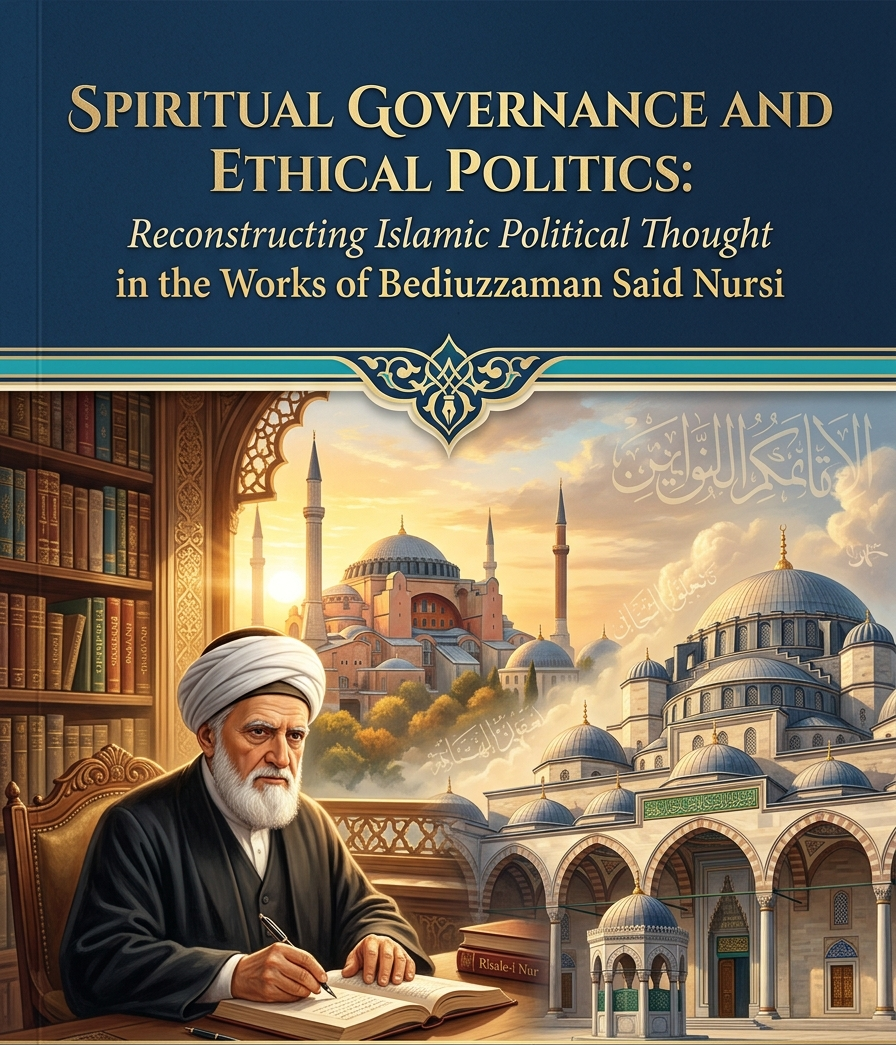
Spiritual Governance and Ethical Politics: Reconstructing Islamic Political Thought in the Works of Bediuzzaman Said Nursi
DOI:
https://doi.org/10.32350/jitc.161.19Keywords:
Bediuzzaman Said Nursi, Islamic governance, political ethics, Risale-I-Nur, spiritual leadershipAbstract
The ethical crisis in contemporary politics—characterized by systemic corruption, moral disintegration, and the instrumentalization of power—demands the exploration of alternative models of governance grounded in spiritual and ethical values. This study aimed to reconstruct key Islamic political principles from the thought of Bediuzzaman Said Nursi to formulate a comprehensive framework of ethical-spiritual governance. Utilizing a qualitative library research method, the study applied hermeneutic-philosophical and content analysis approaches to Nursi’s seminal works, particularly the Risale-i Nur and his epistles, supplemented by contemporary academic literature on his political philosophy. The findings identified six central principles in Nursi’s political thought: (1) tawḥīd as the metaphysical and ethical foundation of governance, (2) amānah as a moral responsibility in leadership, (3) justice and maslaḥah as the guiding objectives of public policy, (4) shūrā (consultation) as a participatory political mechanism, (5) anti-corruption ethics grounded in zuhd (asceticism toward power), and (6) prophetic leadership based on tazkiyah (spiritual purification). These principles collectively form a normative structure for governance that emphasizes divine consciousness, moral accountability, and inclusive civic participation. This ethical-spiritual governance model, rooted in Nursi’s thought, offers a critical and constructive alternative to secular and technocratic paradigms—particularly in the context of Muslim-majority nations, such as Indonesia. By reintroducing spirituality into political ethics, this study contributed to the advancement of Islamic political theory and offered actionable insights for reforming governance towards justice, transparency, and public service.
Downloads
References
Abu-Rabi, Ibrahim M. “Said Nursi and the Turkish Experience of Modernity.” The Muslim World 89, no. 3–4 (1999): 218–34. https://doi.org/10.1111/j.1478-1913.1999.tb03692.x
—. Spiritual Dimensions of Bediuzzaman Said Nursi’s Risale-i Nur. Albany: State University of New York Press, 2008.
Akhmetova, Elmira. “Said Nursi on Secularism, Religious Rights, Ethics, and Education.” ICR Journal 12, no. 1 (2021): 53–72. https://doi.org/10.52282/icr.v12i1.816
An-Na’im, Abdullahi Ahmed. Islam and the Secular State. Cambridge, MA: Harvard University Press, 2008.
Auda, Jasser. Maqasid Al-Shariah as Philosophy of Islamic Law: A Systems Approach. London: International Institute of Islamic Thought, 2008.
Budiarto, Gema. “Indonesia Dalam Pusaran Globalisasi Dan Pengaruhnya Terhadap Krisis Moral Dan Karakter (Indonesia in the vortex of globalization and its influence on the moral and character crisis).” Pamator Journal 13, no. 1 (2020): 50–56. https://doi.org/10.21107/pamator.v13i1.6912
Casanova, José. Public Religions in the Modern World. Chicago: University of Chicago Press, 1994.
Diana, Rashda., Siswanto Masrruri, Surwandono. “Etika Politik Dalam Perspektif Al-Mawardi (Political Ethics in the Perspective of al-Mawardi).” Tsaqofah Jurnal Peradaban Islam 14 (2018): 363–384.
Edesco, Maria. “Affect, the State, and Political Subjectivity among the Nur Community in Turkey.” Political Theology 25, no. 3 (2024): 186–202.
Fadel, Kamil., and Eren Tatari. “A Political Analysis of Bediuzzaman Said Nursi’s Damascus Sermon.” Humanities and Social Sciences Review 5, no. 3 (2016): 303–22.
Farhah, and Achmad Farid. “Prinsip Etika Politik Pemimpin Dalam Islam (Ethical Principles of Political Leadership in Islam).” Dauliyah: Journal of Islam and International Affairs 4, no. 2 (2019): 66–84.
Fitria, Vita., and Haekal Adha Al Giffari. “The Language of Science and Religion: An Approach to Understand the Encounter between Science and Religion According to Ian G. Barbour.” Humanika 21, no. 1 (2021): 55–68. https://doi.org/10.21831/hum.v21i1.40453
Ghani, Abdul, and Fatima Ghan. “The Secularization Project in the Light of Bediuzzaman Said Nursi’s Risale-I-Nur.” South Asian Journal of Religion and Philosophy (SAJRP) 3, no. 1 (2022): 1–23.
Habermas, Jürgen. “Religion in the Public Sphere.” European Journal of Philosophy 14, no. 1 (2006): 1–25. https://doi.org/10.1111/j.1468-0378.2006.00241.x
Hakan Çoruh. “Celebrating Diversity of Humanity, Struggling for Peace, and Establishing Culture of Coexistence.” Journal of Cultural and Religious Studies 3, no. 3 (2015): 143–51. https://doi.org/10.17265/2328-2177/2015.03.003
Hallaq, Wael B. The Impossible State: Islam, Politics, and Modernity’s Moral Predicament. New York: Columbia University Press, 2013.
Hermawan, Iwan. Metodologi Penelitian Pendidikan Kuantitatif, Kualitatif Dan Mixed Methode (Educational Research Methodology: Quantitative, Qualitative, and Mixed Methods). Kuningan: Hidayatul Quran Kuningan, 2019.
Huringiin, Nabila, Achmad Reza Hutama Al Faruqi, and Achmad Wildan Sayyidul Bachr. “Harmonizing Society: Bediuzzaman Said Nursi’s Vision of Islamic Politics.” Muharrik: Jurnal Dakwah Dan Sosial 6, no. 2 (2023): 191–200. https://doi.org/10.37680/muharrik.v6i1.3528
Huringiin, Nabila., Achmad Reza Hutama Al Faruqi, and Siti Nurhalisa. “The Implementation of Badiuzzaman Said Nursi ’ s Concept of Hope in Addressing the Crisis of Public Trust in Indonesian Politics.” Fokus: Jurnal Kajian Keislaman Dan Kemasyarakatan 9, no. 2 (2024): 136–48. https://doi.org/https://doi.org/10.29240/jf.v9i2.11294
Ibrahim M. Abu-Rabi. Spiritual Dimensions of Bediuzzaman Said Nursi’s Risale-I Nur. New York: Suny Press, 2008.
Ihsan, Nur Hadi., Muhammad Alif Rahmadi, and Jamal Jamal. “Spirituality as The Foundation of The Hierarchy of Needs in The Humanistic Psychology of Abraham Maslow and Sufi Psychology of Said Nursi.” Afkaruna: Indonesian Interdisciplinary Journal of Islamic Studies 18, no. 1 (2022): 1–28. https://doi.org/10.18196/afkaruna.v18i1.14495
Ihsan, Nur Hadi., Ridani Faulika Permana, and Abdullah Muslich Rizal Maulana. “Bediuzzaman Said Nursi and the Nature of Human Creation in His Major Works: Considering a New Breakthrough in Islamic Philosophy.” Journal of Islamic Thought and Civilization 12, no. 1 (2022): 114–37. https://doi.org/10.32350/jitc.121.06
Imhoff, Roland., Felix Zimmer, Olivier Klein, João H. C. António, Maria Babinska, Michal Bilewicz, Adrian Bangerter, et al. “Conspiracy Mentality and Political Orientation across 26 Countries.” Nature Human Behaviour 6, no. 3 (2022): 392–403. https://doi.org/https://doi.org/10.1038/s41562-021-01258-7
Kamali, Mohammad Hashim. Citizenship and Accountability of Government: An Islamic Perspective. Cambridge: Islamic Texts Society, 2011.
Khamami, Akhmad Rizqon. “The Nurcu Movement and Tafsir Risale-i Nur: Formation of Muslim Identity in the Midst of Modernization.” Mashdar: Jurnal Studi Al-Qur’ān Dan Hadis 5, no. 1 (2023): 79–92. https://doi.org/10.15548/mashdar.v5i1.6195
Lindsey, Tim., and Mas Achmad Santosa. “The Trajectory of Law Reform in Indonesia: A Short Overview of Legal Systems and Change.” In Indonesia: Law and Society, edited by Tim Lindsey, 3–30. Sydney: Federation Press, 2008.
Majeed, Shumaila. “An Analytical Study of Bediuzzaman Said Nursi’s Intellectual Development and Composition of Risale-i Nur (A Thematic Qur’ānic Exegesis).” Journal of Islamic Thought and Civilization 10, no. 2 (2020): 170–89. https://doi.org/10.32350/jitc.102.10
Maksum, Muhammad. “Implementation of Al-Ghazali Maslahah Concept In Islamic Economic Activities.” Salam: Jurnal Sosial Dan Budaya Syar-I 9, no. 2 (February 17, 2022): 481–90. https://doi.org/10.15408/sjsbs.v9i2.24825
Mardin, Şerif. Religion and Social Change in Modern Turkey: The Case of Bediuzzaman Said Nursi. Albany: State University of New York Press, 1989.
Masri, Dedi. “The Concept of Islamic Musyawarah.” Budapest International Research and Critics Institute-Journal (BIRCI-Journal) 4, no. 3 (2021): 7395–7403. https://doi.org/10.33258/birci.v4i3.2619
Mohamad, Mohamad Zaidin., Noorsafuan Che Noh, Hanif Lateh Junid, Wan Mohd, and Khairul Firdaus. “The Importance of Nursi ’ s Thought in Empowering Muslim Identity.” Pakistan Journal of Life and Social Sciences 22, no. 2 (2024): 518–24.
Mohammad, Qaisar. “Faith and Revolution: The Case of Islamic Resurgence by Said Nursi in Turkey.” Analisa: Journal of Social Science and Religion 5, no. 02 (2020): 153–66. https://doi.org/10.18784/analisa.v5i02.1135
Munandar, Siswoyo Aris., Jazilus Sakhok, Puji Astuti, and Elia Malikhaturrahma. “Nursi’s Sufism Without Sufi Order: A Centemporary Debate Among The Ulama.” Jurnal Ushuluddin 28, no. 2 (2020): 155–169. https://doi.org/10.24014/jush.v28i2.9643
Musni, Siti Norhanani Binti., Sharifatul Nadiah Binti Sulim, Muhamad Helmi Md Said, and Fatima Abdel Rahim Ali. “Secularism: Freedom of Religion or Freedom from Religion?” Geopolitics Quarterly 19, (2023): 145–66.
Noor, Zeeshan., Rafeel Wasif, Shariq Siddiqui JD, and Sabith Khan. “Racialized Minorities, Trust, and Crisis: Muslim‐American Nonprofits, Their Leadership and Government Relations during COVID‐19.” Nonprofit Management and Leadership 32, no. 3 (2021): 341–64. https://doi.org/https://doi.org/10.1002/nml.21486
Nursi, Badi’uzzaman Sa’id. Mulhaq Emirdag 2(The Emirdağ Letters). Edited by Husein Utsman. Mesir: Sozler Publications, n.d.
Nursi, Bediuzzaman Said. Staff of Moses. Cairo: Sozler Publications, 2004.
—. The Damascus Sermon. Istanbul: Sozler Publications, 1996.
—. The Flashes. Istanbul: Nesil, 2004.
—. The Letters. Istanbul: Sozler Publications, 1997.
—. The Rays. Istanbul: Nesil, 2004.
—. The Words. Edited by Şükran Vahide. Istanbul: Sözler Publications, 2002.
Orhan, Sadettin. “Said Nursi ’ s Cause-Wisdom Congruence Method as a Method of Social Analysis.” Cogent Social Sciences 11, no. 1 (2025). https://doi.org/10.1080/23311886.2025.2502603
—. “The Past, Present and Future of Social Stratification from Said Nursi’s Perspective.” Journal of Muslims in Europe 13, no. 1 (2023): 81–108.
Philp, Mark. Political Conduct. Cambridge: Harvard University Press, 2007.
Pope, Jeremy. Confronting Corruption: The Elements of a National Integrity System. Berlin: Transparency International, 2000.
Pramono, Muhamad Fajar., Mohamad Latief, and Chandra Dwisetyo Widodo. “Ethical Politic in the View of Bediuzzaman Said Nursi: A Response to Political Pragmatism.” Dialogia 22, no. 1 (2024): 23–44.
Prayogo, Tonny Ilham., Saidil Yusron, Sujiat Zubaidi Saleh, Agus Mulyana, Universitas Darussalam Gontor, and East Java. “Badiuzzaman Said Nursi ’ S Perspective on The Neo-Tasawwuf Issue of Risale-I Nur in Urban Muslim Society.” Akademika: Jurnal Pemikiran Islam 29, no. 2 (2024). https://doi.org/10.32332/akademika.v29i2.9587
Rahardjo, Mudjia. “Meluruskan yang ‘Bengkok’ dalam Penelitian Kualitatif (Straightening the “crooked” aspects in qualitative research).” Malang: Universitas Islam Negeri Maulana Malik Ibrahim Malang Repository, 2023. https://repository.uin-malang.ac.id/15156/.
Rawls, John. Political Liberalism. New York: Columbia University Press, 1996.
Saeed, Abdullah. “Islamic Ethical Principles and Public Governance.” Journal of Islamic Studies 23, no. 3 (2012): 351–373. https://doi.org/10.1093/jis/ets039
—. Islamic Thought: An Introduction. London and New York: Routledge, 2006.
Sahin, Mustafa Gokhan. Spirituality and Social Justice in Islam. Edited by Vincent J. Cornell and Bruce B. Lawrence. he Wiley Blackwell Companion to Islamic Spirituality, 2022. https://doi.org/10.1002/9781118533789.ch13
Saritoprak, Zeki. “Islam and Politics in The Light of Said Nursi’s Writings.” Islam and Christian-Muslim Relations 19, no. 1 (2008): 113–26. https://doi.org/10.1080/13510340701770337
Sayem, Md Abu. “Badi’uzzaman Said Nursi (1876-1960) and Islamic Eco-Theological Ethics.” Quest: Studies on Relkigious & Culture in Asia 5, no. April (2022): 1–16.
Shaheen, Maisoon Sa id. “The Traditional Approach of Sid Nursi to Reform Higher Education in Turkey.” Dirasat: Human and Social Sciences 48, no. 3 (2021): 368–379.
Sumaryono. Hermeneutika, Sebuah Metode Filsafat (Hermeneutics: A philosophical method). Yogyakarta: Kanisius, 1999.
Syam, Aldo Redho. “Konsep Kepemimpinan Bermutu Dalam Pendidikan Islam (The Concept of Quality Leadership in Islamic Education).” At-Ta’dib 12, no. 2 (2017): 49–69. https://doi.org/10.21111/at-tadib.v12i2.1214
Taylor, Charles. A Secular Age. United States of America: Harvard University Press, 2007.
Trisnani, Asif., Muhammad Thoriqul Islam, Raisya Miftakhul Rahma, and Nawa Marjany. “Interpretation of Tau Ḥīd Verses from Said Nursi ’ s Perspective : An Esoteric Approach and Its Influence on Islamic Thought.” Fikri: Jurnal Kajian Agama, Sosial Dan Budaya 9, no. 1 (2024): 40–54. https://doi.org/https://doi.org/10.25217/jf.v9i1.4650
Turner, Colin. The Qur’ān Revealed: A Critical Analysis of Said Nursi’s Epistles of Light. Berlin: Gerlach Press, 2013.
Vahide, Şükran. Islam in Modern Turkey: An Intellectual Biography of Bediuzzaman Said Nursi. New York: State University of New York Press, 2005.
Vicini, Fabio. “Rescuing the Muslim Collective Self: The Nur Case in Light of the Modern Muslim Subjectivities Project.” Asiatische Studien-Études Asiatiques 75, no. 3 (2021): 811–830.
Vieira, K A L., and G M De Queiroz. “Hermeneutic Content Analysis: A Method of Textual Analysis.” International Journal of Business Marketing and Management 2, no. 8 (2017): 2456–4559.
Wulandari, Yusrina Dyah., Romlah Widyawati, Rochmad, and Niken Sylvia Puspitasari. “The Concept of Tazkiyah An-Nafs Bediuzzaman Said Nursi In Risale-i Nur.” Al-Fahmu: Jurnal Ilmu Al-Qur’an Dan Tafsir 3, no. 2 (2024): 221–233. https://doi.org/10.58363/alfahmu.v3i2.90
Yavuz, M Hakan. Toward an Islamic Enlightenment: The Gülen Movement. Oxford: Oxford University Press, 2013.
Yılmaz, İhsan. “Civil Society and Muslim Democracy in Turkey.” Journal of Civil Society 5, no. 3 (2009): 211–28. https://doi.org/10.1111/j.1478-1913.2005.00077.x
Yucel, Salih. “Purpose-Driven Life in Islam And Emotional Stability: Examining Said Nursi’s Perspective.” Australian Journal of Islamic Studies 2, no. 2 (2024): 19–36.
Yusuf, Maulana, Bahrul Ulum., M. Rusydi, and M. Ishak. “Etika Islam Dalam Ranah Politik: Respon Dan Tinjauan Kritis Nahdlatul Ulama Dan Muhammadiyah Provinsi Jambi Terhadap Penyelenggaraan Pilkada Langsung, 2005-2015 (Islamic Ethics in the Political Sphere: Responses and Critical Perspectives of Nahdlatul Ulama and Muhammadiyah in Jambi Province toward the Implementation of Direct Regional Elections, 2005–2015).” MIQOT: Jurnal Ilmu-Ilmu Keislaman 41, no. 1 (2017): 139–54. https://doi.org/10.30821/miqot.v41i1.306
Zulqarnain, Muhammad., Muhammad Rizwan Mahmood, Muhammad Umer Raheel, Ahmad Munir, and Faizan Hassan Javed. “Interpretation of Diverse Dimensions of ‘Faith’ By Bediuzzaman Said Nursi And İts Impact Upon Reawakening Muslim Societies.” Jurnal Webology 19, no. 3 (2022): 3619–30.
Published
How to Cite
Issue
Section
License
Copyright (c) 2026 Nabila Huringiin, Muhamad Fajar Pramono, Moh. Isom Mudin, Achmad Reza Hutama Al Faruqi

This work is licensed under a Creative Commons Attribution 4.0 International License.

This work is licensed under a Creative Commons Attribution 4.0 International License. Authors retain copyright and grant the journal right of first publication with the work simultaneously licensed under a Creative Commons Attribution (CC-BY) 4.0 License that allows others to share the work with an acknowledgement of the work’s authorship and initial publication in this journal.












.png)