
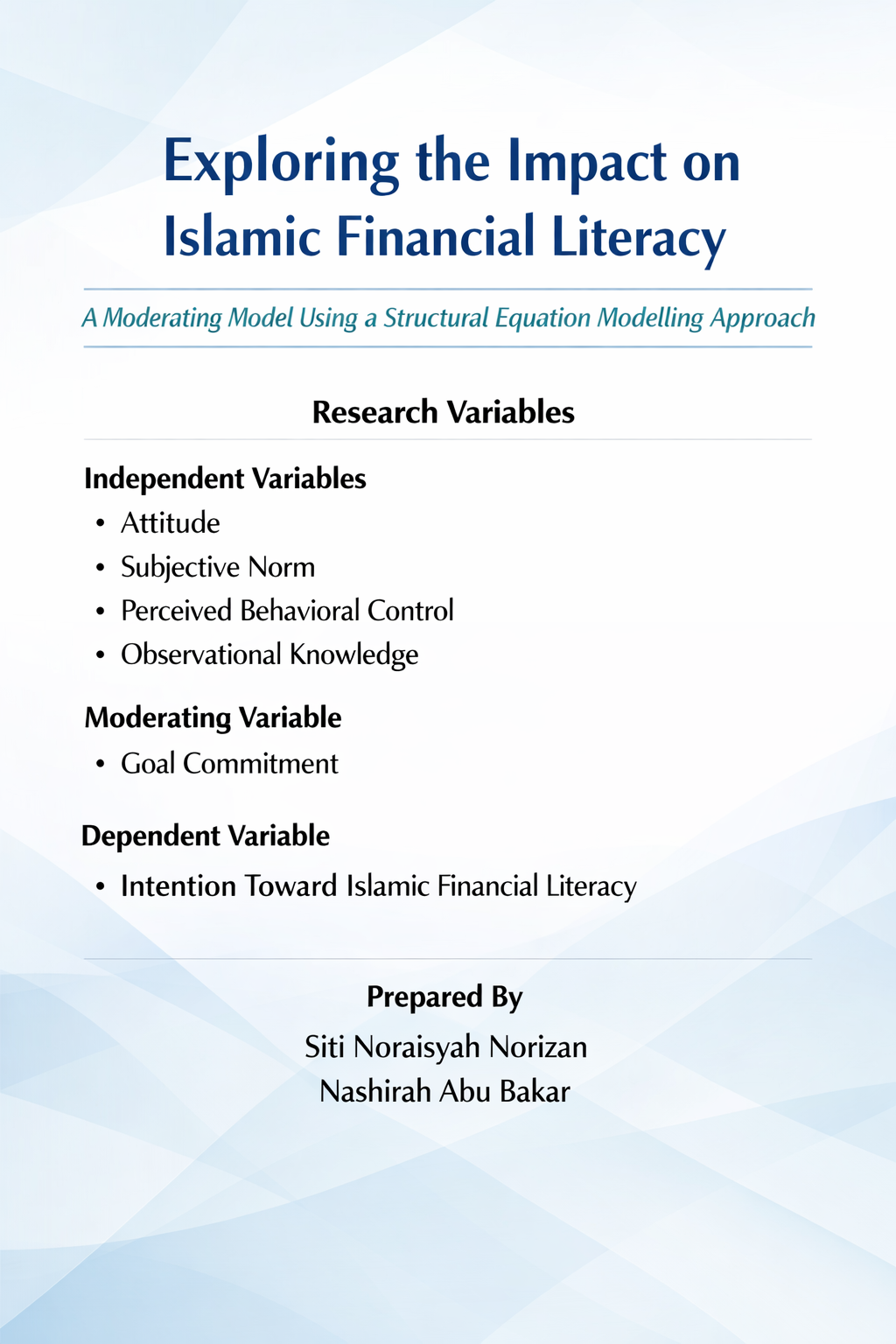
Exploring the Impact on Islamic Financial Literacy: A Moderating Model Using a Structural Equation Modelling Approach
DOI:
https://doi.org/10.32350/jitc.161.09Keywords:
Goal Setting Theory, Islamic financial literacy, Malaysia, Social Learning Theory, Theory of Planned Behaviour, university studentsAbstract
This study examined the factors influencing Intention (IT) toward Islamic financial literacy by integrating three theories. Theory of Planned Behaviour (TPB) involves several constructs including Attitude (ATT), Subjective Norm (SN), and Perceived Behavioural Control (PBC). Social Learning Theory (SLT) comprises the construct including Observational Knowledge (OK); and Goal Setting Theory (GST) contains the construct including Goal Commitment(GC). This study employs a quantitative approach, using a cross-sectional survey and random sampling to select respondents. Accordingly, 379 respondents from a Malaysian public university were gathered at the end of the study. The construct was analysed using Partial Least Squares Structural Equation Modelling (PLS-SEM) through SMARTPLS4. The findings of this study revealed that ATT (β = 0.112, p = 0.039), SN (β = 0.144, p = 0.027), PBC (β = 0.278, p < 0.001), and OK (β = 0.124, p = 0.009) significantly influenced students’ IT toward Islamic financial literacy. Additionally, GC moderated the relationship between SN and IT (β = 0.140, p = 0.029). Furthermore, the model explained 60.6% variance when R-squared indicates the value of 0.606, with SRMR being 0.072, and achieved a satisfactory model fit. This study’s finding encourages promoting Islamic financial literacy through educational programmes, social observation, and motivational strategies. Overall, future research should explore SLT or GST as a whole to strengthen Islamic financial literacy.
Downloads
References
Aisyah, Siti., M. Ikhsan Harahap, Nurbaiti Nurbaiti, and Mustapa Khamal Rokan. “The Factors Influencing Behavioural Intention Fintech Lending (Paylater) among Generation Z Indonesian Muslims and Islamic Consumption Ethics Views.” Journal of Islamic Economics 7, no. 1 (June 30, 2023): 01–20. https://doi.org/10.30983/es.v7i1.6233.
Aisyah, Muniaty., Umiyati Umiyati, and Leis Suzanawaty. “The Impact of Islamic Financial Literacy on Islamic Financial Planning of Islamic University Students.” JPS (Journal of Islamic Banking) 6, no. 1 (April 28, 2025): 22–40. https://doi.org/10.46367/jps.v6i1.2223.
Ajzen, Icek. “The Theory of Planned Behavior.” Organizational Behavior and Human Decision Processes 50, no. 2 (December 1991): 179–211. https://doi.org/10.1016/0749-5978(91)90020-T.
Ali, Muhammad., Syed Ali Raza, Chin-Hong Puah, and Mohd Zaini Abd Karim. “Islamic Home Financing in Pakistan: A SEM-Based Approach Using Modified TPB Model.” Housing Studies 32, no. 8 (March 15, 2017): 1156–1177. https://doi.org/10.1080/02673037.2017.1302079.
Allah Pitchay, Anwar. “Factors Influence Intention of Management of Sharī‘ah-Compliant Companies to Participate in Islamic Voluntary Charity.” International Journal of Islamic and Middle Eastern Finance and Management 15, no. 5 (January 25, 2022): 967–985.. https://doi.org/10.1108/imefm-11-2019-0466.
Amin, Hanudin., Abdul Rahim Abdul Rahman, Stephen Laison Sondoh, and Ang Magdalene Chooi Hwa. “Determinants of Customers’ Intention to Use Islamic Personal Financing.” Journal of Islamic Accounting and Business Research 2, no. 1 (April 19, 2011): 22–42. https://doi.org/10.1108/17590811111129490.
Amin, Hanudin., Abdul-Rahim Abdul-Rahman, and Dzuljastri Abdul-Razak. “An Integrative Approach for Understanding Islamic Home Financing Adoption in Malaysia.” International Journal of Bank Marketing 31, no. 7 (October 7, 2013): 544–73. https://doi.org/10.1108/ijbm-02-2013-0008.
Analia, Ferdiana Dwi., and Titing Widyastuti. “Analysis of Community Saving Interest in Bank Mega Syariah through Islamic Banking Literacy and Family Environment with Trust in Islamic Banking as an Intervening Variable.” GoodWill Journal of Economics, Management, and Accounting 5, no. 1 (2025): 17–30.
Bandura, Albert. Social Foundations of Thought and Action: A Social Cognitive Theory. Englewood Cliffs, NJ, USA: Prentice Hall, 1986.
Bashir, Zahid, Muhammad Sabeeh Iqbal, and Muhammad Aamir. “Millennial Muslims and Islamic Financial Literacy.” In The Routledge Handbook of Islamic Economics and Finance, edited by Hussain Mohi-ud-Din Qadri, M. Ishaq Bhatti, and Mohd Azmi Omar, 385. London: Routledge, 2025.
Chai, Shijun., Yang Chen, Bihong Huang, and Dezhu Ye. “Social Networks and Informal Financial Inclusion in China.” Asia Pacific Journal of Management 36, no. 2 (March 19, 2018): 529–563. https://doi.org/10.1007/s10490-017-9557-5.
Cheah, Jun‐Hwa., Francesca Magno, and Fabio Cassia. “Reviewing the SmartPLS 4 Software: The Latest Features and Enhancements.” Journal of Marketing Analytics 12 (December 8, 2023): 97–107, https://doi.org/10.1057/s41270-023-00266-y.
Choudhry, Fahad., Long Ming, Khadeeja Munawar, Syed Zaidi, Rahul Patel, Tahir Khan, and Shandell Elmer. “Health Literacy Studies Conducted in Australia: A Scoping Review.” International Journal of Environmental Research and Public Health 16, no. 7 (2019): 1112. https://doi.org/10.3390/ijerph16071112.
Dimaunahan, Doni Sevaztianne F., Angelique France B. Santiago, Maria Christiana C. Eusebio, Sumella Maria M. Loteriña, Ardvin Kester S. Ong, and John Xavier S. Chavez. “Financial Literacy and Sustainable Planning Assessment among Filipino Millennials.” Acta Psychologica 259 (July 24, 2025): 105334. https://doi.org/10.1016/j.actpsy.2025.105334.
Durak, İsmail, Mehmet Akif Öncü, and Osman Kartal. “Measuring Islamic Financial Literacy and Discovering Its Relations with Entrepreneurship among University Students in Turkey.” Bilimname 2020, no. 42 (November 2, 2020): 215–42. https://doi.org/10.28949/bilimname.819736.
Firdous, Tasneema., Zoe Darwin, and Shaima M. Hassan. “Muslim Women’s Experiences of Maternity Services in the UK: Qualitative Systematic Review and Thematic Synthesis.” BMC Pregnancy and Childbirth 20, no. 1 (2020). https://doi.org/10.1186/s12884-020-2811-8.
Fishbein, Martin., and Icek Ajzen. “Belief, Attitude, Intention and Behavior: An Introduction to Theory and Research.” Contemporary Sociology 6, no. 2 (March 1975): 130–132.
Fornell, Claes., and David F. Larcker. “Structural Equation Models with Unobservable Variables and Measurement Error: Algebra and Statistics.” Journal of Marketing Research 18, no. 3 (August 1981): 382–88. https://doi.org/10.2307/3150980.
Franzoni, Simona., and Asma Ait Allali. “Principles of Islamic Finance and Principles of Corporate Social Responsibility: What Convergence?” Sustainability 10, no. 3 (February 28, 2018): 637. https://doi.org/10.3390/su10030637.
Gunawan, Ade., Mukmin, Irma Christiana, Azzura Kahfi Ilzam, and Friska Nur Laily. “Factors Affecting the Financial Well-Being of Islamic University Students in Indonesia: The Mediating Role of Financial Behavior.” Investment Management and Financial Innovations 22, no. 2 (April 10, 2025): 65–76. https://doi.org/10.21511/imfi.22(2).2025.06.
Hair, Joseph F., William C. Black, Barry J. Babin, Rolph E. Anderson, and Ronald L. Tatham. Multivariate Data Analysis. 7th ed. 2019.
Hanif, Muhammad. “Differences and Similarities in Islamic and Conventional Banking.” International Journal of Business and Social Sciences 2, no. 2 (2014): 166–175.
Hassan, M. Kabir., and Sirajo Aliyu. “A Contemporary Survey of Islamic Banking Literature.” Journal of Financial Stability 34 (February 2018): 12–43. https://doi.org/10.1016/j.jfs.2017.11.006.
Henseler, Jörg., Geoffrey Hubona, and Pauline Ash Ray. “Using PLS Path Modeling in New Technology Research: Updated Guidelines.” Industrial Management & Data Systems 116, no. 1 (February 2016): 2–20.
Huda, Nurul., Nova Rini, and Yosi Mardoni. “The Analysis of Attitudes, Subjective Norms, and Behavioral Control on Muzakki’s Intention to Pay Zakah,” International Journal of Business and Social Science 3, no. 22 (January 1, 2012): 271–279.
Izzah, Nurul., and Sri Sudiarti. “Generation Z's Level of Muslim Understanding on Sharia Capital Market.” Al-Masharif: Journal of Economic and Islamic Studies 10, no. 1 (2022): 54–69.
Jingyi, Wang., and Syed Kamaruzaman Bin Syed Ali. “A Systematic Review of the Relationships Between Attitude, Subjective Norms, Perceived Behavioral Control, and Exercise Intention.” The Open Public Health Journal 18, no. 1 (June 23, 2025): 1–12, https://doi.org/10.2174/0118749445394456250605043155
Kapoor, Sunanda. “The Role of SmartPLS in Optimizing Statistical Analysis: A Case Study Approach.” Paper presented at the 5th International Conference on Innovative Research in Applied Science, Engineering and Technology (IRASET), Fez, Morocco, May 15–16, 2025.
Kline, Rex B. “Book Review: Psychometric Theory (3rd Ed.).” Journal of Psychoeducational Assessment 17, no. 3 (September 1999): 275–80. https://doi.org/10.1177/073428299901700307.
Kuanova, Laura Aibolovna., Rimma Sagiyeva, and Nasim Shah Shirazi. “Islamic Social Finance: a Literature Review and Future Research Directions.” Journal of Islamic Accounting and Business Research 12, no. 5 (2021): 707–728.
Kusumawati, Intan Bigita., Achmad Dhany Fachrudin, Ilma Indra, None Zulkardi, Ummy Salmah, and Muhammad Khusni Mubarok. “Designing Mathematics’ Tasks to Promote Students’ Islamic Financial Literacy.” AIP Conference Proceedings 3114 (January 1, 2024): 020072–72. https://doi.org/10.1063/5.0201055.
Latham, Gary. “Goal setting: A Five-step Approach to Behavior Change.” In Organizational Collaboration, 10-20. Routledge, 2020.
Lee, Joonyup., and John G Cagle. “Measures of Financial Burden for Families Dealing with Serious Illness: A Systematic Review and Analysis.” Palliative Medicine 35, no. 2 (December 4, 2020): 280–94. https://doi.org/10.1177/0269216320973161.
Locke, Edwin A., and Gary P. Latham. “Building a Practically Useful Theory of Goal Setting and Task Motivation: A 35-Year Odyssey.” American Psychologist 57, no. 9 (2002): 705–717. https://doi.org/10.1037//0003-066x.57.9.705.
Mahmoud, Mahmoud Ahmad., Muhammad M Ma’aji, Mohammed Sani Abdullahi, Abubakar Balarabe Karaye, and Abubakar Salisu Garba. “Factors Influencing the Islamic Fintech Acceptance: Moderating Role of Islamic Financial Literacy.” Journal of Islamic Accounting and Business Research, Advanced online publication, April 29, 2025. https://doi.org/10.1108/jiabr-08-2024-0322.
Moldakmatov, Asylbek., Kubanychbek Idinov, Azyk Orozonova, and Azamat Sulaimanov. “Islamic Principles of Finance: Features and Prospects of Their Use in Central Asia.” International Journal on Culture, History, and Religion 7, no. SI1 (September 9, 2025): 765–790. https://doi.org/10.63931/ijchr.v7isi1.339.
Mols, Floortje., Bianca Tomalin, Alison Pearce, Billingsley Kaambwa, and Bogda Koczwara. “Financial Toxicity and Employment Status in Cancer Survivors. A Systematic Literature Review.” Supportive Care in Cancer 28 (August 31, 2020). https://doi.org/10.1007/s00520-020-05719-z.
Muhtarom, Zamroni Alpian., Adrianda Anwar, Abdurrahman Abdurahman, and Mohammad Najib Roodhi. “The Urgency of Islamic Investment Literacy in Managing Muslim Personal Finance.” Journal of Accounting, Management, and Economic Development 1, no. 1 (2025): 23–33.
Muninggar, Putri., Moh Shadam Taqiyyuddin Azka, Furqonul Haq, and Ahmad Febriyanto. “The Role of Islamic Financial Literacy in Shaping Economic Behavior: Evidence from Generation Z.” Diponegoro Journal of Economics 14, no. 2 (August 18, 2025): 81–97. https://doi.org/10.14710/djoe.48925.
Nawi, Md., Farah Amalina, Muhammad Ridhwan Ab Aziz, and Syahidawati Shahwan. “Conceptualizing the Influence of Religiosity and Islamic Financial Knowledge on Islamic Financial Behaviours.” International Journal of Academic Research in Business and Social Sciences 12, no. 11 (November 17, 2022). https://doi.org/10.6007/ijarbss/v12-i11/15262
Noh, Yeayoung., and Na Young Ahn. “Millennials’ Perceived Value and Intention to Purchase Athleisure Products: The Mediating Role of Desire for Conspicuous Consumption.” International Journal of Sports Marketing and Sponsorship 26, no. 3 (January 7, 2025): 548–567. https://doi.org/10.1108/ijsms-06-2024-0122.
Norizan, Siti Noraisyah Binti., Nashirah Binti Abu Bakar, Muhammad Saeed Iqbal, and Izzyan Binti Mohd Idris. “Examining Financial Well-Being among Students: Islamic Social Finance and Theory of Planned Behavior Approach.” Review of Islamic Social Finance and Entrepreneurship, March 5, 2025, 1–16. https://doi.org/10.20885/risfe.vol4.iss1.art1.
Osman, Ismah., Faigah Syed, Mohsin Abdur Rehman, Ruhaini Muda, Faridah Hassan, Rohail Hassan, and Hasni Abdullah. “The Dilemma of Millennial Muslims towards Financial Management: An Islamic Financial Literacy Perspective.” Journal of Islamic Marketing, March 31, 2023. https://doi.org/10.1108/jima-09-2021-0283.
Palumbo, Rocco. “Examining the Impacts of Health Literacy on Healthcare Costs. An Evidence Synthesis.” Health Services Management Research 30, no. 4 (October 16, 2017): 197–212. https://doi.org/10.1177/0951484817733366.
Patrisia, Dina., Abror Abror, Shabbir Dastgir, and Rita Rahayu. “Generation Z’s Financial Behaviour: The Role of Islamic Financial Literacy.” ISRA International Journal of Islamic Finance 15, no. 2 (May 23, 2023): 20–37. https://doi.org/10.55188/ijif.v15i2.540.
Ramayah, T., Jacky Cheah, Francis Chuah, Hiram Ting, and Mumtaz Ali Memon. Partial Least Squares Structural Equation Modeling (PLS-SEM) Using SmartPLS 3.0: An Updated and Practical Guide to Statistical Analysis. 1st ed. Pearson Malaysia, 2018.
Ramayah, Thurasamy, J. A. Yeap, Noor Hazlina Ahmad, Hasliza Abdul Halim, and Syed Abidur Rahman. “Testing a Confirmatory Model of Facebook usage in SmartPLS using Consistent PLS.” International Journal of Business and Innovation 3, no. 2 (2017): 1-14.
Ringle, Christian M., Dirceu Da Silva, and Diógenes De Souza Bido. “Structural Equation Modeling with the Smartpls.” Revista Brasileira de Marketing 13, no. 02 (May 1, 2014): 56–73. https://doi.org/10.5585/remark.v13i2.2717.
Rodrigues, Isabel B., Jonathan D. Adachi, Karen A. Beattie, and Joy C. MacDermid. “Development and Validation of a New Tool to Measure the Facilitators, Barriers and Preferences to Exercise in People with Osteoporosis.” BMC Musculoskeletal Disorders 18, no. 1 (December 2017): 540. https://doi.org/10.1186/s12891-017-1914-5.
Rozikin, Achmad Zainul., and Irmadatus Sholekhah. “Islamic Financial Literacy, Promotion, and Brand Image towards Saving Intention in Sharia Bank.” Iqtishadia 13, no. 1 (June 15, 2020): 95. https://doi.org/10.21043/iqtishadia.v13i1.6489.
Sayuti, Khadijah M., and Hanudin Amin. “Islamic Mortgage Adoption: Examining the Moderating Effects of Islamic Altruism.” Journal of Islamic Marketing 13, no. 8 (September 29, 2021): 1728–1750. https://doi.org/10.1108/jima-11-2018-0219.
Salleh, Hasnol., Nazlida Muhammad, Lutfi Abdul Razak, M. Hairul Azrin Hj Besar, and Hassan. “Role of Islamic Values and Financial Attitudes on Setting Financial Goals: An Exploratory Study of Bruneian Muslims.” Journal of Islamic Accounting and Business Research, May 20, 2025. https://doi.org/10.1108/jiabr-01-2025-0027.
Sayuti, Khadijah Muhammad., Hanudin Amin, Dzuljastri Abdul Razak, and Hamid Rizal. “Receptiveness of Islamic Home Financing among Malaysians: A Revisit.” International Journal of Business and Society 21, no. 2 (July 21, 2020): 784–802. https://doi.org/10.33736/ijbs.3294.2020.
Subhaktiyasa, Putu Gede . “PLS-SEM for Multivariate Analysis: A Practical Guide to Educational Research Using SmartPLS.” EduLine: Journal of Education and Learning Innovation 4, no. 3 (August 1, 2024): 353–65. https://doi.org/10.35877/454ri.eduline2861.
Sukmana, Raditya, and Budi Trianto. “The Effect of Islamic Financial Literacy on Business Performance with Emphasis on the Role of Islamic Financial Inclusion: Case Study in Indonesia.” Journal of Islamic Marketing, 16, no. 1 (September 2025): 166–192. https://doi.org/10.1108/jima-07-2022-0197.
Widiastuti, Tika, Sri Ningsih, Ari Prasetyo, Imron Mawardi, Sri Herianingrum, Anidah Robani, Muhammad Ubaidillah Al Mustofa, and Aufar Fadlul Hady. “Developing an Integrated Model of Islamic Social Finance: Toward an Effective Governance Framework.” Heliyon 8, no. 9 (September 2022): e10383. https://doi.org/10.1016/j.heliyon.2022.e10383.
Yeef, Lee Chin, and Kelvin Lee Yong Ming. “Islamic Financial Literacy Education on Innovative Retirement Financial Product.” International Journal of Islamic Thought 27 (June 1, 2025): 117–114. https://doi.org/10.24035/ijit.27.2025.322.
Yustati, Herlina, Heri Junaidi, and Asnaini Asnaini. “The Level of Islamic Financial Literacy and Islamic Financial Inclusion of Students in the Islamic Capital Market.” EKOMBIS REVIEW: Journal of Economics and Business 12, no. 1 (January 9, 2024): 837–844. https://doi.org/10.37676/ekombis.v12i1.5072.
Published
How to Cite
Issue
Section
License
Copyright (c) 2026 Siti Noraisyah binti Norizan, Nashirah Abu Bakar

This work is licensed under a Creative Commons Attribution 4.0 International License.

This work is licensed under a Creative Commons Attribution 4.0 International License. Authors retain copyright and grant the journal right of first publication with the work simultaneously licensed under a Creative Commons Attribution (CC-BY) 4.0 License that allows others to share the work with an acknowledgement of the work’s authorship and initial publication in this journal.











.png)