
Artificial Reasoning and Islamic Law: Mapping LLM Capabilities Across Juristic Ranks and Reasoning Frameworks
DOI:
https://doi.org/10.32350/jitc.161.12Keywords:
artificial reasoning, fatwa, fiqh, generative Artificial Intelligence (AI), ijtihad, juristic reasoning, Large Language models (LLMs), mujtahidAbstract
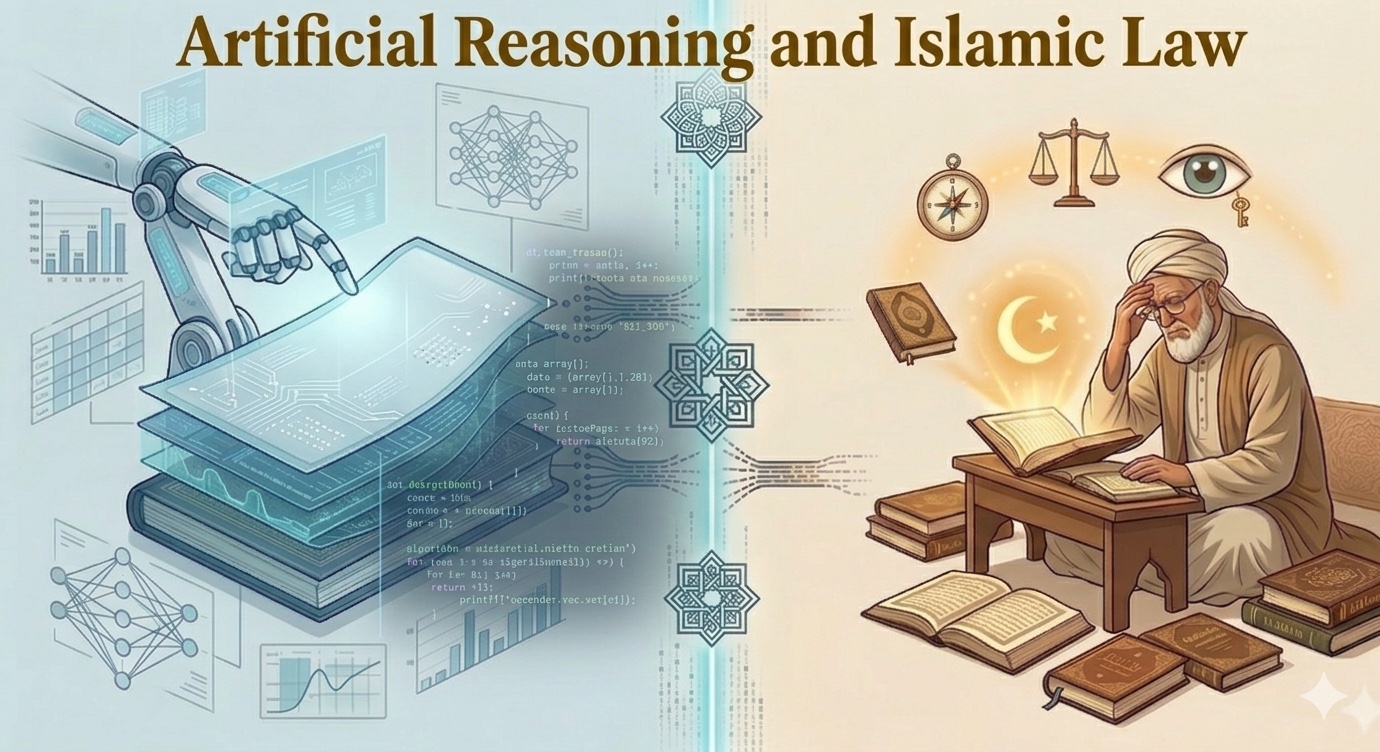
The growing use of Artificial Intelligence (AI) in religious inquiry raises a question about how these systems can contribute to Islamic legal reasoning. The current study aimed to examine whether Large Language Models (LLMs) can approximate the forms of analysis that Islamic jurisprudence expects from its practitioners. Islamic legal tradition has identified ranks of competence, from the independent mujtahid to the mufti and to the muqallid, each with expectations in terms of language, evidence, and judgment. The study assessed LLM performance in relation to these expectations by examining their training data, reasoning patterns, and results of empirical evaluations. Recent models show improved results on structured and rule-based tasks, such as inheritance calculations, where fine-tuning and retrieval-augmented methods improve accuracy and reduce hallucination rates. They can classify concepts, organize texts, and reproduce deductive patterns found in juristic writings. These strengths support LLMs as juristic research tools. Important limitations remain. LLMs cannot judge the strength of evidence, reconcile competing juristic views, or distinguish between equivocal and unequivocal proofs. They treat textual inputs without considering evidentiary hierarchy and therefore lack calibration for the assessment of proofs. Most critically, they cannot access what this study calls the passive contextual element in juristic reasoning that relies on awareness of intention, social custom, social conditions, and consequences of a ruling, none of which LLMs can reliably infer or evaluate. The study concluded that LLMs hold an intermediate position. They assist juristic research through retrieval, organization, and structured reasoning, yet they cannot assume the epistemic or ethical responsibilities that shape Islamic legal judgment.
Downloads
References
Abbas, Ummar, et al. “Fanar: An Arabic Centric Multimodal Generative AI Platform.” arXiv preprint arXiv:2501.13944 (2025). https://doi.org/10.48550/arXiv.2501.13944
Abū Zahra, Muḥammad. Uṣūl al Fiqh [Principles of Islamic Jurisprudence]. al Qāhirah: Dār al Fikr al ʿArabī, 1973.
ʿAfīfī, ʿAmr Muḥammad. Ḥarakat al-naqd al-fiqhī: Fuṣūl fī tārīkh al-ijtihād wa-masīrat al-naqd al-fiqhī [The Movement of Juristic Critique: Studies in the History of Ijtihād and the Trajectory of Juristic Criticism]. al-Riyāḍ: Markaz Namāʾ li-al-Buḥūth wa-al-Dirāsāt, 2025.
Alammar, Jay., and Maarten Grootendorst. Hands-On Large Language Models: Language Understanding and Generation. 1st ed. Sebastopol, California: O’Reilly Media, 2024.
Ammar, Adel, et al. “Prediction of Arabic Legal Rulings Using Large Language Models.” Electronics 13, no. 4 (2024): 764. https://doi.org/10.3390/electronics13040764.
Aleid, Hayfa A., and Aqil M. Azmi. “Hajj FQA: A Benchmark Arabic Dataset for Developing Question Answering Systems on Hajj Fatwas.” Journal of King Saud University – Computer and Information Sciences (July 25, 2025). https://doi.org/10.1007/s44443-025-00128-w
Benched.ai. “What’s in GPT 5’s Dataset?” Accessed February 25, 2026. https://benched.ai/guides/gpt-5-dataset
Bouchekif, Abdessalam, et al. “Assessing Large Language Models on Islamic Legal Reasoning: Evidence from Inheritance Law Evaluation.” In Proceedings of the Third Arabic Natural Language Processing Conference, 246–257. Suzhou, China: Association for Computational Linguistics, 2025. https://doi.org/10.18653/v1/2025.arabicnlp-main.20.
Bouchekif, Abdessalam, et al. “QIAS 2025: Overview of the Shared Task on Islamic Inheritance Reasoning and Knowledge Assessment.” In Proceedings of the Third Arabic Natural Language Processing Conference: Shared Tasks, 851–860. Suzhou, China: Association for Computational Linguistics, 2025. https://doi.org/10.18653/v1/2025.arabicnlp-sharedtasks.117.
Brown, Tom B., et al. “Language Models Are Few-Shot Learners.” In Advances in Neural Information Processing Systems 33 (2020): 1877–1901.
Chi, Haoang, et al. “Unveiling Causal Reasoning in Large Language Models: Reality or Mirage?” In Advances in Neural Information Processing Systems 37. Neural Information Processing Systems Foundation, 2024. https://proceedings.neurips.cc/paper_files/paper/2024/file/af2bb2b2280d36f8842e440b4e275152-Paper-Conference.pdf.
Chu, Zheng, et al. “Navigate through Enigmatic Labyrinth: A Survey of Chain-of-Thought Reasoning.” In Proceedings of the 62nd Annual Meeting of the Association for Computational Linguistics (Volume 1: Long Papers), 1173–1203. August 11–16, 2024. https://aclanthology.org/2024.acl-long.65.pdf.
Elmahjub, Ezieddin, et al. “IslamicLegalBench: Evaluating LLMs’ Knowledge and Reasoning of Islamic Law Across 1,200 Years of Islamic Pluralist Legal Traditions.” arXiv preprint arXiv:2602.21226 (2026). https://arxiv.org/abs/2602.21226.
Elmahjub, Ezieddin. “From Manuscripts to Digital Corpus: Structuring Islamic Data Sources for the Future of AI Jurisprudence.” IslamicLaw.app Blog, March 27, 2025. https://islamiclaw.blog/.
Google DeepMind and Google Cloud. Gemini 3 Pro Model Card. 2025. Accessed February 25, 2026. https://ai.google.dev/gemini-api/docs/models
Guha, Neel, et al. LegalBench: A Collaboratively Built Benchmark for Measuring Legal Reasoning in Large Language Models. arXiv preprint arXiv:2308.11462 (2023). https://arxiv.org/abs/2308.11462.
Hallaq, Wael B. A History of Islamic Legal Theories: An Introduction to Sunni Uṣūl al-Fiqh. Cambridge: Cambridge University Press, 1997.
Ibn al-Ṣalāḥ, ʿUthmān ibn ʿAbd al-Raḥmān. Adab al-muftī wa-al-mustaftī [Guidelines for the Jurisconsult and the Questioner]. 1st ed. Bayrūt: Maktabat al-ʿUlūm wa-al-Ḥikam, 1986.
Ibrahim, Ahmed Fekry. “Rethinking the Taqlīd Hegemony.” Journal of the American Oriental Society 136, no. 4 (2017). https://doi.org/10.7817/jameroriesoci.136.4.0801.
Al-Juwaynī, Abū al-Maʿālī ʿAbd al-Malik ibn ʿAbd Allāh. al-Ghiyāthī: Ghiyāth al-umam fī ilyāth al-ẓulam [The Succor of Nations in Times of Tyranny]. Bayrūt: Dār al-Kutub al-ʿIlmiyyah, 1997.
Karydas, Dimitris, Dimosthenis Margaritis, and Helen C. Leligou. “Training Methods for Large Language Models: Current Approaches and Challenges.” Technologies 14, no. 2 (2026): 133. https://doi.org/10.3390/technologies14020133.
Al Khalifa, Shahad, et al. “The Landscape of Arabic Large Language Models.” Communications of the ACM 68, no. 10 (2025): 54–61. https://doi.org/10.1145/3737453.
Ma, Yusong, et al. “A Survey of Retrieval Augmented Generation (RAG) for Large Language Models.” In 2025 International Conference on Trustworthy Big Data and Artificial Intelli-gence (ICTBAI), 7–13. Piscataway, NJ: IEEE, 2025. https://doi.ieeecomputersociety.org/10.1109/ICTBAI68361.2025.00008
Madkūr, Muḥammad Sallām. Manāhij al-ijtihād fī al-islām fī al-aḥkām al-fiqhiyyah wa-al-ʿaqīdiyyah [Methodologies of Ijtihād in Islam in Legal and Doctrinal Matters]. 1st ed. Kuwait: Jāmiʿat al-Kuwayt, 1973.
Mienye, Ibomoiye Domor, et al. “Large Language Models: An Overview of Foundational Architectures, Recent Trends, and a New Taxonomy.” Discover Applied Sciences 7, no. 1027 (2025). https://doi.org/10.1007/s42452-025-07668-w.
Mohammed, Marryam Yahya, et al. “Aftina: Enhancing Stability and Preventing Hallucination in AI-Based Islamic Fatwa Generation Using LLMs and RAG.” Neural Computing and Applications 37 (2025): 20957–20982. https://doi.org/10.1007/s00521-025-11229-y.
Mousi, Basel, et al. “AraDiCE: Benchmarks for Dialectal and Cultural Capabilities in LLMs.” In Proceedings of the 31st International Conference on Computational Linguistics, 4186–4218. Abu Dhabi, United Arab Emirates: Association for Computational Linguistics, 2025. https://aclanthology.org/2025.coling-main.283/.
Naidu, Nagraj, and Omar F. El Gayar. “A Review of Reasoning in Artificial Agents Using Large Language Models.” In Proceedings of the 58th Hawaii International Conference on System Sciences. 2025. https://scholar.dsu.edu/bispapers/440.
Al-Nawawī, Abū Zakarīyā Muḥyi’d Dīn. Al Majmūʿ Sharḥ al Muhadhdhab [The Compendium in the Explanation of the (Shāfiʿī) School]. Bayrūt: Dār al Fikr, 1996.
Nigst, Lorenz, et al. OpenITI: A Machine-Readable Corpus of Islamicate Texts. Version 2021.1.4. Dataset. 2020. https://doi.org/10.5281/zenodo.4513723.
Alotaibi, Saud S., et al. “KAB: Knowledge Augmented BERT2BERT Automated Questions Answering System for Jurisprudential Legal Opinions.” International Journal of Computer Science and Network Security 22, no. 6 (2022): 346- 356. https://doi.org/10.22937/IJCSNS.2022.22.6.44
Al-Qarāfī, Aḥmad ibn Idrīs., and Qāsim ibn al Shāṭṭ. Al Furūq [The Differences Separating Legal Rules]. Vol. 1. Bayrūt: Dār Iḥyāʾ al Kutub al ʿArabīyah, 1929.
Al-Qurishi, Muhammad., Sarah Alqaseemi, and Riad Souissi. “AraLegal-BERT: A Pretrained Language Model for Arabic Legal Text.” In Proceedings of the Natural Legal Language Processing Workshop 2022, 338–344. Abu Dhabi, United Arab Emirates: Association for Computational Linguistics, 2022. https://doi.org/10.18653/v1/2022.nllp-1.31.
Rūmī, Haytham ibn Fahd. al-Ṣiyāghah al-fiqhiyyah fī al-ʿaṣr al-Hadīth: Dirāsah taʾṣīliyyah [Contemporary Juristic Discourse: A Foundational Study]. al-Riyāḍ: Dār al-Tadmuriyyah, 2014.
Samy, Mohamed, et al. “Tokenizers United at QIAS-2025: RAG-Enhanced Question Answering for Islamic Studies by Integrating Semantic Retrieval with Generative Reasoning.” In Proceedings of the Third Arabic Natural Language Processing Conference: Shared Tasks, 960–965. Suzhou, China: Association for Computational Linguistics, 2025. https://doi.org/10.18653/v1/2025.arabicnlp-sharedtasks.133.
Al-Shāṭibī, Ibrāhīm ibn Mūsá ibn Muḥammad. al-Muwāfaqāt [The Reconciliations]. 2nd ed. Vol. 5. al-Qāhirah: Dār Ibn ʿAffān, 2006.
Spaić, Bojan, and Miodrag Jovanović. “Artificial Reason and Artificial Intelligence: The Legal Reasoning Capabilities of GPT-4.” Anali Pravnog fakulteta u Beogradu 72, no. 3 (2024): 383–422. https://doi.org/10.51204/Anali_PFBU_24302A.
Al-Subkī, Alī ibn ʿAbd al Kāfī. Fatāwā al Subkī [Fatwas of al Subkī]. Bayrūt: Dār al Maʿrifah, 1950.
Al-Tabrīzī, Muḥammad ibn ʿAbd Allāh al Khaṭīb. Mishkāt al Maṣābīḥ [The Niche of Lamps]. Edited by Muḥammad Nāṣir al Dīn al Albānī. 3rd ed. Bayrūt: al Maktab al Islāmī, 1985.
Vaswani, Ashish, et al. “Attention Is All You Need.” Advances in Neural Information Processing Systems 30 (2017): 5998–6008. https://doi.org/10.48550/arXiv.1706.03762.
Yeo, Wei Jie, et al. “How Interpretable Are Reasoning Explanations from Prompting Large Language Models?” In Findings of the Association for Computational Linguistics: NAACL 2024, 2148–2164. Mexico City, Mexico: Association for Computational Linguistics, 2024. https://doi.org/10.18653/v1/2024.findings-naacl.138.
Alyemny, Ohoud., Hend Al-Khalifa, and Abdulrahman Mirza. “A Data-Driven Exploration of a New Islamic Fatwas Dataset for Arabic NLP Tasks.” Data 8, no. 10 (2023): 155. https://doi.org/10.3390/data8100155.
Zhang, Li, et al. “Thinking Longer, Not Always Smarter: Evaluating LLM Capabilities in Hierarchical Legal Reasoning.” arXiv preprint arXiv:2510.08710 (2025). https://doi.org/10.48550/arXiv.2510.08710.
Zhu, Jian-Qiao., and Thomas L. Griffiths. “Incoherent Probability Judgments in Large Language Models.” arXiv preprint arXiv:2401.16646 (2024). https://doi.org/10.48550/arXiv.2401.16646.
Al-Zuḥaylī, Wahbah. al-Fiqh al-islāmī wa-adillatuh [Islamic Jurisprudence and Its Evidence]. 2nd ed. Dimashq: Dār al-Fikr, 1984.
Published
How to Cite
Issue
Section
License
Copyright (c) 2026 Abdullah Omran, Said Hassan , Wesam M. Hassan

This work is licensed under a Creative Commons Attribution 4.0 International License.

This work is licensed under a Creative Commons Attribution 4.0 International License. Authors retain copyright and grant the journal right of first publication with the work simultaneously licensed under a Creative Commons Attribution (CC-BY) 4.0 License that allows others to share the work with an acknowledgement of the work’s authorship and initial publication in this journal.












.png)