
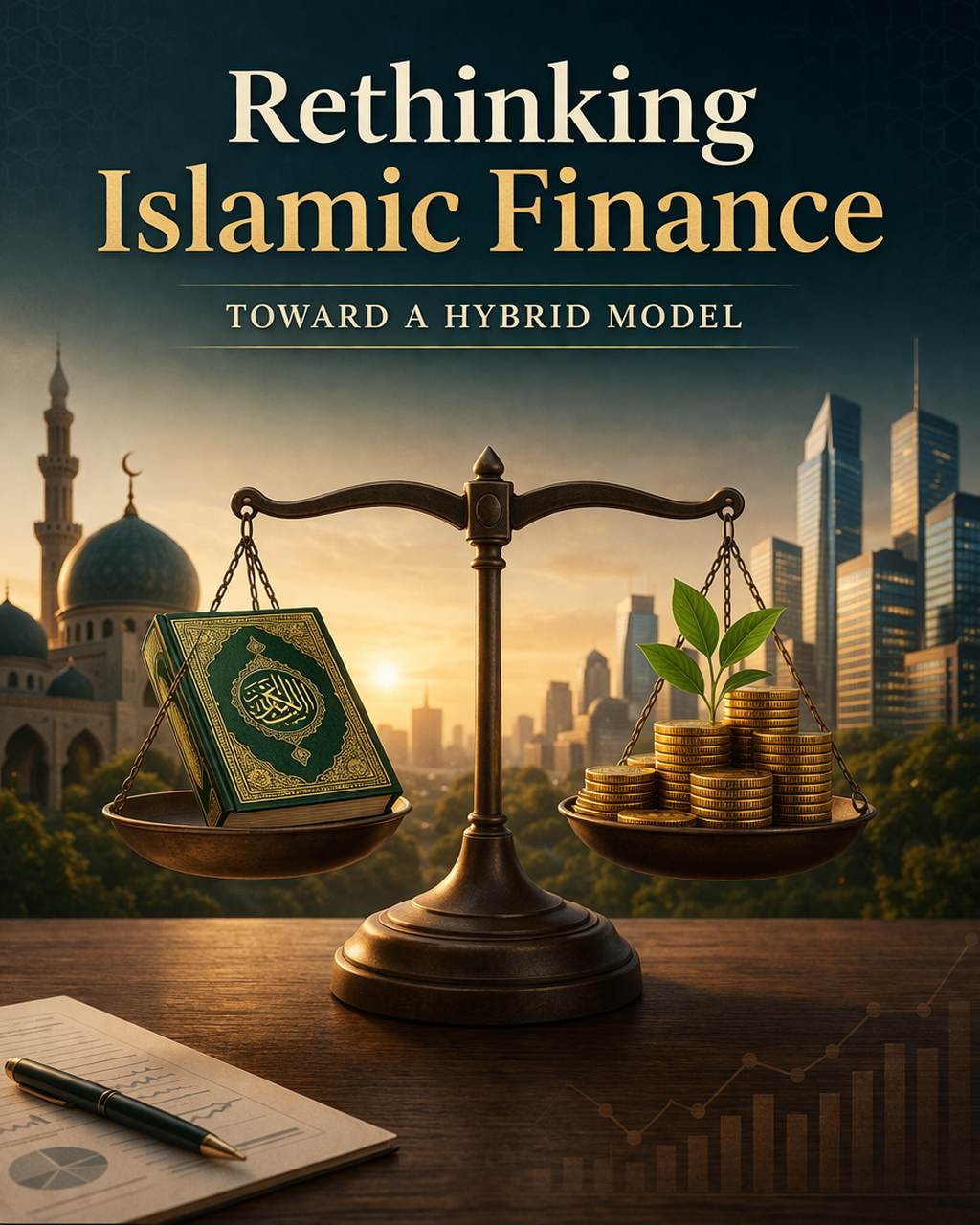
Rethinking Islamic Finance: Toward A Hybrid Model
DOI:
https://doi.org/10.32350/jitc.161.13Keywords:
hybrid model, idealist approach, Islamic finance, liberal model, maqasid al –Shariah, pragmatic approach, Sharia compliance, socio-economic impactAbstract
This paper critically reexamines the foundational approaches in the development of Islamic finance by exploring the evolution from idealist to pragmatic and liberal paradigms, and proposes a hybrid model that synthesizes ethical imperatives with economic practicality. The study begins by evaluating the idealist approach, which emphasizes profit-and-loss sharing (PLS) as an Islamic alternative to conventional finance, yet faces challenges in practical implementation. It then explores the pragmatic approach, which adapts classical jurisprudence to modern realities, often relying on debt-based instruments while seeking legitimacy through legal stratagems. The liberal approach, in contrast, interprets riba within a modern context and promotes the integration of Islamic values into existing financial structures without the need for separate institutions. A central contribution of this paper is the elaboration of a hybrid model that balances the maqasid al-Sharī‘ah (objectives of Islamic law) with operational and ethical considerations, supported by examples such as cash waqf linked sukuk, green sukuk (Islamic bonds), musharakah mutanaqisah (diminishing partnership) and takaful (Islamic insurance) cooperative model. This study highlights the necessity of institutional innovation, regulatory flexibility, and contextual interpretation to advance the global relevance and sustainability of Islamic finance. The paper concludes that the hybrid model offers a viable path forward, providing a nuanced framework that reconciles form with substance, tradition with innovation, and Sharī‘ah compliance with socio-economic impact.
Downloads
References
Abdul-Rahman, Aisyah., and Reza Gholami. “Islamic Finance and COVID-19 Recovery: The Role of Profit-Loss Sharing Contract.” Jurnal Pengurusan 59 (2020): 7–10. https://doi.org/10.17576/pengurusan-2020-59-02
Abedifar, Pejman., Iftekhar Hasan, and Amine Tarazi. “Finance-Growth Nexus and Dual-Banking Systems: Relative Importance of Islamic Banks.” Journal of Economic Behavior & Organization 132 (2016): 198–215. https://doi.org/10.1016/j.jebo.2016.03.005
Alkhan, Ahmed Mansoor., and M. Kabir Hassan. “Takaful Operators: Analysing Segregated Accounts between Operator/Participants.” Journal of Islamic Accounting and Business Research 11, no. 9 (2020): 1649–1664. https://doi.org/10.1108/JIABR-01-2020-0005
Ascarya, and I. A. Rahmawati. “Cash Waqf Linked Sukuk (CWLS) Model and Its Application in Indonesia.” Journal of Islamic Monetary Economics and Finance 7, no. 2 (2021): 225–248. https://doi.org/10.21098/jimf.v7i2.1334
Asutay, Mehmet. “Conceptualising and Locating the Social Failure of Islamic Finance: Aspirations of Islamic Moral Economy vs the Realities of Islamic Finance.” Asian and African Area Studies 11, no. 2 (2012): 93–113. https://doi.org/10.14956/asafas.11.93
Asutay, Mehmet. “Conceptualisation of the Second-Best Solution in Overcoming the Social Failure of Islamic Banking and Finance: Examining the Overpowering of Homo Islamicus by Homo Economicus.” International Journal of Economics, Management and Accounting 15, no. 2 (2007): 167–195. https://doi.org/10.31436/ijema.v15i2.134
Caeiro, Alexandre. “The Social Construction of Sharīʿa: Bank Interest, Home Purchase, and Islamic Norms in the West.” Die Welt des Islams 44 (2004): 351–375. https://doi.org/10.1163/1570060042562516
Chapra, M. Umar. Towards a Just Monetary System. Vol. 35. Leicester: The Islamic Foundation, 1985.
Dadaboev, Umidjon., Shoh-Jakhon Khamdamov, Samariddin Makhmudov, Bakhtiyor Yusupovich Menglikulov, Erkinjon Tulovov, Zokir Mamadiyarov, Muyassarhon Ganievna Umarkhodjaeva, and Nargiza Narimanovna Kalandarova. “Econometric Analysis of the Impact of Takaful Financial Services on Economic Development: A Case Study of Malaysia.” In International Conference on WorldS4, 491–501. Singapore: Springer Nature Singapore, 2024. https://doi.org/10.1007/978-981-97-9559-8_43
El‐Din, Seif I. Tag., and N. Irwani Abdullah. “Issues of Implementing Islamic Hire Purchase in Dual Banking Systems: Malaysia’s Experience.” Thunderbird International Business Review 49, no. 2 (2007): 225–249. https://doi.org/10.1002/tie.20141
Dusuki, Asyraf Wajdi., and Nurdianawati Irwani Abdullah. “Maqasid al-Shariah, Maslahah, and Corporate Social Responsibility.” American Journal of Islamic Social Sciences 24, no. 1 (2007): 25–45. https://doi.org/10.35632/ajis.v24i1.415
Dusuki, Ayraf Wajdi., and Said Bouheraoua. “The Framework of Maqasid Al-Shari'ah and Its Implication For Islamic Finance.” ICR Journal 2, no. 2 (2011): 316–336. https://doi.org/10.52282/icr.v2i2.651
El-Gamal, Mahmoud A. “‘Interest’ and the Paradox of Contemporary Islamic Law and Finance.” Fordham International Law Journal 27, no. 1 (2003): 108–149. https://ir.lawnet.fordham.edu/ilj/vol27/iss1/6
El-Gamal, Mahmoud A. Islamic Finance: Law, Economics, and Practice. Cambridge: Cambridge University Press, 2006.
Glenn, H. Patrick. Legal Traditions of the World: Sustainable Diversity in Law. Oxford: Oxford University Press, 2014.
Gultom, Mitra Sami., and Muhammad Iman Sastra Mihajat. “Cash Waqf Linked Deposit: A Proposed Waqf Model for Education Program and Poverty Alleviation in Indonesia.” In Strategic Islamic Business and Management: Solutions for Sustainability, edited by Ahmad Rafiki, Veland Ramadani, Léo-Paul Dana, and Sutan Emir Hidayat, 313–325. Cham: Springer Nature Switzerland, 2024. https://doi.org/10.1007/978-3-031-61778-2_17.
Hassan, R., S. Kassim., H. Majdi, and S. A. Salman. “Is Takaful Industry Innovative? Examining the Perception of Takaful Operators in Malaysia.” Paper presented at the 32nd IBIMA Conference, 2018.
Hassan, Rusni., and Syed Ahmed Salman. “Guiding Principles in Developing Shari’ah Governance Framework for Islamic Capital Market.” International Journal of Economic Research 14, no. 6 (2017): 27–38.
Hassan, Rusni., Syed Ahmed Salman, and Syarah Syahira Mohd Yusoff. “Risk Mitigation of Sustainable Finance and the Effective Role of Takaful.” In Islamic Sustainable Finance, edited by Mohd Ma'Sum Billah, Rusni Hassan, Razali Haron, and Nor Razinah Mohd Zain, 119–132. London: Routledge, 2024. https://doi.org/10.4324/9781003395447-15.
Hegazy, Walid S. “Contemporary Islamic Finance: From Socioeconomic Idealism to Pure Legalism.” Chicago Journal of International Law 7 (2006): 581–600. https://chicagounbound.uchicago.edu/cjil/vol7/iss2/13
How, Janice CY., Melina Abdul Karim, and Peter Verhoeven. “Islamic Financing and Bank Risks: The Case of Malaysia.” Thunderbird International Business Review 47, no. 1 (2005): 75–94. https://doi.org/10.1002/tie.20041
Hussain, Zeeshan. “A Search for Authenticity.” SOAS Law Journal 1 (2014): 1.
Iqbal, Zamir., and Abbas Mirakhor. An Introduction to Islamic Finance: Theory and Practice. Singapore: John Wiley & Sons (Asia), 2007.
Jafar, Ahmad., Hafsa Ibrahim, and Rizwan Malik. “Waqf: From Classical Charitable System to Modern Financial Tool.” International Journal of Ethics and Systems (2025). https://doi.org/10.1108/IJOES-10-2024-0354
Kamla, Rania., and Rana Alsoufi. “Critical Muslim Intellectuals’ Discourse and the Issue of Interest (Ribā).” Accounting Forum 39, no. 2 (2015): 140–154. https://doi.org/10.1016/j.accfor.2015.02.002
Kammer, Alfred., Mohamed Norat, Marco Pinon, and Ananthakrishnan Prasad. Islamic Finance: Opportunities, Challenges, and Policy Options. IMF Staff Discussion Note. Washington, DC: International Monetary Fund, 2015. https://www.imf.org/external/pubs/ft/sdn/2015/sdn1505.pdf
Khan, Hayat. “A Nontechnical Guide on Optimal Incentives for Islamic Insurance Operators.” Journal of Risk and Financial Management 12, no. 3 (2019): 127. https://doi.org/10.3390/jrfm12030127
Kunhibava, Sherin. “Legal Issues in Sharīʿah Governance in the Islamic Finance Industry in Malaysia.” ISRA International Journal of Islamic Finance 7, no. 2 (2015): 55–80. https://journal.inceif.edu.my/index.php/ijif/article/view/206
Laldin, Mohamad Akram., and Hafas Furqani. “Innovation versus Replication: Some Notes on the Approaches in Defining Sharī‘ah Compliance in Islamic Finance.” Al-Jami‘ah: Journal of Islamic Studies 54, no. 2 (2016): 249–272. https://doi.org/10.14421/ajis.2016.542.249-272
Lewis, Mervyn K. “The Evolution of Takaful Products.” In Islamic Capital Markets: Products and Strategies, 185–199. Hoboken, NJ: Wiley, 2012. https://doi.org/10.1002/9781119206040.ch9
Mansoor Khan, M., and M. Ishaq Bhatti. “Development in Islamic Banking: A Financial Risk‐Allocation Approach.” The Journal of Risk Finance 9, no. 1 (2008): 40–51. https://doi.org/10.1108/15265940810842401
Masood, Omar., Jamila E. Chichti, Walid Mansour, and Qaiser A. Amin. “Role of Islamic Mortgage in the UK.” International Journal of Monetary Economics and Finance 2, nos. 3–4 (2009): 366–383. https://doi.org/10.1504/IJMEF.2009.029069
Maulina, Rina. “Factors Influencing the Success of Retail Cash Waqf Linked Ṣukūk (CWLS) Issuance: A Lesson from Indonesia.” Journal of King Abdulaziz University: Islamic Economics 35, no. 1 (2022): 57–74. https://doi.org/10.4197/Islec.35-1.4
Mayer, Ann Elizabeth. “Islamic Banking and Credit Policies in the Sadat Era: The Social Origins of Islamic Banking in Egypt.” Arab Law Quarterly 1 (1985): 32–50. https://doi.org/10.2307/3381671
Moghul, Umar F. A Socially Responsible Islamic Finance: Character and the Common Good. Cham: Springer International Publishing, 2017. https://doi.org/10.1007/978-3-319-48841-7
Mohd Arif, Mohd Ismail A., and Rahmah Markom. “Role and Status of the Sharī‘ah Advisory Council in Enhancing the Islamic Financial System in Malaysia.” Jurnal Pengurusan 38 (2013): 127–132. https://doi.org/10.17576/pengurusan-2013-38-12
Mokhtar, Hamim Syahrum Ahmad., Izwayu Abdul Aziz, and Noraziyah Md Hilal. “Surplus-Sharing Practices of Takāful Operators in Malaysia.” ISRA International Journal of Islamic Finance 7, no. 1 (2015): 99–126. https://doi.org/10.12816/0021398
Muala, Asyharul., and Muhammad Lutfi Hakim. “Cash Waqf Linked Sukuk for Islamic Social Welfare and National Development: Evidence from Indonesia.” Global Journal Al-Thaqafah 13, no. 1 (2023): 16–34. https://doi.org/10.7187/GJAT072023-2
Muhamat, Amirul Afif., and Ronald McIver. “Linking Governance Qualities and Stewardship Attributes: Findings from Malaysian Takaful Operators.” Journal of Islamic Accounting and Business Research 10, no. 5 (2019): 736–755. https://doi.org/10.1108/JIABR-04-2016-0048
Naz, Aisha., and Muhammad Ali. “Takaful Governance and Sustainable Practices.” In Islamic Finance and Corporate Governance: Synergies for Sustainable Growth, edited by Muhammad Ali, Syed Ali Raza, Nor Shaipah Abdul Wahab, Chin-Hong Puah, Hanudin Amin, and Abadullah, 175–201. Bingley: Emerald Publishing Limited, 2025. https://doi.org/10.1108/978-1-83662-346-520251023.
Noor, Azman Mohd., and Muhammad Abd Hadi Bin Abd Rahman. “Cooperative Takaful for Non-Banking Financial Institutions: Islamization of SOCSO in the Case of Malaysia.” Intellectual Discourse 24 (2016): 459–476. https://doi.org/10.31436/id.v24i0.929
OECD. Green Islamic Finance: Scaling Up the Green Sukuk Market in Emerging Economies. Paris: OECD, 2023.
Puspita, Dila., Adam Kolkiewicz, and Ken Seng Tan. “Discrete Time Ruin Probability for Takaful (Islamic Insurance) with Investment and Qard-Hasan Activities.” Journal of Risk and Financial Management 13, no. 9 (2020): 211. https://doi.org/10.3390/jrfm13090211
Rahman, Abdul Rahim Abdul. “Islamic Banking and Finance: Between Ideals and Realities.” International Journal of Economics, Management and Accounting 15, no. 2 (2007). https://doi.org/10.31436/ijema.v15i2.132
Rizwan, Shahid., and Husam-Aldin N. Al-Malkawi. “Islamic Insurance (Takaful): An Overview.” In Islamic Finance in the Modern Era, edited by Hussain Mohi-ud-Din Qadri and M. Ishaq Bhatti, 112–124. London: Routledge, 2024. https://doi.org/10.4324/9781003366751-8
Rosman, Romzie., Razali Haron, and Nurul Balqis Mohamed Othman. “The Impact of Zakāt Contribution on the Financial Performance of Islamic Banks in Malaysia.” Al-Shajarah: Journal of the International Institute of Islamic Thought and Civilisation (2019): 1–19. https://doi.org/10.31436/shajarah.v0i0.894
Roy, Delwin A. “Islamic Banking.” Middle Eastern Studies 27, no. 3 (1991): 427–456. https://doi.org/10.1080/00263209108700869
Saeed, Abdullah. Islamic Banking and Finance. Singapore: Institute of Southeast Asian Studies, 2004.
Saeed, Abdullah. Islamic Banking and Interest: A Study of the Prohibition of Riba and Its Contemporary Interpretation. Vol. 2. Leiden: Brill, 1996.
Said, Ali., and Rania Grassa. “The Determinants of Sukuk Market Development: Does Macroeconomic Factors Influence the Construction of Certain Structure of Sukuk?” Journal of Applied Finance & Banking 3, no. 5 (2013): 251–267.
Said, Muhammad M., and Dwi Irianti Hadiningdyah. “Cross-Sector Collaboration and Innovation in Cash Waqf Linked Sukuk in Indonesia.” In Innovative Ventures and Strategies in Islamic Business, edited by Ahmad Rafiki and Adel Sarea, 415–432. Hershey, PA: IGI Global, 2025. https://doi.org/10.4018/979-8-3693-3980-0.ch020.
Shah, Syed Muhammad Abdul Rehman., Mohamad Husam Helmi, Muhammad Umar Farooq, and Anis Kabir. “Interbank Rate and Monetary Policy: Evidence from Dual Banking System of Developing Countries.” ISRA International Journal of Islamic Finance 16, no. 2 (2024): 131–153. https://doi.org/10.55188/ijif.v16i2.553
Siddiqi, Mohammad N. “Islamic Banking and Finance in Theory and Practice: A Survey of State of the Art.” Islamic Economic Studies 13, no. 2 (2006): 1–48.
Tripp, Charles. Islam and the Moral Economy: The Challenge of Capitalism. Cambridge: Cambridge University Press, 2006. https://doi.org/10.1017/CBO9780511617614
Usmani, Muhammad Taqi. An Introduction to Islamic Finance. Leiden: Brill, 2002.
—. “The Concept of Musharakah and Its Application as an Islamic Method of Financing.” Arab Law Quarterly 14 (1999): 203–220. https://doi.org/10.1163/026805599125826435
Ustaoğlu, Murat., and Ahmet İncekara, eds. Balancing Islamic and Conventional Banking for Economic Growth: Empirical Evidence from Emerging Economies. Cham: Springer, 2017. https://doi.org/10.1007/978-3-319-59554-2
Warde, Ibrahim. Islamic Finance in the Global Economy. Edinburgh: Edinburgh University Press, 2000.
Wilson, Rodney. The Development of Islamic Finance in the GCC. London: The Kuwait Programme on Development, Governance and Globalisation in the Gulf States, 2009.
Wilson, Rodney. “The Contribution of Muḥammad Bāqir Al-Ṣadr to Contemporary Islamic Economic Thought.” Journal of Islamic Studies 9, no. 1 (1998): 46–59. https://doi.org/10.1093/jis/9.1.46
Wilson, Rodney. Islam and Economic Policy: An Introduction. Edinburgh: Edinburgh University Press, 2015.
World Bank. Green Sukuk: Islamic Finance and Climate Change. Washington, DC: World Bank, 2021.
Published
How to Cite
Issue
Section
License
Copyright (c) 2026 Yudi Ahmad Faisal

This work is licensed under a Creative Commons Attribution 4.0 International License.

This work is licensed under a Creative Commons Attribution 4.0 International License. Authors retain copyright and grant the journal right of first publication with the work simultaneously licensed under a Creative Commons Attribution (CC-BY) 4.0 License that allows others to share the work with an acknowledgement of the work’s authorship and initial publication in this journal.











.png)