
Individuated-Basis for Rights: Tahaian Offer for the Enhancement of the Human Rights Concept
DOI:
https://doi.org/10.32350/jitc.161.17Keywords:
dignity, human rights, liberty, self-regulation, Taha AbdurrahmanAbstract
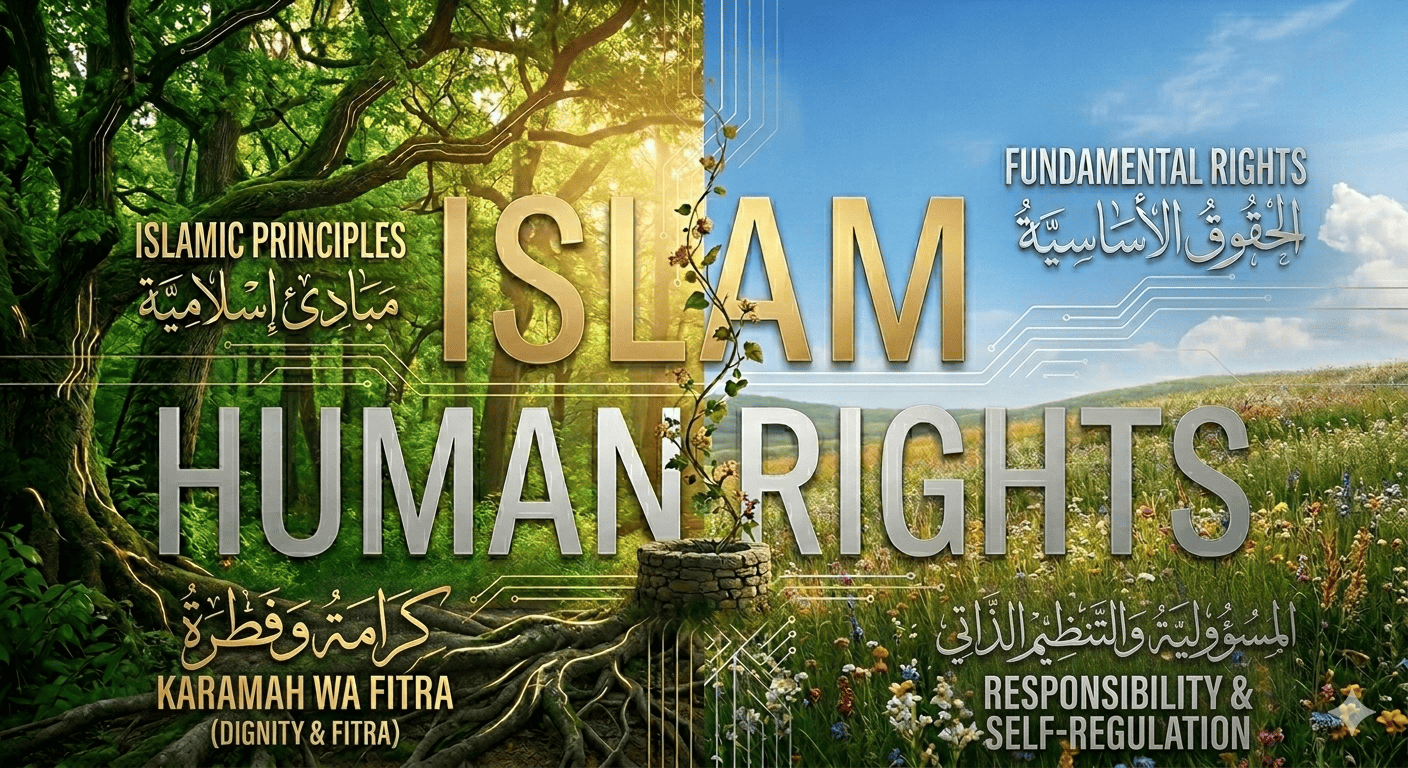
To foster human progress and freedom, human rights are proclaimed as universal standards for all. However, in practice, the partiality of human rights enforcement raises many questions about its philosophical foundations. In the Muslim world, amidst many progressive thinkers’ efforts to solve the problem of Islam’s compatibility with human rights, Taha Abdurrahman’s thought on modernity, ethics, and the self offers a new perspective in the discourse on human rights. By applying qualitative analysis, this research aimed to explore Taha Abdurrahman’s critique of human rights elaborated through his overall ideas, comparing it with Axel Honneth’s social conditions of rights. Departing from the traditional issue of the relationship between rights and obligations, Taha’s new concept of human offers significant consideration of the subjective internal role in human rights. This study argued that according to Taha’s viewpoint, for human rights to function properly, they must be built upon subjective conditions. This idea corresponds to Axel Honneth’s social context for rights. Thus, Tahaian human rights draw the context inward, nurturing a self-regulative quality that enables recognitive action. This idea could become a solid basis to address the challenges posed by akrasia (weakness of will), such as those found in drug abuse and suicide. The strengthening of self-regulative power could become an important part of a human-rights-based policy to address these issues.
Downloads
References
Abderrahmane, Taha. Dialogues for The Future. Leiden: Brill, 2023.
Abdurrahman, Taha. The Arab Right in Philosophical Difference. Cassablanca: Al-Markaz al-Tsaqafi al-Araby, 2006.
Abdurrahman, Taha. The Question of Ethics: A Contribution to the Ethical Critique of Western Modernity. Cassablanca: Al-Markaz Al-Tsaqafy Al-Araby, 2020).
Abdurrahman, Taha. The Spirit of Modernity: An Introduction to the Foundation of Islamic Modernity. Cassablanca: Al-Markaz Al-Tsaqafy Al-Araby, 2016.
Asad, Talal. “What Do Human Rights Do? An Anthropological Enquiry.” Theory and Event 4, no. 4 (2000). https://muse.jhu.edu/article/32601.
Awad, Najib George. “Philosophy as a ‘Resisting Identity’? Taha Abdurrahman, Fethi al-Meskini and Aziz al-Azmeh in Dialogue on Modernist Arab Philosophy.” Journal of Islamic and Muslim Studies, 7 no. 1 (2022): 1–25. https://doi.org/10.2979/jims.7.1.02.
Ben Hammed, Mohamed Wajdi. “(Dis)Enchanting Modernity: Sufism and its Temporality in the Thought of Mohammed Abed al-Jabri and Taha Abdurrahman.” The Journal of North African Studies, 26, no. 3 (2021): 552–571, https://doi.org/10.1080/13629387.2019.1697241.
Benhabib, Seyla. “Another Universalism: On the Unity and Diversity of Human Rights.” Proceedings and Addresses of the American Philosophical Association 81, no. 2 (2007): 7–32.
Berlin, Isaiah. Liberty. New York: Oxford University Press, 2002.
Cliquennois, Gaëtan., Sonja Snacken, and Dirk van Zyl Smit. “The European Human Rights System and the Right to Life Seen through Suicide Prevention in Places of Detention: Between Risk Management and Punishment.” Human Rights Law Review, 22, no. 1 (2022): ngab023. https://doi.org/10.1093/hrlr/ngab023.
Dailey, Anne C., and Laura A. Rosenbury. “The New Parental Rights.” Duke Law Journal 71, no. 1 (2021): 75–165. https://scholarship.law.duke.edu/dlj/vol71/iss1/7
De Souza, Luiz Gustavo Da Cunha. “Human Rights, Reciprocal Recognition and The State: A Durkheimian Contribution.” Human Affairs 29, no. 3 (2019): 293–310. https://doi.org/10.1515/humaff-2019-0025.
Domaradzki, Spasimir., Margaryta Khvostova, and David Pupovac. “Karel Vasak’s Generations of Rights and the Contemporary Human Rights Discourse.” Human Rights Review 20, no. 4 (2019): 423–443. https://doi.org/10.1007/s12142-019-00565-x.
Edmund Burke. Reflections on The French Revolution. London: J.M. Dent and Sons Ltd, 1951.
Emon, Anver M., Ellis, Mark S., and Glahn, Benjamin. Islamic Law and International Human Rights Law. Oxford University Press, 2012. https://doi.org/10.1093/acprof:oso/9780199641444.001.0001.
Fagan, Andrew. “The Subject of Human Rights: From the Unencumbered Self to the Relational Self.” Nordic Journal of Human Rights 42, no. 2 (2024): 215–233. https://doi.org/10.1080/18918131.2024.2339012.
Fontes, Paulo Vitorio. “Axel Honneth’s Normative Proposal for The Renewal of Human Rights.” Janus.Net E-Journal of International Relation 11, no. 1 (2020): 1–17. https://doi.org/10.26619/1647-7251.11.1.1
Gündoǧdu, Ayten. “Potentialities of Human Rights: Agamben and The Narrative of Fated Necessity.” Contemporary Political Theory 11, no. 1 (2012): 2–22, https://doi.org/10.1057/cpt.2010.45.
Guyette, Frederick W. “Human Rights Education and Religious Education: from Mutual Suspicion to Elective Affinity.” British Journal of Religious Education, 31, no. 2, (2009): 129–139. https://doi.org/10.1080/01416200802661118
Hallaq, Wael. Reforming Modernity: Ethics and the New Human in the Philosophy of Abderrahmane Taha. New York: Columbia University Press, 2019. https://doi.org/10.7312/HALL19388.
Hashas, Mohammed., and Mutaz Al-Khatib. Islamic Ethics and the Trusteeship Paradigm: Taha Abderrahmane’s Philosophy in Comparative Perspectives. Leiden: Brill, 2020. https://doi.org/10.1163/9789004438354.
Hashas, Muhammed. “Taha Abderrahmane’s Trusteeship Paradigm: Spiritual Modernity and the Islamic Contribution to the Formation of a Renewed Universal Civilization of Ethos.” Oriente Moderno, 95 (2015): 67–105. https://doi.org/10.1163/22138617-12340077.
Hashemi, Nader., and Emran Qureshi. “Islam and Human Rights: A 50 Year Retrospective.” Muslim World Journal of Human Rights 19, no. 1 (2022): 1-18. https://doi.org/10.1515/mwjhr-2022-0007
Hayden, Patrick. “The Human Right to Health and the Struggle for Recognition.” Review of International Studies, 38 (2012): 569–588. https://doi.org/10.1017/S0260210511000556
Heather, Nick., and Gabriel Segal. “Understanding Addiction: Donald Davidson and The Problem of Akrasia.” Addiction Research & Theory 21, no. 6 (2013): 445–452. https://doi.org/10.3109/16066359.2012.754014.
Honneth, Axel. “Integrity and Disrespect: Principles of a Conception of Morality Based on the Theory of Recognition.” Political Theory 20, no. 2 (1992): 187–201. https://doi.org/10.1177/0090591792020002001.
—. “Recognition and Justice: Outline of a Plural Theory of Justice.” Acta Sociologica 47, no. 4 (2004): 351–364. https://doi.org/10.1177/0001699304048668.
—. Reification and Recognition: A New Look at An Old Idea. New York: Oxford University Press, 2008.
—. The Pathologies of Individual Freedom: Hegel’s Social Theory. New Jersey: Princeton University Press, 2010.
—. The Struggle for Recognition: The Moral Grammar of Social Conflicts. Massachusetts: The MIT Press, 1995.
Ibn Miskawayh, Muhammad. The Refinement of Morals. Beirut: Darul Kutub Ilmiah, 1985.
Al-Jabri, Mohammed Abed. Democracy, Human Rights and Law in Islamic Thought. London: Bloomsbury Publishing Plc., 2009.
Knieriem, Marijn. “The Limits of Recognition.” Inquiry, (2024): 1–36. https://doi.org/10.1080/0020174X.2024.2338822.
Kruger, Reiss. “‘Recognizing’ Human Rights: An Argument for the Applicability of Recognition Theory Within the Sociology of Human Rights.” Human Rights Review 22, No. 4 (2021): 501–519. https://doi.org/10.1007/s12142-021-00638-w.
Lacroix, Justine., and Jean-Yves Pranchère. Human Rights on Trial: A Genealogy of Critiques of Human Rights. Cambridge: Cambridge University Press, 2018. https://doi.org/10.1017/9781108334884.003.
Li, Yingru., and John McKernan. “’Achieved Not Given’: Human Rights, Critique and The Need for Strong Foundations.” International Journal of Human Rights 21, no. 3 (2017): 252–269. https://doi.org/10.1080/13642987.2017.1298731
Lidinillah, Mustofa Anshori., Mukhtasar Syamsuddin, and Arqom Kuswanjono. “Iqbal Humanism and Human Rights.” Jurnal Filsafat 33, no. 1 (2023): 74–95. https://doi.org/10.22146/JF.81126.
Marneros, Christos. “’Human Rights Do Not Exist’: Thinking About and Beyond the Existence of Human Rights.” Australian Journal of Human Rights 29, no. 2 (2023): 299–313. https://doi.org/10.1080/1323238X.2023.2290040.
Morgan-Foster, Jason. “Third Generation Rights: What Islamic Law Can Teach the International Human Rights Movement.” Yale Human Rights and Development Law Journal 8, no. 1 (2005): 67–116. https://openyls.law.yale.edu/handle/20.500.13051/5843.
Obiedat, AZ. Modernity and the Ideals of Arab-Islamic and Western-Scientific Philosophy: The Worldviews of Mario Bunge and Taha Abd al-Rahman. Cham: Springer International Publishing, 2022. https://doi.org/10.1007/978-3-030-94265-6.
O' Neill, Onora. “The Dark Side of Human Rights." International Affairs 81, no. 2 (2005): 427–439. https://doi.org/10.1017/CBO9781316337103.013.
Radez, John Peter. Ibn Miskawayh, the Soul, and the Pursuit of Happiness. Maryland: Lexington Books, 2019.
Raible, Lea. “Allocating Human Rights Obligation in ECHR.” Human Rights Law Review 24, no. 1 (2024): 1–19. https://doi.org/10.1093/hrlr/ngad030.
Rakhmat, Aulia. “Religion and Reason in Contemporary Islamic Ethics: A Comparative Study of Syed Muhammad Naquib al-Attas and Taha Abderrahmane Thought.” Journal of Islamic Thought and Civilization 13, no. 2 (2023): 134–51. https://doi.org/10.32350/JITC.132.09.
Richmond, Joel Craig. “Al-Ghazālī’s Moral Psychology: From Self-Control to Self-Surrender.” PhD diss., University of Toronto, 2021.
Saeed, Abdullah. Human Rights and Islam: An Introduction to Key Debates between Islamic Law and International Human Rights Law. Massachusetts: Edward Elgar Publishing, 2018.
Stoyanova, Vladislava. “Correlativity Between Human Rights and Positive Obligations and Its Role for the Execution of Judgments Delivered by the European Court of Human Rights.” European Convention on Human Rights Law Review 5 (2024): 455–486. https://doi.org/10.1163/26663236-bja10106.
Szucs, Lazlo G. “Social Freedom and Critical Theory: The Tension Axel Honneth’s Political Philosophy and his Critical Programme,” RUDN Journal of Philosophy 29, no. 2 (2025): 548–564. https://doi.org/10.22363/2313-2302-2025-29-2-548-564.
Torres, Catya., Diego Vallejo Huanga, and Ximana Ramirez Ocana. “Quantitative Evaluation of Family Functions and Changes in a Postmodern Context.” Heliyon 7, no. 6 (2021): e7435. https://doi.org/10.1016/j.heliyon.2021.e07435.
Ward, Ann. “Theory and Akrasia in Aristotle’s Ethics.” Perspectives on Political Science 44, no. 1 (2015): 18–24. https://doi.org/10.1080/10457097.2014.921489.
Wojciechowski, Bartosz. “Human Rights as an Element of Mutual Recognition and Equality of Opportunity.” Politeja 18, no. 71 (2021): 95–114. https://doi.org/10.12797/POLITEJA.18.2021.71.05
Published
How to Cite
Issue
Section
License
Copyright (c) 2026 Kurniawan Dwi Saputra, Agus Himmawan Utomo

This work is licensed under a Creative Commons Attribution 4.0 International License.

This work is licensed under a Creative Commons Attribution 4.0 International License. Authors retain copyright and grant the journal right of first publication with the work simultaneously licensed under a Creative Commons Attribution (CC-BY) 4.0 License that allows others to share the work with an acknowledgement of the work’s authorship and initial publication in this journal.











.png)