

| Review | Open Access |
|---|
Stretching a Surface in a Rotating Fluid through Porous Medium |
 |
|---|
 Shafqat Ali1 ,
Muhammad Shahzad Shabbir1 ,
Sajid Hussain2* ,
Ayesha Mahmood1 ,
Samer Perveen1 , and
Muhammad Sajid Rashid3
Shafqat Ali1 ,
Muhammad Shahzad Shabbir1 ,
Sajid Hussain2* ,
Ayesha Mahmood1 ,
Samer Perveen1 , and
Muhammad Sajid Rashid3
1Department of Mathematics, The Islamia University of Bahawalpur, Pakistan
2Department of Statistics, The Islamia University of Bahawalpur, Pakistan
3Department of Computer Science, The Islamia University of Bahawalpur, Pakistan
This study examines the rotating fluid flow of a viscous fluid originated by the stretching of the surface over which the fluid exists. The study focuses on the effects of slip velocity and the porosity of the medium. The Homotopy Analysis Method (HAM) is utilized to obtain the analytical expressions of the flow variables. Similarity transformations are used to convert the involved partial differential equations into ordinary differential equations. The effect of porosity and slip velocity parameters are presented through graphs. It is found that the parameter of porosity increases the similarity velocity profiles of the rotating fluid.
Highlights
- Analytical HAM (homotopy analysis method) solutions reveal porosity boosts velocity profiles in rotating fluid flow over stretching surfaces
- Slip parameter reduces x-direction velocity but enhances y-direction velocity in porous medium flows
- The current study advances low-Re laminar flow modeling for filtration and seepage applications
1. INTRODUCTION
Flow through porous media is an important class of small Reynolds number (Re) laminar flow. This type of flow is found in the filtration of fluids and the seepage of water in canal and river banks. Some other examples of this flow are the movements of underground water and oils [1-3].
The slip condition is also an important aspect which has not been given proper attention in the study of fluid dynamics. Navier [4] described shear stress-based slip boundary condition. Saqib et al. [5] used fractional derivatives in Caputo sense. In another paper, Saqib et al. [6] discussed Cu – Al2O3 – H2O hybrid nanofluid. Hussan et al. [7] investigated a viscoplastic Casson fluid in a two dimension flow, with a stretching surface taken into account. Some of the recent advancements regarding flow over a stretching sheet and slip effects have been referenced in the literatue [8-14]. Nadeem et al. [15] developed the Caputo fractional model for Casson fluid with the help of Flick’s and Fourier’s laws. Farhad et al. [16] analyzed blood flow using Casson fluid model through a horizontal cylinder in the presence of magnetic particles. Nadeem et al. [17] discussed the Brinkman type fluid flow in a channel.
We used the Homotopy Analysis Method (HAM) [18-22] to obtain the analytic series outcomes in this paper. Crane [23] explored the stretching of a surface. Brady and Acrivos [24] and Wang [25] provided deep insight into axisymmetric and three-dimensional cases. They expressed the effects of different parameters in to and three dimensional flows. Wang [26] discussed the case of stretching a surface in rotating fluid.
Keeping all the above-mentioned ponts, the arrangement of the paper is as fallows.
Section 1 includes introduction, section 2 includes mathematical formulation equations and Homotopy Analysis Method, section 3 includes discussion, and finally, section 4 includes graphical representation.
2. MATHEMATICAL FORMULATION
The velocity field is defined as


In this method, we use the initial guesses, satisfying the given boundary conditions

The equations of zeroth order are defined below,

We note that deformation equations of the zero-order contain the auxiliary parameters ℏ1, ℏ₂. Note that ℏ1 and ℏ₂ are assumed, so that the problem of zero-order may have a solution for all p∈ [0,1]

Now taking mth derivative of zero order deformation equations with respect to p, then putting p = 0 and dividing it by m!, we get

So the problem is


where


3. DISCUSSION
In this study, the analytical solution for stretching a surface in a rotating fluid through a porous medium with partial slip is constructed. Figures (1) to (3) show the effect of the porosity parameter R, keeping slip parameter β and variation parameter λ fixed on the similarity velocity profile in the x-direction. The effect of the porosity parameter remains negligible. Figures (1), (4), and (5) show the effect of the slip parameter β, keeping porosity parameter R and variation parameter λ fixed on the similarity velocity profile in the x-direction. Velocity decreases as the value of β increases. Figures (6) to (8) show the effect of slip parameter β, keeping porosity parameter R and variation parameter λ fixed on the similarity velocity profile in the y-direction. Velocity increases with an increase in β. Figures (9) and (10) show the effect of porosity parameter R, keeping slip parameters β and variation parameter λ fixed on the similarity velocity profile in the y-direction. Noticeably, an increase in R causes an increase in h.
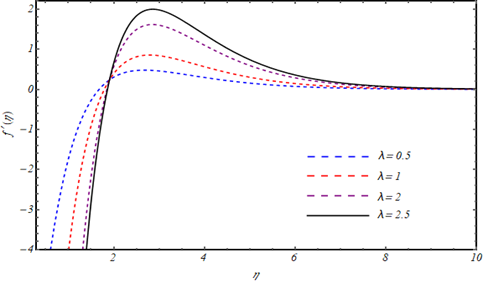
Figure 1. Effects of R, β, and λ on f ′(η) taking ℏ1 = 0.7, β = 0.1, and R = 0.0.
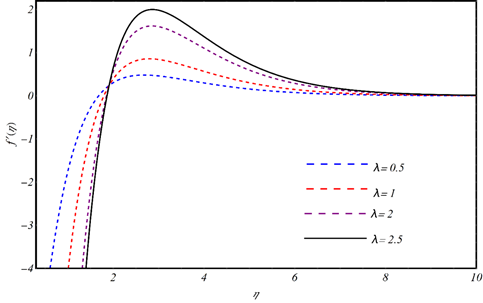
Figure 2. Effects of R, β, and λ on f ′(η) taking ℏ1 = 0.7, β = 0.1, and R = 0.3.
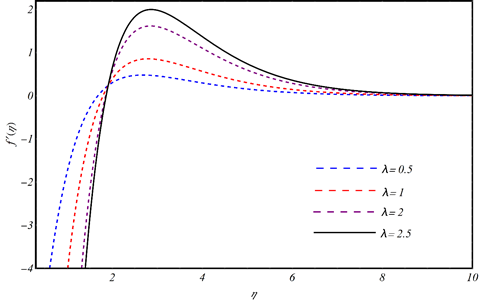
Figure 3. Effects of R , β, and λ on f ′(η) when ℏ1 = 0.7, β = 0.1, and R = 0.5.
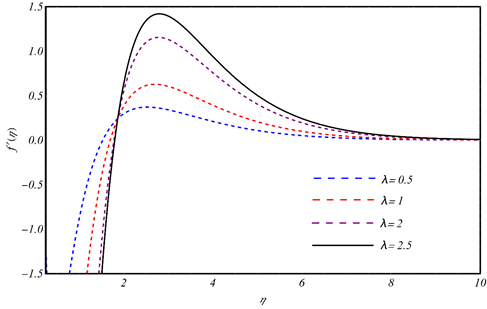
Figure 4. Effects of β, R, and λ on f ′(η) when ℏ1 = 0.7, β = 0.3, and R = 0.1.
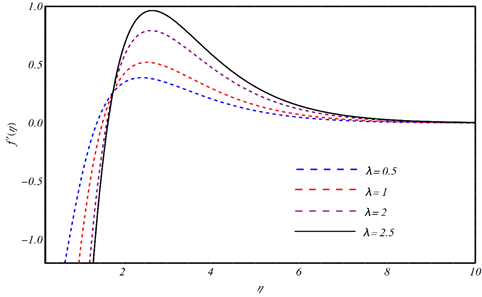
Figure 5. Effects of β, R, and λ on f ′(η) when ℏ1 = 0.7, β = 0.5, and R = 0.1.
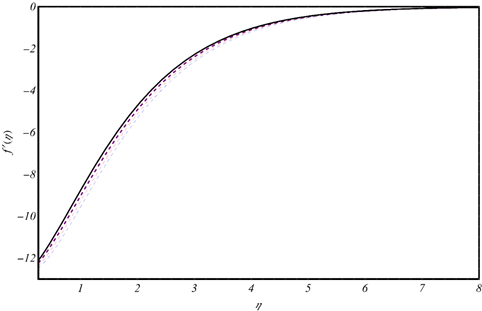
Figure 6. Effects of β, R, and λ on h(η) when ℏ2 = – 0.3, β = 0.1, and R = 0.2.
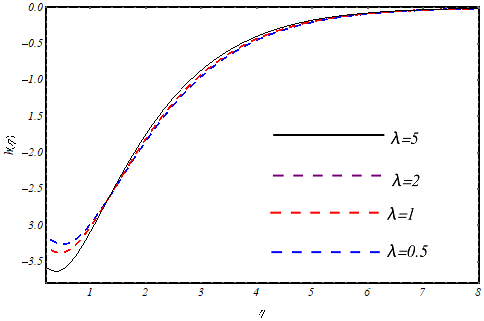
Figure 7. Effects of β, R, and λ on h(η) when ℏ2 = – 0.3, β = 0.3, and R = 0.2.
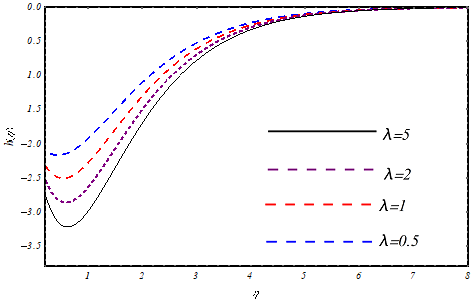
Figure 8. Effects of β, R, and λ on h(η) when ℏ2 = – 0.3, β = 0.6, and R = 0.2.
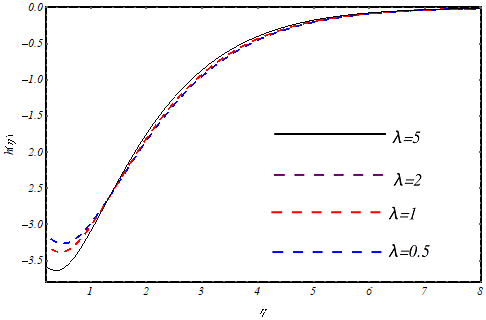
Figure 9. Effects of R, β, and λ on h(η) when ℏ2 = – 0.3, β = 0.3, and R = 0.4.
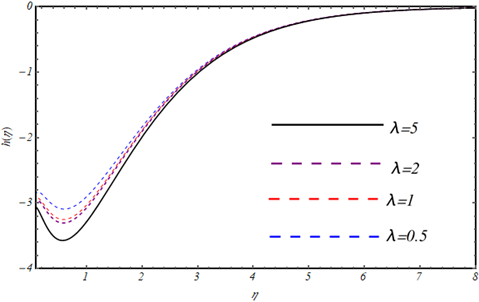
Figure 10. Effects of R , β, and λ on h(η) when ℏ2 = – 0.3, β = 0.3, and R = 0.7.
In this study, the rotating flow of viscous fluid caused by the stretching of the surface is investigated. The governing equations after reducing into ODEs are solved by using HAM. The results are presented by employing graphs and the influence of the involved parameters is discussed in detail. It is noticed that the velocity of the rotating fluid increases with the corresponding increase in the porosity parameter.
Author Contribution
Shafqat Ali: conceptualization & supervision. Muhammad Shahzad Shabbir: formal analysis, methodology. Sajid Hussain: project administration, formal analysis, methodology, visualization, investigation. Ayesha Mahmood: writing - original draft. Samer Perveen: validation. Muhammad Sajid Rashid: writing - review & editing
Conflict of Interest
The authors of the manuscript have no financial or non-financial conflict of interest in the subject matter or materials discussed in this manuscript.
Data Availability Statement
Data availability is not applicable as no new data was created.
Funding Details
No funding was received for this research.
Generative AI Disclosure Statement
The authors did not use any type of generative artificial intelligence software for this research.
REFERENCES
- Erdogan Flow due to eccentric rotating a porous disk and a fluid at infinity. J Appl Mech. 1976;43(2):203-204. https://doi.org/10.1115/1.3423808
- Murthy SN, Ram RKP. MHD flow and heat transfer due to eccentric rotations of a porous disc and a fluid at infinity. Int J Eng Sci. 1978;16(12):943-949. https://doi.org/10.1016/0020-7225(78)90053-8
- Siddiqui AM, Haroon T, Hayat T, Asghar S. Unsteady MHD flow of a non-newtonian fluid due to eccentric rotations of a porous disk and a fluid at infinity. Acta Mechanica. 2001;147(1-4):99-109. https://doi.org/10.1007/bf01182355
- Navier Memoir on the laws of fluid motion. Memoi Royal Acad Sci Instit France. 1823;6:389-440.
- Saqib M, Khan I, Shafie S. Application of Atangana–Baleanu fractional derivative to MHD channel flow of CMC-based-CNT’s nanofluid through a porous medium. Chaos Solit Fract. 2018;116:79-85. https://doi.org/10.1016/j.chaos.2018.09.007
- Saqib M, Khan I, Shafie S. Application of fractional differential equations to heat transfer in hybrid nanofluid: modeling and solution via integral transforms. Adv Differ Equat. 2019;2019(1)e52. https://doi.org/10.1186/s13662-019-1988-5
- Hussanan A, Khan I, Salleh M, Shafie S. Slip effects on unsteady free convective heat and mass transfer flow with Newtonian heating. Thermal Sci. 2016;20(6):1939-1852. https://doi.org/10.2298/tsci131119142a
- Saqib M, Khan I, Chu YM, Qushairi A, Shafie S, Nisar KS. Multiple fractional solutions for magnetic bio-nanofluid using Oldroyd-B model in a porous medium with ramped wall heating and variable velocity. Appl Sci. 2020;10(11):e3886. https://doi.org/10.3390/app10113886
- Saqib M, Shafie S, Khan I, Chu YM, Nisar KS. Symmetric MHD channel flow of nonlocal fractional model of BTF containing hybrid nanoparticles. Symmetry. 2020;12(4):e663. https://doi.org/10.3390/sym12040663
- Saqib M, Rahman A, Mohammad NF, Ling D, Shafie S. Application of fractional derivative without singular and local kernel to enhanced heat transfer in CNTs nanofluid over an inclined plate. Symmetry. 2020;12(5):768-768. https://doi.org/10.3390/sym12050768
- Saqib M, Hanif H, Abdeljawad T, Khan I, Shafie S, Nisar KS. Heat transfer in MHD flow of Maxwell fluid via fractional Cattaneo-Friedrich model: a finite difference approach. Comput Mater Cont. 2020;65(3):1959-1973. https://doi.org/10.32604/cmc.2020.011339
- Hussanan A, Salleh MZ, Khan I, Shafie S. Analytical solution for suction and injection flow of a viscoplastic Casson fluid past a stretching surface in the presence of viscous dissipation. Neural Comput Appl. 2016;29(12):1507-1515. https://doi.org/10.1007/s00521-016-2674-0
- Hussanan A, Khan I, Gorji MR, Khan WA. CNTS-Water–Based nanofluid over a stretching sheet. BioNanoScience. 2019;9(1):21-29. https://doi.org/10.1007/s12668-018-0592-6
- Hussanan A, Salleh MZ, Alkasasbeh HT, Khan I. MHD flow and heat transfer in a Casson fluid over a nonlinearly stretching sheet with Newtonian heating. Heat Trans Res. 2018;49(12):1185-1198. https://doi.org/10.1615/heattransres.2018014771
- Sheikh NA, Ling D, Khan I, Kumar D, Nisar KS. A new model of fractional Casson fluid based on generalized Fick’s and Fourier’s laws together with heat and mass transfer. Alexandria Eng J. 2019;59(5):2865-2876. https://doi.org/10.1016/j.aej.2019.12.023
- Ali F, Sheikh NA, Khan I, Saqib M. Magnetic field effect on blood flow of Casson fluid in axisymmetric cylindrical tube: a fractional model. J Magnet Magnet Mater. 2017;423:327-336. https://doi.org/10.1016/j.jmmm.2016.09.125
- Sheikh NA, Chuan Ching DL, Khan I, Sakidin H. Generalization of the convective flow of brinkman-type fluid using fourier’s and fick’s laws: exact solutions and entropy generation. Tsai SB, ed. Mathematical Problems in Engineering. 2020;2020:1-13. https://doi.org/10.1155/2020/8896555
- Liao Beyond Perturbation. CRC Press; 2003.
- Liao On the homotopy analysis method for nonlinear problems. Appl Math Comput. 2004;147(2):499-513. https://doi.org/10.1016/s0096-3003(02)00790-7
- Liao S, Campo A. Analytic solutions of the temperature distribution in Blasius viscous flow problems. J Fluid Mech. 2002;453:411-425. https://doi.org/10.1017/s0022112001007169
- Hayat T, Khan M, Ayub M. Couette and Poiseuille flows of an Oldroyd 6-constant fluid with magnetic field. J Math Anal Appl. 2004;298(1):225-244. https://doi.org/10.1016/j.jmaa.2004.05.011
- Yang C, Liao S. On the explicit, purely analytic solution of Von Kármán swirling viscous flow. Commun Nonl Sci Numer Simul. 2004;11(1):83-93. https://doi.org/10.1016/j.cnsns.2004.05.006
- Crane Flow past a stretching plate. J Appl Math Phy. 1970;21(4):645-647. https://doi.org/10.1007/bf01587695
- Brady JF, Acrivos A. Steady flow in a channel or tube with an accelerating surface velocity. An exact solution to the Navier—Stokes equations with reverse flow. J Fluid Mech. 1981;112(-1):127-127. https://doi.org/10.1017/s0022112081000323
- Wang The three-dimensional flow due to a stretching flat surface. Phy Fluids. 1984;27(8):1915-1915. https://doi.org/10.1063/1.864868
- Wang Stretching a surface in a rotating fluid. J Appl Math Phy. 1988;39(2):177-185. https://doi.org/10.1007/bf00945764