

| Review | Open Access |
|---|
Quantum Principles from Time-Phase Geometry: A Relativistic Foundation for Uncertainty, Superposition, and Interference |
 |
|---|
In this paper, we extend the framework introduced in [1], which proposed a two-dimensional model of time as a means to reconcile relativistic invariance with quantum discreteness. Building on this foundation, we derive key principles of quantum theory such as the uncertainty and exclusion principles and also introduce a fourth postulate: “The probability of an event is the same in all inertial frames of reference (IFR), independent of the observer's position in space.” This postulate enables us also to derive the probability amplitude interference from a purely relativistic time-phase geometry. We show that trajectories in the two-dimensional time plane, governed by relativistic constraints and discrete frequency-phase dynamics, naturally give rise to quantized measurements and path-based superposition. Using the Mach-Zehnder interferometer as an illustrative case, we demonstrate that the square of the proper time trajectory corresponds to quantum probability and interference phenomena emerge from the structure of phase evolution in time. Our formulation also aligns with Feynman’s path integral framework, showing that quantum mechanics can be interpreted as a direct geometric consequence of extended relativistic principles.
1. INTRODUCTION
Reconciling the deterministic geometry of relativity with the probabilistic nature of quantum mechanics remains one of the most profound challenges in theoretical physics. While both frameworks exhibit remarkable predictive power within their respective domains, they rely on fundamentally incompatible assumptions: spacetime symmetry and continuous trajectories in relativity versus discrete eigenstates and non-commuting observables in quantum theory. Recent research suggests that key quantum phenomena, including uncertainty, exclusion, and interference, may not be purely axiomatic but could instead emerge from deeper geometric or kinematic structures embedded in spacetime [2–7]. For instance, fidelity-based metrics and symplectic geometry have been employed to reformulate the uncertainty principle [2, 3], while curvature-induced effects offer novel perspectives on quantum bounds [4, 5]. Additionally, interference has been interpreted through phase-space filtering mechanisms and geometric constraints in extended temporal dimensions [6, 7]. Building on these insights and extending the two-dimensional time model introduced in [1], this work explores how quantum principles may arise as natural consequences of a relativistic theory augmented by a fourth postulate asserting the invariance of probability amplitude across IFR. This framework leads to a geometric derivation of uncertainty relations and quantum discreteness, independent of canonical quantization procedures.
The foundational model introduced in [1] extended special relativity by positing a third postulate: “The magnitude of the velocity in time of any particle, regardless of its inertial frame or mass, is a universal constant.” This led to a reinterpretation of time as a two-dimensional complex plane, comprising a real (observable) and an orthogonal imaginary (hidden) component, and enabled the recovery of standard relativistic effects alongside insights into discrete phase intersections. Nonetheless, the initial framework did not encompass explicit derivations of core quantum mechanical principles such as uncertainty, exclusion, and interference. The present work introduces a Fourth Postulate, asserting that probability amplitudes associated with temporal trajectories remain invariant under inertial frame transformations. This principle parallels the norm-preservation of state vectors in quantum theory but is grounded in the geometric invariance of complex temporal trajectories rather than Hilbert space formalism. Theoretical support for this approach is found in studies on Lorentz-invariant quantum amplitudes [8], complex-time structures in quantum cosmology [9], and the covariance of phase-space probability distributions [10, 11]. Additionally, geometric formulations of the uncertainty principle [2–4], exclusion mechanisms arising from temporal orthogonality [5, 7], and interference effects viewed through phase-space geometry [6, 12] provide compelling precedent for a geometric reinterpretation of quantum behaviour. Within this extended model, uncertainty relations arise from phase–frequency complementarity, Pauli-like exclusion follows from orthogonality in time-phase space, and interference patterns are seen as manifestations of coherent overlaps in complex time trajectories.
The extension of relativistic frameworks to include quantum like features has long motivated reinterpretations of spacetime structure, particularly in the presence of quantum interference and discreteness. Within the present model, the emergence of phenomena such as quantum interference, uncertainty, and exclusion are attributed not to axiomatic quantization procedures but to geometric features of complexified time trajectories. Specifically, the temporal evolution of particles along complex valued paths on the time plane introduces inherent phase relationships that naturally give rise to discrete observational effects. Such interpretations resonate with experimental findings in single photon interferometry [13], relativistic time dilation in quantum interference visibility [14], and atom interferometry in curved spacetime [15]. Furthermore, geometric treatments of quantum phases such as Berry's phase and its generalizations support the notion that underlying spacetime curvature or rotation in the phase domain can manifest in measurable probability amplitudes [16, 17]. Recent advances in covariant formulations of path superpositions [18], as well as interference-based violations of classical assumptions [19], also suggest a deep connection between the topology of temporal evolution and the probabilistic features of quantum mechanics. Within this context, the proposed fourth postulate asserting that probability amplitudes derived from complex time trajectories are invariant under inertial frame transformations acts as a geometric analogue of quantum norm preservation. This perspective is reinforced by the decoherent histories approach to quantum probabilities [20], where the role of complex structure and temporal ordering becomes essential. Additionally, phase space formulations of the uncertainty principle and arguments linking gravitational fields to the emergence of classicality further highlight the physical relevance of geometric and relativistic effects in interpreting quantum behaviour [21, 22]. Thus, rather than importing quantum postulates a priori, the present framework suggests that quantization may arise as a necessary condition from deeper geometric and relativistic symmetries in a two-dimensional time manifold.
A deeper geometrical understanding of quantum theory necessitates unifying amplitude and phase within a consistent spatiotemporal framework. Foundational analyses of phase and angle variables in quantum mechanics revealed structural complications in operator definitions due to their inherent non-commutativity and boundary conditions on Hilbert spaces [23, 24]. Advancements in noncommutative geometry and quantum field theory have since indicated that at Planckian scales, the very structure of spacetime becomes quantized, with phase-space exhibiting curvature and discreteness that influence quantum fields and their propagation [25–27]. This reinforces the interpretation of phase not as an arbitrary gauge artifact but as a physical observable linked to geometric holonomies and topological features, as established in the general formulation of Berry’s phase [28]. In real-time stochastic quantization, maintaining a restricted yet coherent evolution in phase space has been shown to preserve causality and replicate quantum correlations, affirming the physical significance of structured phase-space trajectories [29]. Additionally, Shannon’s foundational theory of information [30] has inspired interpretations wherein complex amplitudes and interference patterns emerge from information theoretic constraints, particularly when extended to algebraic foundations involving division algebras and categorical quantum structures [31]. Decoherence theory further supports this view by showing that suppression of phase coherence via environmental entanglement leads to classicality, making the persistence of phase relationships critical for retaining quantum behaviour [32, 33]. Recent attempts to derive Feynman’s path integral formalism from symmetry and information principles [34] also converge on the idea that complex amplitudes and their geometric underpinnings are not optional constructs but foundational consequences of a deeper temporal and phase-oriented structure of quantum theory.
Building on these insights, the present study advances a geometric reformulation of core quantum principles within the two-dimensional time framework established in [1]. Central to this effort is the articulation of a Fourth Postulate, which posits that probability amplitudes defined over complex temporal trajectories are invariant under inertial transformations. This postulate provides a natural bridge between relativistic invariance and quantum discreteness, offering a unified geometric foundation for phenomena traditionally introduced axiomatically. Specifically, we demonstrate that the Heisenberg uncertainty relation emerges from the phase frequency complementarity inherent in complex time; the Pauli exclusion principle arises from orthogonality in the time-phase plane; and quantum interference manifests through the coherent superposition of complex temporal paths. In contrast to conventional quantum theory, which encodes these principles within Hilbert space formalism, our approach reveals them as emergent properties of geometric symmetries and observer invariant temporal structure.
The structure of this paper is as follows. Section 2 derives a geometric analogue of the Heisenberg uncertainty principle from orthogonal components of time and phase. Section 3 presents a reformulation of the Pauli exclusion principle based on orthogonality in complex time space. Section 4 explores interference phenomena as arising from the coherent overlap of time-phase trajectories. Section 5 addresses the invariance of probability amplitudes under Lorentz transformations and derives conditions for amplitude preservation across reference frames. We conclude with a discussion of broader implications for quantum foundations, the role of complex time in quantum gravity, and directions for future research.
2. The Uncertainty Principle and the Exclusion Principle
The foundational structure of quantum mechanics is deeply rooted in two seemingly distinct yet fundamentally related principles: Heisenberg uncertainty principle and Pauli exclusion principle. In the present framework, we revisit these principles through the lens of the two-dimensional time model proposed in [1]. We begin with the derivation of an uncertainty-like inequality that arises from the orthogonal complementarity of time and frequency within the two-dimensional time manifold. Subsequently, we reinterpret the exclusion principle as a geometric constraint, arising from the requirement that no two particles may share identical temporal trajectories in the time-phase plane if their trajectories are not orthogonal.
To develop the uncertainty principle within the two-dimensional time framework, we begin by recalling the form of a particle’s temporal trajectory as perceived by an inertial observer O. For a particle moving with constant velocity or, equivalently, with a constant frequency in time, the trajectory in the complex time plane is expressed as follows:
(for matter),
(for photons),
where
ρ=-1 for a particle moving closer to the observer,otherwise ρ=1,
ω∈ { 1/t,2/t,…} is the frequency of a photon (For simplicity, ignore the phase shift when ρ changes sign),
and ωv∈ { 0,( 1)/t,( 2)/t,…} is the frequency of a matter particle.
The condition that observer-particle intersections occur only at real values imposes phase-frequency quantization and reveals a geometric trade-off: precise localization in frequency corresponds to temporal indeterminacy. This yields a natural analogy of the uncertainty relation, aligned with prior work on time-energy duality and phase-space geometry [35–39].
Furthermore, when two particles share identical complex-time trajectories, their intersection points with the observer become indistinguishable. Distinguishability thus requires orthogonality in their time-phase paths, offering a geometric counterpart to the Pauli exclusion principle [36, 40]. In this setting, uncertainty and exclusion emerge not as axioms but as consequences of the geometry of time, reinforcing the view that quantum discreteness may be rooted in relativistic temporal structure.
2.1 The Trajectory in time for Photons and the Uncertainty PrincipleWithin the two-dimensional time framework proposed in [1], trajectory of a photon in the complex time plane, as perceived by an inertial observer O, is described by
Here ρ=-1, for a photon moving toward the observer and ρ=1 otherwise. The variable ω∈ { 1/t,2/t,…}, denotes the discrete frequency of the photon, interpreted as the number of complete cycles the photon executes in the θ-dimension per unit of observer time t. Given the quantized energy of a photon as
The Planck’s constant is the energy that is needed to rotate a photon one cycle (2π) in the θ-dimension. A photon that has a frequency of 1 will turn once in the -dimension in one unit of time and will have an energy equal to . We can think of this in the following Figure 1.
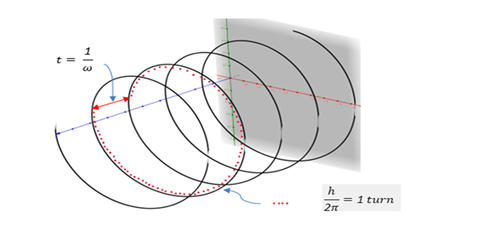
Figure 1. Photon with Frequency of 1 will Turn Once in the -dimension in One Unit of Time and Will Have an Energy Equal to .
Since an observer is in an IFR, only moving in the t-dimension at a rate of 1 and the photon touches the t-axis every turn. This formulation implies that interactions between the observer and the photon observable events occur only when the photon's trajectory intersects the observer's time axis. Consequently, the observer is constrained to perceive information from the photon only once per cycle, establishing a lower bound on temporal resolution. That is, no temporal information can be extracted with a resolution finer than one full oscillation
At the same time the minimum energy for a photon with frequency is given by the energy formula, and therefore, the energy for photons of that given frequency comes in steps of ωh:
Multiplying these bounds and recognizing that uncertainty is defined as half the minimum measurable unit due to discrete intersections, we recover a geometric derivation of the time-energy uncertainty relation:
This result signifies that the uncertainty principle is not an abstract postulate but a direct geometric consequence of how photonic trajectories evolve in the two-dimensional time manifold. It also reframes Planck's constant as the minimal quantum of temporal resolution, reinforcing its interpretation as the fundamental action associated with phase evolution in time. In other words, an observer needs a higher energy photon to achieve a higher resolution in time. The θ-dimension in time is the cause for the quantum of energy. This is an amazing result: we have derived the uncertainty principle from the completed time equation for Special Relativity.
1.2 The Path in time for Matter and the Uncertainty Principle,(∆x∆p)Since photons and matter particles are governed by structurally symmetric temporal equations, it is natural to anticipate an analogous uncertainty principle for massive particles in spatial dimensions. In this framework, the frequency ωv of a matter particle's temporal evolution is related to its velocity in space v. As shown in Figure 1, the velocity of a particle is proportional to θ ̇ . As (θ ̇ → π⁄4) then (v→1)and as (θ ̇ → 0+ ) then (v→0). We also know that v=0 , the IFR of the observer, particles are not moving in the dimension and therefore ωv=0. Therefore, we can assume that when (v→1) then (ωv→ ∞). .
The relativistic momentum for a particle with a mass m is
According to Einstein, energy and matter are the same and the time equation for photons and matter is symmetrical, therefore, the smallest possible mass of a particle is also Planck’s constant:
As mentioned earlier, momentum for photons depends on the frequency and Planck’s constant, having units of mass. Therefore, we can determine an equivalent to frequency for matter as
Since velocity in space plays a role analogous to frequency in time, the minimum resolvable distance in space (∆x) for a matter particle is governed by the same inverse-frequency relation that constrains temporal resolution for photons. Accordingly, the smallest spatial resolution achievable for a particle at a given velocity is
Hence, multiplying spatial uncertainty with momentum uncertainty and recognizing that uncertainty is defined as half the minimum measurable unit due to discrete intersections yields
This result mirrors the earlier derivation for photons and reinforces the view that uncertainty in position and momentum is not a fundamental axiom but a natural consequence of the structure of time-phase trajectories for matter. Together with the ∆E∆t relation, it highlights a deeper duality between spatial and temporal observables, where wave-like behavior arises from the finite resolution imposed by the geometry of complex time. In this framework, the wave–particle duality is not an added feature but an intrinsic outcome of how matter and energy propagate through a two-dimensional temporal manifold.
2.3 The Exclusion PrincipleThe two-dimensional time framework introduced in this study allows us to geometrically reinterpret classical principles of quantum mechanics. In particular, we now formulate a generalized exclusion principle as a constraint on trajectory overlap in extended time.
Consider the time manifold as a cylindrical surface, where the linear dimension trepresents the temporal axis of the observerO , and the angular coordinate θcorresponds to the internal phase rotation of a particles-trajectory in time. As illustrated in Figure 2, a photon traveling at the speed of light c=1 advances along the time cylinder at an angle of π/4, returning to the same point on the t-axis every full cycle in θ . In this picture, a photon completes one full turn in the curled θ-dimension while progressing by one unit along t, establishing a periodic, observer-invariant trajectory.
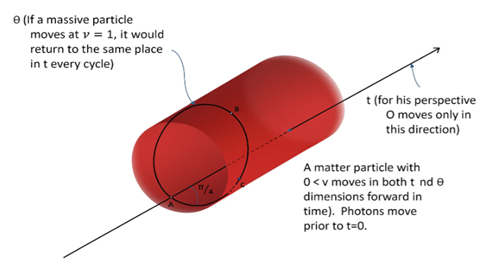
Figure 2. Movment of Massive Particle
Matter particles with 0<v<1 , by contrast, move in both and , tracing helical paths along the surface of the time cylinder. Particles at rest in the IFR of the observer follow trajectories purely along t, with no phase rotation in , while photons (with v=1 travel entirely along the -dimension in the time manifold.
In this extended view of spacetime, each physical event is represented by a point in a five-dimensional manifold,
Hypothesis: “The trajectory of two particles cannot overlap in spacetime.” In other words, the trajectories of two particles cannot intersect in extended spacetime unless their worldlines are distinguishable in the full five-dimensional manifold. We will call this hypothesis “Exclusion Principle”.
This postulate yields the following implications:
- Two massive particles cannot occupy the same position in space, (x1,y1,z1 )≠(x2,y2,z2 ), if they have the same velocity and direction, because their trajectories in time would overlap.
- Two or more photons can occupy the same position in space and t-dimension in time (t1,x1,y1,z1 )=(t2,x2,y2,z2 ), provided they have a different frequency: θ_1≠θ_2 as they will have non-overlapping trajectories in time. I believe this is the reason white light is always white because the frequency of the photons composing it is always balanced (no duplicate frequencies).
- Photons (assuming 2 is given) can occupy the same position in space as massive particles at a certain point in time because matter and photons move in opposite directions in time (the phase of matter and photons does not overlap). This explains for example how an electron can “absorb” and “emit” a photon.
This geometric interpretation provides a deeper understanding of the foundational structure of quantum behavior. We highlight three key insights emerging from this reformulation:
- Unlike in classical special relativity, where motion is observer-dependent, the magnitude of velocity in the two-dimensional time manifold becomes an absolute quantity. This resolves a longstanding tension between quantum discreteness and relativistic invariance.
- The geometric duality between photons and massive particles manifested in their symmetric time trajectories offers a more unified treatment of wave-particle duality within the relativistic framework.
- The exclusion principle emerges not as an abstract postulate of Hilbert space, but as a natural consequence of geometric non-overlap in extended spacetime.
In the next section, we further advance this geometric framework to show that the inclusion of the θ dimension gives rise to quantum superposition. This sets the stage for deriving quantum amplitudes and interference phenomena directly from relativistic postulates, offering a unified foundation for quantum theory and relativity.
3. Equations of Quantum Mechanics: Probability and Superposition
In the two-dimensional time framework, quantum probability and superposition emerge naturally from the geometry of complex temporal trajectories. Probability amplitudes correspond to invariant quantities derived from phase evolution in the (t,θ) plane, while superposition arises from the coexistence of multiple, distinguishable paths in time. This geometric interpretation offers a coherent foundation for quantum mechanics, rooted in time-phase structure rather than abstract postulates.
3.1 Postulate 4 and Probability AmplitudeWe now introduce a fourth postulate, aimed at unifying relativistic invariance with the statistical predictions of quantum mechanics:
Postulate 4: It is a law of nature that the probability of an event is the same in all frames of reference regardless of an observer’s position in space.
To explore the implications of this postulate, we analyze a canonical quantum-optical experiment, the Mach–Zehnder interferometer, commonly used to probe the quantum nature of light and interference. As depicted in Figure 3, the interferometer permits a single photon to travel along two spatially distinct paths before reaching one of two detectors. We consider two observers at rest but located at different positions relative to the interferometer.
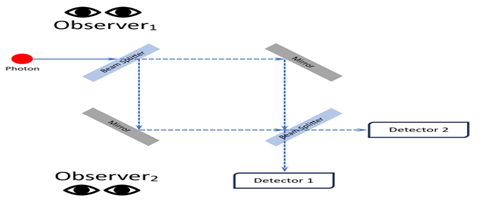
Figure 3. Two Observer Framwork
Empirical results demonstrate that the detector activation probabilities depend on the set of paths accessible to the photon [41]. However, within the two-dimensional time framework, the trajectory in time governed by phase evolution and encoded in the factor pvaries with the observers position. For Observer 1, the photon is always moving away ρ=〖_〗+, so 1 (always positive).. For Observer 2, the photon reverses direction in some segments, resulting in alternating values of ρ=±1 (positive and negative). This raises a conflict: if probability depends on the complex time trajectory S^'=ρte(-i2πωt), , then it would appear to be frame-dependent, violating Postulate 4.
Yet, quantum theory maintains that all observers must agree on the probability of an event. Since probability is computed as the modulus squared of a complex amplitude, the amplitude itself must be invariant under inertial transformations. We propose that this invariant quantity is the square of the proper time separation τd2 between events in the time-phase plane. So
This formulation ensures that and remains consistent for all inertial observers. The invariance across IFRs supports its interpretation as a natural candidate for the square of the probability amplitude. Consequently, the trajectory in time plays the role of the probability amplitude, and its squared magnitude yields the observer-independent probability. This interpretation is compatible with Feynman's path integral approach, where the total probability amplitude is determined by summing over all possible quantum paths, and the probability of an event is given by the square of this amplitude [13]. In our framework, each complex trajectory in time contributes a unit amplitude determined by its proper time structure, and invariance is preserved geometrically rather than axiomatically. Thus, Postulate 4 enforces consistency between relativistic time symmetry and quantum probability, revealing that observer-invariant trajectories in complex time serve as the geometric basis for probability amplitudes in quantum mechanics [41, 42].
3.2 Trajectory in Time and the Definitions of Probability and SuperpositionBuilding on our postulate that all observers must agree on the probability of an event, we hypothesize that the probability of a particle following a specific trajectory is a function of the square of its proper distance in time,τd2 , measured within the extended two-dimensional temporal framework.
From the perspective of any inertial observer at rest, all potential trajectories available to a particle within a quantum system such as an interferometer exist within the observer’s temporal past. This is because the observer’s frame advances through the t-dimension at maximal velocity relative to any massive or massless particle. As a result, from the observer’s viewpoint, all trajectories are encoded within the past light cone and remain in superposition until measurement. In the absence of external constraints or biases, there is no a priori reason to favor one trajectory over another. Therefore, all possible paths are assumed to be equally probable, consistent with Feynman's path integral formulation of quantum mechanics [1].
For a quantum system with n equally likely trajectories, the probability of the particle taking trajectory i is defined as follows:
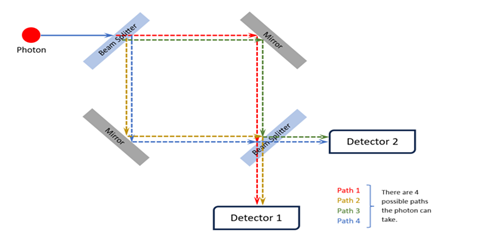
Figure 4. Phonton Detector Framework
Figure 4 illustrates a simplified Mach–Zehnder interferometer in which a photon has four distinct trajectories, two leading to detector 1 and two to detector 2. With 50/50 beam splitters, each path is equally likely, i.e., Pi=1/4.
To introduce the concept of probability amplitude, we define the complex-valued amplitude associated with the ith trajectory as follows:
where
Here,
Ai-Amplitude of the i^th trajectory (probability weighted trajectory S),
ti-Time relative to the observer of the i trajectory
ω-Frequency of the photon (ωt_i number of cycles in the i^th trajectory)
ϕi-represents the phase accumulated along the trajectory.
The reason we work with amplitudes , rather than direct probabilities pi , is because the underlying dynamics are governed by complex trajectories in time, not by their squared magnitudes alone. The square of modulus of Aiyields the observable probability, but it is S' , the trajectory itself, that carries the physically meaningful content of the quantum state [2].
Now consider a quantum event that can occur through multiple indistinguishable paths. For instance, detector 1 may light up if the photon follows trajectory 1 or 2, while detector 2 corresponds to trajectories 3 or 4. The total amplitude for a possible event j is then the superposition of the amplitudes of its contributing trajectories
where
Sj-Superpostion for each event ,
j -Each possible event ,
nj-Number of possible trajectories for each possible event ,
Aji-Time amplitudes of possible trajectories for each event.
The probability of event occurring is given by the squared modulus of its net amplitude:
The total probability across all mutually exclusive events j=1,… ,J must satisfy the normalization condition:
This framework is general and applies to any quantum system with multiple trajectory possibilities not just the simplified case of a Mach–Zehnder interferometer. As the number of possible paths increases, the resulting quantum interference patterns and probability calculations become more intricate, but the principle remains grounded in the superposition of phase-weighted time trajectories.
3.3 Application of the Equations to Obtain Probabilities of Events in the Mach-Zender InterferometerWe now apply the formalism of probability amplitudes and time-phase trajectories to calculate the probability of detection events in a standard Mach–Zehnder interferometer setup. As previously established, for a system with four equally probable paths, each trajectory has an amplitude with magnitude √(P_i )=1/2.. Therefore, the probability amplitude for each trajectory can be expressed as follows:
The superposition for Event 1 (paths 1 and 2) is
Defining the phase difference φ=φ1- φ2 , and noting that the modulus of the phase factor is unity , (|e-iφ1 ) |=1), the modulus squared of becomes
This result expresses the probability P1 of detection at detector 1 as a function of the relative phase between the two interfering trajectories.
Similarly, for Event 2, detection via path 3 or 4, the total amplitude is
Again factoring yields
In this case, we assume a relative phase shift of φ+π between paths 3 and 4 due to experimental symmetry and detector exclusivity. Substituting this relation, we find:
φ3- φ4= φ + π
Therefore
Thus, the probability of detection at detector 2 depends complementarily on the phase shift between the interfering trajectories. As expected, the sum of the two detection probabilities satisfies normalization,
This confirms the internal consistency of the formalism and reinforces the principle that quantum probabilities emerge from the interference of time-dependent probability amplitudes.
By adjusting the phase difference (e.g., via path length variations or refractive index changes), one can control the relative intensities at the detectors. In the limiting cases, constructive interference ( ) results in full detection at one output port, while destructive interference ( ) results in complete suppression at that port. This phase sensitive behavior illustrates how trajectories in time encode quantum interference, directly linking the geometry of time with measurable probabilities in quantum systems.
Ultimately, this section demonstrates that the quantum probability amplitudes and their superpositions, when defined through trajectories in extended time dimensions recover the expected outcomes of interference experiments. This strengthens the claim that quantum mechanical behavior can be derived from relativistic time-phase geometry without requiring independent probabilistic axioms.
3.4 Equivalency to Feynman’s Sum of Paths Formalism for Quantum MechanicsThe framework developed in this article aligns closely with Richard Feynman’s sum over paths (or path integral) formalism for quantum mechanics. In QED: The Strange Theory of Light and Matter [43], he outlines the fundamental rules that govern this interpretation.
Feynman’s Grand Rule states, “The probability of an event is equal to the square of the length of an arrow called the probability amplitude.” This corresponds directly to the notion that the squared modulus of a probability amplitude, derived from the trajectory in two-dimensional time, yields the probability of an event. In our formalism, the amplitude represents the trajectory in complex time-space, and the squared amplitude captures its physical manifestation as probability.
Feynman’s General Rule for alternative paths is as follows: “If an event can occur in several different ways, draw an arrow (amplitude) for each path. These arrows are then added head-to-tail. The final arrow from the tail of the first to the head of the last gives the total amplitude. The square of its length is the probability of the event.”
This rule is entirely consistent with our treatment of superposition: each trajectory contributes a weighted amplitude based on its temporal phase, and these amplitudes are summed to yield the total probability amplitude for a given outcome. The probability is then obtained by squaring the modulus of this combined amplitude.
Thus, our derivation based purely on geometric considerations of time and motion reproduces the core rules of Feynman’s quantum theory. Moreover, while Feynman’s approach typically invokes a continuous summation over all possible paths (as ), our discrete formalism leads to equivalent results when the number of paths becomes large. This suggests that the probabilistic structure of quantum mechanics, as described by Feynman, can be viewed as a natural consequence of the underlying time-phase geometry established in the completed theory of Special Relativity.
3.5 Interference and the Exclusion PrincipleA central feature of quantum behaviour is the phenomenon of interference between alternative paths, a result that emerges naturally within the trajectory based framework, we have proposed. However, the underlying cause of interference remains open to deeper interpretation.
It is hypothesized here that interference arises fundamentally from an exclusion principle rooted in the structure of extended spacetime. Specifically, certain trajectories may interfere destructively because they attempt to place the particle at the same point in five-dimensional spacetime, a configuration that is not permitted. In this view, interference is not merely a computational artifact of wave-like superposition, but a geometric constraint imposed by the topology of space and time.
Although a rigorous mathematical proof of this hypothesis remains beyond the scope of the current paper, it offers a compelling perspective: that destructive interference is the manifestation of deeper incompatibilities in allowable configurations of physical reality. Exploring this conjecture further may lead to a geometric derivation of Pauli’s exclusion principle and other fundamental quantum rules from relativistic spacetime constraints.
4. CONCLUSION
In this work, we have proposed a novel framework that derives foundational quantum mechanical principles from a two-dimensional time construct embedded in a completed version of Special Relativity. By introducing an additional temporal dimension denoted as , we showed that the motion of particles in time acquires a directionality and curvature, characterized by rotational dynamics in the -plane. This approach redefines frequency as a geometric property of time and establishes a direct correspondence between a particle’s trajectory in time and quantum uncertainty.
The Uncertainty Principle arises naturally within this model as a consequence of phase resolution in the -dimension, wherein energy and time (for photons) or momentum and position (for matter) are constrained by geometric relationships on the curved temporal path. This derivation avoids heuristic assumptions and instead grounds uncertainty in the geometry of time itself.
The Exclusion Principle is likewise given a geometric reinterpretation. We hypothesize that particle indistinguishability and exclusion are consequences of the impossibility of overlapping identical trajectories in a higher-dimensional spacetime framework. While a complete proof of this geometric exclusion is left for future work, the foundational logic aligns with observed quantum statistics and offers a promising route to unify symmetry-based quantum rules with spacetime geometry.
Furthermore, we re-derived the formalism of quantum superposition and interference by assigning probability amplitudes to trajectories in the time-phase space. In this model, the probability of an event is proportional to the square of the proper temporal distance associated with each possible trajectory. Applied to the Mach–Zehnder interferometer, this approach recovers Feynman’s path integral framework, showing that the interference pattern emerges from the coherent sum of all geometrically permitted paths. The invariant nature of probabilities across frames is ensured by defining probability amplitudes as functions of proper time, a relativistic consistent quantity.
Collectively, these results suggest that quantum mechanics can be viewed not as a separate probabilistic postulate driven framework, but as an emergent description of the geometry of time itself. This geometric reinterpretation not only reproduces established quantum predictions but also reconciles relativistic invariance with quantum discreteness, thereby narrowing the conceptual gap between the two pillars of modern physics.
Future work will explore the extension of this framework to entangled systems, quantum field theory, and gravitational interactions. In particular, the role of the -dimension in describing quantum correlations across spacetime could offer new insights into the structure of nonlocality and the fabric of reality itself. The proposed time-phase geometry opens a promising direction toward a unified description of quantum and relativistic phenomena through the language of higher-dimensional geometry.
This work is a part of the series of articles [1, 44].
CONFLICT OF INTEREST
The authors of the study have no financial or non-financial conflict of interest in the subject matter or materials discussed in this study.
DATA AVAILABILITY STATEMENT
Data of this study will be provided by corresponding author upon reasonable request.
FUNDING DETAILS
There are no funding resources dedicated for this research.
REFERENCES
- Steinvorth R, Mardan SA. Two dimensions of time: reconciling relativistic invariance and quantum discreteness. Figshare Web site. https://doi.org/10.6084/m9.figshare.29517641. Upstaed July 9, 2025. Accessed August 1, 2025.
- Wu Y, Li H. Geometric formulation of the uncertainty principle. Phys Rev A. 2014;89(3):e034101. https://doi.org/10.1103/PhysRevA.89.034101
- Gessner M, Pezzé L. Phase-space geometry and optimal state preparation in quantum metrology with collective spins. PRX Quantum. 2023;4(2):e020314.https://doi.org/10.1103/PRXQuantum.4.020314
- Giné J, Luciano GG. Gravitational effects on the Heisenberg uncertainty principle: a geometric approach. Results Phys. 2022;38:e105594. https://doi.org/10.1016/j.rinp.2022.105594
- Capozziello S, Lambiase G, Scarpetta G. Generalized uncertainty principle from quantum geometry. Int J Theor Phys. 2000;39:15–22. https://doi.org/10.1023/A:1003634814685
- Dragoman D. Quantum interference as phase space filtering. Optik. 2001;112(1):31–36. https://doi.org/10.1078/0030-4026-00006
- Anastopoulos C, Savvidou N. The role of phase space geometry in Heisenberg’s uncertainty relation. Ann Phys. 2003;308(1):329–353. https://doi.org/10.1016/S0003-4916(03)00145-3
- Dowker F, Sorkin RD. The reference-frame independence of quantum probabilities. arXiv. 2023. https://doi.org/10.48550/arXiv.2301.00692
- Gibbons GW. The emergent nature of time and the complex numbers in quantum cosmology. arXiv. 2011. https://doi.org/10.48550/arXiv.1111.0457
- Brody DC, Hughston LP. Geometric quantum mechanics. J Geom Phys. 2001;38(1):19–53. https://doi.org/10.1016/S0393-0440(00)00052-8
- Heydari H. Geometry and structure of quantum phase space. arXiv. 2015. https://doi.org/10.48550/arXiv.1504.02946
- Palmer TN. The invariant set postulate: a new geometric framework for the foundations of quantum theory and the role played by gravity. Proc R Soc. 2009;465(2108):3165–3185. https://doi.org/10.1098/rspa.2009.0080
- Singh S, Katti R. Quantum analysis of a Mach–Zehnder interferometer with propagating a single-photon Gaussian wave packet. J Opt Soc Am. 2024;41(2):456–465. https://doi.org/10.1364/JOSAB.498566
- Zych M, Costa F, Pikovski I, Brukner Č. Quantum interferometric visibility as a witness of general relativistic proper time. Nat Commun. 2011;2:e505. https://doi.org/10.1038/ncomms1498
- Asenbaum P, Overstreet C, Kovachy T, Brown DD, Hogan JM, Kasevich MA. Phase shift in an atom interferometer due to spacetime curvature across its wave function. Phys Rev Lett. 2017;118(18):e183602. https://doi.org/10.1103/PhysRevLett.118.183602
- Samuel J, Bhandari R. Geometry and quantum interference: the general setting for Berry’s phase. Nature. 2023;625:79–80. https://doi.org/10.1038/d44151-023-00171-4
- Pikovski I, Zych M, Costa F, Brukner Č. Universal decoherence due to gravitational time dilation. Nat Phys. 2015;11:668–672. https://doi.org/10.1038/nphys3366
- Christodoulou M, Rovelli C. On the possibility of laboratory evidence for quantum superposition of geometries. Phys Lett. 2019;792:64–68. https://doi.org/10.1016/j.physletb.2019.03.015
- Greenberger DM, Horne MA, Zeilinger A. Multiparticle interferometry and the superposition principle. Phys Today. 1993;46(8):22–29. https://doi.org/10.1063/1.881360
- Halliwell JJ. Probability and complex numbers in quantum mechanics: a decoherent histories perspective. Contemp Phys. 2005;46(2):93–101. https://doi.org/10.1103/PhysRevD.80.124032
- Kechrimparis S, Weigert S. Geometry of uncertainty relations for linear combinations of position and momentum. arXiv. 2017. https://doi.org/10.48550/arXiv.1703.06563
- Bonder Y, Okon E, Sudarsky D. Can gravity account for the emergence of classicality? Phys Rev D. 2015;92(12):e124050. https://doi.org/10.1103/PhysRevD.92.124050
- Carruthers P, Nieto MM. Phase-and-angle variables in quantum mechanics. Rev Mod Phys. 1968;40(2):411–440. https://doi.org/10.1103/RevModPhys.40.411
- Vourdas A. Analytic representations in quantum mechanics. J Phys A Math Gen. 2004;37(3):819–852. https://iopscience.iop.org/article/10.1088/0305-4470/39/7/R01
- Doplicher S, Fredenhagen K, Roberts JE. The quantum structure of spacetime at the Planck scale and quantum fields. Commun Math Phys. 1995;172(1):187–220. https://doi.org/10.1007/BF02104515
- Kempf A. Fields over unsharp coordinates. Phys Rev Lett. 2000;85(14):2873–2876. https://doi.org/10.1103/PhysRevLett.85.2873
- Kempf A. Covariant information-density cutoff in curved space-time. Phys Rev Lett. 2004;92(22):e221301. https://doi.org/10.1103/PhysRevLett.92.221301
- Samuel J, Bhandari R. General setting for Berry’s phase. Phys Rev Lett. 1988;60(23):2339–2342. https://doi.org/10.1103/PhysRevLett.60.2339
- Anzaki R, Fukushima K, Hidaka Y, Oka T. Restricted phase-space approximation in real-time stochastic quantization. Ann Phys. 2015;353:107–128. https://doi.org/10.1016/j.aop.2014.11.004
- Shannon CE. A mathematical theory of communication. Bell Syst Tech J. 1948;27(3):379–423. https://doi.org/10.1002/j.1538-7305.1948.tb01338.x
- Baez JC. Division algebras and quantum theory. Found Phys. 2012;42:819–855. https://doi.org/10.1007/s10701-011-9566-z
- Paz JP, Zurek WH. Environment induced decoherence and the transition from quantum to classical. In: Kaiser R, Westbrook C, David F, eds. Coherent Atomic Matter Waves. Vol 72. Springer; 2001:533–614. https://doi.org/10.1007/3-540-45338-5_8
- Zurek WH. Decoherence, einselection, and the quantum origins of the classical. Rev Mod Phys. 2003;75(3):715–775. https://doi.org/10.1103/RevModPhys.75.715
- Goyal P, Knuth KH, Skilling J. Origin of complex quantum amplitudes and Feynman’s rules. Phys Rev A. 2010;81(2):e022109. https://doi.org/10.1103/PhysRevA.81.022109
- Hall MJW. Exact uncertainty relations. Phys Rev A. 2001;64(5):e052103. https://doi.org/10.1103/PhysRevA.64.052103
- Rovelli C. Relational quantum mechanics. Int J Theor Phys. 1996;35(8):1637–1678. https://doi.org/10.1007/BF02302261
- Egusquiza IL, Muga JG. Free-motion time-of-arrival operator and probability distribution. Phys Rev A. 1999;61(1):e012104. https://doi.org/10.1103/PhysRevA.61.012104
- Aharonov Y, Kaufherr T. Quantum frames of reference. Phys Rev D. 1984;30(2):368–385. https://doi.org/10.1103/PhysRevD.30.368
- Busch P, Heinonen T, Lahti P. Heisenberg’s uncertainty principle. Phys Rep. 2007;452(6):155–176. https://doi.org/10.1016/j.physrep.2007.05.006
- Amrein WO. The time-energy uncertainty relation. Helv Phys Acta. 1969;42:149–190. https://doi.org/10.5169/seals-114037
- Kok P. A First Course in Quantum Mechanics. Sheffield, UK: Apple Books; 2014.
- Susskind L, Friedman A. Special Relativity and Classical Field Theory: The Theoretical Minimum. New York, NY: Basic Books; 2017.
- Feynman RP. The Strange Theory of Light and Matter. Princeton, NJ: Princeton University Press; 1985.
- Steinvorth R, Mardan SA. Foundations of a two-time relativistic framework: Lorentz symmetry, proper time, and matter structure. Figshare Web site. https://figshare.com/s/a7a911e914bb5778ea51. Updated July 24, 2025. Accessed August 1, 2025.