

| Review | Open Access |
|---|
Quality of Audit and Financial Markets: Evidence from South Asian Economies |
 |
|---|
 Danish Ali1 ,
Waiza Nisar1 , and
Muhammad Asif Khan1,2,*
Danish Ali1 ,
Waiza Nisar1 , and
Muhammad Asif Khan1,2,*
1Department of Commerce, University of Kotli, Azad Jammu Kashmir, Pakistan
2University of Johannesburg, South Africa
We study the impact of Quality of Audit (QA) on Financial Markets (FM) in a group of South Asian Economies (SAEs) using panel dataset collected from World Economic Forum’s Global Competitive Index reports from 2006 to 2020. We estimated fixed effect regression as baseline model, and robustness is performed using robust fixed effect, Driscoll Kraay and PCSE, which are capable of correcting standard error issues associated with fixed effect regression. The results document a positive and significant role of QA in boosting FM in our sample. The study findings support the argument that QA may provide accurate and translucent financial reporting, lessen the asymmetry of information, and develop the confidence of investors. Investor confidence builds with transparent information which not only increases the investment opportunities but also increases the liquidity and stability of financial markets of SAEs. Improved QA helps to reduce the incidents of financial frauds and misstatements, and makes financial statements more reliable and trustworthy. Both domestic and international investors rely on audited financial statements, and it helps them make investment decisions, so it is the need of the businesses to enhance audit practices. The study has several limitations including the sample, the period tested, and data source. The results have implications for private and public institutes of SAEs, policymakers, government bodies, and financial institutions of SAEs, to apply for financial development. In our information, this is the foremost study investigating the direct effect of QA on FM in SAEs, and our results are robust across alternative estimators.
1. INTRODUCTION
This study aims to examine the impact of Quality of Audit (QA) on Financial Markets (FM) in a group of eight South Asian Economies (SAEs). The motivation to study SAEs is not only enduring but also considered very important (Huq & Ichihashi, 2025), which supports the academic importance of the regions of SAEs. Notably, SAEs hold a major share of global population and offer comparatively higher returns historically than many other regions. In the context of development, SAEs hold a unique position being in an intermediate phase between emerging and advanced economies. It shows that analyzing the development of SAEs is specifically important to understand how countries move to the advanced level of financial progress.
FM is considered as the backbone of the economy as it provides a platform to facilitate a country’s trade, raising the capital and opportunities for investment for both local and international investors (Stiglitz, 1993). FM plays a crucial part in economic development and stability where these improvements are important to achieve the status of a developed market. In financial markets, securities are exchanged among the investors without a flow of finance in businesses (Bond et al., 2012). Transparency and investor trust are critical factors in FM which can be achieved with the enhanced quality of audit. QA plays a vital role in upholding this trust by certifying the dependability and accuracy of financial statements and providing guidelines for financial reporting. The impact of QA on FM in the context of SAEs has significant importance due to the region’s swiftly changing financial landscape.
In a world dominated by fraudulent practices, QA serves as a necessity to safeguard transparency, reliability, and answerability in the financial markets. The Enron scandal is a good example of business fraud in which Enron Corporation intentionally used accounting outs to hide huge debts and increase profits (Arnold & De Lange, 2004), These scandals and fraudulent practices inside companies create a need to formulate the Sarbanes Oxley Act 2002, underlining the need for robust principles to protect investors’ confidence and ensure transparency and quality of financial reporting (Act, 2002).
For instance, Khlif and Guidara (2018) state that QA has a significant influence on a nation's promises to transparency. Stronger QA and the growing trend of internationalization of businesses and FM require the production of higher quality of financial reporting (Boolaky et al., 2013). SAEs financial markets comprise various divisions, for instance the stock market, bond market, and numerous financial entities including banks, life insurance firms etc. (Haque, 1997). Fundamentally, improved FM allows SAEs to achieve financial stability and wealth observed in developed nations (Hayes, 2022).
Since QA improves the reliability and transparency of financial data across countries and jurisdictions, its strength is a key determinant of financial reporting (Achim, 2018). Earlier inquiries have shown that QA has significantly positively impacted FM in the context of emerging and advanced economies, which support the notion that QA has a strong influence on FM. In addition, to attract and meet the investor’s expectations, companies publish audited financial statements and enhance the financial transparency (Yi & Yang, 2024). However, despite the recognition of significant importance of QA, there is still a research gap and limited research on how QA affects FM in the context of SAEs. Although several studies examine the role of QA on earnings management (Chafai et al., 2024; Hussien et al., 2024), reliability of financial reporting (Alsmady, 2022), efficiency of investment (Wang et al., 2025), and transparency of institution (Khlif & Guidara, 2018) on firm level, these firm level studies leave an outstanding gap of the direct, macro level impact of QA on FM, in the context of SAEs. Our study is the foremost to investigate this direct impact. Given the implication of the role of FM of SAEs in the overall economic progress, this study addresses this gap by investigating how QA promotes FM in SAEs to reduce the occurrence of fraud and falsification, protecting stakeholders’ interests.
Theoretically, agency theory provides fundamental support for this study, which suggests that QA increases the reliability of information by reducing the conflicts between the agents and principals, building trust of investors and increasing their market participation. This confidence is essential for market liquidity, pricing, and mobilization of capital, which are the key components of FM. When investors trust the integrity of financial reports their participation in the market increases, and thus the efficiency of the market is also increased. Despite this theoretical connection, empirical justification of these market level effects, especially within SAEs, remains limited, creating a need for the present study.
The hypothesis is tested to state that higher QA will lead to a significant positive impact on FM in SAEs. To verify the strong positive impact of QA on FM, we conduct our tests on a sample of SAEs using measurement of FM, control variables and different robust tests including Driscoll Kraay and Panel Corrected Standard Error (PCSE). Compared to other tests PCSE is frequently considered exceptional for panel data because it deals better with econometric problems such as heteroscedasticity and autocorrelation, and provides more consistent results.
The outcomes of all tests suggest a strong positive impact of QA on FM in a group of SAEs. The results present an insight into SAEs stakeholders, policy formulators, public and private institutions and government agencies to promote the financial development.
Literature Review
QA research has a rich and vast literature such as style of audit, audit rotation, audit fees and including empirical studies from various countries such as Jordan and Indonesia (Almarayeh et al., 2020; Budisantoso & Kurniawan, 2022). QA is mandatory for capital markets to work efficiently because QA ultimately helps to reduce agency risks and to enhance transparency. However, various studies claim that reporting quality is affected by the capital market (Beisland et al., 2015). Therefore, this argument validates two claims: a country should possess strong QA to assure efficient performance and financial transparency (Gerayli et al., 2021) and a suitable financial reporting system, for instance, securities and exchange rules on reporting. In finance and economics, the markets of security exchange are a broad and researchable topic (Naseer et al., 2021).
QA is effective in guaranteeing the correctness of financial data and improving the proficiency of auditing practices (Al-ahdal & Hashim, 2021; Gao & Zhang, 2019). In order to maintain integrity, dependability, and transparency in the financial markets, QA is essential (Khlif & Guidara, 2018). Robust auditing and reporting conditions are needed to achieve investor trust. The reliability of financial data forms the foundation of investor trust, thus playing a vital role in supporting stability and effectiveness of financial system (Quoc et al., 2024). Therefore, the goal of our study is to reveal the effect of QA on FM in SAEs. The study focused on literature related to QA and summarized the main points and prior studies related to our research objective.
Considering United Kingdom (UK) as sample, Amara et al. (2025) document the impact of QA on a number of women members in the committee of audit on earning management (EM), range of age and number of domestic women members. The study takes the sample of 165 firms operating in the UK over the period 2011 to 2021. Results indicate strong negative association between QA and EM. It shows that including women members in committees does not affect EM, but the demographic factors such as age and nationality can be controlled.
Using annual reports of banks from Dubai over the period 2010 to 2022, Jameel et al. (2024) have explored the result of characteristics of audit committee (AC) on earning management (EM). Findings are evident that independence of AC and size of committee have a strong positive effect on EM. However, according to the study, reputation of auditor, experience, gender, commitment level and frequent meetings affect earning management significantly. The study claims that both the investors and leaders will benefit from this study, who want to witness the fair position of finance with the help of strong audit practices.
Chafai et al. (2024) investigate how QA moderates the capital investment of business by taking a group of 400 listed firms, from 2007 to 2020, of emerging economies across Middle East and North Africa (MENA). Finding indicates that the combination of financial inclusion and QA is essential to reduce the agency cost. This combination is important because it helps in reducing agency costs which ultimately facilitates FM by reducing capital cost, enlightening allocation of capital, and developing investor’s trust. These all help in making a more effective and strong financial system.
Using a group of 40 companies of Amman Stock Exchange over the period of 2019 to 2022, Hussien et al. (2024) review the effect of QA on deceptive behavior of management. The study makes evident that when QA improves, the deceptive behavior of management decreases. In order to control personal interests and deceptive choices it is necessary to adopt and implement higher QA. The reduction of this biased behavior will ultimately lead to higher performance and transparent environment in the firm. Stable and transparent work enhances the trust of investors which will make an impact on FM.
Khelil et al. (2023) explore the effect of QA on infrastructure quality, and the impact of the affiliation between non-structured behavior and independence of the judiciary on this relationship. The sample contains yearly observations of 08 countries from 2014 to 2017. Results indicate a significant positive correlation between QA and the infrastructure quality. Similarly, same variable is positively impacted by the firm’s ethical behavior. The relationship between QA and the infrastructure quality is still significant for sub-samples with elevated levels of judicial independence and a firm’s ethical behavior. However, it is not significant with low levels of judicial independence or a firm’s ethical behavior when the moderating effects of these factors are considered.
Financial statement analysts’ concerns revolve around the earnings capability of companies, emphasizing the significance of reliable data derived from ARQ, which inevitably influences the performance of GCC companies. Guided by the agency theory, Alsmady (2022) investigates the impact of reporting quality, QA, and the power of earnings on a company’s performance across six countries of GCC. The findings corroborate that enhanced QA and quality of financial reporting enhance financial statement’s reliability, while mitigating asymmetry of information.
Alzeban (2019) has conducted a study examining how QA is affected by internal audit adherence with International Standards for Professional Practice of Internal Auditing. Findings show that businesses that comply with internal audit standards have stronger QA. They also suggest that QA is affected by the correlation between compliance with standards and the expertise of internal audits.
By using Kuwait Stock Exchange listed companies over the period 2002 to 2013, Alfraih (2016) has examined the impact of QA (measured by Big 4 audit firms) on value relevance (VR) of accounting measures. It becomes evident that QA has a strong positive impact on VR of accounting measure to participate in the market. The study is important for FM because accounting information through value relevant reporting helps the stakeholders to make decisions regarding investments to invest in more efficient and transparent markets.
Karaibrahimoglu and Cangarli (2016) conducted a study to examine how national cultural values affect the association between ARQ and the ethical behavior of businesses. By conducting regression analysis on a sample of 54 countries spanning 2007 to 2012, they discovered that perceived ARQ has a more pronounced impact on a firm’s ethical behavior in societies categorized by in-group collectivism and low power range, as well as uncertainty avoidance, future orientation, and elevated level of institutional collectivism. The empirical findings emphasize the role of national values in shaping frameworks and firms’ ethical behaviors.
Theoretical FrameworkAs mentioned earlier with the study of (Chafai et al., 2024), QA helps in reducing agency costs and facilitates FM. Therefore, agency theory is used to support this study because it offers a theoretical background to examine the impact of QA on FM in SAEs. However, we extended this theory to the macro level.
Agency theory involves the relationship between the principal (shareholder), and agent (manager), where managers are hired for smooth functioning of operations (Jensen & Meckling, 1976) . The principal (shareholders) hires the agents (managers) for smooth functioning of business operations and to increase the performance of the company. The conflict arises when the stake of both sides is not aligned, for instance, when managers grow their assets at companies’ expense. The conflicts become more severe when there is a great asymmetry of information between Principals and agents. Myers and Majluf (1984) argued that contrary selection arises among insiders or agents who manage the company operations having more superior information related to the firm as compared to the potential investors. QA helps to lower the asymmetry of information to the extent that it provides reliable and accurate information to all the investors and shows the true position of business. QA helps investors make informed decisions, maintain market confidence, and prevent fraudulent activities such as those seen in the Enron case. Additionally, agency theory is crucial in understanding the relationship involving stakeholders, management, and auditors, emphasizing the importance of Quality of Audit and auditors’ role as economic agents. With information extracted through QA, investors will face less asymmetry of information thereby reducing the agency cost (Francis et al., 2003; Francis et al., 2014; Shi et al., 2021). In brief, QA helps in resolving conflicts between principals and agents at firm level due to asymmetry of information. When this reduction in asymmetry of information occurs, this builds widespread investors’ trust in the entire market. This trust of investors at macro level is necessary for market liquidity and mobilization of capital in FM.
Research HypothesisBased on empirical literature and theoretical support, we posit that QA is crucial in the development of FM. The question is to what extent QA directly impacts FM on a sample of SAEs. Based on prior literature, we can frame the hypothesis:
H1: Quality of Audit has a significant impact on FM in a group of 8 SAEs.
The null hypothesis which expresses that QA has no effect on FM for SAEs is rejected.
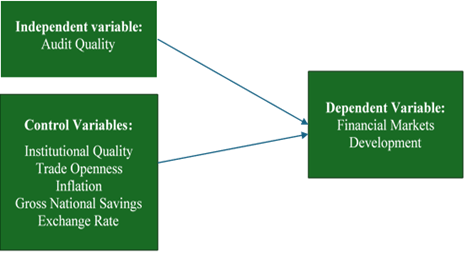
Theoretical FrameworkFigure 1
Research Model
Methodology
Variables and Data SourceWe studied the impact of QA on FM in a group of 8 SAEs, because QA has become the need of the hour for businesses, therefore our core variable is QA, with FM being the dependent variable in this study. FM represents the inclusive performance, solidity, and efficacy of financial markets within a specific country or region (Pagano, 1993). FM has a crucial role in the allocation of capital and the pricing of risk in an economy. They offer a platform for stakeholders to trade financial instruments such as, shares, bonds, and derivatives, depending on future risks and returns (Alfaro et al., 2004). The sample comprises 08 SAEs including India, Pakistan, Bangladesh, Nepal, Maldives, Bhutan, Afghanistan and Sri Lanka. The sample SAEs were chosen to share common socio-economic characteristics, economic growth, changing financial systems, and diverse institutional contexts. Several statistical tests including panel data fixed effect regression (as recommended by Hausman test) and robustness tests (Driscoll Kraay, PCSE) are used to analyze the data. we recognize the potential for endogeneity in panel studies at a macro level, and PCSE is used specifically to provide stable and reliable results against serial correlation, heteroscedasticity, and cross-sectional dependence.
Several control variables including Inflation (INF), Gross National Savings (GNS), Exchange Rate (XR), Institutional Quality (IQ), and Trade Openness (TRO) are used in this study, to moderate the potential omitted variable bias and ensure the reliability of outcomes. The data is obtained from World Economic Forum’s Global Competitiveness Index (GCI) Report (World Economic Forum [WEF], 2024) which provided the data for inflation, GNS, IQ, and TO, while the IMF's official website, an open access database, provided the data for ER. These control variables are crucial to the dynamics of FM in South Asian nations. Table 1 lists the data's source and stream. In management sciences, many researchers including (Black & Carnes, 2006; van de Walle, 2006; Yang & Huang, 2009) have used this source to derive data because it is considered a reliable source of data.
Table 1
Variable and Data Source
|
Variable |
Acronym |
Variable Sources |
Measurement of Variable |
|---|---|---|---|
|
Quality of Audit |
QA |
WEF GCI |
SARS Index (Scale 1-7) |
|
Financial Markets |
FM |
WEF GCI |
FMD Index (Scale 1-7) |
|
Inflation |
INF |
WEF GCI |
Percentage of annual change in the consumer price index (CPI) |
|
Gross National Savings |
GNS |
WEF GCI |
Percentage of GDP_PC |
|
Exchange Rate |
XR |
IMF |
Value of currency against other countries |
|
Institutional Quality |
IQ |
WEF GCI |
Institutional Pillar Score (Scale 1-7) |
|
Trade Openness |
TRO |
WEF GCI |
TRO = (Imports + Exports) as a percentage of GDP |
The impact of QA on FM was hypothesized using a panel regression model namely fixed effect model. The following equation is the usual econometric model related to the effect of QA on FM in a group of SAEs:
FMit=β0+β1 QAit+β2 INFit+β3 GNSit+β4 XRit+β5 IQit+β6 TROit+∈it……(1)Where Table 1 lists FM, QA, INF, GNS, XR, IQ, and TRO. The effects of INF, GNS, XR, IQ, and TRO on FM are displayed by the model controls.
Results
Table 2 consists of the outline of descriptive statistics that provides the total observations, mean, standard deviation, min and max, displaying the statistical values of the underlying variables for the sample of 8 SAEs. The results of descriptive statistics include FM as dependent variable and QA as independent variable. Moreover, different control variables such as INF, GNS, XR, IQ, and TRO are included in the model. The results reveal that the mean value of FM is 3.948, with an SD value of .512, varying a min of 2.092 and max of 5.102. The mean QA value was 4.379 with an SD value of .609, and min and max values ranged from 3.325 to 5.868. The different control variables mentioned earlier also provide a broad summary of the metrics that influence FM in a group of South Asian Economies.
Table 2
Descriptive Statistics
|
Variable |
Obs. |
Mean |
Std. Dev. |
Min |
Max |
|---|---|---|---|---|---|
|
FM |
120 |
3.948 |
.512 |
2.092 |
5.102 |
|
QA |
120 |
4.379 |
.609 |
3.325 |
5.868 |
|
INF |
120 |
7.856 |
3.535 |
.932 |
22.564 |
|
GNS |
120 |
25.708 |
7.164 |
6.447 |
39.124 |
|
XR |
120 |
85.384 |
31.939 |
41.349 |
178.73 |
|
IQ |
120 |
4.029 |
1.007 |
2.505 |
6.031 |
|
TRO |
120 |
17.673 |
15.693 |
1.071 |
61.209 |
Note: The table shows descriptive properties of the variables used in this research. All the abbreviations are defined in Table 1.
Table 3 exhibits the outcomes of the correlation matrix including FM as dependent variable, which shows a significant positive association with the independent variable QA (0.515), indicating that QA is associated with FM. Moreover, INF also shows a strong positive impact on FM (0.109), indicating that improved IQ contributes to more developed financial markets. Several control variables, including GNS (0.270) and TRO (0.510), also showed a positive impact, although weaker, but indicated their role in supporting FM. Furthermore, XR and IQ show a significant and negative impact on FM (-0.180) and (-0.061). Overall, the correlation between these variables highlights the importance of QA and various influential factors in promoting FM in South Asian Economies.
Table 3
Matrix of Correlations
|
Variables |
(1) |
(2) |
(3) |
(4) |
(5) |
(6) |
(7) |
|---|---|---|---|---|---|---|---|
|
(1) FM |
1.000 |
|
|||||
|
(2) QA |
0.515 |
1.000 |
|
||||
|
(3) INF |
0.109 |
0.097 |
1.000 |
|
|||
|
(4) GNS |
0.270 |
-0.021 |
-0.002 |
1.000 |
|
||
|
(5) XR |
-0.180 |
-0.148 |
-0.249 |
-0.336 |
1.000 |
|
|
|
(6) IQ |
-0.061 |
-0.075 |
-0.095 |
0.511 |
0.023 |
1.000 |
|
|
(7) TRO |
0.510 |
0.397 |
0.213 |
-0.074 |
-0.358 |
-0.085 |
1.000 |
Note: The table reports the correlation matrix of the underlying variables, while each of the abbreviations is defined in Table 1.
Table 4 exhibits the results of a fixed effects model, which is applied based on hausman test results (c2= 35.51, p-value = 0.0000) to analyze the impact of QA on FM in SAEs. The results of the fixed effects model state a significant positive impact of QA on FM, with a coefficient value of 0.3858 (p<0.01), which indicates that improved QA has a strong influence on FM in SAEs. It means one unit increase in QA leads to an increase in FM, indicating the economic importance of QA practices.
Table 4Fixed Effect Regression
|
Variables |
FE |
|---|---|
|
QA |
.3858***(.1233) |
|
INF |
-.0069(.0116) |
|
GNS |
.0178**(.0082) |
|
XR |
-.0046**(.0023) |
|
IQ |
-.1807***(.0654) |
|
TRO |
.0106(.0064) |
|
Constant |
2.7911***(.7537) |
|
Observations |
120 |
|
R2 |
.5012 |
Note: Standard errors are in parentheses. *** p<.01. ** p<.05. * p<.1.
Table 5 states the results of diagnostic tests used to identify the potential issues in panel data. The Wooldridge test for autocorrelation indicates the presence of serial correlation with value (F= 21.593, p=0.0056). Additionally, Modified Wald test reveals a significant groupwise heteroscedasticity (χ² = 148.14, p = 0.001), though, Pesaran cross sectional dependence (CSD) test shows no evidence of CSD.
Table 5
Panel Diagnostic Tests
|
Test Type |
F-Stat/ c2 |
p-Value |
|---|---|---|
|
Serial Correlation/ Wooldridge Test |
21.593 |
0.0056 |
|
Heteroskedasticity/ Modified Wald Test |
148.14 |
0.0000 |
|
Pesaran's test for Cross-sectional Dependence |
PCSD= -1.185 |
0.2362 |
Considering the diagnostic issues with fixed effect estimation in Table 4, such as autocorrelations, heteroskedasticity, and cross sectional dependance, robustness tests were performed using alternative estimators that can deal with these issues. These include three alternative estimators i.e. the Fixed effect robust, Driscoll–Kraay standard errors, and Panel corrected standard error (PCSE). Table 6 shows the results of alternative estimators including fixed effect robust, Driscoll-Kraay standard error and PCSE, implying that QA is still positive and statistically significant across all estimating methods. The notion that improved QA fosters FM by enhancing accountability, transparency, and investor trust within SAEs is highly supported by this consistent result.
Table 6Robustness with Alternative Estimators
|
|
FE Robust |
Driscoll |
PCSE |
|---|---|---|---|
|
QA |
.386**(.1461) |
.2988**(.0931) |
.2988***(.0752) |
|
INF |
-.0069(.0108) |
.001(.0088) |
.001(.0095) |
|
GNS |
.0179(.0127) |
.0374***(.0087) |
.0374***(.008) |
|
XR |
-.0046(.0069) |
.0035*(.0017) |
.0035**(.0014) |
|
IQ |
-.1805(.1657) |
-.1358*(.0531) |
-.1358***(.0364) |
|
TRO |
.0106(.0073) |
.0151***(.0034) |
.0151***(.0026) |
|
Constant |
2.7896**(.979) |
1.6473*(.6846) |
1.6473***(.423) |
|
Observations |
90 |
120 |
120 |
|
R2 |
.5013 |
.5373 |
.5373 |
|
F-stat/c2 |
- |
277.1705 |
(c2)313.304 |
Note: Standard errors are in parentheses.
*** p<.01. ** p<.05. * p<.1.
Discussion
The impact of QA on FM has been examined in this study with a sample of 08 SAEs from 2006 to 2020. The results specify that QA has a strong positive effect on FM, with a coefficient of 0.3858 (p<0.01), suggesting that to boost the reliability and credibility of FM, a higher QA is needed, which in turn promotes the trust and participation of investors in FM. The prior literature supported our study i.e., (Beisland et al., 2015; Sattar et al., 2020). Furthermore, GNS positively influenced FM, having coefficient value of 0.178 (p<0.05), indicating that higher savings rate provides more funds to invest in FM, which enhances market participation. GNS plays a key role in developing FM, which is consistent with (Bayar, 2014), who state a strong link between GNS and FM.
On the contrast, negative coefficient of -0. 1807 (p<0.01) has been presented by the IQ. This indicates that IQ does not have any key role in FM in SAEs context, which is in contrast with most of the studies which shows positive association of IQ with FMD, consistent with (Olaniyi & Oladeji, 2021) in contrast with (Alawi et al., 2022). Additionally, XR has a -0.0046 (p<0.05), which represents its impact in the context of SAEs.
However, the insignificant effect of TRO contradicts the outcomes of this study that underline its importance in the development of FM efficiency, consistent with (Arif & Rawat, 2019). Overall, this study features the crucial role of QA in enhancing the performance of FM, although it reveals the complex interaction of different macroeconomic variables.
The results are also supported theoretically with agency theory, which indicates that high QA lessens the information asymmetry between agents and principals, reduces agency cost and promotes corporate governance practices. High QA improves the dependability of financial statements and information shown by the company regarding prices of securities, which is supportive for investors to make decisions established on reliable information.
Conclusion and ImplicationsThe goal of this study is to explore the impact of Quality of Audit (QA) on Financial Markets (FM) in a group of South Asian Economies (SAEs). Panel data obtained from World Economic Forum’s Global Competitive Index (GCI) report for the time spanning 2006 to 2020 was used in this study, subject to availability. Results state that QA has a strong positive impact on FM concerning SAEs. The findings state that improved QA also enhances the reliability, stability and liquidity of financial markets, which marks the crucial role of QA to achieve investor’s confidence, reducing risk and economic development.
Compliance with QA ultimately leads to attracting both local and foreign investment, market stability, and efficiency of FM as investors depend on financial statements. Improved QA provides accurate, transparent and reliable financial information, which is an important factor in making investment decisions. More accurate assessment of financial statements can only be made through transparent reporting, which is only possible through higher QA. QA makes financial statements more reliable and reduces risk of financial fraud and misconduct.
Overall, the results highlight the need for useful and strong QA for the progress and stability of financial markets in SAEs. The study has implications for private and public institutions of SAEs, policymakers, regulatory bodies, government, and financial institutions to attain economic development, and firmness. This study has multiple limitations: (a) it is conducted in the context of SAEs; further research can be done with the sample of other countries, (b) beside QA, there may be some other factors influencing FM, further research can be conducted with other factors, (c) panel data were used in this study; further research can be conducted using time-series data to dig deeper and offer country specific policy recommendations.
Author Contribution
Danish Ali: Conceptualization, methodology, formal analysis, writing-original draft. Waiza Nisar: Data Curation, investigation, writing-original draft. Muhammad Asif Khan: Supervision, validation, writing-original draft, writing-review & editing.
Conflict of Interest
The authors of the manuscript have no financial or non-financial conflict of interest in the subject matter or materials discussed in this manuscript.
Data Availability Statement
The data associated with this study will be provided by the corresponding author upon request.
Funding Details
No funding has been received for this research.
Generative AI Disclosure Statement
The authors did not used any type of generative artificial intelligence software for this research.
REFERENCES
Achim, A. M. (2018). The strength of auditing and reporting standards in relation to financial reporting quality. SEA – Practical Application of Science, 6(17), 193–197.
Al-Ahdal, W. M., & Hashim, H. A. (2021). Impact of audit committee characteristics and external audit quality on firm performance: Evidence from India. Corporate Governance: The International Journal of Business in Society, 22(2), 424–445. https://doi.org/10.1108/CG-09-2020-0420
Alawi, S. M., Abbassi, W., Saqib, R., & Sharif, M. (2022). Impact of financial innovation and institutional quality on financial development in emerging markets. Journal of Risk and Financial Management, 15(3), Article e115. https://doi.org/10.3390/jrfm15030115
Alfaro, L., Chanda, A., Kalemli-Ozcan, S., & Sayek, S. (2004). FDI and economic growth: The role of local financial markets. Journal of International Economics, 64(1), 89–112. https://doi.org/10.1016/S0022-1996(03)00081-3
Alfraih, M. M. (2016). The role of audit quality in firm valuation: Evidence from an emerging capital market with a joint audit requirement. International Journal of Law and Management, 58(5), 575–598. https://doi.org/10.1108/IJLMA-09-2015-0049
Almarayeh, T. S., Aibar-Guzmán, B., & Abdullatif, M. (2020). Does audit quality influence earnings management in emerging markets? Evidence from Jordan. Revista de Contabilidad-Spanish Accounting Review, 23(1), 64–74. https://doi.org/10.6018/rcsar.365091
Alsmady, A. A. (2022). Quality of financial reporting, external audit, earnings power and companies performance: The case of Gulf Corporate Council countries. Research in Globalization, 5, Article 100093. https://doi.org/10.1016/j.resglo.2022.100093
Alzeban, A. (2019). An examination of the impact of compliance with internal audit standards on financial reporting quality: Evidence from Saudi Arabia. Journal of Financial Reporting and Accounting, 17(3), 498–518. https://doi.org/10.1108/JFRA-09-2018-0085
Amara, N., Bourouis, S., Alshdaifat, S. M., Bouzgarrou, H., & Al Amosh, H. (2025). The impact of audit quality and female audit committee characteristics on earnings management: Evidence from the UK. Journal of Risk and Financial Management, 18(3), 136. https://doi.org/10.3390/jrfm18030136
Arif, I., & Rawat, A. S. (2019). Trade and financial openness and their impact on financial development. South Asian Journal of Business Studies, 8(1), 26–39. https://doi.org/10.1108/SAJBS-06-2018-0063
Arnold, B. V., & De Lange, P. A. (2004). Enron: An examination of agency problems. Critical Perspectives on Accounting, 15(6–7), 751–765. https://doi.org/10.1016/j.cpa.2003.08.005
Bayar, Y. (2014). Financial development and domestic savings in emerging Asian countries. Theoretical and Applied Economics, 7(596), 55–66.
Beisland, L. A., Mersland, R., & Strøm, R. Ø. (2015). Audit quality and corporate governance: Evidence from the microfinance industry. International Journal of Auditing, 19(3), 218–237. https://doi.org/10.1111/ijau.12041
Black, E. L., & Carnes, T. A. (2006). Analysts' forecasts in Asia‐Pacific markets: The relationship among macroeconomic factors, accounting systems, bias, and accuracy. International Journal of Accounting, Auditing and Performance Evaluation, 3(3), 208–227. https://doi.org/10.1111/j.1467-646X.2006.00127.x
Bond, P., Edmans, A., & Goldstein, I. (2012). The real effects of financial markets. Annual Review of Financial Economics, 4(1), 339–360. https://doi.org/10.1146/annurev-financial-110311-101826
Boolaky, P. K., Krishnamurti, C., & Hoque, A. (2013). Determinants of the strength of auditing and reporting standards: A cross-country study. Australasian Accounting, Business and Finance Journal, 7(4), 17–36. https://doi.org/10.14453/aabfj.v7i4.3
Budisantoso, T., & Kurniawan, H. (2022). The contagion effect of decreasing audit quality on financial statement audit engagement: The Indonesian case. Asia-Pacific Journal of Business Administration, 16(1), 63–76. https://doi.org/10.1108/APJBA-11-2020-0393
Chafai, A., Khémiri, W., Tobar, R., Attia, E. F., & Abozeid, H. O. (2024). The moderating effect of audit quality on the relationship between financial inclusion and corporate investment: New evidence from the Middle East and North Africa region. Cogent Economics & Finance, 12(1), Article 2378121. https://doi.org/10.1080/23322039.2024.2378121
Francis, J. R., Khurana, I. K., & Pereira, R. (2003). The role of accounting and auditing in corporate governance and the development of financial markets around the world. Asia-Pacific Journal of Accounting & Economics, 10(1), 1–30. https://doi.org/10.1080/16081625.2003.10510613
Francis, J. R., Pinnuck, M. L., & Watanabe, O. (2014). Auditor style and financial statement comparability. The Accounting Review, 89(2), 605–633. https://doi.org/10.2308/accr-50642
Gao, P., & Zhang, G. (2019). Auditing standards, professional judgment, and audit quality. The Accounting Review, 94(6), 201–225. https://doi.org/10.2308/accr-52389
Gerayli, M., Rezaei Pitenoei, Y., & Abdollahi, A. (2021). Do audit committee characteristics improve financial reporting quality in emerging markets? Evidence from Iran. Asian Review of Accounting, 29(2), 251–267. https://doi.org/10.1108/ARA-10-2020-0155
Haque, N. U. (1997). Financial market reform in Pakistan. The Pakistan Development Review, 36(4), 839–854.
Hayes, A. (2022). Financial markets: Role in the economy, importance, types, and examples. Investopedia. https://www.investopedia.com/terms/f/financial-market.asp
Huq, M. T., & Ichihashi, M. (2025). Can historical economic growth patterns be traced in South and Southeast Asian countries as the classical theory suggests? Journal of Economic Structures, 14(1), Article e11. https://doi.org/10.1186/s40008-025-00355-4
Hussien, L., Zraqat, O., Zureigat, Q., Al-Rawashdeh, H. A., Alrawashedh, N., Almutairi, A., & Alrashidi, M. (2024). The Impact of Audit Quality on Reducing Earnings Management Practices in the Jordanian Industrial Companies. In A. Hamdan & U. Braendle (Eds.), Harnessing AI, machine learning, and IoT for intelligent business: Volume 2 (pp. 569–578). Springer Nature Switzerland. https://doi.org/10.1007/978-3-031-47210-0_50
Jameel, S. Z. M., Al-Sendy, A. M., & Hamoudi, K. M. T. (2024). The impact of audit characteristics on earnings management: Evidence from Dubai banks. Journal of Risk and Financial Management, 17(6), Article e249. https://doi.org/10.3390/jrfm17060249
Jensen, M. C., & Meckling, W. H. (1976). Theory of the firm: Managerial behavior, agency costs and ownership structure. Journal of Financial Economics, 3(4), 305–360. https://doi.org/10.1016/0304-405X(76)90026-X
Karaibrahimoğlu, Y. Z., & Çangarlı, B. G. (2016). Do auditing and reporting standards affect firms' ethical behaviours? The moderating role of national culture. Journal of Business Ethics, 139(1), 55–75. https://doi.org/10.1007/s10551-015-2571-y
Khelil, I., Guidara, A., & Khlif, H. (2023). The effect of the strength of auditing and reporting standards on infrastructure quality in Africa: Do ethical behaviour of firms and judicial independence matter? Journal of Financial Management of Property and Construction, 28(1), 145–160. https://doi.org/10.1108/JFMPC-02-2021-0017
Khlif, H., & Guidara, A. (2018). Quality of management schools, strength of auditing and reporting standards and tax evasion. EuroMed Journal of Business, 13(2), 149–162. https://doi.org/10.1108/EMJB-05-2017-0017
Myers, S. C., & Majluf, N. S. (1984). Corporate financing and investment decisions when firms have information that investors do not have. Journal of Financial Economics, 13(2), 187–221. https://doi.org/10.1016/0304-405X(84)90023-0
Naseer, M. M., Khan, M. A., Popp, J., & Oláh, J. (2021). Firm, industry and macroeconomics dynamics of stock returns: A case of Pakistan non-financial sector. Journal of Risk and Financial Management, 14(5), Article e190. https://doi.org/10.3390/jrfm14050190
Olaniyi, C. O., & Oladeji, S. I. (2021). Moderating the effect of institutional quality on the finance–growth nexus: Insights from West African countries. Economic Change and Restructuring, 54(1), 43–74. https://doi.org/10.1007/s10644-020-09275-8
Pagano, M. (1993). Financial markets and growth: An overview. European Economic Review, 37(2–3), 613–622. https://doi.org/10.1016/0014-2921(93)90051-B
Quoc, T. N. K., Le Van, T., Minh, H. N., & Ngoc, O. N. T. (2024). Financial statements' reliability affects firms' performance: A case of Vietnam. Journal of Eastern European and Central Asian Research, 11(1), 143–155. https://doi.org/10.15549/jeecar.v11i1.1066
Sarbanes–Oxley Act of 2002, Pub. L. No. 107-204, 116 Stat. 745 (2002).
Sattar, U., Javeed, S. A., & Latief, R. (2020). How audit quality affects firm performance with the moderating role of product market competition: Empirical evidence from Pakistani manufacturing firms. Sustainability, 12(10), Article e4153. https://doi.org/10.3390/su12104153
Shi, H., Wen, W., Zhou, G., & Zhu, X. (2021). Do individual auditors have their own styles? Evidence from clients' financial statement comparability in China. Accounting Horizons, 35(3), 187–215. https://doi.org/10.2308/HORIZONS-18-002
Stiglitz, J. E. (1993). The role of the state in financial markets. The World Bank Economic Review, 7(Suppl. 1), 19–52. https://doi.org/10.1093/wber/7.suppl_1.19
van de Walle, S. (2006). The state of the world's bureaucracies. Journal of Comparative Policy Analysis: Research and Practice, 8(4), 437–448. https://doi.org/10.1080/13876980600971409
Wang, Y. (2025). Audit quality, board independence, and investment decisions: empirical evidence from emerging markets. Applied Economics, 1-15.
World Economic Forum. (2024). The global competitiveness report 2024. World Economic Forum. https://www.weforum.org/
Yang, C.-H., & Huang, Y.-J. (2009). Do intellectual property rights matter to Taiwan's exports? A dynamic panel approach. The World Economy, 32(3), 555–578. https://doi.org/10.1111/j.1468-0106.2009.00460.x
Yi, W., & Yang, Q. (2024). The influence of ESG performance on corporate value: An empirical analysis of Chinese A-share listed sports companies. SAGE Open, 14(2), Article e21582440241249892. https://doi.org/10.1177/21582440241249892