

| Review | Open Access |
|---|
Workplace Bullying as a Predictor of Organizational Commitment: Unveiling the Mediating Role of Mobbing |
 |
|---|
 Hamna and
Fahria Masood
Hamna and
Fahria Masood
Institute of Applied Psychology, University of the Punjab, Lahore, Pakistan
The current research aimed to study the relationship between workplace bullying, mobbing and organizational commitment in employees. The study used quantitative correlational research design to examine the relationship between mobbing, workplace bullying, and organizational commitment. Non-probability purposive sampling strategy was used to recruit the sample of N = 150 from national and multinational company employees of Lahore. Workplace Bullying Scale EAPA-T, Luxembourg Workplace Mobbing Scale and TCM Employee Commitment Survey were used for data collection purpose. Pearson Product Moment Correlation Analysis was run to investigate the relationship among workplace bullying, mobbing and organizational commitment. Test of mean differences was used to identify the effect of multiple groups of a demographic variable on the dependent variable. Multiple Hierarchical Regression Analysis was used to find out the mediating role of mobbing in relationship between workplace bullying and organizational commitment. Results indicated that there was a negative correlation of workplace bullying and mobbing with organizational commitment. Workplace bullying negatively predicted organizational commitment. There was a partial mediation of mobbing between workplace bullying and organizational commitment. There were no gender differences in these three variables. This study provides an insight that organizational commitment can be increased by handling workplace bullying and mobbing.
1. INTRODUCTION
When a person gets a job in an organization, they acquire some kind of attachment and link with it. They become committed to their job and organization. Organizational commitment is one of the basic requirements to do a job with satisfaction. Commitment also predicts the outcomes for an organization. Although employees’ commitment to their organization has a strong and irrefutable effect on the outcomes of the business, but there are many organizational confounding variables that affect organizational commitment (Wazirman et al., 2022).
Meyer and Allen (1991) define organizational commitment is the emotional state of employees that describes their relation with the organization, determining the continuity of their membership with the organization. They put forward three components of organizational commitment including desire (affective commitment), need (continuance commitment) and an obligation (normative commitment). Although many organizational scientists have developed definitions and scales but Meyer and Allen (1991)’s model for the organizational commitment has its own place.
This model of commitment asserts that organizational commitment has three components that are related with different psychological states. Affective commitment was found to be an enduring, demonstrably indispensable, and central characteristic of organizational commitment (Umezulike et al., 2024). Affective commitment can be explained as optimistic emotive supplement of an employee with his institute. It is the desire constituent of organizational commitment as designated by Meyer and Allen (1991). Continuance Commitment is explained as an employee’s desire of either remaining a part of an association or to leave it based on the entailed advantages or disadvantages. This is called continuance commitment. They designated it as need constituent of organizational commitment. The last constituent of the organizational commitment is Normative Commitment. The workers sense a kind of debt toward their institute, motivating their desire to continue working there. This is normative commitment. It is the obligation component of organizational commitment.
Employees stay with the organization because they ought to. However, there are many other factors at play as well. For example, if an employee gives his best to the organization, following their normative commitment, then they receive the advanced rewards. It will increase their obligation with their organization and they would never want to leave it. The organizations that value the honesty, loyalty and hard-work and methodically converse the facts to the workers with bonuses have a number of employees with higher normative commitment (Estigoy et al., 2020).
Workplace bullying may be defined as the obstinate array of exploitation in the workroom that causes somatic or emotive damage. The tactics used for this are physical, psychological, verbal and non-verbal mistreatment. It also includes humiliation. Workplace bullying is different from typical school bully as it occurs within the frame of traditional rules and strategies of their institute. Although, in almost all cases, workplace bullying is being done by somebody who has the authority over the person who is being bullied, but in some cases, bulling can also be done by coworkers and subordinates (Hodgins et al., 2020).
Workplace bullying not only affect the perspective of employees towards the organization, but also negatively influence their services towards their client. Sabir et al. (2023) studied the impact of workplace bullying on patient quality services that strongly suggested that workplace bullying negatively predicted patient quality services mediated by workplace deviance.
According to the researches, a significant number of workers are open to mobbing in their workplace. Among the bullies, managers are the most common source of bullying (Tuckey et al., 2022). According to the results of Workplace Bullying Institute (2024) U.S survey, 32% adult Americans were bullied. 74.8 million workers were bullied, among those 59% were bullied by the same gender. Survey also suggested that 87% workers support workplace bullying laws which is appreciated. Anjum and Shoukat (2013) conducted a survey in Punjab Pakistan, which showed that 78% employees of different companies experienced workplace bullying.
According to the research, supervisors initiate the bullying followed by peers, subordinates and customers (Özkan, 2021). This is also suggested in the research that the toxic leadership also impact workplace bullying (Ashfaq et al., 2025). There may be three relationships formed by contributors in the bullying (Blomberg & Rosander, 2019): between supervisor and subordinate, among co-workers, and employees and customers.
One of the occurrences of workplace bullying is between the establishment and the workers. In a workplace, bullying may occur due to power. Bullying represents the exploiting aspect of this power. This exploiting behavior may be a representation of abusive culture of that organization. However, a bullying relationship also occurs among co-workers (Adeel et al., 2022). Colleagues may bully each other for many reasons. To suppress their competition, or to get the position of the victim, the abuser bullies the person and harasses him. It is seen in the workplace that if bullying occurs among peers, the evaluation that is done is often biased. It can be done intentionally or unintentionally. The third working relationship is between employees and customers (Bloisi, 2021), even though it is very rare. It can be positive or negative. It also plays an important role in the efficiency of the organization. Overworked or tensed employees are unable to give their best to the organization. This will definitely affect the productivity and the quality of the products of the organization. The above-mentioned culture is neither productive nor creative in any sense. This culture definitely affects the productivity of the organization, leading to heavy loss in the form of money as well as the loss of talented employees (Dyer, 2023).
Mobbing, as a social term, refers to a person being bullied by a group, in any situation, such as family, peers, school, workplace, community, and on the Internet. The events of physical and emotional harassment at work creates a hostile environment, which often force the employees to quit their jobs. Such harassment may occur during meeting with co-workers, subordinates or supervisors and may include forcing a person to leave work through rumors, innuendo, intimidation, embarrassment, insults, and isolation. These actions constitute a form of violence that is nonetheless harmful and unjust (Gil-Monte et al., 2024; Mhaka-Mutepfa & Rampa, 2021). Konrad Lorenz (2002), in his book, On Aggression, explained the animosity between animals and the birds, saying that this was a tendency toward Darwinian struggle for prosperity. Likely, many people have similar thoughts but are able to control them.
Adams and Field don’t use the word mobbing, instead they used the term harassment on the job or in the workplace (Davenport et al., 1999). They consider mobbing as a form of bullying in terms of describing the emotional assault. According to them, it starts with a single person, and later, other people join him, turning bullying into mobbing. In the beginning, the victim gets hurt or offended (Gil-Monte et al., 2024; Valdivieso, 2020). It is believed that mobbing is established in workplaces with poorly planned or operational procedures and incompetent or negligent management, and that abuse victims are often different people who have shown ingenuity, skill, integrity, accomplishment and dedication (Gil-Monte et al., 2024; Greenbaum et al., 2019).
Workplace bullying can be better comprehended with several theory lenses. Citing social learning theory, workers tend to imitate positive and negative behaviors from either their seniors or colleagues (Al-Qadi, 2021). A targeted employee of mobbing can subsequently exhibit similar undesirable behaviors towards juniors and perpetuate the mistreatment cycle. In cases wherein colleagues or partners join hands with a bully to persecute a specific staff member, such escalation can be accounted for with social identity theory, wherein exclusion and belonging to groups identify organizational relationships. In such cases, such behaviors are further supported by the work-environment hypothesis, wherein badly organized or unsupportive environments enable bullying and mobbing behaviors. In such situations, mobbing creates stress and social exclusion for victims, a process elaborated upon by social isolation theory. Secondly, with regard to the attribution-emotion model of stigmatization, it elaborates that when a lot of responsibility is imputed upon the victim, people who are simply observing can get involved in anti-social activities, further exacerbating social exclusion of the victim (Pouwelse et al., 2021). Comprehensively, such theory lenses elucidate that mobbing disrupts an employee's sense of identity and belonging and hence diminishes organizational commitment, further elaborated upon by social categorization theory.
All the variables in this study are closely interlinked. Workplace bullying often begins at the supervisory level, but when coworkers join in and collectively target the victim, it escalates into mobbing (Mujtaba & Senathip, 2020). Both bullying and mobbing negatively affect employees on physical, psychological, and emotional levels, which, over time, erodes their organizational commitment. Victims frequently experience reduced attachment, disengagement, and heightened turnover intentions. Conversely, employees who do not encounter bullying or mobbing are more likely to feel valued, develop stronger identification with their organization, and sustain higher levels of commitment (Kaya & Onağ, 2024). Thus, the integration of these theories provides a comprehensive explanation for the proposed mediation model, where bullying escalates into mobbing, which in turn diminishes organizational commitment.
Xia et al. (2023) studied the mediating role of organizational commitment between workplace bullying and turnover intention in clinical nurses. Nurses from 40 hospitals from China were taken as sample. Self-reported questionnaires were given for the data collection purpose. Results from various analysis showed that workplace bullying significantly negatively related to organizational commitment and positively related to turnover intention. Results also suggested that organizational commitment mediated the relationship between workplace bullying and turnover intention.
Khurram et al. (2020) carried out a cross-sectional study to demonstrate the effect of emotional exhaustion, emotional labor and workplace bullying on organizational commitment. Their findings reported a significant positive relationship between organizational commitment and emotional labor, while emotional exhaustion and workplace bullying were negatively associated with organizational commitment.
Güllü et al. (2020) studied mobbing and turnover intention. He also studied organizational commitment as a mediator in his study. Different scales for relevant purpose were used for data collection. The results of the research explained that organizational commitment and mobbing has negative and significant relation among them. It is also concluded that mobbing affects turnover intention in a positive manner. It can also be seen by the results that organizational commitment played a partial mediation role among them. Aras (2019) intended to conclude the affiliation amid mobbing, organizational commitment and job satisfaction in music teachers. A study was conducted using relational survey model. Negative behavior scale, organizational commitment scale and job satisfaction scale were used for data collection purpose. The result of this research suggested that a significant negative relationship was present between mobbing and organizational commitment and job satisfaction.
Malik et al. (2018) studied the consequence of workplace bullying on upshots of an organization. The role of psychological contract breach was also discussed in the study. It had become clear by the result of the study that psychological contract breach was caused by workplace bullying that plays the role of mediator amongst workplace bullying and organizational commitment in the employees. Ghorbannezhad and Fallahmorad (2018) studied the connection amid Mobbing and organizational commitment of personnel of Shahid Beheshti power plant of Loshan. They used descriptive and correlational type of study in this research. Data were gathered using Standard Spillage and Holt Organizational Bullying Questionnaire and Allen and Meyer's Organizational Commitment Questionnaire. It is concluded from the results that there is a negative correlation amid Mobbing and Organizational commitment of employees.
Erdogan (2022) evaluated the association among mobbing, organizational commitment and job satisfaction in healthcare sector. Healthcare professionals were taken as sample. Data were collected by using The Mobbing Behaviors Scale, Minnesota Satisfaction Questionnaire, and Organizational Commitment Scale. According to the findings of this research, nurses were more exposed to mobbing than doctors. Females were more exposed to mobbing than males. Results showed that exposure to mobbing was negatively related to job satisfaction but organizational commitment was not influenced much. Galanaki et al. (2024) intended to study the relationship between workplace bullying, organizational culture and affective commitment. Employees of several public and private sector were recruited as sample. Data were collected through a self-reported questionnaire. Findings suggested that those who had experienced workplace bullying, had low score affective commitment while culture positively related to affective commitment.
These researches showed a significant relationship between workplace bullying, mobbing and organizational commitment. Workplace bullying negatively predicts the organizational commitment and has a positive relationship with mobbing. The people subjected to workplace bullying and mobbing have low level of organizational commitment.
RationaleWorkplace bullying has widely been characterized as a corrosive force that undermines employee well-being and organizational effectiveness. Bullying most often begins with subtle negative behaviors directed toward discrete targets, but such behaviors can transition to more organized and collective forms of mistreatment, most often described as mobbing (Altoobi & Awashreh, 2025). Mobbing acts as the transition mechanism through which workplace bullying is translated into compromised organizational commitment. Conceptualizing mobbing as a mediator accordingly plays a key role because it provides a finer-grained account of how negative interpersonal experiences get translated into larger organizational outcomes. In spite of increasing acknowledgment of the harm-causing effect of mobbing, results across studies have not necessarily conformed uniformly. Concurrently, most of the previous studies tended to study either bullying's direct impact on organizational outcomes or to conceptualize mobbing as a dimension of bullying without elucidating its unique function to mediate between other variables. What remains, then, is a critical conceptual deficit that cannot help explain why and how bullying would result in organizational disengagement. By investigating mobbing as a mediator, the present study addresses this gap and moves beyond the general observation that bullying undermines commitment. In doing so, the study also provides clarity to the inconsistent findings in prior research and highlights the conditions under which mobbing may play a critical role. This focus contributes not only to refining the theoretical understanding of workplace mistreatment but also to offering practical insights for organizations to intervene effectively before bullying escalates into mobbing, ultimately safeguarding employee commitment.
Objectives of the Study- To study the relationship between workplace bullying and organizational commitment in employees.
- To investigate the relationship between mobbing and organizational commitment in employees.
- To investigate mobbing as a mediator between workplace bullying and organizational commitment in employees.
- To study gender differences in study variables in employees.
- There is likely to be a negative relationship between workplace bullying and organizational commitment and also a negative relationship between mobbing and organizational commitment in employees.
- Mobbing is likely to mediate the relationship between workplace bullying and organizational commitment.
- There are likely to be gender differences in workplace bullying, mobbing and organizational commitment among employees.
Figure 1
Hypothesized ModelMethod
Research DesignA correlational research design was used for unearthing the bond between workplace bullying, mobbing and organizational commitment in the employees of national and multinational companies of Pakistan.
SampleA total of 150 employees, within the age bracket of 25 to 65 years (M= 41.02; SD= 7.67), of different national and multinational companies of Lahore were taken as sample of this research.
Sampling StrategyThe sample was recruited using non-probability purposive sampling to collect the data from different national and multinational companies.
Assessment MeasuresFollowing are the assessment measures, which were used for this study:
Demographic Information Sheet and Informed Consent
The first portion of the survey tools was about the demographic information. It was self-made demographic questionnaire in which the subject was asked about his/her age, gender, education, marital status, tenure of office and company.
Table 1
Descriptive Statistics of Demographics Characteristics (N= 150)
|
Characteristics |
f |
% |
|---|---|---|
|
Gender Male Female |
87 63 |
58 42 |
|
Marital status Married Single Divorced |
87 56 7 |
58 37.3 4.7 |
|
Age 26-45 years 46 and above |
86 64 |
57.3 42.7 |
|
Education Bachelor’s Master’s PhD |
43 101 6 |
28.7 67.3 4 |
|
Duration of Service 1-10 years 11 and above |
76 74 |
50.7 49.3 |
|
Company National Multinational |
37 113 |
24.7 75.3 |
Workplace Bullying Scale EAPA-T (Escartín et al., 2010) was used in this study. It was a 12 items scale which was used to measure the workplace bullying. All of the items were positive indicators of bullying. EAPA-T scale is used mainly by experts, researchers and psychologists to find out workplace bullying in the employees of different workplace settings. Responses were collected on a 5-point Likert scale, that ranges from 0 (Nothing) to 4 (Extremely). The Cronbach’s α value of the scale was .90.
The Luxembourg Workplace Mobbing Scale (LWMS)Luxembourg workplace mobbing scale (Steffgen et al., 2016) was used. This scale has 5 items, and was used to measure the mobbing in workplace settings. The response scale was a 5-point Likert scale ranging from 1 = never to 5 = almost at all times. All the items assess positive indicators of workplace mobbing. Its Cronbach’s α value was .73.
TCM Employee Commitment SurveyTCM Employee Commitment Survey (Meyer & Allen, 2004) was used. This survey has further three subscales: the Affective Commitment Scale (ACS), the Normative Commitment Scale (NCS) and the Continuance Commitment Scale (CCS). In this study, revised version of this survey was used in which each subscale contains 6 items. The responses were given on 1 (strongly disagree) to 7 (strongly agree) points. Some items were reverse scored for data analysis purpose. The Cronbach’s α of the its subscales were: .85 (affective), .73 (normative), and .79 (continuance).
ProcedureFirst of all, the synopsis was approved by the board of studies of the university. After that, permission was taken from the authors of the scales. The formal questionnaire was generated by using the respective scales and demographic sheet for data collection. Every participant was briefed about the purpose of conducting the research. Only those people were taken as participants who fulfilled the inclusion criteria and were willing to participate in the research. They were assured about the confidentiality of their information. They were also assured that they could withdraw from the research voluntarily at any step without any penalty. Following that, the questionnaire was shared with the participants on their phones and it was assured that all the assessment measures were filled by the participants themselves. Data were analyzed using SPSS 21 version, descriptive analysis were used for demographics, number of participants and their percentages. Cronbach alpha reliability analysis was used to test the reliability of the scales and subscales. Pearson product moment correlation was used to find out the relationship between variables and their subscales. Independent sample t-test analysis was applied for the comparison between males and females and also between old and new employees. Multiple hierarchical regression was used to check the mediation of mobbing in relationship between workplace bullying and organizational commitment. After that, the result was concluded.
Results
The collected data were statistically analyzed and their results are represented in this section. Different analyses were done in order to test the hypotheses. The response patterns of the participants were also interpreted.
Table 2
Descriptive Statistics and Reliabilities of Scales (N=150)
|
Scales |
M |
SD |
Range |
α |
Skewness |
Kurtosis |
|---|---|---|---|---|---|---|
|
Workplace Bullying |
16.42 |
10.64 |
0-40 |
.94 |
.30 |
-.87 |
|
Mobbing |
13.91 |
6.05 |
5-25 |
.93 |
-.20 |
-1.46 |
|
Organizational Commitment |
75.73 |
23.87 |
34-120 |
.95 |
.09 |
-1.18 |
|
Affective Commitment |
26.08 |
9.72 |
10-42 |
.94 |
.17 |
-1.17 |
|
Continuance Commitment |
24.43 |
8.60 |
6-42 |
.87 |
.33 |
-.90 |
|
Normative Commitment |
25.21 |
8.21 |
6-42 |
.88 |
.17 |
-1.02 |
Alpha reliability values for the total scales including workplace bullying, mobbing, and organizational commitment and its subscales are provided in above table.
Table 3
Correlation between Workplace Bullying, Mobbing and Organizational Commitment in Employees (N=150)
|
Variable |
2 |
3 |
4 |
5 |
6 |
|---|---|---|---|---|---|
|
1. Workplace Bullying |
.81*** |
-.58*** |
-.66*** |
-.33*** |
-.56*** |
|
2. Mobbing |
- |
-.57*** |
-.65*** |
-.31*** |
-.56*** |
|
3. Organizational Commitment |
|
- |
.92*** |
.83*** |
.95*** |
|
4. Affective Commitment |
|
|
- |
.56*** |
.90*** |
|
5. Continuance Commitment |
|
|
|
- |
.68*** |
|
6. Normative Commitment |
|
|
|
|
- |
Note. ***p<.001
Pearson product moment correlation analysis was carried out to assess the relationship between workplace bullying, mobbing and organizational commitment. The relationship of workplace bullying with mobbing turned out to be significant and positive, while its relationship with organizational commitment was significant and negative. Mobbing was related significantly and negatively with the organizational commitment
Table 4
Simple Linear Regression of Workplace Bullying and Mobbing in Employees (N=150)
|
Variables |
B |
95% CI |
S.E |
β |
R2 |
|
|---|---|---|---|---|---|---|
|
LL |
UL |
|||||
|
Constant |
6.32 |
5.26 |
7.37 |
.53 |
|
.34 |
|
Workplace Bullying |
.46 |
0.41 |
0.52 |
.03 |
.81*** |
|
Note. ***p<.001
The table showed that workplace bullying predicted mobbing. The overall model was significant and had 66% variance F (1, 148) = 286.95 p <.001.
Table 5
Mediation through Multiple Hierarchical Regression of Workplace Bullying, Mobbing and Organizational Commitment in Employees
|
Variables |
B |
95% CI |
S.E |
β |
R2 |
ΔR2 |
|
|---|---|---|---|---|---|---|---|
|
LL |
UL |
||||||
|
Step 1 |
|
|
|
|
|
.34 |
.34 |
|
Constant |
97.08 |
91.27 |
102.89 |
2.94 |
|
|
|
|
Workplace Bullying |
-1.30 |
-1.60 |
-1.00 |
.15 |
-.58*** |
|
|
Step 2 |
|
|
|
|
|
.37 |
.03 |
|
Constant |
104.49 |
96.54 |
112.44 |
4.02 |
|
|
|
|
Workplace Bullying |
-.76 |
-1.26 |
-.26 |
.25 |
-.34** |
|
|
|
Mobbing |
-1.17 |
-2.05 |
-.30 |
.44 |
-.30** |
|
|
Note. **p<.01; ***p<.001
The above table showed that there was significant mediation of mobbing in relationship between workplace bullying and organizational commitment. The model 1 was significant and explained 34% of the variance F (1, 148) = 74.74, p <.001. The overall model 2 was significant and explained 37% of the variance F (2, 147) = 42.37, p <.001.
For evaluating mediating role of bullying, Sobel-z test was carried out. Result indicated that mobbing was significantly partially mediating in relationship between workplace bullying and organizational commitment (Sobel t = -0.54, S.E =.21, p <.01).
Figure 2
Emerged Model
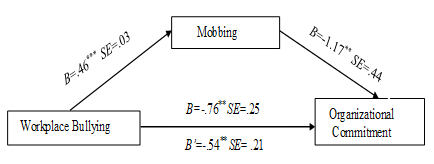
Table 6
Independent Sample t-test Indicating Gender Differences in Workplace Bullying, Mobbing and Organizational Commitment in Employees(N=150)
|
Variables |
Male |
Female |
t(148) |
p |
95% CI |
Cohen’s d |
|||
|---|---|---|---|---|---|---|---|---|---|
|
M |
SD |
M |
SD |
LL |
UL |
||||
|
Workplace Bullying |
16.23 |
10.52 |
16.69 |
10.88 |
-.265 |
.79 |
-3.95 |
3.02 |
0.04 |
|
Mobbing |
13.59 |
5.94 |
14.34 |
6.23 |
-.749 |
.45 |
-2.73 |
1.2 |
0.12 |
|
Organizational Commitment |
75.60 |
22.33 |
75.90 |
26.03 |
-.073 |
.94 |
-8.33 |
7.74 |
0.01 |
An independent sample t-test was run to find out if there were any gender differences in workplace bullying, mobbing and organizational commitment. The results showed that there are no significant gender differences in workplace bullying, mobbing and organizational commitment
In a nutshell, the results indicated that the relationship between workplace bullying and mobbing was positive while the relationship between workplace bullying and organizational commitment was negative. Mobbing and organizational commitment also had negative relationship. Mobbing mediates the impact of workplace bullying on organizational commitment. There were no gender differences in the level of workplace bullying, mobbing and organizational commitment.
DiscussionThe study's findings shed light on the intricate dynamics of interactions at work, especially as they relate to the connections between workplace mobbing, bullying, and organizational commitment. According to Grzesiuk et al. (2022), there appears to be a range of unfavorable workplace behaviors, given the positive correlation between workplace bullying and mobbing. This result is in line with earlier studies that show victims of bullying are more likely to become targets of mobbing incidents. Both bullying and mobbing actions can produce a hostile work atmosphere in an organization, which can have detrimental effects on both the staff and the company (Salin et al., 2018).
Furthermore, the adverse effect of bullying on workers' commitment to their organization is highlighted by the negative association that exists between workplace bullying and organizational commitment (Einarsen et al., 2020). Bullying can make workers feel alienated and detached from their jobs, which may lower their dedication to the company. Another reason for this behavior can be the stress that is caused by the bullying in the heads of the victims which negatively affects the employees’ commitment to their organization. These findings are in line with earlier studies that show that exposure to bullying might weaken a person's sense of loyalty and belonging at work (Kong et al., 2024; Sun et al., 2025).
The finding that mobbing acts as a mediator between workplace bullying and organizational commitment offers important new understandings into the processes by which these actions shape employee attitudes and behaviors. Reduced organizational commitment appears to be one of the main ways that mobbing, which is the systematic abuse of an individual by a group, translates the harmful impacts of bullying (Einarsen, 2020). This result is in line with earlier findings suggesting that mobbing activities may worsen the detrimental effects of bullying on workers' perceptions of their employer (Qureshi et al., 2015).
The relevance of addressing group dynamics and individual bullying behaviors in the workplace is underscored by the mediation role of mobbing. Organizations should pay attention to the larger corporate culture and group interactions that can lead to mobbing behaviors in addition to preventing and treating bullying at the individual level (Salin et al, 2018). Organizations can lessen the detrimental effects of workplace bullying on organizational commitment by addressing mobbing as a mediator.
Given that workplace bullying, mobbing, and organizational commitment are issues that affect people of all genders, it is important to know that there is no gender difference in these categories. This finding implies that workplace harassment of male and female employees is as likely to occur, and that their levels of organizational commitment are comparable (Hamna & Mehmood, 2024). This result goes against the findings of some earlier research (Rosander et al., 2020) that revealed gender differences in the experience of bullying at work. For instance, according to their findings, men were more likely to be labelled as bullied based on their negative experiences, while women showed a higher tendency towards self-labeling as being bullied.
It is implied that broader organizational and cultural dynamics, rather than gender-specific characteristics, are the driving forces behind workplace bullying, mobbing, and organizational dedication, as there are no gender disparities in these areas. It proposes that all employees, regardless of gender, should be included in interventions meant to reduce workplace harassment and improve organizational commitment (Diez-Canseco et al., 2022).
Furthermore, the lack of gender differences in organizational commitment is consistent with earlier studies that revealed no discernible gender variations in the degree of commitment workers had for their organizations (Salin et al., 2018). This shows that individual experiences and views may have a greater influence on organizational commitment than characteristics particular to a person's gender. One reason for this uniformity can be the inclusion that has been observed for the females in corporate sector in today’s era. As females have equal opportunities to grow and achieve their goals, so they also face the same hurdle as males do (Tripti et al., 2024).
ConclusionThis study's primary goal was to investigate the relationship between bullying and mobbing and organizational commitment among workers in domestic and international corporations. The results of this investigation were consistent with those of earlier studies. The study finds that low organizational commitment is a result of workplace bullying; however, mobbing moderates this link. Mobbing and bullying at work were both poor indicators of organizational commitment. Therefore, the hypothesis was approved in light of the findings.
Limitations and SuggestionsThere are limitations to this study. First, although the sample size (N = 150) was sufficient for statistical analyses, it might not fully reflect the heterogeneity of the larger workforce because participants were mainly from a certain sector and geographical area. This affects its generalizability, and future studies should ensure larger and more diverse samples from different industries and organizational settings. Second, three-component organizational commitment were aggregated to a single construct to give a total assessment. This method has precedence in the literature, but it might conflate the differential contribution of each dimension, and future studies might analyze them in separate instances to give a finer-grained understanding. Third, because of its cross-sectional nature, the study cannot permit causal inferences and cannot reflect the temporal dynamics of the mediation process. A longitudinal study or a multi-wave study can permit researchers to explore over time how workplace bullying evolves to mobbing and how it affects organizational commitment accordingly. With these limitations in mind, however, the current study still provides useful insights while identifying useful directions for future studies. To overcome this bullying situation in an organization, the management of the organization should make precise policies and strategies that aid a healthy and friendly environment. Misuse of power should be forbidden in order to create a productive culture. Everybody’s behavior should be monitored, and rewards and punishments should be given to the respective employees. Bullying takes breath in that organizational culture where it is supported by a backbone of higher authorities. It occurs in the environment where abusers are permitted to continue their abusive behavior. Moreover, the reliance on self-reported measures may have introduced common method bias. Future studies should consider incorporating multi-source data (e.g., supervisor or peer evaluations) alongside employee self-reports to strengthen validity.
ImplicationsThis study can provide basis for further studies of these variables. Organizations can better understand how workplace bullying and mobbing affects organizational commitment in employees. It provides the insight that organizational commitment can be increased by handling workplace bullying and mobbing. This study also sheds light upon the importance of an organizational psychologist in the organizations as they can deal with these types of issues.
Author Contribution
Hamna: conceptualization, data curation, formal analysis, writing – original draft. Fahria Masood: supervision, writing – review & editing.
Conflict of Interest
The authors of the manuscript have no financial or non-financial conflict of interest in the subject matter or materials discussed in this manuscript.
Data Availability
The data associated with this study will be provided by the corresponding author upon request.
Funding Details
No funding has been received for this research.
Generative AI Disclosure Statement
The authors did not used any type of generative artificial intelligence software for this research.
REFERENCES
Adeel, N. A., Batool, N. S., Daisy, N. K. M. H., Madni, N. Z., & Khan, N. M. K. (2022). Leader-member exchange and creative idea validation: The role of helping and bullying. Asian Academy of Management Journal, 27(2), 107–134. https://doi.org/10.21315/aamj2022.27.2.6
Al-Qadi, M. M. (2021). Workplace violence in nursing: A concept analysis. Journal of Occupational Health, 63, Article e12226. https://doi.org/10.1002/1348-9585.12226
Altoobi, S., & Awashreh, R. (2025). Workplace bullying framework for organizational health and employee well-being. In B. Alareeni (Eds.), Big data in finance: Transforming the financial landscape. Studies in big data (pp. 413–421). Springer. https://doi.org/10.1007/978-3-031-75095-3_33
Anjum, A., & Shoukat, A. (2013). Workplace bullying: prevalence and risk groups in a Pakistani sample. Journal of Public Administration and Governance, 3(2), 226–235. https://doi.org/10.5296/jpag.v3i2.3985
Aras, A. (2019). The effect of mobbing levels experienced by music teachers on organizational commitment and job satisfaction. Eurasian Journal of Educational Research, 19(84), 1–28. https://doi.org/10.14689/ejer.2019.84.2
Ashfaq, Z., Ashraf, A., & Ahmad, J. (2025). Effect of toxic leadership on workplace bullying: A mediation and moderation analysis. Journal of Management and Research, 12(1), 40–66. https://doi.org/10.29145/jmr.121.02
Bloisi, W. (2021). Workplace bullying and negative behaviour in the hospitality industry. In P. D'Cruz, E. Noronha, L. Keashly, & S. Tye-Williams (Eds.), Special Topics and Particular Occupations, Professions and Sectors. Handbooks of workplace bullying, emotional abuse and harassment (pp. 501–528). Springer Nature. https://doi.org/10.1007/978-981-10-5308-5_9
Blomberg, S., & Rosander, M. (2019). Exposure to bullying behaviours and support from co-workers and supervisors: a three-way interaction and the effect on health and well-being. International Archives of Occupational and Environmental Health, 93(4), 479–490. https://doi.org/10.1007/s00420-019-01503-7
Davenport, N., Schwartz, R. D., & Elliott, G. P. (1999). Mobbing: Emotional abuse in the American workplace. Bonus Books.
Diez-Canseco, F., Toyama, M., Hidalgo-Padilla, L., & Bird, V. J. (2022). Systematic review of policies and interventions to prevent sexual harassment in the workplace in order to prevent depression. International Journal of Environmental Research and Public Health, 19(20), Article e13278. https://doi.org/10.3390/ijerph192013278
Dyer, C. (2023). The power of company culture: How any business can build a culture that improves productivity, performance and profits. Kogan Page Publishers.
Einarsen, S. V., Hoel, H., Zapf, D., & Cooper, C. L. (2020). Bullying and harassment in the workplace: Theory, research and practice. CRC Press.
Erdogan, Y. (2022). A meta-analytic review of school bullying involvement and popularity in the peer group. McGill University.
Escartín, J., Rodríguez-Carballeira, Á., Gómez-Benito, J., & Zapf, D. (2010). Development and validation of the workplace bullying scale EAPA-T. International Journal of Clinical and Health Psychology, 10(3), 519–539.
Estigoy, E., & Sulasula, J. (2020). Factors affecting employee commitment in the workplace: An analysis. Journal of Education and Practice, 11(27), 160–171. https://doi.org/10.7176/jep/11-27-19
Galanaki, E., Papalexandris, N., Zografou, I., & Pahos, N. (2024). Nothing personal, it's the organization! Links between organizational culture, workplace bullying, and affective commitment. Frontiers in Psychology, 15, e1293610. https://doi.org/10.3389/fpsyg.2024.1293610
Ghorbannezhad, M., & Fallahmorad, A. (2018). The relationship between mobbing and organizational commitment in work place: In case of Loshan power plant. Journal of Biochemical Technology, 9(2), 24–33.
Gil-Monte, P. R., Espejo, B., Checa, I., & Gil-LaOrden, P. (2024). Mobbing as a predictor of health risk behaviours and seeking specialist support in non-university teachers. Journal of Work and Organizational Psychology, 40(1), 41–49. https://doi.org/10.5093/jwop2024a4
Greenbaum, R., Bonner, J., Gray, T., & Mawritz, M. (2019). Moral emotions: A review and research agenda for management scholarship. Journal of Organizational Behavior, 41(2), 95–114. https://doi.org/10.1002/job.2367
Grzesiuk, L., Szymańska, A., Jastrzębska, J., & Rutkowska, M. (2022). The relationship between the manifestations of mobbing and reactions of mobbing victims. Medycyna Pracy, 73(1), 1–12. https://doi.org/10.13075/mp.5893.01002
Güllü, S., Yildiz, B. S., & Kaya, R. (2020). The mediating effect of organizational commitment between mobbing and turnover intention: An application on physical education and sports teachers. European Journal of Education Studies, 7(2), 181–190. https://doi.org/10.46827/ejes.v0i0.2953
Hamna, H., & Mahnoor Mehmood. (2024). Workplace spirituality as a predictor of psychological well-being among private sector employees: Unveiling the mediating role of organizational commitment. Al-Mahdi Research Journal, 5(5), 97–105.
Hodgins, M., MacCurtain, S., & Mannix-McNamara, P. (2020). Power and inaction: Why organizations fail to address workplace bullying. International Journal of Workplace Health Management, 13(3), 265–290. https://doi.org/10.1108/ijwhm-10-2019-0125
Kaya, E., & Onağ, Z. (2024). The effect of sports club employees' levels of emotional intelligence and compassionate love on mobbing perceptions. Avrasya Spor Bilimleri Ve Eğitim Dergisi, 6(2), 304–315. https://doi.org/10.47778/ejsse.1507357
Khurram, S., Khurram, A., Hassan, S., & Fatima, S. (2020). Examining organizational justice, emotional exhaustion and workplace bullying as antecedents of organizational commitment: A developing country's perspective. Journal of Applied Economics and Business Studies, 4(1), 123–142. https://doi.org/10.34260/jaebs.416
Kong, F., Zhao, L., Tao, X., & Wu, G. (2024). The effect of workplace bullying on knowledge sharing of the employees in scientific and technological enterprises: A moderated mediation model. BMC Psychology, 12(1), 546. https://doi.org/10.1186/s40359-024-02056-2
Lorenz, K. (2002). On aggression. Psychology Press.
Malik, M. S., Sattar, S., & Yaqub, R. M. S. (2018). Mediating role of psychological contract breach between workplace bullying, organizational commitment & employee turnover intentions. Pakistan Journal of Commerce and Social Sciences, 12(3), 935–952.
Meyer, J. P., & Allen, N. J. (1991). A three-component conceptualization of organizational commitment. Human Resource Management Review, 1(1), 61–89. https://doi.org/10.1016/1053-4822(91)90011-z
Meyer, J. P., & Allen, N. J. (2004). TCM employee commitment survey academic users guide 2004. The University of Western Ontario. https://employeecommitment.com/TCM-Employee-Commitment-Survey-Academic-Package-2004.pdf
Mhaka-Mutepfa, M., & Rampa, S. (2021). Workplace bullying and mobbing: Autoethnography and meaning-making in the face of adversity in academia. International Journal of Qualitative Studies in Education, 37(1), 1–18. https://doi.org/10.1080/09518398.2021.1991028
Mujtaba, B. G., & Senathip, T. (2020). Workplace mobbing and the role of human resources management. Business Ethics and Leadership, 4(1), 17–34. https://doi.org/10.21272/bel.4(1).17-34.2020
Özkan, A. H. (2021). Abusive supervision climate and turnover intention: Is it my coworkers or my supervisor ostracizing me? Journal of Nursing Management, 30(6), 1462–1469. https://doi.org/10.1111/jonm.13398
Pouwelse, M., Mulder, R., & Mikkelsen, E. G. (2021). The role of bystanders in Workplace Bullying: An overview of theories and Empirical research. In P. D'Cruz, E. Noronha, L. Keashly, & S. Tye-Williams (Eds.), Special Topics and Particular Occupations, Professions and Sectors. Handbooks of workplace bullying, emotional abuse and harassment (pp. 385–422). https://doi.org/10.1007/978-981-13-0935-9_14
Qureshi, M. I., Iftikhar, M., Janjua, S. Y., Zaman, K., Raja, U. M., & Javed, Y. (2015). Empirical investigation of mobbing, stress and employees' behavior at work place: Quantitatively refining a qualitative model. Quality & Quantity, 49(1), 93–113. https://doi.org/10.1007/s11135-013-9976-4
Rosander, M., Salin, D., Viita, L., & Blomberg, S. (2020). Gender matters: Workplace bullying, gender, and mental health. Frontiers in Psychology, 11, Article e560178. https://doi.org/10.3389/fpsyg.2020.560178
Sabir, I., Majid, M. B., & Aslam, M. Z. (2023). Impact of workplace bullying on patient's quality-of-care services: A healthcare sector perspective. Journal of Applied Research and Multidisciplinary Studies, 4(1). https://doi.org/10.32350/jarms.41.05
Salin, D., Cowan, R. L., Adewumi, O., Apospori, E., Bochantin, J., D'Cruz, P., Djurkovic, N., Durniat, K., Escartín, J., Guo, J., Işik, I., Koeszegi, S. T., McCormack, D., Monserrat, S. I., Olivas-Luján, M. R., & Zedlacher, E. (2018). Prevention of and interventions in workplace bullying: A global study of human resource professionals' reflections on preferred action. The International Journal of Human Resource Management, 31(20), 2622–2644. https://doi.org/10.1080/09585192.2018.1460857
Steffgen, G., Sischka, P., Schmidt, A. F., Kohl, D., & Happ, C. (2016). The Luxembourg workplace mobbing scale. European Journal of Psychological Assessment, 35(2), 164–171. https://doi.org/10.1027/1015-5759/a000381
Sun, S., Chen, H., He, Y., Yu, F., Yang, Y., Chen, H., & Tung, T. H. (2025). Workplace bullying and turnover intentions among workers: A systematic review and meta-analysis. BMC Public Health, 25(1), e2394. https://doi.org/10.1186/s12889-025-23339-2
Tripti, K., Sharma, N. K., Ganie, M. A., & Srivastava, K. (2024). Advancing gender equality in the workplace: Strategies for inclusive progress. Poonam Shodh Rachna, 3(12), 1–9. https://doi.org/10.56642/brdu.v03i12.012
Tuckey, M. R., Li, Y., Neall, A. M., Chen, P. Y., Dollard, M. F., McLinton, S. S., Rogers, A., & Mattiske, J. (2022). Workplace bullying as an organizational problem: Spotlight on people management practices. Journal of Occupational Health Psychology, 27(6), 544–565. https://doi.org/10.1037/ocp0000335
Umezulike, A. N., Okoye, A. C., Ezenwanne, R. C., & Ufaroh, P. C. (2024). Quantitative analysis of the influence of affective commitment on the performance of administrative staff in tertiary institutions, Anambra states. International Journal of Social Science Humanity & Management Research, 3(4), 408–415. https://doi.org/10.58806/ijsshmr.2024.v3i4n02
Valdivieso, R. F. (2020). Mobbing and bullying in workers, pregnant students and parents who work and study. Women S Health Science Journal, 4(1), 1–8. https://doi.org/10.23880/whsj-16000140
Wazirman, W., Fitri, A. N., Pratama, A., Abrianto, C., & Butar-Butar, D. (2022). Influence of organizational culture, job satisfaction and work experience on employee work motivation regional secretariat financial section sungai penuh city. Education and Social Sciences Review, 3(1), 1–9. https://doi.org/10.29210/07essr167000
Workplace Bullying Institute. (2024). 2024 WBI U.S. Workplace bullying survey: The national study. https://workplacebullying.org/2024-wbi-us-survey/
Xia, G., Zhang, Y., Dong, L., Huang, F., Pu, Y., Luo, J., Chen, Y., & Lei, Z. (2023). Correction to: The mediating role of organizational commitment between workplace bullying and turnover intention among clinical nurses in China: A cross-sectional study. BMC Nursing, 22(1), e438. https://doi.org/10.1186/s12912-023-01591-4