
| Review | Open Access |
|---|
Exploring the Socio-Cultural and Economic Determinants of Divorce: A Case Study of South Punjab, Pakistan |
 |
|---|
 Mahnoor Akmal* and
Mahnoor Akmal
Mahnoor Akmal* and
Mahnoor Akmal
Department of Applied Psychology, Women University Multan, Pakistan
The current study explored the factors that underlie the complex phenomenon of divorce and suggested ways to strengthen marital stability in order to curb the rate of divorce. The data was collected by conducting semi-structured and in-depth interviews with 16 participants (6 males and 10 females), selected through a purposive sampling approach. The obtained data was analyzed through thematic analysis using Clarke and Braun’s approach. The results revealed that the determinants, such as in-laws’ interference, unwanted expectations, early and forced marriages, poverty and inflation, personality disorders, Western influence, and lack of verification of proposal before marriage can cause dissolution of marriage. While female respondents cited unmet needs, incompatibility, and exchange wedding, male respondents cited insecurity, misunderstandings, and social media influence. Haq Mehr didn’t work as intended, serving as a security for females after marriage. Males and females reacted emotionally differently. Women reported depression and social shame, whereas men more often reported emotional relief. Coping mechanisms employed by both males and females included praying, keeping themselves busy, taking medication, and taking their children as a source of strength to move forward. However, some men used negative coping, including smoking and substance use(marijuana). Participants advised that space should be given in marriage, external interference can be sidestepped, finances should be taken care of, and mutual respect should be maintained. This research, therefore, emphasized the need for culturally responsive interventions to maintain marital stability in Pakistan.
1. INTRODUCTION
When families begin to break down and become unworkable, divorce becomes the last option (Al-Bahrani, 2021). According to the law, divorce is the act of breaking up a marriage and canceling out the obligations that the couple has to each other legally. By the laws of the respective country or state, it cuts the marital bonds. The continuously increasing rate of divorce around the world has become a major moral, social, and global issue (Oldham, 2021). Statista Research Department, US (2021) reported about 42% of 100 marriages in Europe ended in divorce during 2019. In 2020, Pakistan’s divorce rate has risen by 700 percent (Sahoutara, 2021). Women in the Sindh province alone filed 5,198 Khula (judicial divorce) cases as their husbands failed to perform their basic responsibilities. According to the Gallup (2022), Pakistan has a 40% increase in the divorce rates during the last decade. In all over Punjab, the rate of divorce increased by 35% in the last five years, whereas the prevalence of divorce rate in Multan (city of South Punjab) is noted as 21.14% while the provincial capital city Lahore has the highest ratio (Mahmood et al. 2016). The process of divorce is disliked by every religion of the world. Islam has emphasized the importance of marriage and family in the Quran (Holy Book of Muslims) as, “They are clothing for you and you are clothing for them” (Al Quran 2:187). It is narrated in Sunan Abu-Dawud (book#6, 2173) that the Holy Prophet (PBUH) (last messenger of Allah whose followers are Muslims) said, Allah did not make anything lawful more abominable to Him than divorce. Divorce involves more than the dissolution of a marital bond, it also damages the mental and physical state of the children. Divorce is not just an issue for the ones who initiate it but also for the immediate family members, as well as to the future generations in terms of mental health, soundness of mind, and overall wellbeing of a family unit. Recently, it is noticed by various researchers that women are more inclined towards divorces. Studies also demonstrated that 28% of women feel very overwhelmed by their marriage, due to unequal power and disrespectful behavior by husbands, lack of support in difficult times, experiences of violence and abuse, and failure to fulfill basic needs of the family, as well as the unrealistic expectations which are largely determined by the media portrayals (Khalil et al., 2014; Sahoutara, 2021).
Divorce is a multidimensional phenomenon caused by many main and underlying factors. Many social factors are responsible in marital dissolution. Pakistan is a country characterized by collectivist values (this implies that individuals maintain a profound connection with their families). People take responsibility for one another; however, the study's findings reveal a ranking of perceived proximate divorce foundations. Importantly, the interference of in-laws in the couple's affairs is identified as one of the most significant contributors to divorce (Rubab & Alam, 2022). Unnecessary interference and undesired involvement from in-laws create a conflict between individuals, who, in turn, may end up parting from each other (Khan et al., 2019). Such interference is often amplified in joint-family systems, where boundaries between couples and extended relatives are blurred, increasing opportunities for conflict.
Integration of electronic media into everyday life has cultivated multiple issues between partners (spouses), including domestic violence, economic hardships, infidelity and having more than one marriage. It has transformed societal and relational priorities, leading to a pervasive atmosphere of distrust and misunderstanding among couples. This phenomenon undermines fundamental values of family unit. Additionally, it has significantly heightened demands and expectations placed on partners; however, this exacerbates a vicious cycle of envy and dissatisfaction within marital relationships, often culminating in divorce. Moreover, couples frequently fail to acknowledge their matrimonial responsibilities (media distractions severely diminish their capacity to navigate marital challenges) (Rubab & Alam, 2022). The content in TV dramas promotes modernism and western culture displaying materialistic approach of both husband and wife demanding a luxurious life but in reality, their low income contributes to marital conflict (Hussain & Siddiqui, 2023). Social media has a profound impact on the life of its users, blurring the lines between online and offline realities result in unrealistic expectations, which makes them more susceptible to psychological and personality problems.
Infidelity is another critical factor among the divorcees. Due to this many people experience stress, anxiety, and depression (Azhar et al., 2018). Infidelity (a significant factor) is among the primary causes of failed married life. According to traditional estimates, infidelity is present in 20-25% of the marriages and appears to be more common in younger couples. However, divorcees in this study ranked infidelity highly as an underlying foundation for divorce (Rubab & Alam, 2022). An additional significant factor contributing to divorce in Pakistan is the presence of temperamental incompatibility. In such cases, both partners often possess divergent interests, life perspectives, and beliefs. There is, however, a noticeable lack of harmony in their lifestyle and mental compatibility (Khan et al., 2019). Research has identified incompatible personality traits as a significant perceived proximate reason for divorce in the study area. These traits include dominant, patriarchal, and untruthful characteristics. Additionally, behaviors, such as nitpicking, superstitious tendencies, and immaturity contribute to the problem. Furthermore, rude, short-tempered, abusive, and sarcastic behavior of the spouse plays a pivotal role in marital discord. Mutual love and respect towards each other strengthen the matrimonial relationship and increase the duration of marriage (Muzammil et al., 2024). However, researches elucidate domestic violence and abuse as an endemic catalyst for divorce in Pakistan. The emotional and psychological ramifications of such abuse significantly undermine women’s self-worth and overall well-being (Waseem et al., 2020). Humans are inherently social beings, craving connections within interpersonal relationships. However, media addiction disrupts communication within households, particularly between spouses; thus, the longing to engage in meaningful interactions can culminate in divorce (Rubab & Alam, 2022). Social-media driven psychological behaviors can have economic consequences which potentially lead to divorce (Kamal, 2021; Widiantari et al., 2019).
Besides personal and social factors contributing to divorce as stated above, economic factors can also contribute to divorce. The findings of available studies indicate that the ranking of perceived proximate causes of divorce reveals a significant correlation between marital conflict and financial difficulties. In other words (or perhaps more precisely), when spouses encounter financial strain, the likelihood of conflict escalates. This suggests that any event—whether it be job loss or a reduction in income—can heighten the risk of divorce (Rubab & Alam, 2022).
In a culture like South Punjab, parents of the bride often secure their daughter’s future by registering a portion of groom’s property or a specific amount of gold or money as Haq Mehr, a rightful claim for the bride in case of divorce or marital disputes. Despite this practice aimed at reducing divorce rates, the incidence of divorce continues to rise alarmingly. Therefore, this study aimed to explore the underlying reasons for the increasing divorce rate despite the registration of Haq Mehr and to collect suggestions from divorcees on ways to decrease divorce rates.
Significance of the StudyThis study holds substantial importance as it examines the key determinants of divorce, the emotional and social consequences of marital dissolution, and practical recommendations for preventing such outcomes. This research will provide some valuable insights concerning divorce that will enrich the current body of knowledge on it, provide useful information for policy makers, researchers and those in the family and relationship professions. Moreover, it focuses on the case of Haq Mehr to demonstrate the cultural and contextual factors at play in divorce in South Punjab, Pakistan.
Research Questions- What are the significant psychological, social, and economic factors that contribute to divorce in South Punjab?
- What are the emotional reactions of people after divorce?
- What are the coping strategies employed by divorcees to face their challenges after divorce?
Although there is a lot of researches on divorce till date, further research is required on determining how social and cultural factors contribute to increasing or decreasing the divorce rate (Rubab & Alam, 2022). The existing literature is usually focused on factors of divorce and how it is socially, emotionally and psychological effecting on women. In that, the current study addresses this gap by incorporating both men’s and women’s narratives and by examining the culturally significant role of Haq Mehr, which has been largely overlooked in previous qualitative research especially in South Punjab where properties are registered as Haq Mehr to avoid divorce rates (Shujja et al., 2022).
Theoretical FrameworkUrie Bronfenbrenner (1979) was one of the prominent proponents of human development, family, and social policy who founded the Social Ecological Model (SEM). The model demonstrates how human behavior, as well as outcome is determined by a network of interrelated factors on various levels (Bronfenbrenner, 1979). It also suggests that divorce in the Pakistani context is shaped by multi-factor influences including individual factors (personality traits, infertility, and education) (Rubab & Alam, 2022), interpersonal factors (domestic violence, poor communication, and in law’s interference) (Khan et al., 2019; Khalil et al., 2014), institutional factors (lack of employment opportunities, economic hardship of children, such as school fee and transportation) (Shabbir et al., 2022), community factors (social isolation due to stigma, lack of social isolation, and lack of acceptance from society) (Ikram & Usman, 2022), and the societal factors (changing societal norms, i.e., social media influence), and patriarchal culture) are not only triggering the rate of divorce but also shaped how divorce is experienced (Hussain & Siddiqui, 2023). Therefore, this research will analyze the effect of all the above-mentioned overlapping factors in causing matrimonial dissolution.
Method
This research utilized a qualitative study design, using inductive approach, to investigate the intricacies of divorce in South Punjab, Pakistan. Semi-structured, in-depth interviews were conducted to gather data, which enabled participants to freely discuss their personal experiences while ensuring that the deigned research questions were answered. An interview guide was developed based on the comprehensive review of existing literature aligned with the purpose of study. It comprised of three main parts: the first part focused on demographic information of participants, the second part involved the question related to pre-divorce phase, aiming to identify the factors leading to divorce, and the third section explores the post-divorce process and its aftermaths. Purposive sampling method was employed to recruit participants. All the participants approached in court settings over a period of 17-18 visits. A total of 16 participants (10 females and 6 males) were interviewed. All the participants voluntarily agreed. The data collection process continued until a saturation point is reached. Participants were chosen based on their firsthand experience with divorce within South Punjab and who had specified property or gold in their Haq Mehr agreements, to ensure applicability to the study’s objectives. Those who didn’t document any property in their Haq Mehr were not included. Informed consent of the participants was taken verbally after explaining the purpose of study before conducting interview. One-on-One interviews were conducted in person, as well as, online (via phone call), as per the convenience of the participants. Researcher conducted interviews both in person or via phone call, accommodating participant’s preference and increasing participation rates. The duration of interview recorded from 35-80 minutes. All the interviews were audio-recorded with participants' consent to guarantee precision in data gathering. Ethical practice was adhered rigorously, as participants' identities were kept anonymous and personal details remained confidential to guarantee participants' privacy and adherence to ethical standards. The data were analyzed applying thematic analysis where patterns and repetition of themes can be identified among the narratives. The themes, sub-themes, and codes were developed through a systematic process of rigorous, manual reading of the data along with coding and categorizing of the data proposed by Clarke and Braun (2013). The process of thematic analysis involves the following six steps.
- Getting familiar with the data
- Code generation
- Theme searching
- Reviewing of themes
- Naming of themes
- Writing up
This facilitated thorough and rich meaning of the determinants, emotional effects, and coping mechanisms concerning divorce in South Punjab's culture.
Results
Demographic Characteristics of DivorceesTable 1 shows demographic information of the divorcees. According to the findings, half of the female divorcee population-initiated divorce while the other half did not. Also, most of the divorces occurred during the first 5 years of marriage. Most of the divorcees have either none or a single child. More number of divorces are in highly educated. After divorce, most of the male participants got married again, whereas majority of the females remained single. It is also seen that the females are employed more before marriage and after divorce. A nearly similar empirical results have been reported in research conducted in Hazara division of Pakistan (Rubab & Alam, 2022).
|
Variables |
|
Male |
Female |
Total |
|---|---|---|---|---|
|
|
(n=6) |
(n=10) |
(N=16) |
|
|
Age |
20-30 |
3 |
4 |
7 |
|
|
31-40 |
1 |
5 |
6 |
|
|
41-50 |
0 |
1 |
1 |
|
|
51-60 |
2 |
0 |
2 |
|
Age at |
<-15 |
1 |
0 |
1 |
|
The time |
16-20 |
0 |
6 |
6 |
|
Of |
21-25 |
4 |
1 |
5 |
|
marriage |
26-30 |
0 |
3 |
3 |
|
|
31-35 |
1 |
0 |
1 |
|
Duration |
< 1yrs |
2 |
3 |
5 |
|
Of |
1yr-5yrs |
2 |
6 |
8 |
|
Marriage |
6-10yrs |
0 |
0 |
0 |
|
|
11-15yrs |
0 |
0 |
0 |
|
|
16-20yrs |
2 |
1 |
3 |
|
Education |
illiterate |
1 |
0 |
1 |
|
|
Primary/middle |
1 |
2 |
3 |
|
|
Secondary |
1 |
2 |
3 |
|
|
Higher Secondary |
0 |
2 |
2 |
|
|
Graduation or above |
3 |
4 |
7 |
|
Number |
0 |
2 |
3 |
5 |
|
of |
1 |
1 |
5 |
6 |
|
Children |
2 |
0 |
1 |
1 |
|
|
3 |
1 |
0 |
1 |
|
|
More than 3 |
2 |
1 |
3 |
|
Divorce |
Khula (women induced) |
0 |
5 |
5 |
|
Type |
Divorce (Male induced) |
4 |
5 |
9 |
|
|
Mutual consent |
2 |
0 |
2 |
|
Employment Status |
Employed before marriage |
3 |
5 |
8 |
|
Employed during marriage |
6 |
2 |
8 |
|
|
|
Employed after marriage |
6 |
5 |
11 |
|
|
Unemployed |
0 |
5 |
5 |
|
MaritalStatus now |
Married |
3 |
1 |
4 |
|
Single |
3 |
8 |
11 |
|
|
|
Other |
0 |
1 |
1 |
|
Socio-economic status |
Lower class |
1 |
0 |
1 |
|
Middle class |
5 |
10 |
15 |
|
|
Upper class |
0 |
0 |
0 |
Table 2 shows the highest psychological determinants of divorce in males and females is infidelity while in-laws’ interference is the highest social determinant. Additionally, in females the highest economic factor is seen as not fulfilling of basic needs while in males it is seen as financial instability and dependence. Among all comparison factors, forceful marriages, distance from religion or westernization of culture, poverty, and inflation is seen as the 2nd highest psychological, social and economic determinant respectively.
|
Determinants |
Females (n=10) |
Males (n=6) |
Total (N =16) |
|---|---|---|---|
|
Psychological Determinants |
|
|
|
|
Extra Marital Affairs/ Infidelity |
7 |
2 |
9 |
|
Comparison |
5 |
3 |
8 |
|
Unwanted Expectations |
2 |
3 |
5 |
|
No Compatibility |
4 |
1 |
5 |
|
Disrespecting Spouse |
4 |
1 |
5 |
|
Personality Disorders |
3 |
1 |
4 |
|
Physical or Mental Abuse |
3 |
1 |
4 |
|
. No Compromise |
2 |
1 |
3 |
|
Lack of Patience |
1 |
1 |
2 |
|
Social Determinants |
|
|
|
|
In-laws’ Interference |
7 |
4 |
11 |
|
Forceful Marriages |
5 |
1 |
6 |
|
Distance from Religion/ Westernization of Culture |
5 |
1 |
6 |
|
Social Media Influence |
1 |
3 |
4 |
|
Beauty Standards |
1 |
2 |
3 |
|
No Space and Privacy |
3 |
0 |
3 |
|
Economic Factors |
|
|
|
|
Basic Needs Not Fulfilled |
5 |
1 |
6 |
|
Poverty / inflation |
1 |
2 |
3 |
|
Financial Instability and Dependence |
0 |
3 |
3 |
|
Others |
|
|
|
|
Miscellaneous Factors |
1 |
1 |
2 |
Marital dissolution is a phenomenon in which multiple psychological, social, and economic factors overlap and result in the ending of relationship. The current study highlighted many overlapping factors which are discussed below.
In-laws’ InterferenceOne of the leading causes of divorce in our society is joint family system due to which interference in a couple personal life becomes inevitable (Qamar & Faizan, 2021). One female participant shared her divorce cause as,
The primary reason for my divorce was my sister-in-law, she created problems for me. I didn't have any personal issues with my husband. He used to get in their words and then he used to mentally disturb me. He used to mentally torture me. That's why we got divorced.’
InfidelityExtra marital affairs is one of the most common determinants of divorce (Azhar et al., 2018). Participants revealed that they have found extra marital affairs of their spouse. A female participant said during the interview,
When I come to know about his extra marital affairs and I saw messages and pictures of other girls on his mobile. And then I talked to him about all that. He, interestingly, confessed about all his marital affairs in no time without hesitation. After that I talked with my family about this issue, and it is in my upbringing that I can compromise anything but I can’t compromise on cheating and deceiving.
Out of 6, 3 male participants said that their ex-wife had extra marital affairs, one of them said that,
My wife had an affair with another boy. One day, I noticed that she is using another mobile. I don't know from where that mobile came either my sister bought that mobile for her or someone else, I am still not confirmed. So, I take the mobile and I saw there were messages of that boy. At this, my heart broke and I cried a lot.
One of the main reasons for infidelity is seen as misunderstanding and long-distance relationship, as we all know that the financial crisis in Pakistan is increasing and men are migrating to other countries for the sake of earning. Unfortunately, this long distance results in lack of understanding and infidelity among spouses (Rubab & Alam, 2022).
Space and PrivacyDue to lack of resources among middle class families, couples can’t afford separate houses. On the contrary, majority of the families does not allow their sons to move in separate houses. This joint family system doesn’t allow the newlywed spouses to spend time and understand each other (Khalil et al., 2014). One of the participants spoke about this while giving the interview,
Most of the reasons for divorce are that husband and wife should be allowed to live separately. That is, they should be given a separate environment where they can spend time together. This is not the case in our society. It is a system of joint family. Husband and wife don't give much time to each other.
Distance from Religion and Westernization of CultureIslam has given a complete code of life. Today, many conflicts arise because people have started following Western culture and are forgetting their religious culture and values, they are more inclined towards materialistic approach (Arham, 2024). One of the biggest sources of promoting Western culture and materialistic mindsets is social media. Many participants spoke about this during the interview. One of the male participants told that,
Western culture is increasing. People follow it more. Even my wife used to say that we should live in America. People from the congested minds live here. So, Western culture is being followed. Tik-Tokers, Tik-Tok things, social media, Facebook. So, all these things are spoiling people's minds these days. Even you see in court the primary reason of divorce now a days is if you look at it from both sides, you will find that our culture is being westernized. People are moving away from Islam. This is the main reason. Because of this, divorces are happening. As long as Islam exists, both will be tolerated. Whether male or female, both will be tolerated. They will support each other.
Unwanted ExpectationsOne of the common causes of increasing marital conflicts and divorces is the never-ending process of expectations (Sahoutara, 2021). One of a male participants expressed it as,
There is a reason that you expect a lot from your partner. Girls expect boys to treat them like princesses, that they don't have to do any work, that they should be kept in the palace, that they should be decorated in the showcase. When a person cannot do that, then obviously, the response is not good from both sides. So, this is the reason for divorce.
Lack of Tolerance and CompromiseRate of tolerance in our society is decreasing rapidly, no one is ready to compromise in any situation which eventually leads to the destruction of family (Hussain & Siddiqui, 2023). A male participant expressed this as, “The primary reason for divorce is that you can't compromise with each other. You don't have patience; people who are more patient don't have more problems.”
Forceful MarriageIt is a common practice in our culture that the children would get married as per the will of their parents or grandparents, which results in incompatibility among spouses (Khalil et al., 2014). Many participants argued about these facts, according to one female interviewee,
I didn't want to get married but got married because my family was pressurizing me. They wanted me to get married. They thought that I had a good proposal. They didn't want to refuse the proposal. I wanted to focus on my studies. So, I got married because they were pressuring me. Because I didn't have any understanding with my husband and due to which divorced occur.
Disrespectful SpouseIn a study conducted in Pakistan, approximately half of the respondents revealed that they were persistently subjected to domestic violence. However, divorcees within the studied demographic identified domestic violence as one of the foremost proximate causes of divorce. They encountered domestic violence through various manifestations, such as social strictness, physical abuse, molestation, emotional torment, isolation, the exercise of male privilege, verbal assaults or threats, blame, and economic coercion (Rubab & Alam, 2022). One of the interviewees argued that,
My husband slapped me in front of everyone. I was very angry. I told him that our fight is fine. You are not respecting me. He slapped me again in front of everyone. I argued in front of him. He beat me so hard that the skin of my face was torn. Blood was coming out of my mouth.
No Proper VerificationA lot of cases have been reported where people send proposals using fake details and the other party doesn’t verify them properly. They rely solely on the provided information and get misguided by the suitors (Khurshid et al., 2012). Late on, when truth gets revealed, it mostly results in the dissolution of marriage. One female participant told that,
My husband didn’t have a job. They, before marriage, used to show us that they had a boutique of clothes in Karachi and Lahore and have different branches they showed their pages of shop on Facebook as well, but at the end we came to know that there is nothing like that.
Social Media InfluenceBesides all these factors, determinants, such as comparison, high beauty standards, body shaming, and mobile addiction are caused by the excessive use of social media. Such factors have greatly impacted the mindset of young generation (Kuss & Griffiths, 2011). A male interviewee told that,
My ex-wife used to say that, she wants a heighted man that he should be like the hero of the movie. He should be tall; he should be white and he should not be black. There were such problems, not just this, and there were many other issues like in our university there are some environments, so all that matters in the middle and how it is done.
Financial InstabilityMost men argued that inflation and poverty brought financial instability in their personal lives. As a result of this, they failed to meet the needs and other requirements of their spouses. Such scenarios eventually lead to conflicts (Killewald, 2016). A male participant argued that,
My wife used to say, this is my right, and you are responsible for taking care of me. And I used to say that, you are right, but when the time comes when I am able, I will get you those things, how can I do it now. I was a student at that time.
Not Fulfilling Basic NeedsFew female participants argued that despite being financially stable, their spouses failed to fulfill their basic needs (Sahoutara, 2021). One female expressed that,
My husband was not responsible in any matter. He did not know that Eid is coming. He did not know that he has to take care of his wife and child. I was pregnant in the first two months of my pregnancy. I used to vomit in the first two months. I used to vomit when I ate something. After that, my health deteriorated. He is not a poor person. He is an assistant branch manager in an insurance company. Still, there was nothing for me to eat. I used to spend most of my time sleeping.
Rebellious Nature of WomenMale participants mostly argued that their ex-wives were rebellious and criticizing in nature. A male participant argued about his reason for taking divorce as,
I can say that when the rebelliousness increases by a woman divorce happened. I would define it as the act of refusing to do something or doing something which is prevented to do. This is called Rebelliousness. Not obeying to what I was saying, opposing what I was saying. I mean, when a person is moving towards success, his legs were pushed. Why are you doing this? What's the point? Don't do this. Don’t do that. I mean, the point is that there are so many objections like criticizing every aspect.
Another male participant told that, “A woman destroys her house when she feels herself greater than her man.”
Unnecessary Side TakingMales also argued that the support system takes unnecessary side even when there is a need to explain and understand their daughter or son. Parents become biased and their wrong judgements result in the relationship breakdown. A male participant revealed that,
The main thing is when your elders don't try to make you understand in a positive way. See, in every person, in the beginning, there are problems. People need time to understand each other. So, at that time, if you don't have people to feed you in a positive way, your elders are treating you negatively. So, they become the main reason to end the relationship.
Role of Haq MehrThe role of Haq Mehr in divorce cases is of crucial importance. While the practice of holding property and gold in the daughter's name is intended to secure her economically, its effectiveness in preventing divorce is questionable. The findings showed that Haq Mehr does not always function as a security against financial instability for women in divorce cases. Husbands at times recover Haq Mehr in their favor, and in-laws also coerce women to take divorce herself so that they are not responsible for giving them the owed money.
A female interviewee revealed that,
I took divorce from him because my mother-in-law used to say that if we give her divorce then we have to give her four lakh rupees and 2 Marla land as well so we will neither divorce her nor we settle her down. If she wants, she will take it by herself. So, I took initiative and I filed for divorce. Because if they gave me divorce then they have to pay me my Haq Mehr so I get divorce from them and leave all the property of my Haq Mehr.
Another female interviewee revealed that, “Before marriage, my husband himself said If we marry, He would give me a 2 Marla’s house. He registered it to my name. But he sold the house and bought a new one. So, it means he take it back”
A very few cases, such as infertility and exchange marriages are also found, which ended in divorce.
Emotional ReactionsEmotional reaction shown by males and females are diverse, it is observed that females show more intense emotional reaction towards divorce than males (Azhar et al., 2018). In response to divorce, females isolate them, become less socialized, have suicidal thoughts, sleep disturbance, feel sad overthink cry a lot, become angry, and develop trust issues. While on the other hand, it can be seen that some men take it as a sign of relief. The following chart represents the different reactions reported by men and women after divorce.
Figure 1
Emotional Reactions by Females and Males after Divorce
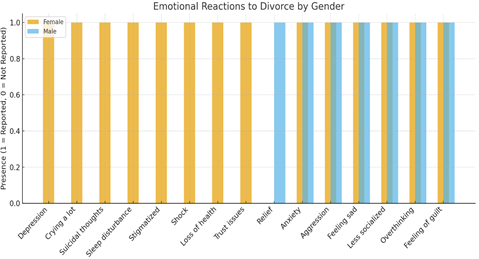
Ending a relationship is not a joyful experience. However, women are more inclined towards these psychological problems (Azhar et al., 2018). Some of the responses of females are as follows:
I kept waking up at night thinking, walking, it means there was no one who understood me, so no one could understand me. Then I thought that I should commit suicide. But then I thought that my parents were suffering so much for me that they should bring me out of there alive and then I would end my own life.
At that time, when you suddenly got a divorce. I was angry at that time. I didn't expect that my husband would say these words or say something like that. In the beginning, I had forgotten myself. I used to see the kids and cry. I didn't want to take care of myself. I had completely forgotten myself.
Stigma for FemalesDivorce is seen as a stigma in our society, especially for females even though if the ending of a relationship appears to be beneficial for a female, yet she would get emotional reaction over divorce (Ikram & Usman, 2022). Many females argued about this as,
Our society is such that it does not point its finger at men much, it always points its finger at women and says that no matter what happens, a woman should build her own home.
Contrarily, males also show emotional reaction over their divorce, however theirs are not very intense as compared to females. It has been observed that the majority of men would get tensed, overthink a lot, feel burdened, sad, and heartbroken, but in some cases, men would take a sign of relief after getting divorced. A reaction of male participant is as follow,
I didn't have any emotional reaction. But yes, I was tensed. I had a lot of thoughts in my mind. How can this happen to me? Although I have never done anything wrong to anyone. How can this happen to me? That was my only emotional reaction. At first, for a week or two, I didn't know what to do. I didn't know what to do. I was always tensed. I used to stay at home. I used to leave work early. I didn't spend much time at work.
On the other hand, males who get a relief after divorce described their emotional reaction as,
It was like, there is a nail in the shoe, and it hurts you again and again. When the nail comes out, then you can wear the shoe and walk comfortably. It was the same system. One thing was disturbing me again and again. When I was separated from it, the disturbing was over. Life became smooth.
Coping MechanismsDifferent individuals react differently towards divorce. However, in order to resolve the aftermath of marital dissolution, they mostly adopt common coping strategies to regain an emotionally stable and adapted post-divorce life. Following are the strategies revealed through thematic analysis.
Keeping Themselves Busy
Divorcees keep themselves busy either in their jobs or other household works to distract themselves from the aftershocks of divorce that make them emotional. As one of the participants said, “I kept myself busy, so that I have no time to remember my past events”.
Spiritual Attachment : It has been observed that the majority finds inner peace through praying and making themselves more indulged in religion. As one of the participants said, “I prayed to ALLAH if I need something, after that I don’t ask for anything from anyone”.
Parental Strength: Some seek strength through their children and find motivational support that helps them to move forward. As one of the participants claimed, “I used to look at my children and wonder what would happen to them if I lost my courage”.
Social Engagement: In order to feel less isolated, divorcees go out, meet other people, and engage themselves in a more positive environment. As one of the participants said, “I usually came out of my house to forget my sorrow and went to places where people talk less about these things”.
Optimistic Thinking: Few participants exhibited an optimistic approach by reflecting on the lessons they learned from their experiences. A male participant said, “such things occur in life, what we need to do is to focus on the positive aspects and learn from the experience to avoid such things in future”.
Vicarious Copying: Some participants gained motivation through observing people who have successfully navigated divorce and recovered emotionally from a similar situation. A male participant said, “I used to look at the people who had this experience in their life and think that if they had moved on in their lives, I could too.”
Through Talking: Best way to do catharsis is to express yourself. People, when talk about their feelings feel less burdened. A female participant said, “I used to talk about this with my family especially my sisters, and my heart felt lighter after talking to them.”
In case of extreme emotional reaction towards divorce, it has been observed that mostly females undergo therapy sessions and medications to cope with their emotional instability. However, in men, negative coping has been noticed as they indulge in smoking in order to deal with their emotional burden after divorce.
Discussion
The current study aimed to explore the psychological, social, and economic determinants that contribute to divorce, along with the emotional reactions and coping strategies employed by divorcees. The results showed that the psychological determinants of divorce are infidelity, lack of compromise, comparison, unwanted expectations, and lack of compatibility, which are quite common among both the genders. On the other hand, among the social determinants, in-laws' interference, forced marriages, adoption of Western culture, and distance from religion are the most common. Social media exposure also played a great role in determining divorce. In terms of economic factors, lack of fulfillment of basic needs and financial instability are the reasons. These findings align with previous research, suggesting that infidelity, incompatibility, in-laws' interference, and failure to fulfill basic needs exert significant pressure on marital relationships (Killewald, 2016; Mahmood et al., 2016). All these psychological, social, and economic factors effect divorce on multiple levels, as stated above in the theoretical background (Khan et al., 2019).
Moreover, the findings revealed that there is a notable difference in the emotional reactions exhibited by both males and females after divorce. Women exhibit more intense emotional reaction due to stigma and economic dependence. This intense emotional reaction in females is because of community factors. On the other hand, men experience a sense of relief after divorce. These findings are consistent with the previous studies which suggested that women often face social judgements and lack of support. Consequently, they experience more emotional suffering as compared to men (Ikram & Usman, 2022; Shujja et al., 2022).
Coping strategies among divorcees varied from both the genders and availability of support. The current study shed light on the coping mechanism of divorcees which also supported the findings of previous studies. In most of females, it is seen that they make themselves busy or strengthen themselves because of their children. They often cope through social support, religious practices, yet struggle for financial independence due to stigma and dependency issues. While in most of the males, vicarious copying is observed. Men may cope by remarrying more quickly, seeking relief in work, or perceiving divorce as freedom from marital conflict (Khalil et al., 2014).
The study also revealed a troubling trend. In certain families, in-laws deliberately avoid using the term "divorce," instead subjecting women to extended periods of psychological or physical distress. This pressure often leads women to seek Khula, which is the legal process for a wife to initiate divorce. In such situations, unless the marriage contract states otherwise, women frequently have to give up their Haq Mehr rights (Zaman, 2014). This strategy allows men to dodge financial obligations while placing the blame squarely on the woman, which undermines both the ethical and legal standards of Islamic marriage.
Recommendations to Reduce Divorce Rates >Advice and recommendations from ‘people that are gone through the rat race of divorce’ on how not to go around the divorces sortie in regards to your marriage. These insights are through the phases of before marriage, during the marriage, and after end of marriage which fully describes the relationship dynamics that are dominated by social, cultural, and religious norms.
Recommendations Before MarriageThe divorcees really stressed personal choice and compatibility as being critical when it comes to marriage and divorcees. Most of them advised parents and guardians against pressuring parents into marrying their children without their consent, as mutually understanding is difficult and the distance often results in irrelevant emotional separation and unhappiness. Another consensus was that men and women before the wedding must be financially stable and independent. Another piece of advice was to get married after doing a thorough background check on prospective partners, something that a majority of would have averted their future heartaches. Interestingly, these divorcees also remarked that there should be an opportunity given beforehand for couples to meet and exchange views if they’re to marry — that they are intellectually and emotionally alike. It serves to an easing away from traditional cultural norms that injustice such interactions.
Recommendations During MarriageUpon exchange of the vows, participants share different ways of nourishing and staying safe within the marital bond. The key suggestions for leading a prosper life are to give the newlyweds some space, minimize interference from extended family and avoid sharing personal issues with outsiders. It has been proved that gossip, unsolicited advice, and outside interference can escalate trivial issues.
Patience, empathy, respect, and lines of communication are a number of ways that can save a relationship. In fact, the participants pointed out that you need work, understanding, and compromise for a happy marriage. Indeed, having the support from family and support systems was also shown to help maintain a healthy relationship.
Post-Divorce Recommendations and ReflectionsThe process of divorce embarks several people on a journey of self-discovery. They dedicate themselves to individual development while developing their resilience skills. Individuals began to make meaningful contributions to society while developing skills to become self-sufficient, as well as reconstruct their lives specifically to benefit children. People acknowledged the possibility of remarriage for individual cases where no children exist and when a suitable right partner emerges.
A significant number of divorcees particularly women who are raising children as a single parent appear to be extremely cautious while remarrying. Such divorcees emphasized self-reliance, as well as the importance of kids' happiness and daughters' well-being above strict marriage traditions.
These insights gathered from divorce survivors demonstrate the emotional development which takes place when people gain wisdom after divorcing. Their personal accounts bring crucial insights for families and community leaders and policymakers as Pakistan faces rising divorce statistics.
LimitationsThe sample is very small and the weightage is not equally divided among male and female populations. This sample is only confined to South Punjab region, thus lacks generalizability. Furthermore, studies are required to include sample from all over Pakistan in order to obtain vast generalizable findings. Although the study discussed the role of Haq Mehr, but there is limited scope of legal aspects. Being qualitative in nature, this study does not provide any statistical data.
SuggestionsThe current study highlights a crucial issue regarding Haq Mehr in which in-laws exploit Haq Mehr provision, often pressuring women to take Khula, which legally obliges them to forfeit their Haq Mehr. Further research is needed to explore the prevalence of this practice and to provide better potential interventions to prevent the misuse of Khula provision. Based on the findings, it is suggested that there is still a need to perform this study on a larger sample to ensure generalizability. A mixed method study should be performed so that it will help in finding the mediating and moderating factors of divorce and correlation and regression factors. This study is bound to South Punjab exclusively, however there is a need for a study based on a sample belonging to every socio-economic status for vast set of knowledge. It should be investigated that how religious teachings and cultural norms influence decisions about divorce, remarriage, and Haq Mehr, only then it could provide richer contextual understanding.
ConclusionIn-depth analysis of the life experiences of divorcees revealed that the reasons behind marital breakdowns are not really easy as people may presume. Divorce is not caused by one thing only, in fact it has a complicated web of emotional, cultural, financial, and interpersonal problems in play. In-laws’ interference, infidelity, financial struggles, or never-ending expectations are some common reasons why partnerships fail. Some of these problems can be attributed to the absence of good, strong, and guiding values within the family structure. With the adoption of Islamic principles, these would form a cornerstone of a blessed family and a flourishing marriage. In today’s modern world, the youth are feeling the impact of social media phenomenon and developed interest in materialism and Western ideals in particular. There is moving away from tolerance closer to emotional immaturity that minimizes the value of marriage and familial responsibility.
Furthermore, the findings suggested that in order to avoid the closure of marriages, couples should be made to go for mandatory pre-marital education as well as counseling. Such practices will make them ready for the challenges they might encounter in married lives. The couple training would primarily focus on mutual respect, conflict resolution, and other Islamic values pertaining to family life. Moreover, policymakers have to take charge by rationalizing the inappropriate online content and patronizing media projects aimed at multiplying healthy relationships and affirming social values. If we guarantee proper implementation of Haq Mehr and skills-based independence (especially for women), it will particularly bring marital stability and curb the increasing divorce rate.
Author Contribution
Mahnoor Akmal: conceptualization, data curation, formal analysis, writing – original draft, visualization, and writing – review & editing. Asma Bashir: supervision, formal analysis, writing – review & editing.
Conflict of Interest
The authors of the manuscript have no financial or non-financial conflict of interest in the subject matter or materials discussed in this manuscript.
Data Availability Statement
The data associated with this study will be provided by the corresponding author upon request.
Funding Details
No funding has been received for this research.
Generative AI Disclosure Statement
The authors did not used any type of generative artificial intelligence software for this research.
REFERENCES
Al-Bahrani, M. A. (2021). Post-divorce experience within Arab context: Gender differences. International Journal of Social Science and Humanity, 11(3), 54–58.
Arham, M. (2024). 35% increase in divorce rate in Pakistan: Statistics Bureau report. Evision Pakistan. https://envisionpakistan.com/35-increase-in-divorce-rate-in-pakistan-statistics-bureau-report/
Azhar, A., Abbas, J., Wenhong, Z., Akhtar, T., & Aqeel, M. (2018). Linking infidelity stress, anxiety, and depression: Evidence from Pakistan married couples and divorced individuals. International Journal of Human Rights in Healthcare, 11(3), 214–228. https://doi.org/10.1108/IJHRH-11-2017-0069
Bronfenbrenner, U. (1979). The ecology of human development. Harvard University Press.
Clarke, V., & Braun, V. (2013). Teaching thematic analysis: Overcoming challenges and developing strategies for effective learning. The Psychologist, 26(2), 1–18.
Hussain, S., & Siddiqui, A. (2023). Impact of divorce-related content in Pakistani TV dramas on marital life of viewers in Pakistani society. Journal of Mass Communication, 29, 95–130. https://doi.org/10.46568/jmcd.v29i2.209
Ikram, K., & Usman, A. (2022). Informal social networks and post-divorce challenges of middle-aged divorced women. Pakistan Languages and Humanities Review, 6(3), 253–262. https://doi.org/10.47205/plhr.2022(6-III)21
Kamal, N. M. (2021, November 7–8). Social media: Contributors to relationship dissolution? [Paper presentation]. Proceedings of the 7th International Conference on Communication and Media, Kedah, Malaysia.
Khalil, R., Naeem, Z., Yousafzai, M. T., & Gul, S. (2014). Marriage as a bond or a burden: A study on married female college teachers of Karachi, Pakistan. International Journal of Social Sciences and Education, 4(3), 636–642.
Khan, G., Sikander, P., & Akhlaq, A. (2019). Factors pertaining to rising divorce rate and its consequences on the family culture of Pakistan: A qualitative study. IBT Journal of Business Studies, 15(2), 199–210.
Khurshid, F., Khatoon, S., & Khurshid, N. (2012). Personal, social and psychological factors leading towards divorce. Interdisciplinary Journal of Contemporary Research in Business, 3(11), 212–230.
Killewald, A. (2016). Money, work, and marital stability: Assessing change in the gendered determinants of divorce. American Sociological Review, 81(4), 696–719. https://doi.org/10.1177/0003122416655340
Kuss, D. J., & Griffiths, M. D. (2011). Online social networking and addiction—A review of the psychological literature. International Journal of Environmental Research and Public Health, 8(9), 3528–3552. https://doi.org/10.3390/ijerph8093528
Mahmood, Z., Anwer, M. S., Javaid, A., & Nawaz, S. (2016). Social and economic determinants of divorce in Pakistan: A case study of Multan District. Journal of Culture, Society and Development, 19, 18–24.
Muzammil, M. A., Umm-e-Salma, & Mumtaz, S. (2024). Socioeconomic determinants of divorce in Pakistan: A case study of Bahawalpur. Zakariya Journal of Social Sciences, 3(1), 11–22. https://doi.org/10.59075/zjss.v3i1.435
Oldham, J. T. (2021). Divorce, separation, and the distribution of property. Law Journal Press.
Gallup. (2022). Pakistan statistical yearbook 2022. https://gallup.com.pk/post/33614
Qamar, A. H., & Faizan, H. F. (2021). Reasons, impact, and post-divorce adjustment: Lived experience of divorced women in Pakistan. Journal of Divorce & Remarriage, 62, 349–373. https://doi.org/10.1080/10502556.2021.1871840
Rubab, K., & Alam, A. (2022). Perceived proximate and underlying divorce causes in Hazara Division, Pakistan. Pakistan Journal of Social Research, 4(4), 65–78.
Sahoutara, N. (2021). Cases of women seeking khula jumped by over 700pc in 2020. https://www.dawn.com/news/1599786
Shabbir, M., Akram, S., & Niaz, U. (2022). Psycho-social and economic complications faced by divorced women in Faisalabad, Pakistan: A qualitative study. Annals of Human and Social Sciences, 3(3), 351–359. https://doi.org/10.35484/ahss.2022(3-III)33
Shujja, S., Akram, A., Holzapfel, J., & Randall, A. K. (2022). Perceived ex-husband rejection and psychological distress among Pakistani remarried women following divorce: Does emotional intelligence moderate? Current Psychology, 41, 631–642. https://doi.org/10.1007/s12144-019-00601-6
Statista Research Department. (2021). Divorce rates in Europe in 2019, by country. https://www.statista.com/statistics/612207/divorce-rates-in-european-countries-per-100-marriages/
Waseem, J., Muneer, R., Hoor-Ul-Ain, S., Tariq, R., & Minhas, A. (2020). Psychosocial determinants of divorce and their effects on women in Pakistan: A national review. International Journal of Human Rights in Healthcare, 13(4), 299–315. https://doi.org/10.1108/IJHRH-09-2018-0059
Widiantari, M. M., Utari, P., & Nurhaeni, I. D. (2019). Social media effect on divorce. In Proceedings of the 1st Annual International Conference on Social Sciences and Humanities (AICOSH 2019). https://doi.org/10.2991/aicosh-19.2019.34
Zaman, F. (2014). Haq mehr and the right to property: Legal perspectives on Muslim women's rights in Pakistan. Islamic Studies, 53(1), 63–85.