

| Review | Open Access |
|---|
Personality Traits and Cyberchondria: Investigating the Mediating Role of Rumination among Women with Polycystic Ovarian Syndrome |
 |
|---|
 Huda Khawar1*,
Masha Asad Khan1
Maloney Karen Javed2*, and
Maheen Abid3
Huda Khawar1*,
Masha Asad Khan1
Maloney Karen Javed2*, and
Maheen Abid3
1Department of Psychology, Kinnaird College for Women Lahore, Pakistan
2Memory Service, Oxleas NHS Foundation Trust, England
3Institute of Psychology, Beaconhouse National University, Lahore, Pakistan
This study examined the relationship between personality traits and cyberchondria using rumination as a mediator in women diagnosed with polycystic ovarian syndrome (PCOS). It was hypothesized that there will be a significant relationship between personality traits and cyberchondria in women with PCOS. Additionally, each personality trait will likely to predict cyberchondria. Furthermore, rumination will significantly mediate the relationship between traits of personality and cyberchondria. Correlational research design was used employing non-probability purposive sampling technique, to recruit the participants and data collection. The data were collected using Big Five Inventory, Rumination Response Style Questionnaire, and Cyberchondria Severity Scale. Correlational analysis, multiple regression and mediation analysis were performed. Findings confirmed a significant correlation between extraversion and cyberchondria and rumination and cyberchondria. Results also revealed that extraversion and rumination are significant predictors of cyberchondria. In conclusion, rumination acts as a significant mediator between conscientiousness and cyberchondria, agreeableness and cyberchondria and neuroticism and cyberchondria. This study fills the research gap by spreading awareness to all those women with different personality traits who are experiencing PCOS. Individuals who know themselves better can control themselves more efficiently. This research can also provide guidance in the development of therapeutic interventions for cyberchondria, particularly for women with PCOS.
1. INTRODUCTION
Polycystic ovarian syndrome (PCOS) is a commonly occurring disorder of endocrine system in females of reproductive age, affecting 8-13% of them (Hoegar et al., 2021). PCOS is a chronic health problem that threatens patients’ physical and mental health (Yin et al., 2021). These difficulties may be explained by underlying personality dispositions that affect how individuals perceive and cope with health threats. Neuroticism has been repeatedly associated with negative affect and dysfunctional coping among the big five personality traits (McCrae & Costa, 2008). Females with high neuroticism can become more obsessed with bodily sensation and health, leading them to excessive online searches for a range of physical issues also known as cyberchondria (Newby & McElroy, 2020; Torabi & Pourmohammad, 2025). Repeated and excessive consulting of information on the internet about health is a central feature of cyberchondria that serves as a paradoxical contributor to mild anxiety, rather than its intended purpose reassurance (McMullan et al., 2019).
Studies have found that increased neuroticism is known to give rise to cyberchondria, on account of proneness to anxiety and avoidance of ambiguity (Bajcar & Babiak, 2020). For women with PCOS this is especially pertinent, as so many live with chronic uncertainty in relation to their symptoms, treatments and long-term health morbidities (Bazarganipour et al., 2013). The unpredictability of PCOS related health concerns could potentially serve to trigger excessive information seeking, perpetuating cycles of anxiety (Sucu et al., 2024).
One of the key mechanisms that may mediate the connection between personality and cyberchondria is rumination i.e., passive and repetitive focus on one’s distress or symptoms and their possible source and consequences (Nolen-Hoeksema et al., 2008). Those high in neuroticism are more likely to engage in ruminative processes that maintain negative effect and motivate maladaptive behavioural tactics e.g. reassurance seeking or compulsive internet seeking (Singh & Mishra, 2023). In health contacts, rumination can heighten attention to symptoms amplify perceived threat and increase the likelihood of turning to online resources thereby escalating cyberchondriasis (Joyner et al., 2018). Soomro and Akhlaq (2018), in their study unveiled that a particular dimension of cyberchondriasis, referred to as compulsion, displayed a significant correlation with an increased likelihood of PCOS patient seeking health related information online in Pakistan.
Polycystic ovarian syndrome is a problem that occurs among females in their reproductive age. The physiological side of PCOS is better known, and the increasing attraction of research on its psychological side consequently. Rumination and cyberchondria represent one of such dimensions, and may be in interaction with personality traits. The exploration of this relationship is of significance because personality traits are excusatory in shaping the dissimilar behavior of various individuals in terms of viewing, processing, and reacting to the information about health differently. Five factor model that was offered by Costa and McRae in 1992 can be used to answer the question of how traits, including neuroticism (associated with the tendency toward anxiety) or openness (associated with the need to acquire information) (Xie & Cobb, 2020) could contribute to cyberchondria, whereas the trait is ruminative. The fact that PCOS among the Pakistani population is widespread and that more people are relying on the Internet to obtain health information cause the necessity to understand the possible psychological implications. By frantically seeking information, women with PCOS may end up increasing their health anxiety unknowingly digging their own grave on the weight of a long-term disease and performing too much rumination.
Based on the metacognitive theories, the proposed hypothesis of mediation indicated that personality traits affect ruminative tendencies that subsequently mediate the relationship between personality traits, on the one hand, and cyberchondria, on the other hand, among PCOS women. The possibility was that neuroticism made women more prone to rumination, which worsened health anxiety and increased inclination to cyberchondriacs. Instead, extraversion may be linked to reduced ruminating disposition leading to a decreased participation in health-related Internet research (Hastall et al., 2017). Past results have emphasized that the big five personality models are connected to the various psychological states (Kotov et al., 2010). In particular, high neuroticism, low conscientiousness, and low extraversion have been effectively related to anxiety disorders i.e. health anxiety and cyberchondria (Asmundson & Taylor, 2020; de la Cuesta et al., 2019).
Additionally, a number of studies have proven the apparent relationship between cyberchondria and neuroticism and negative emotions (Bajcar & Babiak, 2020; Bordbar, 2023; Maftei & Holman, 2020; Manzoor et al., 2025; Nasiri et al., 2023) and rumination and personality (Liu et al., 2023).
The results of one of the studies by Blachnio et al. (2023) showed that rumination mediated partially in the relationship between perceived stress as a threat and cyberchondria, and perceived stress as harm or loss and cyberchondria. Cyberchondria was found to have positive relationships with rumination, perceived stress as harm or loss and perceived stress as a threat.
The main objectives of the study were to explore tendencies of cyberchondria in women with PCOS, the relationship between personality traits and cyberchondria and further, to explore the role of rumination in the relationship of personality traits and cyberchondria, as a mediator in women with PCOS. For the said reason, following hypotheses were proposed.
H1: There is a significant relationship between personality traits and cyberchondria in women with PCOS.
H2: Each personality trait will likely to predict cyberchondria in women diagnosed with PCOS.
H3: Rumination will significantly mediate the relationship between traits of personality and cyberchondria in women with PCOS.
Method
Research DesignIn order to find the relationship between personality traits and cyberchondria in women with PCOS, correlational research design was used. Participants were recruited using non-probability purposive sampling technique for data collection.
SampleA sample of 150 women diagnosed with PCOS was included in the study. The sample was collected from different hospitals, private clinics and through online forums like Facebook support groups.
Female adults aged 18 to 45 years, diagnosed with PCOS were included in the study. Women below eighteen years or above forty-five years of age with the presence of other severe medical or psychiatric conditions or currently undergoing specific psychological interventions or pregnant participants were excluded from the study as all the mentioned features can influence both personality traits and health information-seeking behaviors. According to Hoegar et al. (2021), the age range of 10 to 19 years is the period of pubertal maturation which serves as a dilemma for the diagnosis of PCOS. On account of this very reason, the females below 18 years were not included in the study. As for the women above 45 years of age, Opoku et al. (2023) report that menopausal age varies from country to country. An estimated onset of menopause is 45 to 49 years. Therefore, females above the age range of 45 were excluded from the study.
Table 1 shows the socio-demographic characteristics of the participants involved in the study.
Table 1
Socio-demographic Characteristics of the Participants (N = 150)
|
Sociodemographic characteristics |
M |
SD |
f |
% |
|---|---|---|---|---|
|
Age |
24.33 |
3.52 |
- |
- |
|
Marital status |
|
|
|
|
|
Married |
- |
- |
31 |
20.7 |
|
Unmarried |
- |
- |
119 |
79.3 |
|
Education |
|
|
|
|
|
Matric |
- |
- |
2 |
1.3 |
|
Intermediate |
- |
- |
20 |
13.3 |
|
Graduate |
- |
- |
114 |
76.0 |
|
Postgraduate |
- |
- |
14 |
9.3 |
|
Weight |
59.83 |
13.32 |
- |
- |
|
Residence |
|
|
|
|
|
Rural |
- |
- |
47 |
31.3 |
|
Urban |
- |
- |
103 |
68.7 |
|
PCOS symptom severity |
|
|
|
|
|
Mild |
- |
- |
60 |
40.0 |
|
Moderate |
- |
- |
61 |
40.7 |
|
Severe |
- |
- |
29 |
19.3 |
|
Access to instant health care |
|
|
|
|
|
Yes |
- |
- |
121 |
80.7 |
|
No |
- |
- |
29 |
19.3 |
|
Frequency of internet usage before PCOS diagnosis |
||||
|
Infrequent |
- |
- |
26 |
17.3 |
|
Sometime |
- |
- |
71 |
47.3 |
|
Quiet often |
- |
- |
53 |
35.3 |
|
Frequency of internet usage after PCOS diagnosis |
||||
|
Infrequent |
- |
- |
24 |
16.0 |
|
Sometime |
- |
- |
47 |
31.3 |
|
Quiet often |
- |
- |
79 |
52.7 |
|
Sources of health information |
|
|
|
|
|
Random Google articles |
- |
- |
50 |
33.3 |
|
Specific health related websites |
- |
- |
30 |
20.0 |
|
Social media platforms |
- |
- |
59 |
39.3 |
|
Others |
- |
- |
11 |
7.3 |
|
Type of health information sought online |
|
|
|
|
|
Treatment options for PCOS |
- |
- |
76 |
50.7 |
|
Undiagnosed medical conditions |
- |
- |
30 |
20.0 |
|
Other’s experiences of PCOS |
- |
- |
26 |
17.3 |
|
Others |
- |
- |
18 |
12 |
The Big Five Inventory, developed by John et al. (1991), was used to assess personality traits. This self-report inventory measures five major personality traits and consists of 44 items that respondent’s rate on a five-point Likert scale, ranging from 1 to 5. Higher scores typically indicate a stronger presence of that trait. Satisfactory reliability has been indicated by alpha coefficients, ranging from .70 to .80.
Rumination Response Style Questionnaire (RRSQ)The Rumination Response Styles Questionnaire (RRSQ) was developed by Nolen-Hoeksema (1991) as a self-report tool. Its purpose is to measure individual’s habitual tendency to engage in repetitive and passive focus on distress. It also assesses two distinct response styles i.e., reflective rumination and brooding rumination. Consisting of 22 items, the RRSQ employs a 4-point Likert scale that ranges from 1 (almost never) to 4 (almost always). The internal consistency of this scale was found to be .89 (Nolen- Hoeksema & Morrow, 1991).
Cyberchondria Severity Scale (CSS-12)Cyberchondria Severity Scale was developed by McElroy and Shevlin (2014). CSS-12 consists of four subscales namely, excessiveness, distress, reassurance and compulsion. Higher scores reflect greater severity of cyberchondria. Cronbach's alpha coefficient for the reliability of the CSS was 0.89, which shows high internal consistency.
ProcedureThe authors of scales were formally contacted and permission was sought for the usage of their tools in this study. A formal data collection authorization was obtained from the institution. The process of data collection commenced, involving engagement with various hospitals, private clinics, and online Facebook groups for the recruitment of the participants. The authorities of the respective institutions were contacted to get the permission to recruit the patients from their institutions. The authorities were requested to ask the willing patients of PCOS to fill this proforma. Patients who came as outdoor patients were directly asked to participate in the research. Participants were administered on a demographic sheet, Big Five Inventory, Rumination Response Styles Questionnaire and Cyberchondria Severity Scale. Participants took 10-15 minutes approximately to fill in the questionnaires. One time approach to participants was used.
Ethical ConsiderationsThe hospital outpatient setting was sampled by collecting data after the consent of the treating gynecologist, who would also be the first point of contact to make sure that potential participants would be contacted in a way that would be ethically correct and culturally sensitive. Women got to know about the study only when their clinical consultation had been completed, and no specifics of patient were revealed to the researcher before the consent. The physician briefly introduced the study to the eligible participants and provided them with a chance to talk with the researcher in case they were interested. Since reproductive health conditions like PCOS were culturally sensitive, recruitment was done in a culturally sensitive manner with consideration of privacy, respect and autonomy as well as all the study information presented in the language that the participants understand and enough time was given to question and clarifications.
Informed consent was obtained by providing a clear explanation of the study objectives, procedures, potential risks, and confidentiality protection to the participants before data collection. The involvement was purely voluntary and the respondents could choose to decline or withdraw at any point without it affecting their medical treatment. The questionnaires were completed in a confidential, non-pressurizing environment, the data were kept confidential and made available to the researcher through the use of participant codes, the data has been stored and accessed afterwards. The original authors granted permission to all standardized assessment instruments, which was preceded by emails before commencement of the study, and this has ensured that ethical research standards are met.
Results
Table 2
Psychometric Properties of Study Variables (N = 150)
|
Scale |
M |
SD |
Range |
α |
Skewness |
Kurtosis |
|---|---|---|---|---|---|---|
|
BFI |
|
|
|
|
|
|
|
Openness |
32.08 |
5.31 |
1.80 |
.74 |
-3.27 |
3.28 |
|
Conscientiousness |
25.96 |
4.61 |
1.88 |
.70 |
.96 |
.70 |
|
Extraversion |
21.65 |
4.98 |
1.05 |
.70 |
-0.68 |
-0.47 |
|
Agreeableness |
32.58 |
5.51 |
1.34 |
.75 |
1.03 |
-2.23 |
|
Neuroticism |
27.89 |
6.12 |
1.17 |
.80 |
-0.29 |
-1.91 |
|
RRS |
57.91 |
12.85 |
.79 |
.92 |
2.16 |
-0.89 |
|
CSS |
35.59 |
9.35 |
.88 |
.87 |
1.39 |
-0.25 |
Note. BFI = Big Five Inventory, RRS = Rumination Response Style, CSS = Cyberchondria Severity Scale.
Table depicts acceptable internal consistencies of the subscales of the Big Five Inventory (BFI). The table also shows strong internal consistency of Rumination Response Styles Questionnaire and good internal consistency of Cyberchondria Severity Scale
|
Variables |
M |
SD |
1 |
2 |
3 |
4 |
5 |
6 |
7 |
|---|---|---|---|---|---|---|---|---|---|
|
Openness |
3.46 |
.48 |
- |
|
|
|
|
|
|
|
Consc. |
3.27 |
.54 |
.13 |
- |
|
|
|
|
|
|
Extra. |
3.14 |
.64 |
.09 |
.16 |
- |
|
|
|
|
|
Agrebl. |
3.62 |
.61 |
.40** |
.36** |
.03 |
- |
|
|
|
|
Neuro. |
3.48 |
.76 |
.15 |
-.34** |
-.32** |
-0.16* |
- |
|
|
|
Rumin. |
57.91 |
12.85 |
.22** |
-.19* |
-.03 |
.04 |
.45** |
- |
|
|
CC |
35.59 |
9.35 |
-.00 |
-.01 |
.18* |
-.01 |
.01 |
.36** |
- |
Note. Consc. = conscientiousness, Extra.= extraversion, Agrebl.= agreeableness, Neuro.= neuroticism, Rumin.= rumination, CC = cyberchondria
p* ˂ .05, p** ˂ .01
The results revealed that there is a significant positive relationship between openness and rumination, neuroticism and rumination, extraversion and cyberchondria and rumination and cyberchondria, while, a significant negative correlation was found between conscientiousness and rumination.
Table 4
Multiple Linear Regression showing Personality Traits and Rumination as Predictors of Cyberchondria (N = 150)
|
Predictors |
B |
95% CI for B |
SE |
β |
R2 |
|
|---|---|---|---|---|---|---|
|
LL |
UL |
|||||
|
Cyberchondria |
||||||
|
|
|
|
|
|
|
.23 |
|
Constant |
17.02 |
.63 |
33.40 |
8.29 |
---- |
|
|
Personality Traits |
|
|
|
|
|
|
|
Openness |
-1.65 |
-4.86 |
1.56 |
1.62 |
-.09 |
|
|
Conscientiousness |
1.46 |
-1.31 |
4.23 |
1.40 |
.09 |
|
|
Extraversion |
2.39 |
.19 |
4.60 |
1.11 |
.17* |
|
|
Agreeableness |
-0.59 |
-3.13 |
1.94 |
1.28 |
-.04 |
|
|
Neuroticism |
-1.76 |
-3.95 |
0.42 |
1.11 |
-.15 |
|
|
Rumination |
0.34 |
0.23 |
0.46 |
0.60 |
.50*** |
|
Note. *p< .05, ***p< .001
In the model, six predictor variables were entered and the regression model was found to be significant, R2= .23, F (6, 140) = 7.02, p < .001. Among all the predictors entered, extraversion and rumination emerged as significant positive predictors of cyberchondria.
Mediation Analysis
The SPSS Macro PROCESS by Hayes (2013) was run to investigate the mediating role of rumination between personality traits and cyberchondria.
Table 5
Simple Mediation Analysis showing Direct and Indirect Effects of Rumination on Personality Traits and Cyberchondria (N = 150)
|
Criterion Variable |
Predictor Variable |
β |
p |
95% CI |
|||
|---|---|---|---|---|---|---|---|
|
LL |
UL |
||||||
|
Direct Effect |
|||||||
|
Rumination |
Openness |
6.13** |
< .01 |
1.79 |
10.48 |
||
|
Cyberchondria |
Openness |
-1.52 |
.308 |
-4.45 |
1.42 |
||
|
Cyberchondria |
Rumination |
.28*** |
< .001 |
.17 |
.39 |
||
|
Indirect Effect |
|||||||
|
Cyberchondria |
Openness through Rumination |
1.71 |
---- |
.55 |
3.05 |
||
|
Direct Effect |
|||||||
|
Rumination |
Conscientiousness |
-4.70* |
< .05 |
-.857 |
-.83 |
||
|
Cyberchondria |
Conscientiousness |
2.01 |
.124 |
-.56 |
4.58 |
||
|
Cyberchondria |
Rumination |
.28*** |
< .001 |
.17 |
.39 |
||
|
Indirect Effect |
|||||||
|
Cyberchondria |
Conscientiousness through Rumination |
-1.33 |
---- |
-2.63 |
-.20 |
||
|
Direct Effect |
|||||||
|
Rumination |
Extraversion |
-.66 |
.691 |
-3.95 |
2.62 |
||
|
Cyberchondria |
Extraversion |
3.09** |
< .01 |
1.04 |
5.14 |
||
|
Cyberchondria |
Rumination |
.27*** |
< .001 |
.17 |
.37 |
||
|
Indirect Effect |
|||||||
|
Cyberchondria |
Extraversion through Rumination |
-.01 |
---- |
-.07 |
.05 |
||
|
Direct Effect |
|||||||
|
Rumination |
Agreeableness |
.81 |
.641 |
-2.63 |
4.26 |
||
|
Cyberchondria |
Agreeableness |
-.18 |
.872 |
-2.04 |
2.04 |
||
|
Cyberchondria |
Rumination |
.27*** |
<.001 |
.16 |
.37 |
||
|
Indirect Effect |
|||||||
|
Cyberchondria |
Agreeableness through Rumination |
.22 |
---- |
-.77 |
1.24 |
||
|
Direct Effect |
|||||||
|
Rumination |
Neuroticism |
7.67*** |
<.001 |
5.20 |
10.15 |
||
|
Cyberchondria |
Neuroticism |
-2.83** |
<.01 |
-4.78 |
-.88 |
||
|
Cyberchondria |
Rumination |
.34*** |
<.001 |
.23 |
.46 |
||
|
Indirect Effect |
|||||||
|
Cyberchondria |
Neuroticism through Rumination |
.22 |
---- |
.13 |
.33 |
||
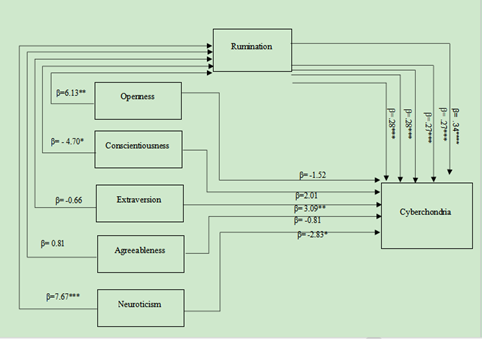
Results revealed that rumination fully mediates the relationship between openness and cyberchondria. It also revealed that rumination mediates the relationship between conscientiousness and cyberchondria and also between extraversion and cyberchondria. While, it partially mediates the relationship between neuroticism and cyberchondria. For agreeableness, rumination did not mediate the relationship and didn’t show direct or indirect effects on cyberchondria.
The figure below explains the mediation model of rumination as a mediator between personality traits and cyberchondria among PCOS women.
Figure 1
Emerged Mediation Model Showing Rumination as a Mediator between Openness, Conscientiousness, Extraversion, Agreeableness, Neuroticism and Cyberchondria
Discussion
Polycystic ovarian syndrome (PCOS) is a prevalent endocrine disorder which afflicts most women during their reproductive age. It is frequently accompanied by additional stress, health-related anxieties, and reduced life quality, in general (Yin et al., 2021). As the symptoms of PCOS may be chronic and difficult to diagnose, many individuals resort to online health forums to know more and attempt to control their disorder. Although the convenience of information accessibility may assist, excessively searching information, a phenomenon that is referred to as cyberchondria, may actually increase the level of anxiety and result into inappropriate coping mechanisms (Nasiri et al., 2023).
This research examined the possible role of personality factors and rumination in the promotion of cyberchondria among PCOS women. This study attends to rumination as a major mental process since individuals who constantly revert to negative thoughts may be more likely to let their health concerns get out of control when searching the Internet. It is essential to understand these connections in order to identify individuals at risk as well as to develop more effective psychological support.
The accessibility of medical information online and increased utilization of digital resources to manage health problems have significantly heightened the practice of health-related internet use, even in chronic conditions (Jungmann & Witthöft, 2025; Zhao et al., 2022). Health-related online searches often relate to high levels of health anxiety and reinforce cyberchondria, as it is considered excessive and distressing online health information seeking which increases rather than reduces anxiety (Schenkel et al., 2021).
Firstly, it was proposed that personality traits and cyberchondria will be significantly associated in women with PCOS. The results of this study showed that there is a significant positive relationship between extraversion and cyberchondria. This indicates that extroverted women with PCOS are more likely to engage in repetitive online health information seeking behaviours i.e., cyberchondria. Our results exclusively reveal that among all the traits of Five Factor Model, only extraversion has a relationship with cyberchondria. Oniszczenko (2025) found a weak negative association between extraversion and cyberchondria, while investigating the relationship among body mass index, traits and cyberchondria. However, most of the previous researches show a relationship between neuroticism and cyberchondria (de la Cuesta et al., 2019; Maftei & Holman, 2020). de la Cuesta et al. (2019), on the basis of their research findings inferred that conscientiousness and neuroticism have an influence on the rise of health anxiety in people via a repetitive Internet search for health information. While the traits of extraversion, agreeableness, and openness do not affect cyberchondria. This heightened psychological distress could alter the typical associations between personality traits and behaviors such as cyberchondria. Maftei and Holman (2020) also showed that neuroticism and cyberchondria are associated with each other positively.
Current research targeted a population that was not previously studied with these study variables. Most existing studies on cyberchondria and personality traits have focused on general populations or different subgroups. In contrast, this research specifically targets women with PCOS, as this condition not only affects physical health but also affects psychologically. The individual who are extrovert are more prone to be influenced by other opinions whether it be other people or online available information (Pinto et al., 2024).
It was also hypothesized that personality traits will predict cyberchondria in women diagnosed with PCOS. Only extraversion, of the five personality traits emerged as the significant positive predictor of cyberchondria. A recent study although showing association between extraversion and cyberchondria did not confirm extraversion as the predictor of it (Oniszczenko, 2025). These findings are not supported by much of the previous research on personality traits and cyberchondria (Bajcar & Babiak, 2020; Maftei & Holman, 2020).
Bajcar and Babiak, (2020) in their study reported that neuroticism does not explain cyberchondria directly, but might be mediated by other factors. Maftei and Holman (2020) concluded their research on the impact of optimism and neuroticism on cyberchondria that optimism served as a protective factor for cyberchondria while neuroticism positively predicted cyberchondria in all age groups.
Extroverted individuals are often more socially active and may use the internet to seek out health information as a means of engaging with and expanding their social networks. For women with PCOS, online forums and support groups can be a critical source of support and information. This social aspect of health information seeking may contribute to the observed positive relationship between extraversion and cyberchondria. Owing to lack of enough published research on the role of personality traits in predicting cyberchondria, more research is required to improve the understanding of cyberchondria and its nature.
Additionally, it was hypothesized that rumination significantly mediates the relationship between personality traits and cyberchondria in women with PCOS. Patients high in openness are mostly curious and find new information including health related concerns. This curiosity can cause distress and low mood leading to rumination. Previous research doesn't have much to say about the partial mediation of rumination and between conscientiousness and cyberchondria and there could be numbers of reasons for that, such as conscientious people tend to focus more on each and every detail which can lead to over-thinking and disturb thinking affecting cyberchondria.
Extroverted individuals tend to use coping mechanisms such as family, social support which helps them to deal with stress and get rid of disturbing thoughts. Moreover, extroverted people have different online activities such as online gaming, online social groups, vlogging etc., which divert their interests and decrease stress and the tendency to engage in rumination. Nasiri et al. (2023) found that personality traits like openness to experience, agreeableness, and conscientiousness do not significantly influence other variables in the model.
Neuroticism and extraversion were the only personality traits that had significant pathways to cyberchondria, mediated by cognitive bias, health-related metacognitions, and emotion dysregulation. Additionally, rumination was shown to affect cyberchondria significantly, while the direct effects of neuroticism and extraversion on cyberchondria were insignificant (Nasiri et al., 2023).
Limitations and SuggestionsThe population size used in the study was small because the population under investigation is very scarce. The findings should be validated by replication studies carried out in other demographic and cultural setups. This was a very critical limitation to the participation in the study. The limitation of the study is that the poor reliability of subscales of Big Five Inventory. The implication of this is that the contents of this subscale might not always assess the construct of character traits. Subsequently, the results concerning this subscale need to be treated cautiously. Further studies must take into account future corrections on the items in this subscale or employing other measures which have been found to be reliable.
The study is cross-sectional and thus it is not possible to make any causal inferences. The longitudinal study designs that may be implemented in the future will help gain a better insight into the temporal couples of personality traits, rumination, and cyberchondria. It could also be established in future research on the role of various demographics on the variables of a study.
Future Implications of the ResearchThe results of the current research affirm the need to carry out further research on the processes that relate personality traits, rumination, and cyberchondria. Although rumination was considered as a possible mediator, cyberchondria is a complex phenomenon, which is probably affected by additional cognitive and emotional mechanisms. Further studies must therefore include more intervening variables, which include; health anxiety, illness related metacognitive beliefs, intolerance of uncertainty, emotion-regulation strategies and reassurance seeking behaviors.
Moreover, the current study has limited inferences about the causal and temporality relationship among personality traits, rumination, and cyberchondria because it has a cross-sectional research design. Longitudinal designs will be needed to explain whether personality traits that remain consistent through the years make people vulnerable to habitual rumination and then cyberchondria, or whether habitual participation in health-related online searching and health anxiety-enhancing growth are aspects that lead to the rising levels of ruminative thought over time. Those designs would also enable studying the alterations in cyberchondria at different phases of illness adjustment, especially in chronic diseases like polycystic ovary syndrome (PCOS). This, in its turn, would allow more evidence to be offered on the basis of causal actions and inform the schedule and targets of psychological intervention.
ConclusionThe research concluded that extraversion and cyberchondria possessed positive significant correlation and rumination and cyberchondria had positive significant correlation as well. Furthermore, extraversion and rumination predicted cyberchondria in women with PCOS. The mediation parameter of rumination in relation to the correlation between openness, conscientiousness, and neuroticism with cyberchondria is significant. But rumination significantly mediated the relationship between conscientiousness and neuroticism with cyberchondria, not in the case of openness to experience, and cyberchondria among PCOS women.
Author Contribution
Huda Khawar: conceptualization, data curation, formal analysis, writing – original draft, visualization. Masha Asad Khan: supervision, methodology, writing – review & editing. Maloney Karen Javed: writing – review & editing. Maheen Abid: formal analysis, visualization.
Conflict of Interest
The authors of the manuscript have no financial or non-financial conflict of interest in the subject matter or materials discussed in this manuscript.
Data Availability Statement
The data associated with this study will be provided by the corresponding author upon request.
Funding Details
No funding has been received for this research.
Generative AI Disclosure Statement
The authors did not used any type of generative artificial intelligence software for this research.
REFERENCES
Asmundson, G. J., & Taylor, S. (2020). How health anxiety influences responses to viral outbreaks like COVID-19: What all decision-makers, health authorities, and health care professionals need to know. Journal of Anxiety Disorders, 71, Article e102211. https://doi.org/10.1016/j.janxdis.2020.102211
Bajcar, B., & Babiak, J. (2020). Neuroticism and cyberchondria: The mediating role of intolerance of uncertainty and defensive pessimism. Personality and Individual Differences, 162, Article e110006. https://doi.org/10.1016/j.paid.2020.110006
Bazarganipour, F., Ziaei, S., Montazeri, A., Foroozanfard, F., Kazemnejad, A., Faghihzadeh, S., & Faghihzadeh, S. (2013). Health-related quality of life in patients with polycystic ovary syndrome (PCOS): A model-based study of predictive factors. Journal of Sexual Medicine, 10(10), 2672–2682. https://doi.org/10.1111/jsm.12263
Błachnio, A., Przepiórka, A., Kot, P., Cudo, A., & McElroy, E. (2023). The mediating role of rumination between stress appraisal and cyberchondria. Acta Psychologica, 238, Article e103946. https://doi.org/10.1016/j.actpsy.2023.103946
Bordbar, F. T. (2023). Determining the relationship and predictive contribution of personality traits and self-concept to cyberchondria during the coronavirus disease 2019 pandemic. Journal of Medicine and Public Health, 4, Article e1061.
de la Cuesta, J., Catedrilla, J., Ebardo, R., Limpin, L., Leaño, C., & Trapero, H. (2019, December 2–6). Personality traits of future nurses and cyberchondria: Findings from an emerging economy [Paper presentation]. Proceedings of the International Conference on Computers in Education, Kenting, Taiwan.
Hastall, M. R., & Wagner, A. J. (2017). Enhancing selective exposure to health messages and health intentions. Journal of Media Psychology, 28(3), 97–99. https://doi.org/10.1027/1864-1105/a000204
John, O. P., Donahue, E. M., & Kentle, R. L. (1991). Big Five Inventory. Journal of Personality and Social Psychology, 61(1), Article e11. https://doi.org/10.1037/0022-3514.61.1.11
Joyner, C., Rhodes, R. E., & Loprinzi, P. D. (2018). The prospective association between the five-factor personality model with health behaviors and health behavior clusters. Europe's Journal of Psychology, 14(4), 880–896. https://doi.org/10.5964/ejop.v14i4.1750
Jungmann, S. M., & Dessauer, E. (2025). Health-related internet use and cyberchondria in adolescents: Population-based cross-sectional survey. Journal of Medical Internet Research, 27, Article e65792. https://doi.org/10.2196/65792
Hoegar, K. M., Dokras, A., & Piltonen, T. (2021). Update on PCOS: Consequences, challenges, and guiding treatment. The Journal of Clinical Endocrinology & Metabolism, 106(3). https://doi.org/10.1210/clinem/dgaa839
Kotov, R., Gamez, W., Schmidt, F., & Watson, D. (2010). Linking "big" personality traits to anxiety, depressive, and substance use disorders: A meta-analysis. Psychological Bulletin, 136(5), 768–821. https://doi.org/10.1037/a0020327
Liu, A., Yu, Y., & Sun, S. (2023). How is the Big Five related to college students' anxiety: The role of rumination and resilience. Personality and Individual Differences, 200, Article 111901. https://doi.org/10.1016/j.paid.2023.111901
Maftei, A., & Holman, A. C. (2020). Cyberchondria during the coronavirus pandemic: The effects of neuroticism and optimism. Frontiers in Psychology, 11, Article 567345. https://doi.org/10.3389/fpsyg.2020.567345
Manzoor, I., Ahmad, S., & Arshad, H. (2025). Health anxiety, personality traits, emotional regulation and cyberchondria among university students. Journal of Behavioural Sciences, 35(1), 28.
McCrae, R. R., & Costa, P. T., Jr. (2008). The five-factor theory of personality. In O. P. John, R. W. Robins, & L. A. Pervin (Eds.), Handbook of personality: Theory and research (3rd ed., pp. 159–181). Guilford Press.
McElroy, E., & Shevlin, M. (2014). The development and initial validation of the Cyberchondria Severity Scale (CSS). Journal of Anxiety Disorders, 28(2), 259–265.
McMullan, R. D., Berle, D., Arnáez, S., & Starcevic, V. (2019). The relationships between health anxiety, online health information seeking, and cyberchondria: A systematic review and meta-analysis. Journal of Affective Disorders, 245, 270–278. https://doi.org/10.1016/j.jad.2018.11.037
Nasiri, M., Mohammadkhani, S., Akbari, M., & Alilou, M. M. (2023). The structural model of cyberchondria based on personality traits, health-related metacognition, cognitive bias, and emotion dysregulation. Frontiers in Psychiatry, 13, Article 960055. https://doi.org/10.3389/fpsyt.2022.960055
Newby, J. M., & McElroy, E. (2020). The impact of internet-delivered cognitive behavioural therapy for health anxiety on cyberchondria. Journal of Anxiety Disorders, 69, Article 102150. https://doi.org/10.1016/j.janxdis.2020.102150
Nolen-Hoeksema, S., & Morrow, J. (1991). A prospective study of depression and posttraumatic stress symptoms after a natural disaster: The 1989 Loma Prieta earthquake. Journal of Personality and Social Psychology, 61(1), 115–121.
Nolen-Hoeksema, S., Wisco, B. E., & Lyubomirsky, S. (2008). Rethinking rumination. Perspectives on Psychological Science, 3(5), 400–424. https://doi.org/10.1111/j.1745-6924.2008.00088.x
Oniszczenko, W. (2025). Body mass index, Big Five personality traits and cyberchondria in a sample of Polish men and women: A mediation model. Psychiatria Polska, 59(2). https://doi.org/10.12740/PP/OnlineFirst/182792
Opoku, A. A., Abushama, M., & Konje, J. C. (2023). Obesity and menopause. Best Practice & Research Clinical Obstetrics & Gynaecology, 88, Article 102348. https://doi.org/10.1016/j.bpobgyn.2023.102348
Pinto, J., Cera, N., & Pignatelli, D. (2024). Psychological symptoms and brain activity alterations in women with PCOS and their relation to reduced quality of life: A narrative review. Journal of Endocrinological Investigation, 47, 1–22. https://doi.org/10.1007/s40618-024-02329-y
Schenkel, S., Jungmann, S., Gropalis, M., & Witthöft, M. (2021). Conceptualizations of cyberchondria and relations to the anxiety spectrum: A systematic review and meta-analysis. Journal of Medical Internet Research, 23(11), Article e27835. https://www.jmir.org/2021/11/e27835
Singh, P., & Mishra, N. (2023). Rumination moderates the association between neuroticism, anxiety and depressive symptoms in Indian women. Indian Journal of Psychological Medicine, 45(6), 614–621. https://doi.org/10.1177/02537176231171949
Soomro, M., & Akhlaq, A. (2018, April 23–26). Impact of cyberchondriasis on polycystic ovarian syndrome patients searching health information online [Paper presentation]. Proceedings of the 2018 International Conference on Digital Health, Lyon, France.
Sucu, S. T., Gayretli, T. K., Küçükkayıkçı, A. S., Kurt, D., Ergörün, S. K., Eryılmaz, T., & Soysal, Ç. (2024). Cyberchondria levels in adolescent patients with polycystic ovary syndrome in the digital age. Journal of Pediatric and Adolescent Gynecology, 37(6), 569–573. https://doi.org/10.1016/j.jpag.2024.08.006
Torabi, S. S., & Pourmohammad, P. (2025). The relationship between neuroticism and cyberchondria: The mediating role of intolerance of uncertainty and metacognitive beliefs about health. Research Square. https://doi.org/10.21203/rs.3.rs-6675727/v1
Xie, D., & Cobb, C. L. (2020). Revised NEO Personality Inventory (NEO-PI-R). In B. J. Carducci, C. S. Nave, & B. J. Carducci (Eds.), The Wiley encyclopedia of personality and individual differences: Measurement and assessment (pp. 335–350). Wiley. https://doi.org/10.1002/9781118970843.ch127
Yin, X., Ji, Y., Chan, C. L. W., & Chan, C. H. Y. (2021). The mental health of women with polycystic ovary syndrome: A systematic review and meta-analysis. Archives of Women's Mental Health, 24, 11–27. https://doi.org/10.1007/s00737-020-01043-x
Zhao, Y., Zhao, M., & Song, S. (2022). Online health information seeking among patients with chronic conditions: Integrating the health belief model and social support theory. Journal of Medical Internet Research, 24(11), Article e42447. https://doi.org/10.2196/42447