

| Review | Open Access |
|---|
Digital Epidemiology in the Post-pandemic Era: Opportunities and Gaps in Public Health Surveillance |

|
|---|
 Ammaz Sajid1, Maria Anam2, Amna Salahudin2, Umair Safdar3, Aitzaz Sajid2, and Alina Riaz4*
1University of Bedfordshire, Luton, United Kingdom
2Health Services Academy, Islamabad, Pakistan
3Govt. Children Hospital, Mandi Bahauddin, Pakistan
4 Department of Pharmacy, Faculty of Pharmaceutical Sciences, The University of Faisalabad, Faisalabad, Pakistan
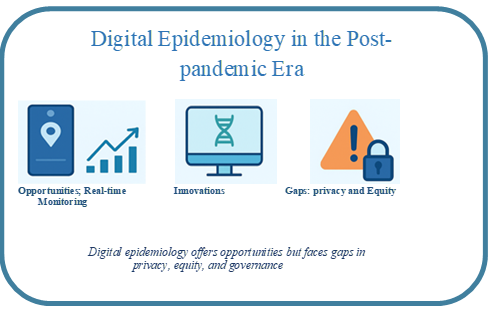
The COVID-19 pandemic has irreversibly changed our approach to public health surveillance, piloting the widespread use of digital epidemiological tools and exposing new possibilities along with ongoing deficits in our surveillance architecture. The current study looked at recent developments in digital epidemiology during the post-pandemic period in terms of evolution, opportunities, and challenges. The study presented important opportunities, such as the ability to provide real-time surveillance, democratized access to epidemiological data, and integrated data sources. Furthermore, it also identified common challenges surrounding data privacy rules, digital divide, technical constraints, and governance systems. It demonstrated that although digital epidemiology holds great promise to improve public health surveillance, to fulfil it, the community must grapple with such key challenges as interoperability, equity, trust, and governance. These findings underscore the need for the post-pandemic period (2020–2025) to be a policy window of opportunities where it would be possible to build strong digital surveillance systems that are sustainable, equitable, and can effectively meet the needs of future public health emergencies whilst protecting individual rights and promoting health equity.
1. INTRODUCTION
In the context of COVID-19 pandemic, several existing and novel surveillance tools were deployed to aid the public health response. States, public health authorities, and private sectors often defended the use of digital tools (e.g., cell phone geolocation, mobile contact tracing applications, closed-circuit cameras as well as drones). These digital tools were used, in compliance with the public health measures of COVID-19 to limit its spread, in order to survey the population and collect data [1]. Lyon (2007) defines surveillance as “the concentrated, structured, and systematic attention to personal details for purposes of influence, management protection or direction” (p. 14), Moreover, the World Health Organization (WHO) provides a broad-based definition of public health surveillance as sustained watchfulness and the observation of human events related to intervention [2]. Public health surveillance includes both passive (reporting data on routine diseases and programs) and active (a conscious search for information about a disease or condition) surveillance. Active surveillance has been established and sustained both for pandemic and non-pandemic reasons using a mix of passive and active measures that utilize sophisticated data analytics and innovative technological tools. Surveillance data can improve the efficiency and effectiveness of healthcare services by targeting interventions and reporting their effects on the population [3].
Need for this development is the quest to mitigate the implications of pandemic (e.g., illness-related morbidity/mortality, health services burden, social and economic consequences) which has led to a surge in digital innovation supporting public health efforts. Yet, concerns remain that while the pace of this response may be characteristically quick and effective, it also risks itself to backfire in unintended ways. Examples include threats to privacy with incursions on civil liberties and differential surveillance of vulnerable groups or potential erosion of human rights [4]. However, the rapid embrace also laid bare problems: privacy risks, algorithmic bias, and unequal access to technology, inadequate system compatibility, and fragile governance. Now, lessons learned from those experiences guide our thinking as to how stronger and more equitable systems can be created in the future [5]. This study sought to offer an overview of the digital epidemiology landscape, opportunities, and challenges that would shape this field in the future and ongoing gaps that may limit public health preparedness and response.
The current study offered a wide scope of different dimensions of digital epidemiology, covering technological breakthrough, methodological development, implementation issues, ethical considerations, and policy implications. Through aggregating knowledge from recent studies across these areas, this study aimed to support evidence-based decision-making around future digital surveillance infrastructure investments. Moreover, it also provided a roadmap for the prioritization of further research, policy formulation, and capacity building in the post-pandemic era.
2. DIGITAL TECHNOLOGY IN COVID-19 EPIDEMIC MANAGEMENT
2.1. Real-time Epidemic Monitoring SystemObserving the epidemic trend is a basic and necessary part of epidemic prevention and control [6]. During the COVID-19 pandemic, cloud computing, Artificial Intelligence (AI), and big data technologies promoted the transformation of passive observation to active monitoring and early warning for public health big data [7, 8]. The latest information technologies, such as AI and big data make a great contribution to public health surveillance, as some experts pointed out [9]. In particular, AI algorithms can be applied to forecast infection rates based on big data analysis and statistics as well as confirmed case numbers to estimate the overall scale of epidemic. Crucially, trend prediction could inform on the course of the epidemic at large, whether an inflection point would occur and when that might be (if at all) [10]. These projections are critical for lifting the lockdown and reopening production.
Prediction of gene expression patterns can be a fundamental image-analysis factor in transition from passive prevention to active prevention; it also works as a prerequisite for decision-making [11]. Using the tool of mathematical modelling, big data analysis, and Machine Learning (ML) to display realistic epidemic dynamics is conducive to help the management departments take an initiative in controlling the outbreak [12]. Many provinces in China used big data, AI, cloud computing, and other digital technologies to continuously improve the monitoring measures of the epidemic [13].
Europe employ satellites to oversee and reduce the effects of the COVID-19 pandemic. Their satellite navigation and earth observation systems are open to the public, and the data gathered could help inform decisions to combat the epidemic [14].
Smart analysis and predictive decisions are helpful for government’s decision-making, crisis control, and resource deployment. These help managers understand the dynamic development and context of emergencies in that area from useful information through continuous changes, reaching a conclusion quickly [15]. In addition, fast and accurate information exchange is not only an important means to stabilize public mood and social order during COVID-19 epidemic period but also a necessary way for government to improve epidemic control. It depicts the epidemic situation in real-time, and involves official information guidelines, improving the trustworthiness and transparency of data further to prevent misunderstandings from spreading [1].
Table 1. Pre-pandemic vs Post-pandemic Epidemiology
|
Pre-pandemic |
Post-pandemic |
|---|---|
|
Traditional Surveillance Systems |
Digital & hybrid surveillance |
|
Manual Data Collection |
Automated Real-time Data Capture |
|
Hospital and Lab-based Reporting |
EHR, IoT, Social Media Integration |
|
Delayed Reporting (Days-Weeks) |
Rapid Reporting (Minutes-Hours) |
|
Limited Geographic Coverage |
Global Reach and Fine Granularity |
|
Aggregate |
Individual-level +Geospatial Insight |
3. EMERGING TECHNOLOGIES AND METHODOLOGIES
3.1. Artificial Intelligence (AI) ApplicationsThe concept of AI was first launched in 1956 by McCarthy [1]. AI is capable of miming human decision-making and reasoning with the potential to enhance and augment human intelligence through continuous ML [16]. It combines computer science, mathematics, cognitive science, neurophysiology, and information theory among other fields including expert systems, ML, Natural Language Processing (NLP), automatic planning, and image processing [17]. Medical staff is also important in controlling the spread of a pandemic [18]. AI can support them with additional diagnosis and therapy as well as contribute to reduce their workload, increasing efficiency and quality of healthcare.
Smart AI systems are applied in a range of medical fields. The most commonly used and considered method for these intelligent systems is image inspection. Many medical institutions apply AI functional image recognition technology to analyse large amounts of images and diagnostic data in order to extract features from medical images [19]. The characteristics in the images are exploited to identify whether there is a lesion inside human body, and further deterioration of lesions inside human body, so as to increase the efficiency and accuracy of the diagnosis [20]. An AI-based medical robot is a major breakthrough in the current clinical practice. Surgical robot ‘The Da Vinci’ surgical robot system represents the most advanced surgical robots available to date. It can capture the surgical environment images through a 3-D vision system and complete some tasks which cannot be performed by hand [21].
3.2. Internet of Things (IoT) and Sensor NetworksThe Internet of Things (IOT) devices have the ability to decrease healthcare cost [22]. As the age pyramid is becoming an inverted triangle in society, the number of patients suffering from chronic diseases increases. The families of chronically-ill patients are burdened both financially and time wise with long-term care. Hence, IoT makes the automatic monitoring and tracking of patients as well as medical staff more feasible [23, 24].
Data from personal wearable devices, in particular, offers insights into population-level health monitoring by capturing trends including heart rate variability, sleep patterns, and indicators of activity levels or other physiological measures. These may serve as proxies for early signs of illnesses or changes in health statuses. However, the application of surveillance data from wearable devices raises important issues regarding privacy and consent that must be carefully considered to ensure proper use and protection of personal health information [25]. Environmental monitoring systems have been extended to monitor wastewater for viral RNA and air quality for surveillance of human respiratory health, as well as climate monitoring for the assessment of risks to environmental health. These systems are valuable complements to clinical surveillance systems and some may have early warning potential for a range of health threats [26].
3.3. Blockchain and other Distributed Ledger TechnologiesBlockchain technologies have been proposed as an enabling resource for data sharing and privacy challenges in digital epidemiology, enabling secure, transparent, and tamper-proof records of epidemiological data that upholds individual privacy through the use of cryptographic methods. Decentralized applications have been made for privacy-protection, contact tracing, electronic vaccination or health credentials. These could help overcome contested privacy risks that prevent mass adoption of centralized digital surveillance tools in pandemics [27].
Novel concepts, such as smart contracts also known as automated data sharing agreements, implemented using blockchain technology, may support more efficient and transparent data sharing in epidemiology while maintaining adequate governance oversight. Such systems could potentially facilitate automated requirements for data sharing agreements, privacy protection mechanisms, governance, and other nomenclature along with simultaneously reducing administrative burden and enhancing cooperation/efficiency of inter-watching surveillance [28].
4. OPPORTUNITIES IN POST-PANDEMIC DIGITAL EPIDEMIOLOGY
4.1. Democratization of Epidemiological Data and AnalysisThe transformation of epidemiology has extended digital democratization as the global community from researchers to the public health workforce and NGOs throughout the world, can now engage in surveillance techniques and epidemiological research. Open-source platforms, cloud-based computing solutions, and user-friendly analytical tools have also minimised barriers of entry into epidemiological research and surveillance as a consequence helping to democratize their participation in public health [29, 30].
Citizen science projects have effectively captured public enthusiasm for participation in collecting and analysing the data, fostering emerging surveillance networks that do not compete with rather supplement the existing public health assets. Applications that permit self-report of symptoms, vaccination status, exposure history, and other health information represent real-time disease surveillance networks, complementing classical clinical reporting systems. Such participatory surveillance strategies have shown particular utility for monitoring seasonal diseases, vaccination coverage, and identifying health disparities in different populations [31]. Academic institutions have invested in web-based portals and educational curricula that facilitate access to specialized training in digital epidemiology methods for the global public health workforce. Large online open courses (MOOCs), webinars, and other educational technologies have extended the reach of training in data science, epidemiological methods, and digital health technologies for the development of capacity SOAs/epidemiological public health MDSSes. These are helpful to create skilled workforces with competencies necessary to implement and sustain digital surveillance systems [1, 32].
4.2. Integration of Different Data SourcesBased on the linkage of clinical information derived from electronic health records and public health surveillance, for instance, community-level exposure, interventions can lead to opportunities to understand the interface between individual health status and population level exposures and interventions. Such integration may help inform decisions about clinical care as well as population health strategies, building bridges between individual patient care and public health practice [33].
The power of ML algorithms lies in their ability to detect complex patterns and associations among multiple different data streams. These may provide insights on disease causation, transmission dynamics, and intervention effectiveness that are not evident through single-source surveillance [34]. Geospatial analysis has evolved with the application of satellite imagery, mobility data, environment monitoring systems, and ground level surveillance data. They allow tracking of environmental forces affecting risk of diseases, analysing the spread dynamics in a population by using mobility data and gauging specific geographic locations that need strategic interventions. Integration of remote sensing data with conventional epidemiological data continued to be particularly beneficial for surveillance of vector-borne diseases, environmental health risks, and the health impacts of climate change [35].
Table 2. Opportunity vs Challenges in Post-pandemic Digital Epidemiology
|
Opportunities |
Challenges |
|---|---|
|
Real-time Outbreak Detection |
Data Privacy and Governance |
|
Integration of Diverse Data Sources |
Interoperability |
|
AI/ML for Predictive Modelling |
Algorithmic Bias and Validity |
|
Democratized Data Access |
Digital Divides and Inequity |
|
Genomic + Digital Surveillance |
Limited Sequencing Capacity |
|
One Health Approaches |
Sustainability and Scalability |
5. PERSISTENT GAPS AND CHALLENGES
5.1. Data Privacy, Security, and TrustNow, even when tremendous achievements of the technology and utility during the pandemic have been shown, privacy and security issues are still core challenges in digital epidemiology for public acceptance and system effectiveness. The sensitive nature of health data creates high privacy risks that need to be carefully weighed against public health benefits. Furthermore, consumer trust in digital surveillance systems was severely damaged by experiences during the pandemic, particularly with contact tracing applications and other surveillance technologies [5].
Privacy-preserving methods, such as differential privacy, homomorphic encryption, federated learning, and secure multi-party computation may serve as potential tools for enabling epidemiological analysis with protection of individual privacy. Secondly, such technologies have yet to be well-proven at the scale necessary for population-level surveillance, and trade-offs between preservation of privacy while preserving epidemiological utility need to be carefully considered and communicated openly with affected groups. The technical sophistication required to implement privacy-preserving mechanisms also serves as a bottleneck for uptake, especially in low-resource settings where technical capabilities may be limited [36].
Laws and other regulations have lagged technological capacities, with uncertainty about how to govern digital epidemiologic data contributing to public mistrust in surveillance capacity. The absence of transparent legal benches for emergency surveillance powers, data retention strategies, and algorithmic accountability has made the public sceptical with respect to digital surveillance systems [37]. A lack of open governance models, accountability mechanisms, and public involvement in the design and oversight of surveillance systems have further alienated the public from digital surveillance technologies [38].
5.2. Digital Divide and Equity of HealthThe existing health disparities are at a risk of being further exacerbated by digital surveillance systems that systematically exclude those with low levels of digital access, literacy or trust in technology. Rural, elderly, and low-income communities as well as various minority populations may be underrepresented in digital surveillance efforts. This leads towards blind spots that threaten the effectiveness of the system or maintain inequalities [39].
Owning a mobile phone and the ability to access internet are unequally distributed globally and within countries. Hence, this reduces the coverage and representativeness of smartphone-based surveillance systems. Even within the developed countries, there are huge differences in digital connectivity and use, especially among the elderly, low-income people, and minorities who may be at a higher risk of poor health. These differences imply that digital surveillance could systematically underreport the populations most in need of public health action [40]. Translation algorithms would not likely be able to grasp the nuance of local health concepts and terminology. Furthermore, cultural distinctions in health-seeking behaviours, privacy considerations, and technology use may impact participation in digital surveillance systems. The lack of culturally appropriate design and community engagement in surveillance system development may perpetuate the exclusion of marginalized communities [41].
5.3. Technical Issues and System LimitationsChallenges include the reliability, validity, and scalability of digital epidemiological systems. The paradox of integrating the data from heterogeneous sources with multiple collection procedures, quality criteria, and temporal scales presumes new challenges for data quality and analytic accuracy [42].
Algorithmic bias is a major concern, especially when ML models are trained on patterns lacking complete representation of the target populations. In the absence of diverse training data, poor validation practices, and a lack of attention to fairness in algorithmic development, surveillance systems may perform poorly for marginalized communities [43]. Challenges with signal-to-noise ratio are profound, especially in systems monitoring social media and the Internet in which true epidemiological signals must be separated from background noise and distractions, such as the media coverage of diseases, or other biases. Volume and velocity of digital data streams may surpass analytics ability, also the presence of disinformation, coordinated manipulation, and other types of data pollution could threaten surveillance validity [44]. Interoperability has been a challenge even after much progress has been made in standards development, especially at the semantic and organizational levels. Public bodies have their own definitions around data, how they collect it, how it can be analysed, and what to report — all of this adds complexity when trying to integrate into the wider industry. While technical standards for interoperability may help solve part of the problem, organizational, legal, and cultural barriers to data sharing frequently impede system integration effectively [45].
A lot of digital surveillance does experience problems with scalability of its systems in general, particularly when using manual data processing, complex analytical workflows or high-volume resource-intensive (often computational) analysis. A second issue is that funding charges for high-tech digital surveillance infrastructure could potentially be cost-prohibitive for some smaller public health agencies or resource-poor health jurisdictions, leading towards inequities in surveillance and response capacity [46].
5.4. Governance, Regulation, and AccountabilityThe accelerated development of digital surveillance technologies in response to the COVID-19 pandemic transcended the established regulatory guidelines, leaving unavoidable legal and ethical uncertainties that shall loom into the post-pandemic era. Concreate governance frameworks were called for, to determine data ownership rights, informed consent practices, algorithmic responsibility, transparency standards, and sunset processes of emergency surveillance measures [5, 47]. There is a need to modernize ethical oversight frameworks for digital epidemiological research and surveillance, including those involving big data analytics, AI applications, real-time surveillance systems, and population-level monitoring technologies. Conventional research ethics paradigms may not fully capture the distinct ethical challenges of population-level digital surveillance, such as collective consent, community benefit, algorithmic fairness, and long-term data use [48].
There is little public oversight of surveillance systems, including inadequate community input, grievance procedures, and system modification in response to user complaints [49]. The dynamic nature of digital technologies means that it requires continuous effort to keep knowledge and skills up-to-date, coupled to interdisciplinary competencies across a wide range of public health, data science, technology, ethics, and policy domains [50].
6. POLICY IMPLICATIONS
In the post-pandemic era, digital epidemiology requires strong policy frameworks that promote ethical, secure, and efficient use of digital health data. Policymakers should establish clear regulations for data privacy, cross-platform data sharing, and the responsible use of AI-driven surveillance tools. National health systems must integrate digital reporting systems, strengthen digital literacy among healthcare workers, and ensure equitable access to digital technologies across regions. Investing in robust digital infrastructure and transparent governance will enable faster outbreak detection, improved public health decision-making, and enhanced preparedness for future health emergencies.
6.1. Strengthening Public Health InfrastructureThe post-pandemic period calls for significant and long-term investment in public health infrastructure to support digital epidemiology capacities, namely the technological (systems) complemented by the human resources, institutional capacity, and governance mechanisms required for surveillance effectiveness. This investment should be based on the fact that digital surveillance systems need ongoing maintenance, updating, and evaluation to remain effective (and it not just a one-time technology deployment) [42]. Budgeting should take account of the entire cost lifecycle of digital surveillance (including start-up, overheads, system upgrading, workforce training; data storage and resources in terms IT processing power/support) as well as routine monitoring/review and improvements to systems. The attributing of digital surveillance capacity within routine public health practice involves reorganization, workflow adjustment, and staff development that necessitate dedicated efforts and resources [51].
6.2. RecommendationsWorkforce development efforts should concentrate on training public health professionals in digital epidemiologic methods, data science skills, as well as ethical and governance issues related to digital surveillance. Interdisciplinary training that cuts across public health, data science, technology, ethics, and policy is required for digital epidemiology. Public health organizations require capacity to manage the data, analyse it, integrate systems that apply statistical quality assurance standards, and evaluate trends. Engagement with academic institutions, technology entities, community-based organizations, and other partners would help secure enhanced expertise and resources with proper oversight and accountability [52].
6.3. Establishing Ethical and Legal NormsEthical standards for digital epidemiology should consider foundational issues around the proper extent of public health surveillance, when individual privacy can be justifiably constrained in service to collective goals, as well as how to prevent the abuse of surveillance powers [5]. Data governance within government data ownership, consent processes, retention policies, sharing agreements, and accountability for digital epidemiological systems should be covered in policies. Policies need to be made clear as to when the data is (a) encompassed by the principle of data minimization, (b) subject explicitly to purpose limitation requirements, or (c) require being removed or anonymized once surveillance purposes have been fulfilled [53].
Laws need to be updated to respond to emerging technologies, such as digital surveillance, cross-border data flows, algorithmic decision-making processes, the use of AI, and automated processing of personal health information. International coordination is necessary to design harmonized legal frameworks, allowing legitimate public health surveillance while respecting privacy rights and preventing misuse of surveillance capabilities [54]. Publication of surveillance system performance, value, and adherence to ethical standards can foster public confidence and promote ongoing improvement in surveillance [55].
6.4. Addressing Health Equity and Digital InclusionDigital surveillance systems should be developed with explicit consideration of the ethical principles associated with health equity to minimize exclusion of marginalized groups, and directly and actively promote equitable access to the benefits generated by surveillance. This demands purposeful design decisions that take into account the needs, capacities, preferences, and concerns of a wide range of populations about surveillance technologies [56].
Equity-focused impact assessments for proposed digital surveillance systems would help identify harmful impacts on specific subgroups of the population and allow deployment strategies to be adjusted to minimize unintended consequences. These evaluations should involve community stakeholders, including individuals from the affected populations, in evaluative activities. Furthermore, these evaluations should also consider how surveillance systems not only directly impact those who are under surveillance but also indirectly impact access to services, stigma, and other social determinants of health. These efforts should consider that digital surveillance systems are most effective when they are representative of all population groups, especially those with the highest risks of adverse health outcomes [57].
7. FUTURE DIRECTIONS AND EMERGING TRENDS
The future role of AI and ML for digital epidemiology would focus on accuracy, interpretability, fairness, and validity. Explainable AI can reduce concerns about opaque algorithms while maintaining predictive performance, allowing practitioners to validate recommendations and apply insights responsibly [29]. Federated learning can support joint model trainings across institutions sharing no central data, to mitigate privacy risks and provide more robust models. The development of NLP would facilitate the utilization of multiple text resources, including social media data, news, and clinical reports to enable the early extraction of epidemiological information. Computer vision and the mining of data from various sources would continue to revolutionize fields, such as medical imaging, environmental monitoring, and surveillance of behaviour while maintaining an emphasis on privacy and consent [58].
Better merging of digital surveillance with clinical systems is good for both public health and anti-inflation. Electronic health records (EHRs) would play a role in both population surveillance and clinical decision-making. Moreover, precision public health initiatives may also integrate genomic, environmental, and behavioural data into personalized recommendations. Continuous monitoring and early sickness detection are possible through wearable devices, though successful integration demands meticulous focus on data quality and privacy [59, 60]. CDSS based 6 detailed environmental data for inclusion in health surveillance, particularly where resources were lacking. Some of these other emerging areas may be more concerned with responses to specific challenges (e.g., environmental monitoring, health and transport planning, urban design) but there is a need to deal with the integration across systems and also engage communities [61].
Epidemic preparedness and global health security should also be digital. Prepared by early warning systems, genomic surveillance for rapid pathogen characterization as well as integrated modelling and simulation would provide real-time assessment of interventions and resources allocation [42]. Enhanced global surveillance systems would require investment in capacity, infrastructure, and governance to secure equitable participation and balance sovereignty with the imperatives of global health security.
8. CONCLUSION
Digital epidemiology has been making rapid progress as a result of the COVID-19 pandemic. Furthermore, it also enables real-time data collection from different sources for better public health surveillance. This development offers the possibility of responding rapidly to health risks and provides surveillance services to a larger proportion of the population. However, it also presents challenges including issues related to data privacy and the digital divide that could exacerbate health discrepancies. All governance systems and ethical considerations are important to make sure that surveillance systems are implemented fairly. In the future, efforts must concentrate on implementing AI into surveillance. This promotes international collaboration and establishes systems for health equity which, in turn, protects trust and accountability. Long-term digital epidemiology investments are essential to respond to new health threats.
CONFLICT OF INTEREST
The authors of the manuscript have no financial or non-financial conflict of interest in the subject matter or materials discussed in this manuscript.
DATA AVAILABILITY STATEMENT
Data availability is not applicable as no new datasets were generated or analysed.
FUNDING DETAILS
No funding has been received for this research.
REFERENCES
- Wang Q, Su M, Zhang M, Li R. Integrating digital technologies and public health to fight Covid-19 pandemic: key technologies, applications, challenges and outlook of digital healthcare. Int J Environ Res Public Health. 2021;18(11):e6053. https://doi.org/10.3390/ijerph18116053
- Sohrabi C, Alsafi Z, O'neill N, Khan M, Kerwan A, Al-Jabir A, et al. World Health Organization declares global emergency: A review of the 2019 novel coronavirus (COVID-19). Int J Surg. 2020;76:71-76. https://doi.org/10.1016/j.ijsu.2020.02.034
- Ghanbari B. On forecasting the spread of the COVID-19 in Iran: the second wave. Chao, Soli Fract. 2020;140:e110176. https://doi.org/10.1016/j.chaos.2020.110176
- Wang Q, Su M. A preliminary assessment of the impact of COVID-19 on environment – a case study of China. Sci Total Environ. 2020;728:e138915. https://doi.org/10.1016/j.scitotenv.2020.138915
- Bayram M, Springer S, Garvey CK, Özdemir V. COVID-19 digital health innovation policy: a portal to alternative futures in the making. OMICS: A J Integ Biol. 2020;24(8):460-469. https://doi.org/10.1089/omi.2020.0089
- Daughton C. The international imperative to rapidly and inexpensively monitor community-wide Covid-19 infection status and trends. Sci Total Environ. 2020;726:e138149. https://doi.org/10.1016/j.scitotenv.2020.138149
- Braithwaite I, Callender T, Bullock M, Aldridge RW. Automated and partly automated contact tracing: a systematic review to inform the control of COVID-19. Lancet Digit Health. 2020;2(11):e607-e621. https://doi.org/10.1016/S2589-7500(20)30184-9
- Abeler J, Bäcker M, Buermeyer U, Zillessen H. COVID-19 contact tracing and data protection can go together. JMIR Mhealth Uhealth. 2020;8(4):e19359. https://doi.org/10.2196/19359
- Sun Z, Zhang H, Yang Y, Wan H, Wang Y. Impacts of geographic factors and population density on the COVID-19 spreading under the lockdown policies of China. Sci Total Environ. 2020;746:e141347. https://doi.org/10.1016/j.scitotenv.2020.141347
- Bai X, Fang C, Zhou Y, et al. Predicting COVID-19 malignant progression with AI techniques. MedRxiv. 2020;3:e20037325. https://doi.org/10.1101/2020.03.20.20037325
- Jia JS, Lu X, Yuan Y, Xu G, Jia J, Christakis NA. Population flow drives spatio-temporal distribution of COVID-19 in China. Nature. 2020;582(7812):389-394. https://doi.org/10.1038/s41586-020-2284-y
- Al-Qaness MA, Ewees AA, Fan H, Abd El Aziz M. Optimization method for forecasting confirmed cases of COVID-19 in China. Clinic Med. 2020;9(3):e674. https://doi.org/10.3390/jcm9030674
- Tuli S, Tuli S, Tuli R, Gill SS. Predicting the growth and trend of COVID-19 pandemic using machine learning and cloud computing. Int Things. 2020;11:e100222. https://doi.org/10.1016/j.iot.2020.100222
- Boban M, Klarić M. Impact of Covid 19 pandemic on digital transformation of public administration in European Union. Paper presented at: 44th International Convention on Information, Communication and Electronic Technology (MIPRO): September 27 – 01 October; 2021. https://doi.org/10.23919/MIPRO52101.2021.9596678
- Zhao S, Chen H. Modeling the epidemic dynamics and control of COVID‐19 outbreak in China. Quant Biol. 2020;8(1):11-19. https://doi.org/10.1007/s40484-020-0199-0
- Haenlein M, Kaplan A. A brief history of artificial intelligence: on the past, present, and future of artificial intelligence. California Manag Rev. 2019;61(4):5-14. https://doi.org/10.1177/0008125619864925
- Nadarzynski T, Miles O, Cowie A, Ridge D. Acceptability of artificial intelligence (AI)-led chatbot services in healthcare: a mixed-methods study. Digital Health. 2019;5:1-12. http://dx.doi.org/10.1177/2055207619871808
- Liu R, Rong Y, Peng Z. A review of medical artificial intelligence. Glob Health J. 2020;4(2):42-45.
- Yang Y, Zheng X, Liu X, Zhong S, Chang V. Cross-domain dynamic anonymous authenticated group key management with symptom-matching for e-health social system. Future Gener Comput Syst. 2018;84:160-176. https://doi.org/10.1016/j.future.2017.06.025
- Zhu R, Niu H, Yin N, Wu T, Zhao Y. Analysis of varicose veins of lower extremities based on vascular endothelial cell inflammation images and multi-scale deep learning. IEEE Access. 2019;7:174345-174358. https://doi.org/10.1109/ACCESS.2019.2954708
- Liu Y, Zhang W, Pan S, Li Y, Chen Y. Analyzing the robotic behavior in a smart city with deep enforcement and imitation learning using IoRT. Comput Commun. 2020;150:346-356. https://doi.org/10.1016/j.comcom.2019.11.031
- Banta HD. Future health care technology and the hospital. Health Policy. 1990;14(1):61-73. https://doi.org/10.1016/0168-8510(90)90364-J
- Catarinucci L, De Donno D, Mainetti L, et al. An IoT-aware architecture for smart healthcare systems. IEEE Int Things J. 2015;2(6):515-526. https://doi.org/10.1109/JIOT.2015.2417684
- Branger J, Pang Z. From automated home to sustainable, healthy and manufacturing home: a new story enabled by the Internet-of-Things and Industry 4.0. J Manag Anal. 2015;2(4):314-332. https://doi.org/10.1080/23270012.2015.1115379
- Alrobei EK, Alrobaei SM, Yousef FME, Kalfot BMF, Altakroni RB, Alshahrani AN. Wearable sensors for monitoring infection risks among healthcare workers. Biomater Translat. 2024;5(2):212-225.
- Leifels M, Rahman OK, Sam I-C, et al. The one health perspective to improve environmental surveillance of zoonotic viruses: lessons from COVID-19 and outlook beyond. ISME Commun. 2022;2(1):e107. https://doi.org/10.1038/s43705-022-00191-8
- Akande OA. Integrating blockchain with federated learning for privacy-preserving data analytics across decentralized governmental health information systems. Int J Comput Appl Technol Res. 2022;11(12):622-637. https://doi.org/10.7753/IJCATR1112.1025
- Marbouh D, Simsekler MCE, Salah K, Jayaraman R, Ellahham S. Blockchain for patient safety: use cases, opportunities and open challenges. Data. 2022;7(12):e182. https://doi.org/10.3390/data7120182
- D'Anza B, Pronovost PJ. Digital health: unlocking value in a post-pandemic world. Popul Health Manag. 2022;25(1):11-22. https://doi.org/10.1089/pop.2021.0031
- Mizani MA, Dashtban A, Pasea L, Lai AG, Thygesen J, Tomlinson C. Using national electronic health records for pandemic preparedness: validation of a parsimonious model for predicting excess deaths among those with COVID-19-a data-driven retrospective cohort study. Global Health Action. 2023;116(1):10-20. https://doi.org/10.1177/01410768221131897
- Broeder LD, Devilee J, Oers HV, Schuit AJ, Wagemakers A. Citizen science for public health. Health Prom Int. 2018;33(3):505-514. https://doi.org/10.1093/heapro/daw086
- Cunha MN, Chuchu T, Maziriri E. Threats, challenges, and opportunities for open universities and massive online open courses in the digital revolution. Int J Emerg Technol Learn. 2020;15(12):191-204.
- Li C, Mowery DL, Ma X, et al. Realizing the potential of social determinants data in EHR systems: a scoping review of approaches for screening, linkage, extraction, analysis, and interventions. J Clinic Translat Sci. 2024;8(1):e147. https://doi.org/10.1017/cts.2024.571
- Gomes HM, Read J, Bifet A, Barddal JP, Gama J. Machine learning for streaming data: state of the art, challenges, and opportunities. ACM SIGKDD Explor Newsletter. 2019;21(2):6-22. https://doi.org/10.1145/3373464.3373470
- Palaniyandi M, Anand P, Maniyosai R. Spatial cognition: a geospatial analysis of vector borne disease transmission and the environment, using remote sensing and GIS. Inform Syst. 2014;1(3):39-54.
- Froelicher D, Troncoso-Pastoriza JR, Raisaro JL, et al. Truly privacy-preserving federated analytics for precision medicine with multiparty homomorphic encryption. Nature Commun. 2021;12(1):e5910. https://doi.org/10.1038/s41467-021-25972-y
- Mello MM, Wang CJ. Ethics and governance for digital disease surveillance. Science. 2020;368(6494):951-954. https://doi.org/10.1126/science.abb9045
- Martin AK, Van Brakel RE, Bernhard DJ. Understanding resistance to digital surveillance: Towards a multi-disciplinary, multi-actor framework. Surveill Soc. 2009;6(3):213-232. https://doi.org/10.24908/ss.v6i3.3282
- Noormahomed EV, Reid MJ, Mubuuke AG, et al. Prioritizing post-COVID-19 health research in sub-Saharan Africa: a modified Delphi study for future pandemic. Sci Afr. 2024;23:e02103. https://doi.org/10.1016/j.sciaf.2024.e02103
- Saeed SA, Masters RM. Disparities in health care and the digital divide. Curr Psych Rep. 2021;23(9):e61. https://doi.org/10.1007/s11920-021-01274-4
- Adedinsewo D, Eberly L, Sokumbi O, Rodriguez JA, Patten CA, Brewer LC. Health Disparities, Clinical Trials, and The Digital Divide. Elsevier; 2023.
- Ezenwaji CO, Alum EU, Ugwu OP-C. The role of digital health in pandemic preparedness and response: securing global health? Glob Health Action. 2024;17(1):e2419694. https://doi.org/10.1080/16549716.2024.2419694
- Faust O, Salvi M, Barua PD, Chakraborty S, Molinari F, Acharya UR. Issues and limitations on the road to fair and inclusive AI solutions for biomedical challenges. Sensors. 2025;25(1):e205. https://doi.org/10.3390/s25010205
- Ampavathi A, Saradhi VT. Research challenges and future directions towards medical data processing. Comput Meth Biomech Biomed Eng: Imag Visualiz. 2022;10(6):633-652. https://doi.org/10.1080/21681163.2021.2018665
- Iroju O, Soriyan A, Gambo I, Olaleke J. Interoperability in healthcare: benefits, challenges and resolutions. Int J Innov Appl Stud. 2013;3(1):262-270.
- Okoye SC. Harnessing digital epidemiology and AI surveillance to combat emerging infectious disease outbreaks globally. Int J Adv Res Publ Rev. 2025;2(6):48-72. https://doi.org/10.5281/zenodo.15761153
- Savage L, Gaynor M, Adler-Milstein J. Digital health data and information sharing: a new frontier for health care competition. Antitrust LJ. 2018;82:e593.
- Adegoke BO, Odugbose T, Adeyemi C. Data analytics for predicting disease outbreaks: a review of models and tools. Int J Life Sci Res Updates. 2024;2(2):1-9.
- Groseclose SL, Buckeridge DL. Public health surveillance systems: recent advances in their use and evaluation. Annu Rev Public Health. 2017;38:57-79. https://doi.org/10.1146/annurev-publhealth-031816-044348
- Eckmanns T, Füller H, Roberts SL. Digital epidemiology and global health security; an interdisciplinary conversation. Life Sci Soc Pol. 2019;15(1):e2. https://doi.org/10.1186/s40504-019-0091-8
- Baker BE. Were Out of What? The Disastrous Consequences of Supply Shortages on First Responders During Public Health Emergencies. Thesis. Naval Postgraduate School; 2023.
- Choudhary V, Mehta A, Patel K, Niaz M, Panwala M, Nwagwu U. Integrating data analytics and decision support systems in public health management. South East Euro J Public Health. 2024:158-172.
- Perez-Pozuelo I, Spathis D, Gifford-Moore J, Morley J, Cowls J. Digital phenotyping and sensitive health data: implications for data governance. J Amer Med Inform Assoc. 2021;28(9):2002-2008. https://doi.org/10.1093/jamia/ocab012
- Khan MNI. Cross-Border data privacy and legal support: a systematic review of international compliance standards and cyber law practices. SSRN. 2025. https://dx.doi.org/10.2139/ssrn.5227777
- Salathé M. Digital pharmacovigilance and disease surveillance: combining traditional and big-data systems for better public health. J Infect Dis. 2016;214(suppl_4):S399-S403. https://doi.org/10.1093/infdis/jiw281
- Noormahomed EV, Reid MJA, Mubuuke AG, et al. Prioritizing post-COVID-19 health research in sub-Saharan Africa: a modified Delphi study for future pandemic. Sci Afr. 2024;23:e02103. https://doi.org/10.1016/j.sciaf.2024.e02103
- Petrou C, Jameel L, Nahabedian N, Kane F. A call for digital inclusion initiatives in mental health services: an integrative review. J Psych Ment Health Nurs. 2023;30(5):911-941. https://doi.org/10.1111/jpm.12931
- Gonzalez-Hernandez G, Sarker A, O'Connor K, Savova G. Capturing the patient's perspective: a review of advances in natural language processing of health-related text. Yearbook Med Info. 2017;26(1):214-227. https://doi.org/10.15265/IY-2017-029
- Birkhead GS, Klompas M, Shah NR. Uses of electronic health records for public health surveillance to advance public health. Annu Rev Public Health. 2015;36:345-359. https://doi.org/10.1146/annurev-publhealth-031914-122747
- Pavia G, Branda F, Ciccozzi A, et al. Integrating digital health solutions with immunization strategies: improving immunization coverage and monitoring in the Post-COVID-19 Era. 2024;12(8):e847. https://doi.org/10.3390/vaccines12080847
- Aina YA, Abubakar IR, Almulhim AI, Dano UL, Tilaki MJM, Dawood SR. Digitalization and smartification of urban services to enhance urban resilience in the post-pandemic era: the case of the pilgrimage city of Makkah. Smart Cities. 2023;6(4):1973-1995. https://doi.org/10.3390/smartcities6040092