Comparative Evaluation of Dormand Prince and Cash-Karp Method in Lengyel Epstein Reaction Model Forming Zinc Oxide (ZnO) Nanostructures
Kaniz Fatima1 *, Talat Sharafat Rehmani1, and Sarwat Ishaque2
1Department of Humanities and Social Sciences, Bahria University, Karachi Campus, Pakistan
2Department of Computer Science and Quantitative, KASB Institute of Technology, Karachi, Pakistan


ABSTRACT
The current study employed two different numerical techniques to solve the Ordinary Differential Equations (ODEs) of the Lengyel Epstein reaction model. This was done for direct comparison with their results on the production of Zinc oxide (ZnO) nanostructures using Dormand Prince and Cash-Karp methods. Furthermore, the study aimed to determine the numerical approximation that may provide an estimate for the concentration of Zinc ion () and Hydroxyl ion (OH-) in the growth process of a ZnO nanostructure. The current study utilized the Cash-Karp method to solve ODE used in the development of the Lengyel Epstein reaction model. Afterwards, the results obtained from this approach were compared with the Dormand Prince method to determine its efficiency. After appropriate detail analysis, it was determined that Cash-Karp yields more consistent results as compared to the Dormand Prince method. The simulation for the solution of ODEs offers a higher convergence rate when Cash-Karp method is used. The error margin of the Cash-Karp method is comparatively smaller than that of the Dormand Prince method which may also be verified by the experimental results of growth of ZnO nanostructures.
1. INTRODUCTION
Zinc oxide (ZnO) is an inorganic compound with diverse applications in different manufacturing fields around the globe (Klingshirn, 2007). The chemical, physical, and mechanical properties of ZnO are different which may be utilized in engineering fields including electronics and optics for many purposes (Sharma et al., 2022). ZnO has an excellent absorption of ultraviolet rays, which is the reason it provides a protection shield to the skin against UV radiation (Reinosa et al., 2016). ZnO is also used in the manufacturing of skincare products. This is because it has the ability to prevent skin from the UV rays (Chen et al., 2022). Therefore, this compound is the key ingredient of all sun blocks. Furthermore, ZnO is also helpful in the prevention and healing of skin infections (Kaushik et al., 2019). It can also be used to treat skin rashes since it is the basic component used in the rash creams (Abramovits et al., 2010; Morganti, 2010).
ZnO is extensively used in different optoelectronic devices, since it exhibits an uninterrupted and wide bandgap of 3.4-3.7eV at room temperature (Lu et al., 2006). Another significant feature of this compound is that it is a good conductor of electricity. Hence, it can be used in the manufacturing of solar cells (Liu et al., 2013). ZnO’s property of connectivity is combined with the optical transparency to manufacture other devices, such as LEDs, laser diodes, and touchscreens (Sandeep et al., 2017). ZnO also holds the piezoelectric property, so it can be used in the sensors and in devices that convert energy into motion (Le et al., 2020).
Due to its hardness, ZnO can be used in products that protect a surface’s critical application including paints and coatings. Additionally, ZnO can bear extreme mechanical stress, thus appealing for structural integrity applications (De Lucas-Gil et al., 2020; Haque & Desai, 2007). It can also be used to dissipate heat as it has a high thermal conductivity (Florescu et al., 2002). Such an attribute is quite useful in applications containing heat management. ZnO can expand and contract with the change in temperature due to its coefficient of thermal expansion (Yamamoto et al., 2011). This is why it can be widely used for applications with thermal stability and dimensional precision involved. The most versatile and economical method to produce ZnO in large quantities is Aqueous Chemical Growth (ACG). This simple method can be carried out at low temperatures. By changing the temperature, it is possible to achieve different ZnO morphologies, such as nanorods, nanoflexes, nanospheres, nanoneedles, and nanowires. In this method, for the preparation of ZnO, a redox reaction occurs between zinc salt and hydroxide ions which is performed in a liquid medium (Mammah et al., 2012).
According to the Lengyel Epstein reaction model, mathematically, the formation of ZnO can be studied. The Lengyel Epstein reaction model predicts how much concentration of Zinc ion () and Hydroxyl ion (OH-) can be used in the synthesis of nanostructures for ZnO (Fatima et al., 2024). There are several ways to solve the Ordinary Differential Equations (ODEs) for this model. Different numerical methods provide approximated results. Some of them include Euler's, fourth order Runge Kutta, Adams Bashforth Moulton, and Dormand Prince (Fatima et al., 2022; Naranjo-Noda & Jimenez, 2020). In this work, the alternative numerical method, the Cash-Karp method, was adopted to determine the estimated concentration of and OH- ions. Additionally, a comparative study was conducted using the Cash-Karp and Dormand Prince methods to estimate the growth of ZnO nanostructures. The Cash-Karp method is also used to solve ODEs in this case. This method maintains a fifth order accuracy to solve stiff as well as non-stiff ODEs. Therefore, by controlling the step size through an adjustability mechanism, complex systems of differential equations may be very easily solved through the Cash-Karp method. The adjustment is compensated by maintaining the stability within the system and a minimum error margin (Cash & Karp, 1990; Ianni, 2003).
Experimental Procedure
To produce ZnO nanostructures, the most reliable method is ACG method due to the following reasons:
- This method is environment-friendly; hence no harmful gas is produced by utilizing this method.
- This method is budget friendly, portable, and highly result-oriented.
- This method is dependent on low temperature and all the equipment used in this method is low cost.
- This method can produce different morphologies of ZnO nanostructures, such as nanorods, nanowires, nanoneedles, nanoflowers, and nanoflexes by temperature adjustments.
- This method has a potential to grow ZnO nanostructures on rigid, soft, and flexible substrates including glass, silicon, silicon carbide, textile, plastic, common paper, and many more.
The first step to start this procedure is the preparation of substrate. A smooth and contamination free piece of gold-coated glass is taken as a substrate and dipped into the solution of low concentrated hydrofluoric acid with the deionized water. Afterwards, the substrate is cleaned with acetone and dried under the flow of nitrogen gas at room temperature. Now, the substrate is ready for the next step of procedure.
The second step involves the deposition of seed layer using the spin coating technique. At 4000 round per minute, the seed solution of zinc acetate is dehydrated and is spun coated 2-3 times on the substrate. Afterwards, the substrate is heated at low temperature (approx. 70˚C) for few moments so that the seed particles are stuck on the surface of that substrate.
The third step is to prepare precursors solution in equimolar concentration of zinc nitrate (Zn (NO3)2.6H2O) and hexamethylenetetramine (C6H12N4) and is dissolved in 200 ml deionized water. Now, the seed coated substrate is dipped into this solution. The container is fully covered by an aluminum foil to avoid all the external particles.
The last step is nucleation process where the container is placed into a pre-heated oven at a temperature of 95˚C for 6 hours. Afterwards, the growth of ZnO nanorods takes place. After the ZnO nanorods have grown, the oven is turned off and the sample is left to cool for 30 minutes. In the end, the substrate is washed with deionized water and is dried with the flow of nitrogen gas (Begum et al., 2008; Vayssieres, 2003; Wada, 2008).
Mathematical ModelThe Lengyel Epstein reaction model is a mathematical method that defines autocatalytic chemical reactions. This model is also used to examine the formation of ZnO nanostructures by analyzing the growth rate of the concentrations of Zn+2 and OH- . Literature shows many techniques to solve this model's ODEs (Seen et al., 2014). In this study, the Cash-Karp method was used for the first time to solve the ODEs of this model in order to estimate the growth of concentration of zinc and hydroxyl ions. The results of this method were then compared with the Dormand Prince method.
In the Lengyel Epstein reaction model, the following system of ODEs was used to estimate the growth of ZnO nanostructures. Carmen Chicone presents these equations depending on the theoretical structure in (Mishra et al., 2015).
If the concentrations of OH- are represented by 'x' and the concentrations of Zn+2 are represented by y, then the differential equations can be written as:
The system's behaviour can be evaluated by the parameters μ and ω used in the equations. To examine the steady behaviour of OH-and Zn+2 concentration, the condition ω>3μ/5-25/μ must be followed. The experimental results validate that the growth of ZnO showed constant behaviour after a specific time (Mishra et al., 2015).
The above ODEs can be solved using the Cash-Karp method to examine the concentration of OH- and Zn+2. The results obtained from this method are the approximation concentrations of OH- and Zn+2 with a high accuracy level. Afterwards, these results would be compared with the results of Dormand Prince method to explore the better approximation method in order to determine the growth of ZnO nanostructures.
Dormand Prince Method
The extensive form of the Runge Kutta method of 5th order accuracy level is also known as Dormand Prince Method which is used to solve ODEs (Naranjo-Noda & Jimenez, 2020). This iterative method solves the ODEs of the Lengyel Epstein reaction model to observe the concentration of OH- and Zn2+ in the formation of ZnC nanostructures.
The intermediate stages of the Dormand Prince method are:
For the next step, the value of yk+1 is computed as:
Cash-Karp Method
The Cash-Karp method is also used to solve the OEDs with iterative technique. It holds both 4th and 5th order accuracy level which make this method efficient and reliable. This is a consistent method to solve OEDs with high accuracy and efficiency.
The intermediate stages of the Cash-Karp method are as follows:
For the next step, the value of yk+1 is computed as:
This method can efficiently solve the complex system of differential equations.
Results
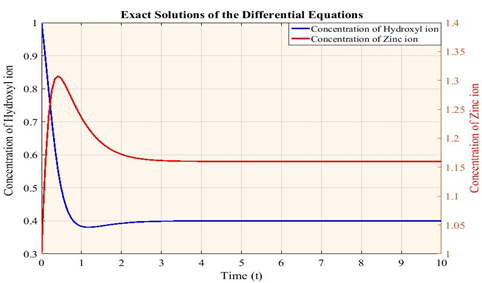
The results of the OEDs used in the Lengyel Epstein reaction model were obtained. The exact solutions of differential equations showed the concentration of OH-drops to its minimum value of 0.38080 at around 1.18658 hours. Meanwhile, the concentration of Zn+2exhibits a maximum point, achieving the highest value of 1.30732 at 0.41048 hours. This instantaneous behaviour of the ions OH-and Zn+2depicts the dynamic interaction during the reaction procedure. Figure 1 shows the specific time when the concentration of both ions changes most significantly.
Figure 1
Concentrations of Hydroxyl and Zinc ions of the exact solution
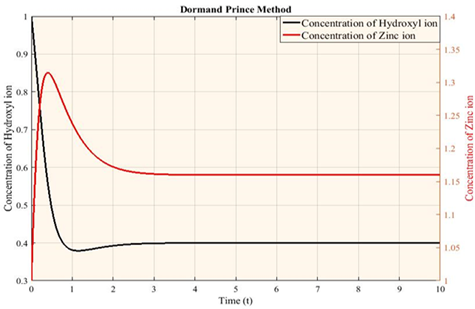
To solve the model's differential equations using the Dormand Prince method, the concentrations of OH-and Zn+2were calculated. The analysis shows the concentration of OH-drops to the lowest value of 0.37939 at 1.18658 hours, while the concentration of Zn+2touches the highest value of 1.31471 at 0.41048 hours, as shown in Figure 2. This is how the Dormand Prince method provides details at a specific time which helps to understand the reaction dynamics during the reaction process.
Figure 2
Concentrations of Hydroxyl and Zinc ions of the Dormand Prince Method
The model's differential equations are now solved by using another numerical technique: Cash-Karp method, to calculate the concentrations of OH- and Zn+2. The results show that the concentration of OH- has the minimum value of 0.38056 at 1.18658 hours. The concentration of Zn+2 reaches the highest value of 1.30901 at 0.41048 hours, as shown in Figure 3. This analysis of the Cash-Karp method provides a detailed overview of the dynamics of OH- and Zn+2 reactions during the reaction process for the growth of ZnO nanostructures.
Table 1 presents the comparative analysis of concentrations of OH- and Zn+2 from the Dormand Prince method and the Cash-Karp method. Table shows a detailed analysis of the critical values given by both methods, helping to make a comparison between them. Results indicate that the Cash-Karp method is closer to the exact solutions than the Dormand Prince method. Although, the Dormand Prince method also provides a worthy estimation for the concentrations of OH- and Zn+2, when compared with the Cash-Karp method, the estimation of the Cash-Karp method is more accurate than it.
Figure 3
Concentrations of Hydroxyl and Zinc ions of the Cash-Karp Method
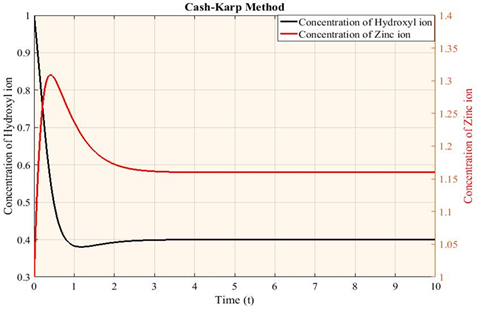
Table 1
-Concentrations of OH- and Zn+2 for the Numerical Methods
|
Method |
Concentrations of |
Concentrations of |
|---|---|---|
|
For t=1.18658 |
For t=0.41048 |
|
|
Exact solution |
0.3808 |
1.30732 |
|
Dormand Prince |
0.37939 |
1.31471 |
|
Cash Karp |
0.38056 |
1.30901 |
Discussion
Different numerical techniques can be used to examine the approximation solution of the OEDs of Lengyel Epstein reaction model in order to determine the concentration of Zn+2 and OH- in the formation of ZnO nanostructures. The Euler's method, the fourth order Runge Kutta method, Adams Bashforth Moulton method, and Dormand Prince method are already being used to examine the concentration of Zn+2 and OH- (Fatima et al., 2022). The current study found the Cash-Karp method to be the best approximation method with minimum error.
In this study, the differential equations of the Lengyel Epstein reaction model were solved by the Cash-Karp method to calculate the concentrations of OH- and Zn+2 and a detailed comparison was made between the Cash-Karp method and Dormand Prince method. From the Dormand Prince method, the concentration of OH- was 0.37939 at 1.18658 hours and the concentration of Zn+2 was 1.31471 at 0.41048 hours (Vayssieres, 2003). While, from Cash-Karp method, the concentration of OH- was 0.38056 at 1.18658 hours and the concentration of Zn+2 was 1.30901 at 0.41048 hours. This analysis shows that Cash-Karp method provides better approximation results to analyze the concentrations of OH- and Zn+2 in the formation of ZnO nanostructures.
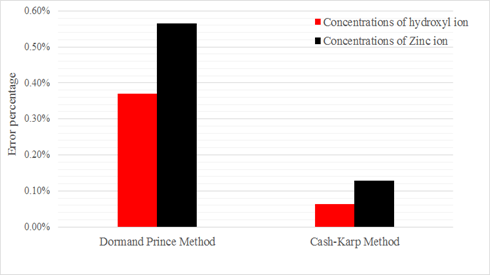
The error of the numerical methods, to solve the differential equation of the Lengyel Epstein reaction model, can be calculated by comparing the results of the numerical method with the exact results. The estimation of the concentration of OH- and Zn+2 from the Dormand Prince and Cash-Karp methods provides close results to the exact solutions, however, has small variances. The results of OH- concentration at t = 1.18658 hours obtained from the Cash-Karp method were more accurate than the Dormand Prince method. Similarly, the results of Zn+2 at t = 0.41048 hours obtained from Cash-Karp method were more reliable than the other method. The error analysis of both methods was examined. It concluded that the error from the Dormand Prince method at t=1.18658 hours was 0.370% for OH- concentration and 0.565% at t= 0.41048 hours for Zn+2 concentration, as shown in Table 2. While, the error estimation of Cash-Karp method was smaller than the Dormand Prince method. The error estimation of the OH- concentration at t=1.18658 hours was 0.063% and the error for the concentrations of Zn+2 was just 0.129%.
Table 2
Error of the Concentrations of OH- and Zn+2 for Numerical Methods
|
Method |
Concentrations of OH- |
Concentrations of Zn+2 |
|---|---|---|
|
For t=1.18658 |
For t=0.41048 |
|
|
Dormand Prince |
0.370% |
0.565% |
|
Cash Karp |
0.063% |
0.129% |
Figure 4 highlights a detailed comparison between the Dormand Prince and Cash-Karp methods. This comparison analysis emphasizes the importance to select the most suitable numerical technique for the Lengyel Epstein reaction model in order to ensure accuracy and efficiency. This error analysis highlights how the method performs under similar conditions. Both methods are effective and yield good predictions. However, the Cash-Karp method provides better results and produces results with the minimum margin of error as compared to the Dormand Prince method.
Figure 4
Error of the Concentrations of OH- and Zn+2 for the Numerical Methods
Conclusion
The current study closely examined the performance of numerical approaches that were different from each other to solve the OEDs within the model in order to form ZnO nanostructures. The comparison of Dormand Prince and Cash Karp methods has been used to estimate hydroxyl and Zinc ion’s concentrations. The analysis shows that the Cash Karp method outperforms the Dormand Prince method in giving a low margin of error, there by responsible for consistency in model predictions. This is because the Cash Karp scheme provides a better accurate solution to solve the Lengyel Epstein reaction model for analyzing growth of ZnO nanostructures.
Conflict of Interest
The author of the manuscript has no financial or non-financial conflict of interest in the subject matter or materials discussed in this manuscript.
Data Availability Statement
The data associated with this study will be provided by the corresponding author upon request.
Funding Details
No fundings has been received for this research.
REFERENCES
Abramovits, W., Granowski, P., & Arrazola, P. (2010). Applications of nanomedicine in dermatology: Use of nanoparticles in various therapies and imaging. Journal of Cosmetic Dermatology, 9(2), 154–159. https://doi.org/10.1111/j.1473-2165.2010.00492.x
Begum, P. S., Joseph, R., & Yusuff, K. M. (2008). Preparation of nano zinc oxide, its characterization and use in natural rubber. Progress in Rubber Plastics and Recycling Technology, 24(2), 141–152. https://doi.org/10.1177/147776060802400204
Cash, J. R., & Karp, A. H. (1990). A variable order Runge-Kutta method for initial value problems with rapidly varying right-hand sides. ACM Transactions on Mathematical Software, 16(3), 201–222. https://doi.org/10.1145/79505.79507
Chen, J., Jing, Q., Xu, Y., Lin, Y., Mai, Y., Chen, L., Wang, G., Chen, Z., Deng, L., Chen, J., Yuan, C., Jiang, L., Xu, P., & Huang, M. (2022). Functionalized zinc oxide microparticles for improving the antimicrobial effects of skin-care products and wound-care medicines. Biomaterials Advances, 135, Article e212728. https://doi.org/10.1016/j.bioadv.2022.212728
De Lucas-Gil, E., Menéndez, J., Pascual, L., Fernández, J. F., & Rubio-Marcos, F. (2020). The benefits of the ZnO/Clay composite formation as a promising antifungal coating for paint applications. Applied Sciences, 10(4), Article e1322. https://doi.org/10.3390/app10041322
Fatima, K., Ali, B., Ishaque, S., & Ahmed, H. (2024). Comparison of Adams-Bashforth-Moulton and Dormand-Prince methods in Lengyel-Epstein reaction model forming zinc oxide nanostructures. Scientific Inquiry and Review, 8(3), 88–101. https://doi.org/10.32350/sir.83.04
Fatima, N. K., Ali, N. B., & Mahnoor, N. (2022). Implementation of Lengyel-Epstein reaction model for zinc oxide (ZnO) nanostructures by comparing euler and fourth-order Runge–Kutta (RK) methods. Scientific Inquiry and Review, 6(1), 23–33. https://doi.org/10.32350/sir.61.02
Florescu, D. I., Mourokh, L. G., Pollak, F. H., Look, D. C., Cantwell, G., & Li, X. (2002). High spatial resolution thermal conductivity of bulk ZnO (0001). Journal of Applied Physics, 91(2), 890–892. https://doi.org/10.1063/1.1426234
Haque, M. A., & Desai, A. V. (2007, January 22–23). Mechanical properties of ZnO nanowires [Paper presentation]. Proceedings of SPIE, the International Society for Optical Engineering. California, USA. https://doi.org/10.1117/12.700353
Ianni, J. C. (2003). A comparison of the Bader-Deuflhard and the Cash-Karp Runge-Kutta integrators for the GRI-MECH 3.0 model based on the chemical kinetics code Kintecus. In K. J. Bathe (Ed.), Computational fluid and solid mechanics (pp. 1368–1372). Elsevier. https://doi.org/10.1016/b978-008044046-0.50335-3
Kaushik, M., Niranjan, R., Thangam, R., Madhan, B., Pandiyarasan, V., Ramachandran, C., Oh, D., & Venkatasubbu, G. D. (2019). Investigations on the antimicrobial activity and wound healing potential of ZnO nanoparticles. Applied Surface Science, 479, 1169–1177. https://doi.org/10.1016/j.apsusc.2019.02.189
Klingshirn, C. (2007). ZnO: From basics towards applications. Physica Status Solidi, 244(9), 3027–3073. https://doi.org/10.1002/pssb.200743072
Le, A. T., Ahmadipour, M., & Pung, S. (2020). A review on ZnO-based piezoelectric nanogenerators: Synthesis, characterization techniques, performance enhancement and applications. Journal of Alloys and Compounds, 844, Article e156172. https://doi.org/10.1016/j.jallcom.2020.156172
Liu, Y., Li, Y., & Zeng, H. (2013). ZnO‐Based transparent conductive thin films: Doping, performance, and processing. Journal of Nanomaterials, 2013(1), Article e196521. https://doi.org/10.1155/2013/196521
Lu, M., Gong, H., Song, T., Wang, J., Zhang, H., & Zhou, T. (2006). Nanoparticle composites: FePt with wide-band-gap semiconductor. Journal of Magnetism and Magnetic Materials, 303(2), 323–328. https://doi.org/10.1016/j.jmmm.2006.01.246
Mammah, S. L., Opara, F. E., Sigalo, F. B., Ezugwu, S. C., & Ezema, F. I. (2012). Effect of concentration on the optical and solid state properties of ZnO thin films deposited by aqueous chemical growth (ACG) method. Journal of Modern Physics, 3(10), 1516–1522. https://doi.org/10.4236/jmp.2012.310187
Mishra, Y. K., Modi, G., Cretu, V., Postica, V., Lupan, O., Reimer, T., Paulowicz, I., Hrkac, V., Benecke, W., Kienle, L., & Adelung, R. (2015). Direct growth of freestanding ZnO tetrapod networks for multifunctional applications in photocatalysis, UV photodetection, and gas sensing. ACS Applied Materials & Interfaces, 7(26), 14303–14316. https://doi.org/10.1021/acsami.5b02816
Morganti, P. (2010). Use and potential of nanotechnology in cosmetic dermatology. Clinical Cosmetic and Investigational Dermatology, 3, 5–13. https://doi.org/10.2147/ccid.s4506
Naranjo-Noda, F., & Jimenez, J. (2020). Locally linearized Runge-Kutta method of dormand and prince for large systems of initial value problems. Journal of Computational Physics, 426, Article e109946. https://doi.org/10.1016/j.jcp.2020.109946
Reinosa, J. J., Leret, P., Álvarez-Docio, C. M., Del Campo, A., & Fernández, J. F. (2016). Enhancement of UV absorption behavior in ZnO–TiO2 composites. Boletín De La Sociedad Española De Cerámica Y Vidrio, 55(2), 55–62. https://doi.org/10.1016/j.bsecv.2016.01.004
Sandeep, K., Bhat, S., & Dharmaprakash, S. (2017). Structural, optical, and LED characteristics of ZnO and Al doped ZnO thin films. Journal of Physics and Chemistry of Solids, 104, 36–44. https://doi.org/10.1016/j.jpcs.2017.01.003
Seen, W. M., Gobithaasan, R. U., & Miura, K. T. (2014). GPU acceleration of Runge Kutta-Fehlberg and its comparison with Dormand-Prince method. AIP Conference Proceedings, 1605(1), 16–21. https://doi.org/10.1063/1.4887558
Sharma, D. K., Shukla, S., Sharma, K. K., & Kumar, V. (2022). A review on ZnO: Fundamental properties and applications. Materials Today: Proceedings, 49, 3028–3035. https://doi.org/10.1016/j.matpr.2020.10.238
Vayssieres, L. (2003). Growth of Arrayed Nanorods and Nanowires of ZnO from Aqueous Solutions. Advanced Materials, 15(5), 464–466. https://doi.org/10.1002/adma.200390108
Wada, C. (2008). Investigation of a distance presentation method using speech audio navigation for the blind or visually impaired. In S. Pinder (Ed.), Advances in human-computer interaction (pp. 535–542). Intech Open. https://doi.org/10.5772/5906
Yamamoto, N., Makino, H., & Yamamoto, T. (2011). Young’s modulus and coefficient of linear thermal expansion of ZnO conductive and transparent ultra-thin films. Advances in Materials Science and Engineering, 2011(1), 1–10. https://doi.org/10.1155/2011/136127