

| Review | Open Access |
|---|
Digitization of Land Title and Records of the Cooperative Housing Societies |
 |
|---|
Munib ur Rehman*
Department of Media Studies, Bahria University, Islamabad, Pakistan
Cooperatives are autonomous, people centered and voluntary associations of persons efficaciously addressing the common economic, social, and cultural needs and aspirations of the members, aiming at their wellbeing through collective action. These organizations work democratically, in line with Cooperative Principles & Values to meet their objectives. Cooperatives have exhibited remarkable performance in almost all sectors of economic life. In housing, Cooperatives’ contribution is significant as it added to government’s affirmation of providing shelter to the shelter-less on self-help basis without any governmental financial implication. Cooperative Department Govt of Punjab has, time and again, been introducing different interventions to strengthen the Cooperative Societies so as to make them more vibrant player in national economy. Computerization of Landtitles and Records (CLTR) of Cooperative Housing Societies in Punjab is one of such initiative to ensure transparency, efficiency and strengthening of cooperative institutions through automation of processes. The focus of present study is to evaluate the working of the CLTR in institutionalizing the transparency, efficient service delivery and effective monitoring . The study, first ever of its kind, was conducted through qualitative approach by discourse analysis (organizational documents) and by semi structured interviews. The data so collected was thematically analyzed using Nvivo v 10 which indicated that implementation of this intervention was highly welcomed and is considered as a meaningful measure for enhancement in the performance of Cooperatives Department as well as of Cooperative Housing Societies as well as ensuring strengthening of the cooperative movement and creating employment opportunities in the society.
1. INTRODUCTION
Cooperatives are playing a pivotal role in the economy of the country, particularly in the province of Punjab where, as per Annual Report of Cooperatives Department Government of Punjab 2025, 24000+ Cooperative Societies are working, majority of which are agricultural and housing cooperatives, thus contributing towards economic empowerment of their members. Let's break down the concept of cooperatives into four key points: Common Need, Common Goal: Cooperatives are formed by people with shared needs or problems, coming together to address them collectively; Voluntary Membership, Shared Resources: Members freely join and contribute resources, creating an organization that's owned and controlled by its members; Democratic Governance, Equitable Benefits: Cooperatives are governed democratically; ensuring decisions benefit all members fairly and equally; Autonomous, Member-Driven Enterprises: Cooperatives are independent organizations, owned, promoted, and controlled by their members to meet their economic and social needs.
The International Co-operative Alliance (ICA) defines a cooperative as "an autonomous association of persons united voluntarily to meet their common economic, social, and cultural needs and aspirations through a jointly-owned and democratically-controlled enterprise."
In essence, cooperatives are people-centered organizations that aim to address economic and social needs, promoting betterment and empowerment. Core values like equity, equality, and self-help, and seven guiding principles of “Voluntary and open membership, Democratic member control, Member economic participation, Autonomy and independence, Education, training and information, Co-operation among co-operatives, Concern for community”, that put these values into practice.
According to Skurnik (2002), cooperatives empower their members to tackle numerous challenges with limited resources by promoting “self-help, resource pooling, and democratic decision-making”, encapsulated in the motto "One for All and All for One".
Chambo (2009) notes that cooperatives can be established in various sectors, including services, industries, housing, agriculture, credit, farming, education, marketing, and supply, among others, to address diverse economic and social needs, inferring that cooperatives enable members to address common challenges collectively, fostering a sense of solidarity and mutual support. By pooling resources and working together, members can achieve greater economic and social benefits than they could individually.
Cooperatives in Pakistan / Punjab
The cooperative movement was first introduced in the Indian subcontinent, including present-day Pakistan, in 1904. In Pakistan, cooperatives fall under the purview of provincial governments, with each province having its own cooperative setup and infrastructure. This decentralized approach allows provinces to tailor their cooperative policies and programs to suit local needs and conditions, promoting more effective and targeted development. In Punjab, the Cooperatives Department oversees the cooperative movement, as outlined in the Punjab Government Rules of Business 2011. The Cooperative Societies Act 1925 and Rules 1927 provide the legal framework for cooperatives, with the Registrar of Cooperatives regulating the sector. A tiered organizational structure is in place, extending up to the union council level.
As of June 30, 2025, Punjab is home to 23998 cooperative societies, with over 7 million members. Notably, the Model Town Cooperative Housing Society Lahore is the first cooperative housing society in the subcontinent. Currently, 254 cooperative housing societies operate in the province, providing members with shelter and amenities through member contributions, without relying on government support
This study will focus on Housing Cooperatives. Housing Cooperatives are formed to meet the housing needs of its members and provide affordable shelter in economical way. Besides that, the entire setup of municipal services in a Housing Coop is run and maintained by the organization through an elected Managing Committee with the help of members’ contributions. Thus need of smart monitoring mechanism becomes significant. The intervention of CLTR provides the requisite mechanism.
Problem Statement
Stocktaking and recordkeeping in Cooperative Housing Sector were being carried out manually, causing ambiguity in non-transparency of operations, leading tax evasion and pilferage of govt revenue as well as inefficient service delivery to the members. Some CHSs automated their systems individually. It was felt to have a coherent and consolidated automated mechanism with prime focus on ease of doing, service delivery, transparency and stocktaking of assets (land & record) of societies. Hence the project of CLTR was conceived
Research Question
The study in hand focuses on the following research question.
“How has the digitization of land titles and record of Cooperative Housing Societies in Punjab brought efficiency (performance improvement) and transparency in the operations of Housing Societies?”
Justification of Study
Like any other organization, Cooperatives also need to keep on improving its performance as per changing environment. Members’ Participation in the business of the society is highly significant towards the performance, particularly in the Governance to long run the organization and to ensure sustainability of its operations. Cooperatives Department Govt of the Punjab being the regulator has time and again been introducing interventions in this regard for ensuring transparency of processes, service delivery to the members/stakeholders and to strengthen the cooperative institutions with prime focus on sustainability. Digitization of Land Titles and Records of Cooperative Housing Societies, under the title of Computerization of Land Titles and Records of Cooperative Housing Societies (CLTR), is one such interventions, which is also the first one of its kind, resulting in improvement of efficiency of Cooperative Housing Sector which is catering the housing needs of people on self-help basis without any financial implication on the government, thus has proved to be a vibrant partner of the government in fulfilling its obligation of providing the shelter to the public. The study in hand, being the first ever, is of great significance as it would lead to further enhancement in the intervention.
Cooperative Housing Profile
Housing Sector is the most vibrant sector of Cooperatives Department. there is 254 Cooperative Housing Societies across Punjab facilitating the housing needs of the members and creating decent work for number of economic sectors, thus contributing significantly towards public exchequer. The detail is given as under:
Table 1
Cooperatives Department in Different Cities
|
S. No |
Division |
Number of CHSs |
|---|---|---|
|
1 |
Lahore |
147 |
|
2 |
Rawalpindi |
34 |
|
3 |
Gujranwala |
12 |
|
4 |
Multan |
13 |
|
5 |
Faisalabad |
16 |
|
6 |
Sargodha |
14 |
|
7 |
Bahawalpur |
5 |
|
8 |
DG Khan |
3 |
|
9 |
Sahiwal |
10 |
|
|
Total |
254 |
The membership of Cooperative Housing Societies is 276680 with working capital of Rs. 22198.083 Millions. The Cooperative Housing Sector Contributes 1000 + Millions annually towards public exchequer in the form of 06 taxes (Cooperatives Annual Report 2025). The Project (Computerization of Land titles and Records of the Cooperative Housing Societies.)
The Government of Punjab initiated the computerization of land titles and records of cooperative housing societies in 2014-15, with a budget of Rs. 100 million. The project aims to create an integrated automated system to streamline cooperative housing society functions across Punjab. The project's objectives include “Improving land records and service delivery in Punjab, Enhancing tenure security for cooperative housing society members, Facilitating members' access to their premises.” And its expected outcomes are “Members can access land records at lower transaction costs through a responsive service, increased land-rights security for cooperative housing society members and greater transparency in land transactions.”
Scope of the Project
The CLTR provides following three tier interconnectivity via web-based networking linkage, elaborated as under:
- Office of the Registrar, Cooperatives, Punjab, Lahore (Main Depository).
- Offices of the District Officers Cooperatives
- Offices of the Cooperative Housing Societies
Literature Review
Like all spheres of social and economic life, the pace and scope of digital innovation targeting the cooperative real estate sector has become intensified over the period of time. Astuti et al. (2023) infer that the development of digital-based financial institutions can shift conventional financial activities. The ease of transactions and the variety of options for access to finance have led to an increase in public data that can be channelled into the productive sector and accelerate growth.
Andjarwati and Wulan (2021). Finds that carrying out of digitalization efforts in a centralized manner is of great significance in meaning of governance, starting from information about policies, training to funding from up to bottom, namely from the center which is then distributed through representatives to the lowest line, namely end user level.
Hughes (2022) while discussing land reforms in Rwanda observes that ICT innovation resulted in transformation across the core sectors of the economy; land, agriculture, health, finance and trade and industry in Rwanda, Kaikini (2020) finds that digitization has increased the efficiency of the employees and the societies digitalization besides ensuring appropriate supervision on part of regulators.
Borzaga et al. (2019) determines, while discussing Italian Cooperatives, innovation and digitalization as important competitive elements for enterprise. Further argues that digitization for cooperatives is of great importance especially in context of valuation of work performance and effectiveness of activities as it will lead to analyze the strengths and weaknesses of cooperatives and suggesting improvement with great precision.
Maratdaevna (2019). observes that “studies in Uzbekistan show that the implementation of digital technology in companies is hindered by the slow process of introducing electronic services, lack of mechanisms to transfer documents from paper to electronic form, technical and organizational deficiencies, generational and social status differences as not all employees can use electronic services. Therefore, HR Capacity building is equally necessary with introduction of digital innovation in any institution.
Philippon (2017) observes FinTech as an industry that covers digital innovations and technology-enabled business model innovations in the financial sector. He shows that such innovations can disrupt existing industry structures and blur industry boundaries. They can democratise access to financial services, but also create significant privacy, regulatory and law enforcement challenges.
Chaudhuri (2015) describes while investigating the impact of digitization on economic growth and its potential for creating employment opportunities “digitization” as a key economic driver in the present world because of its importance to integrate the economy by creating digital markets.
Khan et al. (2015) in their paper “Digitalization and its impact on Economy” attempted to explain that “the waves of adoption and usage of ICTs (Information and Communication Technologies) have revolutionized our world by introducing distinct technology– enabled services in every sphere of our lives. There are various applications of ICT, digitization is one of them. Digitization is a process of converting the diverse forms of information, such as text, sound, image or voice into digitalized format. The digitization has a proven impact on economy and society by reducing unemployment, improving quality of life, and boosting access to knowledge and other public services. The process of digitization is marked by cost effectiveness to cut the cost that incurred in various knowledge practices related to the production, organization and communication of information that makes long-term economic growth. Their paper highlights the concept of digitization along with the social economic and ecological benefits of digitization of knowledge and information”
Anjanah and Subhashini (2024). See that digitization and digitalization are key to prevent new, innovative acts of mischief and offences relating to land/property/ownership issues in general revenue matters and particularly for assets of the members in Cooperative Housing Societies. It is further noted by the authors that “Digitization of documents will help society as a whole by compiling records of buying, selling and transferring of all types of land under centralized mechanism”.
Biraro et al. (2021) in the work titled as Good Practices in Updating Land Information Systems that Used Unconventional Approaches in Systematic Land Registration, says that digitization aims at the improvement of land administration, to increase the degree of certainty of land ownership and its security against fraudulent activity.
Digitization also leads to e-governance, as is found by Priyowidodo (2021), that in line with information and communication technology development, the government as an agent for providing public services is also adapting and adopting technology-based services. This modernization and reform of public services are called e-government”. Despite extensive literature on e-governance and land digitization, three gaps remain. First, most studies focus on centralized state land registries rather than hybrid governance models such as cooperative housing societies. Second, empirical qualitative evidence from South Asian cooperative systems is extremely limited. Third, existing studies emphasize technical efficiency but under-theorize trust, member response to change, and institutional legitimacy. This study addresses these gaps by examining the CLTR initiative in Punjab through a performance-trust lens.
Research FrameworkThis study's framework is based on the work of Taylor et al. (2004). The dependent variable is "Performance Improvement", while the independent variables are "Satisfaction", "Perceived Value", "Response to Change", and "Trust". The following propositions are developed to address the research objectives: -
P1. ICT intervention (CLTR) is a leading step towards Organizational Development.
P2. It is perceived that ICT intervention has resulted in better service delivery, governance, transparency, participation and improved processes as well as efficient monitoring on part of both Cooperatives Department and Societies.
P3. Members' response to change is a crucial indicator of their loyalty and trust in the cooperative institution, influencing its long-term success..
P4. When We Build Trust, We Build strength and sustainability in organization.
Methodology
In consonance with the above context, the study in hand has been carried out under qualitative approach because, as supported by literature, it answers “how” and “why” questions and that it has gained an established place in management studies. And a number of research studies (Bryman, 2004; Cassell & Symon, 2006) have ascertained its potential for provision of “detailed insight and contextual explanations” for the issues in management practices. It covers a range of theoretical paradigms by employing a variety of methods, methodologies and strategies, which include case studies, participant observations, action research, oral history, interviews, etc. According to Yılmaz (2013) , qualitative research is “an emergent, inductive, interpretive and naturalistic approach to the study of people, cases, phenomena, social situations and processes in their natural settings to reveal in descriptive terms the meanings that people attach to their experiences of the world”. Qualitative approach, in the present study, has also been adopted for its ability to bring in diverse perspectives of description of the phenomenon of interest rather than measurement thereof. This description of said phenomenon can only occur by capturing the experience of the study participants - for example, through observing them in their practice or by collecting their own accounts, such as through interviews or diaries ( Denzin & Lincoln, 2011). In the above context, a semi structured interview and analysis of organizational documents (discourse analysis) were used as research instrument.
The collected data was analyzed using thematic analysis with Nvivo 10 software, following the approach suggested by Boyatzis (1998). This method allowed for the identification, analysis, and reporting of patterns and themes” within the data, providing insights into various aspects of the research topic. The analysis helped evaluate the accuracy and effectiveness of the propositions, while stakeholder feedback enabled informed inferences about the study's findings.
Data Collection
Data for analysis was collected through the instruments of semi structured interviews and examination of organizational documents (discourse analysis). Director of the CLTR Project, Joint Registrar Housing Cooperatives, Registrar Cooperatives Punjab (in the capacity of regulators) and Presidents of three Cooperative Housing Societies (as beneficiary of the intervention), selected through non-probability purposive sampling technique, were interviewed. Organizational Documents like PC 1, evaluation reports, PC-IV were examined, besides that similar initiative introduced in Indian Punjab and Italy were also studied to make inferences about strengths and weaknesses of the interventions.
Inferences regarding justification of ICT intervention, background, strategy of government, technical assistance strategy etc. were made out of interviews/discussions with the stakeholders, supported by literature review. Besides that the intervention was physically visited also. The gist of inferences is as under:
Director of the CLTR Project
The Director of the project while discussing the salient aspects of the intervention apprised that certain situations led to development of the intervention in hand e.g.
It was a vision of the Chief Minister Punjab to computerize the land record by all the concerned institutions like Revenue Department and the Cooperative Housing Societies in the Punjab. The cooperative housing societies cover 1/3rd urban area of Lahore District and laid down infrastructure from their own resources. The Cooperative Housing Sector contributed 54% revenue regarding stamp duty and CVT of the total revenue during 2011-12 and 52% during 2013-1
The Government has taken initiatives in the large interest of public regarding the issues of land which are as under:-
- Land ownership and administration are crucial in Pakistan, particularly in Punjab, where agriculture drives the rural economy and poverty reduction.
- Inefficient land records lead to high transaction costs, disputes, and thin land markets, with prices exceeding agricultural earnings.
- Inequalities in land distribution, tenure insecurity, and administrative difficulties constrain rural and urban populations, especially the poor.
- Limited land mobility perpetuates unequal distribution and livelihood opportunities.
- Punjab's population is 94.4 million (55.2% of Pakistan's total), with 70% living in rural areas; however, dispersed land records make land rights uncertain.
- High transaction costs and difficulties harm landowners and prospective owners, making them vulnerable to middlemen.
- Unclear land rights reduce income and hinder social cohesion, governance, and community stability.
- The Land Revenue Act (1967) doesn't provide state-certified land titles, and records are presumed accurate but contestable.
- Courts have ruled that land records aren't documents of title and can be challenged.
- Urban land recording involves multiple agencies (BOR, ETD, LDA), with no single agency maintaining updated records.
- BOR's role has shifted from revenue collection to record-keeping, but business processes remain focused on traditional role.
- The Cooperative Housing Societies are performing tremendous role for delivering all types of services to the members at their door steps within the premises. These institutions not only maintaining their land record but also keeping record of plots of the members. Their members are paying revenue to the Government more than Rupees one billion every year in shape of stamp duty, CVT and gain tax, income tax etc.
It was further stated by the Director that intervention was introduced as government strategy as it intended to move to an effective, for ensuring transparency, better service delivery and governance, system of land records management which will link text and special data effectively and will make rights in land more secure. This will entail significant institutional, legal and policy changes, as well as investment in human resource development, information system, and improvement in the available data basis on land. The modernization land system is prime focus of the Government, particularly urban area land records in the Cooperative Housing Societies in the Punjab. Due to computerization of land records, the leakage of taxes would be eliminated. Further the land disputes would be discouraged. The scale of litigation would be decreased. As a result, litigation expenses will be curtailed.
The initiative was consisting of the components of infrastructure, hardware, software development and HR hiring besides providing training to the dealing hands of the societies as well as of departmental functionaries. The project office was setup in PCBL Building where server was installed. Energy support was ensured by LESCO Supply, Solar and UPS Backup. Dedicated fiber optic line for internet connectivity was procured from PTCL. Through a transparent bidding process, the contract for development of application was awarded. Requisite qualified HR including KPOs, DBA, NWA, Town planner, Draftsman, Stenographer and ministerial staff was hired through a competitive process as success of the initiative was directly linked with the competent operational staff.
The following physical activities in implementation of the project are of significance.
- Constitution of project steering committee comprising Secretary Cooperatives, Additional Secretary Cooperatives and Registrar Cooperative Societies, Punjab for implementation of Cooperative Computerization of Land Record Project.
- Setting up of Technical Wing.
- Appointment of Consultants and HR of Technical Wing
- Development of server and client application through PITB or outsourcing by inviting bids from software development companies.
- Appointment of staff and its capacity building.
- Purchases of all types of equipment like computers, printers, scanners, servers etc. Payment of bills
The initiative also caused upgradation of all offices of Cooperative Department as 100 latest computers with printers and scanners were purchased and supplied. Besides that all offices were interlinked through local network as well as through web-application. A backup server was also installed at Poonch House. The department had to face some issues in case of printers regarding after-sale service and provision of printers.
In the first phase, the cooperative housing societies were focused. Currently all kinds of societies are being computerized. Regarding housing societies, all records pertaining to land, members files, assets of the society, layout plans, transfer process etc have been computerized. Digitization of layout plans is approximately 70% complete. This initiative has helped in curbing the violation of LOPs. For accuracy in digitization, GIS app was got developed from PITB.
Due to financial restraints, the project met a halt for some time. In 2020 it was resumed and revisited. Resultantly PITB was tasked for its completion. The Director viewed it as a big success in evidence- based monitoring in near future. It was further apprised that the system would cater following features.
Society’s Land
- Khewat No.
- Khasra No.
- Khatuni No.
- Mutation No.
- Volume No.
- Jild Bandi No.
- Fard No.
- Name of Chak/Village
- Mauza
- Tehsil
- Exemption No.
- Serial No.
- Square No.
- Total area (in acres, kanals, marlas, sq.ft)
- Name of owner (to whom land purchased)
- Ownership of the society.
- Paid amount
- Land type
- Structured Award
- Exempted Land.
Status of Land/plots
- Total Land purchased.
- Clear land.
- Land under dispute.
- Nature of dispute.
- Master plan approved or not
- of plots mortgaged with Development Authority/agency
- of mortgaged plots.
- of plots under caution/lien
- of residential plots.
- of commercial plots.
- Land reserved for roads
- Land reserved for graveyards
- Land reserved for school (s)
- Land reserved for hospital/dispensary
- Land reserved for community/multipurpose hall.
- Detail of cancelled plots with reasons.
- New allotment of cancelled plot with name of allottee, date, cost of land received etc.
- Plot changed with names, date, reasons of change etc.
Member’s plot record
- Name of Member
- Father’s name
- Complete Address
- Contact No.
- D. Card No.
- Names of seller and purchaser if sold.
- Membership No.
- Plot No.
- Phase No.
- Lane No.
- Sector
- Date of allotment/transfer of plot.
- Allotment letter/Transfer letter No. & date with photographs of the seller and purchaser.
House Construction Policy
- Possession application
- Possession process
- Possession demarcation
- Site plan printed
- Layout Plan issued
- House completion
Government Dues
- Size of plot
- Date of transfer of plot
- Payment of Government dues with date:-
- of Stamp Duty (Due, paid, outstanding)
- Payment of CVT (Due, paid, outstanding)
- Payment of Capital Gain Tax (Due, paid, outstanding)
- Payment of Income Tax etc (Due, paid, outstanding)
- Bank challan No. & date
- Date of verification by the Govt. Treasury Office.
- Any other dues/tax
Document Preservation Module
- Document Type Definition
- Document Scan
- Document indexing and titling
- Document Search
Biometric Module
- Finger print enrollment of sellers and buyers
- Member verification
Integrated Gl
- Maintain Chart of Account Up to five levels.
- User defined voucher types.
- Journal Vouchers
- Bank Payment Vouches
- Bank Receipt Vouches
- Cash Payment Vouchers
- Cash Receipt Vouches
- Handling of subheads accounts.
- User-defined financial periods.
- Handling of accounts Cost Centre Wise/ Department Wise/ Branch Wise.
- Complete user help.
- Auto balance movement to next year at the end of financial year.
- Special feature of posting for all entered vouchers.
- Runtime balance Sheet and PLS with US$ conversion rates.
- Reports Export features to Hard disk on any format (MS Word, Excel, PDF or access).
- Handling of Fixed Assets Register
- Cheque printing features
- Batch posting & un-posting feature
- Computerized Bank Reconciliation
- Budget Management (Cost Centre wise)
- Cheque Management
Table 2
Latest Progress on the Project
| No. | Module | Description |
|---|---|---|
| 1 | Society Registration | Deployed and Functional in all Divisions |
| 2 | Society Governance | Deployed and Functional in all Divisions |
| 3 | Legal Case Management | Deployed and Functional in all Divisions |
| 4 | Loan Advancement | Deployed and Functional in all Divisions |
| 5 | Assets & Inventory | Deployed and Functional in all Divisions |
| 6 | Finance Management |
Deployed but not functional. New requirements under development. New Requirements received in Oct, 2022 |
| 7 | E-Filling | Integration within ERP is in process |
| 8 | Geo Tagging |
Geo Tagging of Housing societies done (60%) Remaining societies in process |
| 9 | Land Acquisition | Deployed and Functional in all Divisions |
| 10 | User Management | Deployed and Functional in all Divisions |
| 11 | Society Management | Deployed and Functional in all Divisions |
| 12 | Member Enrollment | Deployed and Functional in all Divisions |
| 13 | Plot Management | Change Request Settings: Society Logos Settings page Deployed and Functional in all Divisions |
| Change Request Settings: Development Authority Settings Page Deployed and Functional in all Divisions | ||
| Change Request Settings: Society Organization Settings Page Deployed and Functional in all Divisions | ||
| Change Request: QR code in transfer letters | ||
| Change Request: Flats/Apartments | ||
| 14 | Layout plan 1st Revision | Change Request |
| 15 | Layout plan 2nd Revision | Change Request |
| 16 | GIS Mobile App | Change Request |
| 17 | GIS Module | Change Request |
| 18 | Finance Module | Under Development |
| 19 | Digitization of LOPs | In Process |
| 20 | Reports | Reports will be provided after the completion of all modules |
Modules with Completion Date
| No. | Module | Description | Completion Date |
|---|---|---|---|
| 1 | APIs for SMS Mobile App |
Dependency on ERP and CLTR modules Data to be fetched from ERP and CLTR modules |
15th December, 2022 |
| 2 | Contact Details | ||
| 3 | AGM/SGM | ||
| 4 | Election | ||
| 5 | Complaints | ||
| 6 | Society Profiling | ||
| 7 | Addition/Removal of Members | ||
| 8 | Audit Requests | ||
| 9 | Loan Management | ||
| 10 | CLTR APIs integration | ||
| 11 | Member enrollment module for Current Management Committee of societies other than housing societies |
Table 4
Financial Outlay

Figure 1
Graphical Processes as Explained by The Director
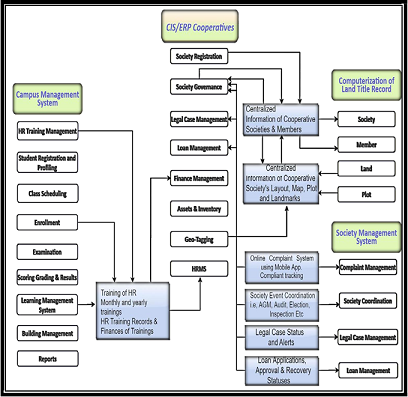
Figure 2
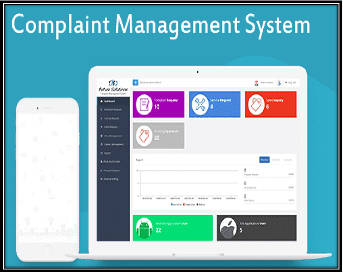
Complaint Management System to Address Issues Relating to Cooperative Housing Societies
Joint Registrar Cooperatives Punjab
The Joint Registrar (Housing) during the discussions highlighted that project is of great value for the following aspects.
- The Project would assist the Cooperative Housing Societies for permanent computerization of land titles and record.
- The concerned Field Offices of the Cooperatives Department would be able to monitor the activities of the Cooperative Housing Societies within their respective area of jurisdiction by way of data collection and maintaining updated record.
- The Office of the Project Director at Provincial level would be monitoring all activities regarding land documents, land, transfer of plots, payment of Government dues etc.
- The Head Office would have the access to the data, maintained in field Offices and societies’ Offices.
Registrar Cooperatives Punjab
The Registrar (Functional Head of the Department) in his views, expressed that initially biometric system was adopted in 2012-13 by the Cooperative Housing Societies for making fool proof and transparent system for transfer of plots. The payment of Government dues was linked with this system. Now under CLTR which is a comprehensive mechanism, the managements of cooperative societies would be bound to provide all types of data regarding land, ownership of land, particulars of members, allotment of plots, transfer of plots, payment of stamp duty, CVT, Capital Gain Tax, Income Tax etc to the Cooperatives Department. For security and privacy purpose, the general public would not be able to access the data. However the member concerned would be able to access data personal to him/her. Further, all details as per revenue records, would be entered in the system. All transfers of plots through this system will definitely enhance government revenue. The transparency through this system will result in building of members/public trust on cooperative system.
The Registrar Cooperatives while highlighting the Financial Benefits of project stated that the project is bring following financial benefits.
- Increase in the income of the Government revenue (Stamp Duty, CVT, Gain tax etc) by eradication of tax evasion.
- The project would support the Cooperative Housing Societies to earn handsome income on account of transfer of plots in transparent way.
- The concept of open files would be eliminated.
- The disputes on account of land issues would be discouraged due to updated land titles records.
- The job opportunities would be created in 21 districts in Punjab where cooperative housing societies are working.
- Sustainable mechanism would be established.
Continuing, the RCS Punjab further highlighted that the project in hand is a cogent step for increasing transparency and efficiency in the system e.g
- Digital Record Keeping: With computerization, all records and transactions can be digitized and stored securely, reducing the risk of errors and making it easier to access information when needed.
- Automated Processes: Computerized systems can automate routine tasks such as billing, payment processing, and maintenance requests, reducing the workload for staff and increasing efficiency.
- Improved Communication: Online platforms and portals can be used to communicate with residents, providing them with up-to-date information and enabling them to access information and services from their homes.
- Real-time Monitoring: With computerization, management can monitor the performance of the society in real-time and make informed decisions based on data and analytics.
- Increased Transparency: Digital systems increase transparency by providing a clear and accurate picture of the financial health of the society, enabling members to hold the management accountable for their decisions.
Overall, computerization can improve the transparency and efficiency of cooperative housing societies by streamlining processes, reducing manual effort, improving communication, and increasing accountability.
Views, as elaborated below were also taken from the management of the some of Cooperative Housing Societies so as to ascertain an analysis of the initiative from both sides. i.e from the perspective of regulatory regime as well as from client/beneficiary side.
President Education Town CHS Lahore
The President of the Society, representing the managing committee, highly appreciated the initiative taking it as a gigantic step towards improvement in system leading to transparency and efficiency. He viewed that the Computerization of Land Titles and Records in cooperative housing societies is bringing several benefits, including:
Improved Accuracy
A computerized system can store and manage land title and record information more accurately and efficiently than manual systems.
Enhanced Security
Computerized systems can secure sensitive information with passwords, encryption, and backup systems, reducing the risk of fraud, tampering, and loss of records.
Faster Transactions
Computerization can automate many manual processes, such as title searches, record-keeping, and document management, making it easier and faster for members to access information and complete transactions.
Increased Transparency
A computerized system can provide members with online access to land title and record information, reducing the need for physical meetings and improving the flow of information.
Better Decision-making
With access to accurate and up-to-date information, the management can make informed decisions and track the performance of the cooperative.
It was concluded that overall, computerization of land titles and records can bring greater efficiency, security, transparency, and accountability to cooperative housing societies, helping them to operate more effectively and provide better services to their members besides contributing towards national exchequer through increased revenue generation from Cooperative Sector.
President AGRICS CHS Lahore
The project is equally beneficial for both Government and Cooperative Sector as expressed below:
- Automation of processes: Computerization can automate many manual processes, such as record-keeping, fee collection, and document management. This can reduce the chances of errors and increase the speed of transactions.
- Improved record-keeping: A computerized system can keep accurate records of all transactions, members, and assets of the cooperative. This can help improve transparency and accountability.
- Enhanced communication: Computerization can provide a platform for members to access information, communicate with the management, and make requests. This can improve the flow of information and reduce the need for physical meetings.
- Increased security: Computerized systems can be secured with passwords, encryption, and backup systems, which can help protect sensitive information from unauthorized access.
- Better decision-making: With access to accurate and up-to-date information, the management can make informed decisions and track the performance of the cooperative.
Although the initiative of computerization can bring greater efficiency, transparency, and accountability to cooperative housing societies, allowing them to operate more effectively and provide better services to their members, however HR development is equally necessary for the success of the project.
President NFC Employees Cooperative Housing Society Lahore
Transparency is the key to success in Cooperatives. These are people – centered organizations working on the principles of mutual help, assistance and trust by the members. The initiative was highly needed in present era of digitization and automation because the need for computerization of cooperative housing societies arises from the growing demand for improved efficiency, transparency, and accountability in the management of these organizations. highlighting some of the key reasons for computerizing cooperative housing societies, it was added that :
- Increased efficiency: Computerization can automate many manual processes, reducing the time and effort required to complete transactions.
- Improved record-keeping: A computerized system can store accurate records of all transactions, members, and assets of the cooperative, making it easier to track changes over time.
- Enhanced communication: Computerization can provide a platform for members to access information, communicate with the management, and make requests, reducing the need for physical meetings.
- Better decision-making: With access to accurate and up-to-date information, the management can make informed decisions and track the performance of the cooperative.
- Increased security: Computerized systems can be secured with passwords, encryption, and backup systems, which can help protect sensitive information from unauthorized access.
Concluding, it was remarked by him that the need for computerization of cooperative housing societies arises from the need to improve the efficiency, transparency, and accountability of these organizations, and to provide better services to their members.
Thematic Analysis
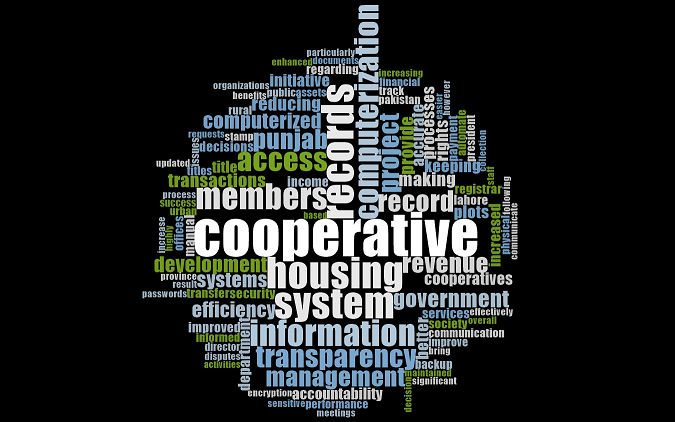
Examining the Computerization of Land Titles and Records of Cooperative Housing Societies initiative was a fascinating experience, being the first ever empirical effort to map its contribution, offering a unique opportunity to test our propositions and lay the groundwork for research in Punjab for cooperatives. Discussions were analyzed and documents using Nvivo V 10, revealing that members prefer cooperatives due to their “transparency, efficiency, governance, satisfaction, perceived value, response to change, and trust”. These factors are direct results of the “cooperative's performance”. The analysis showed that increased “transparency” and “efficiency” lead to greater “members’ loyalty”. Furthermore, government patronage fosters “trust, satisfaction, and promotes transparency and efficiency” in governance
The thematic analysis is presented as under:
Table 5
Summary of Themes
|
Word |
Length |
Count |
Weighted Percentage (%) |
|---|---|---|---|
|
Cooperative |
11 |
92 |
2.15 |
|
Transparency |
12 |
91 |
2.14 |
|
Information |
11 |
51 |
1.19 |
|
Members |
7 |
50 |
1.17 |
|
computerization |
15 |
47 |
1.10 |
|
Revenue |
7 |
36 |
0.84 |
|
Government |
10 |
32 |
0.75 |
|
Development |
11 |
28 |
0.65 |
|
Efficiency |
10 |
27 |
0.63 |
|
Systems |
7 |
27 |
0.63 |
|
Accurate |
8 |
21 |
0.49 |
|
Processes |
9 |
21 |
0.49 |
|
Rights |
6 |
21 |
0.49 |
|
Initiative |
10 |
20 |
0.47 |
|
Accountability |
14 |
18 |
0.42 |
|
Department |
10 |
18 |
0.42 |
|
Improved |
8 |
15 |
0.35 |
|
Income |
6 |
15 |
0.35 |
|
Security |
8 |
15 |
0.35 |
|
Services |
8 |
15 |
0.35 |
|
Automate |
8 |
12 |
0.28 |
|
communication |
13 |
12 |
0.28 |
|
Improve |
7 |
12 |
0.28 |
|
Informed |
8 |
12 |
0.28 |
|
Performance |
11 |
12 |
0.28 |
|
Assets |
6 |
11 |
0.26 |
|
Financial |
9 |
11 |
0.26 |
|
Benefits |
8 |
9 |
0.21 |
|
Collection |
10 |
9 |
0.21 |
|
Communicate |
11 |
9 |
0.21 |
|
Decision |
8 |
9 |
0.21 |
|
Disputes |
8 |
9 |
0.21 |
|
Monitoring |
10 |
8 |
0.19 |
|
Transparent |
11 |
8 |
0.19 |
|
Digitization |
12 |
7 |
0.16 |
|
Intervention |
12 |
7 |
0.16 |
|
Administration |
14 |
6 |
0.14 |
|
Automation |
10 |
6 |
0.14 |
|
Capital |
7 |
6 |
0.14 |
|
Governance |
10 |
6 |
0.14 |
|
Important |
9 |
6 |
0.14 |
|
Improvement |
11 |
6 |
0.14 |
|
Institutional |
13 |
6 |
0.14 |
|
Litigation |
10 |
6 |
0.14 |
|
Mechanism |
9 |
6 |
0.14 |
|
Monitor |
7 |
6 |
0.14 |
|
Opportunities |
13 |
6 |
0.14 |
Figure 3
Tree Map
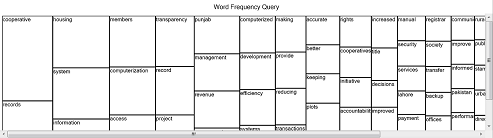
Figure 4
Cluster Analysis
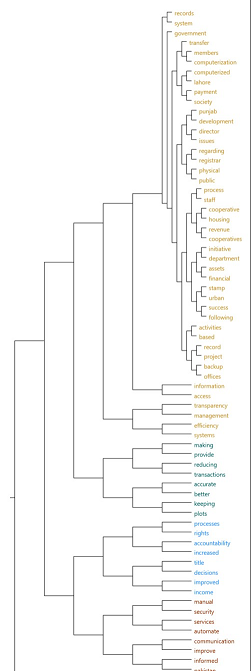
Figure 5
Word Cloud
Conclusion and Recommendations
In conclusion, the computerization of land titles and records of cooperative housing societies has been a crucial step towards streamlining the processes involved and ensuring that the information is easily accessible, secure, and up-to-date for efficient monitoring and transparency besides enhancing government revenue from cooperative’s perspective. With the use of advanced information technologies, the system has become more efficient and transparent, reducing the risk of fraud and errors. Moreover, the online platform has also provided a convenient platform for members to access their records, making it easier for them to keep track of their property rights and ownership. Besides that complaint management system is an effective intervention to address issues of the members as well as it also provides efficient monitoring mechanism. Overall, the computerization of land titles and records has proven to be a positive development, offering numerous benefits to cooperative housing societies and their members.
In addition, the computerization of land titles and records of cooperative housing societies has proven to be a beneficial step towards a more efficient and organized system. With the use of modern technology, information can now be easily stored, retrieved and updated, reducing the risk of human error and providing quicker access to important data. This leads to improved transparency, accuracy, and accountability in the management of cooperative housing societies. Additionally, it also helps in streamlining processes such as property transactions and resolving disputes. The computerization of land titles and records provides numerous benefits to both the society and its members, making it an important initiative that should be encouraged and implemented in all cooperative housing societies. In order to have desired results, it would be beneficial to ensure capacity building of resource persons of Cooperative Housing Societies and of Cooperatives Department. Besides that regular enhancement and updating of applications should be a focused point for the management of CLTR so as it may meet ever changing IT needs.
Conflict of Interest
The authors of the manuscript have no financial or non-financial conflict of interest in the subject matter or materials discussed in this manuscript.
Data Availability Statement
Data supporting the findings of this study will be made available by the corresponding author upon request.
Funding Details
No funding has been received for this research.
REFERENCES
Andjarwati, T., & Wulan, V. (2021). Technology transformation: Promoting sustainable Indonesia MSMEs and cooperatives by digitalization. JEJAK: Jurnal Ekonomi dan Kebijakan, 14(2), Article e31662. https://doi.org/10.15294/jejak.v14i2.31662
Anjanah, G. J., & Subhashini, S. (2024). Transformation of land records: The 21st century digital era. IJCRT Research Journal, 14(4), 50265–50273. https://doi.org/10.61359/2024050031
Astuti, Purwiyanta, & Udjianto, P. (2023). The impact of the digital economy on economic growth in Southeast Asia. International Journal of Advanced Economics, 5(1), 10–17.
Biraro, M., Zevenbergen, J., & Alemie, B. K. (2021). Good practices in updating land information systems that used unconventional approaches in systematic land registration. Land, 10, Article e437. https://doi.org/10.3390/land10040437
Borzaga, C., Calzaroni, M., Carini, C., & Lori, M. (2019). Structure and performance of Italian cooperatives: A quantitative analysis based on combined use of official data. Journal of Entrepreneurial and Organizational Diversity, 8(1), 65–83.
Boyatzis, R. E. (1998). Transforming qualitative information: Thematic analysis and code development. Sage Publications.
Bryman, A. (2004). Social research methods (2nd ed.). Oxford University Press.
Cassell, C., & Symon, G. (2006). Qualitative methods in industrial and organizational psychology. In G. P. Hodgkinson & J. K. Ford (Eds.), International review of industrial and organizational psychology 2006 (pp. 339–380). Wiley. https://doi.org/10.1002/9780470696378.ch8
Chambo, S. A. (2009, April 28–30). Agricultural co-operatives: Role in food security and rural development [Paper presentation]. Proceeding of the Expert Group Meeting on Cooperatives, United Nations, New York.
Chaudhuri, P. (2015, December 27–29). Role of digitization and e-commerce in Indian economic growth: An employment generation perspective [Paper presentation]. Proceedings of the 98th Annual Conference of the Indian Economic Association, Hyderabad, India,
Denzin, N. K., & Lincoln, Y. S. (2011). The SAGE handbook of qualitative research (4th ed.). Sage.
Hughes, A. K. (2022). Harnessing Technology to Advance Citizen-Centric Land Administration in Rwanda. African Journal of Land Policy and Geospatial Sciences, 5(2), 344–354.
Kaikini, A. A. (2020, January 23–24). Efficiency escalation in cooperatives through digitalization [Paper presentation]. Proceedings of the National Conference on Cooperatives in a Globalised Economy: Relevance, Issues and Challenges, Marcela, Goa.
Khan, S., Khan, S., & Aftab, M. (2015). Digitization and its impact on economy. International Journal of Digital Library Services, 5(2), 138–149.
Maratdaevna, S. (2019). Stages of digital economy development and problems of use of modern ICT on Uzbekistan enterprises. International Journal of Innovative Technology and Exploring Engineering, 9(2), 2097–2101.
Philippon, T. (2017). The FinTech opportunity. National Bureau of Economic Research. https://www.nber.org/system/files/working_papers/w22476/w22476.pdf
Priyowidodo, G. (2021). E-government organizational governance, policy communication and digitalization of land ownership identity. Journal of Southwest Jiaotong University, 56(4), 564–580. https://doi.org/10.35741/issn.0258-2724.56.4.48
Skurnik, S. (2002). The role of cooperative entrepreneurship and firms in organizing economic activities: Past, present and future. The Finnish Journal of Business Economics, 1(2), 103–124.
Taylor, S. A., Celuch, K., & Goodwin, S. (2004). The importance of brand equity to customer loyalty. Journal of Product & Brand Management, 13(4), 217–227.
Yilmaz, K. (2013). Comparison of quantitative and qualitative research traditions: Epistemological, theoretical, and methodological differences. European Journal of Education, 48, 311–325. https://doi.org/10.1111/ejed.12014