

| Review | Open Access |
|---|
Persuasive Appeals: Influence of Digital Advertisements on Consumer Attitude Diversion in E-Shopping |
 |
|---|
Komal Mehreen*, Abdul Basit, and Qamar Abbas
Department of Media Studies, Bahria University, Islamabad, Pakistan
Digital advertising is one sector of marketing that is swiftly advancing. Marketers and academics are now paying monumental attention this mode of advertising because it is one of the most effective instruments of lure and persuasion of consumer in the digital era. Regulators have now turned to devising varied ways of exploiting digital platform to maximize profitability and that digital advertisements become the blood line to any business to maneuver consumer online buying behavior. The current study will seek to establish persuasive appeal of online advertisements that affect the degree of attitude diversion in consumers towards e-shopping. An example of a cross-sectional study design has been employed to gather quantitative data on a sample of 1270 students selected out of the top six public universities in KP, Pakistan, using a multistage stratified sampling technique. The information was collected by the help of self-designed questionnaires and analyzed with Simple Linear Regression. The statistical analysis shows that the extent of the attitude diversion of the consumers in the cognitive, affective, and conative dimension is greatly influenced by the nature of digital advertisements, which will eventually influence their intentions to purchase online.
1. INTRODUCTION
Internet connectivity in the world is more vibrant than ever before. The proliferation of new technologies has seen the steadily increasing trend of e-commerce that has drawn the interest of marketers who would like to increase their scope of influence beyond the traditional frontiers. Channel Net (previously, Soft Ad Group) was the first one to venture into the Digital Marketing arena in the 1980s, successfully integrating the traditional methods of advertising with the new digital methods. Today, the internet aids as a powerful platform for marketing goods and services. IBIS World (2016) defines digital advertising as "promotional messages that are sent to consumers through online media." It is also called online advertising, which uses online platforms to reach a wide and varied audience (Virgile et al., 2016).
However, there is not much research on how different parts of digital ads affect consumers’ decision to buy something. The present study attempts to address the same gap by exploring the effects of various persuasive components of online advertisements on the attitudes of individuals and their increased desire to shop online. In the current research, persuasive appeals in online advertisement mean the message features aimed at influencing the perception, emotion, and behavior intention of consumers based on online channels. The attitude diversion is theorized as a shift in the cognitive appraisals, affectionate reactions, and conative decisions of consumers to e-shopping due to the impact of digital advertisements. It is necessary to clarify these ideas to comprehend how online advertising works as a persuasion tool and not as a source of information. The idea of persuasive appeals in the digital advertisement in this work can be defined as the aspects of online adverts meant to change the minds, feelings, and purchasing desire of the consumers. Nowadays, online ads contain not only information about a product or a service but also seek to convince a consumer by influencing his/her attitude towards online shopping. Attitude diversion refers to the change in consumers’ cognitive understanding, emotional response, and willingness to purchase online after being exposed to digital advertisements. Clarifying these concepts helps explain how digital advertising works as a persuasive tool rather than only an informational medium.
Literature Review
Online advertising is also referred to as digital advertising wherein companies use the latest digital technology to advertise their products and goods/services to reach global audience. As explained by Beal et al. (2017), digital advertising involves the use of digital platforms, including search engines, SMS (social media websites) and emails. Majority of companies position their advertisement and promotional messages in the practice as pop-up ads, banners and floating ads to persuade and interact with their potential consumers. It is highly inexpensive and versatile means of appealing the consumer and shaping his attitude as compared to the traditional means of advertising. The study conducted by Minnium, (2014) indicates that brands are now more inclined to digital advertising than other advertising mechanisms.
Huizingh (2000) suggests a website of any product, i.e., goods/services, is divided into two broader categories. First, one is related to the characteristics associated with content that could be relayed to the consumer in either video or audio form or in writing. Second, there are design-related features that involve how information or services are given to the customer, whether through animation or multi-media elements. Hsu and Chiu (2004) points out that the main qualities of any website are being up-to-date, having complete information, and being easy to read. The research comparing consumer attitude towards traditional methods of communication and other latest media platforms has suggested that consumers’ attitudes are more influenced with the media containing audio-video visuals. (Djafarova & Rushworth, 2017; Gvili & Levy, 2016; Schivinski & Dabrowski, 2015).
The main goal of a website is to meet the needs of customers. To achieve this, the site should have up-to-date information, an attractive layout, and ensure customer security and privacy (Hussain et al., 2024). These are significant in the customers’ shopping choices (Laia, et al., 2017; Ranganathan & Ganapathy, 2002). It is not an easy task to learn what customers want. That is why, it is valuable to examine the way they behave as the consumers (Muhamed et al., 2019). The consumer research examines all the things, activities and processes that individuals and organizations undertake in the process of contemplating, making decisions, purchasing and consuming products or services. It is done to satisfy the needs and wants of the people as Solomon, (1995) explains.
According to Schiffman and Kanuk (2007), an attitude is a learned belief regarding a thing in a positive or a negative manner. The Attitude Theory presented by Fishbein and Ajzen (1975) shows that three elements can play a key role in determining an attitude of an individual and these include cognition, affect and conation (Abbas et al., 2024). Marketers are currently moving towards digital media where they promote their product/services through different digital tools. It is important to figure out which digital advertising methods are best at changing how consumers feel about a product. Not much research has been done on advertising strategies that focus on consumer attitudes and their intent to buy, as mentioned by Lee et al. (2017).
Theoretical Framework: CAC (Cognition-Affect-Conation) Model of Attitude
An attitude is a complex psychological process that includes thinking, feeling, and acting in response to a situation. It helps people understand and deal with their surroundings in a suitable way (Hawkins & Mothersbaugh, 2010). The Theory of Reasoned Action, developed by Fishbein and Ajzen (1975), explains that a person's attitude has a strong influence on their behavior by affecting their decision to take action. Ellis (1991), a well-known American psychologist, created the Affective-Behavioral-Cognitive (ABC) Model of Attitude by bringing together different psychological ideas to study attitudes. Aronson et al. (2010) suggests that the ABC model brings together behavior, feelings, and thoughts in a surprising but meaningful way.
Figure 1
ABC Model of Attitude

Schiffman and Kanuk (2007) modified this concept to fit the attitude formation in response to this by creating CAC (Cognition-Affect-Conation) Pattern (Figure 2) whereby the capability of an individual to think, feel and act was also applicable to the attitude formation. They suggest that consumer perception establishes consumer behavior (cognition) and consumer attitude establishes consumer perception (cognition) and finally, demonstrating their willingness and intention to demonstrate a behavior (conation). Many scholars have utilized the Cognitive-Affective-Conative (CAC) model of attitude to investigate the processes of attitude development, with the objective of elucidating consumer behavior and forecasting their intentions and subsequent actions. Huang et al. (2019) posits that the CAC framework of attitude ranks among the most pivotal and beneficial frameworks for examining the interrelations of cognition, affect, and conation. The majority of scholars who have applied this model are situated within the communication domain, particularly in areas such as promotional strategies, advertising, and research pertaining to knowledge dissemination (Lavidge & Steiner, 1961; Shu et al., 2022).
Figure 2
Cognition-affect-conation (CAC) Pattern of Attitude

The Cognition–Affect–Conation (CAC) framework is appropriate for the present study because it explains attitude formation as a gradual and connected process. In the context of digital advertising, consumers first evaluate the information presented in online advertisements, then develop emotional reactions, and finally form intentions related to online purchasing. By using the CAC framework, this study is able to analyze how digital advertisements influence consumer attitudes in a structured manner across cognitive, affective, and conative dimensions. This model of Attitude serves as a fundamental framework for the present research endeavor aimed at elucidating the varying degrees of attitude divergence exhibited by consumers. Furthermore, it addresses the challenge of converting the consumers' levels of attitude divergence and perceptions into online shopping behaviors, which aligns seamlessly with the research objectives of this study. Recent studies further reinforce the role of digital advertising features in shaping consumer attitudes within online environments. The contemporary research emphasizes that interactive design, personalization, and perceived credibility of digital advertisements significantly influence cognitive evaluations and emotional engagement, which in turn strengthen purchase intentions (Hussain et al., 2024). These findings suggest that digital advertising effectiveness increasingly depends on how persuasive appeals are cognitively processed and emotionally internalized by consumers, particularly in e-commerce contexts where trust and usability play a central role.
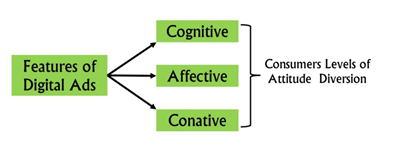
Figure 3
Persuasive Appeals (Features) of Digital Ads and Levels of Attitude Diversion
Objectives of the Study
- To investigate the demographic variables of the respondents influenced by digital advertisements.
- To explore different persuasive appeals of digital advertisements influencing consumer e-shopping behavior
- To investigate the influence of characteristics inherent to digital advertisements on varying dimensions of consumer attitude divergence, namely cognitive, affective, and conative.
Hypothesis of the Study
H1. A significant association exists between the characteristics of digital advertisements and the cognitive level of consumer attitude diversion.
H2. A correlation exists between the characteristics of digital advertisements and the consumer's affective level of attitude diversion.
H3. There exists a correlation between the characteristics of digital advertisements and the consumer's conative level of attitude divergence.
Research Methodology
Research Approach and Study Design
The present study chose the cross-sectional survey method where the data are gathered from the target population or representative subset using self-constructed questionnaire using a five-point Likert scale ranging between 1 (strongly disagree) and 5 (strongly agree) within a given period of time.
Population and Sample Size
Population is something that catches the eye of study. The population is the students of the six best six public sector university of KP. Multi-stage stratified sampling technique was used to select the sample as it has 1270 respondents (499 females and 771 male).
Results
Table 1
Demographic Profile of the Respondents
|
Categories |
Type/Group |
Frequency |
Percentage |
|---|---|---|---|
|
Gender |
Male |
771 |
60.7% |
|
Female |
499 |
39.3% |
|
|
Age |
21-30 |
717 |
56.5% |
|
31-40 |
479 |
37.7% |
|
|
Above 40 |
74 |
5.8% |
|
|
Residential Status |
Urban |
718 |
56.5% |
|
Rural |
552 |
43.5% |
|
|
Monthly Income |
Below 20K |
280 |
22.0% |
|
21 to 30K |
749 |
59.0% |
|
|
31 to 40K |
170 |
13.4% |
|
|
Above 40K |
71 |
5.6% |
Table 1 shows the basic details about the people who took part in the study. It includes things like their gender, how old they are, whether they live alone or with others, and how much money they earn each month. The data reveals that a substantial majority of respondents, specifically 60.7%, identified as male, whereas a comparatively smaller cohort, comprising 39.3%, identified as female. Furthermore, the table illustrates that 56.5% of respondents fall within the age bracket of 21-30 years, while 37.7% are situated in the 31–40-year age group; a minimal proportion of respondents, amounting to 5.8%, are aged over 40 years. In terms of residential status, the table indicates that 56.5% of the respondents reside in urban locales, in contrast to 43.5% who inhabit rural regions. Additionally, 59% of the respondents’ report earning an income ranging from 21,000 to 30,000, while 5.6% of respondents indicate earnings exceeding 40,000.
Table 2
The Influence of Features of Digital Ads on Consumer Cognitive Level of Attitude Diversion: Simple Liner Regression
|
R |
R2 |
Adjusted R2 |
SE |
F-Value |
B |
Sig. |
|---|---|---|---|---|---|---|
|
.789a |
.623 |
.623 |
.38787 |
2093.742 |
.789 |
.000 |
Table 2 shows the regression summary about the impact of digital advertisement features on the cognitive level of attitude diversion among consumers. The results reveal an R value of .789a and an R Square of .623, which elucidates the presence of variability in the dependent variable, specifically the cognitive level of attitude diversion, as influenced by the predictor features of digital advertisements. Furthermore, the F values are recorded at 2093.742, which substantiates the adequacy of the model fit and provides evidence supporting the rejection of the null hypothesis. The p-value of .000, which is significantly lower than the threshold of p=.05, signifies that the effects of digital advertisement features on the cognitive level of attitude diversion within the consumer population are considerable. A positive beta coefficient means that if the predictor variable goes up by one unit, the cognitive level of attitude diversion among consumers increases by about 0.789 standard deviations.
Table 3
The Influence of Features of Digital Ads on Consumer Affective Level of Attitude Diversion: Simple Liner Regression
|
R |
R2 |
Adjusted R2 |
SE |
F-Value |
B |
Sig. |
|---|---|---|---|---|---|---|
|
.335a |
.112 |
.111 |
.52699 |
160.061 |
.236 |
.000 |
The regression summation about the influence of digital advertisement characteristics on consumers' affective level of attitude diversion is shown in Table No. 3 above. The findings show that R=.335a and R Square=.112 illustrate that there was variation in the affective level attitude diversion because of predictor variables of digital advertisements. In addition, F=160.061 value suggests that the model qualifies and justifies the evidence f or null hypothesis rejection. The finding p=.000<.05 indicates that the characteristics of digital advertisements have a significant effect on consumers' emotive attitude diversion. The positive value of the beta shows that as one unit of predictor increases, then the dependent variable consumer affective level will also increase by.236 SD.
Table 4
The Influence of Features of Digital Ads on Consumer Conative Level of Attitude Diversion: Simple Liner Regression
|
R |
R2 |
Adjusted R2 |
SE |
F-Value |
B |
Sig. |
|---|---|---|---|---|---|---|
|
.558a |
.311 |
.310 |
.96880 |
572.340 |
.558 |
.000 |
The general summary of how digital ad features affect consumers' conative level of attitude diversion is shown in Table 4 above. The results show that R is 0.558 and R Square is 0.311, which means that changes in the dependent variable, which is the conative level of attitude diversion, are influenced by the features of digital advertisements. The F value is 572.340, which shows that the model is good and there's strong support for rejecting the null hypothesis. The p value is 0.000, meaning digital ad elements have a strong effect on consumers' conative level of attitude diversion. A positive beta value means that if one unit of a predictor increases, the dependent variable, which is the conative level, increases by 0.558 standard deviations.
Discussion
The research results of this paper suggest that digital advertisements can significantly influence consumer attitude to e-shopping. The cognitive level is more powerful, which implies that the first stage of the consumer is to process and analyze the information provided in digital ads, like clarity, usefulness, and credibility. After the consumers are convinced at the cognitive level, the emotional responses, as well as purchase intentions, are likely to emerge. This reveals that online advertisements serve as campaign agents that influence the consumers’ thinking to feeling and eventually purchase decision in the online shopping contexts. The research was conducted to learn the impact of messages that are persuasive and particular features of digital advertisements on the development of the opinion of people concerning online shopping in Khyber Pakhtunkhwa, Pakistan.
In the study, the authors discovered that there is positive relationship between the content of digital advertisements and factors that affect attitudes such as thinking, feeling, and the desire to act. This finding supports the work of Ranganathan and Ganapathy (2002) who said that the main purpose of digital websites is to meet the needs of their users. If a website doesn't meet consumers’ needs, it doesn't work well. Their research identified four key factors that influence people: content, design, information, and privacy. These factors can change how consumers think and decide to spend money.
The findings, also, coincide with the work of Laia et al. (2017), who reasoned that up-to-date information on the websites of businesses is essential to fulfill the needs and wants of the consumers. In addition, this information should be presented in a manner that is beautiful and appealing to the eye of the target audience. Further, security and privacy should also be provided to win the loyalty of the consumer to purchase again in the future. The findings also match the model developed by Fishbein and Ajzen (1975) and Ajzen and Fishben (2011), which explains how consumer behavior is influenced by three main parts: cognitive, affective, and conative. The findings also support the research done by Huang et al. (2019) and Lu et al. (2022), which show how cognitive factors affect consumers' emotions and how their behaviors change based on the Consumer Attitude Change (CAC) pattern.
Recommendations for Future Research
Future research may widen the study area of research to cover varying regional and cultural backgrounds in a bid to understand the functioning of the digital advertising variables in the varied market settings. With this kind of growth, a more comprehensive picture of contextual effects on the consumer responses towards digital advertisements would be possible. Even additional studies can be conducted to determine how particular characteristics of the site (design quality, interactivity, information richness and perceived security) can influence consumer attitudes and e-shopping behavior. A closer analysis of these factors can give useful insights into the process of online platform fostering trust, engagement, and purchase intention. Further, future research can use the Elaboration Likelihood Model to examine the way different attributes of digital advertising can persuade consumers using both central and peripheral processing pathways, and thus provide a more subtle insight into how digital advertisements persuade consumers, as well as increase the theoretical strength of digital advertisement research.
Conflict of Interest
The authors of the manuscript have no financial or non-financial conflict of interest in the subject matter or materials discussed in this manuscript.
Data Availability Statement
Data supporting the findings of this study will be made available by the corresponding author upon request.
Funding Details
No funding has been received for this research.
REFERENCES
Abbas, Q., Ahmad, R. W., Hassan, A. A. U., & Ahmed, D. (2024). Vlogging culture in Pakistan and its impact on society. Competitive Research Journal Archive, 2(4), 388–402.
Ajzen, I., & Fishbein, M. (2011). Attitudes and the attitude–behavior relation: Reasoned and automatic processes. European Review of Social Psychology, 11, 1–33. https://doi.org/10.1080/14792779943000116
Aronson, E., Wilson, T. D., & Akert, R. M. (2010). Social psychology (7th ed.). Prentice Hall.
Beal, B. D., & Astakhova, M. (2017). Management and income inequality: A review and conceptual framework. Journal of Business Ethics, 142(1), 1–23. https://doi.org/10.1007/s10551-015-3118-8
Djafarova, E., & Rushworth, C. (2017). Exploring the credibility of online celebrities' Instagram profiles in influencing the purchase decisions of young female users. Computers in Human Behavior, 68, 1–7. https://doi.org/10.1016/j.chb.2016.11.009
Ellis, A. (1991). The revised ABCs of rational-emotive therapy (RET). Journal of Rational-Emotive & Cognitive-Behavior Therapy, 9, 139–172. https://doi.org/10.1007/BF01061227
Fishbein, M., & Ajzen, I. (1975). Belief, attitude, intention and behaviour: An introduction to theory and research. Addison-Wesley.
Gvili, Y., & Levy, S. (2016). Antecedents of attitudes toward eWOM communication: Differences across channels. Internet Research, 26(5), 1030–1051. https://doi.org/10.1108/IntR-08-2014-0201
Hawkins, D. I., & Mothersbaugh, D. L. (2010). Consumer behavior: Building marketing strategy. McGraw-Hill.
Hsu, M. H., & Chiu, C. M. (2004). Internet self-efficacy and electronic service acceptance. Decision Support Systems, 38(3), 369–381. https://doi.org/10.1016/j.dss.2003.08.001
Huang, Y., Lou, S., Huang, T., & Jeng, Y. (2019). Middle-aged adults' attitudes toward health app usage: A comparison with the cognitive–affective–conative model. Universal Access in the Information Society, 18, 927–938. https://doi.org/10.1007/s10209-018-0621-9
Huizingh, E. K. R. E. (2000). The content and design of web sites: An empirical study. Information & Management, 37(3), 123–134. https://doi.org/10.1016/S0378-7206(99)00044-0
Hussain, S., Abbas, Q., & Shah, S. F. A. (2024). Populism fuels hate speech and disinformation: Evidence from political discourse on X (formerly Twitter) in India and Pakistan. International Journal of Communication, 18, Article e20.
Laia, C. Y., Lia, Y. M., & Lin, L. F. (2017). A social referral appraising mechanism for the e-marketplace. Information & Management, 54, 269–280. https://doi.org/10.1016/j.im.2016.07.001
Lavidge, R., & Steiner, G. (1961). A model of predictive measurements of advertising effectiveness. Journal of Marketing, 25, 59–62. https://doi.org/10.2307/1248516
Lee, E. B., Lee, S. G., & Yang, C. G. (2017). The influences of advertisement attitude and brand attitude on purchase intention of smartphone advertising. Industrial Management & Data Systems, 117(6), 1011–1036. https://doi.org/10.1108/IMDS-06-2016-0229
Lu, Y., Miao, X., & Fang, G. (2022). Research on the influence of information flow advertising based on ABC attitude model—Take Zhihu as an example. Young Journalists, 6, 49–52. https://doi.org/10.15997/j.cnki.qnjz.2022.06.038
Minnium, P. (2014, November 26). 8 reasons why digital advertising works for brands. MarTech. https://martech.org/10-reasons-digital-advertising-works-brands/
Muhamed, A. A., Ab Rahman, M. N., Mohd Hamzah, F., Che Mohd Zain, C. R., & Zailani, S. (2019). The impact of consumption value on consumer behaviour. British Food Journal, 121(11), 2951–2966. https://doi.org/10.1108/BFJ-10-2018-0692
Ranganathan, C., & Ganapathy, S. (2002). Key dimensions of business-to-consumer web sites. Information & Management, 39(6), 457–465. https://doi.org/10.1016/S0378-7206(01)00112-4
Schiffman, L. G., & Kanuk, L. L. (2007). Consumer behavior (9th ed.). Prentice Hall.
Schivinski, B., & Dabrowski, D. (2015). The impact of brand communication on brand equity through Facebook. Journal of Research in Interactive Marketing, 9(1), 31–53. https://doi.org/10.1108/JRIM-02-2014-0007
Shu, X., He, Y., & Min, Z. (2022). Research on the network presentation of tourist scenic spots based on ABC attitude model—Taking Guizhou Province 5A and 4A scenic spots as an example. Resource Development & Market, 38, 650–656. https://doi.org/10.3969/j.issn.1005-8141.2022.06.002
Solomon, M. (1995). Consumer behaviour (3rd ed.). Prentice Hall.
Virgile, M., Vines, M., Bates, N., & Walejko, G. (2016, May 13). Digital advertising encouraging participation in the decennial census. U.S. Census Bureau. https://www.census.gov/newsroom/blogs/research-matters/2016/05/digital-advertising-encouraging-participation-in-the-decennial-census.html