Alignment of Punjab Textbook Board’s English Textbooks with the National Curriculum for English (2006): An Evaluative Study
Shahbaz Malik*
International Islamic University, Islamabad, Pakistan


ABSTRACT
In Pakistan, English language textbooks are considered as the most authentic and useful material for English language teaching. They are expected to fulfil the objectives stated in the National Curriculum for English, 2006. The Federal Government has complete control over designing and selecting the content of the textbooks. Pakistani society is challenged by religious, cultural, and ethnic diversity. In view of this diversity, a curriculum is expected to promote national identity and unity among various groups. Therefore, the national agenda is disseminated and promoted through textbooks to build a cohesive society. Pakistan is a developing country, where traditional methods and techniques are used to teach language. Hence, it becomes necessary to minutely evaluate the teaching material. For this purpose, textbooks taught in the Intermediate level English classes are evaluated in this research, keeping in view the objectives stated in the National Curriculum. Data has been taken from the four textbooks taught at the Higher Secondary School Certificate (HSSC) level in Punjab, Pakistan. Data is evaluated by using the qualitative approach as summation and calculations are involved in the analysis. The analysis of the exercises and the content shows various types of deviations from the objectives of the Curriculum. The study finds that most textbook exercises are partially aligned with the Student Learning Outcomes (SLOs) of benchmarks, standards, and competencies mentioned in the National Curriculum. The study also suggests the ways to synchronize the selected textbooks with the policy document which would ultimately improve the overall English language skills of the students.
1. INTRODUCTION
In Pakistan, textbooks play a pivotal role in every sphere of education, particularly in language learning. English language textbooks provide authentic and useful materials for English language teaching. They are designed and edited to meet the objectives mentioned in the National Curriculum, 2006. Pakistani society is a composition of various multicultural, religious, and ethnic groups. Hence, a unified curriculum is required which satisfactorily addresses the challenges posed by the various groups. This is also pointed out by Shoukat and Ghani (2015) who suggest that “historically, the textbooks of English taught at higher secondary level in Punjab have remained under the control of political, religious and social ideologies” (p. 312). Moreover, the selection and designing of the content of textbooks is under the control of the Federal Government. This control helps in promoting the national agenda by the government and brings cohesiveness among the various factions of the society. Shoukat and Ghani (2015) also state that “textbooks are meant to help nations to achieve their national goals, and strengthen their ideological foundations. Textbooks are the effective way of ruling the consciousness of people” (p. 313).
Textbooks play a crucial role in developing the mindset of the learners through their content, therefore, they require a very minute and careful selection of the content (Jamil et al. 2024). Helm (1951) is of the view that “the textbook is a valuable source of information and the ideas it expresses may influence students' thinking; careful selection, therefore, is essential” (p. 522). This careful selection gives leverage to the Federal Government of Pakistan to enhance its influence in designing and selecting the contents of the textbooks. This undermines other important stakeholders and marginalizes them to an extent, since they have to accept and promote whatever has been designed and selected for them. It also shows the significant control of the Federal Government. Naseem (2014) claims that “textbooks in Pakistan are often badly designed and badly produced by approved publishers. None of the key stakeholders (parents, teachers, school administrators, students, and/or publishers) have a say in the content of the textbooks” (p. 14). Strict administrative control of the Federal Government and scrutiny of the textbooks from various forums has not produced the desired results; rather, it has further complicated the process. Administrative control of the Federal Government on the preparation of curricula and textbooks has been responsible for stagnation in this area.
The role of the Federal Government in designing the curriculum was established by the first education policy expounded in the 1950s. Since then, it has increased over time and the Federal Government has taken full control in all aspects deemed necessary to promote a national agenda synchronized with Islamization. Afzal (2015) states that “since the 1980s, historians and scholars have criticized Pakistan’s official curriculum and textbooks, have documented biases and historical errors in them, and have argued that the books promote intolerance and bigotry” (p. 3). This increased role of the Federal Government has led to marginalizing the strata of the society other than Sunni Muslims, consciously or unconsciously. Giunchi (2007) states that from the perspective of national unity, curricular reform has nurtured resentment and encouraged ethnic separatist forces by denying cultural diversity. The denial of heterogeneity has also increased sectarian strife, as evident by the Shi'a protests in Gilgit since 2003 against the introduction of Sunni-orientated texts (Giunchi, 2007). The indoctrination of government schools, which cater to the lower middle class and the poor, is also likely to foster resentment against the westernized elite and give this resentment a religious slant.
There are various functions of textbooks, such as the promotion of different ideologies through hidden curriculum. Their foremost concern is the achievement of the intended objectives envisaged in the policy document. Pakistan is a developing country where teachers use traditional methods and techniques to teach language. Hence, it becomes necessary to minutely evaluate the teaching material from all angles. This is also corroborated by Shoukat and Ghani (2015) as follows:
The function of textbooks is to manifest the ideologies and philosophies of the curriculum. Textbooks influence a person's worldview, and the gravity of influence depends on the teacher how the teacher imparts the knowledge provided in the textbooks, and what method of teaching is acquired etc. In this regard, how a teacher perceives textbooks is the main factor on which the whole process of education depends. (p. 275)
Apart from its role as a tool to project the national identity and various ideologies, the main focus of the National Curriculum, 2006 (which is usually neglected) is to make the learners global citizens who can participate in world affairs as aware and thinking individuals, instead of rote learners. Giunchi (2007) states that
The ideological reorientation of Pakistani textbooks has had many adverse effects. From the perspective of national development, rather than promoting critical thinking and imparting knowledge and skills that are needed in an increasingly globalized economy, the Islamisation of the educational system has stultified creativity and promoted an uncritical and simplistic vision. (p. 378)
The curriculum is a vast spectrum which covers all aspects of the learning process, ranging from classroom environment to improvement in the non-academic environment. This study focusses to evaluate one aspect of the curriculum, which is the alignment of textbook exercises with the stated objectives of the National Curriculum. This point is further elaborated by Shoukat and Ghani (2015) who state that “to what extent, textbooks of English language are effective to transform curriculum guidelines into syllabus” (p. 275). Books play an important role in the education system. As stated by Carter (1987), “A textbook that is up to date, well written and accurate, and attractive is a powerful tool in bringing about change in the lives of students” (p. 425). Due to their importance, the governments of different countries pay special attention to designing the textbooks in terms of their objectives, contents, and other aspects. Since textbooks play a significant role, especially in language teaching classes, many governments conduct studies to determine their alignment with the desired objectives. Textbook revisions may bring positive changes in the overall language teaching environment, although such revisions cannot warrant the desired results if the particular textbook is not appropriately revised according to the parameters mentioned in the policy document.
On the contrary, it has been argued that textbooks are not that important because they are superficial and unable to cover the diversified and broader needs of their users. Apart from this discussion, their importance cannot be undermined because of the consistency and systematicity they provide to the overall learning process. Genesee (2001) stated that evaluation in TESOL settings is a process of collecting, analyzing and interpreting information. This process enables us to make informed decisions through which student achievements will increase and educational programs will be more successful. Textbooks systematically help the language learning process. They also help the teachers to use readymade material that could be tailored according to the needs analysis of the class. Polikoff (2015) contends that textbooks affect students directly through their daily use and indirectly through the teachers' use of texts to guide instruction. There are three stages of the material evaluation of textbooks, as suggested by Ellis (1997). These are pre-use, in-use, and post-use. Pre-use evaluation examines the future or potential performance of a textbook, in-use evaluation examines the currently used material, and post-use evaluation is reflective and used after the textbooks have been used in a specific institution or situation.
The curriculum is not just a collection of books, rather it is a means to academic learning based on physical, psychological, and social activities. Curriculum is an umbrella term which includes syllabi, intellectual growth, aims, and objectives. It should be precise, based on the needs of the learners, and by design measure the quality and effectiveness of the learning process. Saylor and Alexander (Farooq, 1993) also support these arguments, “The curriculum is the total of the school’s efforts to influence learning, whether in the classroom, on the playground, or out of school” (p.25). In light of the facts stated above, it is beyond doubt that curriculum holds a pivotal place in any educational system. Moreover, revision and assessment of the curriculum are important. By such measures, new inputs based on revision and assessment may be included to improve the teaching and learning process.
The curriculum is mostly prepared by the federal or provincial governments, complying with pre-defined standards and benchmarks and targeting specific student learning outcomes (SLOs). It is mostly confused with the syllabi which comprises books and reference material. It is not a collection of texts, instructions, and guidelines to be followed as prescribed. Rather, in the broader perspective, it is an umbrella term that includes multiple activities, ranging from mental to physical, abstract to concrete, and psychological to social grooming. Oliver (1965) is also of the opinion that curriculum is something to be felt rather than something to be seen. Hence, it is not just a set of learning and instructional materials applied in an academic setting; rather, it is a broader term that encompasses the environment, teachers, syllabi, aims and objectives, and the foremost aesthetic and intellectual development. It also covers the formal and informal aspects of learning that influence both studies and practical life.
Curriculum is a systematic way of achieving the stated aims and objectives; hence, it can be considered as the backbone of any educational activity. Polikoff (2015) says that curriculum materials are among the most important influences on teachers. However, according to him, it is also important that the material provided to the teachers should be clear and easy to implement, so that it may provide the intended outcomes. According to Polikoff (2015), the theories of standards-based reform postulate that teachers must receive clear and mutually reinforcing messages from standards, assessments, and curriculum materials about the content they should be teaching. He further points out that the weaknesses due to which the curriculum is not implemented completely include the non-alignment of textbooks with the objectives of the document, A second likely contributor to weak standards implementation is the poor quality and alignment of textbooks and curriculum materials (Hill, 2001; Spillane, 2004). Polikoff (2015) is also of the view that textbooks affect students directly through their daily use and indirectly through teachers' use of texts to guide instruction (Ball & Cohen, 1996). A large number of teachers and students use textbooks frequently (Chingos & Whitehurst, 2012), even in an era when curriculum materials are increasingly available online. To be sure, teachers do not passively implement textbooks as written—rather, teachers adapt them as they are implemented (Barr, 1988). Nevertheless, textbooks affect what is taught and what students learn (Schmidt et al., 2002). In mathematics, in particular, topics that are not included in textbooks are unlikely to be taught (Stein et al., 2007).
The content of schooling in all of its forms (written or unwritten) is called the curriculum. Owing to its importance, a curriculum should have a vast spectrum and should cover all types of learning requirements of the students. However, the content of the curriculum is usually decided by the state to fulfil obvious and hidden agendas. Usually, the hidden agenda termed as ‘inclusive curriculum’ or ‘the politics of curriculum’ is not prominent, but it plays its role in shaping the minds of the students. English (1992) points out that in the US, and the most societies the public schools are the agents of the state, and the state is run by those in power, the definition of the state, whether it is secular or sacred, becomes the screening framework for what is eventually included and excluded in the school curriculum.
Consequently, it is mainly the textbooks which impact language teaching and learning. They play an important role, especially in English language teaching and learning, and comprise the primary sources of learning. Therefore, they need to be revised and modified according to the changing needs and requirements. In Pakistan, the curriculum for English language (grades I-XII) was revised in 2005-06 with the intention to make it comparable with the international standards. It is important to evaluate that this basic source of learning fulfils the requirements of teachers, students, and examiners. Therefore, the contents of English textbooks should be modified, and if required, altered according to the new and emerging circumstances, needs, and challenges.
This study is significant as it provides a better understanding of the textbooks taught at Higher Secondary School Certificate (HSSC) in Punjab, Pakistan. It also provides guidelines to address the existing flaws of these textbooks and synchronize them with the SLOs of the National Curriculum.
How far Intermediate English textbooks published by Punhab Textbook Board (PTBB) are in alignment with the National Curriculum for English (2006)?
Research Methodology
Punjab Textbook Board (PTBB) has published four books for Intermediate students. Two books including Book 1 (short stories) and Book 3 (plays and poems) are taught in Grade 11, whereas Book 2 (prose) and a novel Goodbye Mr. Chips are taught in Grade 12. Data has been taken from all the exercises of the aforementioned four English textbooks taught at the HSSC level in Punjab, Pakistan. The study is delimited to see only the alignment of textbook exercises with the objectives of the National Curriculum for English, 2006. The Curriculum sets different competencies, standards, and benchmarks and textbook exercises have been evaluated in light of these competencies, standards, and benchmarks. Both qualitative and quantitative approaches are employed for data analysis and evaluation. The study suggests synchronizing textbook exercises with the policy document which would improve the overall English language skills of the students.
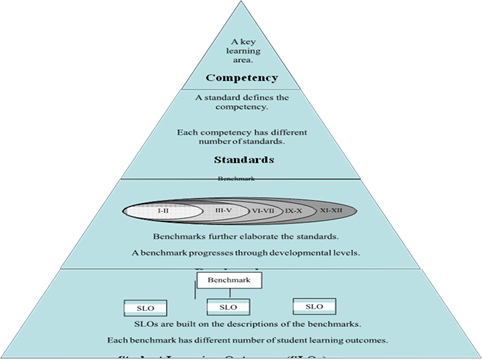
Figure 1
Organization of the Curriculum Framework
Note: Adapted from Punjab Curriculum and Textbook Board (2006, p. 6) National Curriculum for English Language Grades I-XII (2006) sets Competencies (Cs), Standards (Ss), Benchmarks (Bs), and Student Learning Outcomes (SLOs).
CompetencyIt is defined as a key learning area.
StandardsThese define the competency by specifying broadly the knowledge, skills, and attitudes that students will acquire, should know about, and be able to do in a particular key learning area during twelve years of schooling.
BenchmarksThe benchmarks further elaborate the standards, indicating what the students will accomplish at the end of each of the five developmental levels to meet the standards. These provide, at a glance, the continuum of English language learning, such as the benchmarks for grades I and II define what the students will be able to do by the end of grade II.
Student Learning Outcomes (SLOs)These are built on the descriptions of the benchmarks and describe what students will accomplish at the end of each grade.
Data Analysis
Data has been taken from the exercises of all four English textbooks of the Punjab Textbook Board (PTBB) taught at the Intermediate level. The exercises of each textbook are evaluated separately. The study focuses on whether the textbook questions are aligned with the objectives of the National Curriculum or not. The study also determines which competencies and questions based on these competencies are more prevalent in textbook exercises. The analysis of the exercises shows various types of deviations from the objectives of the Curriculum.
Intermediate English Book I (Short Stories)The content of this textbook is maintained according to the National Curriculum. The textbook has been sanctioned by the Punjab Curriculum and Textbook Board, Lahore. The textbook consists of fifteen short stories. Twelve short stories are written by foreign authors, two by local authors, and one is based on folk tale by an anonymous writer.
Types of Questions in the BookEach story in the book consists of a reading passage and an exercise. Every lesson’s exercise has more or less the same types of questions. For students’ assistance, in reading notes sections, vocabulary items (15-20 items) from each passage are given with their general and contextual meanings. The objective type questions include multiple choice items, matching items, fill in the blanks, true/false, and binary items. Whereas, subjective type questions include sentence making, short answers in 100-150 words, punctuating the sentences, and grammar-based exercises.
Intermediate English Book II (Modern Prose and Heroes)This textbook is also based on the National Curriculum for English language. The textbook has been sanctioned by the Punjab Curriculum and Textbook Board, Lahore. The book consists of sixteen lessons. Fifteen lessons are written by foreign writers and one by a local writer.
Intermediate English Book III (Plays and Poems)This textbook is based on the National Curriculum. The textbook has been sanctioned by the Punjab Curriculum and Textbook Board, Lahore. The book consists of three plays and twenty poems. Foreign authors have written all the three plays. Thirteen poems are written by foreign authors, six by local authors, and one poem is from Ecclesiastes, 3, 1-12.
Intermediate English Book IV: Goodbye, Mr. ChipsThe textbook is a novelette written by James Hilton, corrected by National Review Committee for College Textbooks, and edited by Muhammad Kalimuddin. The novelette is fifty pages long and has eighteen chapters. Each chapter has a main idea which is linked to the core thought or the main theme of the novelette. An exercise is given at the end of the novelette. The exercise consists of a list of thirty-one glossary items with their contextual meanings, main theme, descriptions of different characters, and thirteen questions at the end of the textbook.
Competency 1: Reading and Thinking Skills
The first competency in the National Curriculum is the improvement of reading and thinking skills among students.
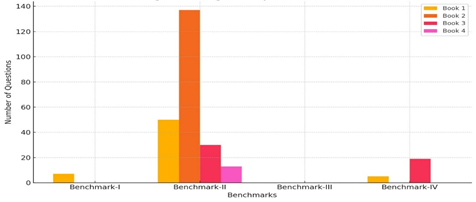
Figure 2
Reading and Thinking Skills by Benchmark and Book
The SLOs at Competency 1, Standard 1, Benchmark I clearly state that the students would be able to “learn strategies to identify the main theme, supporting detail, topic sentence, cohesive device and the overall structure of the reading passage” (p.120). Apart from the inclusion of the suggested themes, overall topics, and relevant grammatical structures, data analysis shows that Book 1 contains questions significant for the improvement of important reading comprehension skills, sub-skills, and different language functions related to C1, S1, and B1. Although their frequency is low according to the number of lessons; out of fifteen exercises only six have questions pertaining to SLOs. However, they are framed as per the guidelines mentioned in the policy document. Whereas, books 2, 3, and 4 do not contain any questions related to these SLOs.
Benchmark II requires analysis, synthesis, and evaluation of events, issues, ideas, and viewpoints by applying reading comprehension and thinking strategies. The SLOs at B2 require the learners to apply pre-reading strategies, skimming, and critical thinking; while reading, summary skills, post-reading, and finding signposts and keywords to understand the questions. Figure 1 shows that every exercise of Book 1 contains a minimum of 03 questions. Subjective questions with sub-items are asked keeping in view some aspects of B2, such as “scan to answer short questions” (p.121) and “Why did Norma consider the tone and attitude of Mr Steward offensive?” (Punjab Textbook Board, 2020a, p. 9). The exercises also ask two objective-type questions with sub-items, including multiple-choice questions and mark the statements as true or false for the same benchmarks. Every exercise in Book 2 has questions related to SLOs and most of the exercises in Book 3 also contain questions pertaining to SLOs. Book 4 also has thirteen questions based on reading SLOs but they actually are for improving writing skills. Overall, the SLOs are related to improving reading comprehension skills, but questions are primarily concerned about the improvement of writing skills.
The SLOs at Competency 1, Standard 1, and Benchmark III require students to analyze, summarize, and synthesize information from a visual cue or a graphic organizer, highlighting key areas and main trends, but not a single question relevant to these SLOs has been asked in the exercises of all the four books. It can be assumed that it may break the linchpin necessary for the students to improve their reading skills from a basic level to an advanced level by following these benchmarks.
Benchmark IV requires students to use study skills, encyclopedias, library skills, and textual aids. A total of 06 exercises in Book 1 consist of making sentences based on the given words. Exercises in Book 3 have specific glossaries which define words according to their contextual meanings. These SLOs are comprehensive in the sense that they tend to use additional resources to understand the text. For this purpose, plenty of vocabulary items with definitions are provided to understand the contextualized vocabulary, while the remaining SLOs are neglected in the book. Book 2 and Book 4 both do not contain any questions pertaining to the SLOs.
Competency 1, Standard 2, and Benchmark I ask the learners to make predictions, analyze stories, recognize the author’s point of view, discuss the themes, and evaluate the use of figurative language in the poems. Thirteen exercises in Book 1 contain detailed questions with sub-items related to themes, sub-ideas, and the characters and their feelings. These sorts of short questions can help to better understand the text. Book 2 and Book 4 do not have any specific questions based on these SLOs. Book 3 contains 09 questions related to rhyming, whereas the SLOs are about alliteration.
The analysis of the content further reveals that the comprehension questions are related to the text. On the contrary, exercises are based on questions without proper guidelines which make the learners dependent on the individual instructor/teacher to conduct an important part of the language learning process, namely reading comprehension, on their own. Similarly, there are no charts, tables, diagrams, footnotes, or glossaries which would help to better understand the text. Factual accounts are present in the lessons, but the reading passages are limited mostly to narratives based on short stories. Straightforward questions are asked in the lessons. The answers to these types of questions can be given by just restating the facts which are already present in the text. Hence, these types of questions cannot improve the reading comprehension skills in the real sense (Punjab Textbook Board, 2020a, pp. 9–10). Steps like pre-reading, while-reading, and after-reading given in Competency 1 and its various standards and benchmarks are missing in the exercises. Essential strategies, such as skimming and scanning and summary skills necessary to find out the main theme and to extract specific information from the text are also missing from the exercises.
It may be safely assumed that advancement in reading comprehension may not be achieved without applying the above-stated SLOs. Overall, it may be concluded that the reading comprehension questions have considerable weaknesses.
Competency 2: Writing Skills
Competency Writing Skills Related to C2, S1, B1
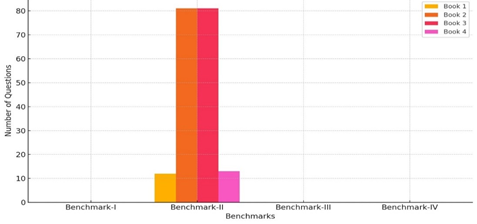
Figure 3
Writing Skills by Benchmark and Book
The SLOs at Competency 2, Standard 1 state that the students would be able to learn how to develop their “own writing by identifying audience and purpose, use a variety of pre-writing strategies, analyze an essay to identify the general subject, main idea, key ideas, supporting details and transitional devices, and how to write an essay on a general subject by following certain steps.” The SLOs mentioned at this level provide basic steps important for learners to improve their writing skills. Figure 2 shows that writing questions related to C2, S1, BI or some of these SLOs are not asked in the exercises of all the four books.
The SLOs at Competency 2, Standard 1, Benchmark II envisage that the students should learn how to “write expository, persuasive, analytical essays, research reports, and extended narratives for multiple purposes and audiences.” Additionally, the SLOs require students to use in their own writing features of an expository composition, write an extended narrative incident, develop a persuasive/argumentative essay, and draft a research report in order to improve their writing skills. Figure 2 shows that all the exercises of the four books have questions related to specific SLOs of Competency 2, Standard 1, Benchmark II, such as one writing question (100-150 words) with sub-items from each lesson is asked. For example, the following question is based on the specific SLOs mentioned in the National Curriculum.
Lesson 01, Q.04: Write a note on the character of Arthur (Punjab Textbook Board, 2020a).
This shows that questions are related to specific SLOs, while important SLOs pertaining to report writing or argumentative writing are totally neglected in the exercises. In this regard, argumentative or persuasive types of writing are substituted with writing a note questions. Another aspect is that the questions asked in reading competency are also applicable to writing exercises. This may be due to a flaw in the demarcation of the SLOs or it could have been intentionally done in the Curriculum, so that the students may learn better while integrating the reading and writing skills.
The SLOs at Competency 2, Standard 1, Benchmarks III and IV are essential to learn the writing skills, such as plan, draft, and revise writing, as well as proofread and edit their own text to an extent necessary for business communication and attaining jobs. Figure 2 depicts that notwithstanding the importance of these skills, no question is added to the exercises of these four books.
Competency 3: Oral Communication Skills
Questions of Oral Communication Skills Related to S1, B1, BII
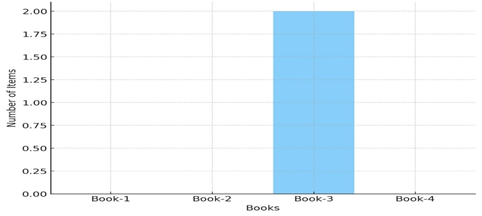
Figure 4
Oral Communication Skills: Total Items
The SLOs require students to evaluate and use expressions for various functions and co-functions. Due to the importance of speaking in communication, the speaking tasks should be flexible and deal with real language. On the contrary, the analysis of the exercises shows that there is only a single question with a sub-item related to this competency in Book 3 which requires the students to identify the speaker who said the specific lines in the play. This is only about recalling the information stated in the text. Moreover, books 1, 2, and 4 do not have questions related to these SLOs. The advanced level communication skills mentioned at B2 are also important for learners to demonstrate through formal talks, individual oral presentations and job interviews, social and academic conventions, and the dynamics to communicate information and ideas. The SLOs state that by achieving this benchmark, the students will be able to demonstrate heightened awareness of the conventions and dynamics of group discussion and interaction, demonstrate the use of appropriate conventions to give a job interview, create and deliver group/class presentations on various themes, problems, and issues, and evaluate to comment orally on the presentation of peers against a predeveloped student/teacher criteria. Again, Figure 3 illustrates that only one exercise in Book 3 has a question for discussion with six sub-questions and all the other books do not have a single question pertaining to these SLOs.
- Questions for Discussion
- “Do you think it is right to allow Clay to believe that there is a pearl in the oyster? Explain briefly” (p.49, Book-3). Although the six questions are designed to sharpen the analytical skills of students, but their frequency is very low which could be counterproductive. Oral communication skills are altogether ignored in the textbooks. No guidelines/drills, strategies, or SLOs are given in these books to be practiced or learnt by the students.
Competency 4: Formal and Lexical Aspects of Language
Single Oral Activity to Improve the Pronunciation of Students
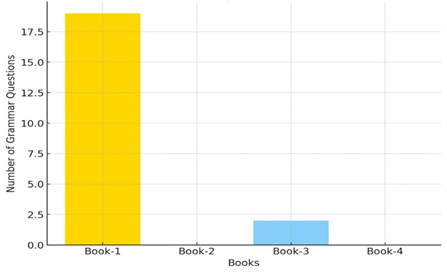
Figure 5
Formal and Lexical Aspects: Grammar Questions
The SLOs at this benchmark state that the students will be able to use the pronunciation key to pronounce words with developing accuracy, recognize the silent letters in words and pronounce them with developing accuracy, recognize, pronounce, and represent primary and secondary stress in words with the help of a dictionary, and recognize and use varying intonation patterns as aids in spoken and written discourse. Figure 4 shows that not a single oral activity or written guidelines to improve the pronunciation of students are given in all the books.
The SLOs at Competency 4, Standard 2, Benchmark I state that the students will learn how to use appropriate vocabulary and correct spellings in their own writing. They should also use the knowledge of literal and figurative meaning, grammatical gender, and syntax to translate passages from English to Urdu. Book 1 has twenty-one vocabulary items which include the explanation of vocabulary in context and phrasal verbs, while all exercises of Book 2 have word explanations. Similarly, Book 3 has twenty-one items of vocabulary explanation and Book 4 has thirty-one contextual vocabulary explanation items. Although the lessons in these books have a considerable number of vocabulary items, in reality such a large number of unfamiliar and difficult lexis can make the textbooks boring or difficult and hamper the acquisition of the target language. The meaning of these vocabulary items is explicated by their contextual usage but there are no guidelines or strategies available regarding how to learn a vocabulary item from basic sounds, from prefixes and suffixes, and from synonymous and connotative uses of a word. Moreover, the lessons may become dense to some learners since they are overloaded with texts and difficult vocabulary items. Likewise, the books under study do not have any formal methods or strategies for both the tutors and the learners to translate a passage from English to Urdu.
The SLOs at Competency 4, Standard 3, Benchmark I state that the students will learn noun, noun phrases and clauses, pronouns, articles, verbs and verb phrases, tenses, adjectives and adjective phrases and clauses, adverbs and adverbials, prepositions and prepositional phrases, and transitional devices. Figure 4 illustrates that Book 1 has 19 grammar questions which include only the use of verbs and prepositions, while Book 3 has only 02 questions about the use of prepositions. Book 2 and Book 4 do not have a single question related to grammar. For example,
Lesson 01; Q.06 is: Use the correct forms of verbs given in the brackets e.g., Norma (unlock) the door, and (go) into the apartment; 05 sub-items,
According to the policy document, the students will learn all parts of speech, tenses, use of articles, and transitional devices, but the data shows that questions are asked about only two aspects of the SLOs at this level. These are verbs and prepositions and the remaining SLOs and their sub-clauses are totally neglected. The SLOs at B2 require students to apply the rules of capitalization wherever applicable, illustrate the use of all punctuation marks wherever applicable, recognize and rectify faulty punctuation in given passages and their own work, recognize and use comma to mark a dependent word or word group that breaks the continuity of the sentence, recognize and use colon between two independent groups not joined by a connecting word (when the first group points forward to the second), recognize and use semicolon, recognize and use quotation marks to enclose titles of published works and titles of their subdivisions, recognize and use hyphen to indicate the division of a word at the end of a line, recognize and use dash to mark parenthesis or apposition to give strong emphasis (to mark off a contrasting or summarizing statement), recognize and use parenthesis (square brackets) to enclose explanation, comment, or criticism inserted by someone other than the person quoted, and recognize and use omission marks or ellipses to signify the omission or deletion of letters or words in sentences.
Twelve exercises of Book 1 have one question, each pertaining to the use of punctuation marks, while Book 3 has 02 questions of punctuation. Book 2 and Book 4 do not have any question of punctuation.
Lesson 01 Q. 07 is Punctuate the following lines “Mr. steward… scope”.
It is a known fact that punctuation marks are very important to understand the message correctly while reading a text and to convey the message through writing. The policy document comprehensively explains and guides through the SLOs in detail. The analysis of the exercises explicates that they have a question of punctuation, however, that question only demands a basic level understanding of punctuation and is also based only on a few sentences (02-03). These are barely sufficient for the learners to understand the complexities of composition without rigorous practice and in-depth knowledge of punctuation marks.
The SLOs at Competency 4, Standard 3, Benchmark III require the students to learn the sentence structures, types of sentences, and use active and passive voice appropriately in speech and writing according to the required communicative function. Figure 4 reveals that Book 1 has 05 questions and Book 3 has 01 question to make sentences with the given words and phrasal verbs, whereas, Book 2 and Book 3 are without any such type of activities. Some exercises have questions pertaining to narration, such as Lesson 01; Q.08 is Write down the following lines in indirect narration e.g. “Don’t you want to know about it?” the salesperson asked the customer (04 sub-items).
The SLOs at this level are important in the sense that for increased effectiveness in communication, learners should clearly understand the differences among different types of sentences. Further, they should “use active and passive voices and direct and indirect speech appropriately in their written and oral communication”, according to the requirements.
Overall, the importance of grammar is evident in the policy document but in practice only limited aspects of grammar are explored in the exercises which can barely fulfil the requirements of the students. It is also worth mentioning that there is no grammar book for the learners to do an in-depth study of concepts mentioned in the Curriculum.
Competency 5: Appropriate Ethical and Social SkillsC5, S1 states that all students will develop ethical and social attributes and values relevant to a multicultural, civilized society.
S1, BI are meant to recognize and practice values and attributes, such as tolerance, humanism, patience, equity, justice, honesty, and empathy relevant for peaceful coexistence between individuals, groups, and nations.
B2 states that the students will develop and portray through actions a sense of importance of individual worth; simultaneously valuing diversity and equality among people. Benchmark III requires students to understand and evaluate contemporary social, economic, and scientific developments and issues, so as to participate in the global society as aware and thinking individuals.
The policy document requires the textbook developers to add the above-mentioned themes in the textbooks, which may bring cohesion to the society. The content related to these themes is reflecting in Book 1 and conforms to the Curriculum. There are a few lessons which mostly reflect the above-mentioned themes. For instance, the theme of tolerance in “Thank you, Ma’am” (Punjab Textbook Board, 2020b, p. 25) and the theme of empathy in “God be Praised” (Punjab Textbook Board, 2020b, p. 79). However, close analysis of the contents reveals the opposite situation.
The SLOs at C5, S1, BI state that the students will learn to recognize and practice values such as tolerance, humanism, patience, equity, justice, honesty, and empathy. The book contains information related to general topics in the form of prose, as well as success stories of the famous men of the world in the form of their biographies. Table 1.0 depicts that the values and questions related to these values are totally ignored in the content as well as in the exercises of these books. A non-inclusive pattern is followed in this competency by not including those aspects which may bring harmony and tolerance in the behavior of students. Tolerance and harmony are themes of every curriculum, so they must be included in our textbooks. Pakistan is a diverse country in terms of its culture and faith. Although the majority of the people belong to Islam, a considerable number of religious minorities also live across the country. According to the Constitution of Pakistan, these minorities enjoy equal status in the country. In the Curriculum, it is mentioned that it should cater to the needs of learners belonging to any religion. Moreover, to create harmony in the society and to achieve social cohesion, topics related to humanism, kindness, and simplicity may be taken from the sacred personalities of other religions and be included in the book. This would give confidence and a sense of belonging to the people following other religions. On the other hand, Muslim students would also get awareness about the diversified nature of the society and other religious figures. However, the analysis of the textbooks shows that lessons do not contain messages that promote social cohesion.
C5, S1, BII state that the students would develop and portray through their actions a sense of importance of individual worth; simultaneously valuing diversity and equality among people. This book contains fourteen lessons by male writers and two by female writers, which highlights gender discrimination in the selection of lessons. These lessons almost completely ignore the existence of women. The names of the lessons denote the male gender, such as “Why Boys Fail in Colleges” (Punjab Textbook Board, 2020b, p. 13) and “The Man who was a Hospital” (Punjab Textbook Board, 2020b, p. 32). Even the characters in the lessons are masculine and there is no female character in the whole book. Furthermore, in the second part of the book which contains the stories of heroes, not a single character is female. The questions also contain gender-biased pronouns, rather than gender-neutral pronouns.
C5, S1, B3 state that the learners will understand and evaluate contemporary social, economic, and scientific developments and issues, so as to participate in the global society as aware and thinking individuals. Relevant material is taken from prose which could fulfil the requirement of the students to familiarize themselves with a variety of texts. Unfortunately, the material selected for the textbooks is quite outdated as the lessons related to modern prose and heroes are from the 19th or 20th century. Since then, the world has become a global village and many advancements have taken place in the field of humanities, medicine, astronomy, or any other current discipline. Moreover, the content of the lessons is restricted to basics. For instance, the lesson “Using a Scientific Method” provides very basic level information. This information might be relevant to the society forty or fifty years back but now people know more about such topics because of easy access to the internet and computer. Even the heroes are from the previous century, which may not keep the interest of the students. Up-to-date and contemporary subject matter may arise the interest of the learners who can correlate the content with their present scenarios.
The Curriculum provides guidelines for textbook developers to embed these age-old golden traits in their textbooks to build a cohesive society. The analysis of the lessons shows that these themes are manifested by a few instances in the contents of the lessons, such as:
The play shows that the people of the 20th century are still in the beginning of their civilization as compared to those of the planets of the other solar systems. The man of the future will be free from hatred and violence, and feel a sense of pride in the service of humanity. (Punjab Textbook Board, 2018, p. 26)
Benchmark II refers to develop and portray through actions a sense of importance of individual worth; simultaneously valuing diversity and equality among people. The theme of the third lesson presents a different situation: “The rich at the upper level get a golden chance first and whatever remain trickles down to the people at the level beneath” (Punjab Textbook Board, 2018, p. 53).
This benchmark calls for equality and diversity among the people. However, even in the selection of lessons, the book negates these notions. Out of twenty-three lessons, seventeen are written by authors from the US, Wales, or those from a European background. Only one poem is written by Rumi from Iran and four are written by local authors, namely Allama Iqbal, Ahmad Nadeem Qasmi, Sachal Sarmast, and Bullah Shah.
Benchmark III of this competency requires that the learners should understand and evaluate contemporary social, economic, and scientific developments and issues, so as to participate in the global society as aware and thinking individuals. The analysis of the content shows that Book 3 is completely lacking in these themes. The contents of the lessons are void of social and economic developments. Likewise, the learners may hardly find any material related to scientific developments and the current scientific topics in these books. The theme of class division is indirectly stated in the theme of different poems, but it again depends on the teacher to interpret it accordingly. The whole book does not contain any questions which directly address these themes. Moreover, the textbook manifests gender discrimination. It has three plays and twenty poems and all writers are men. The analysis shows that the representation of women is ignored advertently or inadvertently in the book, which is a total negation of the Curriculum that underlines the importance of gender equality. Further, the Curriculum also describes the importance of environmental education in its major theme as well as sub-themes. The book contains poems which are linked to the environment, such as The Rain and Loveliest of Trees, the Cherry Now. Still, the researchers could hardly find a single question in the whole book which might give awareness to students about environmental issues.
Book 4, the novelette, has different themes which may teach ethical and social attributes and values to the students. After reading the novel, the students, with the help of teachers, may comprehend these values and co-relate them with their cultures. The novel also talks about modernity and conservatism through its characters, that is, Mr. Chips and Mr. Ralston. It has many themes including patriotism, harmony, and co-existence. However, the exercise of the novel does not have any written or oral questions related to these themes. Consequently, this competency is entirely dependent on the tutor’s ability to inculcate the appropriate ethical and social skills among the students.
Discussion
The analysis of the content reveals that comprehension questions are related to text; however, the exercises are based on questions without proper guidelines, which makes the learners dependent on the individual instructor/teacher to conduct reading comprehension. Similarly, there are no charts, tables, diagrams, footnotes, or glossaries which would help in the better understanding of the text. Factual accounts are present in the lessons but reading passages are limited mostly to narratives based on short stories. Straight forward questions are asked in the lessons. The answers to these types of questions can be given by just restating the facts already present in the text. Hence, these types of questions cannot improve the reading comprehension skills in the real sense (Punjab Textbook Board, 2020b, pp. 9–10). Steps like pre-reading, while-reading, and after-reading given in Competency 1 and its various standards and benchmarks are missing in the exercises. Essential strategies such as skimming, scanning, and summary skills which are necessary to find out the main theme and extract specific information from the text are also missing from the exercises.
It may be safely assumed that advancement in reading comprehension may not be achieved without applying the above-stated SLOs. Overall, it may be concluded that the reading comprehension questions have considerable weaknesses.
It can be presumed that the students’ writing skills can be improved to some extent through the above-mentioned questions. However, it is pertinent to mention here that the textbooks under study come without instructions which can be helpful to attempt and practice composition writing. They come without teaching manuals and guidance about different sorts of writings and only specimens are given, which help students in rote learning to pass the exams. Finally, the writing SLOs, if followed properly, may bring considerable changes in the writing of the learners; however, oral communication skills of the students remain all dependent on the tutor/teacher. This gives leverage to the tutors whether to include oral communication practice sessions in their classes. The reason for not practicing oral communication skills is that the teachers are often not fluent in English themselves which results in neglecting this skill. Another major reason for the lack of practice of oral skills among the students is the examination pattern. Exam questions are taken from the textbooks and not from the curriculum. Mostly, question papers are based on the exercises taken from the lessons and in these exercises, there is not a single activity for oral communication. Whereas, the Curriculum emphasizes the need for teaching and testing of oral skills. To overcome the problems in this competency, a viva voce or oral test may be included in the examination, subject to the allocation of appropriate resources and proper training of the concerned teachers in language teaching.
Conclusion
The textbooks cover a wide range of topics that discuss a variety of issues and happenings from different perspectives. However, more topics related to the contemporary world can be added to the syllabi. Apart from the themes, the content also has certain weaknesses in terms of its functional aspects. The content and the exercises incline students to cram the content of the lessons, rather than learning the language. The question items may help students perform well in their summative assessments but do not help them to improve their language proficiency. The content of the textbooks should be modified according to the requirements, age-groups, and understanding levels of the students by incorporating the above-stated concerns.
This study aimed to find out the strengths and weaknesses of textbook exercises with reference to the National Curriculum for English in order to suggest synchronizing the textbooks exercises with the objectives of the policy document. The textbooks are provided in the schools on the promise that they include all aims of the curriculum and there is no need to provide the policy document to the schools. This research clearly demonstrates that there are obvious shortcomings in these textbooks while delivering the aims and objectives of the Curriculum. The SLOs are mentioned in all five competencies, namely reading, writing, speaking, lexical, grammatical, and ethical aspects of learning. Data analysis makes it evident that there are huge inconsistencies in the selected textbooks despite the fact that the Curriculum is available for complete guidance and directions. The textbooks are replete with the exercises of reading and writing competencies and have questions mostly related to grammar and vocabulary. After thorough analysis of the exercises, it was found that mostly reading, writing, and grammatical aspects of the language are given weightage, whereas oral communication skills are completely neglected. One reason can be the examination patterns in which mostly reading and writing skills are evaluated in board exams. This practice may promote teaching to assessment, rather than teaching to learn the language.
Future Research Directions
Future researchers may continue this research by analyzing anomalies in textbooks in terms of the appropriateness of content. Existing teaching methodologies can be evaluated and modified according to the prevalent international ones. Lacunas in the assessment process can be addressed by synchronizing the questions and their assessments carried out by the boards in the annual exams.
Conflict of Interest
The author of the manuscript has no financial or non-financial conflict of interest in the subject matter or materials discussed in this manuscript.
Data Availability Statement
Data availability is not applicable as no new data is created.
Funding Details
No funding has been received for this research.
REFERENCES
Afzal, M. (2015, April 1). Education and attitudes in Pakistan: Understanding perceptions of terrorism. US Institute of Peace. https://www.usip.org/sites/default/files/SR367-Education-and-Attitudes-in-Pakistan.pdf
Ball, D. L., & Cohen, D. K. (1996). Reform by the book: What is—or might be—the role of curriculum materials in teacher learning and instructional reform? Educational Researcher, 25(9), 6–8.
Barr, R. (1988). Conditions influencing content taught in nine fourth-grade mathematics classrooms. Elementary School Journal, 88(4), 387–411.
Carter, J. L. (1987). Who determines textbook content? Journal of College Science Teaching, 16(5), 425–468.
Chingos, M. M., & Whitehurst, G. J. (2012, April 10). Choosing blindly: Instructional materials, teacher effectiveness, and the common core. Brookings. https://www.brookings.edu/articles/choosing-blindly-instructional-materials-teacher-effectiveness-and-the-common-core/
Ellis, R. (1997). The empirical evaluation of language teaching materials. ELT Journal, 51(1), 36–42. https://doi.org/10.1093/elt/51.1.36
English, F. W. (1992). Deciding what to teach and test: Developing, aligning, and auditing the curriculum. In F. W. English (Ed.), Successful schools: Guidebooks to effective educational leadership. Corwin Press.
Farooq, R. A. (1993). Education system in Pakistan: Issues and problems. Asia Society for Promotion of Innovation and Reform in Education.
Genesee, F. (2001). Evaluation. In R. Carter, & D. Nunan (Eds.), The Cambridge guide to teaching English to speakers of other languages (pp. 144–150). Cambridge University Press.
Giunchi, E. (2007). Rewriting the past: Political imperatives and curricular reform in Pakistan. Internationale Schulbuchforschung, 29(4), 375–388.
Helm, E. M. (1951). Evaluating the textbook. The American Journal of Nursing, 51(8), 522–523.
Hill, H. C. (2001). Policy is not enough: Language and the interpretation of state standards. American Educational Research Journal, 38(2), 289–318. https://doi.org/10.3102/00028312038002289
Hilton, J. (1973). Good-Bye, Mr. Chips. Punjab Text Book Board.
Jamil, M., Yousaf, A., & Naqvi, S. U. E. L. Enhancing sustainability education in Pakistan: analysis of Pakistan studies textbook grade xii. International Journal of Contemporary Issues in Social Sciences, 3(2), 1039-1046. https://ijciss.org/index.php/ijciss/article/view/732
Naseem, M. A. (2014). Deconstructing militarism in Pakistani textbooks. Journal of Educational Media Memory & Society, 6(2), 10–24. https://doi.org/10.3167/jemms.2014.060202
Oliver, A. I. (1965). Curriculum improvement: A guide to problems, principles and procedures. Dodd, Mead & Company.
Polikoff, M. S. (2015). How well aligned are textbooks to the common core standards in mathematics? American Educational Research Journal, 52(6), 1185–1211. https://doi.org/10.3102/0002831215584435
Punjab Curriculum & Textbook Board. (2006). The English language national curriculum-2006 for grades I-XII. https://pctb.punjab.gov.pk/system/files/English%20Language%20I-V_0.pdf
Punjab Textbook Board. (2018). Intermediate English book III. Government of the Punjab.
Punjab Textbook Board. (2020a). Intermediate English book- I. Government of the Punjab.
Punjab Textbook Board. (2020b). Intermediate English book-II. Government of the Punjab.
Schmidt, W. H., Houang, R. T., & Cogan, L. S. (2002). A coherent curriculum: A case of mathematics. American Educator, 26, 10–26.
Shoukat, B., & Ghani, M. (2015). English language teachers’ opinion on intermediate English textbooks taught in Punjab, Pakistan. The Dialogue, 10(3), 312–324.
Spillane, J. P. (2004). Standards deviation: How schools misunderstand education policy. Harvard University.
Stein, M., Remillard, J., & Smith, M. (2007). How curriculum influences students' learning. In F. Lester (Ed.), Second handbook of research on mathematics teaching and learning (pp. 557–628). Information Age Publishing.