

| Review | Open Access |
|---|
Developing Critical Analysis and Argumentation Competence in Higher Education: The Role of Multimodal Pedagogy |
 |
|---|
 Oluwatoyin Ayodele Ajani1* and
Tinashe Charles Matiyenga2
Oluwatoyin Ayodele Ajani1* and
Tinashe Charles Matiyenga2
1Curriculum/Education Studies, University of KwaZulu-Natal, Durban, South Africa
2Languages and Social Sciences Education, University of Zululand, Richards Bay, South Africa
The scoping review examines how multimodal teaching methods in higher education institutions foster students' critical analysis skills, which are essential for academic argumentation. The study uses evidence from 56 peer-reviewed studies published between 2010 and 2026 to identify multimodal strategies that educational institutions used alongside their theoretical frameworks and learning outcomes. The synthesis demonstrates that teaching designs that combine visual, auditory, textual, and digital elements produce better cognitive learning outcomes than those that depend exclusively on text. The review of the studies revealed that multimodal interventions helped participants develop stronger evaluative reasoning skills, showed them how to use evidence, and enabled them to achieve greater depth in reflective judgment and to build stronger academic arguments. Digital technologies enabled these outcomes by supporting interactive learning environments and implementing inclusive practices aligned with Universal Design for Learning principles. The review shows that successful multimodal practices most commonly draw on Transformative Learning Theory and Experiential Learning Theory because both theories highlight how critical reflection and experiential learning help people develop advanced thinking skills. The study uses existing empirical evidence to show that multimodal teaching methods improve students' ability to analyse and argue in higher education, while also demonstrating the need for more longitudinal studies.
1. INTRODUCTION
At higher education institutions, students develop essential reading and logical reasoning skills, which enable them to achieve academic excellence and succeed in future professional and community activities (Andrews, 2010; Wingate, 2012). The present era requires people to enhance their literary abilities due to information overload, global challenges, and the various digital technologies available today. The use of textual materials for teaching basic knowledge with low critical value helps provide a better understanding of students' current educational needs, according to Jewitt (2013). More scholars and academics are currently exploring pedagogies that enable students to develop multimodal literacies through experimental learning.
Multimodality teaching addresses this requirement by connecting different semiotic systems, including visual and auditory modes, as well as spatial and digital learning methods (Kress, 2010; Serafini, 2014). This research study establishes active learning through its design principles, which create active learning environments. Students develop their understanding through interactions with various representational systems (Jewitt, 2013). The multimodal design functions as a fundamental UDL element because it provides multiple ways for students to engage with materials through instance engagement, instance representation, and instance action (Meyer, 2014).
The new pedagogical methods promote deeper understanding through active reading practices because they require students to create knowledge, which they must analyse and assess for comprehension at advanced levels of thinking, according to Cope and Kalantzis (2015). The research findings show that multimodal approaches will enhance our ability to perform analytical-auditory tasks. The studies demonstrate that multimodal assignments require a range of artistic elements, including digital research, video analysis, and infographic creation. The two methods of practising rhetorical skills are superior to text-only methods, as students must follow them, according to Mills (2011) and Dalton (2012). The evidence students handled through visual and textual methods required them to contrast and combine multiple pieces of evidence as they developed their evaluation competencies, according to Serafini (2014). The digital dimension of multimodality is of great significance. Digital tools enable users to combine different media elements, which develop the essential digital skills needed to fulfil twenty-first-century work requirements, with their multiple digital forms and interactive components that require people to assess and create multimedia arguments (Hobbs, 2010; Selwyn, 2016).
The existing research on multimodal interventions proves essential because it establishes a solid theoretical base which supports ongoing discussions about the subject. Argumentation and analysis at the tertiary level lack sufficient evidence because their applications remain incomprehensible within the established standards. The documentation of context-specific challenges and effective strategies needs better coverage, as this knowledge is essential in the field of study. This study develops a multi-strategic mapping method using analysed research results from systematic reviews from 2010 to 2024 to examine how multimodal teaching methods develop critical skills at the tertiary education level through their relationship to general academic strengths.
The study employs Transformative Learning Theory and Experiential Learning Theory because both theories focus on developing advanced thinking skills, which are essential for critical thinking and argument construction. The research examines how multimodal teaching methods enable students to acquire essential skills through their learning activities, which include both active participation and reflective learning. Research on multimodal learning in higher education shows that students develop critical thinking skills through the use of semiotic modes, as they need to assess various viewpoints while creating new knowledge rather than merely memorising content (Harun & Singh, 2024; Rahmanu & Molnár, 2024). The multimodal tasks create conceptual conflicts between visual elements, textual content, and digital formats, which Transformative Learning Theory uses to explain upcoming results. Research studies show that specific teaching methods help university students develop advanced analytical skills and build strong arguments (Nykyporets, 2024). Experiential Learning Theory supports this goal by letting students learn through experience and reflection. Digital storytelling, visual analysis, and multimodal composition create a practical learning cycle that combines action and reflection, enhancing critical thinking and argument-building skills (Siregar, 2025; Carciu & Muresan, 2024). Theories explain how multimodal teaching methods support research goals. This scoping review highlights valid examples of good practice and theoretical alignments that need further validation. With this effort, this review is guided by the following research objectives:
- To examine the effectiveness of multimodal pedagogical approaches in enhancing critical analysis and argumentation skills among university students in higher education contexts.
- To analyse how multimodal learning activities, supported by digital technologies, facilitate higher-order thinking processes such as evaluation, reflection, and evidence-based reasoning.
- To explain the role of Transformative Learning Theory and Experiential Learning Theory as complementary theoretical frameworks for understanding how multimodal pedagogy supports the development of critical analysis and argumentation skills in higher education.
Educating students for critical analysis might begin with argumentation and, given the new educational structure, require a significant reorientation in students' approach to knowledge. The theoretical perspective is grounded in Transformative Learning Theory and Experiential Learning Theory. The synthesis requires exploring how multimodal teaching methods create conditions that enable students to develop skills and undergo substantial cognitive and perspective transformations.
Mezirow (2000) developed Transformative Learning Theory TLT in 1991 and 2000 to explain how critical reflection from disorienting dilemmas enables adult learning. The theory supports a learning pathway in which students must resolve their current imbalance through self-assessment of their learning materials. TLT is a core component of our research because it describes how people learn in multimodal environments that provide multiple types of information. Multimodal environments create disorienting dilemmas when they present information across different modes that either conflict or harmonise. The comparison between statistical data and a personal narrative video establishes a primary tension that leads students to engage in critical reflective discourse, as Mezirow identifies as essential for changing perspectives (Taylor & Cranton, 2012). TLT serves as a fundamental framework for studying multimodal teaching methods that foster deep thinking and reflective learning, developing essential critical thinking skills and argumentation abilities needed for all academic work.
TLT has drawn criticism for emphasising cognitive processes, leading to the neglect of social and contextual aspects of learning and practical learning methods (Merriam & Bierema, 2013). The present study aims to research learning processes to establish Experiential Learning Theory ELT as its core element. The learning process (Kolb, 1984), starts with concrete experiences, followed by reflective observation, and then develops into abstract conceptualisations, which lead to active experimentation. The theory functions as a TLT extension because it provides a system which monitors how fresh learning experiences develop through students' activities and their self-reflection. The ELT framework recognises multimodal activities, including digital documentary production and infographic analysis, as Concrete Experience, according to this review. The requirement to critique and synthesise across modes invites the act of Reflective Observation. The reflection process leads to effective communication principles, which are then tested through active experimentation on new assignments, as described by Kolb and Kolb (2017). TLT explains the transformative results educators achieve through their teaching frameworks, while ELT shows educators how to achieve those results and guide their students through transformation.
The complete combination functions as a multiplication process, which establishes the primary method for analysing the scoping inquiry. The purpose of TLT is to improve critical rationality by teaching students to think reflectively while establishing their capacity to negotiate at more advanced levels. The experiential cycle through which practices unfold will establish the process for achieving this result, according to ELT. The TLT disorienting dilemma begins through multimodal pedagogy, which uses rich multisensory learning experiences to guide students toward their learning objectives. The integrated prism allows us to evaluate the literature by identifying a scholarly challenge that tests the effectiveness of educational methods that require students to engage continuously in hands-on, reflective, and mindful learning, and in conceptualisation and critical perspective experimentation to achieve argumentation competencies through deliberate practice.
The theoretical framework draws on Transformative Learning Theory and Experiential Learning Theory to demonstrate how students improve their critical thinking and argumentative writing skills through multimodal teaching methods. The Transformative Learning Theory defines learning as a process through which students examine their existing beliefs to create a more comprehensive and logical understanding of new knowledge. The system of multimodal pedagogy develops educational pathways that allow students to understand material through different visual, auditory, and physical learning methods, requiring them to analyse information beyond traditional text-based learning. The educational methods create situations that help students identify knowledge gaps as they evaluate their understanding and support their claims, thereby gaining comprehension through different methods, which represent essential abilities for academic discussion at higher levels (Ajani & Matiyenga, 2025; Romero & Bobkina, 2026).
The framework uses Experiential Learning Theory to explain how multimodal learning occurs through experiential cycles that include testing and assessment, active practice, and knowledge retention. Multimodal tasks create essential learning experiences for students because they require students to create multiple representations, which they must evaluate to learn how physical experiences link to mental thought processes (Bailey, 2026; Suri, 2026). Research indicates that students who engage in experiential cycles within multimodal settings, such as project-based learning and digital simulations, develop stronger evaluation skills. Studies highlight improvements in critical assessment and decision-making, as well as more coherent argumentative writing, when students apply critical thinking to analyse and synthesise information across various school settings (Carciu & Muresan, 2024; Rahmanu & Molnár, 2024). The fusion of experiential learning theory and multimodal teaching theory creates a robust framework that demonstrates how these methods enhance students' engagement and understanding, thereby aligning with the study's primary research objectives of improving educational outcomes.
Research MethodologyScoping review methodology helped the researchers develop a comprehensive evaluation of multimodal teaching techniques, demonstrating their influence on the critical thinking and argumentation capabilities of higher education students. The research questions demanded a scoping review, which entails an estimation of all existing evidence to identify important concepts and research gaps, and the reporting of findings across different study methodologies (Arksey & O'Malley, 2005; Levac, 2010). The review was conducted in accordance with the methodological guidelines provided by Arksey and O'Malley (2005) to develop a clear-cut research process, as outlined by Levac (2010).
Search StrategyThe researchers developed a detailed search strategy to identify all necessary research materials. Researchers conducted searches through these electronic databases in January 2026: Scopus, Web of Science Core Collection, ERIC (via EBSCOhost), PubMed, Google Scholar (for grey literature and citation tracking). The search system used Boolean operators with keywords to identify essential ideas. The search strings were adapted to each database's syntax. The core search terms were grouped into four categories (Table 1).
Table 1Sample Search String
|
Concept Group |
Keywords & Phrases |
|---|---|
|
Population/Context |
"university students", "higher education", "undergraduate", "tertiary education", "postsecondary" |
|
Intervention |
"multimodal approach*", "multimodal pedagogy", "multimodal learning", "digital multimodal", "multiliteracies", "multimodal composition" |
|
Skill Outcome 1 |
"critical analysis*", "critical thinking", "critical reflection", "critical literacy", "higher order thinking" |
|
Skill Outcome 2 |
"argumentation skill*", "argumentative writing", "persuasive writing", "rhetorical skill*", "academic discourse" |
Sample search string: ("multimodal approach*" OR "multimodal pedagogy") AND ("critical analysis*" OR "critical thinking") AND ("argumentation skill*" OR "persuasive writing") AND ( "higher education" OR "university student*"). The search was restricted to English-language articles published in peer-reviewed journals and conference proceedings released between January 2010 and January 2026, to ensure the validity of the current research.
Inclusion and Exclusion CriteriaThe study’s selection process required researchers to use the following established criteria.
Inclusion Criteria- The study provides empirical data through either qualitative or quantitative research methods, or through mixed-methods research, or through theoretical or conceptual frameworks.
- The study investigates how multimodal approaches, which include two or more semiotic modes that encompass visual and textual and auditory and spatial elements, are used in higher education.
- The study evaluates critical analysis skills, which include evaluation and interpretation, and synthesis abilities, together with argumentation skills, which include constructing claims and using evidence and structuring reasoning abilities.
- The study covers English publications which span from 2010 to 2026.
- Studies which investigate only primary education or secondary education are excluded from this research.
- Studies that used multimodality as a teaching method without making it their main educational method (non-VR study that used technology only for content delivery without multimodal design implementation).
- The studies that examined non-peer-reviewed sources, which included editorials and opinion pieces, most theses and dissertations, book reviews, and publications that were not in English.
- Studies that focused their research on technical tool development or general student satisfaction and did not provide any information about skill development results.
The study selection process followed the Preferred Reporting Items for Systematic Reviews and Meta-Analyses for Scoping Reviews (PRISMA-ScR) guidelines (Tricco et al., 2018). The reference management software Zotero imported all records for deduplication. A two-phase screening process was then implemented:
- Title and Abstract Screening: Two reviewers independently screened all titles and abstracts against the inclusion/exclusion criteria. The two reviewers resolved their differences through discussion, or they consulted a third reviewer when necessary.
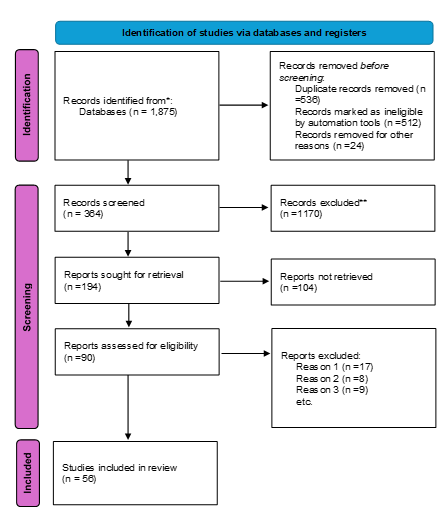
- Full-Text Screening: The full text of potentially relevant studies was retrieved and independently assessed by the same two reviewers for final inclusion. The reasons for exclusion at this stage are documented (see Figure 1 PRISMA Flow Diagram below).
PRISMA Flow Diagram for Study Selection
The screening process identified 56 relevant studies for the final review.
The researchers conducted their quality assessment using a modified version of the Mixed Methods Appraisal Tool (MMAT) by Hong (2018) to evaluate the strength of their empirical research studies. The tool assessed qualitative, quantitative, and mixed-methods research studies based on its fundamental research requirement: the research design must align with the research questions the study seeks to answer. The researcher must present the data collection methods through their actual implementation, as used to obtain the information. The data analysis process needs to follow strict standards. The researcher needs to show three elements that establish the connection between the data and the research study’s findings. The quantitative research process requires evaluation of both the sampling method and the accuracy of measurement techniques. The researchers used three quality levels to evaluate each study, which resulted in High, Medium, and Low ratings. The assessment results guided the interpretation of findings because studies with better research methods received greater weight (Grant & Booth, 2009). The synthesis table (Table 1) presents the quality rating for each study that was included in the research.
Data Extraction and SynthesisThe researchers extracted data from 56 studies using a standardised form they developed in Microsoft Excel. The researchers extracted data on author information, publication year, country, study objectives, research approach, theoretical framework, participant information, description of the multimodal intervention, main results, critical analysis, argumentation, and quality assessment grade. The researchers applied thematic analysis (Braun & Clarke, 2006) to their collected data. The research process began with the researcher becoming familiar with the data before creating initial codes, which led to theme identification, theme definition and naming. The article selection criteria were deliberately defined to align with the scope of this scoping review. The researchers selected studies which had received peer review and were published between 2010 and 2026 as their main focus. Studies investigating multimodal pedagogical interventions demonstrate that these methods improve students' critical analysis and argumentation skills in higher education environments. The research approach follows established scoping review guidelines, which require that research objectives align with research concepts and maintain a transparent, relevant research design (Arksey & O'Malley, 2005; Levac, 2010; Harun & Singh, 2024).
Results
The outcomes of the scoping review indicate that several methods improve the development of critical analysis and argumentation skills in university students. The obtained results have been systematised into five major subheadings: the power of multimodal methods; the impact of digital technologies; the impact on critical thinking and argumentation building; and theoretical considerations alongside Transformative Learning and Experiential Learning theories. The research team conducted a systematic review of relevant studies to achieve the study's objectives, as shown in Table 2. The findings are displayed in Table 3, which follows this statement.
Table 2Selected Studies Grouped by Research Objectives
|
Research Objective |
Relevant Studies |
|---|---|
|
1. To examine the effectiveness of multimodal approaches in enhancing critical analysis and argumentation skills among university students. |
Ajani and Matiyenga (2025), Dalton (2012), Harun and Singh (2024), Mills (2011), Olivier (2021), Rahmanu and Molnár (2024), Serafini (2014), Siregar (2025), Carciu and Muresan (2024). |
|
2. To investigate the role of digital technologies in facilitating multimodal learning for skill development. |
Hobbs (2010), Hoque (2025), Meyer (2014), Rahmanu and Molnár (2024), Selwyn (2016), Cope and Kalantzis (2015), Bailey 2026, Suri (2026) |
|
3. To explore how multimodal approaches impact critical thinking and reflective learning. |
Gatti and Procter (2013). Mills (2011), Nykyporets (2024), Olivier (2021), Serafini (2014), Taylor and Cranton (2012), Mezirow (2000), Suri 2026; Siregar, (2025) |
|
4. To assess the contribution of multimodal strategies to the development of argumentation skills. |
Andrews (2010), Harun and Singh (2024), Riwayatiningsih (2025), Rowsell and Walsh (2011), Siregar (2025), Harun and Singh (2024) |
|
5. To justify the theoretical integration of Transformative Learning Theory and Experiential Learning Theory in understanding the use of multimodal approaches. |
Ajani and Matiyenga (2025). Cope and Kalantzis (2015), Kolb and Kolb (2017), Meyer (2014), Taylor and Cranton (2012), Mezirow (2000), Romero and Bobkina (2026) |
Summary of Findings
|
Author(s) |
Year |
Study Type |
Key Findings / Contribution |
Research Objectives Addressed |
Quality Assessment |
|---|---|---|---|---|---|
|
Ajani and Matiyenga |
Mixed-Methods |
Found multimodal interventions significantly enhanced critical analysis, argumentation skills, digital literacy, and reflective reasoning among undergraduates. |
1, 5 |
High |
|
|
Dalton |
Quasi-Experimental |
Digital storytelling improved analytical thinking and argument construction compared to text-based tasks. |
1 |
Medium |
|
|
Gatti and Procter |
Case Study |
Visual analysis in history courses fostered deeper critical engagement and historical reasoning. |
3 |
Medium |
|
|
Harun and Singh |
Systematic Review |
Highlighted the growing evidence base for multimodal learning in higher education; identified gaps in longitudinal and comparative studies. |
1, 4 |
High |
|
|
Hobbs |
Theoretical/Conceptual |
Argued for integrating digital and media literacy into curricula to support multimodal and critical engagement. |
2 |
High |
|
|
Hoque |
Qualitative (Dissertation) |
Students reported increased engagement and critical reflection when using digital resources in multimodal English language learning. |
2 |
Medium |
|
|
Kolb and Kolb |
Theoretical/ |
Positioned Experiential Learning Theory as a framework for designing multimodal educational experiences. |
5 |
High |
|
|
Meyer |
Conceptual |
Advocated for Universal Design for Learning as a foundation for inclusive, flexible multimodal pedagogy. |
2, 5 |
High |
|
|
Mills |
Empirical (Qualitative) |
Multimodal composition fostered greater creativity and criticality than traditional writing tasks. |
1, 3 |
Medium |
|
|
Nykyporets |
Mixed-Methods |
Reported improved critical thinking skills through multimodal English language instruction in higher education. |
3 |
Medium |
|
|
Olivier |
Qualitative |
Described a pedagogical shift toward multimodal composition in higher education, noting institutional and practical challenges. |
1, 3 |
Medium |
|
|
Rahmanu and Molnár |
Systematic Review |
Found strong support for multimodal immersion in language learning, with positive effects on engagement and comprehension. |
1, 2 |
High |
|
|
Riwayatiningsih |
Quasi-Experimental |
Demonstrated that gamification and multimodal learning within PBL enhanced higher-order thinking skills in writing. |
4 |
High |
|
|
Rowsell and Walsh |
Conceptual |
Emphasised the need to rethink literacy education through multimodality and new literacies. |
4 |
Medium |
|
|
Selwyn |
Critical Review |
Explored the role of technology in education and its implications for multimodal learning and digital literacy. |
2 |
High |
|
|
Serafini |
Theoretical |
Highlighted the importance of visual literacy in developing analytical and interpretive skills. |
1, 3 |
High |
|
|
Siregar |
Empirical (Preprint) |
Analysed lecturers' pedagogical practices, finding balanced multimodal strategies improved higher- and lower-order thinking skills. |
1, 4 |
Medium (Preprint) |
|
|
Taylor and Cranton |
Theoretical/Handbook |
Provided a comprehensive overview of Transformative Learning Theory and its application in diverse educational contexts. |
3, 5 |
High |
|
|
Andrews |
Theoretical/Empirical |
Argued for theory-informed practice in teaching argumentation, with multimodal approaches supporting structured reasoning. |
4 |
High |
|
|
Mezirow |
Theoretical |
Outlined Transformative Learning Theory, emphasising disorienting dilemmas and perspective transformation. |
3, 5 |
High |
|
|
Cope and Kalantzis |
Conceptual |
Proposed a pedagogy of multiliteracies that embraces multimodal meaning-making and cultural diversity. |
2, 5 |
High |
The research results demonstrate that multimodal teaching methods are an effective educational resource, as they help undergraduates develop their critical analysis and argumentation skills. Research demonstrates that when educators purposefully combine various semiotic tools, which include visuals and sounds and written text, students achieve higher cognitive engagement levels than they do with unimodal approaches, which focus only on text comprehension. Students who learn through multiple modalities need to engage in active learning, which includes decoding different systems, comparing them, and synthesising information from various systems, to develop a better understanding of complex subjects (Mills, 2011; Serafini, 2014).
The existing approach requires a comparison-based evaluation between the two sides to assess its effects. Dalton (2012) observed that students, while using digital storytelling, a quintessential multimodal task, far exceeded the critical analytical thinking scores of peers confined to conventional text-based tasks. People need to understand multiple levels of comprehension because different media require them to evaluate and organise information while creating evidence-based arguments. Multimodal composition presents information through different methods, transforming how people learn, and enabling them to develop stronger analytical skills needed to build convincing arguments.
The Significance of Digital TechnologiesToday, digital technology is the primary driver of multimodal educational methods reaching their full potential. Users can create interactive content by combining interactive videos, digital storytelling platforms, and multimedia presentation software. The new representation modals will begin to change how learners study content, offering important benefits to the educational process. The tools create essential components that educational material developers need to build interactive systems that help students build their digital literacy skills. Hobbs (2010) and Buckingham (2013) state that students need to develop critical thinking skills through their experiences with digital media, which include both comprehension and media production activities. Multimodal learning achieves its full potential through effective teaching methods within web-based literacy practices that establish their particular framework. Digital technologies develop new Universal Design for Learning UDL concepts that complete the educational experience through multiple representation methods, engagement strategies, assessment procedures, and other elements (Meyer, 2014). The technique enables educational materials to reach everyone by creating tailored learning materials that match individual needs and preferences.
Impact on Critical ThinkingMultimodal communication has a positive influence on the development of critical thinking for students because it enables them to access a variety of types of information (written text, visual representations, oral presentations, and/or multimedia) that allow them to think about how various types of representations interact to create meaning and provide support for an argument. When students are given a multimodal format in which to analyse, they can explore relationships among ideas, analyse evidence from multiple sources, and combine perspectives to develop logical reasoning.
As an educational tool, writing can help learners synthesise information gathered across multiple modalities. Students who gather information through visual, auditory, and experiential modalities will be able to generate deeper, more thoughtful analyses of material and express arguments more clearly and in greater detail. The act of creating through multiple modalities is also conducive to reflective judgment and helps learners to become more aware of their own assumptions.
Also, contemporary communication demonstrates that people often utilise multiple formats, choosing one based on the audience, purpose, and preferences. Learners are encouraged to consider alternative ways to interpret messages and respond to opposing views when exposed to multiple communication formats. Through exposure to multiple communication formats, students encounter conflicting viewpoints and contradictions in their social and academic lives, which leads to further exploration of problems, solutions, and rational decision-making. As a result, students continually build their critical thinking skills through multimodal learning.
Development of Argumentation SkillsMultimodal instruction has improved students' argumentation skills by requiring them to continuously evaluate evidence throughout their learning. Students develop metacognitive thinking skills as they discover how their media selection and rhetorical choices shape their work process, helping them understand their argument structure and audience participation strategies. Students can use Kolb's Experiential Learning Cycle to understand how they develop their skills. At this stage, 'reflective observation' involves evaluating the effectiveness of various modal choices, and 'abstract conceptualisation' provokes insights into persuasive principles (Kolb, 2015). Students reach advanced learning progress through active experimentation when they apply their improved techniques to more complex argumentative tasks. ITE students demonstrate stronger skills in developing compelling arguments through their research, which involves creative, coherent writing (Rowsell & Walsh, 2011; Serafini, 2014). The process of reflective practice requires deep thought, including developing arguments through analytical study and learning activities that allow students to develop expertise in their area of study (Mezirow, 2000) through Transformative Learning Theory. Students use multimodal arguments to begin a process which leads to self-assessment and skill development.
Theoretical Integration: Transformative and Experiential LearningThe research task investigating multimodal pedagogical methods must draw on Transformative Learning Theory and Experiential Learning Theory as its theoretical foundations. The combined framework formed in the end provides readers with a comprehensive understanding of how people think and how they evaluate themselves. The primary focus of TLT is to establish critical reflection and discourse as essential tools for transforming all components of personal understanding (Mezirow, 2000; Taylor & Cranton, 2012). The given theory uses multimodal environments to create situations where users experience "disorienting dilemmas", which serve as its main theoretical point. The ELT framework provides a complete explanation of the learning process through practical learning activities that describe how multimodal experiences lead to reflection, concept development, and practical testing (Kolb, 1984). Digital technologies serve as active connectors which unite all components of the integrated craft process. The system provides its users with one major function: immersive video game environments that follow Universal Design for Learning (UDL) principles, which help diverse learners (Meyer, 2014). The digital tools mentioned by Selwyn (2016) and Hobbs (2010) foster digital literacies that enable students to generate their own digital content, providing them with hands-on experience in transformative and experiential learning through a repeating process. The combination of TLT and ELT creates an immeasurable theoretical framework which describes the study. Students develop critical thinking skills through multimodal teaching methods that require them to learn from diverse content types. The methods enable students to analyse and assess information received through different types of content delivery systems, thereby fostering a better understanding of the material. The methods encourage students to assess problems through different viewpoints, which helps them develop their analytical skills and their ability to understand different situations. The students gain better abilities to succeed in their academic work and their professional communication duties.
Discussion
The scoping review analysed how multimodal teaching methods enable college students to improve their critical thinking and argumentation skills. The research utilised Transformative Learning Theory and Experiential Learning Theory to demonstrate that multimodal teaching methods enable students to develop critical analysis and argumentative skills. The research shows that multimodal teaching methods yield their best results when students evaluate meanings across different modes rather than simply watching multimodal materials. Activities that use visual elements alongside textual content, auditory components, and digital materials yield better results in evaluative reasoning, evidence handling, and argument creation than traditional text-based methods (Harun & Singh, 2024; Nykyporets, 2024). The results of the study indicate that students develop their argumentation skills through continuous reasoning practice, as they put in more effort during reasoning than during basic rhetorical techniques.
The study's results demonstrate that multimodal teaching methods remain effective because they promote critical thinking about academic material. Transformative Learning Theory serves as the main framework for this process. The studies show that when learners encounter visual stories alongside academic texts or digital simulations with conceptual explanations, they experience cognitive tension, which prompts them to rethink their preconceived notions and their understanding of the material (Ajani & Matiyenga, 2025; Romero & Bobkina, 2026). The learning process for students will be interrupted as they consider something that matters to them while using their own judgment to set their learning objectives. Through argumentation, students use multimodal pedagogy to explore different meanings, thereby taking on the responsibility to defend their chosen interpretation.
The implementation of experiential learning theory allows people to learn about reflective processes through its practical use. Students need to create, design, and evaluate materials in accordance with the multimodal learning activities described in the research literature. The studies which use case-based and design-oriented methods show that students create multimodal artefacts through digital arguments and visual analyses, and multimodal presentations, which help them develop critical thinking and argumentative skills through reflection, abstraction, and application (Carciu & Muresan, 2024; Siregar, 2025; Suri, 2026). The research shows that students learn argumentation skills through direct experience, enabling them to link reasoning to real-world situations. The combination of Transformative Learning and Experiential Learning theories provides a clear understanding of how multimodal pedagogy helps students develop advanced thinking skills through reflective interruptions and hands-on learning experiences.
Educational outcomes for the functions of multimodal pedagogy require digital technologies that serve as fundamental elements supporting their achievement. The studies show that digital tools improve critical analysis and argumentation skills when used in teaching methods that focus on helping students develop understanding through evaluation and justification rather than on teaching technical skills (Harun & Singh, 2024; Rahmanu & Molnár, 2024). Students use digital environments to access various semiotic resources as they create multimodal arguments through viewpoint comparison, thereby learning through multiple forms of representation and expression (Meyer, 2014). The assessment practices remain dedicated to evaluating written material and final outputs. Students who use digital multimodality experience difficulty because it makes their learning superficial rather than fostering a deep understanding (Siregar, 2025).
Research demonstrates that academic work faces significant difficulties because assessment and implementation problems create essential conflicts. The study found that multimodal pedagogy helps students develop complex reasoning and argumentation skills, yet traditional assessment methods do not effectively assess these outcomes. The study demonstrates that text-based evaluation methods fail to recognise multimodal learning objectives, which results in students not being able to identify their analytical work and teachers not using multimodal evaluation methods (Jewitt, 2013; Rowsell & Walsh, 2011). Multimodal pedagogy needs new assessment standards that create educational pathways through assessment modes that evaluate reasoning abilities and assess argument strength while verifying students' reflective thought processes. The evaluation process and assessment materials for multimodal learning have not been integrated, which restricts the complete educational change that multimodal learning should bring.
Multimodal pedagogy requires two elements to function: organisational context and teacher training. The current research demonstrates positive findings across various academic domains and multiple geographical areas, but the limited number of studies that provide evidence of the sustainability of these results over time raises doubts about their permanence (Harun & Singh, 2024; Rahmanu & Molnár, 2024). Teachers require professional development programmes alongside institutional support to develop multimodal tasks that combine theoretical knowledge with diverse cognitive demands (Siregar, 2025; Bailey, 2026). Schools need to establish new educational policies and create new educational materials, while also conducting teacher training to implement multimodal teaching strategies in line with research requirements.
The research demonstrates that multimodal pedagogy improves students' critical analysis skills and their ability to create arguments through educational activities which combine reflective interruption with practical learning experiences. The study establishes connections between multimodal learning and Transformative Learning Theory and Experiential Learning Theory by demonstrating, through research, how multimodal methods enhance academic performance. The research results demonstrate that higher education institutions need to address two primary concerns because current multicultural teaching methods fail to improve students' critical thinking and argumentation skills.
Implications for Educational PracticeThe combined use of Transformative Learning Theory and Experiential Learning Theory through multimodal methods represents the most significant effect that these theories have on educational methods. The design frameworks for learning experiences that these theories present enable schools to create engaging experiences that lead to transformative learning and practical learning outcomes. The active development of critical thinking skills occurs through students who practice critical reflection and active learning in environments which foster deep understanding and essential academic competencies (Brookfield, 2012). Transformative-experience-learning theories, which use multimodal methods, do not meet the educational needs of this diverse group of students because they do not provide multiple ways for students to participate and demonstrate their understanding. The approaches can establish learning spaces that cater to diverse student needs while demonstrating the various learning patterns students exhibit during shared learning sessions. Meyer (2014) claim that Universal Design for Learning involves educational practices which enable students to learn in flexible and accessible ways.
Transformative Learning Theory and Experiential Learning Theory provide a comprehensive theoretical framework which shows how multimodal learning methods assist university students in developing their critical analysis and argumentation skills. The learning potential they bring through critical reflection and active engagement components for practical applications in the learning process aligns quite well with the aim of this study. Educators who use the mentioned theories can implement multimodal learning methods alongside their academic skill development programmes, which connect to the learning of facts and principles.
Implications for Future ResearchThe review introduces fresh research elements which require examination. Future researchers need to conduct longitudinal studies which investigate how multimodal methods affect critical thinking and argument development over time. Research should determine the most effective conditions and contexts for implementing strategies in digital literacy programmes that use Universal Design for Learning principles (Hobbs, 2010; Meyer, 2014). Another consideration for future research is to develop appropriate assessment methods to evaluate multimodal work, ensuring that products conceived through these modalities are measured justly and fairly (Jewitt, 2013).
ConclusionThe scoping review shows that multimodal teaching methods improve university students' critical analysis and argumentation skills when educators explicitly set teaching objectives and draw on academic theories to structure their instruction. The review, based on 56 peer-reviewed studies, demonstrates that multimodal methods achieve their greatest success when students need to analyse and integrate content from visual, textual, auditory, and digital sources, rather than combining different media formats. The pedagogical framework demonstrates how students advance their analytical competencies while developing stronger skills in presenting evidence and building logical academic arguments. The research results show that Transformative Learning Theory and Experiential Learning Theory provide solid frameworks which enable researchers to analyse educational results. Multimodal assignments create conditions that enable students to develop critical thinking skills through active learning, including action-taking, self-assessment, and concept building, thereby improving their argumentative abilities. Educational institutions use digital technology to create dynamic learning environments that enable students to develop multiple interpretations through Universal Design for Learning principles during classroom instruction. The review shows that institutions face ongoing challenges because they need advanced assessment methods, teacher development programmes, and institutional support to develop effective, enduring multimodal teaching practices in higher education. The research results demonstrate that institutions must develop unified curricula to assess critical analysis and argumentation development through multimodal methods, as assessment standards require theoretical frameworks, and teachers require continuous professional development. The study demonstrates that multimodal teaching methods improve advanced academic skills, which higher education institutions can use to develop their research and method development.
Author Contribution
Oluwatoyin Ayodele Ajani: conceptualization, data curation, formal analysis, investigation, resources, validation, writing – original draft, writing – review & editing, methodology, supervision. Tinashe Charles Matiyenga: conceptualization, data curation, investigation, resources, validation, writing – original draft, writing – review & editing, methodology.
Conflict of Interest
The author of the manuscript has no financial or non-financial conflict of interest in the subject matter or materials discussed in this manuscript.
Data Availability Statement
Data availability is not applicable as no new data was created
Funding Details
No funding has been received for this research.
Generative AI Disclosure Statement
The authors did not use any type of generative artificial intelligence software for this research.
REFERENCES
Ajani, O. A., & Matiyenga, T. C. (2025). Enhancing critical analysis and argumentation skills in university students through multimodal approaches: A comprehensive study. International Journal of Educational Reform. Advance online publication. https://doi.org/10.1177/10567879251326556
Andrews, R. (2010). Argumentation in higher education: Improving practice through theory and research. Routledge.
Arksey, H., & O'Malley, L. (2005). Scoping studies: Towards a methodological framework. International Journal of Social Research Methodology, 8(1), 19–32. https://doi.org/10.1080/1364557032000119616
Bailey, R. P., Hoe, T. W., Morrison, G. Z., Ali, A., & Samsudin, N. (2026). Rethinking higher education: Embodied learning and pedagogical transformation. Higher Education, 2026, 1–21. https://doi.org/10.1007/s10734-025-01581-2
Braun, V., & Clarke, V. (2006). Using thematic analysis in psychology. Qualitative Research in Psychology, 3(2), 77–101. https://doi.org/10.1191/1478088706qp063oa
Brookfield, S. D. (2012). Teaching for critical thinking: Tools and techniques to help students question their assumptions. Jossey-Bass.
Buckingham, D. (2013). Media education: Literacy, learning and contemporary culture. Polity Press.
Carciu, O. M., & Muresan, L. M. (2024). Designing multimodal learning for developing multilingual undergraduate students' communication competences in English: A case study. In F. V. Lim & M. Querol-Julián (Eds.), Designing learning with digital technologies (pp. 185–205). Routledge.
Cope, B., & Kalantzis, M. (2015). A pedagogy of multiliteracies: Learning by design. Palgrave Macmillan.
Dalton, B. (2012). Multimodal composition and the common core state standards. The Reading Teacher, 66(4), 333–339. https://doi.org/10.1002/TRTR.01128
Gatti, L., & Procter, C. (2013). Visual analysis and critical thinking: Teaching history to the millennial generation. Journal of Educational Multimedia and Hypermedia, 22(2), 141–155.
Grant, M. J., & Booth, A. (2009). A typology of reviews: An analysis of 14 review types and associated methodologies. Health Information & Libraries Journal, 26(2), 91–108. https://doi.org/10.1111/j.1471-1842.2009.00848.x
Harun, R. N. S. R., & Singh, A. K. J. (2024). A systematic review of multimodal learning in higher education. In M. M. Asad, P. P. Churi, F. Sherwani, & R. B. Hassan (Eds.), Innovative pedagogical practices for higher education 4.0 (pp. 288–303). IGI Global. https://doi.org/10.4018/979-8-3693-6963-6.ch014
Hobbs, R. (2010). Digital and media literacy: Connecting culture and classroom. Corwin Press.
Hong, Q. N., Fàbregues, S., Bartlett, G., Boardman, F., Cargo, M., Dagenais, P., Gagnon, M., Griffiths, F., Nicolau, B., O'Cathain, A., Rousseau, M., Vedel, I., & Pluye, P. (2018). The Mixed Methods Appraisal Tool (MMAT) version 2018 for information professionals and researchers. Education for Information, 34(4), 285–291. https://doi.org/10.3233/efi-180221
Hoque, M. (2025). Multimodal literacy in higher education: University students' perspective on digital resources in English language learning [Doctoral dissertation, BRAC University]. BRAC University Institutional Repository. https://dspace.bracu.ac.bd/xmlui/handle/10361/26256?show=full
Jewitt, C. (2013). Multimodal methods for researching digital technologies. In S. Price, C. Jewitt, & B. Brown (Eds.), The SAGE handbook of digital technology research (pp. 250–265). Sage Publications.
Kolb, A. Y., & Kolb, D. A. (2017). Experiential learning theory as a guide for experiential educators in higher education. Experiential Learning & Teaching in Higher Education, 1(1), 7–44. https://doi.org/10.46787/elthe.v1i1.3362
Kolb, D. A. (1984). Experiential learning: Experience as the source of learning and development. Prentice Hall.
Kolb, D. A. (2015). Experiential learning: Experience as the source of learning and development (2nd ed.). Pearson Education.
Kress, G. (2010). Multimodality: A social semiotic approach to contemporary communication. Routledge.
Levac, D., Colquhoun, H., & O'Brien, K. K. (2010). Scoping studies: Advancing the methodology. Implementation Science, 5(1), Article e69. https://doi.org/10.1186/1748-5908-5-69
Meyer, A., Rose, D. H., & Gordon, D. (2014). Universal design for learning: Theory and practice. CAST Professional Publishing.
Mezirow, J. (2000). Learning as transformation: Critical perspectives on a theory in progress. Jossey-Bass.
Merriam, S. B., & Bierema, L. L. (2013). Adult learning: Linking theory and practice. John Wiley & Sons.
Mills, K. A. (2011). "I'm making it different to the book": Transmediation in young children's multimodal and digital texts. Australasian Journal of Early Childhood, 36(3), 56–65. https://doi.org/10.1177/183693911103600308
Nykyporets, S. S., Melnyk, O. D., Ibrahimova, L. V., Hadaichuk, N. M., & Derun, V. H. (2024). Advancing critical thinking skills among higher education students through English language instruction: Contemporary approaches and strategies. Prospects and Innovations of Science, 1(35), 34–45. https://doi.org/10.52058/2786-4952-2024-1(35)-34-45
Olivier, L. (2021). Multimodal composition pedagogy in higher education: A paradigm shift. Per Linguam: A Journal of Language Learning, 37(2), 13–31. https://doi.org/10.5785/37-2-970
Rahmanu, I. W. E. D., & Molnár, G. (2024). Multimodal immersion in English language learning in higher education: A systematic review. Heliyon, 10(19), Article e38357. https://doi.org/10.1016/j.heliyon.2024.e38357
Riwayatiningsih, R., Prastikawati, E. F., Muchson, M., Haqiqi, F. N., Setyowati, S., & Kartiko, D. A. (2025). Empowering higher-order thinking skills in writing through gamification and multimodal learning within PBL. Forum for Linguistic Studies, 7(2), 385–398. https://doi.org/10.30564/fls.v7i2.7111
Romero, E. D., & Bobkina, J. (2026). Epistemic, emotional, and effective stance strategies for the linguistic articulation of visual critical thinking in interculturally responsive EFL instruction. Thinking Skills and Creativity, 60, Article e102054. https://doi.org/10.1016/j.tsc.2025.102054
Rowsell, J., & Walsh, M. (2011). Rethinking literacy education in new times: Multimodality, multiliteracies, & new literacies. Brock Education: A Journal of Educational Research and Practice, 21(1), 53–62. https://doi.org/10.26522/brocked.v21i1.236
Selwyn, N. (2016). Education and technology: Key issues and debates (2nd ed.). Bloomsbury Academic.
Serafini, F. (2014). Reading the visual: An introduction to teaching multimodal literacy. Teachers College Press.
Siregar, T. (2025). An analysis of lecturers' pedagogical practices: Balancing higher‐and lower‐order thinking skills in higher education. Preprint.Org. https://doi.org/10.20944/preprints202510.1231.v1
Suri, D., Wicaksono, A., Siska, Y., Murtika, W. A., & Ryeo, P. J. (2026). Enhancing literary literacy through multimodal representations: A development study of folklore-based creative puppetry. Jurnal Pendidikan Progresif, 16(1), 158–172. https://doi.org/10.23960/jpp.v16i1.pp158-172
Taylor, E. W., & Cranton, P. (2012). The handbook of transformative learning: Theory, research, and practice. Jossey-Bass.
Wingate, M. E. (2012). The structure of stuttering: A psycholinguistic analysis. Springer Science & Business Media.