

| Review | Open Access |
|---|
Impact of Human Resource Planning on Organizational Performance in Colleges of Education in Oyo State, Nigeria |
 |
|---|
 Saheed Oyeniran1* ,
Ridwan Olabisi Yusuff2 ,
Adedolapo Oluwadamilare Adedokun1 , and
Abdulazeez A. Showunmi1
Saheed Oyeniran1* ,
Ridwan Olabisi Yusuff2 ,
Adedolapo Oluwadamilare Adedokun1 , and
Abdulazeez A. Showunmi1
1Department of Educational Management, University of Ilorin, Kwara State, Nigeria
2Department of Sociology, University of Ilorin, Kwara State, Nigeria
The current study aimed to inspect the impact of Human Resource Planning (HRP) on organizational performance in Colleges of Education in Oyo State, Nigeria. The study used a descriptive research design of correlation type. Moreover, a sample of 384 academic staff was selected using stratified random sampling technique. Two questionnaires titled ‘‘Human Resource Planning Questionnaire’’ (HRPQ) and Organizational Performance Questionnaire (OPQ) were used to collect data from the respondents. The reliability coefficients for HRPQ and OPQ were found to be 0.84 and 0.83, respectively. Three research questions were raised, while four research hypotheses were formulated to guide the study. Descriptive statistic was used to answer the research questions, while Partial Least Square Equation Modeling (PLS-SEM) via Smart PLS 4.3.2. was used to test the hypotheses formulated at .05 level of significance. The findings of the study indicated that: HRP in the Colleges of Education in Oyo State was high (Grand median value of 3.7). Organizational performance in the Colleges of Education in Oyo State was high (Grand median value of 3.9). There was a significant relationship between HRP and organizational performance in Colleges of Education in Oyo State (β= 0.74, t = 28.88, p < 0.05). The study concluded that effective HRP greatly enhances the organizational performance of Colleges of Education, contributing to the achievement of educational objectives. Moreover, the study recommended to sustain high organizational performance by ensuring an adequate number of qualified staff to meet the rising student enrollment in Colleges of Education across the State.
1. INTRODUCTION
Human resource planning (HRP) in higher education involves systematically forecasting, assessing, and aligning the institution's workforce needs to meet its strategic goals and support academic excellence. HRP, in this context, is essential for ensuring that the right number and types of staff, such as faculty, administrators, and support staff are available to fulfill teaching, research, and administrative functions effectively.
The main aspect of HRP in the institution of higher learning comprises examining the existing labor force competences, forecasting future workers’ requirements based on projected enrollment variations and organizational objectives, as well as executing policies for recruitment, retention, and professional development. Effective HRP helps organizations tackle problems, such as shortage of staff, variation in student characteristics, and the need for expert skills in evolving areas of specialization. It also helps in planning for succession, handling workloads, and promotion: an optimistic organizational climate that favors academic and research quality.
Effective HRP has become increasingly important for the performance of organizations, particularly educational institutions, in a rapidly evolving educational landscape (Dessler, 2020). Planning for human resources entails systematically identifying, analyzing, and designing strategies to address an organization's present and future needs for human resources (Armstrong, 2014). One of every organization's top priority is performance. According to worker retention issues, such as search for applicants, trainings, investments, time, and lost knowledge are required in new worker recruitment. Hence, these employees are important to the organization as long as their worth is noteworthy and cannot be simply represented (Igbinoba, 2022).
Ugwu and Hubs (2020) highlighted that for an organization to be successful, there is the need to carry out a systematic and an in-depth personnel planning evaluation. Resultantly, employees’ needs can be assessed, training and development goals can be determined, and contingent labor force options may be used to produce competent employees capable of responding to the needs of the organization. However, if an organization does not successfully hire the human resources necessary to carry out its goals, it would not be able to effectively accomplish organizational performance. For an organization to perform better, the right applicants for the required jobs need to be selected and employed in the organization. The extent to which an organization performs is a determinant of the value of its personnel (Hamza, 2021).
Additionally, Mathis and Jackson (2010) argued that when right people are hired, the organization's objectives are typically met with little oversight. HRP, according to Helavalada and Julius (2017), is the cornerstone of any successful organization. When discussing the effectiveness of Human Resource Management (HRM), Biswajeet (2010) highlighted that if HRP fails, all other HRM techniques would also fail. Shikha and Karishma (2012), on the other hand, hypothesized that the primary reasons for underperformance in the majority of service businesses include human resource managers' incapacity to find the best candidates for a certain job role within the organization. Depending on the type of the industry in which they operate, organizations should focus on distinct concerns and criteria while preparing for human resources. According to Dialoke (2016), essential factors that HR managers should take into account for HRP include the organization's financial capacity, job requirements and demand, supply of manpower in a certain profession, and others.
Organizations struggle to find and retain skilled employees, manage their workload, and live up to expectations (Chuai & Preece, 2010). To find solutions that can boost productivity, efficiency, and overall institutional effectiveness, it is crucial to understand the impact of HRP on organizational performance. Organizations have realized the fact that the institution's human capital can be a unique source of competitive advantage. This is why most of the organizations experience losses in terms of organizational performance by disregarding the essential principles of effective HRP (Chioke & Mbamalu, 2020).
This research is located within the context of the Nigerian Higher Education sector, especially the College of Education sub-sector which plays a prominent role in the training of teachers. This study specifically focused on Colleges of Education in Oyo State. These Colleges of Education were established either by the private investors, the state government or the federal government. Furthermore, these are saddled with the responsibility of training middle level manpower for the state teaching force. Due to the new policy permitting the Colleges of Education to also run degree programmes to produce graduate teachers in addition to the NCE teachers, this has given rise to students’ enrolment and the need to employ more teachers. To this end, HRP has become a major problem in the colleges and has greatly affected their performance despite of various efforts put in place by the proprietors of the institutions.
While the specific role of workable HRP in terms of staff needs planning, staff capacity planning, staff development planning, and staff evaluation is recognized, a significant research gap remains in understanding of the nexus between HRP and performance in the Colleges of Education in Oyo State, Nigeria. The prevailing works frequently study these constructs in isolation. Therefore, the current research was designed to bridge this gap by building and testing a structural equation model that links the two variables. The major purpose of this study was to examine the impact of HRP on performance of Colleges of Education in Oyo State, Nigeria.
Statement of ProblemHRP plays a critical role in aligning workforce capabilities with institutional goals to enhance organizational performance in higher education institutions. The fundamental role of Colleges of Education in the production of would-be teachers and determining excellence in the country’s education system cannot be underestimated. Nevertheless, several colleges in Nigeria encounter major problems that are connected with HRP, which are affecting institutional performance. Misapplication of HRP practices is evident in policy matters, such as inadequate manpower, unqualified staff in specific roles, inability to retain skill personnel, as well as inadequate specialized training prospects. These problems have made it impossible for the colleges to offer first-rate educational services, enhanced student academic achievement, and adequately provide solution to the country’s growing demand of the education sector.
In the colleges, inadequate application of strategic HRP practices frequently results in personnel misplacement, where institutions strive to balance student-lecturer ratios, sustain teaching quality, and meet organizational needs. Moreover, the inability of colleges to come up all-inclusive HRP procedures has given rise to problems in succession planning, with a crop of old employees in terms of age and length of service and inadequate efforts made at replacing the retiring lecturers. Consequently, this gap in HRP affects organizational performance by compromising the colleges' ability to achieve academic excellence, promote research, and improve student learning outcomes. Despite the number of studies that have been carried out on the impact of HRP and organizational performance, there is still a shortage of empirical studies connecting HRP and performance of Colleges of Education in Oyo State. Therefore, it is against this background that this study was designed to examine the impact of HRP practices on the performance of Colleges of Education in Oyo State, Nigeria.
Research QuestionsThis study was guided by the following research questions:
- What is the extent of HRP practices in Oyo State Colleges of Education?
- What is the level of organisational performance in Colleges of Education in Oyo State?
- What is the relationship between HRP and organisational performance of Colleges of Education in Oyo State?
The following research hypotheses were set to guide the study:
Ho1: HRP has no significant impact on organizational performance in Colleges of Education in Oyo State, Nigeria.
Ho2: Staff need planning has no significant impact on organizational performance in Colleges of Education in Oyo State.
Ho3: Staff development planning has no significant impact on organizational performance in Colleges of Education in Oyo State.
Ho4: Staff evaluation planning has no significant impact on organizational performance in Colleges of Education in Oyo State.
Ho5: Staff capacity planning has no significant impact on organizational performance in Colleges of Education in Oyo State.
Literature Review
Human Resource Planning (HRP)HRP involves forecasting future workforce needs, devising strategies to meet those needs, and aligning HR practices with the organization's objectives (Armstrong, 2014). Major dimensions of HRP are recruitment, selection, training, development, performance management, and succession planning (Armstrong, 2014). By aligning personnel and roles effectively, HRP assists in preventing both workers’ surpluses and shortages. Fadipe (2011) described HRP as a proactive effort by institutions to link their educational agenda with their workforce requirements. The HRP process consists of four main steps: evaluating the current labor force, forecasting future labor demands, harmonizing anticipated labor requirements with supply, and supporting organizational objectives (Chuai & Preece, 2010). The goal of HRP is to maximize the effective use of existing employees while planning for future workforce needs in terms of quantity, age, and skills (Dessler, 2020). In this study, HRP was assessed across four dimensions: staff need planning, staff development planning, staff evaluation planning, and staff capacity planning.
Organizational Performance
According to Hillriegel (2018), organizational performance is the culmination of a tremendous deal of individual and group effort. Performance is the level of task achievement in an organization that enhances employee's job performance. Organizational performance is therefore defined as the extent to which the workplace mission is accomplished in order to support an employee’s employment.
According to Ahmad (2019), assessing organizational performance is a big problem. Therefore, the management must first specify the purpose for utilizing a performance appraisal system before deciding how to implement it. Farman (2013) posited that performance measurement in an organization makes employees more engaged and active members of the organization. This helps the organization achieve its goals and unites all of its members at all levels in pursuit of the organization's strategy. This means that organizational performance refers to the outcomes of an organization as evaluated against its planned productivities.
In the context of this study, the researcher presumed that since HRP processes are implemented for the purpose of achieving institutional goals and enhancing organizational performance; then the identification of drivers of educational institutions towards enhancing organizational performance is imperative. Scholars, such as Heywood (2012) and Armstrong and Locke (2012) are of the opinion that HRP processes could have a significant association with organizational performance through the input of the institutional employees. Significantly, HRP processes, such as determination of organization objectives; capacity planning, demand forecasting, supply forecasting, training and development planning, and plans evaluation could be significant to organizational performance.
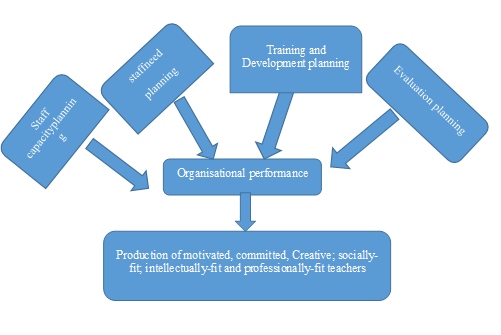
Figure 1
Conceptual Framework
An organization’s capacity refers to its potential to achieve goals through the effective application of skills and resources. HRP aims to enhance this potential by improving resource management and operational capabilities. High-performing organizations leverage their capacities effectively to meet clear goals and fulfill stakeholder needs. Performance is not only shaped by an organization’s capacities but also by both external factors (such as the environment it operates in) and internal factors, which include its culture, reward systems, and management approach. As observed by George (2017), organizational performance is seen as an institution’s capacity to achieve its aims and pursue its mission. Performance can be determined through four main dimensions which include effectiveness (the degree to which institutions achieve their goals), efficiency (the amount of input used in relation to produced output), relevance (alignment of objectives and activities with stakeholder needs), and financial sustainability (guaranteeing financial capability).
An organization’s performance is therefore influenced by the interplay among its capacity, institutional climate, and the external influence. For this study, the institutional climate included factors that determine how successfully the institution can exploit its capacities to achieve its goals. This institutional climate can be understood as the organization’s ‘behaviour,’ influencing both harmony and the ambition towards goals. A strong internal motivation can sometimes overcome external challenges and capacity weaknesses but a weak internal environment may hinder effective capacity use, limiting performance. Key elements of the internal environment include organizational culture, incentive and reward structures, overall institutional climate, history and traditions, leadership and management style, the presence of a clear mission statement, organizational structure (such as defined roles and responsibilities), and shared values that encourage teamwork towards organizational goals (George, 2017).
For this study, HRP practices, such as capacity planning, demand planning, training and development planning, and evaluation planning are conceptualized as indicators to achieving organizational performance in the Colleges of Education. In this study, organizational performance is conceived from the objectives of colleges of education as stated by Oyeniran (2025) as: production of motivated; committed; creative; socially-fit; intellectually-fit; and professionally-fit teachers. The diagrammatic representation is shown in Figure 1. The assumption from the foregoing was that, effective HRP in the colleges that center on capacity planning, staff need planning, training and development planning, and evaluation planning, all things being equal, would enhance the performance of Colleges of Education in terms of producing highly motivated, committed, creative, socially-fit, intellectually-fit, and professionally-fit teachers.
Empirical ReviewNumerous industries and dependent variables have been the subject of extensive research on HRP. Edeh and Dialoke (2020) looked into how HRP affected the performance of a number of hotels in Nigeria. According to the results, organizational performance is favorably and considerably impacted by HRP elements, such proper budgeting, skills, age, and cultural background. Similarly, Anya (2017) investigated the relationship between organizational performance and HRM in oil and gas companies in Port Harcourt, Nigeria. Using organizational structure as a moderating variable, the results indicated a significant positive association between organizational performance and HRP.
Mkandatsama and Nyanhete (2017) looked at HRP in Zimbabwe's unstable economic environment, concentrating on state universities. The findings of their study showed that these organizations' success in HRP is constrained by budgetary constraints, which are significantly impacted by economic uncertainty. The study conducted by Talukder and Khan (2013) on competitive advantage in human resource strategy in an industrial firm also revealed a strong correlation between competitive advantage and elements, such as training, performance management, goal alignment, and labor market conditions.
A study conducted by Maina and Kwasira (2015) centered on the assessment of HRP techniques’ influence on workers’ performance in Kenya. The study outcome discovered that employee attraction and retention moderate staff performance. Another study in the UK’s telecom sector by Farman (2013) showed a strong association between HRP and organizational performance. Eketu and Edeh (2017) also evaluated the connection between organizational sustainability and HRP in some designated telecom companies in Rivers State. Using Spearman’s Rank Correlation Coefficient and IBM SPSS for data analysis, their findings showed a significant connection between sustainability and HRP.
The study conducted by Rohollah and SeidMehdi (2015) examined how HRP affects the quality of services in Melli Bank, by means of service behaviors as a mediating variable. The outcome of their study confirmed a robust relationship between HRP, service behaviors, and service quality. The outcome of the research showed a positive relationship between ERP and training and development while observing a negative association with recruitment, selection, and compensation. The findings further indicated a positive association between compensation, training, recruitment, and organizational productivity.
Although the prevailing literature emphasizes the importance of HR planning across various organizational contexts, there are insufficient studies purposely carried out on Colleges of Education in Nigeria, particularly in Oyo State. This study examined the impact of HRP on the performance of Colleges of Education in Oyo State, Nigeria. By appraising the existing practices and challenges within these colleges, the research provided significant insights for policymakers and administrators to enhance administrative success and improve human capital management.
Methodology
This study used a correlational descriptive-survey research approach. All lecturers at Oyo State's Colleges of Education were included in the target population. Three out of the five Colleges of Education were selected to participate in the research through a stratified random sampling technique, based on type of ownership (Federal, State, and Private). Data collection was done with the use of two questionnaires. These were the “Human Resource Planning Questionnaire (HRPQ)” and the “Organizational Performance Questionnaire (OPQ)”. Each questionnaire was divided into two parts: part A dealt with the collection of demographic information from respondents, while part B was structured to collect information solely related to the constructs of HRP practices and organizational performance in the Colleges of Education. To determine the validity of the instrument, the instrument was reviewed by psychometric experts in Educational Management and Educational Measurement and Evaluation from the University of Ilorin. The Content Validity Index (CVI) for the two instruments was found to be 0.81 for the HRPQ and 0.75 for the OPQ. Cronbach Alpha method was used to determine the reliability of the instrument. The surveys were distributed in a college of education outside the Oyo State. Cronbach’s Alpha coefficients were calculated and found to be 0.71 for the HRPQ and 0.79 for the OPQ.
The researcher got authorization to carry out the study and sought respondents’ consent for involvement in the study. The surveys were then distributed with the help of two research assistants, and completed questionnaires were collected after two days.
Data was collected using both descriptive and inferential statistics. For descriptive analysis, the median was used as a measure of central tendency, given the ordinal nature of the data. The inferential analysis utilized Partial Least Squares Structural Equation Modeling (PLS-SEM) via Smart PLS 4.3.2, which was selected due to the latent, multidimensional nature of the variables and its ability to assess the impact of one variable on another. Hypotheses were tested at a 0.05 significance level. PLS-SEM was deemed appropriate for examining the relationship between HRP and organizational performance.
Results
Research Question 1: What is the level of HRP in the Colleges of Education in Oyo State?
The median was used to calculate descriptive statistics for each item in the constructs in order to respond to this query. This is due to the fact that the analysis's dataset was gathered using an ordinal scale. All of the items were measured using a four-point Likert scale, with strongly disagree (1) at one extreme and strongly agree (4) at the other. The descriptive statistics for HRP are shown in Table 1. To make interpretations easier, the responses to the four-point Likert scale were divided into two categories: low (1–2.49) and high (2.5–4.0).
Table 1Level of Human Resources Planning (HRP)
|
Statement |
Median |
Level |
|---|---|---|
|
Staff Need Planning Staff Capacity Planning Staff Development Planning Staff Evaluation Planning Grand Median |
3.9 3.5 3.5 4.0 3.7 |
High High High High High |
Table 1 shows the median value for each of the sub-constructs of HRP variable ranged from 2.5 and 4.0, while the construct had a grand median value of 3.7. The implication of this finding is that there is evidence of high HRP in the Colleges of Education in Oyo State.
Research Question 2: What is the level of organizational performance in the Colleges of Education in Oyo State?
To answer this question, descriptive statistics for all the items of the constructs were computed using median. This is because the dataset for the analysis is ordinal. Four-point Likert response scale of strongly disagree (1) at one end and strongly agree (4) at the other end were used to measure all the items. Table 2 presents the descriptive statistics for organizational performance; for easy interpretation, the responses to the four Likert scale were grouped into two namely; 1- 2.49 as low and 2.5 – 4.0 as high.
Table 2Level of Organizational Performance
|
Statement |
Median |
Level |
|||||
|---|---|---|---|---|---|---|---|
|
Production of highly motivated teachers Production of highly committed teachers Production of highly creative teachers Production of socially fit teachers Production of intellectually fit teachers Production of professionally fit teachers Grand Median |
4.0 3.9 3.9 3.7 3.9 3.8 3.9 |
High High High High High High High |
|||||
|
Constructs Linkage |
Original Sample (O) |
Sample Mean (M) |
Standard Deviation (STDEV) |
t Statistics (|O/STDEV|) |
p Values |
Confidence Interval Bias Corrected (CIBCa ≠0) |
|
|---|---|---|---|---|---|---|---|
|
2.50% |
97.50% |
||||||
|
Human Resources Planning⇉ Organisational Performance |
0.74 |
0.74 |
0.03 |
28.88 |
0.00 |
0.68 |
0.78 |
|
Staff Capacity Planning ⇉ Organisational Performance |
0.23 |
0.23 |
0.05 |
4.68 |
0.00 |
0.14 |
0.32 |
|
Staff Development Planning ⇉ Organisational Performance |
0.24 |
0.24 |
0.05 |
5.14 |
0.00 |
0.14 |
0.33 |
|
Staff Evaluation Planning ⇉ Organisational Performance |
0.27 |
0.27 |
0.05 |
4.96 |
0.00 |
0.17 |
0.36 |
Structural Model of Sub-constructs and Organizational Performance
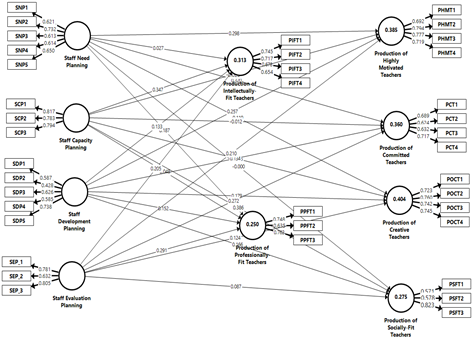
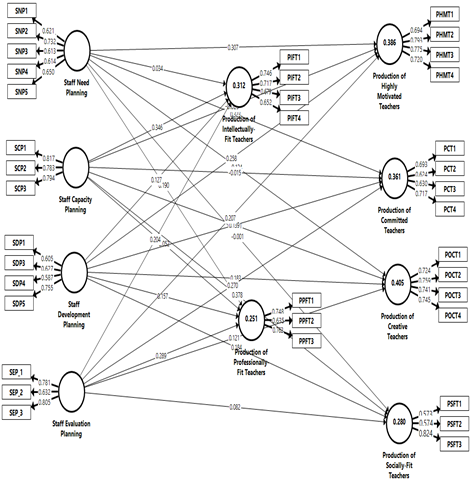
Figures 3 and 4 demonstrate as explicated by Hair et al (2011) that a structural model illustrates the causal linkages among the constructs, which calculates the R2 value and the path coefficients that define the predictive strength of the model. The 95% bias-corrected and accelerated (BCa) bootstrap confidence intervals are used in PLS-SEM to assess the significance of a route coefficient.
This study proposed four operational hypotheses and one primary hypothesis. PLS-SEM was used to test it at the significance level of 0.05.
Ho1: HRP has no significant impact on organizational performance in Colleges of Education in Oyo State.
The results in Table 3 and Figure 4 indicate a significant positive impact between HRP and organizational performance in Colleges of Education in Oyo State, with a coefficient of β = 0.74, t = 28.88, and p < 0.05. The p-value of 0.00 is below the significance threshold of 0.05 for a two-tailed test, leading to the rejection of the null hypothesis, which proposed that HRP has significant impact on organizational performance in these colleges. Additionally, Figure 4 shows that HRP accounts for 57% of the variance in organizational performance, demonstrating its predictive strength over this endogenous variable (organizational performance).
Ho2: Staff need planning has no significant impact on organizational performance in Colleges of Education in Oyo State.
Table 3 shows a significant link between staff need planning and organizational performance, with a coefficient of β = 0.23 and t = 4.44, where p < 0.05. The p-value of 0.00 is below the significance threshold of 0.05 in a two-tailed test, leading to the rejection of the null hypothesis that staff need planning has no significant impact on organizational performance in Colleges of Education in Oyo State. This suggests that each unit increase in staff need planning enhances organizational performance by 0.23 standard deviations.
Ho3: Staff development planning has no significant impact on organizational performance in Colleges of Education in Oyo State.
The findings indicate that staff development planning has a positive and significant impact on organizational performance in Colleges of Education in Oyo State. With a p-value of 0.00, which is less than the 0.05 significance level in a two-tailed test, the null hypothesis stating staff development planning has no significant impact on organizational performance was rejected (β = 0.24, t = 5.14, p < 0.05). This implies that each unit increase in staff development planning boosts organizational performance by 0.24 standard deviations.
Ho4: Staff evaluation planning has no significant impact on organizational performance in Colleges of Education in Oyo State.
Table 3 demonstrates that staff evaluation planning has a significant positive impact on organizational performance in Colleges of Education in Oyo State (β = 0.27, t = 4.96, p < 0.05). The p-value of 0.00, which is below the 0.05 significance level in a two-tailed test, led to the rejection of the hypothesis that staff evaluation planning has no significant impact on organizational performance. This indicates that a 100% increase in staff evaluation planning would result in a 27% improvement in organizational performance.
Ho5: Staff capacity planning has no significant impact on organizational performance in Colleges of Education in Oyo State.
Table 3 indicates a significant positive impact of staff capacity planning on organizational performance in Colleges of Education in Oyo State (β = 0.23, t = 4.68, p < 0.05). With a p-value of 0.00, which is less than the 0.05 significance level in a two-tailed test, the hypothesis that staff capacity planning has no significant impact on organizational performance was rejected. This suggests that each unit increase in staff capacity planning enhances organizational performance by 0.23 standard deviations.
Discussion
The findings of the study demonstrate that the Colleges of Education exhibit a high degree of HRP, covering staff need planning, staff development planning, staff evaluation planning, and staff capacity planning. These HRP functions identified in this study enhance the alignment with the college objectives by guaranteeing that both faculty and resources meet educational demands (Edeh & Dialoke, 2020). The application of HRP activities in these institutions shows an active approach to personnel management, directly associated with effective and efficient operation of the colleges.
The performance of these institutions, as evaluated across some dimensions, such as production of highly-motivated, committed, creative, socially, intellectually, and professionally-fit teachers was also found to be high. This high level of performance is ascribed to strong HRP, which sustains a stable workforce aligned with college objectives. Effective HRP activities, as emphasized, determine the positive institutional outcomes, such as efficient resource use, strong management practices, and a conducive school climate for students and staff alike (Anya, 2017).
The findings of the study showed a significant positive impact between HRP and organizational performance (β = 0.74). Furthermore, the findings showed that well-formulated HRP strategies are important to accomplish organizational standards and achieve organizational goals. The outcomes showed that HRP accounted for about 57% of the changes in organizational performance, indicating that HRP activities determine effective organizational performance. Particularly, staff development planning, staff evaluation planning, and capacity planning were each independent. Moreover, these significantly contribute to organizational performance, enhancing academic and effective functioning and excellence in the Colleges of Education (Armstrong, 2014; Talukder & Khan, 2013).
The outcomes of the study revealed a significant positive impact of staff need planning on organizational performance in Colleges of Education in Oyo State. Staff need planning, an HRP strategy including the organized assessment of personnel needs, contribute immensely to the role of aligning employees’ competences with the college demands. This development confirms that the institution has the required number and combination of HR to achieve educational goals successfully, thereby directly resulting in organizational performance. As shown, effective staff need planning can bring about quantifiable enhancement in the performance of the colleges by improving employee’s stability and job fulfillment. This may eventually lead to the achievement of an organizational climate that promotes high-quality teaching and learning. The statistical analysis in the study shows this impact, indicating that improvement in effective staff need planning accounted for about 23% enhancement in organizational performance (β = 0.23). This makes it an important determinant of organizational performance. This result is in line with previous studies, such as those carried out by Anya (2017), who acknowledged a positive relationship between HRP practices and performance in many institutional settings. In the same way, Edeh and Dialoke (2020) showed that HRP dimensions, such as adequate staffing positively influences organizational performance. This underpinning the important role of aligning HRP with college objectives in achieving operational success.
Another outcome of this research showed a significant positive impact of staff development planning on organizational performance in Colleges of Education in Oyo State. Staff development planning, which involves the design and implementation of training and professional growth opportunities, is crucial to prepare lecturers with skills and knowledge required to achieve college objectives. Through targeted development programs, such as workshops, seminars, and ongoing trainings, colleges can improve lecturer capabilities, which directly impacts instructional quality, job satisfaction, and overall institutional performance. The statistical analysis supports these results, signifying that each enhancement in staff development planning accounted for a 24% improvement in organizational performance (β = 0.24). This positive impact submits that when colleges invest in planned development initiatives, it brings about an inspired and accomplished personnel, eventually contributing to better educational outcomes. These results align with previous researches, such as the one by Farman (2013), which shows the positive impact of HR development activities on organizational performance in various sectors. Talukder and Khan (2013) in the same vein, highlighted that training and development planning significantly enhances competitive advantage and performance by preparing employees with important skills.
The findings of the study also revealed a significant positive impact of staff evaluation planning on organizational performance in Colleges of Education in Oyo State. Staff evaluation planning, which comprises of frequently evaluating staff performance to find out the strengths and weaknesses for development, plays a crucial role in aligning individual contributions with college goals. Effective staff evaluation systems help the Colleges of Education to monitor and improve teaching quality, offer positive feedback, and improve professional development, all of which contribute to enhanced educational outcomes and institutional efficiency. The results indicated that effective staff evaluation planning showed a 27% enhancement in organizational performance (β = 0.27), highlighting its significant impact on organizational accomplishment. By executing planned evaluation practices, colleges can show that the employees are inspired, engaged, and aligned with the organization’s objectives. This result is also in line with the earlier study conducted by Edeh and Dialoke (2020). Their study showed that consistent evaluation practices improve organizational performance by promoting responsibility and development among staff. Similarly, Mkandatsama and Nyanhete (2017) highlighted the relevance of HR assessment in educational settings, emphasizing its role in improving both staff effectiveness and institutional outcomes.
ConclusionThe study concluded that there is a significant positive impact of staff capacity planning on organizational performance in Colleges of Education in Oyo State. Staff capacity planning, which comprises forecasting future personnel requirements based on institutional goals and projected growth, is crucial in confirming that the colleges have workers that are equipped enough to meet the academic and administrative demands. This planning process assists colleges to sustain an optimum equilibrium of skilled staff, supports planned initiatives, and adapts to growing educational needs, eventually bringing about improved organizational performance. The outcomes of the study revealed that effective staff capacity planning accounted for about 23% increase in organizational performance (β = 0.23), stressing its role in organizational achievement. Through accurate capacity planning, colleges can guarantee that they have skilled personnel and staff required to support quality teaching and institutional goals. This finding also agrees with prior studies, such as the one conducted by Edeh and Dialoke (2020), who discovered that adequate capacity planning contributes positively to organizational outcomes in the hospitality sector by aligning personnel capabilities with operational needs. Furthermore, Maina and Kwasira (2015) highlighted that capacity planning in public institutions increases employee performance and organizational effectiveness, underpinning its significance across educational settings.
Author Contribution
Saheed Oyeniran: conceptualization, writing - original draft, data analysis. Yusuff Ridwan Olabisi: methodology, writing- review & editing. Adedokun Adedolapo Oluwadamilare: writing-review & editing. Abdulazeez A. Showunmi: data collection.
Conflict of Interest
The author of the manuscript has no financial or non-financial conflict of interest in the subject matter or materials discussed in this manuscript.
Data Availability Statement
The data associated with this study will be provided by the corresponding author upon request.
Funding Details
No funding has been received for this research.
Generative AI Disclosure Statement
The authors did not use any type of generative artificial intelligence software for this research.
REFERENCES
Ahmed, E. (2019). Motivation and its impact on job performance. Journal of Economics, 2(1), 1–8.
Anya, C. J. P., Umoh, G. I., & Worlu, G. (2017). Human resource planning and organizational performance in oil and gas firms in Port Harcourt. International Journal of Advanced Academic Research: Social & Management Sciences, 3(9), 110–129.
Armstrong, M. (2014). Armstrong's handbook of human resource management practice. Kogan Page.
Armstrong, M., & Locke, C. (2012). The handbook of human resource development. John Wiley & Sons.
Biswajeet, P. (2010). Human resource management (3rd ed.). PHI Learning Private Limited.
Chen, Y., & Huang, J. C. (2009). Strategic human resource practices and innovation performance: The mediating role of knowledge management capacity. Journal of Business Research, 62(1), 104–114. https://doi.org/10.1016/j.jbusres.2007.11.016
Chioke, S. C., & Mbamalu, K. U. (2020). Human resource planning and organizational performance: A philosophical approach. International Journal of Management, Social Sciences, Peace and Conflict Studies, 3(3), 387–398.
Chuai, X. I. P., & Preece, D. (2010). Talent management and HRM in multinational companies in Beijing: Definitions, differences and drivers. Journal of World Business, 45(2), 179–189. https://doi.org/10.1016/j.jwb.2009.09.014
Dessler, G., Cole, N. D., Sutherland, V. J., & Chhinzer, N. (2020). Human resource management in Canada (14th ed.). Pearson Canada.
Dialoke, I. (2016). Advanced human resource planning (PhD class note). Department of Industrial Relations & Personnel Management, Michael Okpara University of Agriculture.
Edeh, F. O., & Dialoke, I. (2020). Effect of human resource planning on organizational performance of the hospitality sector in Nigeria. Business Perspective Review, 2(1), 1–12. https://doi.org/10.38157/business-perspective-review.v2i1.71
Eketu, C. A., & Edeh, F. O. (2017). Human resource planning and organisational sustainability: A study of selected telecommunication firms in Rivers State. International Journal of Social Sciences and Management Research, 3(3), 37–46.
Fadipe, J. O. (2011). Quality control in education: The teacher factor. In T. E. Ajayi & J. Fadipe (Eds.), Skills improvement programme for effective performance of teachers in Nigerian schools. NIEPA Publications.
Farman, A., Kashif, M., Syed, M. R. S., Muhammad, S., & Muhammad, H. (2013). Effect of human resource planning on organizational performance of the telecom sector. Information and Knowledge Management, 3(2), 173–182.
George, N. R. (2017). Examples of organizational performance management. http://smallbusiness.chron.com/examples-organizational-performance-management-11508.html
Hamza, P. A., Othman, B., Gardi, B., Sorguli, S., Aziz, H., Ahmed, S., Sabir, B. Y., Ismael, N. B., Ali, B., & Anwar, K. (2021). Recruitment and selection: The relationship between recruitment and selection with organizational performance. International Journal of Engineering, Business and Management, 5(3), Article e1. https://doi.org/10.22161/ijebm.5.3.1
Hasan. (2019). Conceptual issues of linkage in the assessment of organizational performance. Academy of Management Review, 7(1), 49–58. https://doi.org/10.2307/257248
Helavalada, W., & Julius, T. N. (2017). Significance of manpower planning for effective utilization of human resources in an organization: A conceptual approach. International Journal of Business and Management Invention, 6(8), 16–22.
Heywood, D. (2012). Strategic human resource management: Integrating the universalistic, contingent, configurational and context perspectives. International Journal of Human Resource Management, 16(5), 633–659. https://doi.org/10.1080/09585190500082519
Hillriegel. (2018). Assessing construct validity in organizational research. Administrative Science Quarterly, 36, 421–458. https://doi.org/10.2307/2393203
Igbinoba, E., Joel, O., Igbadumhe, F., & Peter, D. (2022). Employees' retention strategies and organizational performance. Academy of Entrepreneurship Journal, 28(S5), 1–12.
Kinicki, A., & Kreitner, R. (2003). Organizational behavior: Key concepts, skills, and best practices. McGraw-Hill Irwin.
Krejcie, R. V., & Morgan, D. W. (1970). Determining sample size for research activities. Educational and Psychological Measurement, 30, 607–610. https://doi.org/10.1177/001316447003000308
Maina, D. K., & Kwasira, J. (2015). Role of human resource planning practices on employee performance in county governments in Kenya: A case of Nakuru County. International Journal of Economics, Commerce and Management, 3(5), 1569–1580.
Management Study Guide. (2026, January 19). What is human resource planning? https://www.managementstudyguide.com/human-resource-planning.htm
Maryam, S., Muhammad, S., & Rab, N. L. (2014). Impact study of enterprise resource planning (ERP) in HRM practices. Middle-East Journal of Scientific Research, 21(1), 218–222.
Mathis, R. L., & Jackson, J. H. (2010). Human resource management (13th ed.). South-Western College Publishing.
Mkandatsama, P., & Nyanhete, T. (2017). Human resource planning in an unstable economy: Challenges faced (A case of state universities in Zimbabwe). International Journal of Asian Social Science, 7(3), 206–217. https://doi.org/10.18488/journal.1/2017.7.3/1.3.206.217
Oyeniran, S., Ayanwale, M. A., Atolagbe, A. A., & Mochekele, M. (2025). Construction and validation of goal achievement scale for colleges of education. Journal of Applied Research in Higher Education, 17(7), 131–150. https://doi.org/10.1108/JARHE-07-2024-0336
Federal Republic of Nigeria (FGN). (2014). National Policy on Education.
Robbins, S. P., Judge, T. A., & Sanghi, S. (2009). Organizational behavior (13th ed.). Prentice Hall.
Rohollah, R., & SeidMehdi, V. (2015). Investigating the effect of human resource planning (HRP) on the quality of services of Melli Bank via the mediating variable of employees' service behaviors. WALIA Journal, 31(S1), 47–53.
Shikha, N. K., & Karishma, G. (2012). Human resource planning practices. Journal of Business and Management, 3(6), 6–13.
Talukder, A. K. M. M. H., & Khan, M. I. (2013). Human resource planning and competitive advantage: Investigating the relationship. KASBIT Business Journal, 6, 29–37.
Ugwu, F. I., & Hubs, Y. (2020). Effect of workforce planning on the organizational performance of SMEs in Enugu State, Nigeria. International Journal of Advanced Research in Management and Social Sciences, 9(2), 52–77.