

| Review | Open Access |
|---|
Effect of Inquiry-Based Teaching on Problem-Solving Skills at Secondary Level |
 |
|---|
 Asma Sayyam and
Muhammad Tanveer Afzal*
Asma Sayyam and
Muhammad Tanveer Afzal*
Department of Science Education, Faculty of Education, Allama Iqbal Open University, Islamabad, Pakistan
Students’ problem-solving skills can be significantly developed at secondary level when Inquiry-Based Teaching (IBT) is used in combination with Advance Organizers (AOs). Given the dynamic nature of scientific concepts, their modern applications have become increasingly relevant. The objective of this study is to contribute to educational improvement by focusing on how to better equip the students with the ability to think critically and solve problems effectively. Hence, the main objective of this study is to strengthen students’ problem-solving skills. To achieve this, a quasi-experimental design using pre- and post-tests with intact groups was adopted. Over six weeks, the experimental group received a 40-minute session (from Monday to Friday), where lessons were delivered through IBT supported by AOs specifically designed by the researchers. A test to measure problem-solving skill was developed by researchers and used as pre- and post- assessment. The data analyzed revealed that IBT using AOs has a positive effect on the problem-solving skills of the learners. It was concluded that in general, IBT with the inclusion of AOs, has a significant effect.
1. INTRODUCTION
The importance of problem-solving skills cannot be denied as it enhances students’ academic performance and prepares them for the complex challenges facing the modern workforce (Banawi, 2024; Nisula, 2025). In today’s world, improving problem-solving skills has become an important personal and professional strength (Brown & White, 2021). Therefore, there is a need for instructors at the secondary level to specifically design their instructions to equip the learners with this skill, so that they may be prepared for future challenges. There are different opinions about the use of instructional techniques for the development of problem-solving skills. However, amongst a host of teaching methodologies used in the educational sector, Inquiry-Based Teaching (IBT) has gained significant attention. It basically focuses on student-centered hands-on activities that foster their problem-solving skills. Therefore, this research aims to investigate the effect of IBT, including AOs, on the development of problem-solving skills among secondary-level students.
Inquiry-Based Teaching and Problem-Solving SkillsThe concept of Inquiry-Based Teaching (IBT) has its origins in the early 20th century progressive education movement led by John Dewey (1910), who emphasized experiential, hands-on learning and the application of knowledge to real-life contexts. John Dewey’s educational philosophy emphasizes that learners should be active participants in shaping their own understanding, rather than being mere passive learners or recipients of information. Building upon this idea, Bruner (1961) suggested the concept of discovery learning, emphasizing that students gain a deeper and more lasting understanding when they explore problems on their own and strive to find solutions through direct engagement. Over the years, IBT has developed into a more structured pedagogical model, a model that encourages the learners to pose questions, collect evidence, test ideas, and reflect on their thinking process (Hmelo-Silver, 2004). Recent studies indicate that IBT can significantly enhance domain-specific learning outcomes, particularly students’ critical thinking and problem-solving skills at secondary level (Nahar & Machado, 2025).
IBT provides a dynamic learning environment where students participate actively in investigating, experimentation, and reflection, by working together with their classmates. According to Dobber (2017a), IBT has two main dimensions including the dimension of inquiry (whether guided by teachers, students, or collaborative guidance) and the kind of regulation applied, including social, conceptual, or metacognitive aspects. Metacognitive regulation happens when the students take charge of their own learning. Through guided questions, reflection, and meaningful discussions, the students are encouraged to think deeply about how they learn. Through social regulation, a culture of collaboration is established that brings students closer to each other to solve their problems as a team and to lessen the achievement gaps by cooperative problem solving. In IBT, activities including experiments, reviews, fieldwork, interviews, and simulations are encouraged to use spark interaction, build teamwork, and develop the sense of ownership in the learning process (Dobber, 2017b; Pedaste, 2015).
The success of IBT depends on how effectively teachers maintain a balance between structured guidance and students’ freedom to explore. Recent research indicates that learning outcomes improve when teacher guidance is combined with student autonomy, as purely student-led inquiry may create excessive cognitive load and hinder conceptual understanding (Cairns, 2025). Therefore, a balanced model in which both teachers and students share responsibility to direct the learning process remains the most effective approach. Overall, evidence suggests that IBT can greatly enhance the problem-solving skills of secondary level students by providing opportunities for both instructional support and self-directed thinking.
Advance Organizers and Cognitive StructuringAdvance Organizers (AOs), first introduced by David Ausubel in 1960s, are teaching tools that help students make sense of new information by linking it to what they already know. They act like mental roadmaps, presented before the new material, to help learners organize their thinking, recognize relationships among concepts, and retain information more effectively. By offering a clear structure from the start, AOs enable students to devote more attention to higher level understanding and effective problem solving (Ausubel, 1968; Novak & Gowin, 1984). They have also evolved significantly over the years.
Mayer’s (2003) cognitive theory of multimedia learning underscores the concept that there is a need to manage cognitive load through carefully designed visual and auditory materials. Contemporary AOs enable learners to recognize the relationships among concepts more effectively and approach new material with greater depth and understanding. Yani (2023) found that AO-based instruction enhanced primary students’ problem-solving skills by providing a solid cognitive structure for learning.
Advance organizers (AOs) are instructional tools presented in the start of a lesson to help students link new material to what they already know. Examples include narrative organizers, which use stories or scenarios to introduce key ideas, and expository organizers, which provide a structured preview of important concepts before instruction begins. Other formats, such as graphic organizers (e.g., concept maps or diagrams) and KWL charts (Know, Want to know, Learned), also help students organize and connect information, supporting comprehension and retention (KNILT, 2008).
Ausubel (1960) suggested a way to first introduce the organizer, then guide students as they explore new material, and finally, reinforce the connections they’ve made. When used with care, AOs can build strong mental frameworks that help students navigate inquiry-based learning with more clarity, confidence, and purpose
Integrating IBT and AOs for Problem-SolvingCombining IBT and AOs could be a powerful way to enhance problem-solving skills of secondary level students. IBT encourages students to be curious, ask questions, explore ideas, and think critically. AOs, in contrast, offer a structured starting point that helps students link what they already know to new concepts. These two approaches, when used side by side, create a balanced learning environment that supports both open-ended exploration and organized thinking. Recent research indicates that combining IBT with AOs can significantly improve students’ problem-solving and higher-order thinking skills by helping them to organize information effectively and engage more deeply with the learning process (Gunawan, 2020).
However, blending IBT and AOs isn’t always straightforward. AOs are inherently more structured, while IBT emphasizes flexibility and student-driven inquiry. To make this integration effective, teachers must ensure that AOs support rather than constrain the inquiry process, providing enough guidance to stimulate thinking without limiting student autonomy. Research also highlights that the students differ in their backgrounds, readiness, and learning needs, which makes differentiated instruction and ongoing, meaningful feedback vital for its successful implementation (Saigar & Jamaludin, 2025). Specifically, differentiated instruction strategies, such as flexible grouping, tiered tasks, and formative feedback, help educators tailor support according to each student’s readiness, interests, and learning profile, thereby making inquiry-based environments more inclusive and effective (Saigar & Jamaludin, 2025). In secondary school physics classrooms, where students often face abstract and loosely structured problems, combining IBT with AOs offers a refreshing alternative to the traditional lecture model, which can take up as much as 85% of class time (Khan & Rashid, 2019).
This literature review highlights that combining IBT and AOs provides a theoretically sound, empirically supported method for developing both the problem-solving skill and the cognitive structures that sustain it.
Rationale of the StudyMany researchers have attempted to explore the effectiveness of IBT on student learning and achievements. Yuliati (2018) reported that inquiry-based instruction positively affects students’ physics problem-solving skills. Rust (2011) found that students preferred generally to use a traditional, non-inquiry design because they found it easier and more efficient. This shows that, in general, the students are not ready for IBT. Ringo (2019) found that the physics problem-solving skills of all the students were not improved by IBT. In their research, 79% of the students were categorized as experts. On the contrary, novice students still need to be trained intensively to solve problems. Bunterm (2012) also found that there were no significant differences in the physics problem-solving skills of the students taught with traditional teaching and those taught using inquiry-based methods. The factors they found included the fact that the students are not accustomed to the inquiry-based model which requires them to learn and think independently. Also, not all the students can carry out inquiry-based activities. This result aligns with the results of Ringo (2019).
Based on its importance, it is crucial to consider students’ mental condition and cognitive structure in the inquiry-based model. According to Ausubel (1960), one of the main factors that determine the mindfulness of new knowledge and how well it is retained in students’ memory is their cognitive structure. Meaningful learning occurs when the newly presented knowledge is successfully linked with the already existing knowledge. The need to develop the cognitive structure can be easily facilitated by using advanced organizers or AOs. In order to build physics problem-solving skills, a teaching model like IBT that focuses on making the students active to conduct the investigations serves the purpose (Wang, 2015; Wenning, 2011) only in combination with AOs. So, there is a research gap indicating whether IBT, coupled with AOs, enhances the problem-solving ability when learning physics at the secondary level.
Problem StatementThe current study is based on previous research highlighting the importance of problem-solving skills for secondary-level students. This skill is crucial for students to compete within the contemporary world. In the classroom setup, the teacher is the main source of developing this skill. The literature provides substantial evidence regarding the effects of IBT on problem‑solving skills development. Several studies, including Yuliati (2018) and Rust (2011), reported significant positive effects of IBT on students’ problem‑solving abilities. However, Rust (2011) also found that many students tended to prefer traditional, non‑inquiry instruction because they perceived it as easier and more efficient, suggesting that learners may not always be ready for inquiry‑based approaches. Ringo (2019) also found that the problem-solving skills of all the students in physics were not improved by IBT. There was a significant percentage of the students who needed intensive training to develop these skills. Similarly, Bunterm (2021) could not find any significant difference in the problem-solving skills of students taught with traditional teaching and those with the models of inquiry using secondary-level content. Literature suggests that the differences in the results occur mainly because of the gap that exists in the cognitive structure of students and that it needs to be filled to develop their problem-solving skills. Literature also provides evidence that these cognitive structures can be developed by the use of AOs. Hence, this study was conducted to fill this gap, so that the problem-solving skills of all secondary-level students could be developed using IBT in combination with AOs. The subject of physics was selected because of its uniqueness at the secondary level, as described earlier. Kinematics and dynamics (2nd & 3rd) units were used as content, as prescribed by the FDE for SSC-I (9th grade) for session 2023-24 physics students.
Objective and Hypothesis of the StudyThe main objective of the study was to determine the effect of IBT, coupled with AOs, on developing the problem-solving skills of secondary-level students while learning physics. To achieve this objective, the researchers formulated a null hypothesis because only a few studies were found on the effectiveness of the use of IBT in combination with AOs, making it difficult to determine how well this approach may help to improve students’ problem-solving skills.
H₀₁: Inquiry-based teaching (IBT), in combination with advance organizers (AOs), has no significant effect on the problem-solving skills of secondary-level students in physics.
DelimitationsThe study was intentionally limited to Kinematics and Dynamics (2nd and 3rd) units of 9th grade physics, as prescribed by the Federal Directorate of Education, Islamabad, Pakistan for 9th grade students of physics. This study was conducted only on female students.
LimitationsThis study has several limitations. Firstly, intact classes were used rather than randomized groups, which may have introduced pre-existing differences between the experimental and control groups. Secondly, if different teachers were involved in delivering instruction, variations in teaching style and interaction could have influenced student outcomes. Thirdly, the pre-test and post-test instrument, while pilot-tested, may still have limitations in fully capturing all aspects of problem-solving skills. Fourthly and finally, the study focused only on two units of Grade 9 physics and female students, which may limit the generalizability of its findings to other units, topics, or male students.
Significance of StudyThis study provides evidence to fill the gap in developing the cognitive structure of all the students by using the IBT approach in combination with AOs. This approach would lessen the pressure and anxiety faced by learners. For the teachers, it would be significant to make them use AOs in addition to IBT to successfully develop the required skills in all of their students. For the administrators and policymakers, it would be helpful to conduct training to make their teachers comfortable with using more than one model at a time for the betterment of their students.
Method
For this study, a quantitative approach with a quasi-experimental pretest-posttest design was employed. The researchers obtained permission from the school administration and the concerned teachers prior to the study. Two intact groups of Grade 9 female students were selected, comprising 53 students in the experimental group and 45 in the control group.
A pre-test measuring problem-solving skills was administered to both groups before the intervention. The instrument was pilot-tested on a separate group of 15 students to assess item difficulty and discrimination indices. Items with poor metrics were revised to improve their validity and internal consistency was evaluated using Cronbach’s alpha to ensure reliability. Pre-test scores were also analyzed to confirm baseline equivalence between experimental and control groups. Both groups were taught by the same teacher to minimize variations in instructional delivery.
The experimental group received instruction through Inquiry-Based Teaching (IBT), in combination with Advance Organizers (AOs), over a period of six weeks, consisting of 30 sessions of 40 minutes each. AOs were integrated at the beginning of the selected lessons to enhance comprehension. The content for instruction was drawn from the Kinematics and Dynamics chapters of the Grade 9 physics curriculum. After the instructional period, a post-test was administered to both groups to measure changes in problem-solving skills across four levels: understanding a problem, devising a plan, carrying out the plan, and evaluating the solution.
Figure 1
Procedural Framework
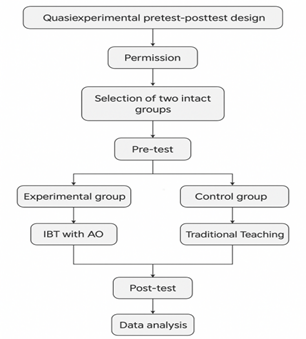
The data collected were analyzed using independent-sample t-test to determine the significance of IBT in improving students’ problem-solving skills. The overall procedure of the study, including group selection, instructional intervention, and data collection, is illustrated in Figure 1.
The syntax of IBT and AOs were integrated in the lesson. They were introduced in the orientation phase of IBT and kept alongside by focusing on the development of students’ cognitive structure via the activities mentioned in the following table.
Table 1Implementation Procedure of Intervention
|
IBT (Inquiry Based Teaching) Model |
Teachers Role in Teacher Directed Inquiry |
Problem-Solving Skill |
Advance Organizer |
|---|---|---|---|
|
Orientation Phase |
The teacher developed curiosity for the topic by using videos. |
Understanding the problem |
AO presentation Phase: The teacher showed an AO, such as KWL chart, flow chart, and mind map to the students to connect the new topic with already learned concepts. |
|
Conceptualization Phase |
The teacher used exercises that encouraged students to think about solving the problem at the meta-cognitive level. |
Devising a plan to solve the problem |
Learning Task Presentation Phase: The teacher made the logical sequence of the learning material explicit. |
|
Conceptualization Phase & Investigation Phase |
Conducted classroom discussion, e.g., exploratory talk. |
Devising a plan to solve the problem |
|
|
Conceptualization Phase |
Used graphical representations along with textual information. |
Understanding the problem |
|
|
Conceptual models were used. |
Understanding the problem / Looking back or evaluating the solution |
|
|
|
Investigation Phase |
Provided goals and sub-goals also provided hints to achieve these goals and monitored progress. |
Understanding the problem |
Strengthening of cognitive structures phase: Teachers and students carried out an integrative adjustment process and acceptance of active learning, resulting in a critical approach to learning material. |
|
Investigation Phase |
Provided students with a platform to collaborate. |
Conducting the plan |
|
|
Conclusion Phase |
Teacher asked the students to conclude. |
Reporting |
|
|
Discussion Phase |
Teacher provided students with a platform to share their results with their classmates. |
Evaluation |
|
The study was conducted for a period of six weeks. Kinematics and dynamics (2nd and 3rd) units of Grade 9 physics textbook, as prescribed by the FDE for SSC-I (session:2023-24), were used as the content of the study. The reason for the selection of these chapters was to ensure that the flow of the chapters reflected the real-world classroom settings. It was predicted that by the time of the intervention the students would have studied the first chapter. So, it was decided to take the second and third chapters in order not to disturb the flow of the studies of the students at the selected school. Other threats attached to design were also considered, so that the findings of the study may be applicable in real-world scenarios.
Population and SamplingThe students at public sector schools under the administrative control of Federal Directorate of Education, Islamabad comprised the population of the study. Students in ninth grade were the population of the study. Two intact sections, 53 students in the experimental group and 45 students in the control group, were sampled for this experiment.
Development of Achievement TestThe test was used as an instrument to measure students’ problem-solving skills. The questionnaire consisted of students’ demographic details and 10 questions related to the topic of kinematics and dynamics. In total, 8 items of 96 marks (each of 12 marks) were included in the test.
The researchers used 4 stages by Selcuk (2008) of problem-solving. The outlines of the four-stage problem-solving model are as under. Each stage had 3 marks.
- Understanding the problem
- Reading and rereading of the statement
- To identify the quantities which are given and which are to be found?
- Identify the constraints of the problem
- Determining important information in the problem
- Restating the problem in different forms (paraphrase the problem, drawing figure(s), diagram or graph(s) about the problem)
- Devising a plan
- Identify the principles, rules, and laws about the problem
- Think and write the accurate mathematical equations to solve the problem
- Carry out the plan
- Using the equation to solve the problem
- Evaluating the solution
- To check the problem-solving pathway
- To check the magnitude and unit of the answer
A rubric was used to score students’ responses on problems. This rubric was adopted from the study of Selcuk (2008).
Validation of the TestThe test was validated through expert opinion. Two experts with physics and education background were involved in this process. The first expert identified some grammatical issues and also asked to align the items with the content in the selected chapters. Whereas, the second said that statements should be kept as simple as possible. Continuity should be kept in mind while selecting the order of numerical questions. Content and face validity were ensured by this process.
Piloting of the TestThe drafted test was piloted on 34 students, out of which 4 students couldn’t complete their tests because of mental stress. So, item analysis was performed on the data collected from 30 students. Item discrimination index and difficulty index were ensured to meet the inclusion criteria. Two items were excluded and a total of 8 items of 96 marks, each of 12 marks, were added to the test. The same test was used for pre- and post-assessment.
Data Analysis and ResultsPre-test post-test intact groups design was used. After conducting pre-test, an intervention was given to experimental group and post-test was administered towards the end. An intervention of 6 weeks using IBT coupled with AOs was implemented. The comparison of both groups before and after the interventions were made using an independent sample t-test to check the effect of IBT and AOs on the problem-solving skill of learners. The following tables show these comparisons.
Table 2Comparison of Groups for their Problem-Solving Skill before Experimentation
|
Groups |
N |
Mean |
SD |
df |
t-value |
p |
|---|---|---|---|---|---|---|
|
Experimental |
53 |
12.2 |
5.04 |
96 |
.12 |
.90 |
|
Control |
45 |
12.0 |
5.32 |
The pre-test scores for problem-solving skills are presented in Table 2. The experimental group (n = 53, M = 12.20, SD = 5.04) and the control group (n = 45, M = 12.02, SD = 5.32) did not differ significantly, t(96) = 0.12, p = .902. This was due to the fact that the p-value exceeded the conventional alpha level of .05, so the difference between the groups was not statistically significant. These findings indicate that the experimental and control groups were equivalent in problem-solving skills prior to the intervention.
Following the six-week intervention, post-test scores were collected and analyzed for both groups. The results of this comparison are presented below in Table 3.
Table 3Comparison of Groups for their Problem-Solving Skill after Experimentation
|
Groups |
N |
Mean |
SD |
df |
t-value |
p |
|---|---|---|---|---|---|---|
|
Experimental |
53 |
68.3 |
13.59 |
93 |
5.21 |
.00 |
|
Control |
45 |
53.1 |
14.67 |
The post-test scores for problem-solving skills are summarized in Table 3. The experimental group (n = 53, M = 68.32, SD = 13.59) scored significantly higher than the control group (n = 45, M = 53.17, SD = 14.67), t(93) = 5.21, p < .001. This was due to the fact that the p-value was below the conventional alpha level of .05. Hence, the null hypothesis of no difference between the groups was rejected. These results indicate that the difference in post-test scores is statistically significant and unlikely to have occurred by chance.
Overall, the findings from the pre-test and post-test comparisons indicate that the experimental and control groups were equivalent in their problem-solving skills prior to the intervention. After six weeks, students in the experimental group outperformed the students in the control group. This suggests that the use of IBT in combination with AOs had a significant positive effect on the problem-solving skills of 9th grade physics students.
Discussion
The findings, in harmony with the studies conducted by Yuliati (2018), underscore the positive impact of IBT on the development of problem-solving skills among secondary-level students. Many researches have pointed out consistently that IBT is a powerful way to help students sharpen their critical thinking and problem-solving skills. The alignment of the current findings with those of Yuliati (2018) not only adds weight to the above argument, it also emphasizes the significance of using IBT in education. Rust (2011) and Ringo (2019) stated that teaching methods are not that straightforward. Indeed, success depends on multiple factors, therefore each approach needs to be examined carefully.
Rust (2011) stated that a lot of students prefer traditional, structured teaching methods as they are simpler and more efficient. This challenges the assumption that the students naturally embrace inquiry-based approaches and highlights that the teachers should consider students’ readiness, comfort level, and learning habits during the designing stage of their lessons. Ringo (2019) found that not all learners benefited from IBT, as they did not feel comfortable with this approach. It is not only IBT as many learners need extra help and training before they can actually improve their problem-solving skills. Their work reinforced the concept that innovative teaching strategies may only succeed when the teachers have a deep understanding of how the students learn and which tool is to be used to bridge the gaps in their understanding. AOs are the tools that are used to improve students’ thinking skills and make the shift to inquiry-based learning smoother.
This research demonstrates that a combination of IBT and AOs has the ability to significantly improve the problem-solving skills of secondary-level students. So, the teachers are encouraged to consider using this combination while planning for their lessons. It helps students to make sense of innovative ideas, link concepts together more clearly, and step into inquiry-based learning with greater confidence. This combination not only simplifies the learning process, rather it enriches it, giving students the support they need to grow cognitively and engage more deeply with their studies.
Limitations and Future ResearchThe focus of this study was FDE public school (female) students studying the Kinematics and Dynamics units of Grade 9 physics curriculum. The generalization of the findings remains limited due to the quasi experimental research design. Long-term effects were not captured as the intervention ran only for six weeks. Also, due to time constraints, the use of multimedia AOs was limited. So, future researches may be conducted on boys studying other science subjects including biology and chemistry. In the future, long-term intervention maybe conducted and other types of AOs, such as fully digital ones, could be used.
Author Contribution
Asma Sayyam: conceptualization, methodology, writing-original draft. Muhammad Tanveer Afzal: conceptualization, methodology, data analysis, supervision.
Conflict of Interest
The author of the manuscript has no financial or non-financial conflict of interest in the subject matter or materials discussed in this manuscript.
Data Availability Statement
The data associated with this study will be provided by the corresponding author upon request.
Funding Details
No funding has been received for this research.
Generative AI Disclosure Statement
The authors did not use any type of generative artificial intelligence software for this research.
REFERENCES
Ausubel, D. P. (1960). The use of advance organizers in the learning and retention of meaningful verbal material. Journal of Educational Psychology, 51(5), 267–272. https://doi.org/10.1037/h0046669
Ausubel, D. P. (1968). Educational psychology: A cognitive view. Holt, Rinehart & Winston.
Banawi, A., Rumasoreng, M. I., Hasanah, N., Rahawarin, D. A., & Basta, I. (2024). The relationship between problem-solving skills and student academic achievement: A meta-analysis in education. Journal of Ecohumanism, 3(3), 1287–1299. https://doi.org/10.62754/joe.v3i3.3413
Brown, A., & White, D. (2021). Problem-solving in the 21st-century classroom: A global perspective. International Journal of Educational Development, 82, 102–374. https://doi.org/10.1016/j.ijedudev.2021.102374
Bruner, J. S. (1961). The act of discovery. Harvard Educational Review, 31(1), 21–32. https://doi.org/10.17763/haer.31.1.0314m5637730t534
Bunterm, T., Wattanathorn, J., Vangpoomyai, P., & Muchimapura, S. (2012). Impact of open inquiry in science education on working memory, saliva cortisol, and problem-solving skill. Procedia - Social and Behavioral Sciences, 46, 5387–5391. https://doi.org/10.1016/j.sbspro.2012.06.444
Cairns, D. (2025). Balancing teacher-led and student-led learning in science: The importance of cognitive load. Large-Scale Assessments in Education, 13(1), Article e27. https://doi.org/10.1186/s40536-025-00263-w
Dewey, J. (1910). How we think. D.C. Heath & Co. https://www.scribd.com/document/730461773/John-Dewey-How-we-think-D-C-Heath-1910
Dobber, M., Zwart, R., Tanis, M., & van Oers, B. (2017b). Regulating inquiry-based learning: The interplay between teacher guidance and student self-regulation. Learning and Instruction, 49, 53–62. https://doi.org/10.1016/j.learninstruc.2016.12.004
Dobber, M., Zwart, R., Tanis, M., & Oers, B. (2017a). Literature review: The role of the Teacher in inquiry-based education. Educational Research Review, 22, 194–214. https://doi.org/10.1016/j.edurev.2017.09.002
Gunawan, G., Harjono, A., Nisyah, M., Kusdiastuti, M., & Herayanti, L. (2020). Improving students' problem-solving skills using inquiry learning model combined with advance organizer. International Journal of Instruction, 13(4), 427–442.
Hmelo-Silver, C. E. (2004). Problem-based learning: What and how do students learn? Educational Psychology Review, 16(3), 235–266. https://doi.org/10.1023/B:EDPR.0000034022.16470.f3
Khan, R., & Rashid, S. (2019). Active learning strategies for physics classrooms: Improving problem-solving skills. International Journal of Science Education, 41(10), 1295–1313. https://doi.org/10.1080/09500693.2019.1596789
KNILT. (2008). What are some examples of advance organizers and how can they be used? The Knowledge Network for Innovations in Learning and Teaching. https://knilt.arcc.albany.edu/UNIT_2-_What_are_some_examples_of_advance_organizers_and_how_can_they_be_used%3F
Mayer, R. E. (2003). The promise of multimedia learning: Using the same instructional design methods across different media. Learning and Instruction, 13(2), 125–139. https://doi.org/10.1016/S0959-4752(02)00016-6
Nahar, L., & Machado, C. (2025). Inquiry-based learning in Bangladesh: Insights into middle and high school students' experiences and 21st century skill development. Disciplinary and Interdisciplinary Science Education Research, 7, Article e2. https://doi.org/10.1186/s43031-025-00122-2
Nisula, A.-M., Heikkinen, A., Hynynen, S.-T., Kianto, A., Ritala, P., & Vanhala, M. (2025). Students' problem-solving skills in-depth: Ready for "real life"? The International Journal of Management Education, 23(3), Article e101267. https://doi.org/10.1016/j.ijme.2025.101267
Novak, J. D., & Gowin, D. B. (1984). Learning how to learn: An illustrated guide for students, teachers, and parents. Cambridge University Press.
Pedaste, M., Mäeots, M., Siiman, L. A., de Jong, T., van Riesen, S. A., Kamp, E. T., & Tsourlidaki, E. (2015). Phases of inquiry-based learning: Definitions and the inquiry cycle. Educational Research Review, 14, 47–61. https://doi.org/10.1016/j.edurev.2015.02.003
Ringo, E. S., Kusairi, S., Latifah, E., & Tumanggor, A. M. R. (2019). Student's problem solving skills in collaborative inquiry learning supplemented by formative e-assessment: Case of static fluids. Journal of Physics: Conference Series, 1397(1), Article e012012. https://doi.org/10.1088/1742-6596/1397/1/012012
Rust, P. M. H. (2011). The effects of inquiry instruction on problem solving and conceptual knowledge in ninth grade physics class (Master's thesis, Montana State University). Montana State University Scholar Works. https://scholarworks.montana.edu/server/api/core/bitstreams/98dba1c0-7a08-467c-9460-3365b97a3379/content
Saigar, S. C. A. P., & Jamaludin, K. A. (2025). Challenges and strategies in the implementation of differentiated instruction in rural schools: A systematic literature review. International Journal of Research and Innovation in Social Science, 20(20), 6641–6660.
Selcuk, G. S., Sahin, M., & Acıkgoz, K. U. (2008). The effects of problem-based learning on problem-solving skill and self-efficacy beliefs of students. Eurasia Journal of Mathematics, Science & Technology Education, 4(1), 7–13. https://doi.org/10.1007/s11165-007-9047-6
Wang, J., & Guo, D. (2015). A study on the effects of model-based inquiry pedagogy on students' inquiry skills in a virtual physics lab. Computers in Human Behavior, 49, 614–623. https://doi.org/10.1016/j.chb.2015.01.043
Wenning, C. J. (2011). The levels of inquiry model of science teaching. Journal of Physics Teacher Education Online, 6(2), 3–11.
Yani, S., Mochsen, A., & Karmaley, I. (2023). Effects of advance organizer-based learning on critical thinking skills. Journal of Educational Research, 116(4), 523–536. https://doi.org/10.1080/00220671.2023.2194512
Yuliati, L., Parno, Hapsari, F., Nurhidayah, I., & Halim, A. (2018). Enhancing physics problem-solving skill through guided inquiry. Journal of Science and Physics Education, 22(1), 78–85. https://doi.org/10.1088/1742-6596/1108/1/012128