
Role of Job Resources in Employee Burnout and Work Engagement: Evidence from Pakistani and European Work Contexts
DOI:
https://doi.org/10.32350/jarms.62.05Keywords:
burnout, cross-cultural, emotional exhaustion, employee engagement, job demands–resources modelAbstract
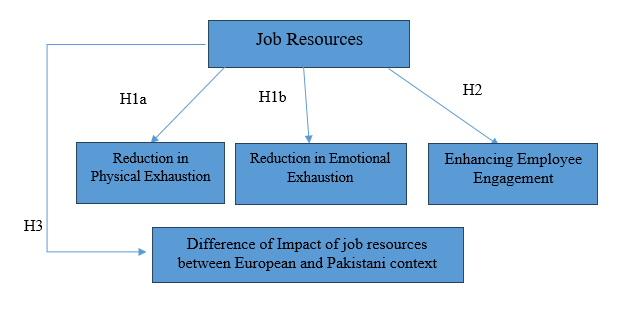
The challenge of employee burnout and work engagement has become a critical concern for organisations operating in complicated and challenging work environments. Based on the Job Demands Resources (JD-R) model, this study examines how job resources contribute to employee burnout and work engagement in two distinct geographical settings; Europe and Pakistan. The study is based on a quantitative, deductive research design, which will integrate secondary data (the European Working Conditions Survey 2021, 36 countries) and primary survey data, collected among employees working in different industries in Pakistan. Burnout is theorised as a multidimensional variable (physical and emotional exhaustion), whereas employee engagement is one of the motivational outcomes. These findings suggest that job resources universally promote employee engagement; however, their protective role in mitigating burnout appears to be culturally and contextually contingent. The study contributes to the JD-R literature by differentiating between burnout dimensions and by providing comparative evidence from Western and South Asian work environments. Practical implications emphasize the need for organisations to design culturally sensitive resource strategies that promote engagement while addressing context-specific sources of burnout.
Downloads
References
Adil, M. S., & Baig, M. (2018). Impact of job demands–resources model on burnout and employees’ well-being: Evidence from the pharmaceutical organisations of Karachi. IIMB Management Review, 30(2), 119–133. https://doi.org/10.1016/j.iimb.2018.01.004
Albrecht, S. L., Green, C. R., & Marty, A. (2021). Meaningful work, job resources, and employee engagement. Sustainability, 13(7), Article e4045. https://doi.org/10.3390/su13074045
Bakker, A. B., & De Vries, J. D. (2021). Job demands–resources theory and self-regulation: New explanations and remedies for job burnout. Anxiety, Stress, & Coping, 34(1), 1–21. https://doi.org/10.1080/10615806.2020.1797695
Bakker, A. B., & Demerouti, E. (2007). The Job Demands–Resources model: State of the art. Journal of Managerial Psychology, 22(3), 309–328. https://doi.org/10.1108/02683940710733115
Bakker, A. B., & Demerouti, E. (2018). Multiple levels in job demands–resources theory: Implications for employee well-being and performance. In E. Diener, S. Oishi, & L. Tay (Eds.), Handbook of well-being (1–13). Noba Scholar.
Bakker, A. B., & Demerouti, E. (2024). Job demands–resources theory: Frequently asked questions. Journal of Occupational Health Psychology, 29(3), 188–207. https://doi.org/10.1037/ocp0000376
Bao, H., Liu, C., Ma, J., Feng, J., & He, H. (2022). When job resources function as a stress buffer: A resource allocation perspective of the job demands–resources model. Personality and Individual Differences, 192, Article 111591. https://doi.org/10.1016/j.paid.2022.111591
Basinska, B. A., & Dåderman, A. M. (2019). Work values of police officers and their relationship with job burnout and work engagement. Frontiers in Psychology, 10, Article e442. https://doi.org/10.3389/fpsyg.2019.00442
Bon, A. T., & Shire, A. M. (2022). Review of the conservation of resources theory in the job demands–resources model. International Journal of Global Optimization and Its Application, 1(4), 236–248. https://doi.org/10.56225/ijgoia.v1i4.102
Chawla, D., & Sodhi, N. (2011). Research methodology: Concepts and cases. Vikas Publishing House.
Contreras, F., Espinosa, J. C., & Esguerra, G. A. (2020). Could personal resources influence work engagement and burnout? A study of a group of nursing staff. SAGE Open, 10(1), 1–12. https://doi.org/10.1177/2158244019900563
Corso-de-Zúñiga, S., Moreno-Jiménez, B., Garrosa, E., Blanco-Donoso, L. M., & Carmona-Cobo, I. (2020). Personal resources and personal vulnerability factors at work: An application of the job demands–resources model among teachers at private schools in Peru. Current Psychology, 39, 325–336. https://doi.org/10.1007/s12144-017-9766-6
Daniel, P. S., & Sam, A. G. (2011). Research methodology. Gyan Publishing House.
Demerouti, E., & Bakker, A. B. (2023). Job demands–resources theory in times of crises: New propositions. Organizational Psychology Review, 13(3), 209–236.
Demerouti, E., Bakker, A. B., Nachreiner, F., & Schaufeli, W. B. (2001). The Job Demands–Resources model of burnout. Journal of Applied Psychology, 86(3), 499–512. https://doi.org/10.1037/0021-9010.86.3.499
Falco, A., Girardi, D., Dal Corso, L., Yıldırım, M., & Converso, D. (2021). The perceived risk of being infected at work: An application of the job demands–resources model to workplace safety during the COVID-19 outbreak. PLOS ONE, 16(9), Article e0257197. https://doi.org/10.1371/journal.pone.0257197
Ferraro, T., dos Santos, N. R., Moreira, J. M., & Pais, L. (2020). Decent work, work motivation, work engagement, and burnout in physicians. International Journal of Applied Positive Psychology, 5(1), 13–35. https://doi.org/10.1007/s41042-019-00024-5
Galanakis, M. D., & Tsitouri, E. (2022). Positive psychology in the working environment: Job demands–resources theory, work engagement, and burnout—A systematic literature review. Frontiers in Psychology, 13, Article e1022102. https://doi.org/10.3389/fpsyg.2022.1022102
Gaude, L. B., Cabrita, J., Eiffe, F. F., Gerstenberger, B., Ivaškaitė-Tamošiūnė, V., Parent-Thirion, A., Weber, T., & White, C. (2022). Working conditions in the time of COVID-19: Implications for the future. https://www.eurofound.europa.eu/en/publications/all/working-conditions-time-covid-19-implications-future#authors
Goddard, W., & Melville, S. (2004). Research methodology: An introduction. Juta.
Goundar, S. (2012). Research methodology and research method. Victoria University of Wellington. https://prallagon.com/wp-content/uploads/2021/05/Research-Methodology-A2.pdf
Gu, Y., You, X., & Wang, R. (2020). Job demands and emotional labor as antecedents of female preschool teachers’ work-to-family conflict: The moderating role of job resources. International Journal of Stress Management, 27(1), 23–35. https://doi.org/10.1037/str0000130
Han, J., Yin, H., Wang, J., & Bai, Y. (2020). Challenge job demands and job resources to university teacher well-being: The mediation of teacher efficacy. Studies in Higher Education, 45(8), 1771–1785. https://doi.org/10.1080/03075079.2019.1594180
Hossan, D., Mansor, Z., Jaharuddin, N., & Jantan, A. (2022). Transformation of job demands–resources model to job demands–resources theory. City University eJournal of Academic Research, 4(3), 1–30.
Hsieh, C. C., Ho, S. S. H., Li, H. C., & Liang, J. K. (2021). Mindfulness as a moderator against emotional exhaustion due to online teaching during the COVID-19 pandemic: An investigation using the job demands–resources model and conservation of resources theory. Frontiers in Psychology, 12, Article e781804. https://doi.org/10.3389/fpsyg.2021.781804
Karaca, A., Aydogmus, M. E., & Gunbas, N. (2023). Enforced remote work during COVID-19 and the importance of technological competency: A job demands–resources perspective. European Review of Applied Psychology, 73(6), Article e100867. https://doi.org/10.1016/j.erap.2023.100867
Khalid, A., Pan, F., Li, P., Wang, W., & Ghaffari, A. S. (2020). The impact of occupational stress on job burnout among bank employees in Pakistan, with psychological capital as a mediator. Frontiers in Public Health, 7, Article e410. https://doi.org/10.3389/fpubh.2019.00410
Korunka, C., & Kubicek, B. (2017). Job demands in a changing world of work. In C. Korunka & B. Kubicek (Eds.), Job demands in a changing world of work (pp. 1–5). Springer. https://doi.org/10.1007/978-3-319-54678-0_1
Lee, S. H., & Kim, E. (2022). Inferential statistics. In S-H. Lee (Ed.), Scholarly research in music: Shared and disciplinary-specific practices (pp. 165-182). Routledge.
Mazzetti, G., Robledo, E., Vignoli, M., Topa, G., Guglielmi, D., & Schaufeli, W. B. (2023). Work engagement: A meta-analysis using the job demands–resources model. Psychological Reports, 126(3), 1069–1107. https://doi.org/10.1177/00332941211051988
Meng, L., Du, J., & Lin, X. (2023). Surviving bench stress: Meaningful work as a personal resource in the expanded job demands–resources model. Current Psychology, 42(21), 17757–17768. https://doi.org/10.1007/s12144-022-02956-9
Meyer, S. C., & Hünefeld, L. (2018). Challenging cognitive demands at work, related working conditions, and employee well-being. International Journal of Environmental Research and Public Health, 15(12), Article 2911. https://doi.org/10.3390/ijerph15122911
Mukherjee, S. P. (2019). A guide to research methodology: An overview of research problems, tasks, and methods. CRC Press.
Okojie, G., Ismail, I. R., Begum, H., Ferdous Alam, A. S. A., & Sadik-Zada, E. R. (2023). The mediating role of social support on the relationship between employee resilience and employee engagement. Sustainability, 15(10), Article e7950. https://doi.org/10.3390/su15107950
Pfenninger, S. E., & Neuser, H. (2019). Inferential statistics in quantitative data analysis. In J. J. McKinley & H. Rose (Eds.), The Routledge handbook of research methods in applied linguistics (pp. 415-426). Routledge.
Rahman, M. M., & Hossain, M. A. (2024). Workplace stressors and their consequences on frontliners’ performance: A conservation of resources perspective. FIIB Business Review. https://doi.org/10.1177/23197145231217381
Rollins, A. L., Eliacin, J., Russ-Jara, A. L., Monroe-DeVita, M., Wasmuth, S., Flanagan, M. E., & Salyers, M. P. (2021). Organizational conditions that influence work engagement and burnout: A qualitative study of mental health workers. Psychiatric Rehabilitation Journal, 44(3), 229–238. https://doi.org/10.1037/prj0000472
Saini, A., & Rangnekar, S. (2024). Impact of job demands and resources on idea generation: A conservation of resources theory perspective. Acta Universitatis Bohemiae Meridionales, 27(2), 31–48. https://doi.org/10.32725/acta.2024.007
Salmela-Aro, K., Hietajärvi, L., & Lonka, K. (2019). Work burnout and engagement profiles among teachers. Frontiers in Psychology, 10, Article e2254. https://doi.org/10.3389/fpsyg.2019.02254
Tang, H., An, S., Zhang, L., Xiao, Y., & Li, X. (2024). The antecedents and outcomes of public service motivation: A meta-analysis using the job demands–resources model. Behavioral Sciences, 14(10), Article e861. https://doi.org/10.3390/bs14100861
Truong, T. V. T., Nguyen, H. V., & Phan, M. C. T. (2021). Influences of job demands, job resources, personal resources, and coworkers’ support on work engagement and creativity. Journal of Asian Finance, Economics and Business, 8(1), 1041–1050. https://doi.org/10.13106/jafeb.2021.vol8.no1.1041
Van den Broeck, A., Vander Elst, T., Baillien, E., Sercu, M., Schouteden, M., De Witte, H., & Godderis, L. (2017). Job demands, job resources, burnout, work engagement, and their relationships: An analysis across sectors. Journal of Occupational and Environmental Medicine, 59(4), 369–376. https://doi.org/10.1097/JOM.0000000000000964
Vander Elst, T., Cavents, C., Daneels, K., Johannik, K., Baillien, E., Van den Broeck, A., & Godderis, L. (2016). Job demands–resources predicting burnout and work engagement among Belgian home health care nurses: A cross-sectional study. Nursing Outlook, 64(6), 542–556. https://doi.org/10.1016/j.outlook.2016.06.004
Xanthopoulou, D., Bakker, A. B., Demerouti, E., & Schaufeli, W. B. (2007). The role of personal resources in the Job Demands–Resources model. International Journal of Stress Management, 14(2), 121–141. https://doi.org/10.1037/1072-5245.14.2.121
Published
How to Cite
Issue
Section
License
Copyright (c) 2025 Syed Muhammad, Farooq-E-Azam Cheema, Saima Hussain

This work is licensed under a Creative Commons Attribution 4.0 International License.