Impact of Drug Information Centers on Healthcare Outcomes: A Narrative Review of Pre- and Post-implementation in South Asian Countries
DOI:
https://doi.org/10.32350/cpr.31.01Keywords:
drug information centers (DICs), drug information services (DISs), healthcare, medicine information, South AsiaAbstract
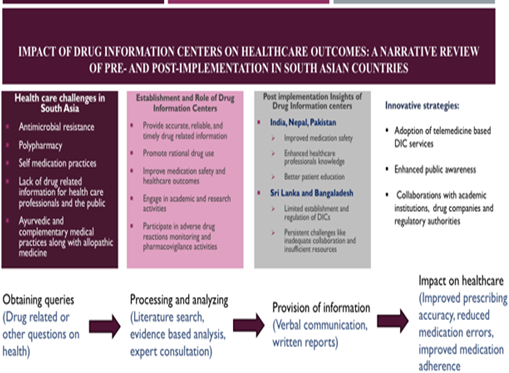
Drug Information Centers (DICs) play a vital role in the provision of accurate, reliable, and updated information on medications to healthcare professionals as well as the general public. These centers are now taking a step forward in the healthcare field. This narrative review aimed to analyze the evolution and impact of DICs on South Asian countries, such as India, Pakistan, Bangladesh, Sri Lanka, and Nepal. Furthermore, it also discussed the role of DICs in healthcare as well as the barriers in the establishment of such services in developing countries. The established DICs in these South Asian countries improves rational drug use and enhances patient safety even though there are significant challenges to establish and expand these centers in South Asia. The DICs established in India, Nepal, and Pakistan have significantly contributed in the enhancement of patient safety and rational use of medications. However, there are challenges in establishing DICs in Sri Lanka and Bangladesh. Innovative strategies, such as telemedicine services and collaboration with healthcare institutes, academics, and regulatory authorities would expand the services of DICs across South Asia.
Downloads
References
Shrestha S, Khatiwada AP, Gyawali S, Shankar PR, Palaian S. Overview, challenges and future prospects of drug information services in Nepal: a reflective commentary. J Multidiscip Healthc. 2020;13:287–295. https://doi.org/10.2147/JMDH.S238262
Canadian Society of Hospital Pharmacists. Drug Information Services: Guidelines. 3rd ed. Canadian Society of Hospital Pharmacists, Ottawa, Ontario; 2015.
Manosalva MAN, Gutiérrez JJL, Cañas M. Drug information centers: an overview to the concept. Rev Colomb Cienc. 2016;45(2):243–245. http://dx.doi.org/10.15446/rcciquifa.v45n2.59940
Kumar BS, Samraksha M, Parvathi K. Overview of status and challenges of drug information services in India. Res Rev. 2022;5(4):1175–1183. https://doi.org/10.52845/CMRO/2022/5-4-2
Chandola A, Ratnakar, Kandari S, Joshi Y. Status of drug information centre and services in India: an overview and challenges. Int J Pharm Sci Rev Res. 2020;64(2):60–64. http://dx.doi.org/10.47583/ijpsrr.2020.v64i02.010
Chhetri A, Palaian S, Mishra P. Drug information services in Nepal: the changing perspectives. PubMed. 2008;6(1):117–121. https://pubmed.ncbi.nlm.nih.gov/18604128
Almuqbil M, Alrojaie L, Alturki H, et al. The role of drug information centers to improve medication safety in Saudi Arabia - a study from healthcare professionals’ perspective. Saudi Pharm J. 2022;30(4):377–381. https://doi.org/10.1016/j.jsps.2022.01.024
Kalra M, Pakhale SP, Khatak MS, Khatak S. Drug information centers - need of the hour. Int Pharm Sci. 2011;1(1):69–76.
Khatiwada AP, Shakya S, Shrestha S. Paradigm shift of drug information centers during the COVID-19 pandemic. Drugs Ther Perspect. 2020;36:389–395. https://doi.org/10.1007/s40267-020-00757-3
Santos JRBD. Regional drug information center disseminates educational materials related to the COVID-19 pandemic. Explor Res Clin Soc Pharm. 2021;4:e100080. https://doi.org/10.1016/j.rcsop.2021.100080
Gabay MP. The evolution of drug information centers and specialists. Hosp Pharm. 2017;52(7):452–453. https://doi.org/10.1177/0018578717724235
Shankar PR, Mishra P, Subish P, Upadhyay DK. The drug information center at the Manipal teaching hospital—going beyond drug information. Ther Innov Regul Sci. 2007;41:761–768. https://doi.org/10.1177/009286150704100608
Thireesha P, Mounika K, Adusumilli P, Harsha CS. An overview of drug information center – functions and challenges in India. Asian J Pharm Clin Res. 2020;13(5):11–15. https://doi.org/10.22159/ajpcr.2020.v13i5.37052
Carlos, V. Drug information centers in developing countries and the promotion of rational use of drugs: a viewpoint about challenges and perspectives. Int Pharm J. 2004;18:21–23.
Khaliq A, Sayed SA. Drug and poison information centres: an emergent need for health care professionals in Pakistan. J Pak Med Assoc. 2016;66(6):639–643.
Joshi MP. Drug information service at teaching hospitals in developing countries. Indian J Pharmacol. 1998;30(1):1–5.
Paul TR, Rahman MA, Biswas M, Rashid M, Islam MAU. Practice of hospital pharmacy in Bangladesh: current perspective. Bangladesh Pharm J. 2015;17(2):187–192. https://doi.org/10.3329/bpj.v17i2.22339
Batool M, Muzzamil U, Qureshi R. Assessment and utilization of a pharmacist-assisted drug and poison information centre in Pakistan. Int J Med Res Health Sci. 2019;8(4):117–123.
University of Colombo. Department of pharmacology–service. University of Colombo Web site. https://med.cmb.ac.lk/pharmac/services/. Accessed November 14, 2024.
Ministry of Health Care and Nutrition. The national medicinal drug policy for Sri Lanka. https://www.health.gov.lk/wp-content/uploads/2022/10/17-National-Medicinal-Drug-Policy-for-Sri-Lanka-2005-compressed.pdf. Published 2005. Accessed November 14, 2024.
Ashenef A, Reshid E, Yilma Z, Melaku T, Chane T. Assessment of the use and status of new drug information centers in a developing country, Ethiopia: the case of public university hospital drug information centers. BioMed Res Int. 2018;2018:e3840976. https://doi.org/10.1155/2018/3840976
Markind JE, Stachnik JM. European drug information centers. J Hum Lact. 1996;12(3):239–242. https://doi.org/10.1177/089033449601200324
Gandra S, Alvarez-Uria G, Turner P, Joshi J, Limmathurotsakul D, Van Doorn HR. Antimicrobial resistance surveillance in low- and middle-income countries: progress and challenges in eight South Asian and Southeast Asian countries. Clin Microbiol Rev. 2020;33(3):e00048-19 https://doi.org/10.1128/cmr.00048-19
Reppe LA, Spigset O, Schjøtt J. Drug information services today: current role and future perspectives in rational drug therapy. Clin Therap. 2016;38(2):414–421. https://doi.org/10.1016/j.clinthera.2015.12.019
Perera T, Ranasinghe P, Perera U, et al. Knowledge of prescribed medication information among patients with limited English proficiency in Sri Lanka. BMC Res Notes. 2012;5:e658. https://doi.org/10.1186/1756-0500-5-658
Alahendra AMAAU, Perera OTS, Guruge ML, Anthony DK, Dasanayaka C, Wijekoon WMPDS. Perceived Self-medication Practices and Associated Factors among undergraduates in a Non-State University. SLIIT J Humanit Sci. 2021;2(1):29–47. https://doi.org/10.4038/sjhs.v2i1.38
Rashid M, Chhabra M, Kashyap A, Undela K, Gudi SK. Prevalence and predictors of self-medication practices in India: a systematic literature review and meta-analysis. Curr Clin Pharmacol. 2019;15(2):90–101. https://doi.org/10.2174/1574884714666191122103953
Shankar P, Partha P, Shenoy N. Self-medication and non-doctor prescription practices in Pokhara valley, Western Nepal: a questionnaire-based study. BMC Fam Pract. 2002;3:e17. https://doi.org/10.1186/1471-2296-3-17
Prinja S, Purohit N, Kaur N, et al. The state of primary health care in south Asia. Lancet Glob Health. 2024;12(10):E1693–E1705. https://doi.org/10.1016/s2214-109x(24)00119-0
Khan N, Chattopadhyay K, Leonardi-Bee J. Incidence, prevalence, risk factors and health consequences of polypharmacy in adults in South Asia: a systematic review protocol. JBI Database Syst Rev Implement Rep. 2019;17(11):2370–2377. https://doi.org/10.11124/jbisrir-d-18-00001
Delara M, Murray L, Jafari B, et al. Prevalence and factors associated with polypharmacy: a systematic review and meta-analysis. BMC Geriat. 2022;22:e601. https://doi.org/10.1186/s12877-022-03279-x
Nualdaisri P, Corlett SA, Krska J. Provision and need for medicine information in Asia and Africa: a scoping review of the literature. Drug Saf. 2021;44:421–437. https://doi.org/10.1007/s40264-020-01038-8
Bhosale UA. Evaluation of knowledge and awareness of patients about prescribed drugs and their package inserts: a cross-sectional study. Asian J Pharm. 2016;10(2):S96–S99
Rahim N, Rafiq K. Judgement of pharmaceutical package inserts available in Pakistan from local and multinational companies. Asian J Pharm Health Sci. 2013;3(1):597–600.
Arsalan A, Qureshi S, Alam M, et al. Errors in patients’ information leaflets of marketed medicines in Pakistan. J Appl Pharm Sci. 2015;5(5):068–074. https://dx.doi.org/10.7324/JAPS.2015.50513
Saheeha MSS, Piumanthi MHS, Perera SP, Samaranayake NR, Fernando GH. Quality of medicine information in product information leaflets: a retrospective audit. Ther Innov Regul Sci. 2018;52(5):656–660. https://doi.org/10.1177/2168479017753128
Islam MS, Farah S. Availability and characteristics of information on drug-durg interactions in the drug package inserts: an experience from Bangladesh. Internet J Health. 2007;6:e9.
Patel S, Ganguly B. Audit of patient information leaflets available with topical medicines for patient use. Int J Pharm Res. 2014;6:50–55.
Alam K, Shah AK, Ojha P, Palaian S, Shankar PR. Evaluation of drug promotional materials in a hospital setting in Nepal. South Med Rev. 2009;2(1):2–6.
Khan MAA, Hamid S, Babar ZUD. Pharmacovigilance practices in South Asian Association for regional cooperation countries: the need for collaboration. J Pharm Health Serv Res. 2022;13(4):378–386. https://doi.org/10.1093/jphsr/rmac046
Ismail M, Iqbal Z, Khattak MB, et al. Potential drug–drug interactions in internal medicine wards in hospital setting in Pakistan. Int J Clin Pharm. 2013;35:455–462. https://doi.org/10.1007/s11096-013-9764-1
Khan MAA, Hamid S, Ur-Rehman T, Babar ZUD. Assessment of the current state of pharmacovigilance system in Pakistan using indicator-based assessment tool. Front Pharmacol. 2022;12:e789103. https://doi.org/10.3389/fphar.2021.789103
Khan J, Karatas Y, Khan Z. Self-Medication in Pakistan: urgent need for medical education and policy implementation. Pak J Med Dent. 2021;10(4):104–105. https://doi.org/10.36283/PJMD10-4/018
Navaratinaraja TS, Kumanan T, Siraj S, Sreeharan N. Potential drug–drug interactions among hospitalised elderly patients in northern Sri Lanka, a lower middle-income country: a retrospective analysis. Drugs - Real World Outcomes. 2022;10:83–95. https://doi.org/10.1007/s40801-022-00333-3
Chauhan N, Moin S, Pandey A, Mittal A, Bajaj U. Indian aspects of drug information resources and impact of drug information centre on community. J Adv Pharm Technol Res. 2013;4(2):84–93. https://doi.org/10.4103/2231-4040.111524
Sakeena MHF, Bennett AA, McLachlan AJ. The need to strengthen the role of the pharmacist in Sri Lanka: perspectives. Pharmacy. 2019;7(2):e54. https://doi.org/10.3390/pharmacy7020054
Shankpal A, Yogita YV, Chinmayee R, Reddy S, Lakshmi PK. Implementation of drug information services in a tertiary care hospital: Patients’ and physicians’ perception. Int J Pharm Investig. 2023;14(1):62–67. https://doi.org/10.5530/ijpi.14.1.9
Peter AV, Murali A, Tomy T, Londhe SP. Assessment and utilization of drug information services and creating awareness for enhanced utilization of drug information centre in a tertiary care teaching hospital. Asian J Pharm Clin Res. 2017;10(5):270–274. http://dx.doi.org/10.22159/ajpcr.2017.v10i5.17180
Mudigubba MK, Sowmya B, Dinesh R, et al. Evaluation of performance of drug information center providing quality of information services to healthcare professionals in a tertiary care teaching hospital of South India. Innov Pharmaceut Pharmacother. 2013;1(2):81–90.
Rao P, George B. Assessment and evaluation of drug information services provided in a South Indian teaching hospital. Indian J Pharmacol. 2005;37(5):315–319. https://doi.org/10.4103/0253-7613.16856
Rajanandh MG, Varghese R, Ramasamy C. Assessment of drug information services in a south indian tertiary care hospital in kanchipuram district. Int J Pharm Pharm Sci. 2011;3(3):273–276.
Kumar SV, Chakilam V. Quality of services provided by the drug information centre of the pharmacy practice department in a tertiary care teaching hospital at Warangal District: Andhra Pradesh, India. Indian J Hosp Pharm. 2012;49:151–156.
Nibu P, Ramesh M, Parthasarathi G. Review of a drug information service in an Indian teaching hospital. Aust J Hosp Pharm. 2001;31(2):144–145. https://doi.org/10.1002/jppr2001312144
Palaian S, Mishra P, Shankar P, Bista D, Pawar B. Contribution of the regional drug information center towards drug safety. J Nepal Med Assoc. 2006;45(161):216–218.
Pathak N, Rasaili A, Barma S, et al. Establishment of a drug information unit and pharmacovigilance cell in a provincial hospital of Nepal: implementation of the 2015 hospital pharmacy service guidelines. Hosp Pharm. 2025:1–5. https://doi.org/10.1177/00185787241306689
Innes AJ, Bramley DM, Wills S. The impact of UK medicines information services on patient care, clinical outcomes and medicines safety: an evaluation of healthcare professionals’ opinions. Eur J Hosp Pharm. 2014;21(4):222–228. https://doi.org/10.1136/ejhpharm-2014-000462
Ali A, Yusoff SM, Joffry SM, Wahab MS. Drug information service awareness program and its impact on characteristics of inquiries at DIS unit in Malaysian public hospital. Arch Pharm Pract. 2013;4(1):9–14.
Tumwikirize AW, Ogwal-Okeng JW, Vernby A, Anokbonggo WW, Gustafsson LL, Lundborg CS. Use of a pilot drug information centre. Afr Health Sci. 2011;11(3):493–498.
Wen MM, Aref H, Abozaid A, Kandil NH, Elsobky YH. Quality evaluation and survey of the essential need for drug information centers. Int J Pharm Pharm Sci. 2016;8(11):137–143. http://dx.doi.org/10.22159/ijpps.2016v8i11.14085
Published
How to Cite
Issue
Section
License
Authors retain copyright and grant the journal right of first publication with the work simultaneously licensed under a Creative Commons Attribution (CC-BY) 4.0 License that allows others to share the work with an acknowledgement of the work’s authorship and initial publication in this journal