Phytochemical Screening and Anti-dandruff Activity of Fruit Husk Extracts of Cassia fistula Lin

  • Mariam Busharat School of Medical, Indigenous and Health Sciences, University of Wollongong, New South Wales, Australia https://orcid.org/0009-0004-7405-1326
  • Faiza Azhar Department of Pharmaceutical Chemistry, Green International University, Lahore, Pakistan https://orcid.org/0009-0004-7405-1326
  • Ahsan Iqbal Department of Pharmaceutical Chemistry, Punjab University College of Pharmacy, University of the Punjab, Lahore, Pakistan
  • Zainab Waheed Department of Pharmaceutical Chemistry, Punjab University College of Pharmacy, University of the Punjab, Lahore, Pakistan
  • Muhammad Nauman Jamil Department of Pharmaceutical Chemistry, Hamza College of Pharmacy, Lahore, Pakistan
Keywords: antimicrobials, anti-dandruff activity, Cassia fistula, medicinal plants, phytochemicals

Abstract

Abstract Views: 475

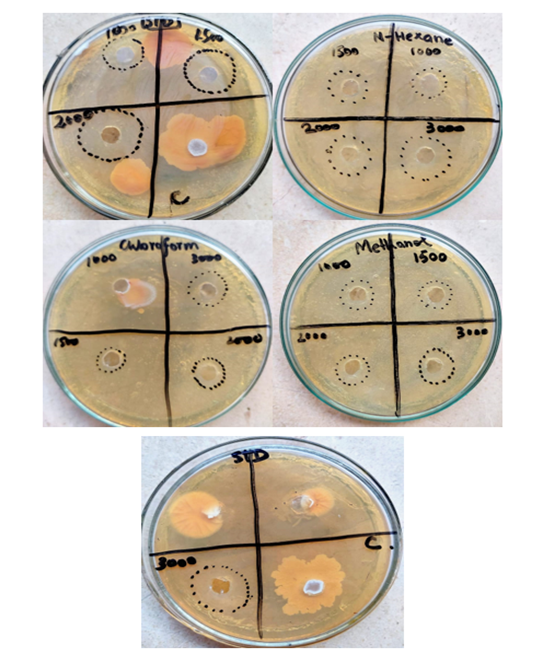
Medicinal plants play a substantial role in treating various disorders. This study aims to evaluate the phytochemicals and anti-dandruff activity of a fruit husk of Cassia fistula Linn as a remedy for treating dandruff. Various extracts of fruit husk were extracted using sequential extraction methods, namely n-hexane, chloroform, and methanol. Primarily, the polyphenols and flavonoids of the various extracts were determined. The methanol extract contained the maximum number of polyphenols (48.97 ± 0.27), while the flavonoids were found in a large amount in the n-hexane extract (123.0 ± 0.82). Anti-dandruff activity was performed using a well-diffusion method against Malassezia species. At 1.0 g/mL concentration, n-hexane showed a zone of inhibition of 12.5 mm, while 18.50 mm and 20.50 mm at concentrations of 1.5 g/mL and 2.0 g/mL, respectively. At the concentration of 3000 mg/mL, the inhibition zone of 23.60 mm was observed. Extracts of Cassia fistula linn were effective for the treatment of dandruff. Therefore, in vivo studies are crucially required to explore the mechanism of action.

Downloads
Download data is not yet available.

References

Abdullahi AA. Trends and challenges of traditional medicine in Africa. Afr J Tradit Complement Altern Med. 2011;8(5S):115–123. https://doi.org/10.4314/ajtcam.v8i5S.5

Pawar AV, Killedar SG. Uses of cassia fistula linn as a medicinal plant. Int J Adv Res Dev. 2017;2(3):85–88.

Abe R, Ohtani K. An ethnobotanical study of medicinal plants and traditional therapies on Batan Island, the Philippines. J Ethnopharmacol. 2013;145(2):554–565. https://doi.org/10.1016/j.jep.2012.11.029

Alamgir ANM. Therapeutic Use of Medicinal Plants and Their Extracts. Springer; 2017.

Danish M, Singh P, Mishra G, Srivastava S, Jha KK, Khosa RL. Cassia fistula Linn. (Amulthus)-An important medicinal plant: a review of its traditional uses, phytochemistry and pharmacological properties. J Nat Prod Plant Resour. 2011;1(1):101–118.

Einstein JW, Rais MM, Mohd MA. Comparative evaluation of the antidiabetic effects of different parts of Cassia fistula Linn, a Southeast Asian plant. J Chem. 2013;2013:e714063 https://doi.org/10.1155/2013/714063

Karthikeyan S, Gobianand K. Antiulcer activity of ethanol leaf extract of cassia fistula. Pharm Biol. 2010;48(8):869–877. https://doi.org/10.3109/13880200903302838

Mohanapriya B, Suresh SN, Sathyapriya A, Kanagaraj C, Mythily N. Evaluation of Anti-dandruff activity of polyherbal serum against the fungus Malasseiza fungus from human scalp. J Coast Life Med. 2023;11(2):1443–1447.

Singla C, Ali M. Antidandruff activity and chemical constituents of the leaves of Betula cylindrostachya Lindl. ex Wall. J Med Plants Stud. 2018;6(4):189–193.

Arora P, Nanda A, Karan M. Plants used in management of dandruff. Ind Pharm. 2011:28–31.

Ro BI, Dawson TL. The role of sebaceous gland activity and scalp microfloral metabolism in the etiology of seborrheic dermatitis and dandruff. J Invest Dermatol Symp Proc. 2005;10(3):194–197. https://doi.org/10.1111/j.1087-0024.2005.10104.x

Sales MDC, Costa HB, Fernandes PMB, Ventura JA, Meira DD. Antifungal activity of plant extracts with potential to control plant pathogens in pineapple. Asian Pac J Trop Biomed. 2016;6(1):26–31. https://doi.org/10.1016/j.apjtb.2015.09.026

Deviha MS, Pavithram KS. Antifungal activity by ethanolic extracts of medicinal plants against Malasseziafurfur: a potential application in the treatment of Dandruff. Int J Pharm Tech Res. 2015;8(3):440–444.

Ferdosi MF, Javaid A, Khan IH. Phytochemical profile of n-hexane flower extract of Cassia fistula L. Bangladesh J Bot. 2022;52(2):393–399. https://doi.org/10.3329/bjb.v51i2.60438

Hada D, Sharma K. Isolation and characterization of chemical compounds from fruit pulp of Cassia fistula and their antimicrobial activity. J Drug Deliv Ther. 2018;8(2):15-20. https://doi.org/10.22270/jddt.v8i2.1664

Antonisamy P, Agastian P, Kang CW, Kim NS, Kim JH. Anti-inflammatory activity of Rhein isolated from the flowers of Cassia fistula L. and possible underlying mechanisms. Saudi J Biol Sci. 2019;26(1):96–104. https://doi.org/10.1016/j.sjbs.2017.04.011

Slinkard K, Singleton VL. Total phenol analysis: automation and comparison with manual methods. Am J Enol Vitic. 1977;28(1):49–55. https://doi.org/10.5344/ajev.1977.28.1.49

Pavun L, Uskoković-Marković S, Jelikić-Stankov M, Đikanović D, Đurđević P. Determination of flavonoids and total polyphenol contents in commercial apple juices. Czech J Food Sci. 2018;36(3):233–238. http://dx.doi.org/10.17221/211/2017-CJFS

Krishnaiah D, Devi T, Bono A, Sarbatly R. Studies on phytochemical constituents of six Malaysian medicinal plants. J Med Plant Res. 2009;3(2):67–72.

Lahlou M. Screening of natural products for drug discovery. Expert Opin Drug Discov. 2007;2(5):697–705. https://doi.org/10.1517/17460441.2.5.697

Nocentini A, Bua S, Prete SD, et al. Natural polyphenols selectively inhibit β‐carbonic anhydrase from the dandruff‐producing fungus Malassezia globosa: Activity and Modeling Studies. ChemMedChem. 2018;13(8):816–823. https://doi.org/10.1002/cmdc.201800015

Mojzer EB, Hrnčič MK, Škerget M, Knez Z, Bren U. Polyphenols: extraction methods, antioxidative action, bioavailability and anticarcinogenic effects. Molecules. 2016;21(7):e901. https://doi.org/10.3390/molecules21070901

Safeena MIS. Effect of crude extract mixtures of five selected medicinal plant species on Malassezia sp. Paper presented at: 9th International Symposium; November 27–28, 2019; Oluvil, Sri Lanka. http://ir.lib.seu.ac.lk/handle/123456789/3941

Chewchinda S, Wuthi-Udomlert M, Gritsanapan W. HPLC quantitative analysis of Rhein and antidermatophytic activity of cassia fistula pod pulp extracts of various storage conditions. BioMed Res Intl. 2013;2013:e821295. https://doi.org/10.1155/2013/821295

Prabhu V, Poonkodi K, Pradeep K, et al. Antidandruff activity of cassia auriculata and cassia alata through fatty acids mediated inhibition of Malassezia furfur. J Appl Nat Sci. 2020;12(4):532–540. https://doi.org/10.31018/jans.v12i4.2390

Prabha MM, Gokul SS, Sharma NK, Babu K, Chiranjeevi A. Antifungal activity of selected plant extracts against Malassezia globosa. Int J Adv Sci Tech Res. 2012;5(2):162–168.

Chandrani D, Lubaina SZ, Soosamma M. A review of antifungal effect of plant extract vs chemical substances against Malassezia spp. Int J Pharma Bio Sci. 2012;3(3):773–780.

Gaitanis G, Magiatis P, Hantschke M, Bassukas ID, Velegraki A. The Malassezia genus in skin and systemic diseases. Clin Microbiol Rev. 2012;25(1):106–141. https://doi.org/10.1128/cmr.00021-11

Published
2023-12-05
How to Cite
Busharat, M., Azhar, F., Iqbal, A., Waheed, Z., & Jamil, M. N. (2023). Phytochemical Screening and Anti-dandruff Activity of Fruit Husk Extracts of Cassia fistula Lin. Currents in Pharmaceutical Research, 1(2), 01-12. https://doi.org/10.32350/cpr.12.01
Section
Articles