Treatment of Children with Pneumonia and Underlying Causes of Recurrent Pneumonia at a Paediatric Hospital in Abbottabad, Pakistan

  • Fiaz Alam Department of Pharmacy, COMSATS University Islamabad, Abbottabad Campus, Abbottabad, Pakistan https://orcid.org/0000-0003-4717-086X
  • Salman Munawar Department of Pharmacy, COMSATS University Islamabad, Abbottabad Campus, Abbottabad, Pakistan
  • Anwar Department of Pharmacy, COMSATS University Islamabad, Abbottabad Campus, Abbottabad, Pakistan
  • Fahad Khan Department of Pharmacy, COMSATS University Islamabad, Abbottabad Campus, Abbottabad, Pakistan
  • Khadifa Shakeel Department of Pharmacy, COMSATS University Islamabad, Abbottabad Campus, Abbottabad, Pakistan
  • Laraib Ejaz Department of Pharmacy, COMSATS University Islamabad, Abbottabad Campus, Abbottabad, Pakistan
Keywords: Abbottabad, antibiotics, hospitals, paediatrics, recurrent pneumonia

Abstract

Abstract Views: 486

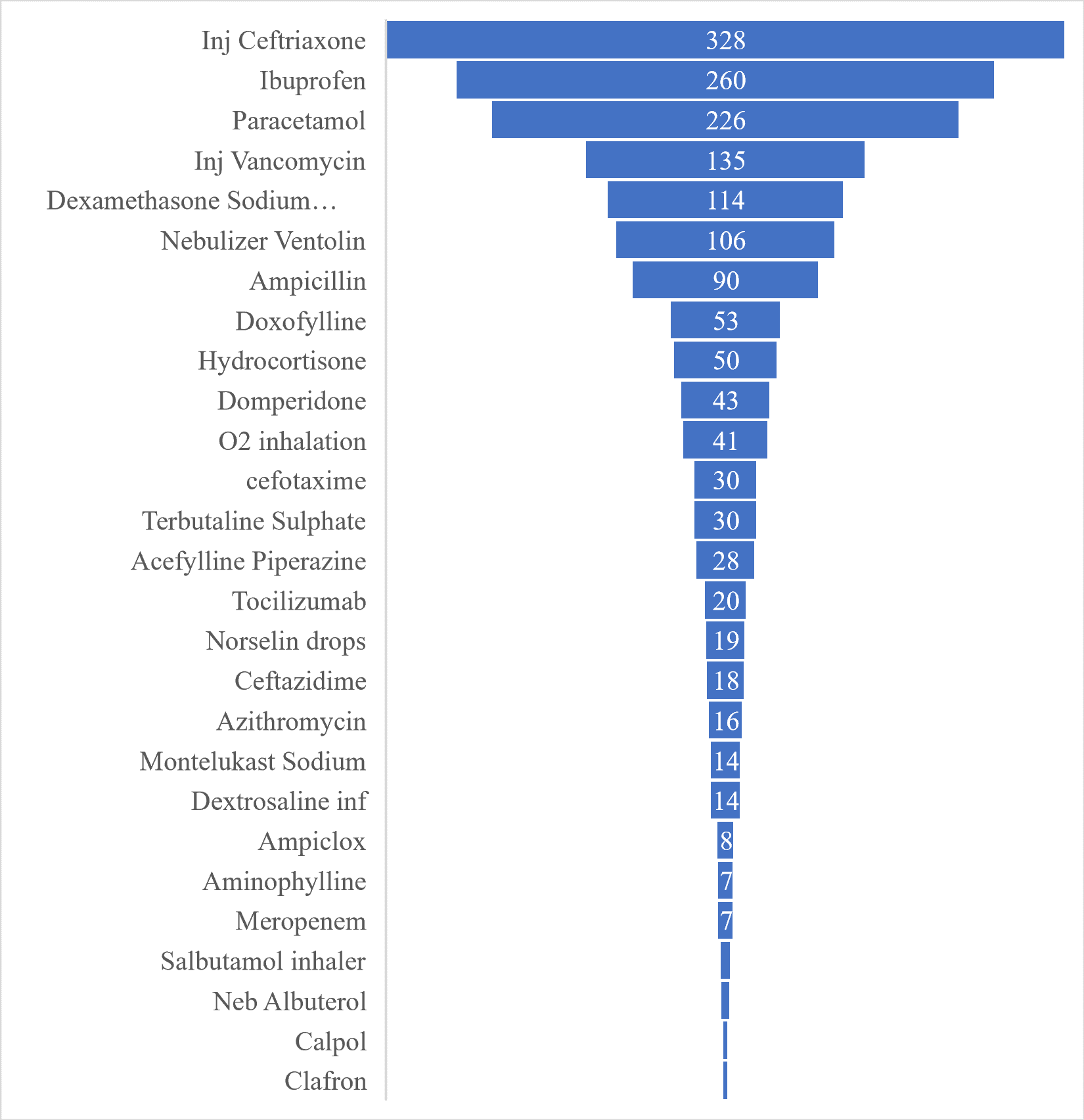
The current study aimed to examine the prescribed drugs, the underlying reasons of recurrent pneumonia in children, and the usage of over-the-counter (OTC) cough suppressants as a supplement to antibiotics for paediatric acute pneumonia. During the study period of one year, more than 420 cases were analyzed comprising 194 males (46.1%) and 226 females (53.8%). Eight drugs were prescribed from Essential Drug List (EDL), while 20 were not prescribed from EDL. The most common prescribed medication included ceftriaxone (inj) 280 times, followed by dexamethasone sodium phosphate 42 times. The most common OTC given was paracetamol 226 times followed by Ibuprofen 137 times. In 96.4% cases, nebulizer ventolin was used to control asthma. The current study identified immunodeficiency, aspiration, and structural abnormalities as significant factors for recurrent pneumonia. The analysis revealed frequent use of antibiotics and OTC medications for symptom management. Understanding these treatment patterns and the role of OTC cough medications as adjuncts to antibiotics may help optimize therapeutic strategies and improve clinical outcomes in pediatric pneumonia.

Downloads
Download data is not yet available.

References

Yadav KK, Awasthi S. Childhood pneumonia: what’s unchanged, and what’s new? Ind J Pediatr. 2023;90(7):693–699. https://doi.org/10.1007/s12098-023-04628-3

Ablakimova N, Smagulova GA, Rachina S, et al. Bibliometric analysis of global research output on antimicrobial resistance among pneumonia pathogens (2013–2023). Antibiotics. 2023;12(9):e1411. https://doi.org/10.3390/antibiotics12091411

Choo ELW, Janhavi A, Koo JR, Yim SH, Dickens BL, Lim JT. Association between ambient air pollutants and upper respiratory tract infection and pneumonia disease burden in Thailand from 2000 to 2022: a high frequency ecological analysis. BMC Infect Dis. 2023;23(1):e379. https://doi.org/10.1186/s12879-023-08185-0

Dinka IR, Seyoum D, Debelo S, et al. Time to recovery and its predictors among under-five children admitted with severe pneumonia in East Wallaga Zone public hospitals, western Ethiopia, 2023; a retrospective cohort study. BMC Pediatr. 2024;24(1):e459. https://doi.org/10.1186/s12887-024-04937-2

Akhtamovna KN. Modern diagnostics and treatment methods of pneumonia in children. J Healthc Life Sci Res. 2023;2(12):155–160.

Postma DF, Van Werkhoven CH, Van Elden LJ, et al. Antibiotic treatment strategies for community-acquired pneumonia in adults. N Engl J Med. 2015;372(14):1312–1323. https://doi.org/10.1056/NEJMoa1406330

Sidabutar E, Bustan N, Birawida AB. Analysis of risk factor for pneumonia in children less than five years in Makassar. J Educ Health Promot. 2024;13(1):e16. https://doi.org/10.4103/jehp.jehp_727_23

Ruuskanen O, Järvinen A. Editorial commentary: what is the real role of respiratory viruses in severe community-acquired pneumonia? Clin Infect Dis. 2014;59(1):71–73. https://doi.org/10.1093/cid/ciu242

Cotter JM, Hall M, Neuman MI, et al. Antibiotic route and outcomes for children hospitalized with pneumonia. J Hosp Med. 2024;19(8):693–701. https://doi.org/10.1002/jhm.13382

Mei M, Dai D, Guo Z, et al. Underlying causes and outcomes of recurrent pneumonia in hospitalized children. Pediatr Pulmonol. 2023;58(6):1674–1682. https://doi.org/10.1002/ppul.26374

Restrepo MI, Sibila O, Anzueto A. Pneumonia in patients with chronic obstructive pulmonary disease. Tuberc Respir Dis. 2018;81(3):187–197. https://doi.org/10.4046/trd.2018.0030

Gupta S, Pattanaik D, Krishnaswamy G. Common variable immune deficiency and associated complications. Chest. 2019;156(3):579–593. https://doi.org/10.1016/j.chest.2019.05.009

Tsegaw H, Yimam M, Nureye D, Woldeselassie W, Hambisa S. Predictors of treatment outcomes among pediatric patients hospitalized with pneumonia in Tikur Anbessa Specialized Hospital, Addis Ababa, Ethiopia. Adv Pharm Pharm Sci. 2021;2021(1):e6690622. https://doi.org/10.1155/2021/6690622

Mishore KM, Girma Y, Tola A, Mekuria AN, Ayele Y. Evaluation of medication use pattern among patients presenting to the emergency department of Hiwot Fana Specialized University Hospital, using WHO prescribing indicators. Front Pharmacol. 2020;11:e509. https://doi.org/10.3389/fphar.2020.00509

Zhang Z, Li H, Hu Y, et al. The efficacy and safety of inhaled antibiotics for pneumonia: a systematic review and meta-analysis. Pulm Pharmacol Ther. 2024;86:e102315. https://doi.org/10.1016/j.pupt.2024.102315

Heffelfinger JD, Dowell SF, Jorgensen JH, et al. Management of community-acquired pneumonia in the era of pneumococcal resistance: a report from the Drug-Resistant Streptococcus pneumoniae Therapeutic Working Group. Arch Intern Med. 2000;160(10):1399–1408. https://doi.org/10.1001/archinte.160.10.1399

Vigo E. Community-acquired infections: focus on unusual epidemics and update on S. pneumonia. Clin Microbiol Infect. 2004;10(3):87–178.

Sileshi A, Tenna A, Feyissa M, Shibeshi W. Evaluation of ceftriaxone utilization in medical and emergency wards of Tikur Anbessa Specialized Hospital: a prospective cross-sectional study. BMC Pharmacol Toxicol. 2016;17:1–10. https://doi.org/10.1186/s40360-016-0057-x

Quinti I, Soresina A, Guerra A, et al. Effectiveness of immunoglobulin replacement therapy on clinical outcome in patients with primary antibody deficiencies: results from a multicenter prospective cohort study. J Clin Immunol. 2011;31:315–322. https://doi.org/10.1007/s10875-011-9511-0

Montella S, Santamaria F. Recurrent pneumonia in children: a reasoned diagnostic approach and a single centre experience. Int J Mol Sci. 2017;18(2):e296. https://doi.org/10.3390/ijms18020296

Clark G, Fitzgerald DA, Rubin BK. Cough medicines for children-time for a reality check. Paediatr Respir Rev. 2023;48:30–38. https://doi.org/10.1016/j.prrv.2023.08.003

Berbakov ME, Hoffins EL, Stone JA, et al. Adapting a community pharmacy intervention to improve medication safety. J Am Pharm Assoc. 2024;64(1):159–168. https://doi.org/10.1016/j.japh.2023.11.009

Shen K, Hong J, El Beleidy A, et al. International expert opinion on the use of nebulization for pediatric asthma therapy during the COVID-19 pandemic. J Thorac Dis. 2021;13(7):e3934. https://doi.org/10.21037/jtd-21-841

Thi TVL, Pham EC, Dang-Nguyen DT. Evaluation of children's antibiotics use for outpatient pneumonia treatment in Vietnam. Braz J Infect Dis. 2024;28(4):e103839. https://doi.org/10.1016/j.bjid.2024.103839

Raj K, Attavar PC. Multidrug resistance in microorganisms causing ventilator-associated pneumonia: a literature review. Int J Res Publ Rev. 2024;5(1):15965–15974.

Published
2024-11-15
How to Cite
Alam, F., Munawar, S., Anwar, Khan, F., Shakeel, K., & Ejaz, L. (2024). Treatment of Children with Pneumonia and Underlying Causes of Recurrent Pneumonia at a Paediatric Hospital in Abbottabad, Pakistan. Currents in Pharmaceutical Research, 2(2), 22-37. https://doi.org/10.32350/cpr.22.02
Section
Articles