Awareness about Non-Prescribed Usage of Antidepressants among University Students in Faisalabad, Pakistan
Abstract
Abstract Views: 415
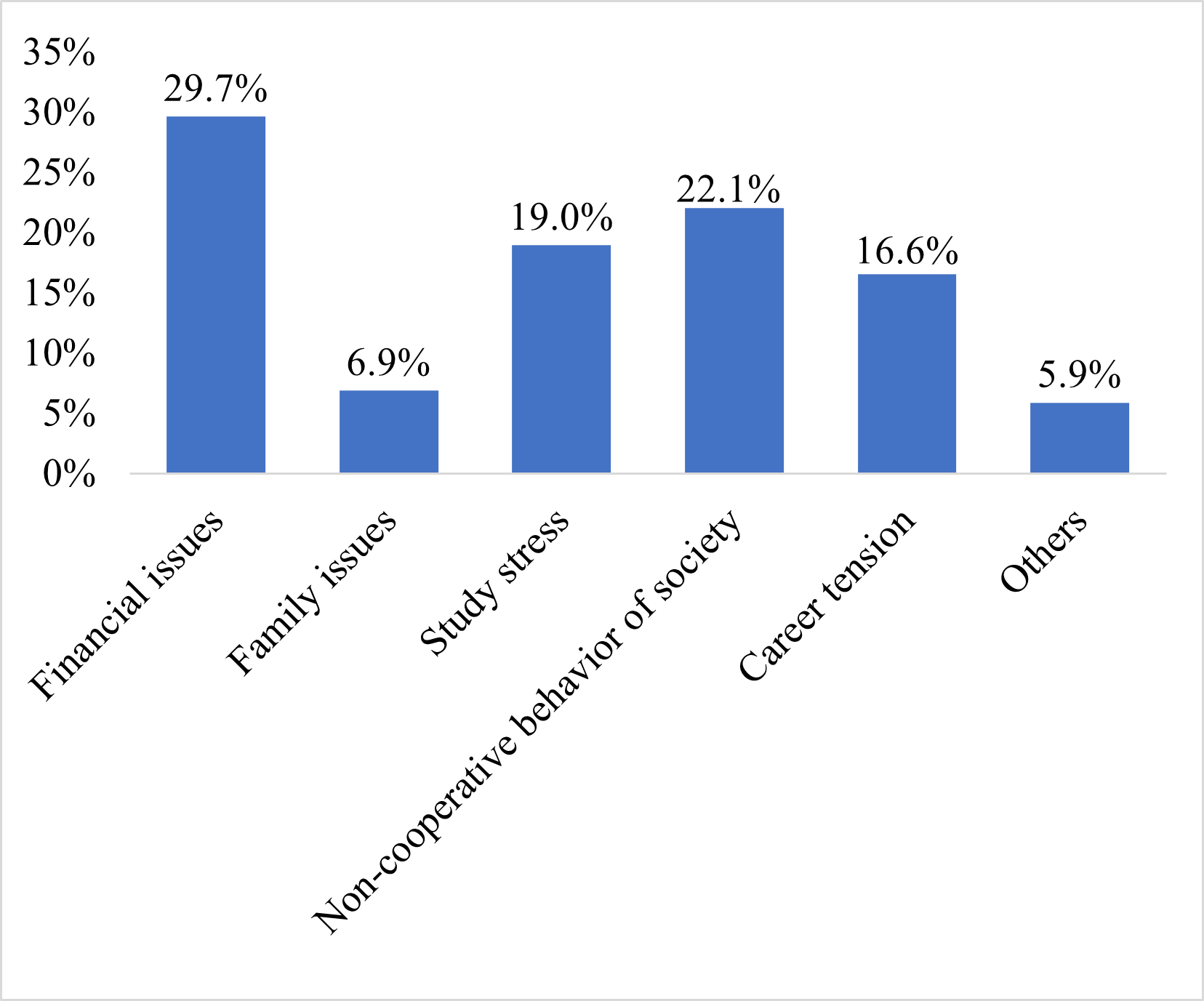
University students are most commonly vulnerable to depression among all the other age groups. Antidepressants are mostly used without proper prescription due to lack of awareness and various other factors like negative attitudes, misconceptions, and lack of education, often impacting the proper utilization of antidepressants. This study aims to gauge the awareness and knowledge of university students regarding the non-prescriptive use of antidepressants and to explore students' understanding of the associated side effects. A cross sectional study was performed among 1740 students of both medical and non-medical background from a public sector university, of Faisalabad. Data were collected by using an online questionnaire that contained 26 close ended and 6 demographics-based questions. The questionnaire was designed after thorough discussion with health care professionals. Descriptive statistics were applied in order to analyze the data. The results showed, among total participants (1740), 35.53% agree that females are more prone to depression in comparison to males 18.62%. In terms of economy, 88.28% participants believe that depression badly affects the economy. 92.02% respondents believe that depression remains undiagnosed due to non-cooperative behavior of society and other factors like lack of awareness, and hesitation. Survey showed, 89.06% students do not get any treatment for depression due to lack of awareness. The prevalence of lack of awareness among university students about non prescribed use of antidepressants and their associated side effects was alarming. Universities can take various initiatives to raise the awareness among students regarding non prescribed use of antidepressants like utilization of mobile health apps, establishment of counseling centers, stigma reduction campaigns and collaboration with health services.
Downloads
References
Abdallat M, Murshidi R, Taha H, et al. An investigation of knowledge and attitudes towards antidepressants: a cross-sectional survey of Jordan’s six medical schools. BMC Psych. 2023;23(1):e604. https://doi.org/10.1186/s12888-023-05037-8
Ormel J, Kessler RC, Schoevers R. Depression: more treatment but no drop in prevalence: how effective is treatment? and can we do better? Curr Opin Psych. 2019;32(4):348–354. https://doi.org/10.1097/yco.0000000000000505
Salik I, Marwaha R. Electroconvulsive Therapy. StatPearls Publishing; 2023.
Chand SP, Arif H. Depression. StatPearls Publishing; 2023.
Sarkar A, Singh A, Chakraborty R. A deep learning-based comparative study to track mental depression from EEG data. Neurosci Inform. 2022;2(4):e100039. https://doi.org/10.1016/j.neuri.2022.100039
Khesht-Masjedi MF, Shokrgozar S, Abdollahi E, et al. The relationship between gender, age, anxiety, depression, and academic achievement among teenagers. J Family Med Prim Care. 2019;8(3):799–804. https://doi.org/10.4103/jfmpc.jfmpc_103_18
Van Leeuwen E, van Driel ML, Horowitz MA, et al. Approaches for discontinuation versus continuation of long‐term antidepressant use for depressive and anxiety disorders in adults. Cochrane Database Syst Rev. 2021;(4):eCD013495. https://doi.org/10.1002/14651858.CD013495.pub2
Alvi T, Assad F, Ramzan M, Khan FA. Depression, anxiety and their associated factors among medical students. J Coll Physicians Surg Pak. 2010;20(2):122–126.
Sohail N. Stress and academic performance among medical students. J Coll Physicians Surg Pak. 2013;23(1):67–71.
Ghayas S, Shamim S, Anjum DF, Hussain M. Prevalence and severity of depression among undergraduate students in Karachi, Pakistan: a cross-sectional study. Trop J Pharm Res. 2014;13(10):1733–1738. https://doi.org/10.4314/tjpr.v13i10.24
Othieno CJ, Okoth RO, Peltzer K, Pengpid S, Malla LO. Depression among university students in Kenya: prevalence and sociodemographic correlates. J Affect Disord. 2014;165:120–125. https://doi.org/10.1016/j.jad.2014.04.070
Daly M. Prevalence of depression among adolescents in the US from 2009 to 2019: analysis of trends by sex, race/ethnicity, and income. J Adolesc Health. 2022;70(3):496–499. https://doi.org/10.1016/j.jadohealth.2021.08.026
Alsabi RNS, Zaimi AF, Sivalingam T, et al. Improving knowledge, attitudes and beliefs: a cross-sectional study of postpartum depression awareness among social support networks during COVID-19 pandemic in Malaysia. BMC Womens Health. 2022;22(1):e221. https://doi.org/10.1186/s12905-022-01795-x
Mofatteh M. Risk factors associated with stress, anxiety, and depression among university undergraduate students. AIMS Public Health. 2021;8(1):36–65. https://doi.org/10.3934/publichealth.2021004
Karki S, Gurung S. Prevalence, knowledge and risk factors for postpartum depression in western Nepal: a cross-sectional study. Europasian J Med Sci. 2021;3(1):18–23. https://doi.org/10.46405/ejms.v3i1.203
Cuijpers P, Noma H, Karyotaki E, Vinkers CH, Cipriani A, Furukawa TA. A network meta‐analysis of the effects of psychotherapies, pharmacotherapies and their combination in the treatment of adult depression. World Psych. 2020;19(1):92–107. https://doi.org/10.1002/wps.20701
Cardozo-Batista L, Tucci AM. Effectiveness of an alternative intervention in the treatment of depressive symptoms. J Affect Disord. 2020;276:562–569. https://doi.org/10.1016/j.jad.2020.06.060
Lee P. Public stigma and self-stigma of depression in college students. DNP Scholar Projects. 2020:e39. https://repository.belmont.edu/dnpscholarlyprojects/39
Herbert C, Meixner F, Wiebking C, Gilg V. Regular physical activity, short-term exercise, mental health, and well-being among university students: results of an online and a laboratory study. Front Psychol. 2020;11:e509. https://doi.org/10.3389/fpsyg.2020.00509
Wei J, Hou R, Zhang X, et al. The association of late-life depression with all-cause and cardiovascular mortality among community-dwelling older adults: systematic review and meta-analysis. Br J Psychiatry. 2019;215(2):449–455. https://doi.org/10.1192/bjp.2019.74
Zenebe Y, Akele B, W/Selassie M, Necho M. Prevalence and determinants of depression among old age: a systematic review and meta-analysis. Ann Gen Psych. 2021;20:e55. https://doi.org/10.1186/s12991-021-00375-x
González-Valero G, Zurita-Ortega F, Ubago-Jiménez JL, Puertas-Molero P. Use of meditation and cognitive behavioral therapies for the treatment of stress, depression and anxiety in students: a systematic review and meta-analysis. Int J Environ Res Public Health. 2019;16(22):e4394. https://doi.org/10.3390/ijerph16224394.
Anoopkumar‐Dukie S, Mey A, Hall S, Bernaitis N, Davey AK, Plummer D. Non‐prescription medicines may contribute to non‐adherence to prescription medicines in people living with chronic health conditions. Int J Clin Pract. 2020;74(6):e13489. https://doi.org/10.1111/ijcp.13489
Ahmed I, Ahmad NS, Ali S, et al. Medication adherence apps: review and content analysis. JMIR mHealth uHealth. 2018;6(3):e6432. https://doi.org/10.2196/mhealth.6432
Mishara BL, Dargis L. Systematic comparison of recommendations for safe messaging about suicide in public communications. J Affect Disord. 2019;244:124–154. https://doi.org/10.1016/j.jad.2018.09.031
Harker N, Erasmus J, Lucas W, Deitz D, Brooke-Sumner C. ‘I Was Present but I Was Absent’: perceptions and experiences of the non-medical use of prescription or over the counter medication among employed South African women. Int J Environ Res Public Health. 2022;19(12):e7151. https://doi.org/10.3390/ijerph19127151
Copyright (c) 2024 Humaira Gul, Hammad Afzal, Amna Shakeel, Bisma Islam, Faraza Javaid, Rabia Munir

This work is licensed under a Creative Commons Attribution 4.0 International License.
Authors retain copyright and grant the journal right of first publication with the work simultaneously licensed under a Creative Commons Attribution (CC-BY) 4.0 License that allows others to share the work with an acknowledgement of the work’s authorship and initial publication in this journal