
Acculturative Stress, Social Interaction Anxiety, and Perception of Teasing among University Students
DOI:
https://doi.org/10.32350/apr.51.05Keywords:
Acculturative Stress, Social Interaction Anxiety, Perception of TeasingAbstract
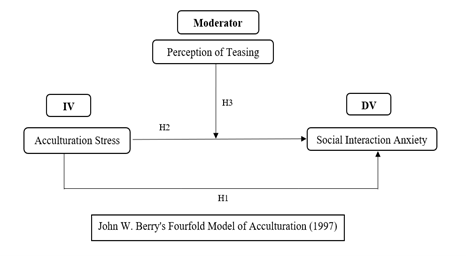
The present study has been carried out using the theoretical framework of Berry's Model of Acculturation developed. This study was planned to explore the effects of acculturative stress on social interaction anxiety as well as the moderating role of perception of teasing among students of other provinces. To carry out this study, a correlational research design was adopted. The data was collected using purposive sampling technique. A sample of 346 university residents from different provinces, aged between 17-27 years (M = 22.31, SD= 1.38) were selected for this study. acculturative stress was measured using acculturative stress scale for international students, social interaction anxiety was measured using social interaction anxiety scale, and perception of teasing was measured using perception of teasing scale. SPSS version 24 and Process by Hayes were used for analysis. The results of correlation analysis show that there is a positive association between acculturative stress and social interaction anxiety. Results of regression analysis reveal that social interaction anxiety significantly predicts acculturative stress among students of other provinces. Results of moderation analysis indicate that perception of teasing acts as moderator between acculturative stress and social interaction anxiety.
Downloads
References
Akram, S., & Farooq, M. (2019). Level of acculturation and accommodation among university students in Punjab, Pakistan. Journal of Organizational Behavior Research, 4(2), 87–97.
Amlashi, R. S., Majzoobi, M., & Forstmeier, S. (2024). The relationship between acculturative stress and psychological outcomes in international students: A systematic review and meta-analysis. Frontiers in Psychology, 15, Article e1403807. https://doi.org/ 10.3389/fpsyg.2024.1403807
Arbona, C., Olvera, N., Rodriguez, N., Hagan, J., Linares, A., & Wiesner, M. (2010). Acculturative stress among documented and undocumented Latino immigrants in the United States. Hispanic Journal of Behavioral Sciences, 32(3), 362–384. https://doi.org/10.1177/0739986310373210
Berry, J. W. (1985). Cultural psychology and ethnic psychology. In I. Reyes-Lagunes & Y. H. Poortinga (Eds.), From a different perspective: Studies of behavior across cultures (pp. 3–15). Swets & Zeitlinger
Berry, J. W. (1997). Immigration, acculturation, and adaptation. Applied Psychology, 46(1), 5–34. https://doi.org/10.1111/j.1464-0597.1997. tb01087.x
Berry, J. W. (2006). Stress perspectives on acculturation. In J. W. Berry, M. H. Segall, & Ç. Kağıtçıbaşı (Eds.), Handbook of cross-cultural psychology: Theory and method (Vol. 1, 2nd ed., pp. 43–56). John Wiley & Sons.
Chen, H. (2025). Acculturative stress and university life adjustment among international students in China: The moderating role of perceived social support. Frontiers in Psychology, 16, Article e1690645. https://doi.org/10.3389/fpsyg.2025.1690645
Church, A. T. (1982). Sojourner adjustment. Psychological Bulletin, 91(3), 540–572. https://doi.org/10.1037/0033-2909.91.3.540
Endo, Y. (2007). Divisions in subjective construction of teasing incidents: Role and social skill level in the teasing function. Japanese Psychological Research, 49(2), 111–120. https://doi.org/10.1111/ j.1468-5884.2007.00338.x
Ersoy, M., & Akçaoğlu, M. Ö. (2025). The interplay between social support, acculturative stress, perceived stress and generalized anxiety among international students. Current Psychology: A Journal for Diverse Perspectives on Diverse Psychological Issues. Advance online publication. https://doi.org/10.1007/s12144-025-07798-9
Fang, L., Sun, R., & Yuen, M. (2014). Acculturation, economic stress, social relationships and school satisfaction among migrant children in urban China. Journal of Happiness Studies, 17(2), 507–531. https://doi.org/10.1007/s10902-014-9604-6
Flórez, K. R., & Gutierrez, E. (2026). What is the role of weight (dis)satisfaction, acculturative stress, and social networks in BMI? An exploration among in Mexican immigrants in New York City. International Journal of Environmental Research and Public Health, 23(1), 52. https://doi.org/10.3390/ijerph23010052
Hayes, S. C., Barnes-Holmes, D., & Roche, B. (Eds.). (2001). Relational Frame Theory: A Post-Skinnerian account of human language and cognition. Plenum Press.
Hayes, A. F. (2022). Introduction to mediation, moderation, and conditional process analysis: A regression-based approach (3rd ed.). The Guilford Press
Hussain, S., Saeed, K., Khan, M. A., & Zaman, N. (2019). Acculturation stress and ethnic identity: A study of Punjabi immigrants in Karachi, Pakistan. Journal of International Migration and Integration, 20(4), 1127–114
Kashdan, T. B. (2002). Social anxiety dimensions, neuroticism, and the contours of positive psychological functioning. Cognitive Therapy and Research, 26(6), 789–810. https://doi.org/10.1023/A:1021293501345
Kowalski, R. M. (2000). “I was only kidding!”: Victims’ and perpetrators’ perceptions of teasing. Personality and Social Psychology Bulletin, 26(2), 231–241. https://doi.org/10.1177/0146167200264009
Lee, A. D. Y., Yang, L., & Vickers, K. (2025). The effects of social anxiety, Taijin Kyofusho, resilience, and social support on acculturative stress in Asian international students. Journal of College Student Mental Health, 40(3), 723–747. https://doi.org/10.1080/28367138.2025.2566916
Leong, F. T., & Kalibatseva, Z. (2011). Cross-cultural barriers to mental health services in the United States. Cerebrum: The Dana Forum on Brain Science. http://dana.org/news/cerebrum/detail.aspx?id=31364
Li, C., & Li, H. (2017). Chinese immigrant parents’ perspectives on psychological well-being, acculturative stress, and support: Implications for multicultural consultation. Journal of Educational and Psychological Consultation, 27(3), 245–270. https://doi.org/10.1080/ 10474412.2016.1275648
Malota, E., & Mucsi, A. (2025). The impact of acculturative stress and sociocultural adaptation on international student satisfaction and loyalty. International Journal of Intercultural Relations, 109, Article e102292. https://doi.org/10.1016/j.ijintrel.2025.102292
Mattick, R. P., & Clarke, J. (1998). Development and validation of measures of social phobia scrutiny fear and social interaction anxiety. Behavior Research and Therapy, 36(4), 455–470. https://doi.org/10. 1016/s0005-7967(97)10031-6
Mazrui, A. A. (1999). Globalization and cross-cultural values: The politics of identity and judgment. Arab Studies Quarterly, 21(3), 97–109.
Murtaza, S. H., & Kiran, N. (2025). Acculturation stress and identity crisis among Afghan refugees in Pakistan. Voices Against Torture. https://www.vastbc.ca/articles/acculturation-stress-and-identity-crisis-among-afghan-refugees-in-pakistan
Ra, Y.-A. (2016). Social support and acculturative stress among Korean international students. Journal of College Student Development, 57(7), 885–891. https://doi.org/10.1353/csd.2016.0085
Riaz, M. A., Rafique, R., & Riaz, M. N. (2025). Mental health model of acculturation among international students in Pakistan. Journal of International Students, 15(8), 185–208. https://doi.org/10. 32674/628f6m83
Rodriguez, M., & Chen, J. (2020). Moderating Effect of Weight-Based Teasing on the Relationship Between Acculturative Stress and Social Interaction Anxiety among Immigrant Adolescents. Journal of Immigrant and Minority Health, 22(4), 863–872.
Rudmin, F. W. (2003). Critical history of the acculturation psychology of assimilation, separation, integration, and marginalization. Review of General Psychology, 7(1), 3–37. https://doi.org/10.1037/1089-2680.7.1.3
Santrock, J.W. (2006). Educational psychology. McGraw Hill.
Sam, D. L., & Berry, J. W. (2010). Acculturation: When individuals and groups of different cultural backgrounds meet. Perspectives on Psychological Science, 5(4), 472–481. https://doi.org/10.1177 /1745691610373075
Sandhu, D. S., & Asrabadi, B. R. (1994). Development of an Acculturative Stress Scale for International Students: Preliminary findings. Psychological Reports, 75, 435–448. https://doi.org/10.2466 /pr0.1994.75.1.435
Schmidt, J., & Martin, A. (2019). Appearance teasing and mental health: Gender differences and mediation effects of appearance-based rejection sensitivity and dysmorphic concerns. Frontiers in Psychology, 10, Article e579. https://doi.org/10.3389/fpsyg.2019.00579
Schweitzer, R. D., Brough, M., Vromans, L., & Asic-Kobe, M. (2011). Mental health of newly arrived Burmese refugees in Australia: Contributions of pre-migration and post-migration experience. Australian and New Zealand Journal of Psychiatry, 45(4), 299–307. https://doi.org/10.3109/00048674.2010.543412
Shepherd, R.-M., & Edelman, R. J. (2009). The interrelationship of social anxiety with anxiety, depression, locus of control, ways of coping, and ego strength amongst university students. College Quarterly, 12(2), 1–13
Smith, R. A., & Khawaja, N. G. (2011). A review of the acculturation experiences of international students. International Journal of Intercultural Relations, 35(6), 699–713. https://doi.org/10.1016 /j.ijintrel.2011.08.004
Thompson, J. K., Cattarin, J., Fowler, B., & Fisher, E. (1995). The Perception of Teasing Scale (POTS): A revision and extension of the Physical Appearance Related Teasing Scale (PARTS). Journal of Personality Assessment, 65(1), 146–157. https://doi.org/10.1207/ s15327752jpa6501_11
Torres, L., Driscoll, M. W., & Voell, M. (2012). Discrimination, acculturation, acculturative stress, and Latino psychological distress: A moderated mediational model. Cultural Diversity & Ethnic Minority Psychology, 18(1), 17–25. https://doi.org/10.1037/a0026710
Tummala-Narra, P., & Claudius, M. (2013). Perceived discrimination and depressive symptoms among immigrant-origin adolescents. Cultural Diversity & Ethnic Minority Psychology, 19(3), 257–269. https://doi.org/10.1037/a0032960
Varela, V., Gavrielidou, K., Savidou, D., Simou, M., & Simos, G. (2025). Childhood teasing experiences and adult emotional distress: The mediating role of social anxiety and self-esteem. Psychiatry International, 6(2), Article e42. https://doi.org/10.3390/ psychiatryint6020042
Voss, L. S. (1997). Teasing, disputing, and playing: Cross-gender interactions and space utilization amount first and third graders. Gender and Society, 11(2), 238–256. https://doi.org/10.1177/ 089124397011002006
Warm, T. R. (1997). The role of teasing in development and vice versa. Developmental and Behavioral Pediatrics, 18(2), 97–101. https://doi.org/10.1097/00004703-199704000-00004
Yeh, C. & Inman, A. (2007). Qualitative data analysis and interpretation in counseling psychology: Strategies for best practices. The Counseling Psychologist, 35(3), 369–403. https://doi.org/10.1177/ 0011000006292596
Yıldız, B., & Karakaya, I. (2025). An examination of bullying experiences in peer relationships of Syrian adolescents in the context of acculturation: Bullying experiences in peer relationships of Syrian adolescents. Turkish Journal of Traumatic Stress, 1(2), 81–88. https://doi.org/10.63175/tjts.18
Yun, S. J., Weaver, S. R., & Chung, Y. B. (2020). Acculturation stress and social anxiety among Korean immigrants: Moderating effects of social support. Journal of Immigrant and Minority Health, 22(4), 673–678.
Zhang, H., & Wang, Y. (2026). Acculturative stress of Chinese students in the multicultural classroom: A qualitative study. Research Square. https://doi.org/10.21203/rs.3.rs-10400671/v1
Downloads
Published
How to Cite
Issue
Section
License
Copyright (c) 2026 Aqsa Abdul Ghaffar, Shamshad Bashir, Najma Iqbal Malik, Syed Mesum Ali

This work is licensed under a Creative Commons Attribution 4.0 International License.