Reusable Cotton Face Mask Treated with Botanical Extracts: A Sustainable Textile Design Approach
DOI:
https://doi.org/10.32350/jdt.42.05Keywords:
Cloth mask, Airborne diseases, Antimicrobial finish, CottonAbstract
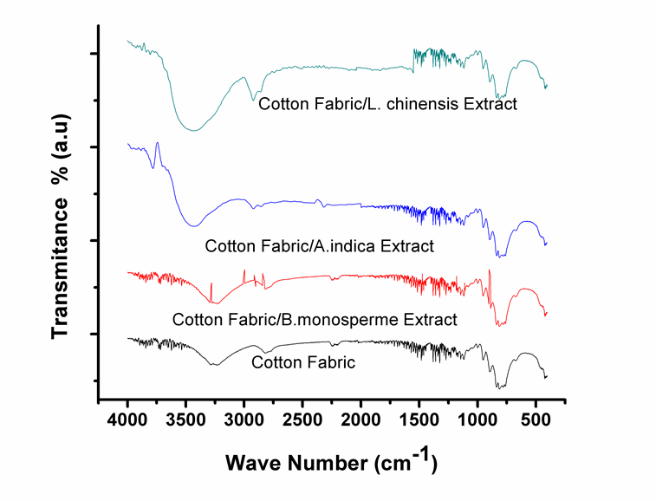
Bacteria that cause airborne infections are most frequently spread by tiny respiratory droplets. When a person with the airborne illness sneezes, coughs, laughs, or exhales in any other way, these droplets are released. Keeping this need in mind, durable and re-washable antimicrobial cotton fabric was prepared for making a cloth mask by using Azadirachata indica, Butea monosperma and Litchi chinensis tree leaves. The cotton is the most suitable and comfortable fabric for making a cloth mask, and secondly, this cloth mask is washable up to 25 times in the home laundry. The antimicrobial finish was fixed on cotton fabric by use of poly urethane binder and the treatment was applied by use of pad dry cure machine. The antimicrobial activity of treated and untreated cotton fabric and durability to successive washes was assessed by using of ASTEM E2149 shake flask method. FTIR and SEM test was used to observe the presence of antimicrobial finish on fabric. The fabric treated with A.indica showed 80%, B.monosperma showed 100% and L. chinensis showed 100% reduction against microorganisms when washed up to 25 times in the home laundry. These findings indicate that this fabric can be used in making reusable cloth face masks which can serve against the airborne diseases as well be used in protective clothing for health care workers.
Downloads
References
Abou Elmaaty, T., Elshafie, A., Mounir, H., & El-Sherif, H. (2024). Bioactive and biodegradable cotton fabrics produced via synergic composite coatings with plant extracts and essential oils. Scientific Reports, 14(1), 5710. https://doi.org/10.1038/s41598-024-59105-4
Ahmed, S., et al. (2023). Wash fastness of natural antimicrobial treatments. Journal of Textile Science.
Ali, A., Ahmad, S., & Farooq, U. (2021). Eco-friendly textile finishes derived from natural resources. Environmental Science & Pollution Research, 28(36), 49633–49647.
Ali, B., & Nazir, S. (2024). Green finishing of cotton textiles with plant extract composites. Sustainable Textiles & Innovation.
Edgar, K. J., & Zhang, H. (2020). Antibacterial modification of lyocell fiber: A review. Carbohydrate Polymers, 250, 116932.
Gadekar, G. P., Ghaoshal, K. P., & Ghatole, A. M. (2021). Silver nanoparticle synthesis using Butea monosperma bark extract. Journal of Applied Biological Sciences, 15(1), 64–74.
Gonzalez, L. (2022). Antimicrobial textiles: Emerging methods and standards. Functional Textiles Review.
Iqbal, M., Khan, M. A., Raza, Z. A., & Rehman, I. (2020). Antibacterial finishing of cotton fabric using herbal extracts. Journal of Natural Fibers, 17(6), 843–855.
Jadoun, S., Verma, A., & Arif, R. (2021). Green synthesis of nanomaterials for textile applications. In Green Chemistry for Sustainable Textiles (pp. 315–324). Woodhead Publishing.
Khan, M. A., et al. (2023). Textile durability of herbal finishes under environmental stress. Textile and Clothing Sustainability Journal.
Khan, R., et al. (2024). Sustainable antimicrobial finishing of blended textiles. Journal of Cleaner Production.
Khan, Z. (2022). Comparative effects of herbal vs. synthetic antimicrobial agents on fabrics. Journal of Fashion and Textiles, 9(3).
Klemeš, J. J., Fan, Y. V., & Jiang, P. (2020). Environmental footprints of disposable and reusable personal protective equipment: A product life cycle approach. Environmental Science & Technology, 54(7), 3763–3775. https://doi.org/10.1021/acs.est.0c03022
Kumar, A., & Vignesh, R. (2023). Characterization of plant-based antimicrobial textiles using FTIR and SEM. Journal of Applied Polymer Science, 140(12), e53619.
Lee, M., & Kim, H. (2022). COVID-19 Pandemic and Microplastic Pollution. Nanomaterials, 12(5), 851. https://doi.org/10.3390/nano12050851.
Lee, S. H., & Kim, D. H. (2021). A review of antimicrobial textiles in response to COVID-19. Journal of Industrial Textiles, 51(1), 3–23.
Liao, M., Liu, H., Wang, X., & Chen, H. (2023). Understanding the environmental impacts of facemasks: A review on microfiber pollution effect of personal protective equipment and disposable face masks. Sustainable Environment Research, 33(1), 12. https://doi.org/10.1186/s42834-023-00182-x
Mehmood, T., Saleem, H., & Javed, R. (2024). Wash durability and biofunctionality of herbal treated textiles. Journal of Cleaner Production, 421, 139883.
Moustafa, M. A., El-Hady, M. A., & Soliman, A. M. (2024). Synthetic versus natural antimicrobial agents for safer textiles. RSC Advances, 14(45), 27614–27630. https://doi.org/10.1039/D4RA04519J
Nasir, F., & Malik, A. (2021). Phytochemical profiling and antibacterial assessment of Butea monosperma. Journal of Ethnopharmacology.
Nasreen, S., Bukhari, S., & Imran, M. (2023). Environmental impact of disposable face masks and textile-based alternatives. Environmental Challenges, 12, 100768.
Raza, Z. A., Anwar, F., & Ashraf, M. (2022). From disposable masks to reusable textile solutions. Sustainable Materials & Technologies, 31, e00388.
Sadaf, S., et al. (2022). Antimicrobial finish effects on 100% polyester. LGU Journal of Life Sciences, 6(4), 89% reduction up to 25 washes.
Sadaf, S., Saeed, A., Hassan, K., & Ahmad, Z. (2023). Antibacterial finish on cotton/polyester with neem, palash, lychee extracts. Plantarum, 5(1).
Shah, A., & Mehmood, S. (2021). Green synthesis of antimicrobial finishes for cotton. Textile Research Journal, 91(5), 564–579.
Sharif, R., Qutab, H. G., Mahmood, K., Gul, S., Ramzan, N., Mohsin, M., Wahlah, A., Nasir, R., Fazal, P., & Ali, B. (2024). One pot application of a green chemistry‑based finish for cotton fabric, providing hydrophobic, flame retardant, and antimicrobial properties. RSC Advances, 14, 6146–6155. https://doi.org/10.1039/D3RA07931G
Sharma, B., & Thakur, V. (2021). Multifunctional finishes from plant derivatives. Fibers and Polymers.
Tegegne, W., Fikadu, F., Mesfin, R., & Godana, C. (2025). Sustainable antibacterial finishing of cotton fabrics using leaves extract from Rumex steudelii Hochst. Discover Materials, 5(77), 1–12. https://doi.org/10.1007/s43939-025-00257-z
Thakur, S., Sharma, B., & Thakur, V. K. (2022). Bioactive agents from plant sources for antimicrobial textiles. International Journal of Biological Macromolecules, 195, 102–115.
Ustaoglu Iyigundogdu, Z., et al. (2021). Development of antiviral cotton (CVC) fabric. Polymers.
Xu, Y., et al. (2020). Silver nanoparticle functionalization for durable antimicrobial cotton. Polymers, 14(20), 4273.
Zhang, Z., Wang, Y., & Chen, S. (2020). Biocompatible antiviral textile coatings: Chitosan and citric acid. Journal of Inorganic & Organometallic Polymers & Materials.
Published
How to Cite
Issue
Section
License

This work is licensed under a Creative Commons Attribution 4.0 International License. Authors retain copyright and grant the journal right of first publication with the work simultaneously licensed under a Creative Commons Attribution (CC-BY) 4.0 License that allows others to share the work with an acknowledgement of the work’s authorship and initial publication in this journal.