
Police Officers’ Trauma: A Psychosocial Process and a Call for Support
DOI:
https://doi.org/10.32350/ccpr.81.04Keywords:
Occupational Stressors, Posttraumatic Growth, TraumaAbstract
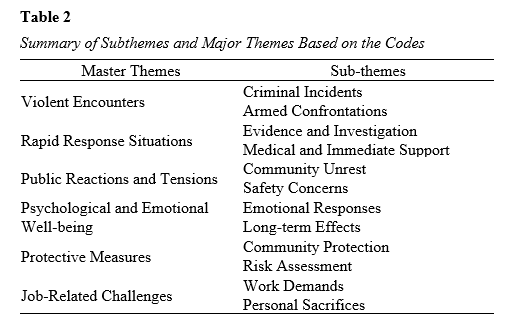
The current study aimed to explore the traumatic experiences following life-threatening events among police officers. Participants’ lived experiences were gathered in detail. The study was designed to explore the research questions, and responses were analyzed using a qualitative approach based on interpretative phenomenological analysis (IPA). Six police officers were interviewed as a sample who had traumatic experiences, each with a minimum of three years of service. After a demographic form, an in-depth semi-structured interview protocol was used to obtain rich data. The six major themes were finalized in light of the sub-themes as follows: violent experiences, rapid response situations, public reactions and tensions, psychological and emotional well-being, as well as protective measures and job-related challenges. While, the sub-themes were produced based on codes. The results indicated that training and education for rehabilitation and mental well-being must be given as training courses to teach cops as to how to spot symptoms of trauma in both them and their peers. Future studies must focus on the interventions for trauma-informed care practices.
Downloads
References
Civilotti, C., Di Fini, G., & Maran, D. A. (2021). Trauma and coping strategies in police officers: A quantitative-qualitative pilot study. International Journal of Environmental Research and Public Health, 18(3), 982. https://doi.org/10.3390/ijerph18030982
Clarke, V., & Braun, V. (2016). Thematic analysis. The Journal of Positive Psychology, 12(3), 297–298. https://doi.org/10.1080/17439760.2016.1262613
Godakanda, V. (2025). A grief counseling intervention after the mass trauma: Lessons learned from the victims of the Easter Sunday attack in Sri Lanka. Kashf Journal of Multidisciplinary Research, 2(1), 13–32. https://doi.org/10.71146/kjmr216
Goldberg, X., & Gray, Y. S. (2025). A lived experience perspective on responses to trauma. Nature Reviews Psychology, 4(3), 168–169. https://doi.org/10.1038/s44159-025-00426-0
Göylüsün, H. K., Keskin, G., Bağiş, K. O., & Çakaloğlu, T. (2026). Evaluation of the psychosocial impact on law enforcement personnel involved in mass incident interventions. Current Psychology, 45(6), Article e585. https://doi.org/10.1007/s12144-025-08746-3
Hashemi, M., & Mahmoudzadeh, M. (2025). The lived experiences of childhood trauma in war: Has post-traumatic growth occurred? European Journal of Psychotraumatology, 16(1), Article e2468605. https://doi.org/10.1080/20008066.2025.2468605
Ishtiaq, H., Batool, T. E., Mamoon, B., Majeed, A. I., Atta, M., Atta, A., & Masood, S. (2025). Mental health problems in Pakistani society as a consequence of violence and trauma: A case for better integration of care. Cureus, 17(5), Article e83486. https://doi.org/10.7759/cureus.83486
Ismail, M., Noor, K., & Sabir, A. (2025). Post-traumatic growth and meaning-making among flood survivors in Pakistan. Policy Journal of Social Science Review, 3(11), 300–307.
Lu, Y., Jian, Y., & Yang, C. (2023). Cumulative exposure to citizens’ trauma and secondary traumatic stress among police officers: The role of specialisation in domestic violence prevention. Police Practice and Research, 25(2), 113–132. https://doi.org/10.1080/15614263.2023.2189593
Memon, M. S., Ismail, H., Baqi, S., Mannan, A., Murtaza, G., Rahujo, N., Zeeshan, S., Ahmed, T., & Bhatti, N. (2023). Establishment and evaluation of Pakistan’s trauma registry. International Journal of Health Sciences, 7(S1), 870–888. https://doi.org/10.53730/ijhs.v7ns1.14288
Mohammed, I., Ahmed, H., Hasin, B., Kizilhan, J., Nariman, H., Ahmed, S., Qader, A., Papiol, S., Rubekeil, M., Schulze, T., Heilbronner, U., & Hautzinger, M. (2026). A study on long-term trauma-related mental health outcomes among Kurdish survivors of chemical attacks. Frontiers in Psychiatry, 16, Article e1693072. https://doi.org/10.3389/fpsyt.2025.1693072
Neubert, A., Hempe, S., Jaekel, C., Gaeth, C., Spering, C., Fetz, K., Windolf, J., Kollig, E., Bieler, D., & LeAf-Trauma-Group (2025). Lived experiences of working-age polytrauma patients in Germany - A qualitative Analysis. Injury, 56(1), Article e111938. https://doi.org/10.1016/j.injury.2024.111938
Paoline, E. A., Wiercioch, A. G., & Gau, J. M. (2025). Police officer mental health: Predictors of and barriers to seeking help. Police Quarterly. https://doi.org/10.1177/10986111251407953
Santre, S. (2024). Mental disorders and mental health promotion in police officers. Health Psychology Research, 12, Article e93904. https://doi.org/10.52965/001c.93904
Shamim, L. (2025). Understanding the impact of childhood trauma on adult relationship satisfaction in Pakistan. Pakistan Journal of Public Health, 15(2), 33. https://doi.org/10.32413/pjph.v15i2.1732
Sheridan, G., & Carr, A. (2020). Survivors' lived experiences of posttraumatic growth after institutional childhood abuse: An interpretative phenomenological analysis. Child Abuse & Neglect, 103, Article e104430. https://doi.org/10.1016/j.chiabu.2020.104430
Tizaa, H. L., Aboagye, L. a. F., Drah, E. A., Ofosuware, J. S., Faustina, E., Nurmalasari, D. E., Marlina, I., Budiyanto, S. K., Sugianto, A., Kpobi, L., Osei-Tutu, A., Setiyawati, D., Jatmika, W. N., Colucci, E., & Read, U. M. (2025). Lived experience in mental health research in Ghana and Indonesia: What have we learned? PLOS Mental Health., 2(6), Article e0000344. https://doi.org/10.1371/journal.pmen.0000344
Vector Solutions. (2025, March 6). The importance of mental health in law enforcement. https://www.vectorsolutions.com/resources/blogs/importance-of-mental-health-in-law-enforcement/
Zevallos-Morales, A., Ramos-Bonilla, G., Rey, L., Carrión, I., Otero-Oyague, D., Siddharthan, T., Hurst, J. R., Parodi, J. F., Gallo, J. J., Pollard, S. L., & Flores-Flores, O. (2025). "How I would like to forget": Lived experiences of traumatic and stressful life events among older adults in Peru. Cambridge Prisms Global Mental Health, 12, Article e108. https://doi.org/10.1017/gmh.2025.10060
Downloads
Published
How to Cite
Issue
Section