
Sibling Estrangement among Unmarried Working Sisters after their Brothers’ Marriages: A Qualitative Study
DOI:
https://doi.org/10.32350/apr.51.04Keywords:
Estrangement, Family Dynamics, Gender Roles, Marriage Transition, Siblings, Thematic AnalysisAbstract
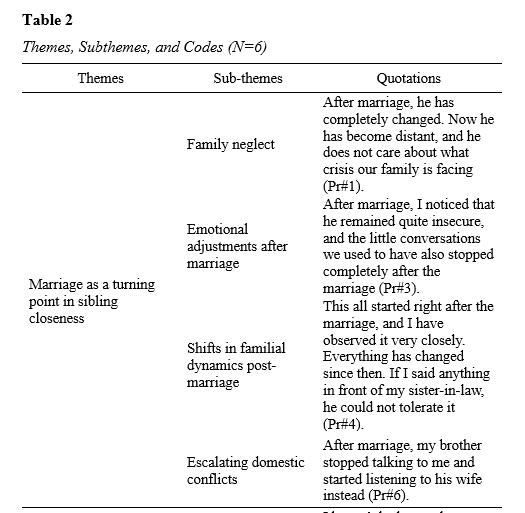
Sibling estrangement is a vital issue in families of collectivist cultures after their respective marriages. As an emerging matrimonial relationship, it sometimes intensifies the existing inequalities and emotional distance. The current study aimed to investigate the single sisters’ estrangement towards their brothers’ marriages, their familial, gender-based psychological and emotional struggles as well as coping strategies. A qualitative research design was implemented by using semi-structured interviews for data collection and reflexive thematic analysis. A sample of six females aged between 30-40 years was recruited through purposive and snow ball sampling techniques from different cities of Pakistan. The sample size was considered appropriate as thematic analysis focuses more on the conceptual depth of data, and thematic saturation was also achieved within the dataset. The participants were expected to have at least one married brother with two years of estrangement. The major themes that emerged included impact of marriage as a turning point in sibling closeness, sibling conflict and comparison, disagreement over personal and financial matters, psychological aspects, emotional unrest, and emotional distancing as coping. The findings indicated that brothers’ marriages function as vital restructuring events that exacerbate pre-existing inequalities and reshape sibling hierarchies. Therefore, awareness sessions, counselling, and developing culturally-sensitive family interventions would be imperative in improving the family ties among family members in collectivist cultures.
Downloads
References
Agllias, K. (2013). The gendered experience of family estrangement. Affilia: Journal of Women & Social Work, 28(3), 309–321. https://doi.org/10.1177/0886109913495727
Bandura, A. (1997). Self-efficacy: The exercise of control. W H Freeman/Times Books/ Henry Holt & Co.
Blake, L., Bland, B., & Rouncefield‐Swales, A. (2023). Estrangement between siblings in adulthood: A qualitative exploration. Journal of Family Issues, 44(7), 1859–1879. https://doi.org/10.1177/0192513X211064876
Braun, V., & Clarke, V. (2019). Reflecting on reflexive thematic analysis. Qualitative Research in Sport Exercise and Health, 11(4), 589–597. https://doi.org/10.1080/2159676x.2019.1628806
Brody, E. M., Litvin, S. J., Hoffman, C., & Kleban, M. H. (1992). Differential effects of daughters’ marital status on their parent care experiences. The Gerontologist, 32(1), 58–67. https://doi.org/10.1093/geront/32.1.58
Buchanan, A., & Rotkirch, A. (Eds.). (2021). Brothers and sisters: Sibling relationships across the life course. Palgrave Macmillan / Springer Nature.
Buyukkececi, Z., & Leopold, T. (2021). Sibling influence on family formation: A study of social interaction effects on fertility, marriage, and divorce. Advances in Life Course Research, 47, Article e100359. https://doi.org/10.1016/j.alcr.2020.100359
Connidis, I. A. (2001). Family ties & aging. Sage Publications.
Cox, M. J., & Paley, B. (1997). Families as systems. Annual Review of Psychology, 48(1), 243–267. https://doi.org/10.1146/annurev.psych.48.1.243
Cicirelli, V. G. (1995). Sibling relationships across the life span. Springer Publishing Company.
Cropanzano, R., & Mitchell, M. S. (2005). Social exchange theory: An interdisciplinary review. Journal of Management, 31(6), 874–900. https://doi.org/10.1177/0149206305279602
Feinberg, M., & Hetherington, E. M. (2001). Differential parenting as a within-family variable. Journal of Family Psychology, 15(1), 22–37. https://doi.org/10.1037/0893-3200.15.1.22
Folkman, S., & Lazarus, R. S. (1988). Coping as a mediator of emotion. Journal of Personality and Social Psychology, 54(3), 466–475. https://doi.org/10.1037/0022-3514.54.3.466
Grover, S. (2017). Marriage, love, caste and kinship support: Lived experiences of the urban poor in India (1st ed.). Routledge. https://doi.org/10.4324/9780203732823
Hank, K., & Steinbach, A. (2022). Sibling estrangement in adulthood. Journal of Social and Personal Relationships, 40(4), 1277–1287. https://doi.org/10.1177/02654075221127863
Kalmijn, M. (2007). Gender differences in the effects of divorce, widowhood and remarriage on intergenerational support: Does marriage protect fathers? Social Forces, 85(3), 1079-1104. https://doi.org/10.1353/sof.2007.0043
Kelly, S.E. (2010) Qualitative Interviewing Techniques and Styles. In I. Bourgeault, R. Dingwall, & R. de Vries (Eds.), The SAGE handbook of qualitative methods in health research, (pp. 307-326). Sage Publications. https://doi.org/10.4135/9781446268247.n17
Martins, N., Brandão, D., Guimarães, L., Penedos-Santiago, E., & Brandão, E. (2023). An importância do design de comunicação no processo de disseminação de práticas comunitárias em bairros sociais: O balteiro [The importance of communication design in the dissemination of community practices in social housing neighborhoods: The Balteiro]. Comunicação E Sociedade [Communication and Society], 43, Article e023010. https://doi.org/10.17231/comsoc.43(2023).4455
Masarik, A. S., & Conger, R. D. (2024). Stress and child development: A review of family stress models. Current Opinion in Psychology, 13, 85–90. https://doi.org/10.1016/j.copsyc.2016.05.008
McHale, J. P. (1995). Coparenting and triadic interactions during infancy: The roles of marital distress and child gender. Developmental Psychology, 31(6), 985–996. https://doi.org/10.1037/0012-1649.31.6.985
Milardo, R. M., & Helms-Erikson, H. (2000). Network overlap and third-party influence in close relationships. In C. Hendrick & S. S. Hendrick (Eds.), Close relationships: A sourcebook (pp. 33–45). Sage Publications. https://doi.org/10.4135/9781452220437.n3
Milevsky, A. (2011). Sibling relationships in childhood and adolescence: Predictors and outcomes. Columbia University Press.
Palys, T. S., & Atchison, C. (2014). Research decisions: Quantitative, qualitative, and mixed method approaches (5th ed.). Nelson Education.
Richmond, M. K., Stocker, C. M., & Rienks, S. L. (2005). Longitudinal associations between sibling relationship quality, parental differential treatment, and children’s adjustment. Journal of Family Psychology, 19(4), 550–559. https://doi.org/10.1037/0893-3200.19.4.550
Scharp, K. M., & Hall, E. D. (2017). Family marginalization, alienation, and estrangement: questioning the nonvoluntary status of family relationships. Annals of the International Communication Association, 41(1), 28–45. https://doi.org/10.1080/23808985.2017.1285680
Scharp, K. M. (2023). Estrangement and impact on family communication. Oxford research encyclopedia of communication. Oxford University Press.https://doi.org/10.1093/acrefore/9780190228613.013.1454
Shortt, J. W., & Gottman, J. M. (1997). Closeness in young adult sibling relationships: Affective and physiological processes. Social Development, 6(2), 142–164. https://doi.org/10.1111/j.1467-9507.1997.tb00099.x
Suitor, J. J., Gilligan, M., Peng, S., Jung, J. H., & Pillemer, K. (2017). Role of perceived maternal favoritism and disfavoritism in adult children's psychological well-being. The Journals of Gerontology. Series B, Psychological sciences and social sciences, 72(6), 1054–1066. https://doi.org/10.1093/geronb/gbv089
Walster, E., Walster, G. W., & Traupmann, J. (1978). Equity and premarital sex. Journal of Personality and Social Psychology, 36(1), 82–92. https://psycnet.apa.org/doi/10.1037/0022-3514.36.1.82
White, L. (2001). Sibling relationships over the life course: A panel analysis. Journal of Marriage and Family, 63(2), 555–568. https://psycnet.apa.org/doi/10.1111/j.1741-3737.2001.00555.x
Downloads
Published
How to Cite
Issue
Section
License
Copyright (c) 2026 Bisma Azeem, Arooj Nazir, Zainab Sohail , Laiba Shaukat

This work is licensed under a Creative Commons Attribution 4.0 International License.