
Cyber Loafing, Self-control, and Academic Burnout in GEN Z University Students
DOI:
https://doi.org/10.32350/apr.51.03Keywords:
Academic Burnout, Cyber Loafing, Gen Z, Psychological Detachment, Self-Control, University StudentsAbstract
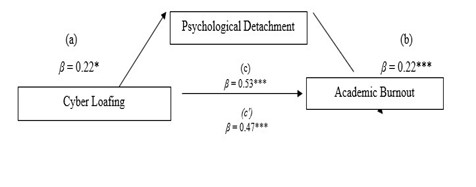
The present study examined the correlation between cyber loafing, self-control, psychological detachment and academic burnout in Gen Z university students. Particularly, the study examined the mediating role of psychological detachment in the relationship between cyber loafing and academic burnout. The research was rooted in CHAT (cultural historical activity theory, Engeström, 2001) to investigate how students’ interaction with digital technology determined by broader social, cultural, and educational context. A cross-sectional correlational design was used, with 252 Gen Z university students, consisting of 120 men and 132 women participants. Non-probability purposive sampling was employed and in person data collection was conducted, using Cyber Loafing Scale, Brief Self-Control Scale, Recovery Experience Questionnaire and Academic Burnout Scale. Results revealed that cyber loafing, psychological detachment and academic burnout are positively correlated whereas, self-control and academic burnout showed negative relationship in Gen Z university students. Furthermore, in Gen Z university students, academic burnout was positively predicted by cyber loafing and psychological detachment, while, negatively predicted by self-control. Lastly, the relationship between cyber loafing and academic burnout was significantly mediated by psychological detachment. The results will help researchers understand how digital distractions affect academic well-being, and provide recommendations on how to enhance self-control and psychological detachment to mitigate the detrimental consequences of cyber loafing.
Downloads
References
Akbulut, Y., Dönmez, O., & Dursun, Ö. Ö. (2017). Cyberloafing and social desirability bias among students and employees. Computers in Human Behavior, 72, 87–95. https://doi.org/10.1016/j.chb.2017.02.043 DOI: https://doi.org/10.1016/j.chb.2017.02.043
Akbulut, Y., Dursun, Ö. Ö., Dönmez, O., & Şahin, Y. L. (2016). In search of a measure to investigate cyberloafing in educational settings. Computers in Human Behavior, 55, 616–625. https://doi.org/10.1016/j.chb.2015.11.002 DOI: https://doi.org/10.1016/j.chb.2015.11.002
Al-Khresheh, M. H., & Alkursheh, T. O. (2024). An integrated model exploring the relationship between self-efficacy, technology integration via Blackboard, English proficiency, and Saudi EFL students’ academic achievement. Humanities and Social Sciences Communications, 11, Article 287. https://doi.org/10.1057/s41599-024-02783-2 DOI: https://doi.org/10.1057/s41599-024-02783-2
Al-Qadri, A. H., Mouas, S., Saraa, N., & Boudouaia, A. (2024). Measuring academic self-efficacy and learning outcomes: The mediating role of university English students’ academic commitment. Asian-Pacific Journal of Second and Foreign Language Education, 9, Article 35. https://doi.org/10.1186/s40862-024-00253-5 DOI: https://doi.org/10.1186/s40862-024-00253-5
Andreassen, C. S., Torsheim, T., Brunborg, G. S., & Pallesen, S. (2012). Development of a Facebook addiction scale. Psychological Reports, 110(2), 501–517. https://doi.org/10.2466/02.09.18.PR0.110.2.501-517 DOI: https://doi.org/10.2466/02.09.18.PR0.110.2.501-517
Bakker, A. B., & Demerouti, E. (2007). The job demands-resources model: State of the art. Journal of Managerial Psychology, 22(3), 309–328. https://doi.org/10.1108/02683940710733115 DOI: https://doi.org/10.1108/02683940710733115
Bresó, E., Salanova, M., & Schaufeli, W. B. (2007). In search of the third dimension of burnout: Efficacy or inefficacy? Applied Psychology, 56(3), 460–478. https://doi.org/10.1111/j.1464-0597.2007.00290.x DOI: https://doi.org/10.1111/j.1464-0597.2007.00290.x
Chen, Z. (2022). The mediating and buffering effect of self-control on the relationship between peer support and academic burnout. European Journal of Humanities and Social Sciences, 6, 71–80. https://doi.org/10.29013/EJHSS-22-6-71-80 DOI: https://doi.org/10.29013/EJHSS-22-6-71-80
Deci, E. L., & Ryan, R. M. (1985). Intrinsic motivation and self-determination in human behavior. Plenum Press. https://doi.org/10.1007/978-1-4899-2271-7 DOI: https://doi.org/10.1007/978-1-4899-2271-7
Doğru, M. C., & Kabasakal, Z. (2023). Investigating cyberloafing and academic burnout in university students during the COVID-19 pandemic. South Asian Journal of Social Studies and Economics, 17(3), 1–11. https://doi.org/10.9734/sajsse/2023/v17i3636 DOI: https://doi.org/10.9734/sajsse/2023/v17i3636
Engeström, Y. (2001). Expansive learning at work: Toward an activity theoretical reconceptualization. Journal of Education and Work, 14(1), 133–156. https://doi.org/10.1080/13639080020028747 DOI: https://doi.org/10.1080/13639080020028747
Everton, W. J., Mastrangelo, P. M., & Jolton, J. A. (2005). Personality correlates of employees’ personal use of work computers. CyberPsychology & Behavior, 8(2), 143–153. https://doi.org/10.1089/cpb.2005.8.143 DOI: https://doi.org/10.1089/cpb.2005.8.143
Gillet, N., Morin, A. J. S., & Reeve, J. (2017). Stability, change, and implications of students’ motivation profiles: A latent transition analysis. Contemporary Educational Psychology, 51, 222–239. https://doi.org/10.1016/j.cedpsych.2017.08.006 DOI: https://doi.org/10.1016/j.cedpsych.2017.08.006
Granberg, E., & Witte, J. (2005). Teaching with laptops for the first time: Lessons from a social science classroom. New Directions for Teaching and Learning, 2005(101), 51–59. https://doi.org/10.1002/tl.20056 DOI: https://doi.org/10.1002/tl.186
Green, S. B. (1991). How many subjects does it take to do a regression analysis? Multivariate Behavioral Research, 26(3), 499–510. https://doi.org/10.1207/s15327906mbr2603_7 DOI: https://doi.org/10.1207/s15327906mbr2603_7
Hanif, M. S., Abdul Hamid, A. B., Khurshid, A., & Butt, M. F. T. (2022). What leads to cyberslacking intentions among students in Pakistan: An enhanced theory of planned behavior perspective. The Electronic Journal of Information Systems in Developing Countries, 88(6), Article e12224. https://doi.org/10.1002/isd2.12224 DOI: https://doi.org/10.1002/isd2.12224
Hobfoll, S. E. (1989). Conservation of resources: A new attempt at conceptualizing stress. American Psychologist, 44(3), 513–524. https://doi.org/10.1037/0003-066X.44.3.513 DOI: https://doi.org/10.1037/0003-066X.44.3.513
Kalaycı, E. (2010). The investigation of relationship between cyberloafing and self-regulated learning strategies among undergraduate students [Unpublished master’s thesis]. Hacettepe University.
Law, D. W. (2007). Exhaustion in university students and the effect of coursework involvement. Journal of American College Health, 55(4), 239–245. https://doi.org/10.3200/JACH.55.4.239-245 DOI: https://doi.org/10.3200/JACH.55.4.239-245
Leont’ev, A. N. (1978). Activity, consciousness, and personality (M. J. Hall, Trans.). Prentice-Hall.
Lim, V. K. G. (2002). The IT way of loafing on the job: Cyberloafing, neutralizing and organizational justice. Journal of Organizational Behavior, 23(5), 675–694. https://doi.org/10.1002/job.161 DOI: https://doi.org/10.1002/job.161
Liu, S., Wang, M., Liao, H., & Shi, J. (2014). Self-regulation during job search: The opposing effects of employment self-efficacy and job search behavior self-efficacy. Journal of Applied Psychology, 99(6), 1159–1172. https://doi.org/10.1037/a0036692 DOI: https://doi.org/10.1037/a0036692
Luria, A. R. (1976). Cognitive development: Its cultural and social foundations (M. Cole, Ed.; M. Lopez-Morillas & L. Solotaroff, Trans.). Harvard University Press.
Luta, D., Pogrebtsova, E., & Provencher, Y. (2021). The wellbeing implications of thinking about schoolwork during leisure time: A qualitative analysis of Canadian university students’ psychological detachment experiences. Journal of Further and Higher Education, 45(6), 771–787. https://doi.org/10.1080/0309877X.2020.1814060
Margaretha, M., Monalisa, Y., Mariana, A., Junita, I., & Iskandar, D. (2021). Cyberslacking behavior and its relationship with academic performance: A study of students in Indonesia. European Journal of Educational Research, 10(4), 1881–1892. https://doi.org/10.12973/eu-jer.10.4.1881 DOI: https://doi.org/10.12973/eu-jer.10.4.1881
Margaretha, M., Saragih, S., Mariana, A., & Simatupang, K. M. (2022). Academic procrastination and cyberloafing behavior: A case study of students in Indonesia. Cypriot Journal of Educational Sciences, 17(3), 752–764. https://doi.org/10.18844/cjes.v17i3.6904 DOI: https://doi.org/10.18844/cjes.v17i3.6904
Maslach, C. (2003). Job burnout: New directions in research and intervention. Current Directions in Psychological Science, 12(5), 189–192. https://doi.org/10.1111/1467-8721.01258 DOI: https://doi.org/10.1111/1467-8721.01258
Meier, S. T., & Schmeck, R. R. (1985). The burned-out college student: A descriptive profile. Journal of College Student Personnel, 26(1), 63–69. https://eric.ed.gov/?id=EJ316471
Meng, Q., & Zhang, Q. (2023). The influence of academic self-efficacy on university students’ academic performance: The mediating effect of academic engagement. Sustainability, 15(7), Article e5767. https://doi.org/10.3390/su15075767 DOI: https://doi.org/10.3390/su15075767
Mercado, B. K., Giordano, C., & Dilchert, S. (2017). A meta-analytic investigation of cyberloafing. Career Development International, 22(5), 546–564. https://doi.org/10.1108/CDI-08-2017-0142 DOI: https://doi.org/10.1108/CDI-08-2017-0142
Merino-Tejedor, E., Hontangas, P. M., & Boada-Grau, J. (2017). The assessment of detachment among university students: Validation of the Recovery Experience Questionnaire in educational contexts. Anales de Psicología/Annals of Psychology, 33(2), 342–350. https://doi.org/10.6018/analesps.33.2.249811 DOI: https://doi.org/10.6018/analesps.33.2.249811
Mihelič, K. K., Lim, V. K. G., & Culiberg, B. (2023). Cyberloafing among Gen Z students: The role of norms, moral disengagement, multitasking self-efficacy, and psychological outcomes. European Journal of Psychology of Education, 38(2), 567–585. https://doi.org/10.1007/s10212-022-00577-0 DOI: https://doi.org/10.1007/s10212-022-00617-w
Nussbaumer, D. (2012). An overview of cultural historical activity theory (CHAT) use in classroom research 2000 to 2009. Educational Review, 64(1), 37–55. https://doi.org/10.1080/00131911.2011.602003 DOI: https://doi.org/10.1080/00131911.2011.553947
Nweke, G. E., Jarrar, Y., & Horoub, I. (2024). Academic stress and cyberloafing among university students: The mediating role of fatigue and self-control. Humanities and Social Sciences Communications, 11, Article e419. https://doi.org/10.1057/s41599-024-02930-9 DOI: https://doi.org/10.1057/s41599-024-02930-9
Peng, J. H. (2022). The impact of college students’ academic self-efficacy on cyberloafing: The role of moral disengagement and individual self-control. Open Access Library Journal, 9, Article e8788. https://doi.org/10.4236/oalib.1108788 DOI: https://doi.org/10.4236/oalib.1108788
Prensky, M. (2001). Digital natives, digital immigrants. On the Horizon, 9(5), 1–6. https://doi.org/10.1108/10748120110424816 DOI: https://doi.org/10.1108/10748120110424816
Rachlin, H. (2000). The science of self-control. Harvard University Press.
Rahmati, Z. (2015). The study of academic burnout in students with high and low level of self-efficacy. Procedia - Social and Behavioral Sciences, 171, 49–55. https://doi.org/10.1016/j.sbspro.2015.01.086 DOI: https://doi.org/10.1016/j.sbspro.2015.01.087
Saeed, W., & Ahmad, R. (2017). Association of emotional intelligence and academic burnout among undergraduate students in Pakistan. Pakistan Journal of Clinical Psychology, 16(1), 49–60.
Safstrom, M., & Hartig, T. (2013). Psychological detachment in the relationship between job stressors and strain. Behavioral Sciences, 3(3), 418–433. https://doi.org/10.3390/bs3030418 DOI: https://doi.org/10.3390/bs3030418
Saxena, M. (2024). Burnout and attention failure in STEM: The role of self-control and the buffer of mindfulness. International Journal of Environmental Research and Public Health, 21(8), Article e1000. https://doi.org/10.3390/ijerph21081000 DOI: https://doi.org/10.3390/ijerph21081000
Schaufeli, W. B., Martínez, I. M., Marques Pinto, A., Salanova, M., & Bakker, A. B. (2002). Burnout and engagement in university students: A cross-national study. Journal of Cross-Cultural Psychology, 33(5), 464–481. https://doi.org/10.1177/0022022102033005003 DOI: https://doi.org/10.1177/0022022102033005003
Sonnentag, S., Binnewies, C., & Mojza, E. J. (2010). Staying well and engaged when demands are high: The role of psychological detachment. Journal of Applied Psychology, 95(5), 965–976. https://doi.org/10.1037/a0020032 DOI: https://doi.org/10.1037/a0020032
Sonnentag, S., & Fritz, C. (2007). The Recovery Experience Questionnaire: Development and validation of a measure for assessing recuperation and unwinding from work. Journal of Occupational Health Psychology, 12(3), 204–221. https://doi.org/10.1037/1076-8998.12.3.204 DOI: https://doi.org/10.1037/1076-8998.12.3.204
Sonnentag, S., & Fritz, C. (2015). Recovery from job stress: The stressor-detachment model as an integrative framework. Journal of Organizational Behavior, 36(S1), S72–S103. https://doi.org/10.1002/job.1924 DOI: https://doi.org/10.1002/job.1924
Steel, P. (2007). The nature of procrastination: A meta-analytic and theoretical review of quintessential self-regulatory failure. Psychological Bulletin, 133(1), 65–94. https://doi.org/10.1037/0033-2909.133.1.65 DOI: https://doi.org/10.1037/0033-2909.133.1.65
Tangney, J. P., Boone, A. L., & Baumeister, R. F. (2018). High self-control predicts good adjustment, less pathology, better grades, and interpersonal success. In R. F. Baumeister (Ed.), Self-regulation and self-control: Selected works of Roy F. Baumeister (pp. 173–212). Routledge. https://doi.org/10.4324/9781315175775-5 DOI: https://doi.org/10.4324/9781315175775-5
Troll, E. S., Friese, M., & Loschelder, D. D. (2021). How students’ self-control and smartphone use explain their academic performance. Computers in Human Behavior, 117, Article 106624. https://doi.org/10.1016/j.chb.2020.106624 DOI: https://doi.org/10.1016/j.chb.2020.106624
Vygotsky, L. S. (1978). Mind in society: The development of higher psychological processes. Harvard University Press.
Vygotsky, L. S. (1986). Thought and language. MIT Press.
Wang, C., Chen, G., Liu, Y., Niu, G., & Yin, H. (2020). The influence of social exclusion on deviant behavior online: The mediating role of self-control and the moderating role of moral homogeneity. Psychological Development and Education, 36(2), 208–215.
Wu, J., Mei, W., & Ugrin, J. C. (2018). Student cyberloafing in and out of the classroom in China and the relationship with student performance. Cyberpsychology, Behavior, and Social Networking, 21(3), 199–204. https://doi.org/10.1089/cyber.2017.0397 DOI: https://doi.org/10.1089/cyber.2017.0397
Wu, J., Mei, W., Ugrin, J., Liu, L., & Wang, F. (2021). Curvilinear performance effects of social cyberloafing out of class: The mediating role as a recovery experience. Information Technology & People, 34(2), 581–598. https://doi.org/10.1108/ITP-03-2019-0105 DOI: https://doi.org/10.1108/ITP-03-2019-0105
Xu, B. (2024). Mediating role of academic self-efficacy and academic emotions in the relationship between teacher support and academic achievement. Scientific Reports, 14, Article e24705. https://doi.org/10.1038/s41598-024-75768-5 DOI: https://doi.org/10.1038/s41598-024-75768-5
Yadav, G. P., & Rai, J. (2017). The generation Z and their social media usage: A review and a research outline. Global Journal of Enterprise Information System, 9(2), 110–116. https://doi.org/10.18311/gjeis/2017/15748 DOI: https://doi.org/10.18311/gjeis/2017/15748
Downloads
Published
How to Cite
Issue
Section
License
Copyright (c) 2026 Tayyaba Nawaz, Amarah Qureshi, Hira Farhan

This work is licensed under a Creative Commons Attribution 4.0 International License.
APR follows an open-access publishing policy and full text of all published articles is available free, immediately upon publication of an issue. The journal’s contents are published and distributed under the terms of the Creative Commons Attribution 4.0 International (CC-BY 4.0) license. Thus, the work submitted to the journal implies that it is original, unpublished work of the authors (neither published previously nor accepted/under consideration for publication elsewhere). On acceptance of a manuscript for publication, a corresponding author on the behalf of all co-authors of the manuscript will sign and submit a completed the Copyright and Author Consent Form.