
Exploring the Role of Language in Shaping Worldview and Actions in the Movie ‘Interstellar’
DOI:
https://doi.org/10.32350/jcct.71.02Keywords:
behavior, Interstellar movie, language, linguistics relativity, Sapir-Whorf Hypothesis, world viewAbstract
This study examines how language usage shapes Cooper, the main character in Christopher Nolan's Interstellar, in terms of his linguistic processing, in light of the Sapir-Whorf hypothesis. Using a straightforward qualitative content analysis procedure, the research examines vocabulary use, speech actions, and sentence structures based on the official script and audiovisual materials of the film. The findings indicate that Cooper's speech is
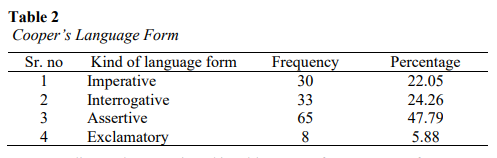
dominated by aggressive statements, with interrogative sentences accounting for around 22.26% of his speech. Furthermore, 58.57% of his speech is made up of just one to five words, indicating a direct and actionoriented speaking pattern. His pragmatic outlook, goal-oriented conduct, and emotional detachment appear to be reflected in, and made possible by these language traits. The research adds to controversies in film linguistics
and improves the weak version of the Sapir-Whorf hypothesis by demonstrating how film language constructs and conveys cognitive orientation.
Downloads
References
Adekunle, O. T. (2015). A linguistic relativity appraisal of an African
drama: The Lion and the Jewel [Master’s thesis, Durban University of
Technology]. DUT University.
https://openscholar.dut.ac.za/items/5866c6a0-f14d-4fca-a2a7-
d741156721aa
Antović, M. (2022). Multilevel grounding: A theory of musical meaning.
Routledge.
Bateman, J., & Schmidt, K. H. (2013). Multimodal film analysis: How films
mean. Routledge.
Bednarek, M. (2010). The language of fictional television. Continuum.
Boroditsky, L. (2011). How language shapes thought. Scientific American,
(2), 62–65.
Boroditsky, L., Schmidt, L. A., & Phillips, W. (2003). Sex, syntax, and
semantics. In D. Gentner & S. Goldin-Meadow (Eds.), Language in
mind: Advances in the study of language and thought (pp. 61–79). MFT
Press.
Chatman, S. B. (1990). Coming to terms: The rhetoric of narrative in fiction
and film. Cornell University Press.
Creswell, J. D. (2017). Mindfulness interventions. Annual Review of
Psychology, 68, 491–516. https://doi.org/10.1146/annurev-psych042716-051139
Shahid et al.
Volume 7 Issue 1, Spring 2025
Department of Linguistics and Communications
Deckert, S. K., & Vickers, C. H. (2011). An introduction to sociolinguistics:
Society and identity. Bloomsbury.
Denzin, N. K., & Lincoln, Y. S. (2018). Introduction. In N. K. Denzin & Y.
S. Lincoln (Eds.), The Sage handbook of qualitative research (5th ed.,
pp. 1–26). Sage Publications.
Dugatkin, L. (2012, July 17). What is behavior anyway? Psychology Today.
https://www.psychologytoday.com/us/blog/the-princeevolution/201207/what-is-behavior-anyway
Eco, U. (1997). The search for the perfect language. John Wiley & Sons.
Halliday, M. A. K. (1994). An introduction to functional grammar. Edward
Arnold.
Iragiliati, E. (2007). Sociolinguistics (2nd ed.). Penerbit Universitas
Terbuka.
Khotimah, K. (2016). Word and culture in Sapir–Whorf hypothesis seen in
the main character of Around the World in Eighty Days movie.
ResearchGate. https://tinyurl.com/46w8z5jn
Kozloff, S. (2000). Overhearing film dialogue. University of California
Press.
Kramsch, C. (1992). Contextes de comprehension. In R. J. Courchene, J.
I.Glidden, J. St. John, & C. Therien (Eds.), Comprehension-based
second language teaching (pp. 63–76). University of Ottawa Press.
Kramsch, C. (2014). Language and culture. AILA Review, 27(1), 30–55.
https://doi.org/10.1075/aila.27.02kra
Kramsch, C., & Hua, Z. (2016). Language and culture in ELT. In G. Hall
(Ed.), The Routledge handbook of English language teaching (pp. 38–
. Routledge.
Kress, G., & van Leeuwen, T. (2001). Discurso multimodal: Los modos y
los medios de la comunicación contemporánea. Arnold.
Lakoff, G. (1993). The contemporary theory of metaphor. UC Berkeley—
Previously Published Works.
Lakoff, G., & Johnson, M. (2008). Metaphors we live by. University of
Chicago Press.
Exploring the Role of Language in…
Journal of Communication and Cultural Trends
Volume 7 Issue 1, Spring 2025
Lakoff, G., & Johnson, M. (2020). Conceptual metaphor in everyday
language. In Shaping entrepreneurship research (pp. 475–504).
Routledge.
McMillan, J. H., & Schumacher, S. (2010). Research in education:
Evidence-based inquiry. Pearson.
Nolan, C., & Nolan, J. (2014). Interstellar: The complete screenplay with
selected storyboards. Faber & Faber.
Sapir, E. (1921). Language: An Introduction to the study of speech.
Harcourt Publisher.
Sapir, E. (1929). The status of linguistics as a science. Language, 5, 207–
Searle, J. R. (1979). Expression and meaning: Studies in the theory of
speech acts. Cambridge University Press.
Simpson, C. (2017). Language, relationships and skills in mixed-nationality
active Learning classrooms. Studies in Higher Education, 42(4), 611–
https://doi.org/10.1080/03075079.2015.1049141
Smith, S. M., & Albaum, G. S. (2012). Basic marketing research: Volume
Handbook for research professionals. Qualtrics Labs Inc.
Stern, H. H. (1983). Fundamental concepts of language teaching:
Historical and interdisciplinary perspectives on applied linguistic
research. Oxford University Press.
Tiono, N. (2002). Language and culture in relation to intercultural
communication in a business context. Kita Journal, 4(1), 36–41.
Uwajeh, M. K. C. (2002). Beyond generative grammar: A course in
performative linguistics. Spectrum Book Limited.
Wardhaugh, R. (2006). An introduction to sociolinguistics. Blackwell
Publishing.
Whorf, B. L. (1956). Language, thought, and reality: Selected writings of
Benjamin Lee Whorf. Technology Press of MIT.
Downloads
Published
How to Cite
Issue
Section
License

This work is licensed under a Creative Commons Attribution 4.0 International License. Authors retain copyright and grant the journal right of first publication with the work simultaneously licensed under a Creative Commons Attribution (CC-BY) 4.0 License that allows others to share the work with an acknowledgement of the work’s authorship and initial publication in this journal.