Adaptive Interaction Design for Heritage Visitor Experience: An Evidence-Based Framework from the Imperial City of Hue, Vietnam
DOI:
https://doi.org/10.32350/jdt.52.02Keywords:
adaptive interaction design, design requirements, heritage interpretation, Imperial City of Hue, visitor experienceAbstract
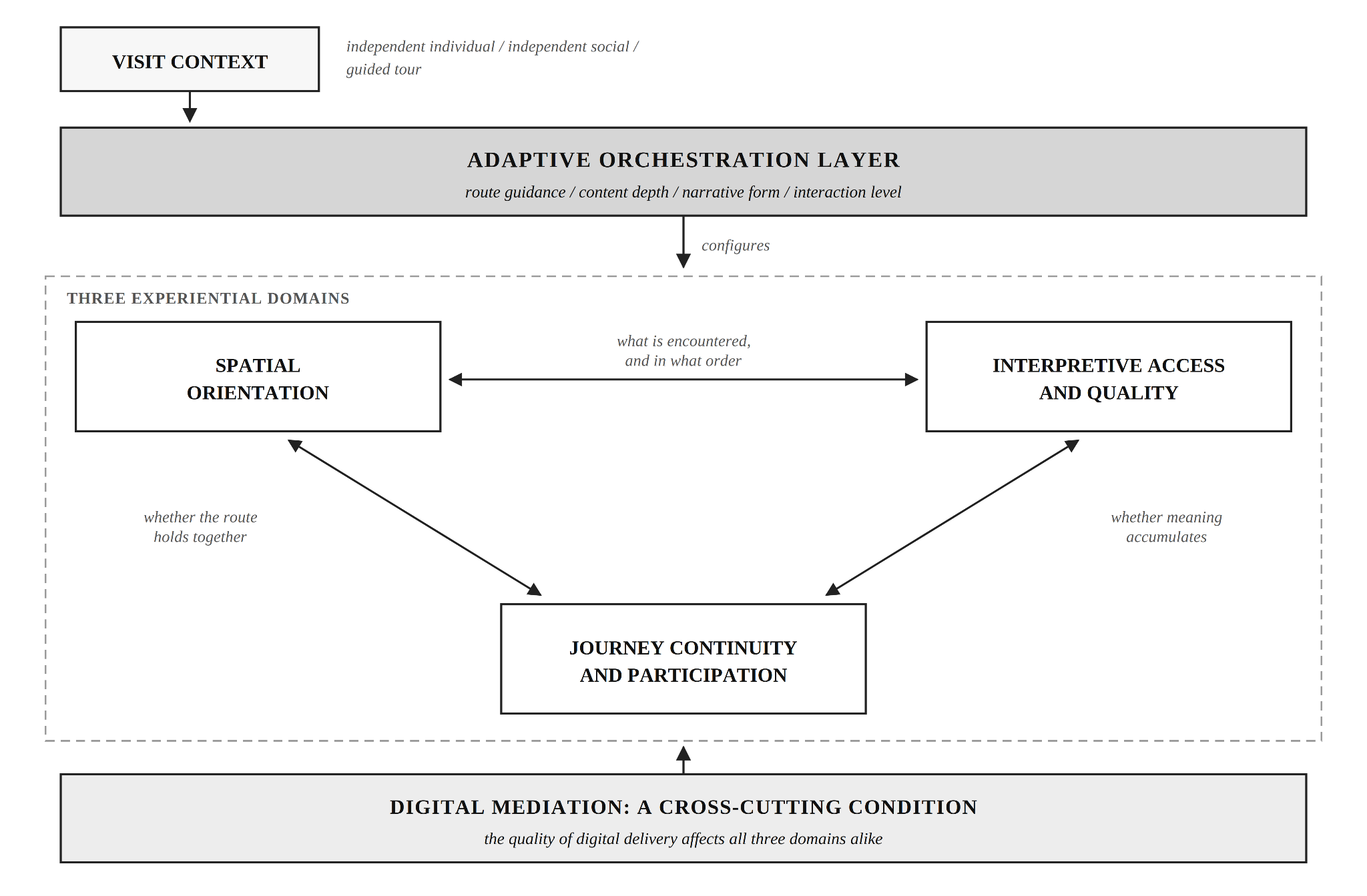
Investment in heritage interpretation continues to grow, yet most of that effort is directed at supplying more content and incorporating new technologies, while comparatively little systematic attention is given to how the visit itself should be organised. This study translates evidence on visitor barriers and interaction needs into design requirements for an interpretive system at the Imperial City of Hue, Vietnam. Data from 153 visitors were analysed at item level across three visit contexts: independent individual, independent social, and guided tour. The main difficulties concerned interpretive quality, spatial orientation and journey continuity rather than simple access to content, and twelve of the sixteen items differed significantly across contexts after Holm correction. Most notably, the two independent groups reported almost identical wayfinding barriers yet differed markedly in their expressed need for wayfinding support, indicating that a comparable barrier does not entail a comparable need for assistance. From four empirical patterns, the study formulates four evidence-informed design requirements and organises them into a two-layer architecture, in which shared interactive components belong to a core layer while the degree of guidance they exert belongs to an adaptive orchestration layer. This structure proposes a way for a single shared system to operate differently across use situations without fragmenting the service
Downloads
References
[1] F. Tilden, Interpreting Our Heritage, 4th ed., R. B. Craig, Ed. Chapel Hill, NC, USA: Univ. of North Carolina Press, 2007.
[2] UNESCO World Heritage Committee, “Decision 17 COM XI: Inscription: The Complex of Hue Monuments (Vietnam),” 1993. [Online]. Available: https://whc.unesco.org/en/decisions/3361/ (accessed Oct. 13, 2026).
[3] T. H. Phan, “50 năm bảo tồn và phát huy giá trị di sản văn hóa Cố đô Huế” [“Fifty years of conserving and promoting the cultural heritage of the Hue Citadel”], Tạp chí Sông Hương. [Online]. Available: http://tapchisonghuong.com.vn/tap-chi/c525/n33519/50-nam-bao-ton-va-phat-huy-gia-tri-di-san-van-hoa-Co-do-Hue.html (accessed Aug. 23, 2026).
[4] People’s Committee of Hue City, “Kế hoạch số 275/KH-UBND về triển khai thực hiện Đề án ‘Phát triển du lịch, dịch vụ du lịch thành phố Huế giai đoạn 2025–2030, tầm nhìn đến năm 2045,’” Hue, Vietnam, June 25, 2025. [Online]. Available: https://hue.gov.vn/Portals/0/Uploads/00.00.H57/Nam2025/Thang6/00.00.H57_275_KH_UBND_2025_PL1_signed.pdf (accessed Oct. 13, 2026).
[5] Hue City Portal, “Du lịch Huế: Nâng tầm giá trị di sản, khẳng định thương hiệu điểm đến khác biệt,” June 10, 2026. [Online]. Available: https://hue.gov.vn/Trang-chu/Tin-so-nganh/tb/Du-lich-Hue-Nang-tam-gia-tri-di-san-khang-dinh-thuong-hieu-diem-den-khac-biet-961900 (accessed Aug. 23, 2026).
[6] G. Ozdemir and S. Zonah, “Revolutionising heritage interpretation with smart technologies: A blueprint for sustainable tourism,” Sustainability, vol. 17, no. 10, Art. no. 4330, May 2025, doi: https://doi.org/10.3390/su17104330.
[7] Fatima-tu-Zuhra, “The role of interior spatial connectivity in museum visitor experience: A space syntax investigation,” J. Des. Text., vol. 5, no. 1, pp. 1–19, June 2026, doi: https://doi.org/10.32350/jdt.51.01.
[8] M. Casillo, F. Colace, D. Conte, M. Lombardi, D. Santaniello, and C. Valentino, “A context-aware recommender system-based framework for improving cultural experiences,” User Model. User-Adapt. Interact., vol. 36, Art. no. 1, 2026, doi: https://doi.org/10.1007/s11257-025-09437-1.
[9] M. Konstantakis, Y. Christodoulou, J. Aliprantis, and G. Caridakis, “ACUX recommender: A mobile recommendation system for multi-profile cultural visitors based on visiting preferences classification,” Big Data Cogn. Comput., vol. 6, no. 4, Art. no. 144, Nov. 2022, doi: https://doi.org/10.3390/bdcc6040144.
[10] F. Wang, X. Peng, Y. Wang, W. Fan, K. Wang, and Y. Du, “Adopting AR wayfinding in heritage tourism: Extending the UTAUT in cultural contexts,” npj Herit. Sci., vol. 13, Art. no. 484, Oct. 2025, doi: https://doi.org/10.1038/s40494-025-02069-z.
[11] E. Not and D. Petrelli, “Blending customisation, context-awareness and adaptivity for personalised tangible interaction in cultural heritage,” Int. J. Hum.-Comput. Stud., vol. 114, pp. 3–19, June 2018, doi: https://doi.org/10.1016/j.ijhcs.2018.01.001.
[12] S. H. Ham, Interpretation: Making a Difference on Purpose. Golden, CO, USA: Fulcrum Publishing, 2013.
[13] G. Moscardo, “Mindful visitors: Heritage and tourism,” Ann. Tour. Res., vol. 23, no. 2, pp. 376–397, Apr. 1996, doi: https://doi.org/10.1016/0160-7383(95)00068-2.
[14] ICOMOS, The ICOMOS Charter for the Interpretation and Presentation of Cultural Heritage Sites. Québec, Canada: ICOMOS, Oct. 4, 2008. [Online]. Available: https://www.icomos.org/images/DOCUMENTS/Charters/interpretation_e.pdf (accessed Oct. 13, 2026).
[15] J. H. Falk and L. D. Dierking, The Museum Experience Revisited. Walnut Creek, CA, USA: Left Coast Press, 2013.
[16] R. Mackay, “Visitor journey mapping,” in Delivering the Visitor Experience: How to Create, Manage and Develop an Unforgettable Visitor Experience at Your Museum. London, UK: Facet, 2023, pp. 35–46, doi: https://doi.org/10.29085/9781783305513.006.
[17] A. Følstad and K. Kvale, “Customer journeys: A systematic literature review,” J. Serv. Theory Pract., vol. 28, no. 2, pp. 196–227, 2018, doi: https://doi.org/10.1108/JSTP-11-2014-0261.
[18] A. Bec, B. D. Moyle, K. Timms, V. Schaffer, L. Skavronskaya, and C. Little, “Management of immersive heritage tourism experiences: A conceptual model,” Tour. Manag., vol. 72, pp. 117–120, June 2019, doi: https://doi.org/10.1016/j.tourman.2018.10.033.
[19] D. Petrelli, L. Ciolfi, D. van Dijk, E. Hornecker, E. Not, and A. Schmidt, “Integrating material and digital: A new way for cultural heritage,” Interactions, vol. 20, no. 4, pp. 58–63, July–Aug. 2013, doi: https://doi.org/10.1145/2486227.2486239.
[20] E. Hornecker and L. Ciolfi, Human-Computer Interactions in Museums. San Rafael, CA, USA: Morgan & Claypool, 2019, doi: https://doi.org/10.2200/S00901ED1V01Y201902HCI042.
[21] Y. Pei, “The value of technology and interactive systems in cultural heritage interpretation: A study based on existing empirical research,” Mus. Manag. Curatorship, vol. 40, no. 5, pp. 659–677, 2025, doi: https://doi.org/10.1080/09647775.2024.2408240.
[22] M. Hassenzahl and N. Tractinsky, “User experience—A research agenda,” Behav. Inf. Technol., vol. 25, no. 2, pp. 91–97, Mar.–Apr. 2006, doi: https://doi.org/10.1080/01449290500330331.
[23] B. Neuhofer, D. Buhalis, and A. Ladkin, “A typology of technology-enhanced tourism experiences,” Int. J. Tour. Res., vol. 16, no. 4, pp. 340–350, July–Aug. 2014, doi: https://doi.org/10.1002/jtr.1958.
[24] L. Ardissono, T. Kuflik, and D. Petrelli, “Personalization in cultural heritage: The road travelled and the one ahead,” User Model. User-Adapt. Interact., vol. 22, no. 1–2, pp. 73–99, Apr. 2012, doi: https://doi.org/10.1007/s11257-011-9104-x.
[25] G. Pisoni, N. Díaz-Rodríguez, H. Gijlers, and L. Tonolli, “Human-centered artificial intelligence for designing accessible cultural heritage,” Appl. Sci., vol. 11, no. 2, Art. no. 870, Jan. 2021, doi: https://doi.org/10.3390/app11020870.
[26] H. Persson, H. Åhman, A. A. Yngling, and J. Gulliksen, “Universal design, inclusive design, accessible design, design for all: Different concepts—one goal? On the concept of accessibility—historical, methodological and philosophical aspects,” Univers. Access Inf. Soc., vol. 14, no. 4, pp. 505–526, Nov. 2015, doi: https://doi.org/10.1007/s10209-014-0358-z.
Downloads
Published
How to Cite
Issue
Section
License
Copyright (c) 2026 Nhat Phuong Ngo

This work is licensed under a Creative Commons Attribution 4.0 International License.

This work is licensed under a Creative Commons Attribution 4.0 International License. Authors retain copyright and grant the journal right of first publication with the work simultaneously licensed under a Creative Commons Attribution (CC-BY) 4.0 License that allows others to share the work with an acknowledgement of the work’s authorship and initial publication in this journal.